
SEO doesn't have one timeline: changes can show in hours or take months, so the honest answer is staged milestones measured in weeks and months rather than a fixed date. But if your pages are appearing in search and sales haven't changed, has SEO started working?
That's the gap behind most timeline questions. A business owner wants customers, while an SEO report might celebrate indexed pages or rising impressions. Both matter, but they aren't the same result.
The useful question isn't just how long does SEO take to show results? It's which result should appear next, how you'll recognize it, and what you'll do if it doesn't.
Table of Contents
- The Real Answer Is Four Milestones, Not One Date
- How Search Engines Actually Deliver Your Page
- Factors That Stretch or Shorten Your Timeline
- Realistic Timeframes for Different Goals
- What the Benchmark Numbers Actually Show
- Modern KPIs for the AI Overview Era
- Your 90-Day SEO Measurement Plan
The Real Answer Is Four Milestones, Not One Date
You've approved the website changes, paid for content, and checked your rankings more often than you'd admit. The report shows activity. Your inbox doesn't.
That frustration is reasonable. An SEO engagement should connect implementation to business outcomes, not ask you to accept an open-ended waiting period. Start by defining what progress means at each milestone.
Separate visibility from business performance
- Indexing: Google has included the page in its index. This establishes technical eligibility, not commercial success.
- Ranking movement: The page begins appearing for relevant searches or improves its visibility for existing queries. Relevance matters more than movement for unrelated terms.
- Qualified clicks: Searchers with a plausible need for your product or service visit the website. An informational visitor and someone requesting an emergency repair have different commercial value.
- Conversions: Visitors take meaningful actions, such as submitting a qualified inquiry, booking an appointment, or purchasing a product.
Treat these as connected milestones, not interchangeable achievements. A new service page can make technical progress without generating inquiries yet. Conversely, an established page might already attract visitors but need a clearer offer rather than more visibility.
And that distinction changes the work you should approve. If the page isn't eligible to appear, rewriting its call to action won't solve the immediate problem. If qualified visitors arrive but abandon the inquiry process, another batch of blog posts may miss the bottleneck.
Agree on evidence before approving more work
Ask your SEO provider to define the intended audience, the priority pages, the queries those pages should serve, and the business action each page supports. Then agree on the evidence that would justify continuing, revising, or stopping a tactic.
Practical rule: Every SEO report should distinguish what the team completed, what changed in search, and what changed for the business.
Keep those categories separate in your reporting. Publishing content is an output. Gaining relevant visibility is an intermediate result. Generating profitable business is the commercial objective.
For a small business with limited resources, this distinction also protects the budget. You don't need to fund every possible SEO activity at once. You need to identify the current constraint, address it, and watch for the next observable change. Progress with a reason behind it.
How Search Engines Actually Deliver Your Page
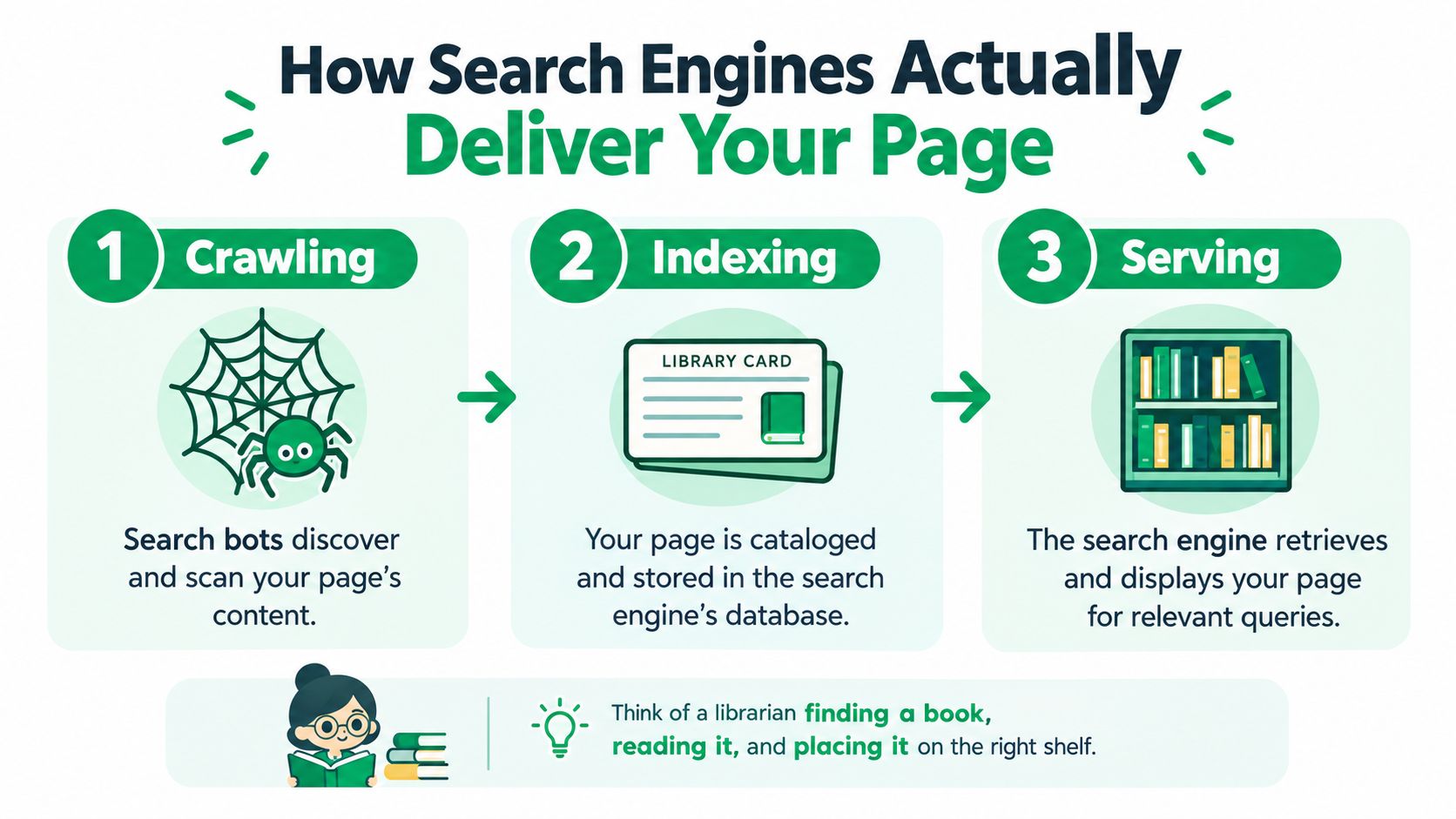
Think of a librarian handling an unfamiliar book. They must find it, examine it, catalog it, and decide when to recommend it to someone asking a particular question.
Google describes a comparable sequence: crawling, indexing, and serving search results. Its explanation of how Search works makes an important distinction: inclusion in the index doesn't guarantee that a page will rank prominently.
Crawling and indexing need different checks
Crawling is discovery and retrieval. Google downloads the content it finds. Its crawling and indexing FAQ says crawling can take a few days to a few weeks, and requesting a recrawl doesn't guarantee immediate inclusion or ranking.
In Google Search Console, inspect the exact URL rather than assuming a sitemap submission settled the issue. Check whether Google can access the page and whether its last crawl reflects your changes.
Indexing involves analyzing the retrieved content and deciding how to store it. If Google hasn't indexed a priority page, investigate before commissioning more content:
- Access restrictions: Check robots.txt and noindex directives for unintended exclusions.
- Canonical selection: Confirm that the intended page, rather than a duplicate or alternative URL, is being selected.
- Discovery paths: Review internal links and sitemap entries so the page isn't isolated.
- URL duplication: Look for competing versions that complicate which page should appear.
These checks belong in a repeatable technical SEO best-practices workflow, not a scramble triggered by a disappointing traffic report.
Serving is where relevance becomes visible
Once a page is indexed, Google must decide whether it fits a particular search. Its explanation of Search describes ranking as programmatic, with factors including the searcher's location, language, and device.
Search Console impressions provide evidence that Google is serving the page. Examine the associated queries, not just the total. A commercial service page appearing mainly for loosely related definitions may need a different content approach.
Average position also needs context. Filter by page and query before interpreting a sitewide average, especially when newly appearing queries change the mix.
The practical sequence is straightforward: confirm access, verify the indexed version, then inspect where the page appears. Don't diagnose a relevance problem with a sitemap submission, or a blocked page with another rewrite.
Factors That Stretch or Shorten Your Timeline
A clean website with established visibility starts from a different position than a new domain with unfinished service pages. The same work won't produce the same sequence of results.
Google's SEO Starter Guide says changes may be reflected within hours or take several months, recommends waiting several weeks before assessing their effect, and cautions that not every change produces a noticeable impact. That's a reason to set checkpoints, not permission to wait indefinitely.

Diagnose the starting position
Site history and existing assets. An established business may already have useful content, relevant links, and pages earning impressions. Review what you can improve before replacing everything. For example, a neglected service page may deserve attention before an unrelated blog launch.
Keyword competitiveness. A broad product category puts you against a different set of competitors than a specific compatibility question. Compare the actual search results and ask whether your page can offer a credible alternative.
Content quality and intent. A buyer searching for installation services needs service details, coverage information, and a clear next step. A long explanation of how the equipment works isn't automatically the right answer. More words, wrong job.
Backlink support. An unfamiliar business may need to develop recognition beyond its own website. Relevant industry relationships, useful original resources, and legitimate publicity deserve consideration. Buying a volume of links isn't a substitute for evaluating their relevance.
Technical health. An unintended canonical pointing away from a priority page is a specific implementation problem. Correcting it is different from earning a stronger competitive position. Use an SEO audit to identify the actual constraint before assigning the budget.
Competitive density. Don't inspect only the highest-ranking competitor. If the visible results all provide detailed product specifications, original imagery, and useful buying guidance, publishing a generic category description leaves a clear gap.
Choose between repair and development
Some work removes an obstacle. Other work builds an advantage. That's the trade-off behind many disappointing forecasts.
A technical correction has a defined completion point: the team can verify that the implementation changed. Building a persuasive service resource or earning relevant recognition requires continued judgment, outreach, and improvement.
A deadline for completing the work is reasonable. A guaranteed date for outranking competitors is a different promise.
Ask what a forecast assumes – more specifically, which pages, resources, and competitive conditions make it plausible. If the answer ignores your starting position, it's a sales schedule rather than a defensible SEO forecast.
Realistic Timeframes for Different Goals
Set evaluation windows around the milestone you're pursuing. Don't assign every page the same commercial deadline, especially when some pages answer research questions and others support an immediate purchase.
The comparison below is a planning aid, not a set of guaranteed delivery dates. Use it to decide what deserves attention now and what requires longer observation.
Four SEO Milestones and Realistic Windows
| Milestone | Typical Window | What Unlocks It | Signal to Watch |
|---|---|---|---|
| Indexing | Initial technical evaluation window | Accessible, discoverable pages with clear indexing signals | URL inspection and index status |
| Ranking movement | Early reviews and continued observation | Relevant content and a credible competitive fit | Query-level impressions and position |
| Qualified clicks | After relevant visibility develops | Search demand, useful positioning, and a compelling result | Relevant queries generating visits |
| Conversions | Once suitable visitors reach a usable offer | Clear differentiation, functional conversion paths, and measurement | Qualified inquiries, purchases, and revenue |
An evaluation window is permission to investigate, not a promise that an outcome will arrive. If the prerequisite is missing, extending the deadline won't address it.
A local service provider should start with the pages representing actual services and locations. Check whether searchers can understand where the business operates, what it handles, and how to contact it. Don't assume publishing general advice is the most direct route to inquiries.
For an e-commerce seller, inspect the relationship between buying intent and landing page. A visitor comparing product types needs a different experience from someone searching for an exact item. Prioritize the pages that can satisfy those distinct needs rather than judging the entire store by aggregate traffic.
Match the scope to the business
A newly launched website needs a narrower initial scorecard than an established site expanding an already successful category. Choose a manageable set of priority pages and document why each belongs in the plan.
Geographic scope also affects what you're comparing. Review the differences between local SEO and national SEO before treating a neighborhood service campaign and a nationwide category campaign as equivalent investments.
- Local businesses: Verify that priority service pages reflect the actual service area and customer needs.
- E-commerce sellers: Separate category, product, and informational performance in reporting.
- New websites: Establish a baseline before interpreting movement as improvement.
This week's useful decision is which milestone is currently blocked. Choose the next action from that diagnosis, not from a generic publishing calendar.
What the Benchmark Numbers Actually Show
The familiar timeline isn't entirely made up. In an Ahrefs poll of 3,680 respondents, the most commonly reported timeframe for SEO results was three to six months.
That's a practical benchmark, but it leaves a critical question unanswered: what did each respondent count as a result? A useful impression trend and a reliable source of qualified leads aren't equivalent outcomes.
Read page-level evidence differently
Ahrefs' page-level ranking statistics report that only 1.74% of newly published pages reached Google's top 10 for at least one keyword within their first year, while 72.9% of pages in those positions were more than three years old.
Those figures don't mean a new page can't succeed. They mean you shouldn't treat a prominent ranking as the default outcome of publishing and waiting. Nor should you interpret page age as proof that time alone produces performance.
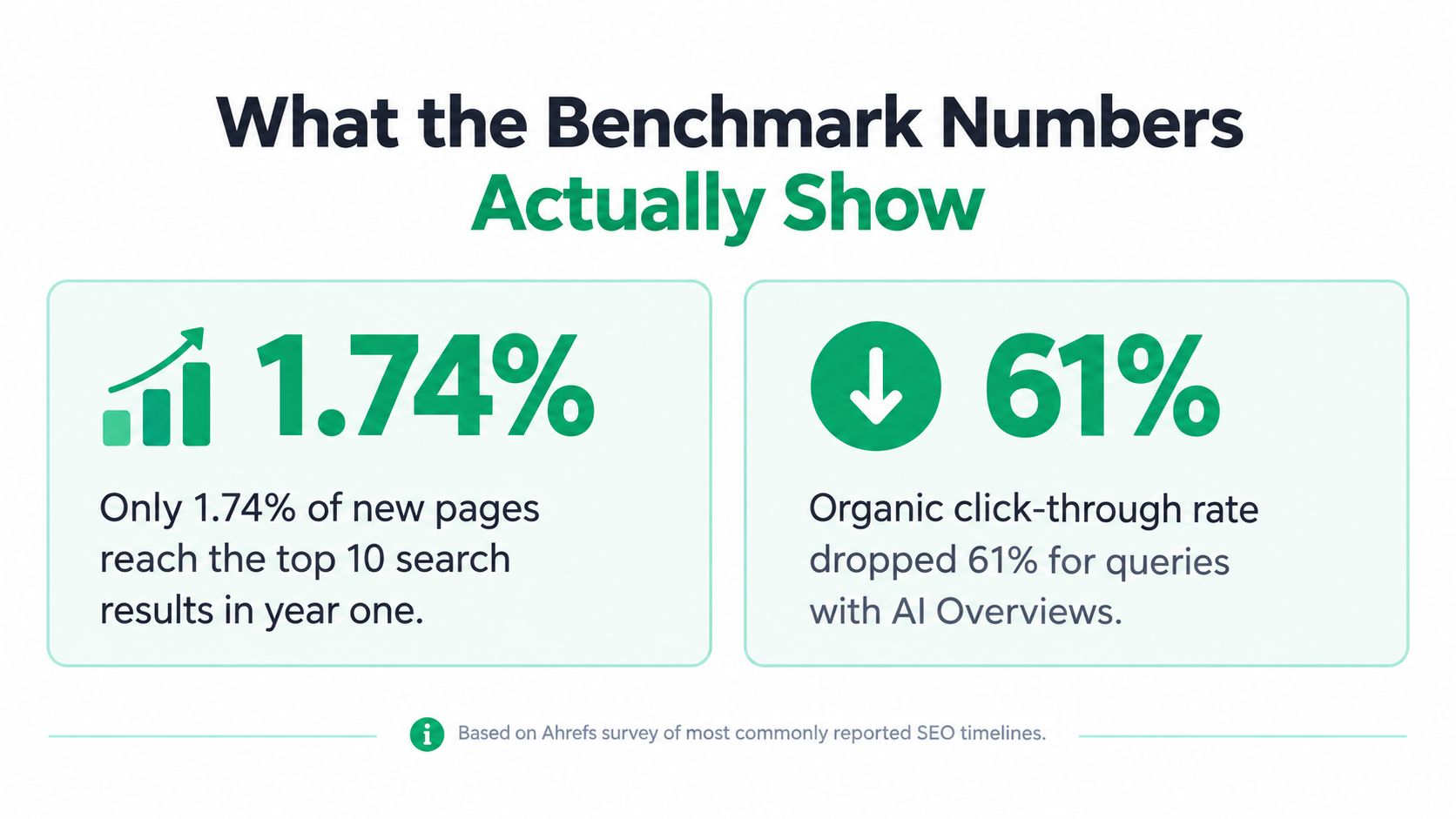
The ranking figures and the click-through finding shown above come from different research. They answer different questions, too: whether pages attain prominent visibility, and whether visibility turns into visits.
A reported study summarized by PWD found that, among the small group reaching prominent results, many did so between 61 and 182 days. That supports the possibility of meaningful movement within an early campaign, not a universal deadline.
Use correlations without turning them into targets
Competitive conditions help explain why outcomes differ. In Backlinko's analysis of 11.8 million Google results, the top result had, on average, 3.8 times as many backlinks as positions 2–10.
That's a relationship, not a required link count or proof that links alone caused the ranking. Don't turn it into a purchasing target.
- Use benchmarks for budgeting: Allow room for implementation, observation, and revision.
- Use your own data for decisions: Compare priority pages against their starting position and intended audience.
- Reject false thresholds: Neither a page's age nor a backlink total guarantees commercial success.
Benchmarks tell you why patience may be necessary. Your page-level evidence tells you whether that patience is justified.
The defensible expectation is conditional: look for evidence that the strategy is progressing, while recognizing that competing for valuable searches may require sustained improvement. Time is part of the process, not the strategy itself.
Modern KPIs for the AI Overview Era
Stable rankings don't necessarily produce stable traffic. If the search results answer the question directly, a visible page may receive fewer visits without losing its position.
MediaPost's reporting on AI Overview click-through research describes an analysis of 3,119 informational queries, across 42 organizations and 25.1 million organic impressions, from June 2024 through September 2025. For queries displaying AI Overviews, organic click-through rate declined 61%, from 1.76% to 0.61%.

Separate exposure from attributable demand
That finding concerns a defined set of informational queries. It doesn't establish an identical effect for your product pages, service searches, or brand queries.
It does make traffic-only reporting inadequate. A program could expand exposure while receiving fewer informational visits. But exposure isn't automatically revenue, and an AI mention isn't evidence of a sale.
Build a scorecard that keeps those distinctions visible:
- Search exposure: Track impressions and relevant query coverage, segmented by page purpose.
- Branded demand: Watch searches involving your business name, while recognizing that other marketing can influence them.
- AI visibility: Record citations or mentions where observable, including the query and testing conditions.
- Qualified engagement: Monitor meaningful actions such as email signups, product exploration, or calls.
- Commercial outcomes: Evaluate qualified leads, purchases, revenue, and assisted conversions where measurement supports them.
Diagnose the click gap before rewriting everything
If impressions and positions look steady while clicks fall, inspect the search results for the affected queries. Compare informational pages with commercial pages rather than blending them into a single traffic chart.
If visits remain healthy but inquiries weaken, review the offer, contact process, and tracking. That's a different diagnosis. Don't use AI Overviews as a convenient explanation for every disappointing report.
For content decisions, prioritize material that gives someone a reason to choose your business: original expertise, useful product comparisons, specific service details, and evidence you can substantiate. A practical AI search optimization approach should support those business goals rather than chase mentions in isolation.
And don't abandon traffic measurement. Keep it, but stop asking it to explain the entire customer journey. The strongest report shows where visibility changed, whether appropriate visitors arrived, and what business activity you can reasonably connect to them.
Your 90-Day SEO Measurement Plan
Use this as a management schedule, not a ranking promise. For a launch, the new-site SEO checklist can support the implementation work.
Set checkpoints and keep a change log
- Week 1: Record priority URLs, Search Console performance, index status, and existing conversions. Test forms and purchase tracking.
- Week 2: Resolve access and canonical problems. Document each change and its intended effect.
- Weeks 3–4: Inspect priority URLs weekly. Your first 30-day report should identify completed work, unresolved blockers, and the next test.
- Weeks 5–8: Review query relevance, page-level impressions, and qualified clicks. Improve pages against a diagnosed gap.
- Weeks 9–12: Compare business outcomes with the baseline and decide what to continue, revise, or investigate.
Separate slow progress from broken measurement
Leading indicators include indexation, relevant impressions, crawl health, and long-tail visibility. Lagging outcomes include qualified sessions, leads, purchases, and revenue. Report both without presenting the former as proof of the latter.
Escalation check: Investigate excluded priority pages, irrelevant queries, broken forms, or missing transaction data instead of extending the waiting period.
Bring in an agency when nobody can connect those checks to a clear next action. A useful audit should explain the constraint, its evidence, and the recommended response, not just deliver a long issue list.
Request a free audit and performance report from Mr. Green Marketing, LLC to identify visibility gaps and prioritize practical improvements. The agency offers strategy-led SEO, conversion-focused web design, and AI search optimization, with a custom plan aligned to measurable business goals.
Leave a Comment
sing in to post your comment or sign-up if you dont have any account.