
Local SEO vs National SEO: You’re probably in the same spot a lot of business owners hit. You know SEO matters, you’ve got a finite budget, and two very different paths are sitting in front of you.
One path says, “Own your city first.” The other says, “Build authority everywhere.”
And that’s where the core local SEO vs National SEO decision starts. Not with definitions. With revenue, timing, and how your customers buy. A local roofer, a regional law firm, an ecommerce store, a SaaS company, and a multi-location medical group should not make the same SEO bet. They just shouldn’t.
This choice also got messier recently. Search isn’t cleanly local or national anymore. AI-driven results can blur intent, especially for businesses that serve both nearby customers and broader markets. So the smartest strategy often isn’t picking one camp forever. It’s knowing where to start, what to prioritize, and when to scale.
Local SEO vs National SEO: The SEO Crossroads Every Business Faces
A business owner’s first SEO dollar is usually the most important one. Spend it in the right place, and SEO starts acting like a growth channel. Spend it in the wrong place, and you can burn months chasing rankings that never turn into calls, leads, or sales.

A lot of companies ask the wrong opening question. They ask, “Should we do SEO?” Instead, the question to ask is, “What kind of SEO fits how we make money?”
Start with the revenue map
If most customers come from a tight service area, local SEO usually deserves first priority. If customers can buy from anywhere and geography doesn’t shape the sale, national SEO is often the better fit. In between, things get more interesting.
Some businesses are obvious:
- Local-first businesses include dentists, roofers, med spas, restaurants, HVAC companies, and local law offices.
- National-first businesses include ecommerce brands, software platforms, online education companies, and remote services.
- Hybrid businesses include multi-location brands, franchises, regional firms, and companies selling both in-person and remote services.
Practical rule: SEO should follow customer geography before it follows ambition.
That matters because local and national search don’t just target different audiences. They reward different assets, run on different ranking signals, and move on different timelines.
Local SEO vs National SEO: Why this decision is expensive when it’s wrong
A local business can waste a year trying to rank broad national terms while nearby prospects keep clicking competitors in the map results.
A national brand can make the opposite mistake. It can obsess over listings and citations while neglecting the content depth and authority signals needed to rank at scale.
And then there’s the middle ground. That’s where many businesses live now. They need visibility in the map pack, yes, but they also need topic authority beyond one city. That hybrid reality is where smart SEO planning wins. Small moves first, then scale.
Local SEO vs National SEO: Defining The Two Worlds of SEO
Local SEO and national SEO share the same broad goal. They both try to make your business more visible when someone searches. But they solve completely different search problems.
Local SEO is about proximity and immediate intent
Think of local SEO like dominating your neighborhood’s main street. You want to show up when someone nearby needs a business they can visit, call, or hire now.
That includes searches like:
- Service plus city queries
- Near me searches
- Urgent need searches, where the buyer wants a nearby provider fast
Local SEO is built around geography. Google tries to match the searcher with businesses that are relevant, nearby, and trusted in a specific market. For many service businesses, that means the searcher isn’t browsing casually. They’re choosing.
National SEO is about authority without geographic limits
National SEO is more like competing for shelf space in every bookstore, not just the one in your neighborhood.
The user might be researching, comparing, or buying, but location isn’t the main filter. They could be looking for a product, a software category, a service they can buy remotely, or information that helps them decide later.
National SEO usually depends on:
- Broad topic coverage
- Strong site architecture
- Content that answers intent across the funnel
- Authority signals that make Google trust your domain
Local SEO answers “Who should I hire near me?”
National SEO answers “Who’s the best option, regardless of location?”
Local SEO vs National SEO: The difference isn’t small
This is where businesses get tripped up. They assume local SEO is just smaller national SEO. It isn’t.
A plumber in Tampa doesn’t need to compete with every plumbing site in the country to win business. That owner needs to be visible when someone nearby searches with local intent. An online CRM company, on the other hand, gains almost nothing from ranking in one city if the product serves companies nationwide.
Here’s the simple version:
| Business trait | Local SEO fit | National SEO fit |
|---|---|---|
| Customers need a physical location or service area | Strong | Weak to secondary |
| Customers can buy from anywhere | Secondary or hybrid | Strong |
| Searches often include city names or near-me intent | Strong | Weak |
| Brand growth depends on broad topical authority | Secondary | Strong |
| Sales happen fast from high-intent searchers | Strong | Sometimes |
| Sales cycle requires education and comparison | Sometimes | Strong |
If you’re weighing local SEO vs National SEO, don’t start by asking what sounds bigger. Start by asking where your next qualified customer comes from. That answer usually points to the right first move.
Local SEO vs National SEO: Ranking Factors A Tale of Two Algorithms
Strategy ceases to be theoretical. Google doesn’t evaluate local and national visibility the same way, and that changes everything about how you allocate time and budget.
Here’s the side-by-side view first.
| Criterion | Local SEO | National SEO |
|---|---|---|
| Primary search surface | Local Pack and Maps | Organic website results |
| Main asset | Google Business Profile plus local signals | Website authority and content |
| Geographic influence | High | Minimal |
| Backlink dependence | Lower | Higher |
| Review impact | Strong practical influence | Limited direct role |
| Best early win | Business profile optimization | Content and technical fixes |
| Common competitive edge | Relevance, proximity, reputation | Authority, depth, link profile |
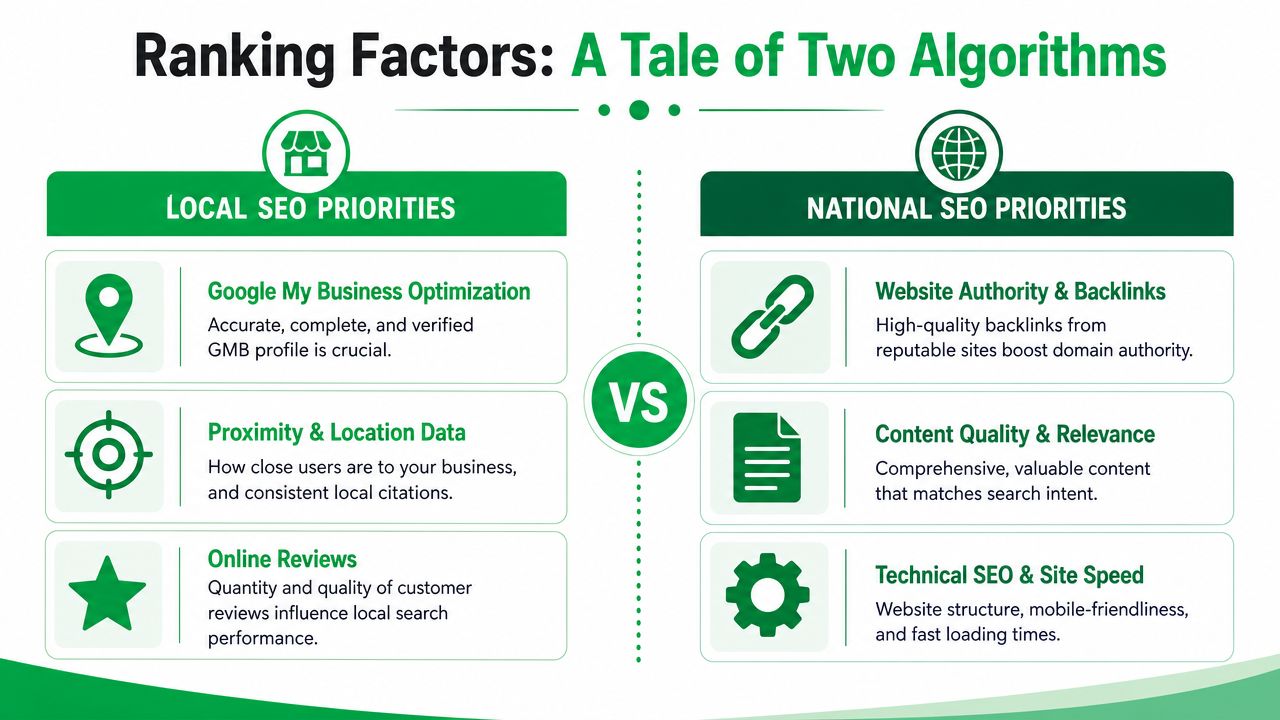
What matters most in local search
In local SEO, your website still matters. But it is not the whole game.
According to BrightLocal’s 2024 Local Ranking Factors study, Google Business Profile signals account for 32% of the total algorithmic weight in Local Pack rankings, while external backlinks account for 27% of the ranking weight in national SEO and only 11% in local rankings.
That single contrast explains why a smaller company can outrank a stronger brand locally. If the smaller company has a well-optimized Google Business Profile, verified location data, relevant categories, strong review activity, and consistent business information across the web, it can win local visibility even with a fairly average site.
That almost never works in national SEO.
Local SEO vs National SEO: What matters most in national search
National SEO leans much harder on the website itself. Google is judging topical authority, content quality, user experience, technical health, internal linking, and the quality of sites that link back to you.
If you’re trying to rank nationally, there’s no shortcut where a profile listing carries the campaign. The website has to do the heavy lifting.
For national campaigns, the common pressure points are:
- Weak topical depth across the core services or product categories
- Thin pages that target keywords but don’t answer intent well
- Poor internal linking that leaves important pages disconnected
- Low-authority backlink profiles
- Technical issues that slow crawling, indexing, and usability
Later in this section, the video below gives a useful visual breakdown of how these priorities split.
Local SEO vs National SEO: Why this changes the budget decision
A lot of failed SEO campaigns come from using national tactics on a local problem, or local tactics on a national one.
If your customers mostly search by city, local optimization often produces faster traction because the ranking system puts real weight on business profile relevance and local trust signals.
If your customers compare providers across the country, polishing your profile won’t solve the authority gap.
A business can earn top local visibility with a strong profile and solid reputation signals. It can’t fake national authority that way.
That’s the big algorithmic divide. In local SEO vs National SEO, you’re not just choosing a market. You’re choosing which assets Google is most likely to reward.
The On-the-Ground Tactical Playbook
Knowing the ranking factors is useful. Execution is what gets you paid.
Local SEO work looks operational. National SEO work looks editorial and authority-driven. That difference shows up in the weekly task list fast.
What local SEO work actually looks like
For local campaigns, the highest-value tasks usually sit around the business profile, business data consistency, and reputation signals.
A practical local playbook often includes:
- Google Business Profile completion. Fill out categories, services, hours, service areas, business description, photos, and the small details most companies skip.
- Review generation and response. Not randomly asking everyone. Building a repeatable process so reviews keep coming in naturally and responses stay timely.
- NAP consistency. Your business name, address, and phone number should match across major directories and local citation sources.
- Location pages. Each real service area or office needs a page that reflects that market, not a spun template.
- Local intent keyword mapping. Match terms like service plus city to the right pages.
- Ongoing listing hygiene. Duplicate listings, outdated phone numbers, and wrong categories drag local performance down.
If you want a solid tactical primer, this guide to learn local SEO from hostAI is worth reviewing because it grounds the work in actual local business tasks instead of vague theory.
What national SEO work actually looks like
National SEO is usually less about directories and more about building a site that deserves to rank across broad topics.
The day-to-day work often includes:
- Topical content planning tied to commercial intent and supporting informational queries
- Pillar pages and supporting articles that build subject depth
- Technical cleanup across indexing, speed, structure, and crawl paths
- Digital PR and authority link building to earn mentions from relevant publications
- Content refresh cycles on pages that have potential but don’t yet compete well
- SERP intent analysis so pages match what Google is already rewarding
Local SEO vs National SEO: What tends to fail
Some patterns miss repeatedly.
- Local businesses publishing generic blogs without fixing GBP basics
- National brands creating city pages for places they don’t serve
- Multi-location companies reusing identical copy across every location page
- Teams buying cheap backlinks while ignoring weak service pages
- Owners treating local SEO as a one-time setup instead of an ongoing process
A lot of local lead generation work breaks down because the business never turns visibility into a proper location-based funnel. If that’s the gap, this walkthrough on local SEO lead generation helps connect rankings to actual inquiry flow.
The best SEO playbook is the one that matches the search surface you’re trying to win. Maps work is not authority publishing. Authority publishing is not map pack optimization.
That sounds obvious. In practice, it’s where most wasted effort lives.
Local SEO vs National SEO: Budgets Timelines and Expected ROI
This is usually where the decision gets real. Business owners can tolerate complexity. What they can’t tolerate is spending the wrong amount of money for the wrong length of time on the wrong outcome.
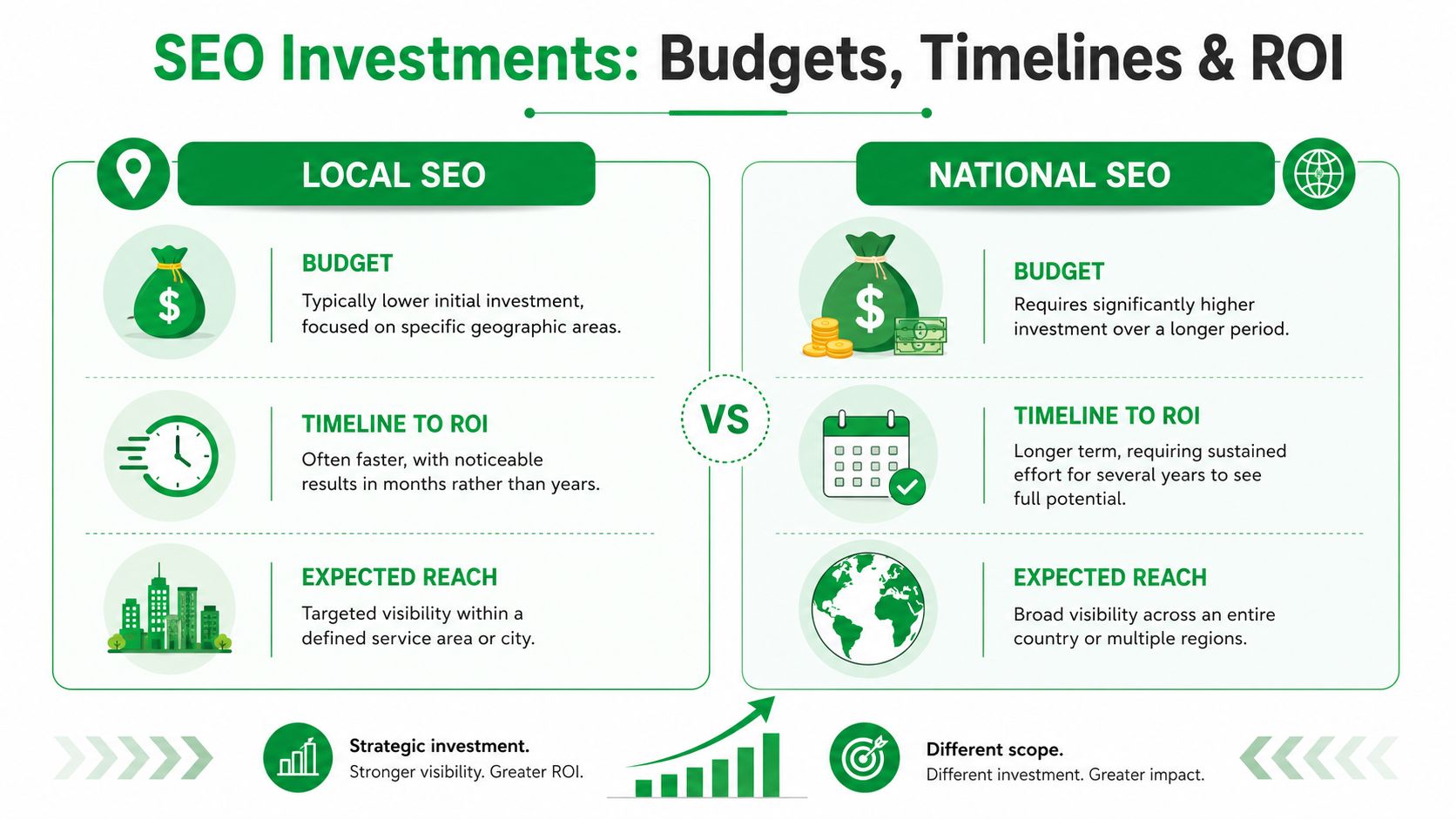
Local SEO usually pays back faster
If the foundation is clean, local SEO tends to move faster.
According to benchmark data, Local SEO typically delivers measurable ranking improvements within 3 to 6 months, while National SEO usually requires 12 to 24 months before generating significant organic pipeline.
That shorter time-to-value matters for smaller businesses. It means you can validate whether the market responds before committing to a bigger long-term content and authority build.
There’s also a major conversion difference in local intent. Verified data shows that 80% of local searches result in a conversion, compared with the 1 to 3% conversion rate typical of national informational traffic. It also shows that 76% of users who search for something nearby visit a business within 24 hours, and local organic traffic converts at a 3.8x higher rate than non-local organic traffic. Those figures are part of the verified data provided for this topic.
Local SEO vs National SEO: The investment range isn’t the same
Local campaigns are generally lighter to fund because the battleground is narrower and the key assets are more contained. Verified data places local SEO costs at £300 to £1,000 per month, compared with £1,500 to £5,000+ for national campaigns.
That doesn’t mean local SEO is cheap in every market. Competitive cities can still be hard. But the structural lift is usually smaller than national SEO, where you may need sustained content production, technical work, and authority building over a much longer runway.
Here’s the business version of that trade-off:
| Investment factor | Local SEO | National SEO |
|---|---|---|
| Time to traction | Faster | Slower |
| Intent quality | Often high and immediate | Often broader and more mixed |
| Monthly cost profile | Lower entry point | Higher ongoing commitment |
| Scalability | Bound by geography | Broad upside if you can sustain it |
ROI depends on the type of demand you’re trying to capture
If a business gets most of its revenue from nearby buyers, local SEO is often the pragmatic first move. Verified data notes this especially clearly for businesses where 80% of revenue originates within a 150-kilometer radius of the main office.
National SEO makes more sense when the upside is broader brand reach, category authority, and customer acquisition that isn’t tied to one market. It can absolutely produce outsized returns. But it usually asks for more patience up front.
And voice search adds another local wrinkle. Verified data shows 40% of adults use voice search daily, often with phrases that trigger local-style results. If your demand already starts with location or urgency, local visibility can bring in revenue sooner than a broad national play.
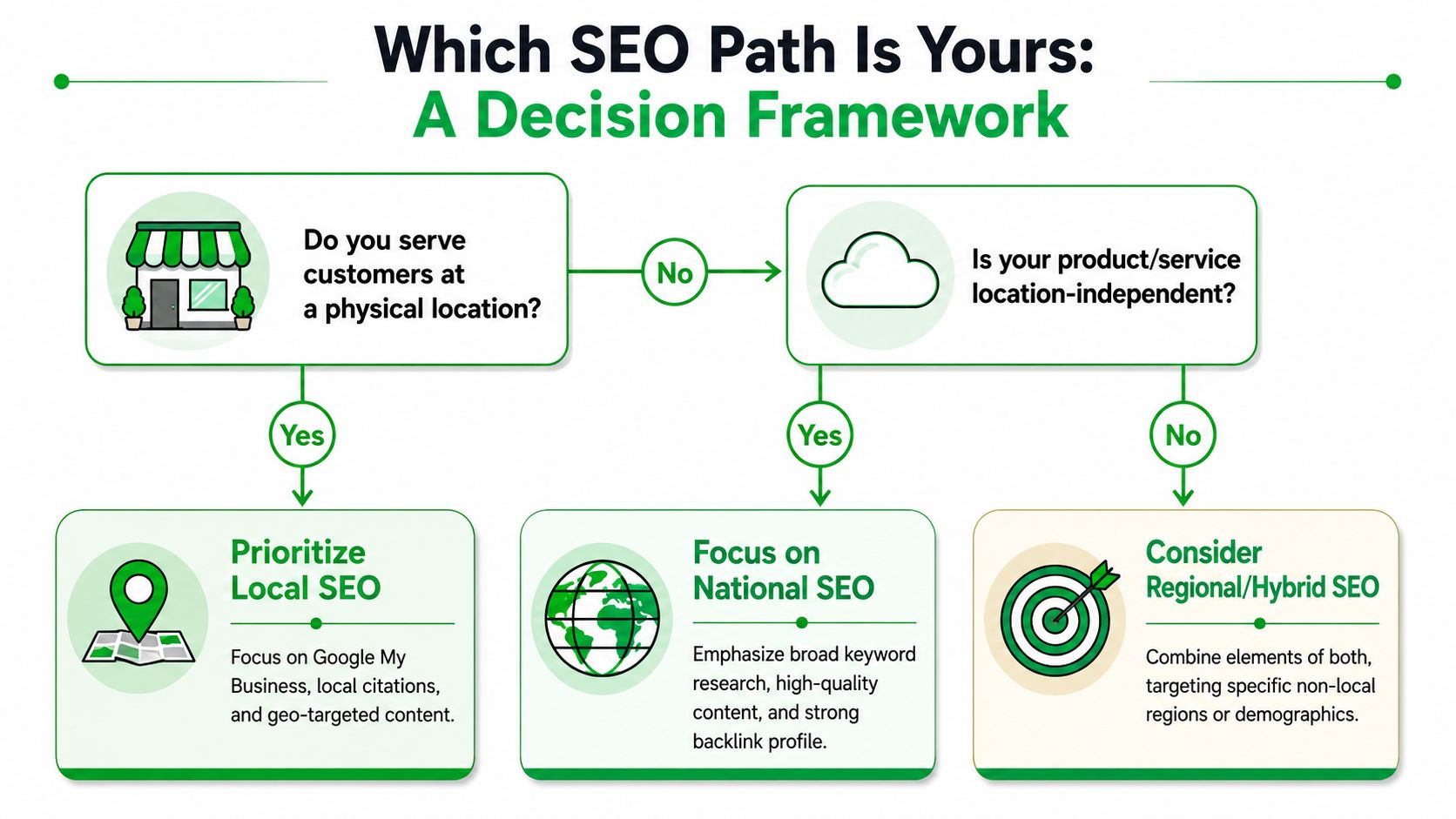
Local SEO vs National SEO: Which SEO Path Is Yours A Decision Framework
Most companies don’t live at the extreme ends. They’re not purely neighborhood-based, and they’re not purely national either. They operate in the overlap. That’s why the cleanest answer is often a phased or hybrid strategy.
Start local when geography clearly drives revenue
If customers visit your location, call local providers, or search with city modifiers, local SEO should usually go first.
That’s especially true when more than 40% of a business’s search queries include city names or local modifiers, because that signals clear local intent. In that situation, the faster route is often to lock down local visibility before trying to scale broad authority.
Good candidates for a local-first approach include:
- Single-location service businesses
- Medical and legal offices
- Restaurants and retail
- Home service companies
- Regional firms testing SEO for the first time
Go national first when location barely matters
If the product or service is location-independent, broad visibility usually deserves priority.
That includes software, ecommerce, digital education, remote consulting, and online services where the buyer doesn’t care where your office is. In these cases, location pages and listing work can support trust, but they won’t replace the need for strong site-wide authority.
Use a hybrid model when the business serves both intents
At this point, modern strategy gets more interesting.
A hybrid model makes sense when:
- You have physical locations and also sell outside those markets
- You operate a franchise or multi-location brand
- You serve some clients locally and others remotely
- Your brand needs local lead capture plus broad topic authority
For these businesses, the sequence often works better than an all-at-once scramble. Start with the side that can create the quickest validated win, then layer in the second motion.
A multi-location company, for example, might need local landing pages and business profiles for each market while also building a central site that ranks for broader category terms. If that’s your setup, this guide on SEO for multi-location business is a useful companion.
Hybrid SEO works best when local assets capture bottom-funnel demand and national content builds trust before the buyer is ready to choose.
The AI proximity illusion changes the old advice
Recent search behavior adds one more wrinkle. According to reporting on recent changes, 2024 to 2025 shifts in Google’s Local Pack show AI over-optimizing for near-me intent, creating a “proximity illusion” that can cause 30%+ of national searches to surface local results for non-physical services.
That matters for remote or mixed-model businesses. If you assume “we’re national, so local doesn’t matter,” AI-influenced SERPs may prove you wrong. At the same time, some companies overreact and abandon national authority building too early.
The smarter response is usually balance. Build pages for service plus city where real market demand exists. Also maintain strong non-geo pages for broader terms. Don’t let AI’s local bias trick you into shrinking your strategy when your revenue model is wider than one map result.
Your Audit Checklist and Next Steps
Decisions turn into action. Pick the checklist that matches your business today, not the business you hope to become next year.
If local SEO is your priority this week
- Audit your Google Business Profile. Check categories, service list, hours, description, photos, and contact details. Fix missing fields first.
- Review your NAP consistency. Compare your name, address, and phone number across your website and major listings. Small mismatches create unnecessary friction.
- Look at your review process. Make sure customers have a clear, repeatable path to leave feedback, and respond to recent reviews.
If you want a structured worksheet for that process, use this local SEO audit checklist.
If national SEO is your priority this week
- Audit technical basics. Indexing, page speed, crawl issues, mobile usability, and internal linking come first.
- Map your core money pages. Know which pages should rank for commercial intent and whether they deserve to.
- Build a content gap list. Identify the topics your competitors cover well and your site barely addresses.
- Review your authority profile. Not every backlink matters, but a weak link profile is hard to hide in national SERPs.
The right move doesn’t have to be complicated. It just has to fit reality. Local SEO vs National SEO isn’t a branding exercise. It’s a resource allocation decision. Start where search intent is strongest, build the asset Google rewards for that market, and scale only after the first layer proves itself.
Mr. Green Marketing, LLC helps businesses make that call with a strategy-first approach. If you need a clearer picture of whether local, national, or hybrid SEO makes the most sense for your market, Mr. Green Marketing, LLC offers custom audits and performance reporting that surface visibility gaps, quick wins, and the next best move for growth.
Leave a Comment
sing in to post your comment or sign-up if you dont have any account.