
How to Optimize for AI Search and Boost Your Traffic – Optimizing for AI search isn’t just about chasing keywords anymore. It’s about providing clear, structured, and authoritative answers that large language models can easily understand and then use as a source.
This means rethinking how we build content. We need to structure it in discrete, answer-focused blocks, wrap it in schema markup to give it context, and build enough topical authority to be seen as a trusted source. And fast.
How to Optimize for AI Search and Why AI Optimization Is Crucial
Let’s be honest—the ground is shifting underneath us. AI search isn’t just another SEO trend; it’s a fundamental rewrite of how people find information online. We’re quickly moving past a simple list of blue links into a world where the search engine gives you one, synthesized answer.
This is the new reality of Google’s AI Overviews, Perplexity, and other generative search tools.
And your old SEO playbook? A relic. Sticking to keyword density and backlink counts alone won’t cut it. The new goal is to achieve visibility within the AI’s answer. This is the core of Generative Engine Optimization (GEO), a concept you need to get very familiar with.
From Clicks to Citations: A Fundamental Shift on How to Optimize for AI Search
The game has changed. We’ve moved from fighting for a click to earning a citation.
When someone asks a question, the AI model scans its index—built from your website and countless others—to construct the best possible answer. If your content is clear, authoritative, and structured correctly, the AI might pull a snippet from your site to use in its response, often linking back to you as the source.
This means you’re no longer just writing for a human reader; you’re writing for a machine that serves a human reader. Your goal is to be the most reliable, easily digestible source of information on any given topic.
This shift requires a new mindset. Success is no longer measured solely by your rank on a results page, but by how often your brand is cited as an authority within AI-generated answers.
The Undeniable Growth of AI Search Traffic
This isn’t some far-off future concept. It’s happening right now, and the numbers are staggering. The growth in traffic coming from AI-powered search is exploding.
Consider this: back in early 2024, AI search traffic across tracked websites was sitting around a modest 17,000 sessions from January to May. Fast forward to the same period in 2025, and that number shot up to 107,000 sessions—a massive 527% year-over-year increase.
Not just a blip. This is a seismic shift showing how models like ChatGPT and Google’s AI Overviews are completely rewriting online discovery.
And this isn’t just about adapting. It’s about spotting a massive opportunity before your competitors do. Businesses that learn how to optimize for AI search now will build a powerful, sustainable advantage. To navigate this new landscape, a solid understanding of AI search engine optimization is essential, and you can get a great overview in Your Guide to AI Search Engine Optimization.
The strategies you’ll learn here are designed to make your website an indispensable resource for these new answer engines. For a deeper dive into this new framework, you can learn more about how Generative Engine Optimization is shaping the future of digital visibility.
Traditional SEO vs AI Search Optimization (GEO)
To really grasp what’s changing, it helps to see the old and new playbooks side-by-side. The table below breaks down the key differences between classic SEO and the new world of Generative Engine Optimization (GEO).
| Focus Area | Traditional SEO | AI Search Optimization (GEO) |
|---|---|---|
| Primary Goal | Rank #1 on a SERP, earn a click. | Get cited as a source in an AI-generated answer. |
| Core Tactic | Keyword targeting and backlink acquisition. | Building topical authority and providing structured answers. |
| Content Focus | Long-form content targeting a primary keyword. | Modular, “chunked” content answering specific questions. |
| Technical Focus | On-page optimization, site speed, mobile-friendliness. | Schema markup, structured data, vector database readiness. |
| Key Metric | Organic traffic, keyword rankings, bounce rate. | Citation frequency, visibility in AI Overviews, brand mentions. |
| User Intent | Matching keywords to broad search queries. | Satisfying conversational and multi-faceted user intent. |
As you can see, GEO doesn’t replace traditional SEO—it builds on it. The foundations of good content and technical health are still critical, but the strategy for creating and structuring that content has fundamentally changed.
Building Your Content Like an AI Answer Engine – How to Optimize for AI Search
So, where do you even start with AI search optimization? It all comes down to a fundamental shift in how you build your content. Forget thinking about an AI “reading” your article over a morning coffee. These models parse information, breaking it down into logical pieces to pull out facts and answers.
Your job is to make that process as smooth as possible for them. Think of yourself less as a writer and more as an information architect. You’re building a structure that’s perfectly designed for a machine to understand, process, and—most importantly—cite. This means moving away from long, rambling articles and toward clear, answer-first content.
Think in Chunks, Not Pages
The single most important tactical change you can make is to embrace content chunking. This is simply the practice of breaking a large topic into smaller, self-contained blocks of information. Ideally, each chunk should answer one specific question.
AI doesn’t just rank pages anymore. It evaluates and ranks individual pieces of content from those pages to assemble its answers. If your content is just a giant wall of text, you’re making it incredibly hard for an AI to pull out a clean, citable snippet.
Here’s a practical way to get started:
- One Idea Per Heading: Use your H2s and H3s to isolate distinct concepts. A heading like “What Makes This Model Quieter?” is far more useful to an AI than a vague one like “Key Features.”
- Q&A Formatting: Structure some of your content as direct questions and answers. This mirrors how people actually search and gives the AI a perfectly formatted pair to lift directly into a response.
- Lists and Tables: Bullet points, numbered steps, and comparison tables are absolute gold. They distill complex details into clean, easily digestible formats that an AI can repurpose instantly.
This flow shows how search is moving beyond a simple list of links. It’s becoming a complex, answer-driven system where your content chunks are the building blocks.
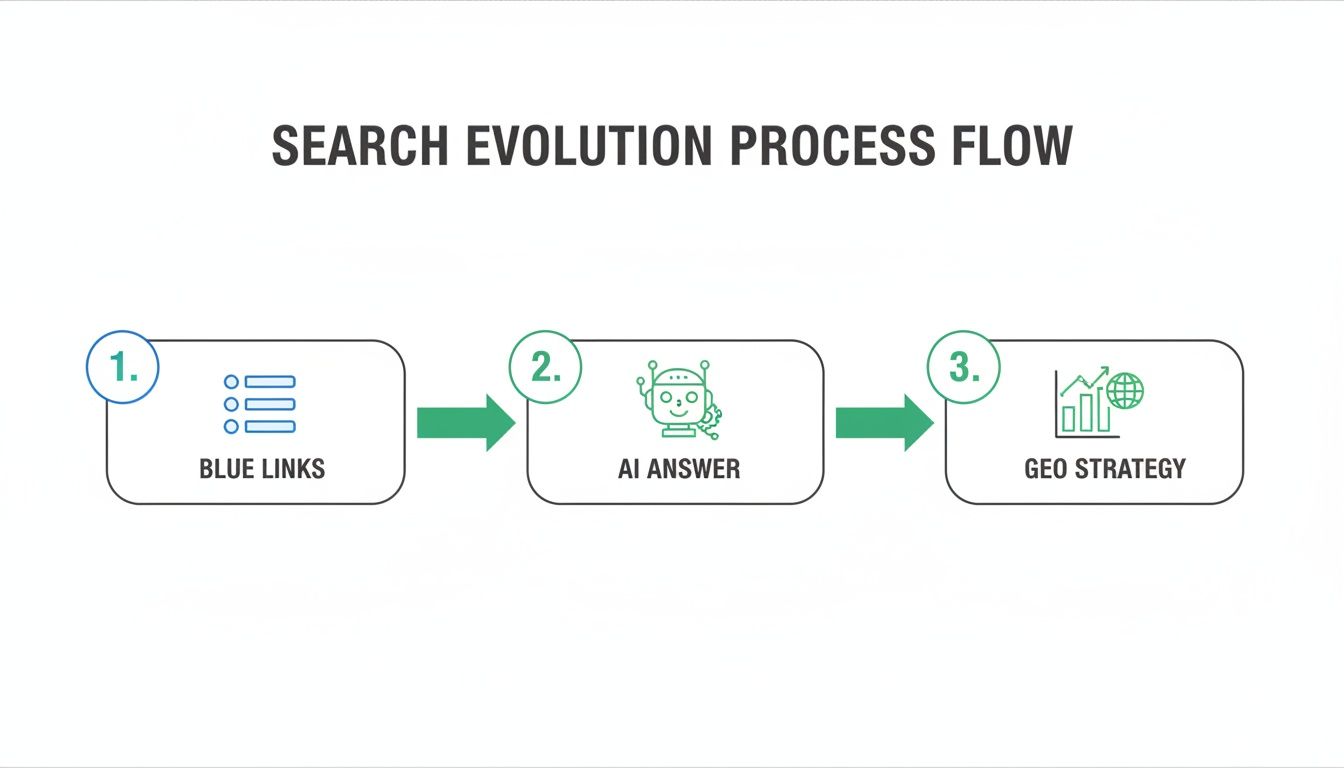
The final step in that diagram, Geo Strategy, really drives the point home. Success is no longer just about ranking; it’s about becoming a citable source inside the AI’s answer.
How to Optimize for AI Search – Create Original Data and Unique Perspectives
Generic, rehashed content is the fastest way to become invisible to AI. Why would an AI model cite you if you’re just rephrasing what ten other sites have already said? To stand out, you need to become a primary source.
This doesn’t require a massive research budget. It can be as simple as:
- Running a quick poll of your customers or social media followers.
- Analyzing your own internal sales data to spot interesting trends.
- Combining a few public data sets in a new or insightful way.
When you publish original findings—even small ones—you create an information asset. You give AI models a compelling reason to reference you, because that data doesn’t exist anywhere else. For more ideas on creating standout material, check out these content marketing best practices.
In the world of AI search, being the source is infinitely more valuable than being an echo. Unique data and firsthand experience are your strongest assets.
Cover Conversational Queries
People don’t talk to AI assistants the same way they type into a search bar. Queries are getting longer, more natural, and are often phrased as complete questions. Instead of “quiet dishwasher,” a user might now ask, “What is the quietest dishwasher I can buy for an open-concept kitchen under $800?”
Your content needs to match this conversational reality. Use tools like AlsoAsked or just look at the “People Also Ask” section in Google to find the long-tail questions your audience is asking.
From there, create specific content chunks that answer them directly. Answering these detailed, nuanced questions positions your site as an indispensable resource for people seeking real solutions—and for the AI engines trying to provide them. Organizing this information effectively is key. Embracing strategies like AI-powered knowledge management can help you structure and surface these niche answers, ensuring your expertise is always ready for an AI to find.
How to Optimize for AI Search – Master Structured Data for Unbeatable Clarity
Now we get to the technical bit, but don’t skip this—it’s an absolute game-changer. If content chunking is about making your information digestible for AI, structured data is about giving every single piece a crystal-clear label.
Think of it this way: you’re no longer just handing a search engine your content. You’re whispering instructions directly into its ear, telling it exactly what every element means. This isn’t just a webpage about a new gadget; it’s a Product. That paragraph about an upcoming webinar? It’s an Event.
This process, known as adding schema markup, turns your ambiguous, human-readable text into a perfectly organized, machine-readable format. For an AI model tasked with delivering a precise, fact-based answer, that level of clarity is gold.
Why Schema Markup Is Your New Best Friend
Without structured data, an AI is left guessing. It sees a date on your page and has no idea if it’s a publication date, an event date, or a product’s expiration. It sees a number and has to figure out if it’s a price, a rating, or part of an address.
Schema markup eliminates the guesswork. It’s a specific vocabulary you add to your site’s HTML—and don’t worry, it’s often easier than it sounds—that explicitly defines entities. This allows AI to pull your data with near-perfect confidence. When it sees your Product schema with a price of “$49.99” and an aggregateRating of “4.8,” it knows precisely what those numbers are and can serve them up directly to answer a user’s question.
The official hub for this vocabulary is Schema.org, a collaboration by Google, Microsoft, Yahoo, and Yandex. It provides the full documentation for hundreds of schema types you can use.

While the site itself can look intimidating, the core takeaway is simple: there’s a standardized code for almost any piece of information you can imagine, from a recipe’s cook time to a local business’s opening hours.
How to Optimize for AI Search – High-Impact Schema Types for AI Search
You don’t need to implement every schema type under the sun. From my experience, focusing on a handful of high-impact ones delivers 80% of the results. The key is to start with what’s most relevant to your business and content.
I always tell clients to prioritize these heavy hitters first. They provide the most immediate value for AI visibility and are relatively simple to implement.
| Schema Type | Primary Function | Ideal For |
|---|---|---|
| FAQPage | Explicitly marks question-and-answer content, making it a prime source for direct AI answers. | Any business with a Q&A section on service, product, or topic pages. |
| HowTo | Breaks down a process into a clear sequence of steps, perfect for tutorial-style AI responses. | DIY guides, instructional content, recipe sites, software tutorials. |
| Product | Defines key e-commerce details like price, availability, SKU, and reviews for shopping results. | E-commerce stores, affiliate marketers, product review sites. |
| LocalBusiness | Confirms your name, address, phone number (NAP), and hours for location-based queries. | Brick-and-mortar stores, service-area businesses, restaurants, clinics. |
| Article | Specifies author, publication date, and headline, establishing credibility and timeliness. | Blogs, news sites, publishers, thought leadership content. |
Getting these implemented can often be done right through plugins on platforms like WordPress or with built-in settings on e-commerce platforms like Shopify, meaning you might not even need to touch a line of code.
By adding schema markup, you fundamentally change your relationship with search engines. You move from being a source they have to interpret to becoming a trusted database they can directly query.
How to Optimize for AI Search – Go Beyond a Single Page with Semantic SEO
Okay, let’s zoom out. Structured data is fantastic for optimizing a single page, but semantic SEO is what builds your website’s authority across an entire topic. This is the art of creating a deep, interconnected web of content that proves your expertise beyond a shadow of a doubt.
This isn’t about stuffing one page with keywords. It’s about building a comprehensive “topic cluster.” You create a main “pillar” page covering a broad subject, then surround it with multiple “cluster” pages that dive deep into related sub-topics, all linking back and forth.
For example, if your pillar page is “A Complete Guide to Quiet Dishwashers,” your cluster content might include:
- An article explaining “How Dishwasher Decibel Ratings Are Measured.”
- A product roundup of the “Top 5 Quietest Dishwasher Brands of 2024.”
- A technical deep-dive into “Sound-Insulating Materials in Modern Appliances.”
This interconnected structure sends an unmistakable signal to AI. It proves your knowledge isn’t superficial; it’s comprehensive, authoritative, and trustworthy. You aren’t just a random page with an answer; you are the resource on the entire subject. And in the new world of AI search, authority is everything.
How to Optimize for AI Search and How E-E-A-T Prepares Your Site for AI
If you want to get ahead of the curve, you need to understand that the next wave of AI search is all about a much deeper, more nuanced grasp of content. This is where we start talking about concepts that sound a little futuristic, like embeddings and vector databases.
Don’t let the jargon scare you. I’ll keep it simple.
Think of embeddings as the AI’s way of understanding the meaning and context behind your words, not just the keywords themselves. It turns your content into a complex map of related ideas. A vector database is the specialized library that stores these “idea maps,” letting an AI find the most conceptually relevant piece of information almost instantly.
So, how do you get ready for a world where AI understands meaning, not just text? You double down on something that’s been right in front of us all along.
Why E-E-A-T Is Your Best Future-Proofing Strategy
You prepare by focusing relentlessly on E-E-A-T—Experience, Expertise, Authoritativeness, and Trustworthiness. These aren’t just fuzzy guidelines anymore; they are the core trust signals that directly influence whether an AI will cite your content as a reliable, authoritative source.
An AI model is designed to avoid getting things wrong. Its entire purpose is to find and surface the most credible information it can. E-E-A-T provides the verifiable proof that your content is exactly that. It’s the difference between being another random blog post and becoming a cited authority.
Breaking Down the Signals for AI
Each letter in E-E-A-T translates into tangible signals that these new AI models are learning to recognize and prioritize. This isn’t a ‘nice-to-have’ anymore; it’s a critical part of optimizing for AI search.
Let’s break down how to build these signals in a way that resonates with both people and machines.
- Experience (E): This is all about proving you’ve actually done what you’re talking about. AI wants firsthand accounts, not regurgitated theory. You can signal this with case studies, original photos or videos of your work, and by using “I” or “we” to share direct insights from your projects.
- Expertise (E): Showcase credentials, plain and simple. Detailed author bios are no longer optional. Make sure to link to the author’s professional profiles (like LinkedIn), list their certifications, and mention any publications they’ve contributed to.
- Authoritativeness (A): This is about external validation. Who else says you’re an expert? Go out and secure mentions, links, and citations from other respected websites in your field. Being a guest on a podcast or getting quoted in an industry publication are powerful authority signals.
- Trustworthiness (T): This comes down to transparency and professionalism. Have a crystal-clear “About Us” page, easy-to-find contact information, and a secure site with HTTPS. Positive reviews on third-party sites also build a strong layer of trust that both users and AI can see.
E-E-A-T is your content’s resume. It tells an AI, “This source has the credentials, the track record, and the reputation to be trusted.” In a world of rampant misinformation, this is your most powerful advantage.
How to Optimize for AI Search – Practical Steps to Boost Your E-E-A-T Now
Building these signals is an ongoing process, not a one-and-done task. You need to weave them into the fabric of your entire website.
A great place to start is by auditing your existing content and author profiles. Can a new visitor—or an AI—quickly figure out who wrote the content and why they are qualified to speak on the topic? If the answer is no, you have your starting point.
The entire digital marketing world is waking up to this new reality. The AI SEO tracking market is projected to explode from $1.99 billion in 2024 to $4.97 billion by 2033. This growth is fueled by the shift from ranked lists to synthesized answers, with 75% of marketers already using AI for their SEO workflows. You can discover more insights about these AI SEO trends and see just how fast the market is adapting.
How to Optimize for AI Search – Measuring Success in the Age of Zero-Click Searches
So you’ve done all this work. And it feels right. But how do you actually prove it’s paying off when the metrics you’ve relied on for a decade are starting to fade?
Traditional KPIs like keyword rankings and organic clicks just aren’t cutting it anymore. As AI serves up answers directly on the results page, the user often has no reason to click through to your site. This is the new reality of “zero-click searches,” and it changes everything.
Welcome to the measurement challenge of Generative Engine Optimization. To succeed, you need a completely new framework. It’s time to shift your focus from a click-centric mindset to one centered on visibility and influence. You have to start measuring your presence inside the AI’s answers.

Tracking Brand Citations as Your North Star
Your new North Star metric is the brand citation. A citation is any time your brand, content, or product gets mentioned or linked within an AI-generated answer. It’s direct proof that the AI sees your website as a credible, authoritative source.
Getting cited is the entire goal of optimizing for AI search. Each one is a powerful signal of authority and a direct touchpoint with a potential customer—even if they never visit your site. Think of it as the digital equivalent of being quoted in a major news article.
There are a few key types of citations to keep an eye on:
- Direct Mentions: The AI names your company or product outright (e.g., “…according to Mr. Green Marketing…”).
- Linked Citations: These are the gold standard. The AI includes a link back to your source page, creating a path for the most engaged users.
- Implied Mentions: The AI uses your unique data, statistics, or a direct quote from your content without naming you. This one is harder to track, but it’s still a win.
New Tools for a New Era
So, how do you actually track this stuff? You can’t just stare at Google Analytics anymore and hope for the best. A new suite of tools and methods is emerging to help monitor your visibility inside these new generative experiences.
Manual checking is a great place to start. Simply ask the AI the questions you want to be the answer for and see if you show up. But for a more scalable approach, you’ll need to look into specialized platforms designed for tracking AI visibility. Tools are starting to pop up that crawl AI Overviews and other models to report on your brand’s presence.
The core idea is to shift from asking “Did they click?” to “Did they see us?” Visibility in an AI answer builds brand recall and authority that pays dividends long before a user ever clicks a link.
Connecting AI Visibility to Business Goals
Okay, so you’re getting cited. Great. But the C-suite wants to know how this connects to the bottom line—and they’re right. You have to tie these new visibility metrics back to tangible business outcomes like leads and revenue.
This requires a more holistic view of the customer journey.
- Correlate with Direct & Branded Traffic: While some traffic will be lost to zero-click answers, the users who do click from an AI citation are often highly qualified. Look for lifts in direct traffic (people typing your URL) and branded search queries (people Googling your company name). These often rise as your brand becomes more visible in AI answers.
- Track Branded Search Volume: Use tools like Google Search Console to monitor how many people are searching for your brand name. As AI mentions your business more often, you should see an uptick. It’s a powerful indicator of growing brand awareness.
- Analyze Assisted Conversions: Dig into your analytics and look at assisted conversions. A user might see your brand cited in an AI answer, not click, but then search for you a week later and convert. That AI citation was a critical touchpoint, even if it wasn’t the last click.
Proving the ROI of your GEO efforts requires building a narrative. You have to connect the dots between being cited, increased brand awareness, and the eventual rise in qualified leads and sales. For a more in-depth look at your entire digital footprint, a comprehensive audit can often reveal these connections. You can learn more by exploring our approach to a digital marketing audit. It’s about building a solid case that visibility, not just clicks, is driving real business growth.
Common Questions on How to Optimize for AI Search
We get it. This new world of AI-powered search brings up a lot of questions. It’s one thing to talk about concepts like content chunking, E-E-A-T, and schema, but it’s another thing entirely to figure out how they apply to your business.
So, let’s dig into some of the most common questions I hear from clients day in and day out. My goal is to give you direct, no-fluff answers so you can move forward with confidence.
Do Keywords Still Matter for AI Search?
Yes, but their job has completely changed. Stop thinking of keywords as rigid targets you have to hit. Instead, see them as the foundational concepts your content needs to cover.
An AI doesn’t just scan your page for a keyword match anymore. It’s looking for semantic relevance—does your content actually nail the topic and satisfy the user’s real intent? You absolutely still need to know what people are searching for, but the focus has shifted to answering their questions completely, not just repeating a phrase over and over.
The real question isn’t “what keyword should I target?” but “what is the most complete answer to this problem?” Your content needs to be the most thorough, clear, and helpful response out there, which will naturally include all the right terms.
Keep doing your keyword research. Just use it to build out topic clusters and answer real, conversational questions, not to hit some arbitrary density target from 2010.
Will AI Search Replace Traditional SEO?
No, it will build on top of it. All the fundamentals of good SEO are still the price of admission. A crawlable site, a great user experience, genuinely valuable content, and authoritative backlinks are more important than ever.
Think of it this way: an AI can’t recommend or cite content it can’t find, understand, or trust.
- Technical SEO is what makes sure AI crawlers can even access your site in the first place.
- Backlinks and E-E-A-T signals are the proof that you’re a credible source worth quoting.
- High-quality content is what provides the actual answer the AI is looking for.
Generative Engine Optimization (GEO) is the strategic layer you add on top of that solid foundation. It’s how you structure all that great content to be perfectly digestible for an AI. You can’t have one without the other; they’re two sides of the same coin now.
How Does AI Optimization Impact Local Businesses?
For local businesses, AI search is a massive opportunity, not a threat. So many AI-driven queries are hyperlocal and have immediate, commercial intent. Think about searches like “find a coffee shop near me with a patio that’s open now” or “who’s the best-rated plumber in Pensacola for a leaky faucet?”
To show up for those queries, your local data has to be flawless.
- Master Your LocalBusiness Schema: This is non-negotiable. Make sure your business name, address, phone number (NAP), and hours are correctly marked up on your website.
- Keep Your Google Business Profile Pristine: AI models lean heavily on GBP data for real-time information. Keep your hours, services, photos, and customer reviews fresh and accurate.
- Answer Hyper-Local Questions: Create content that directly answers questions for your specific service area. A blog post titled “Common Air Conditioning Problems Florida Homeowners Face in Summer” is exactly the kind of content an AI will grab to answer a local query.
AI is making local search more specific and conversational. Being the most direct, reliable, and helpful answer for your community is how you win.
Optimizing for AI search is an ongoing process of building authority and making your expertise crystal clear. At Mr. Green Marketing, LLC, we merge proven SEO fundamentals with forward-looking GEO strategies to ensure your business isn’t just found, but becomes a trusted source. If you’re ready to adapt your strategy for the age of AI, request your free audit today.
Leave a Comment
sing in to post your comment or sign-up if you dont have any account.