
AMZ Marketing Agency: And the most popular advice about hiring an Amazon agency is backwards. Sellers are told to find a full-service partner, hand over the account, and trust the dashboard. That approach confuses activity with progress.
An AMZ marketing agency earns its fee only when its decisions improve a number that matters, such as profitable sales, total advertising efficiency, organic visibility, conversion rate, or contribution margin. A polished monthly deck isn’t a result. Neither is a long list of campaign changes that nobody can connect to profit.
Amazon is now a serious retail media environment. Amazon reported $19.8 billion in advertising services revenue in Q2 2026, up 26% year over year, and its trailing-twelve-month advertising total crossed $70 billion, according to reporting on Amazon’s advertising growth. That scale creates opportunity, but it also makes careless management expensive.
This guide treats an agency as a business decision first and a service bundle second. You’ll see which services move revenue, what pricing really buys, what software already handles, and how to vet a shortlist without getting trapped by vague promises.
AMZ Marketing Agency: Table of Contents
- The Uncomfortable Truth About AMZ Marketing Agencies
- What an AMZ Marketing Agency Actually Is
- Core Services and Which Ones Move the Needle
- Benchmarks That Change What Good Looks Like
- How AMZ Marketing Agencies Price Their Work
- What an Agency Should Do That Software Cannot
- How to Evaluate and Choose the Right Agency
- Decide If an Agency Is the Right Move for You
AMZ Marketing Agency: The Uncomfortable Truth About AMZ Marketing Agencies
Most sellers don’t need more Amazon activity. They need better decisions.
The category is crowded, pricing is often opaque, and many reports amount to screenshots from Seller Central that the seller could have opened for free. A retainer can look polished while leaving TACoS, organic rank, conversion rate, and net margin largely unchanged.
That doesn’t mean every agency is weak. It means the burden of proof belongs to the agency.
Reporting isn’t the product
An agency may send search-term exports, bid-change summaries, keyword charts, and branded slides every month. Those materials can be useful, but only if they explain what changed, why it changed, and what business outcome followed.
Buyer rule: If the report describes work but not commercial impact, you’re paying for documentation.
Amazon’s seller base remains enormous. Independent 2026 reporting estimated roughly 1.56 million to 1.9 million active sellers worldwide, while about 61% of worldwide paid units in Q2 2026 came from third-party sellers, according to Amazon seller ecosystem data. In a field this competitive, basic listing maintenance and routine bid adjustments rarely create a durable advantage on their own.
The strongest agency relationships have a visible chain of reasoning:
- A problem is identified at the ASIN, query, category, or margin level.
- The agency makes a specific intervention.
- The seller can see how the intervention affected paid sales, organic sales, profitability, or customer acquisition.
- The agency keeps, expands, or reverses the decision based on evidence.
AMZ Marketing Agency: The four questions that matter
Before signing, ask:
- Which deliverables can move revenue or margin?
- What does the pricing model incentivize?
- Which tasks can software already perform well?
- Can the agency make its work auditable?
If the answer to those questions is unclear, don’t sign a long contract. An agency is worth its retainer when its judgment changes the economics of the account, not when its team produces a polished monthly presentation.
What an AMZ Marketing Agency Actually Is
An AMZ marketing agency is an outside team that owns or co-owns Amazon marketing execution for a seller or brand. Its work may include Amazon SEO, Sponsored Products, Sponsored Brands, Sponsored Display, DSP, listing content, Storefronts, analytics, and coordination with inventory and pricing teams.
That definition matters because many providers use “Amazon marketing” loosely. A generalist digital agency may run Meta and Google while treating Amazon as another advertising channel. A virtual assistant shop may answer customer messages, monitor restock alerts, and update spreadsheets. Those services can be useful, but they aren’t the same as strategic Amazon management.
A general contractor can coordinate a building project. On the platform itself, though, you want the specialist tradesperson who understands how the wiring behaves under load. Amazon has its own auction mechanics, catalog rules, retail-readiness requirements, attribution limits, and organic ranking dynamics.
The team behind the retainer
A credible full-service team commonly includes:
- A strategist who sets commercial priorities and account direction.
- A PPC specialist who manages campaign structure, bids, placements, targeting, and search terms.
- A copywriter who turns keyword and positioning research into compliant, persuasive listing content.
- A designer who develops images, A+ Content, Brand Store assets, and video concepts.
- An analyst who connects advertising, organic performance, inventory, pricing, and profit.
Some agencies share roles across accounts. That’s fine if the people assigned to your business are named, available, and accountable. The problem is not a shared specialist. The problem is paying for senior expertise while junior staff execute without meaningful review.
For a broader explanation of agency responsibilities, compare the digital marketing agency service model with the narrower requirements of Amazon.
Full-service versus specialist boutiques
A full-service retainer makes sense when your account has several connected problems, such as weak listings, inefficient advertising, poor catalog structure, and unreliable reporting. A niche boutique is better when the gap is specific. An ads-only firm may be appropriate for a mature catalog with strong creative. A listing specialist may be enough when traffic is healthy but conversion is weak.
Don’t buy a full operating model to solve a single broken campaign.
AMZ Marketing Agency: Core Services and Which Ones Move the Needle
An agency’s service menu can be long. Its actual revenue impact usually isn’t.
The most impactful work changes the relationship between search demand, clicks, conversion, and margin. Maintenance work protects the account but rarely deserves the same weight in a retainer.
The revenue-impact ranking
| Service Line | What It Covers | Typical Revenue Impact |
|---|---|---|
| PPC management | Sponsored Products, Sponsored Brands, Sponsored Display, bids, placements, negatives, budgets, search-term harvesting | High when tied to profit and organic growth |
| Listing optimization | Titles, bullets, images, A+ Content, backend terms, variation structure | High when traffic exists but conversion is weak |
| Keyword strategy and SEO | Query mapping, indexing, rank tracking, content alignment, category targeting | High during launches and repositioning |
| Analytics and profit reporting | TACoS, organic versus paid sales, ASIN economics, search-query analysis | High when it changes decisions, low when it only visualizes data |
| DSP and full-funnel media | Audiences, video, remarketing, new-to-brand measurement, upper-funnel reach | High for brands with sufficient traffic and creative assets |
| Storefront management | Brand Store architecture, merchandising, seasonal updates, navigation | Moderate, especially for branded traffic |
| External traffic | Amazon Attribution, Posts, creator or publisher traffic, landing-page coordination | Variable, strongest when measurement and offer alignment are sound |
| Review strategy | Policy-compliant review requests, feedback monitoring, customer experience coordination | Protective rather than immediately revenue-driving |
| Inventory and pricing coordination | Stock risk, Buy Box inputs, margin changes, promotion planning | High when availability or economics constrain advertising |
Sponsored Products performance varies sharply by category. One 2026 benchmark put US median CPC near $0.82, median ACoS near 28%, and ROAS around 3.5, as reported by Sponsored Products benchmark data. Those figures are reference points, not targets. Your agency should calculate bid limits backward from target ACoS, conversion rate, selling price, and contribution margin.
AMZ Marketing Agency: What to demand for each line
For PPC, require campaign architecture, search-term decisions, negative targeting, placement logic, budget rules, and an explanation of which campaigns are designed for harvesting, defense, discovery, or efficiency. Amazon PPC agency best practices are useful only when they appear as account-level decisions, not generic recommendations.
For listing work, demand before-and-after copy, image hypotheses, keyword coverage, compliance checks, and a testing plan. “Optimized listing” is not a deliverable until you can inspect the actual assets.
Storefront refreshes and review workflows matter, but don’t let them dominate the scope. A prettier Storefront won’t rescue an uncompetitive offer, weak detail page, poor inventory position, or an unprofitable bid strategy.
AMZ Marketing Agency: Benchmarks That Change What Good Looks Like
Generic Amazon benchmarks are a poor substitute for category context.
The verified 2026 benchmark data shows a meaningful gap between categories. Electronics recorded roughly $1.45 CPC, 9.5% conversion rate, and 29% ACoS, while Beauty and Personal Care recorded about $1.18 CPC, 15.2% conversion rate, and 24% ACoS, according to category-level Amazon advertising benchmarks.
The same budget can therefore produce very different outcomes. A lower CPC doesn’t automatically mean a better campaign, and a higher ACoS doesn’t automatically mean failure. The agency has to interpret auction pressure alongside conversion, price, repeat purchase potential, margin, and organic contribution.
A practical benchmark table
| Niche | Avg CPC (USD) | Typical ACoS | Typical CVR |
|---|---|---|---|
| Electronics | $1.45 | 29% | 9.5% |
| Beauty & Personal Care | $1.18 | 24% | 15.2% |
An additional 2026 benchmark places average Amazon CPC around $1.18, with many categories between roughly $0.75 and $1.20, while more competitive categories can exceed $1.50, according to Amazon advertising benchmark discussion.
How to pressure-test an agency pitch
Ask the agency to explain:
- Your category baseline: Which comparable products and queries shaped its expectations?
- The conversion assumption: What happens to bids if conversion stays flat?
- The margin boundary: At what ACoS does advertising stop making economic sense?
- The organic objective: Is the campaign buying profitable demand or building ranking?
- The measurement window: Which changes should appear quickly, and which require more observation?
A credible agency won’t promise a universal ACoS. It will show how the target changes when CPC, conversion rate, price, and margin change. For a broader sales framework, review ways to increase Amazon sales, then ask the agency which recommendations belong in your account specifically.
How AMZ Marketing Agencies Price Their Work
Pricing models aren’t neutral. Each one creates incentives, and the contract should make those incentives visible.
Percentage of ad spend
The agency charges a percentage of managed media. This structure scales as your budget grows, which can work for high-AOV categories with substantial media programs. The risk is obvious: the agency can earn more when spend rises, even if profit doesn’t.
Require a profitability guardrail, budget approval rules, and a clear definition of managed spend. Ask whether DSP, Sponsored Brands, creative production, and international campaigns are included or billed separately.
Flat monthly retainer
A flat fee makes forecasting easier and suits newer sellers who need defined execution without variable agency costs. The weakness is scope creep in reverse. A fixed retainer can cover a narrow set of tasks while the seller assumes strategy, creative, analytics, and retail coordination are included.
Industry commentary places some retainers in the $2,500 to $5,000 per month range, while also arguing that software has reduced the value of basic reporting and routine campaign management. See the discussion of Amazon advertising’s agency model before accepting a fee for work a tool already automates.

AMZ Marketing Agency: Hybrid pricing
A hybrid model combines a base fee with a performance component tied to an agreed outcome, such as TACoS, profit, or qualified revenue. It can align incentives for scaling brands, but the definitions matter more than the headline promise. Clarify attribution, refunds, promotions, inventory interruptions, launch periods, and the agency’s right to adjust targets.
For a new seller, prefer a flat, tightly scoped engagement. A scaling brand can consider hybrid pricing. Percentage-of-spend pricing suits high-AOV accounts only when profit protections are written into the agreement. The agency cost guide can help you compare the fee against the actual labor and judgment involved.
What an Agency Should Do That Software Cannot
Software is excellent at repetitive mechanics. It can apply bid rules, schedule dayparting, harvest search terms, add negatives, and process bulk listing edits at a scale that humans shouldn’t attempt manually.
That isn’t where a durable agency advantage lives.
Automation handles repetition
A capable tool can flag a search term that spent beyond a threshold, move a converting term, adjust a bid, or surface a budget constraint. It can make reporting faster and reduce avoidable errors.
Those functions are valuable. They also aren’t enough to justify a large retainer by themselves.
Amazon’s own materials emphasize fuller-funnel measurement, and its official advertising FAQ reflects the platform’s broader measurement environment. The agency’s job is to turn that data into commercial choices across media, creative, pricing, inventory, and product positioning.
Judgment creates the compounding value
Take a high-volume generic search term. A tool can pull the term from a report. It can’t reliably decide whether to:
- Move it into a dedicated campaign with its own budget and placement logic.
- Build a defensive branded campaign around adjacent searches.
- Keep it in discovery while the listing and offer are improved.
- Pause it because the conversion economics don’t support the click cost.
That decision requires context. The strategist needs to understand the product’s margin, the query’s intent, competitor positioning, inventory risk, organic rank, and the seller’s growth objective.
The same applies to creative. Software can identify that a detail page converts below expectations. An experienced operator has to decide whether the problem is the hero image, price framing, review objection, variation structure, mobile readability, or a mismatch between ad promise and product page.
The agency moat is not faster clicking. It is better prioritization under imperfect information.
Keep routine bid rules and bulk operations in-house if your team can manage them. Outsource positioning, competitive teardowns, creative direction, incrementality analysis, and cross-channel translation when those capabilities aren’t available internally. That’s where outsourcing can compound rather than merely replace labor.
AMZ Marketing Agency: How to Evaluate and Choose the Right Agency
Choose an agency as if you’ll need to audit every decision later. Because you should.
A strong sales call is not proof of strong account management. The people who pitch you may never touch the account again, so the evaluation must focus on named operators, evidence, access, and exit terms.
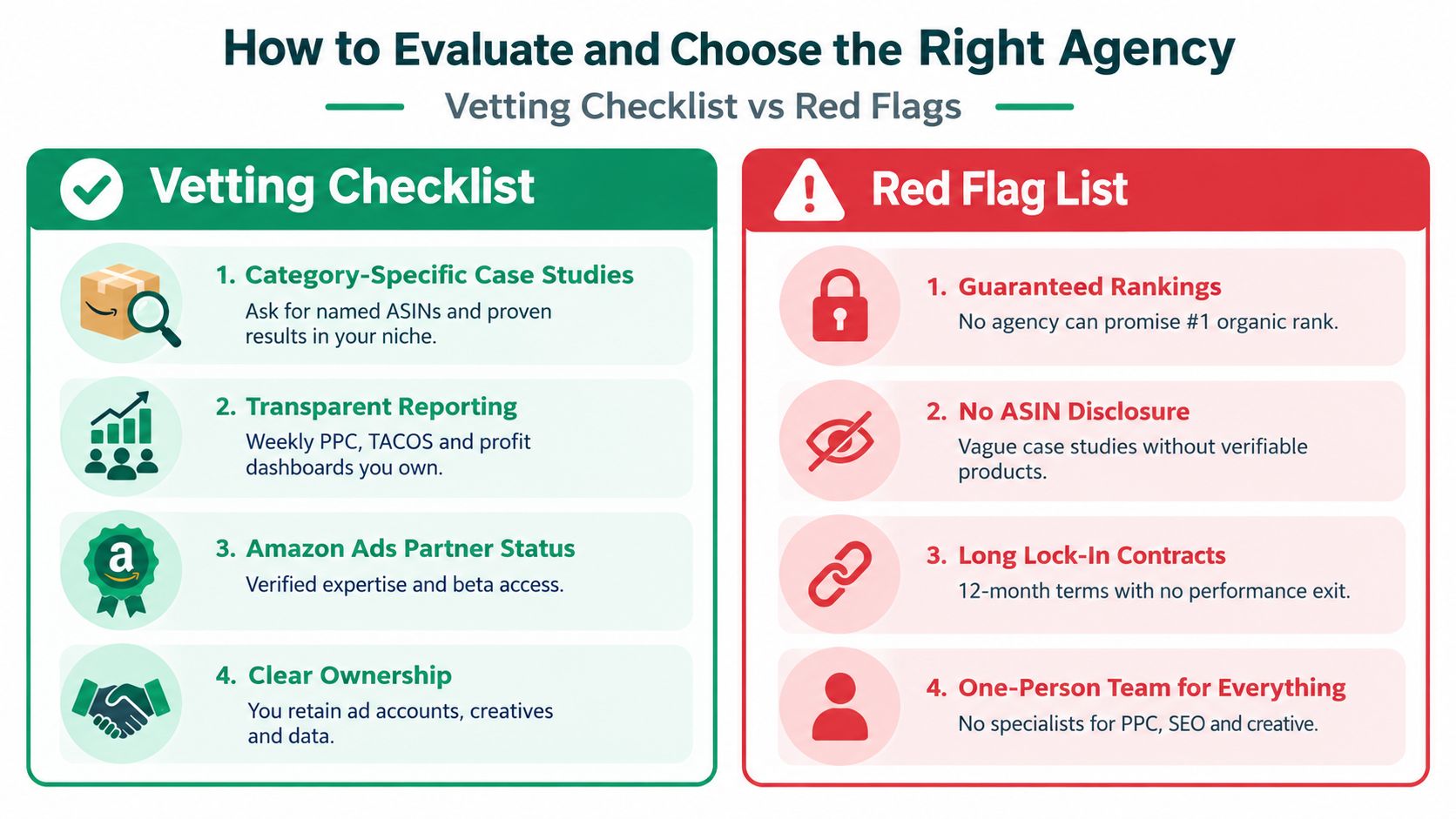
Vetting checklist
- Category-specific evidence: Ask for case studies with named ASINs or revenue figures relevant to your category. Vague logos aren’t evidence.
- Named account leads: Get the strategist, PPC operator, creative lead, and escalation contact by name.
- Data access: Confirm transparent access to Brand Analytics and Search Query Performance, plus reporting that your team owns.
- Commercial alignment: Prefer fees tied to a sensible measure of spend, TACoS, or profit rather than unexplained hours.
- Diagnostic milestone: Require a 30 to 90 day diagnostic period before accepting a long contract.
Red flags worth taking seriously
- Guaranteed rankings: No agency can control Amazon’s organic results or promise a specific ACoS.
- Account ownership demands: You should retain ownership of Seller Central, advertising accounts, creative files, and data.
- Screenshot reporting: A dashboard without keyword-level decisions hides the work that matters.
- No clear contact: If nobody can tell you who manages the account day to day, stop the process.
- Long lock-in: Don’t accept a 12-month contract before a pilot or diagnostic phase.
Ask these five questions on the first call:
- Who will work on the account day to day?
- What was the last campaign you killed, and why?
- How do you attribute sales to organic ranking lifts?
- What does reporting look like weekly and monthly?
- Which benchmarks are acceptable at my average order value?
The answers should be specific enough to test. If the agency says it “optimizes everything,” ask which campaign it would change first and what evidence supports that choice. If it says it improves organic ranking, ask how it separates paid sales from organic sales.
For additional selection criteria, use this guide to choosing a marketing agency alongside your own account audit.
A trustworthy agency makes its work auditable. You should be able to see the decision, the reason, the owner, and the business metric affected.
AMZ Marketing Agency: Decide If an Agency Is the Right Move for You
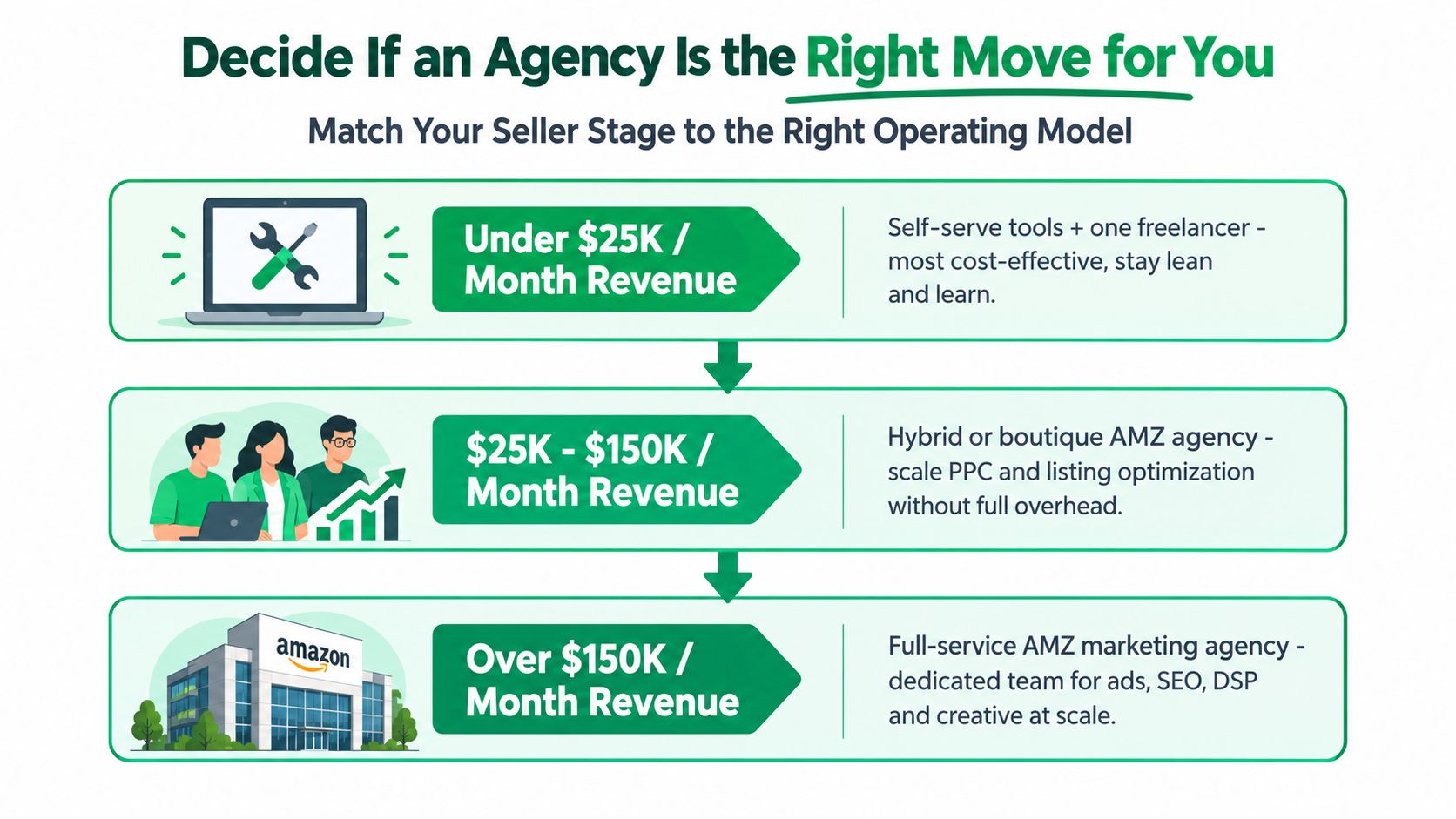
Your seller stage should determine the operating model, not an agency’s sales script.
Below roughly $25,000 per month in Amazon revenue, self-serve tools and one capable freelancer often beat a full retainer. The account is small enough for a focused operator to read directly, and the fixed agency cost can consume too much of the available contribution margin.
From $25,000 to $250,000 per month, a hybrid model usually makes more sense. Keep brand strategy and listing creative close to the business, while using an agency for PPC structure, analytics, and difficult marketplace problems.
Above $250,000 per month, a specialist AMZ marketing agency is often justified. Catalog complexity, media volume, measurement requirements, DSP, video, inventory coordination, and cross-functional testing can exceed what one generalist can manage responsibly.
Before you hire anyone, answer three questions:
- Can you name your top five profit levers today?
- Do you have a clean Amazon P&L?
- Can you separate organic revenue from PPC revenue?
If any answer is no, fix that first. An agency can’t create accountability from numbers your business doesn’t trust.
Mr. Green Marketing, LLC offers strategy-led Amazon marketing, PPC management, listing optimization, SEO, and transparent performance reporting for sellers that need practical execution tied to measurable goals. Visit Mr. Green Marketing, LLC to request a free audit and performance report, then use the findings to decide whether you need an agency, a specialist, or a leaner in-house model.
Leave a Comment
sing in to post your comment or sign-up if you dont have any account.