
Digital Marketing Agency Cost: Most businesses should expect $2,500 to $15,000 per month for a boutique multi-channel retainer and $10,000 to $50,000+ per month for full-service work. That’s the practical buying range I’d use if you want a real budget, not a fantasy quote pulled from a contact form.
And if you’re reading proposals right now, you’re probably staring at three wildly different numbers that all claim to solve the same problem. One agency says retainer. Another says project fee. A third says they’ll “customize a growth plan” after the kickoff. Helpful? Not really. What you need to know isn’t just what an agency charges. It’s what growth costs once you include management, media, creative, tracking, landing pages, and the time it takes to get the machine working.
I’ve seen owners waste months chasing the cheapest line item. Wrong move. Cheap agency fees are easy to buy and expensive to survive.
Digital Marketing Agency Cost: Table of Contents
- Why Most Digital Marketing Agency Cost Conversations Miss the Point
- The Five Pricing Models Agencies Actually Use
- What Really Drives the Number on the Proposal
- Realistic Cost Ranges by Service and Business Size
- Building a Marketing Budget That Holds
- Three ROI Scenarios Worth Stress-Testing
- Ten Questions That Reveal What an Agency Will Really Cost You
- Your Pre-Hire Checklist and a Simple Decision Rule
Why Most Digital Marketing Agency Cost Conversations Miss the Point
A founder sits in a coffee shop with three proposals open on a laptop.
Proposal one is a neat monthly retainer. Proposal two is cheaper, but packed with exclusions. Proposal three costs more and sounds smarter, but hides the actual team behind phrases like “dedicated support.” The founder leaves more confused than when they walked in.
That happens because most digital marketing agency cost conversations are framed around sticker price. Not total cost of growth. And those are not the same thing.
Digital Marketing Agency Cost: Two identical quotes can produce completely different outcomes
An agency can quote the same monthly fee and deliver radically different value depending on what’s inside the scope. One team includes landing page edits, conversion tracking, creative refreshes, and call reporting. Another team posts a report once a month and calls it strategy.
Clutch’s digital marketing agency pricing benchmarks report monthly ranges of $5,000 to $50,000 across its global database of more than 100,000 digital marketing firms, with reviewed project costs commonly falling between $10,000 and $49,999. That range matters because it tells you one blunt truth. “Agency” is not a pricing category. It’s a container for very different scopes.
Practical rule: If a proposal only tells you the management fee, you still don’t know what growth will cost.
The missing line items usually sit outside the retainer. Media spend. Analytics tools. Design hours. Video edits. CRM setup. Call tracking. Feed management. Reporting overhead. Sometimes even basic QA.
If you need a baseline before shopping, start with the practical ranges above. For a smaller boutique partner handling a few channels, $2,500 to $15,000 per month is a reasonable planning range. For broader execution across strategy, creative, paid, SEO, and reporting, $10,000 to $50,000+ is where many serious engagements live. If you want a second opinion on what’s missing from a quote, a structured digital marketing audit service review is often more useful than another sales call.
The better question
Ask this instead: what will it cost, end to end, to produce profitable growth in my business?
That question forces the right conversation. Revenue targets. Channel mix. Conversion rates. Team capacity. Timeline. Not just fee structure.
Digital Marketing Agency Cost: The Five Pricing Models Agencies Actually Use
You get a proposal for $6,000 a month from one agency and $18,000 from another. Same label. “Digital marketing.” Owners assume one of them is overpriced. Usually, they are comparing different pricing structures, different levels of work, and different definitions of responsibility.
That’s why price-sheet shopping goes sideways. The model matters because it shapes how the agency behaves, what gets included, and where your real growth costs start to creep in.
| Digital Marketing Agency Pricing Models Compared | How It Works | Typical Range | Best Fit For |
|---|---|---|---|
| Monthly retainer | Fixed recurring fee for ongoing work | Usually quoted as a monthly management fee tied to a standing scope | Ongoing multi-channel execution |
| Project-based fee | One fixed fee for a defined scope | Reviewed projects often land in the $10,000 to $49,999 range, as noted earlier | Website builds, audits, launches |
| Hourly rate | Pay for time used | Rates vary widely by specialty, seniority, and region | Consulting, troubleshooting, limited scopes |
| Performance-based | Fee tied to leads, sales, or other outcomes | Varies by deal structure | Lead gen offers with clean attribution |
| Percentage of ad spend | Management fee tied to media budget | PPC fees often fall around 10% to 20% of ad spend per Credo’s agency pricing guide | Paid media accounts |
1. Digital Marketing Agency Cost: Monthly retainer
Retainers are the standard for a reason. They work well when the job never really ends. SEO, paid media, email, reporting, CRO, creative testing, and campaign management all need continuity.
I prefer retainers for any business that wants steady growth instead of one-off output. They are easier to staff, easier to forecast, and easier to hold accountable. The catch is simple. A retainer only works if the scope is specific. If the proposal says “full-service marketing support” without naming deliverables, expect scope fights by month two.
2. Digital Marketing Agency Cost: Project-based fee
A project fee is a fixed price for a fixed result. Good examples include an analytics setup, a website redesign, a messaging overhaul, or a launch campaign.
This structure is clean when the finish line is clear. It breaks down fast when owners expect ongoing strategy, revisions, and channel management after handoff. If you hire on a project basis, define what happens after delivery before you sign. That’s where budgets usually get blown.
3. Digital Marketing Agency Cost: Hourly rate
Hourly pricing is straightforward. You buy time.
It makes sense for advisory work, technical cleanup, training, or small fixes where a retainer would be excessive. It also works well when you need senior expertise for a narrow problem and do not want to fund a full monthly team. If you’re trying to compare menu-style offers against monthly scopes, this digital marketing agency pricing packages breakdown helps translate rate cards into real work.
The downside is incentive alignment. Hourly billing rewards more time spent, not better systems or faster execution. Use it for bounded work, not open-ended growth management.
4. Digital Marketing Agency Cost: Performance-based
Performance deals sound attractive because they promise alignment. Pay for leads. Pay for sales. Pay for appointments. Clean idea. Messy execution.
I only like this setup when attribution is tight, the sales cycle is short, and both sides agree on what counts before work starts. If your team is weak at follow-up, your CRM is messy, or revenue depends on several touches across months, this model turns into an argument machine. Agencies either price in that risk aggressively or avoid the deal altogether.
5. Digital Marketing Agency Cost: Percentage of ad spend
This pricing structure is common in paid media. The agency fee rises as your media budget rises.
That can be reasonable if campaign complexity also rises with spend. More budget often means more campaigns, more creative testing, more reporting, and more platform management. But plenty of accounts do not get harder just because spend went up. If an agency wants a percentage of spend, ask what work expands as budget expands. If they cannot answer clearly, you are paying more for volume, not better performance.
One more warning. Percentage-of-spend pricing can separate the agency’s incentives from yours. You want efficient growth. They get paid more when budgets increase.
The right question is not which pricing model is cheapest. It’s which model gives you the clearest line between spend, work, and business results.
Digital Marketing Agency Cost: What Really Drives the Number on the Proposal
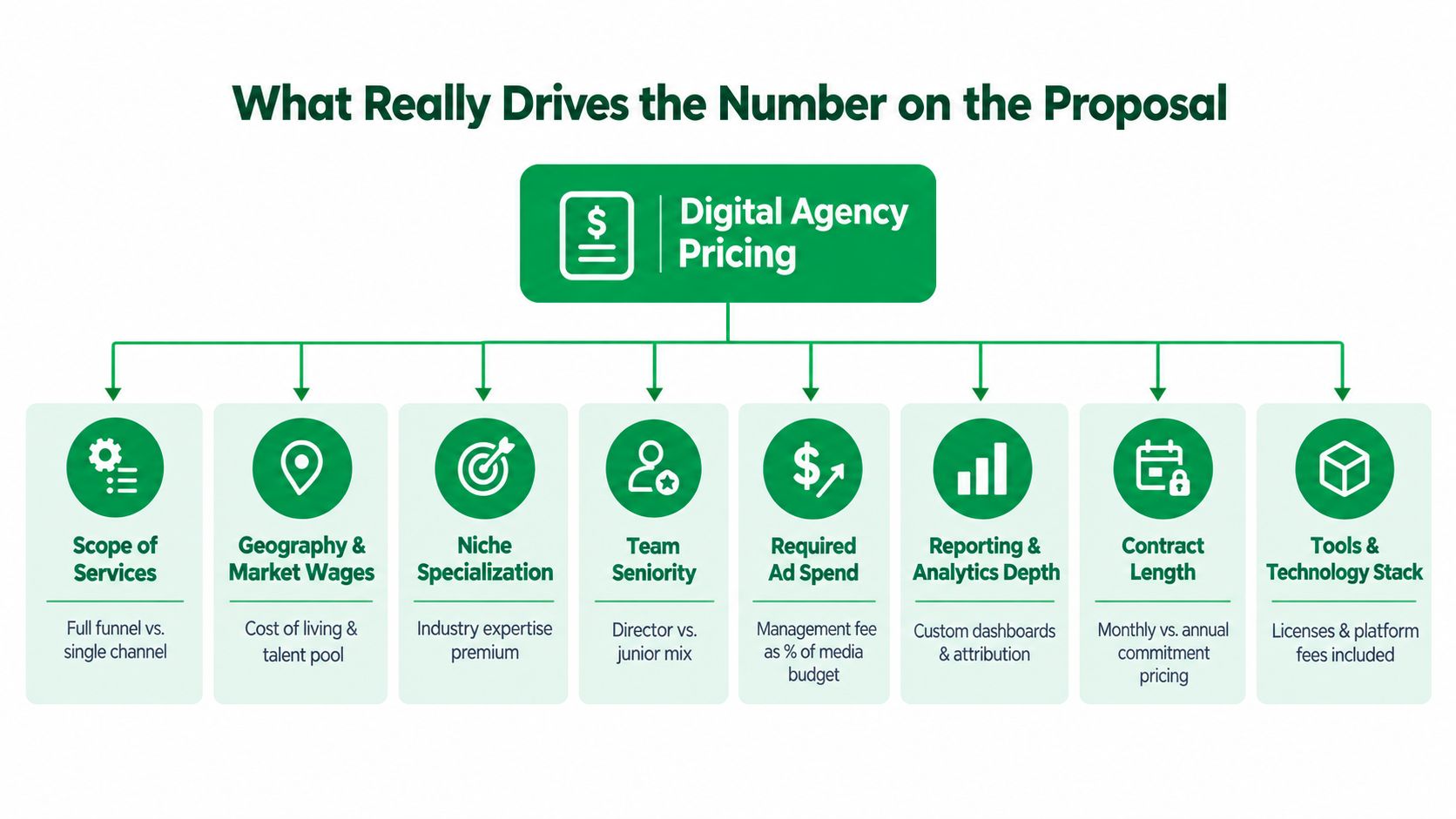
The number on the proposal isn’t random. It’s usually the sum of eight cost drivers stacked on top of each other.
Here’s the visual version first.
Scope changes everything
A single-channel SEO engagement costs less than a program covering SEO, paid search, paid social, landing pages, creative, email, and analytics. Sounds obvious. Yet buyers still compare them as if they’re interchangeable.
The fastest diagnostic is simple:
- Channel count: More channels usually mean more specialists, more meetings, and more QA.
- Execution depth: Strategy-only costs less than strategy plus production.
- Deliverables: If the proposal includes ad creative, copywriting, and CRO work, the fee should rise.
Geography and specialization aren’t cosmetic
Location still affects pricing. Marketing Sherpa reports a U.S. national average hourly rate of $82.66 for digital marketing agencies, with a median of $84.40, while Delaware reaches $132.04 per hour and Nevada averages $107.47, according to a benchmark summary published by The Zulu Method. That spread shows why a remote agency in one state may quote very differently from a team in another.
Specialization pushes the number up too. Not because niche agencies are always better, but because category experience shortens the learning curve. A team that already knows Amazon Seller Central, GA4, Merchant Center, HubSpot, or franchise lead routing won’t spend the first months learning your business on your dime.
The rest of the stack
The remaining drivers are where quotes separate.
- Team seniority: Founder-led strategy costs more than junior account coordination.
- Required ad spend: Bigger paid accounts require more testing, monitoring, and reporting.
- Reporting depth: A simple dashboard is cheaper than custom attribution views.
- Tech stack: Call tracking, landing page software, heatmaps, and feed tools may be bundled or billed separately.
- Contract length: Longer commitments can lower the monthly fee. Shorter terms usually raise it because the agency carries more risk.
One practical example. A local services firm might compare two PPC proposals that look close on paper. One includes Google Ads management only. The other includes call tracking, landing page testing, form QA, search term reviews, and monthly strategy calls. The second quote should be higher. If it isn’t, I’d question whether it’s being done.
Digital Marketing Agency Cost: Realistic Cost Ranges by Service and Business Size
Treat these ranges as guardrails, not quotes. Scope still wins. A lean service business with one location doesn’t buy marketing the same way a national e-commerce brand does.
Side-by-side ranges
| Digital Marketing Agency Cost Ranges by Service and Business Size | Small Business | Mid-Market | Enterprise |
|---|---|---|---|
| SEO | $1,500 to $3,000 per month | $3,500 to $10,000 per month | $10,000 to $25,000+ per month |
| PPC management | 12% to 20% of ad spend | 8% to 15% of ad spend | Flat $5,000 to $50,000 retainer |
| Web design and CRO | $5,000+ project work | Scales by complexity | Can reach $100,000+ |
| Social media management | $1,500 per month and up | Higher with more creative volume | $20,000+ per month |
| Amazon and DTC marketplace work | $2,500 to $15,000 | Higher with catalog complexity | Higher with international and retail layers |
| Branding | $7,000 and up | Larger systems cost more | Can reach $75,000 |
| Video production | Starts at $2,500 per short-form piece | Higher with scripting and editing volume | Higher with campaign-scale production |
Digital Marketing Agency Cost: How I’d interpret these ranges
SEO is usually the first place buyers underbudget. Good SEO isn’t just title tags and blog posts. It’s technical cleanup, content planning, internal linking, page improvements, and authority work. If you’re a small firm trying to rank in one city, the lower end can work. If you’re in legal, medical, SaaS, or national e-commerce, expect the cost to rise fast. If you’re trying to benchmark smaller programs specifically, this guide on small business SEO cost gives more context.
PPC scales with media budget, but not perfectly. That’s the trap. Buyers assume management should stay tiny because “the platform does the work.” It doesn’t. Search query reviews, feed maintenance, negative keyword pruning, audience exclusions, creative testing, and conversion checks still take labor.
Web design and CRO should never be priced by page count alone. A five-page site with CRM forms, scheduling, reviews, accessibility work, and location logic can be far more complex than a larger brochure site.
The variables that push fees up
A proposal can jump for reasons that are completely legitimate:
- Language coverage: Multi-language campaigns need more copy, QA, and reporting.
- Creative volume: More ads, more video, more variants, more revision cycles.
- Integration depth: Salesforce, HubSpot, Klaviyo, GA4, Merchant Center, Amazon, call tracking. It adds labor.
- Reporting cadence: Weekly check-ins and custom reporting cost more than a monthly PDF.
Cheap ranges are useful for planning. They’re dangerous when you mistake them for scope.
Building a Marketing Budget That Holds
You sign a $5,000 retainer, feel good for two weeks, then realize the bill is closer to $12,000 once media, landing pages, tracking tools, and creative work show up. I’ve seen that mistake in proposal reviews for years. Owners ask what the agency charges when the better question is what growth will cost end to end.
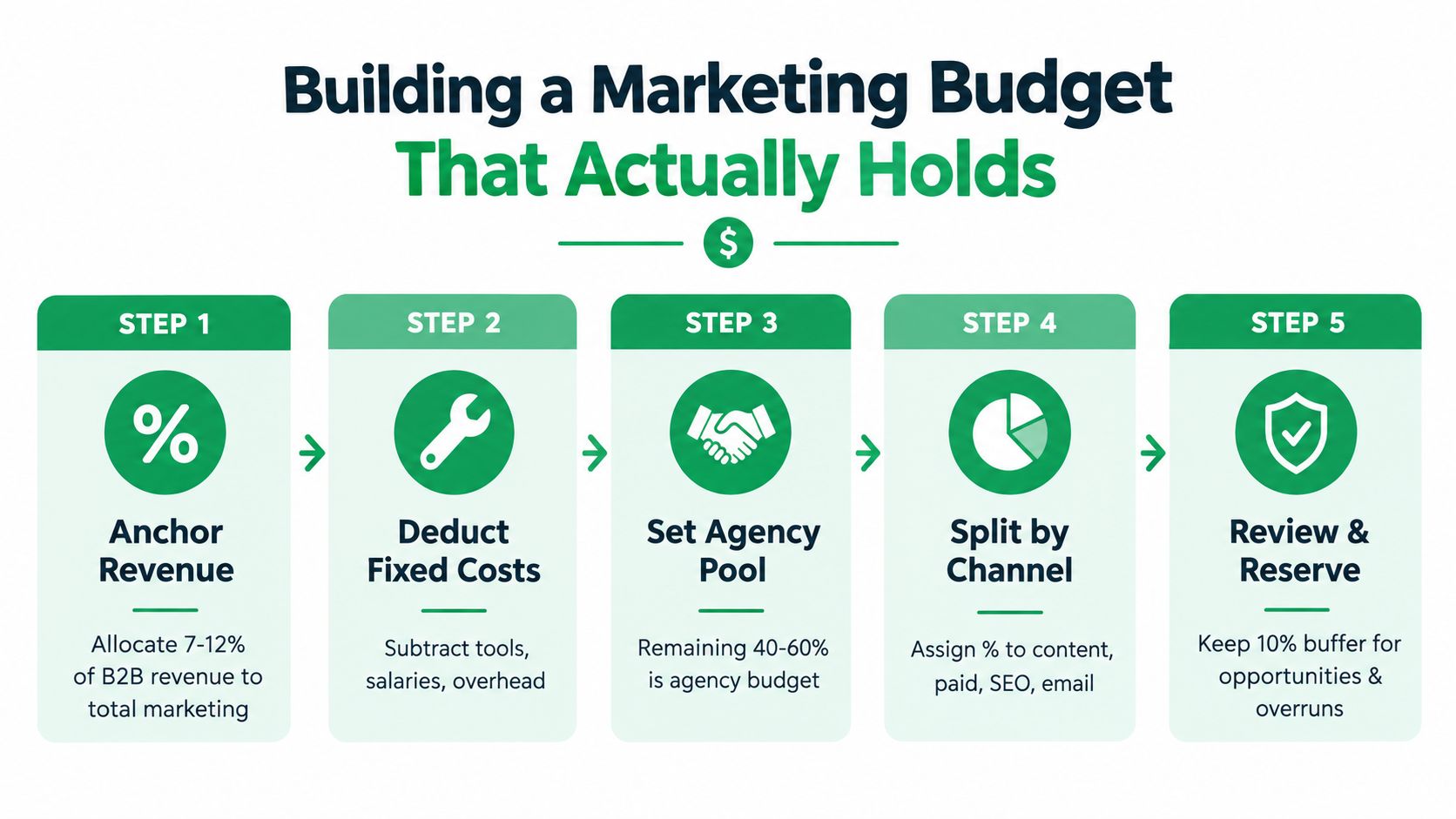
A budget that holds starts with total capacity, not a retainer number in isolation. The agency fee is one line item. It is not the plan.
A five-step worksheet
- Anchor the budget to revenue and cash tolerance
Start with what the business can fund for at least six months without panicking. For many B2B service firms, that often lands in the 7% to 12% of revenue range. E-commerce brands usually need more room because media and creative burn faster, so 10% to 20% is a practical planning range. - Separate working dollars from management dollars
Keep agency fees, ad spend, software, and conversion assets in separate lines. If you blend them together, weak channel economics stay hidden longer than they should. - Assign one job to each channel
Organic search should produce qualified visibility. Google Ads should capture high-intent demand. Paid social should test offers, support remarketing, or create demand at the top of the funnel. If a channel has two or three vague jobs, it usually does none of them well. - Budget for the parts owners forget
Landing pages, call tracking, feed management, email platforms, design support, video edits, CRM cleanup. These costs are routine. Treating them like surprises is how budgets break by month three. - Keep a reserve
Hold back 10%. Accounts need testing money, replacement creative, and occasional cleanup work when tracking fails or a campaign underperforms.
For benchmark context, Gartner reported in its CMO Spend Survey that marketing budgets represented 7.7% of company revenue in 2025. Use that as a reference point, not a rule. Your real number depends on margin, sales cycle length, close rates, and how aggressively you need to grow.
A simple worked example
Take a $2 million service business with a 10% annual marketing budget. That gives you $200,000 per year, or roughly $16,700 per month.
A grounded monthly setup could look like this:
- Agency fee: $6,000 to $7,000
- Media spend: $8,000 to $9,000
- Tools and tracking: $1,000 to $1,500
- Creative and testing reserve: $1,000 to $1,500
That mix is not glamorous. It is stable. More important, it reflects the full cost of execution instead of pretending the retainer is the whole investment.
If you want to map channel percentages before you hire anyone, this guide to marketing budget allocation will help you pressure-test the mix. One option in this category is Mr. Green Marketing, LLC, which works across SEO, PPC, Amazon, web design, branding, social, podcast promotion, and video with custom planning rather than a one-size package.
Three traps that wreck budgets
- Underfunding conversion assets: Paying for traffic without solid landing pages, forms, tracking, and call handling turns media into a guessing exercise.
- Adding channels too early: A weak offer does not improve because you spread it across Google, Meta, LinkedIn, SEO, and email all at once.
- Treating creative like a one-time cost: Ad fatigue is real. So is stale messaging. If the budget has no room for fresh hooks, new visuals, and page updates, performance usually slips before owners notice why.
Three ROI Scenarios Worth Stress-Testing
Skip the glossy case studies for a minute. I’d rather look at math that survives contact with real life.
Honest scenario table
| Three ROI Scenarios: Agency Fee, Media Spend, and Payback Period | Agency Fee | Media Spend | Revenue Generated | Payback Period | Return Ratio |
|---|---|---|---|---|---|
| Local services brand | $3,500 per month | $2,500 per month | Based on lead volume and closed jobs below | Month two | 2.85x return on agency fee over six months |
| E-commerce seller | $6,000 per month | $18,000 per month | $96,000 in attributed revenue | 90-day payback | 2.13x ratio of agency fee to media spend |
| Multi-location franchise | $12,000 per month | $30,000 per month | Based on franchisee lead flow below | Six-month payback | 1.5x ratio |
Scenario one. Local services
Agency fee is $3,500 per month. Ad spend is $2,500. The campaign produces 18 qualified leads at a $150 CPL, and the business closes three jobs at a $4,500 average ticket.
That’s the kind of model I like for local operators because the economics are visible. Calls. Appointments. Jobs. Cash. If the close rate holds, payback in month two is plausible, and the six-month view produces a 2.85x return on the agency fee.
Scenario two. E-commerce
Now the account spends $6,000 per month on management and $18,000 on paid media. Attributed revenue comes in at $96,000, with a 4x ROAS and a 90-day payback.
That can work. It can also fool people. E-commerce math has to survive margin, returns, and promo pressure. Revenue alone doesn’t save a weak account.
Scenario three. Multi-location franchise
This one spends $12,000 per month on agency and $30,000 in media. The program adds 40 franchisee-driven leads per location at $45 CPL, with a six-month payback and a 1.5x ratio.
The headline lesson isn’t that every franchise should spend like this. It’s that multi-location programs live or die on lead routing, location-level response time, and whether operators can convert demand.
If you want to pressure-test your own numbers before signing a retainer, use a framework like this marketing ROI calculator guide.
Lead value, close rate, and time to revenue decide whether the math works. Agency fee is only one variable.
Ten Questions That Reveal What an Agency Will Really Cost You
Headline retainers lie by omission. Not always maliciously. Sometimes the sales team just assumes you’ll ask the right follow-up questions. Most owners don’t.
Ask these exactly as written.
Red flags in plain English
| Vetting Questions vs. Red-Flag Answers | Red-Flag Answer |
|---|---|
| What exactly is included in the monthly fee? | “It depends” without a written scope |
| Who will actually work on the account? | “Our team” with no names or roles |
| Is ad spend billed separately from management? | “It’s bundled” without breakout detail |
| Are there extra fees for tools, stock assets, reporting, or setup? | “We’ll sort that out later” |
| What are the cancellation terms? | Long lock-in with vague exit rules |
| Who owns the ad account, creative assets, and data? | “We manage that internally” |
| How often will we review performance together? | Reporting without live discussion |
| Do you guarantee results? | Guaranteed rankings, leads, or revenue |
| Can you verify the case studies you’re showing me? | Screenshots with no context |
| What work is subcontracted? | “That’s proprietary” or evasive language |
The ten questions I’d use
- What does the monthly fee include, line by line? If they can’t define deliverables, you’re buying ambiguity.
- Who is my day-to-day contact, and who does the strategy? I want names, roles, and seniority.
- Is there any markup on ad spend or vendor tools? Some agencies bury margin where owners don’t look.
- What costs sit outside the proposal? Ask about creative, tracking, landing pages, stock assets, and reporting.
- How do I leave if this doesn’t work? If the answer feels slippery, it probably is.
- Who owns the accounts and assets? Your Google Ads account, GA4 property, Meta assets, CRM workflows, and creative files should not become hostage points.
- What does reporting look like in practice? Fancy dashboards are useless if nobody interprets them.
- Do you offer performance guarantees? Walk away from guarantees that sound too neat.
- Can I speak to a current or recent client with a similar scope? Not a cherry-picked testimonial. A real operating client.
- What work is subcontracted, and who manages quality? Outsourcing isn’t the problem. Hidden outsourcing is.
My blunt read
Defensive answers cost money later. So does vagueness. So does charm without process.
The cheapest proposal usually isn’t the safest one. The safest one is the proposal that makes cost visible, scope explicit, and accountability hard to fake.
Your Pre-Hire Checklist and a Simple Decision Rule
Before you hire anyone, force the decision through one page. If the agency can’t clear this, the proposal isn’t ready.
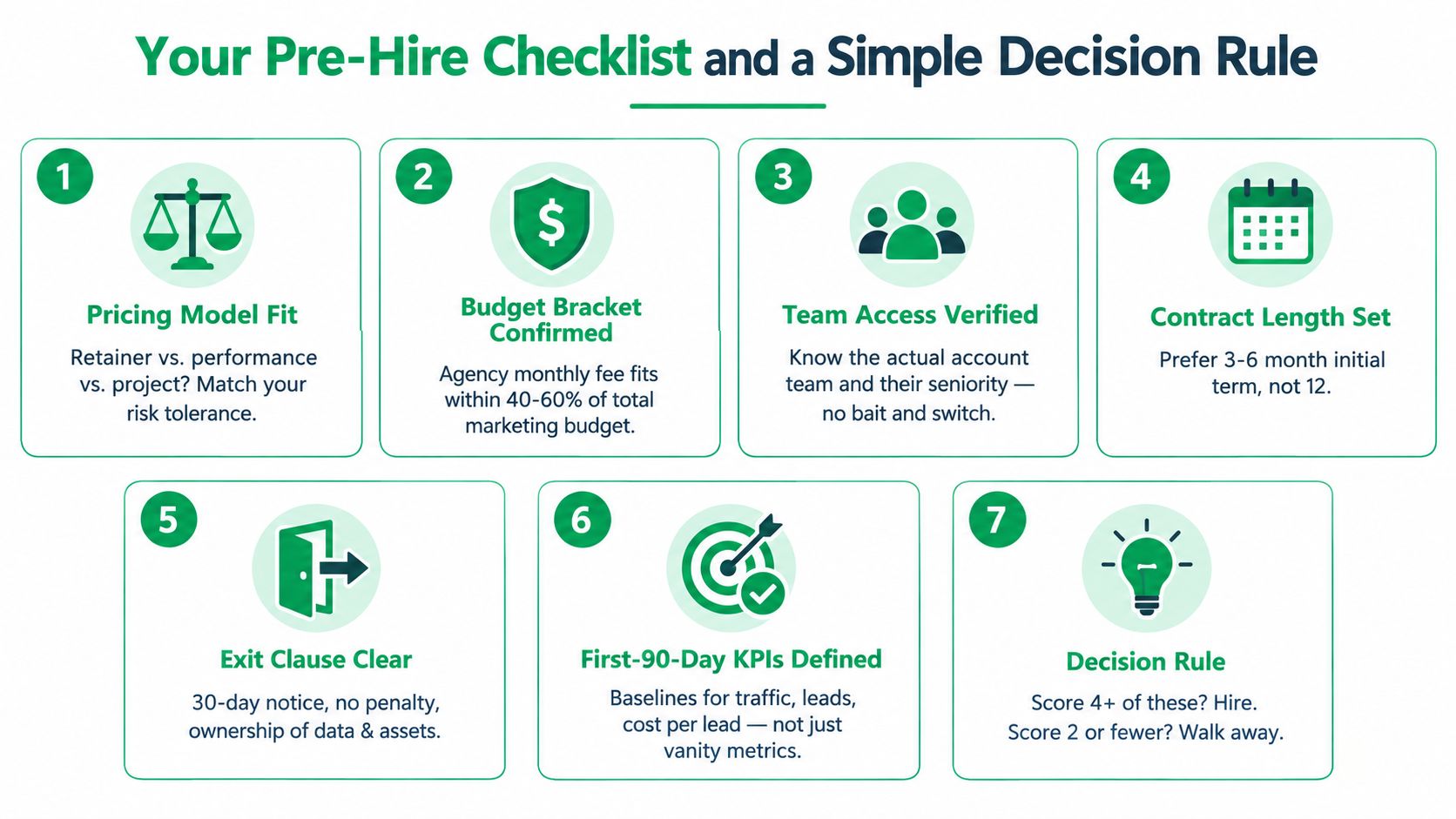
The checklist
- Pricing model fit
Retainer for ongoing execution. Project for a defined build. Performance only if attribution is clean. - Budget bracket confirmed
The fee has to fit inside the total budget, not swallow it. - Team access verified
You know who’s doing strategy, who’s in the platform, and who joins calls. - Contract length set
I prefer an initial 3 to 6 month term over a long lock-in. Long contracts usually protect weak operators more than strong ones. - Exit clause clear
You should be able to leave with reasonable notice, clean access, and your assets intact. - First-90-day KPIs defined
Not vanity metrics. Real baselines for traffic quality, leads, cost efficiency, conversion tracking, and funnel health. - Decision rule applied
If the basics don’t line up before kickoff, execution won’t magically fix it later.
When to hire, when to wait
Hire a boutique agency if you need multi-channel execution and don’t have the in-house team to run SEO, paid, creative, and reporting yourself.
Hire a specialist if one channel is clearly broken. Maybe your Google Ads account leaks spend. Maybe your site ranks but doesn’t convert. Tight problem, tight hire.
Wait if revenue is unstable, positioning is fuzzy, or product-market fit still moves every month. Agencies are not a substitute for a workable offer.
The first month should look like this
- Week one: Access, analytics, CRM, ad accounts, call tracking, baseline review
- Week two: Strategy sprint, channel priorities, measurement plan
- Week three: Launch or restructure
- Week four: First optimization review with actual findings
That’s the simplest decision rule I know. Digital marketing agency cost only means something when you compare it to customer value, payback speed, and the cost of doing nothing while competitors keep compounding.
Mr. Green Marketing, LLC helps businesses sort out exactly this problem by tying SEO, PPC, Amazon marketing, web design, branding, social, and video work to a practical growth plan instead of a vague retainer. If you want a clearer read on what your budget should cover, what a proposal is missing, or whether your current agency fee is justified, visit Mr. Green Marketing, LLC.
Leave a Comment
sing in to post your comment or sign-up if you dont have any account.