
Small Business SEO Cost: Most small businesses that invest seriously in SEO land around $1,000 to $2,500 per month, though pricing can run from $500 to $5,000+ depending on scope. If you’ve been getting wildly different quotes, that’s normal. The core issue usually isn’t the number itself. It’s what the number includes.
You might be in that exact spot right now. One provider says they can do SEO for a few hundred bucks a month. Another comes back with a proposal in the low thousands. Both say they’ll help you rank. Both sound confident. And neither makes it especially easy to compare apples to apples.
That’s where small business SEO cost starts to feel like a black box.
The confusion usually comes from one thing: SEO pricing is tied to labor, scope, and business goals far more than a flat market rate. A local service business with a simple site and one target city needs a very different program than a multi-location company dealing with technical issues, weak content, and serious competitors. If you’re still sorting out the basics, this overview on understanding SEO and SEM is useful because it helps separate organic search work from paid search before you budget for either one.
Small Business SEO Cost: The Big Question How Much Does SEO Really Cost
If you’ve asked three SEO providers for quotes, you’ve probably heard three completely different answers.
That doesn’t automatically mean someone is lying. It usually means they’re pricing different levels of work. One quote may only cover recommendations. Another may include technical fixes, content writing, local SEO, and reporting. Same label. Very different service.
A widely cited 2025 market snapshot says the typical small-business range clusters around $500 to $5,000 per month, with the most common midpoint landing near $1,000 to $2,500 per month for SMBs, according to CausalFunnel’s 2025 pricing guide.
Why quotes feel so inconsistent
A low quote often covers a thin slice of SEO. Think title tags, a few plugin tweaks, maybe a ranking report. That can be fine if your site is already in good shape and you only need maintenance.
But for most small businesses, that’s not the actual job.
Real SEO work often includes:
- Technical cleanup: Fixing crawl issues, indexing problems, broken internal links, duplicate pages, and weak site structure
- Content production: Creating or improving service pages, location pages, blog articles, FAQs, and supporting copy
- Local SEO work: Managing your Google Business Profile, citation consistency, and geo-targeted page optimization
- Reporting and strategy: Reviewing what’s happening, what’s stuck, and what needs to change next
Practical rule: If a quote sounds cheap, ask what work is actually being done each month, not just what outcome is being promised.
Small Business SEO Cost: What a realistic budget usually means
For many small businesses, the question isn’t “Can I find SEO cheaper?” You can. The better question is whether the price matches the amount of work needed to move the business.
A modest local company may sit near the lower end of the range. A more competitive service business or e-commerce brand often needs more ongoing content, technical support, and strategy. That’s why the mid-range is so common. It tends to be where SEO stops being a random task list and starts becoming an actual growth program.
Small Business SEO Cost: The Three Main Ways You Pay for SEO
A business owner gets two SEO quotes in the same week. One is a few hundred dollars. The other is several thousand a month. The gap usually comes down to the pricing model, and the critical distinction lies in what work is included.
SEO is commonly sold three ways: monthly retainer, project-based work, and hourly consulting. Each model fits a different business situation, cash flow comfort level, and level of urgency.
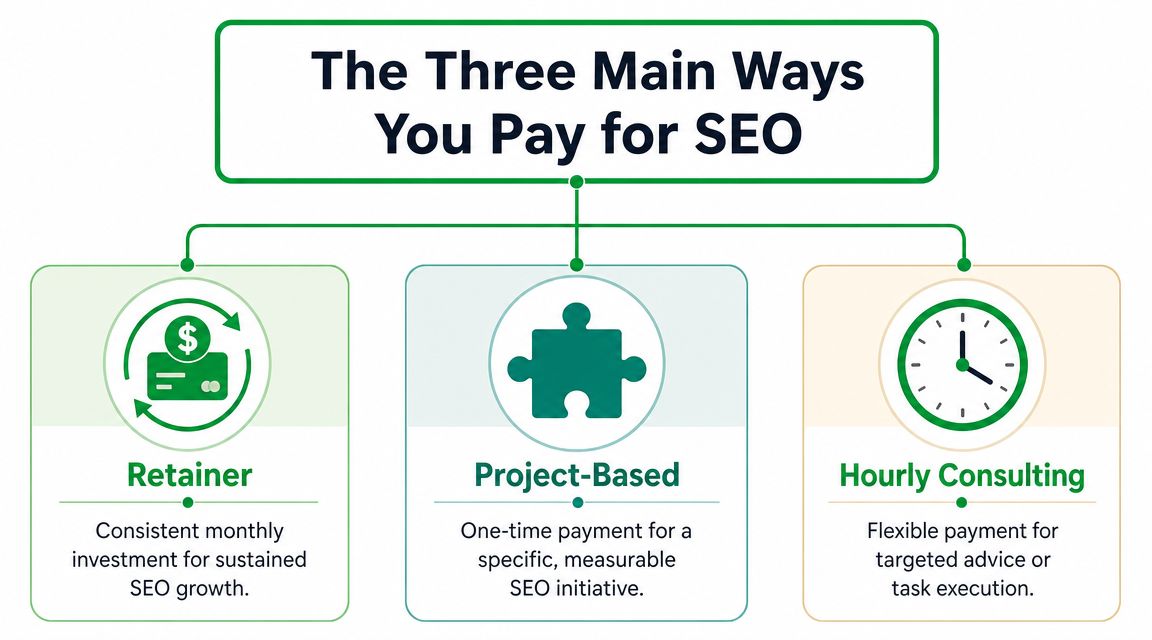
Monthly retainer
A retainer buys ongoing work each month. That usually means a set number of deliverables, such as technical checks, page updates, local SEO tasks, content briefs, reporting, and strategy calls.
For a small business, this is often the most practical setup because SEO gains come from repeated work, not a single fix. If a provider is charging a monthly fee, ask what gets done every month. How many pages are being improved? Is content being written, outlined, or only recommended? Are they fixing issues directly or just sending reports? Those details explain the price better than the label “retainer” ever will.
This model tends to fit best when:
- You need steady output: SEO requires ongoing updates, not occasional attention
- You want one team owning the process: Strategy, implementation, and reporting stay connected
- Your competitors are active: Standing still usually means losing ground
A good retainer should feel like buying work hours and priorities, not vague optimism.
Project-based SEO
Project pricing works well when the scope is clear and the finish line is visible.
Common examples include a technical review, a local SEO setup, migration support, a batch of service page rewrites, or a website SEO audit service that maps out what is broken, what is missing, and what should happen first. You pay for a defined outcome instead of an open-ended monthly relationship.
This option makes sense if you need clarity before committing to a larger spend. It also works when you already have someone who can carry out the recommendations after the project is done. That is the trade-off. Project work can give you a clear plan, but if nobody implements it, the value stalls.
Good fit scenarios:
- You need a one-time fix: Audit, cleanup, setup, or migration
- You want a roadmap first: Priorities before a larger investment
- You have internal support: Someone can turn recommendations into live changes
Hourly consulting
Hourly SEO is useful when the problem is narrow.
Maybe you need a second opinion on a drop in traffic. Maybe your developer needs guidance on redirects. Maybe you want help reviewing content plans or mastering high-ranking content creation before assigning work to your team. In cases like that, paying for expert time can be efficient.
It can also get expensive quickly if you are really looking for execution. Advice is valuable. Advice plus implementation is a different purchase. If an hourly consultant charges for calls, audits, follow-up notes, and review time, the total can climb fast without much getting pushed live on the site.
Use hourly help when you know the question. Avoid it when you need someone to own the whole job.
The right model depends less on what SEO is called and more on what your business needs right now: ongoing production, a defined fix, or targeted expertise.
Small Business SEO Cost: What Really Determines Your SEO Cost
A small business owner gets two SEO proposals. One is $800 a month. The other is $3,200. Both promise better rankings. The price gap looks arbitrary until you ask a simple question: what work is included?
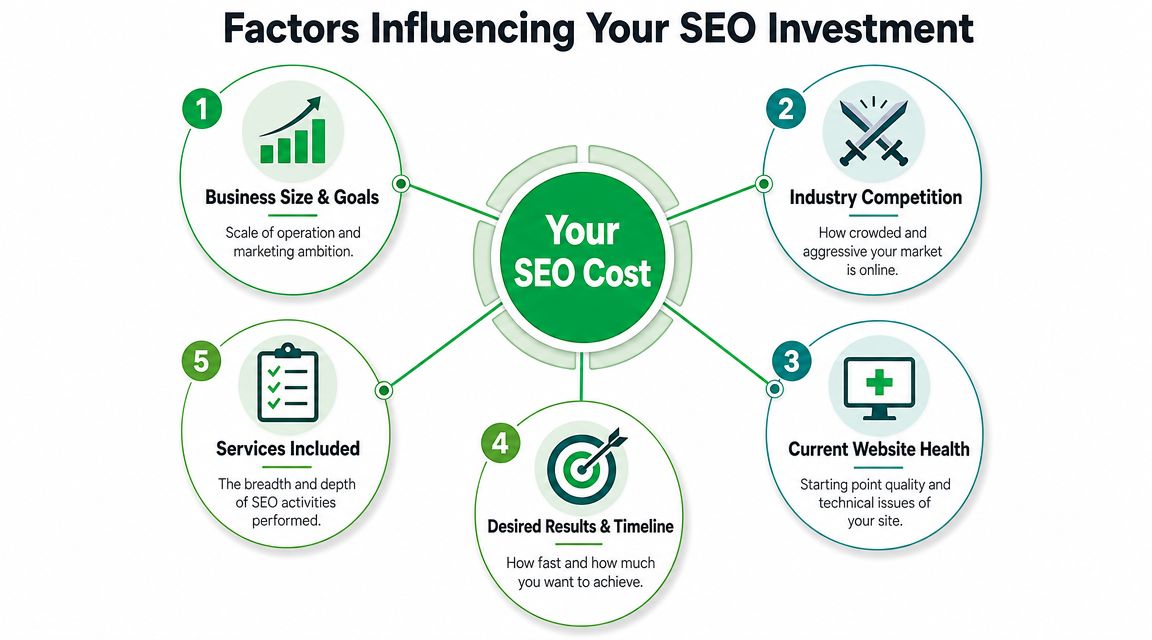
That is what determines cost. SEO pricing follows labor, scope, and difficulty. If a provider cannot connect the fee to specific tasks and business goals, treat that as a warning sign.
Geographic scope changes the workload
Ranking a single-location business in one town usually costs less than supporting a company across several cities or service areas.
The reason is practical. More geography means more pages to build or improve, more local signals to manage, and more competitors to outrank in each market. Analysts at Blueprint Digital’s local SEO cost analysis note that local campaigns often sit in one pricing band, while broader regional or national work tends to land higher because the job is bigger.
A plumber targeting one city may need a strong home page, a few service pages, a healthy Google Business Profile, and basic local authority work. A plumbing company targeting ten cities may need ten useful location pages, cleaner site structure, stronger internal linking, duplicate-content controls, and a plan for how each market earns visibility. Same channel. Different amount of work.
Site condition affects your starting cost
A clean site gives your SEO budget room to produce growth. A messy site burns budget on repairs first.
Common issues include crawl errors, redirect chains, duplicate pages, weak internal linking, bloated page templates, and slow or awkward mobile experiences. None of that is glamorous. All of it affects what gets quoted.
A proper website SEO audit service helps identify where the money should go before you commit to monthly work. Sometimes the right answer is content. Sometimes it is technical cleanup. Sometimes it is both, and that changes the price immediately.
I tell clients this often: the cheapest SEO month usually comes after the foundation problems are fixed.
Content requirements raise or lower recurring spend
Some businesses already have solid service pages and a clear site structure. Others do not. That difference shows up fast in pricing.
If key pages are thin, outdated, off-topic, or written only for keywords, SEO has to include content work. That may mean rewriting service pages, building location pages, adding FAQ content, improving calls to action, or publishing articles that support commercial searches. Businesses that need steady publishing will spend more because writing, editing, optimization, and internal linking all take time.
For a useful reference point, this guide on mastering high-ranking content creation explains how content needs to match search intent and business goals, not just include target phrases.
Small Business SEO Cost: Competition and goals shape the size of the team
SEO gets more expensive when the market is crowded or the timeline is aggressive.
If you are in a quiet niche with a decent site, one strategist and a light implementation plan may be enough. If you are competing in legal, medical, home services, or a dense metro area, the work often expands. You may need technical support, content production, local optimization, reporting, and strategy oversight all running at the same time.
A few variables usually drive the quote:
- Number of pages that need work
- Level of competition in your market
- Whether the provider only advises or also implements
- Amount of new content required
- Local, regional, or multi-location scope
- Urgency of the growth goal
That is the black box, explained plainly. SEO cost is not random. You are paying for specific expertise, hours, and deliverables tied to a business outcome, whether that is more local leads, stronger visibility in new service areas, or a site that stops leaking traffic because the basics finally got fixed.
Small Business SEO Cost: Example SEO Budgets What You Get for Your Money
The easiest way to understand small business SEO cost is to connect money to deliverables.
Not vague promises. Actual work.
Here’s a practical comparison of what different budget levels often look like in common scenarios.
Sample Small Business SEO Packages
| Package Level | Typical Monthly Cost | Core Focus | Key Deliverables | Best For |
|---|---|---|---|---|
| Local Foundation | $500 to $1,500 | Establishing local visibility and fixing basics | Google Business Profile support, core on-page updates, citation review, basic reporting, limited technical fixes, priority page optimization | Single-location businesses with a simple website and clear local service area |
| Growth Engine | $1,500 to $3,000 | Consistent ranking growth with broader execution | Ongoing technical work, local or regional landing page optimization, content planning, recurring content production, internal linking improvements, reporting and strategy calls | Competitive local service businesses and regional brands that need steady lead growth |
| Market Leader | $3,000 to $5,000 | More aggressive growth and larger-scope SEO management | Deeper technical remediation, multi-location support or advanced content expansion, stronger strategic oversight, broader optimization across key pages, recurring reporting and implementation | Multi-location businesses, more competitive regional markets, and brands with larger websites |
These ranges line up with the broader market data already covered earlier, plus the local and regional complexity patterns discussed above.
What changes as the budget goes up
At the lower end, the work is narrower. The provider usually focuses on foundational items that matter most first. That often means fixing core pages, improving local signals, and tightening technical basics. Useful work, yes. But limited.
At the middle tier, SEO starts to function like an ongoing operating system for growth. There’s room for repeated content work, issue monitoring, optimization cycles, and adjustments based on performance. Many small businesses find the right balance at this level. Enough budget to keep moving, not so much that the program becomes bloated.
If your business depends on search leads every month, “some SEO” usually isn’t enough. You need enough budget for consistent execution.
At the higher end, complexity is the driver. More locations. More pages. More technical friction. More stakeholders. More competition. That budget isn’t just buying more hours. It’s buying a broader mix of skills and a faster working cadence.
The mistake business owners make
They compare packages by price before comparing them by output.
That’s backwards.
A lower-priced package may exclude writing, implementation, local citation work, or technical fixes. A more expensive package may include the parts that make the campaign move. If you’re evaluating options, it helps to review a more complete framework for SEO strategies for small businesses so you can match budget to business stage.
A useful proposal should answer these plain-English questions:
- What gets worked on each month
- Who handles implementation
- Whether content is included
- How local SEO is handled
- What success should look like
If those answers are fuzzy, the price is fuzzy too.
Small Business SEO Cost: Choosing Your Partner DIY vs Freelancer vs Agency
Once you understand pricing, the next question is who should do the work.
Small business owners often face a common dilemma. DIY looks affordable. Freelancers look flexible. Agencies appear full-service. All true. And all incomplete.
To make a clean decision, you need to weigh cost, time, expertise, scalability, and support.
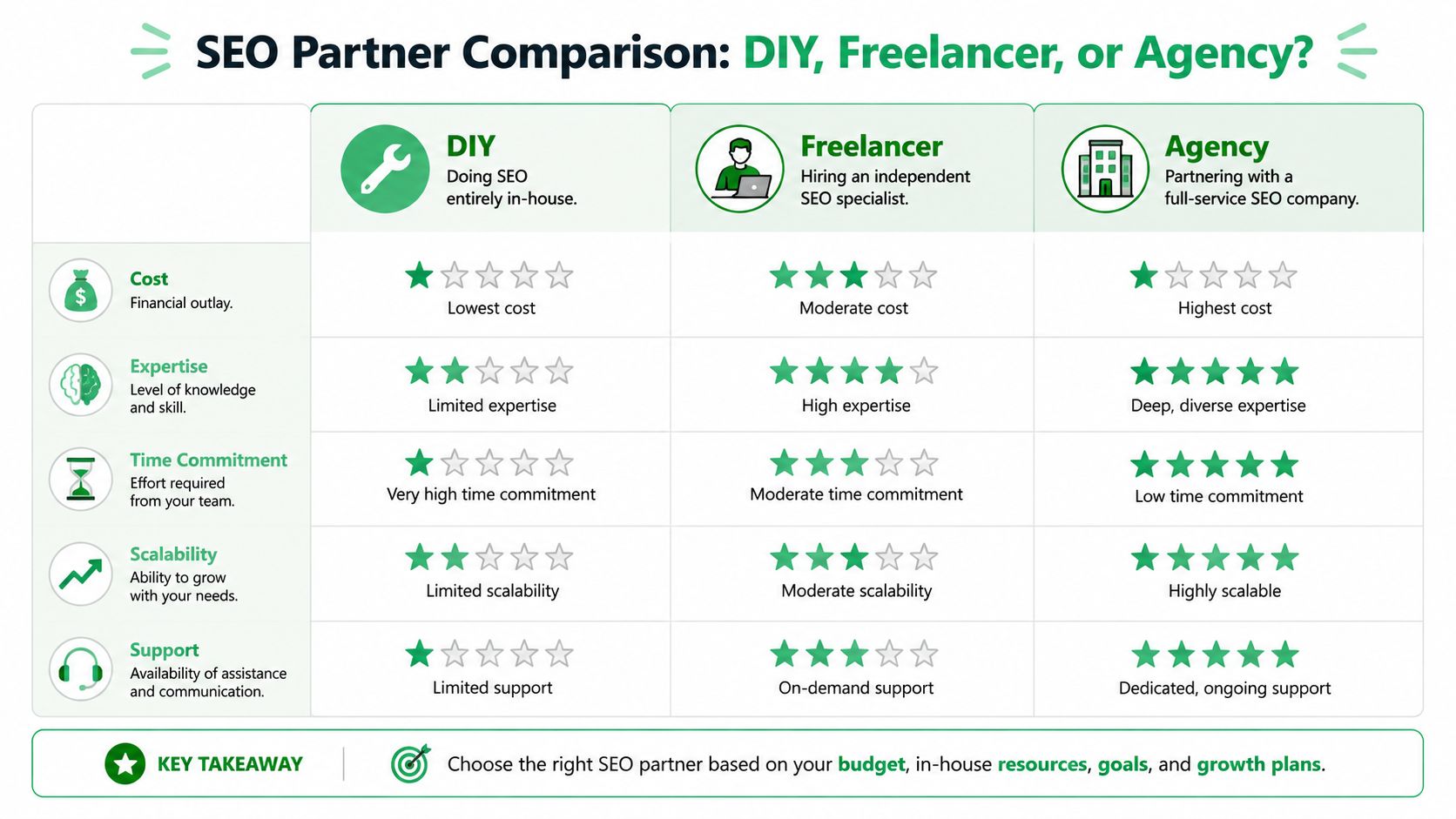
DIY is cheapest in dollars and most expensive in attention
If you have time, curiosity, and a fairly simple business model, DIY can work for foundational SEO. You can improve page titles, tighten service page copy, maintain your Google Business Profile, and publish useful content.
The catch is time. Real business owners rarely have extra hours sitting around waiting to be filled with technical audits, keyword mapping, internal linking reviews, and content updates.
DIY tends to work best when:
- Your market is simple: One location, limited competition, and a modest website
- You can learn fast: You’re comfortable using tools and making site edits
- You want to validate the channel first: You’re proving whether SEO deserves a bigger budget later
A lot of owners underestimate the opportunity cost here. If SEO steals too much time from sales, operations, or service delivery, the “cheap” option can turn expensive.
A short explainer can help if you want another perspective before choosing a delivery model:
Freelancers are often the practical middle ground
Ahrefs reports that agencies average $3,209 per month while freelancers average $1,348 per month, and the most common hourly rate is $100 to $150, according to Ahrefs’ SEO pricing survey.
That pricing gap makes sense. A good freelancer usually offers narrower but more affordable execution. You may get strong help with local SEO, on-page optimization, audits, or content strategy. What you may not get is a full bench of specialists.
Freelancers are often a good fit when:
- You know the main problem: Local SEO cleanup, content guidance, or technical review
- You want direct communication: You’re working with the person doing the work
- Your budget is real but not huge: You need expertise without full agency overhead
Small Business SEO Cost: Agencies cost more because they usually bundle more
When an agency is structured well, you’re not just hiring one person. You’re hiring a process. Strategy, implementation, content support, technical reviews, reporting, and coordination all live under one roof.
That’s the upside. The downside is obvious. Higher monthly cost and the need to choose carefully.
An agency should make the work clearer, not more mysterious. If they can’t explain what happens each month, keep looking.
For some businesses, an agency is the right move because the problem is broad. A site needs content, technical fixes, local visibility work, and a growth plan. In those situations, a team model can be more efficient than piecing together freelancers.
If you’re evaluating providers, this guide on how to choose a digital marketing agency gives a practical way to compare fit, communication, and scope.
And if your SEO plan also depends on stronger visual content for site pages, social proof, or campaign support, lightweight tools that get started with AI video generation can help your team create supporting assets faster without turning that into a whole separate production process.
Small Business SEO Cost: A Simple Checklist for Making Your Decision
When business owners overspend on SEO, it usually happens before the contract is signed. They buy a label instead of a scope.
A useful benchmark: GoodFirms reports that almost 43% of companies spend $1,000 to $2,000 per month on SEO, which is a helpful anchor when you’re judging whether a quote is unusually high or suspiciously low for the work proposed, according to GoodFirms’ SEO pricing survey.
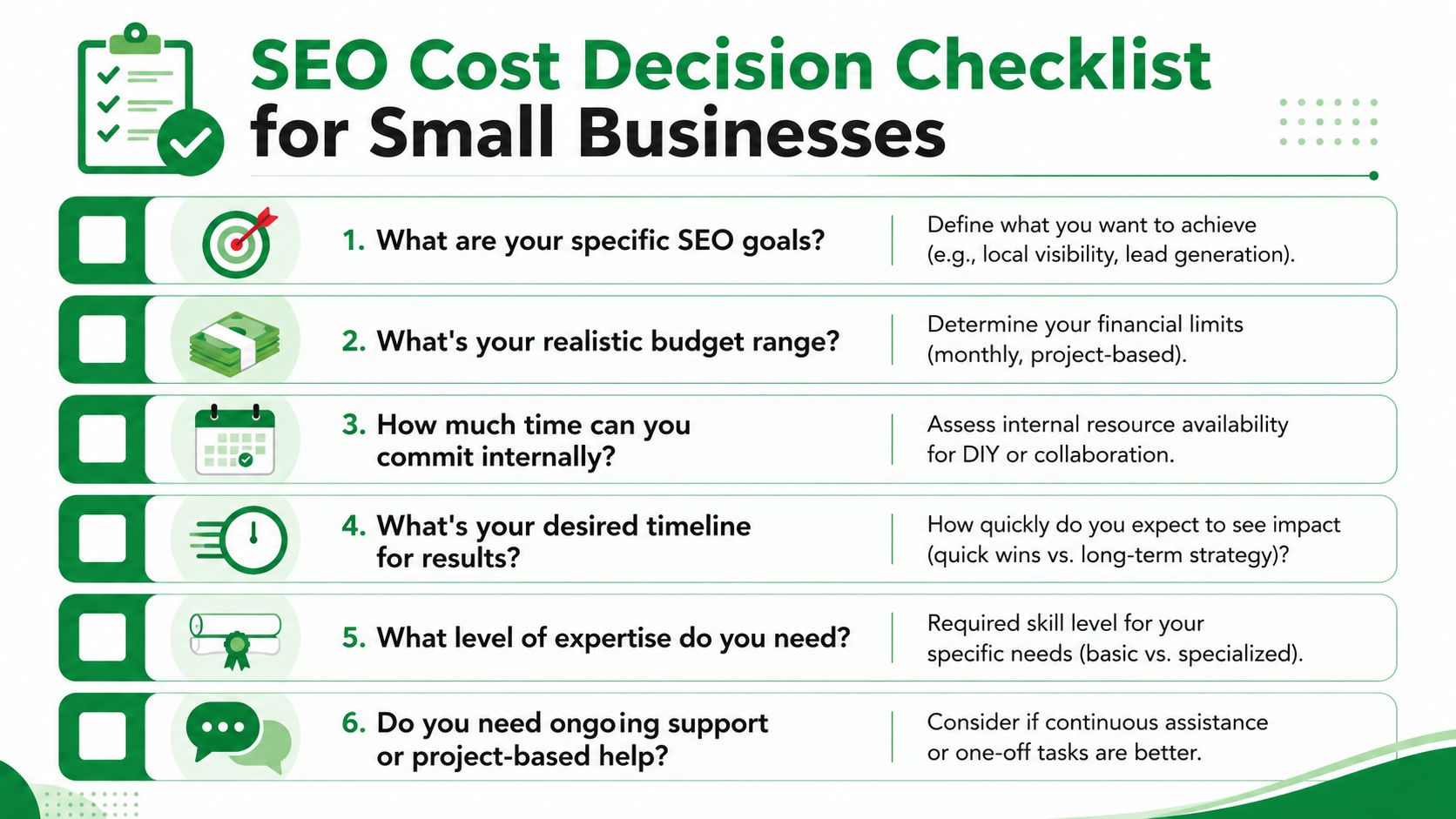
Use this before you sign anything
- Define the business goal: Are you trying to generate local leads, improve visibility for core services, support e-commerce sales, or clean up a weak website? If the provider can’t tie the work to a business goal, the proposal is already off track.
- Set a realistic budget band: Don’t ask what SEO costs in the abstract. Ask what level of work your budget can support. A budget needs to match the amount of implementation required.
- Check whether implementation is included: Some providers diagnose problems. Others also fix them. That distinction matters more than fancy package names.
- Ask what gets done monthly: You want a concrete rhythm. Page updates, content work, technical fixes, local SEO tasks, reporting. Something visible.
- Look at internal capacity: If your team is writing content, approving edits slowly, or handling site changes in-house, progress may depend on your availability as much as the provider’s.
- Get clarity on support style: Ongoing SEO and one-time project work solve different problems. Buy the model that fits the need.
Questions worth asking on a sales call
Ask these plainly:
- What specific deliverables are included?
- Who performs the work?
- What happens if technical issues are found?
- Is content creation included or separate?
- How will progress be communicated?
Short, direct questions. They cut through a lot of nonsense.
Small Business SEO Cost: Your Next Step Toward SEO Success
Small business SEO cost isn’t a mystery once you connect the price to the work.
That’s the part most quotes skip. They tell you the monthly fee but not the engine underneath it. In practice, cost reflects scope, competition, technical condition, content needs, and whether you’re buying strategy, implementation, or both. Cheap SEO that leaves core problems untouched is not a bargain. It’s a delay.
The next smart move is simple. Don’t guess.
Get an audit or assessment that shows what your site needs right now. Maybe you need local cleanup and a few strong service pages. Maybe you need technical remediation before content can do much. Maybe your current provider has been reporting activity without fixing the parts that matter. Until someone looks under the hood, the budget discussion stays abstract.
One option is to ask for a structured review from a provider that starts with visibility gaps, technical issues, and prioritization. Mr. Green Marketing, LLC offers that kind of audit-first approach as part of its broader digital marketing services, alongside SEO planning and implementation support.
That kind of starting point gives you something far better than a generic package. It gives you a reasoned answer to a more useful question: what should SEO cost for your business, given your site, your market, and your goals?
If you want a clearer answer than “it depends,” Mr. Green Marketing, LLC can help you start with a practical audit and performance review. That gives you a concrete picture of what needs fixing, what can wait, and what level of SEO investment makes sense for your business.
Leave a Comment
sing in to post your comment or sign-up if you dont have any account.