
Digital Marketing Agency Pricing Packages: You’re probably here because you asked a few agencies for pricing and got answers that barely looked like they belonged to the same industry.
One quote came back as a low monthly fee. Another showed a much bigger retainer with strategy, reporting, and meetings baked in. A third agency wouldn’t even talk numbers until after a discovery process. Same general promise. Very different prices. And that leaves most business owners asking the right question: what am I buying?
That’s the issue with digital marketing agency pricing packages. The package itself is never just a list of tasks. It’s a mix of labor, seniority, speed, accountability, and risk ownership. Cheap packages often look clean on paper because they leave out the expensive parts. Strategy. Tracking. Creative revisions. Landing page support. Fast pivots when campaigns stall.
So if you’re trying to compare options, don’t stop at price. Read the shape of the work. Read what’s excluded. Read who’s responsible when something breaks.
Digital Marketing Agency Pricing Packages: Why Is Agency Pricing So Confusing
A business owner gets three proposals.
The first says it will handle SEO, PPC, and social for a relatively modest monthly amount. The second comes in much higher, but includes strategy calls, analytics setup, reporting, creative input, and conversion tracking. The third offers a one-time project fee for a funnel build, then suggests ongoing support later. All three claim they can help grow the business.
That’s where the confusion starts.
The pricing feels inconsistent because agencies don’t sell the exact same thing, even when they use the same service labels. “SEO” can mean technical cleanup and content planning at one firm, and a few on-page edits plus a monthly report at another. “Paid media management” can mean active testing and landing page feedback, or just campaign maintenance.
Practical rule: If two packages use the same channel names but assign different ownership, they are not the same package.
The service names match, but the work often doesn’t
Some agencies price around deliverables. Others price around access to a team. Others price around expected complexity. And some intentionally avoid giving a fast quote because they know the scope changes once they review your account, your ad spend, your site, and your tracking setup.
That can feel evasive. Sometimes it is.
But often it’s just reality. A local service business with one location and a simple lead form is not the same as an e-commerce brand managing paid search, paid social, email flows, and a product feed. They may both ask for “digital marketing,” but they are buying very different levels of operational support.
Digital Marketing Agency Pricing Packages: Transparency is the missing piece
The issue isn’t that agencies use different pricing models. It’s that many proposals don’t clearly explain what the fee covers, what the client still owns, and what happens when priorities shift.
That’s why buyers get stuck comparing surface-level items:
- Channel count: How many platforms are listed
- Deliverable volume: How many blogs, ads, or posts appear in the package
- Sticker price: The monthly fee without context
- Promises: Broad language about growth without a method
And that’s exactly how a weak package can look attractive.
Digital Marketing Agency Pricing Packages: The Four Common Pricing Models Explained
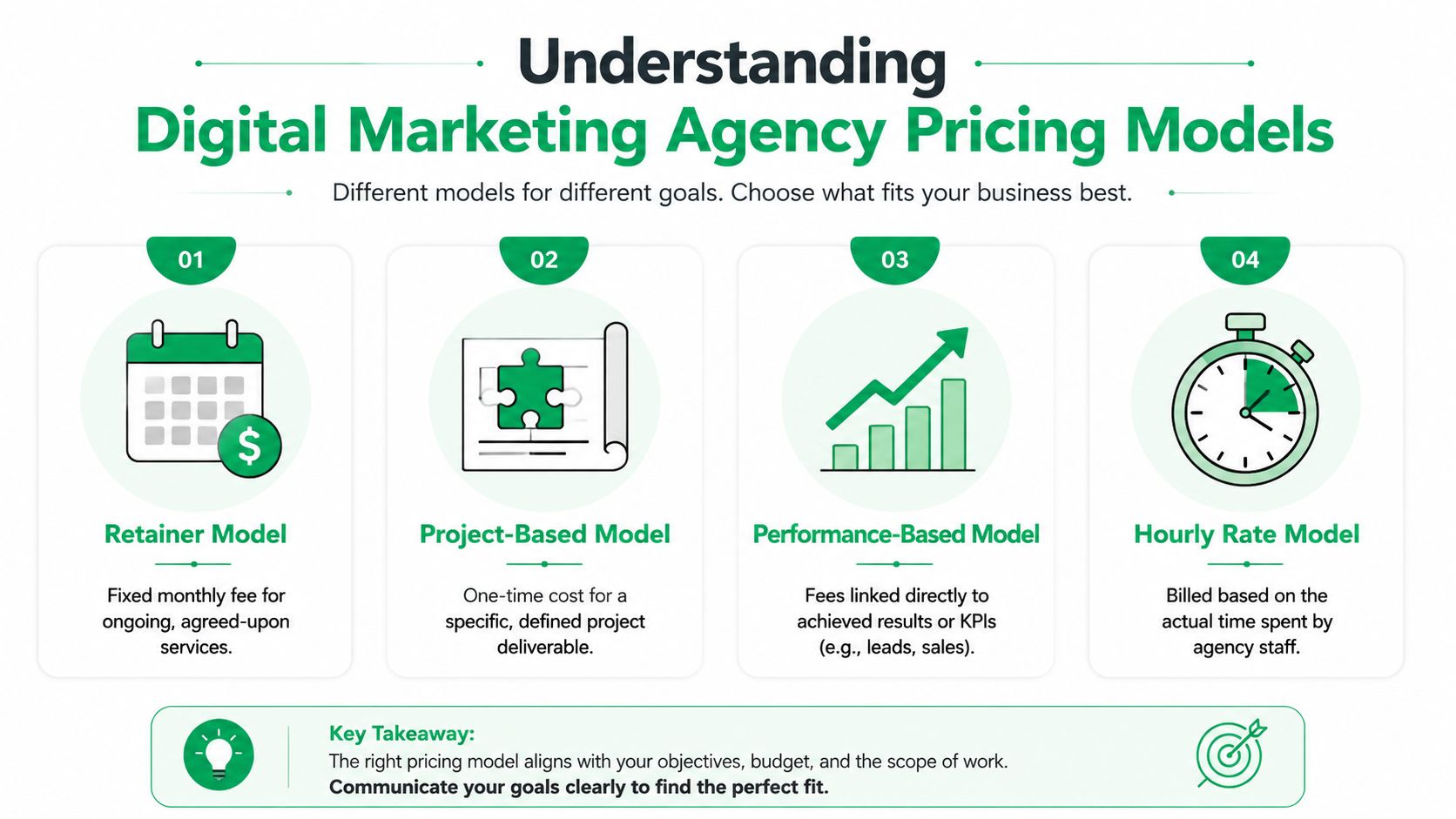
Most agencies charge in one of four ways. Retainer, project-based, hourly, or performance-based. Once you understand those models, the price spread starts making a lot more sense.
Monthly retainer
This is the dominant model, and for good reason. A marketing agency pricing benchmark from Teamwork puts common monthly retainers in the $2,500 to $12,000 per month range, with hourly work averaging around $82.66 and a median of $84.40. The retainer model became standard because channels like SEO and PPC need ongoing optimization, not one-off output.
That matters more than people think.
You’re not only paying for tasks. You’re paying for continuity. Someone monitors performance, adjusts priorities, catches issues, and keeps the work moving without re-scoping every week.
Best fit when:
- You need momentum: SEO, paid media, content, and CRO all benefit from ongoing refinement
- You want one accountable team: Not five separate freelancers and a spreadsheet
- Your business changes fast: Promotions, seasonality, inventory shifts, lead quality issues
Project-based pricing
This model works for a fixed scope with a defined finish line. A website redesign. A tracking cleanup. A brand refresh. A landing page sprint.
It’s usually easier to understand because the boundaries are clearer. But it has a built-in limit. Once the project is delivered, ongoing performance management becomes a different conversation.
Project pricing works well when your need is specific and contained. It works badly when the underlying problem is ongoing execution.
Hourly pricing
Hourly billing sounds simple. Pay for time used. Done.
In practice, it’s often best for consulting, audits, small fixes, or specialist support. It’s less useful as the backbone of a growth program because it doesn’t always capture planning, prioritization, and iteration very well. Clients can also get overly focused on time logs instead of outcomes.
And yes, hourly can look cheaper on paper. That’s one reason it remains appealing in early conversations.
Performance-based pricing
This one gets a lot of attention because it sounds aligned. The agency gets paid when results happen. Simple. Except it usually isn’t simple.
Performance pricing only works cleanly when attribution is reliable, conversion tracking is solid, and both sides agree on what counts as success. In paid acquisition, this often ends up as a hybrid model rather than pure performance.
For businesses trying to understand ad-related pricing in more depth, this PPC packages guide for 2026 is useful because it frames how package structure changes with spend, campaign complexity, and management depth.
Pure performance deals sound attractive, but if the tracking is messy, both sides end up arguing about credit instead of improving the campaign.
Sample Digital Marketing Packages and Prices
Most buyers don’t need another vague explanation of “custom solutions.” They need a practical baseline.
A recent breakdown of digital marketing plans and packages shows how agencies commonly structure offers into tiers such as $5,000, $10,000, $20,000, and $40,000+ per month, often with explicit caps like 35 hours at the $5,000 tier and 70 hours at the $10,000 tier. That’s a helpful reference because it shows how modern packages combine strategy and execution, not just isolated deliverables.
Below is a simple way to think about SMB-focused tiers.
Sample Monthly Digital Marketing Packages for SMBs
| Tier | Best For | Example Services Included | Estimated Monthly Price |
|---|---|---|---|
| Starter | Businesses that need focus, cleaner execution, and one primary growth channel | Foundational strategy, one main channel such as SEO or PPC, reporting, core tracking review, limited creative support, monthly planning | Around $5,000 per month |
| Growth | Companies managing multiple priorities and needing more coordinated execution | Multi-channel management, strategy, reporting, creative collaboration, testing cadence, stronger optimization coverage, more team capacity | Around $10,000 per month |
| Scale | Brands with larger budgets, more moving parts, and higher demand for speed | Cross-channel strategy, deeper optimization, broader creative support, analytics oversight, faster iteration, senior-led account direction | $20,000+ per month |
Digital Marketing Agency Pricing Packages: What a Starter package usually buys
Many small businesses should begin here. Not because it’s the cheapest option, but because it forces focus.
A solid Starter package typically centers on one primary growth lever. That might be SEO with content support. It might be Google Ads with landing page guidance. It might be local search plus review and conversion tracking cleanup. The point is discipline.
What usually works:
- One lead channel with real attention
- Clear reporting and goal alignment
- Basic strategic guidance
- Defined boundaries on revisions and extras
What often doesn’t work is a bargain package trying to cover everything at once. SEO, social, content, email, paid ads. All lightly managed. None managed thoroughly enough to matter.
What changes in a Growth package
Growth packages aren’t just “more stuff.” They’re more coordination.
Now the agency can connect the channels. Paid search data informs landing page decisions. SEO content supports retargeting. Reporting gets more useful because someone is interpreting the signals, not just exporting dashboards.
This is also where team composition starts to matter more. A package can list the same broad deliverables as a cheaper alternative, but if more senior people are setting direction, the quality of decision-making usually improves.
Digital Marketing Agency Pricing Packages: Scale is about complexity, not vanity
A Scale package makes sense when the business has enough motion to justify broader support. More spend. More stakeholders. More assets. More testing. More urgency.
It should also buy you faster response time and stronger operational ownership. Not just a bigger slide deck.
If a high-tier package adds channels but not decision speed, it may be expensive without being strategic.
Digital Marketing Agency Pricing Packages: How to Read a Proposal and Spot Red Flags
A proposal is not a menu. It’s a statement about how the agency thinks, how it scopes risk, and how much responsibility it’s willing to own.

Read the scope before the price
A lot of buyers jump straight to the monthly fee. That’s understandable, but it’s not the best place to start.
Read these items first:
- What is included: Actual services, not umbrella terms
- What is excluded: Landing pages, creative, tracking fixes, meetings, revisions
- Who owns what: Agency, client, third-party vendor
- How success is judged: Specific KPIs, reporting cadence, decision process
- How changes are handled: New requests, urgent work, added channels
A useful way to compare proposals is by scope density. A pricing guide from Feedbird notes that packages in the $100 to $149 per hour range may look economical, but a higher-priced retainer that includes strategy, reporting, creative, and senior staff can produce a much lower effective cost per outcome. The same source also notes that hybrid PPC pricing often uses a base fee plus 10% to 15% of media spend when workload scales with campaign complexity.
That’s the point many proposals hide. One agency may price time. Another prices ownership.
Red flags that deserve extra scrutiny
A few warning signs show up again and again.
- Vague growth promises: “Increase traffic” is not a plan
- No KPI definition: If success isn’t defined, accountability gets slippery fast
- Unclear staffing: You meet the strategist, then junior staff do all execution
- Thin reporting language: Reports promised, but no explanation of what decisions they’ll drive
- No tracking responsibility: The agency wants to manage campaigns but not own measurement quality
And one more. If content is part of the package, it helps to understand what professional production support involves. This guide to hiring a content creation agency is useful because it clarifies where ideation, production, revisions, and brand consistency often get priced separately.
Digital Marketing Agency Pricing Packages: Compare proposals like an operator
Use a side-by-side checklist. Nothing fancy. A spreadsheet works.
Include:
- Primary objective
- Channels included
- Strategy access
- Tracking ownership
- Creative ownership
- Reporting format
- Meeting cadence
- Revision policy
- Senior involvement
- Exit terms
If you’re evaluating firms more broadly, this guide on how to choose a digital marketing agency gives a good framework for weighing fit beyond price alone.
A strong proposal reduces ambiguity. A weak proposal leaves enough vagueness to blame the client later.
Digital Marketing Agency Pricing Packages: What Your Package Price Really Buys
This is the part buyers miss most often.
They compare digital marketing agency pricing packages by counting deliverables. Number of blogs. Number of ads. Number of channels. But that’s not where the biggest difference lives. The primary distinction is usually in capacity, risk, and speed.
A pricing breakdown from Realisma makes that distinction clearly. Effective packages should be evaluated on scope, capacity, risk, and speed, because many businesses compare channel count or headline price while missing whether the agency can measure and improve performance.
Capacity means more than hours
A package doesn’t just buy labor. It buys access to a working system.
That system might include a strategist who notices that paid traffic is landing on a weak page. A media buyer who catches audience fatigue quickly. A content lead who rewrites a message because the search intent is off. An account manager who keeps priorities from drifting.
Same deliverables on paper. Different operating reality.
Here’s what stronger capacity often looks like:
- Deeper specialization: The PPC lead handles paid strategy, not a generalist juggling five disciplines
- Better continuity: Someone is tracking performance over time and making decisions from history
- More reliable follow-through: Fewer stalled tasks, fewer dropped details
- Faster escalation: Problems get solved before a whole month is lost
Digital Marketing Agency Pricing Packages: Risk coverage is part of the price
Cheap packages often exclude responsibility in subtle ways.
The agency will “run ads,” but not check conversion tracking. It will “support SEO,” but not fix site issues. It will “provide reporting,” but not connect reporting to business decisions. That lowers the fee because the hard parts stay on your side of the table.
And if your team can own those gaps, fine. Some businesses can.
But many can’t. That’s where cheap gets expensive.
Speed changes outcomes
When costs per click rise, or rankings slip, or a landing page underperforms, response time matters. A package with more depth often buys faster iteration. Not because the agency works miracles, but because the team has room to act.
That may mean:
- Creative gets revised quickly
- Tracking gets fixed without a separate project
- Budgets are reallocated fast
- The strategy changes before more spend is wasted
Two packages can promise the same output. The better one usually owns more of the mess when reality doesn’t cooperate.
A Smart Way to Think About ROI and Negotiation
If you walk into an agency conversation asking only, “Can you do it for less?”, you usually get one of two outcomes. The agency cuts important scope, or it says yes and thins the work later.
That’s not negotiation. That’s delayed disappointment.

Start with return, not discount
You don’t need a complicated finance model. You do need a working sense of what a customer, lead, or sale is worth to the business.
If that piece feels fuzzy, founders often benefit from a simpler primer on understanding ROI for founders, because it helps frame return in plain business terms rather than agency jargon.
Then ask better questions:
- If my budget is fixed, what scope gives us the best chance of traction?
- Which channel should get the most attention first?
- What work is foundational, and what can wait?
- What dependencies sit on my team versus yours?
That shifts the conversation from price pressure to smart allocation.
Negotiate scope with intent
A good negotiation trims low-value complexity first.
Maybe you pause organic social and concentrate on paid search plus landing page support. Maybe you reduce content volume and keep strategy intact. Maybe you accept a narrower channel mix so the agency can manage the chosen channels well.
That’s much healthier than pushing for “everything, just cheaper.”
For a more tactical framework, this article on how to calculate marketing ROI is a useful reference before you start comparing retainers.
A quick explainer can also help anchor the conversation:
Better negotiation questions
Try these instead:
- What would you remove last if results matter more than volume?
- What part of this package protects performance the most?
- What can my team own to keep the fee manageable?
- How will you prioritize in the first phase if we start lean?
Those questions usually get you a more honest answer than “what’s your best price?”
Digital Marketing Agency Pricing Packages: Find Your Starting Line with a Free Audit
The right package is rarely the cheapest one. It’s the one that matches your stage, your constraints, and your actual bottlenecks.
That’s why digital marketing agency pricing packages make more sense when you stop viewing them as bundles of tasks and start viewing them as operating models. Some buy activity. Some buy clarity. Some buy experienced people who can see around corners a little better. Small difference on paper. Big difference in practice.
Before you commit to any retainer, you need a baseline. What’s working now. What’s broken. Where tracking is weak. Which channels deserve investment first. Which quick wins are realistic.
A free audit is useful because it turns the pricing conversation into a planning conversation. Instead of guessing which package sounds right, you can evaluate what kind of support your business needs. If you want that kind of benchmark first, review these digital marketing audit services and start from the evidence, not the sales pitch.
And that’s the cleanest way to avoid overpaying for noise.
If you want a clearer picture of what your business should invest in, Mr. Green Marketing, LLC offers a free, no-obligation audit and performance report. It’s a practical first step. You’ll see where your visibility gaps are, where the fast wins may be, and what kind of package makes sense before you commit to anything.
Leave a Comment
sing in to post your comment or sign-up if you dont have any account.