
How to choose a marketing agency – Choosing the right marketing agency? It all hinges on one thing: knowing what you want to achieve and what you’re willing to invest before you ever start looking. And this isn’t just a preliminary step—it’s the foundation for a successful partnership, ensuring you evaluate agencies on their ability to deliver the exact results your business needs.
How to Choose a Marketing Agency – First Things First: Define Your Goals

Alright, let’s get down to it. You know you need help, but what does “help” actually look like? Before you even think about hopping on a call with an agency, you have to get brutally honest with yourself. The single most important step. And it’s the one that separates successful partnerships from expensive mistakes.
I’m not talking about vague wishes like ‘we need more sales’ or ‘we want to improve our brand.’ Those aren’t goals; they’re dreams. A good agency can’t build a strategy on dreams. They need a destination. A target.
Think of it this way: your goals are the North Star for your entire search. Guiding every single conversation and decision you make along the way.
How to Choose a Marketing Agency – Get Brutally Specific with Your Objectives
The most effective way to nail this down is to move from a general idea to a specific, measurable outcome. This process turns a fuzzy concept into a crystal-clear target that an agency can actually build a strategy around.
Let’s look at some real-world examples:
- Vague Wish: “We need more leads for our sales team.”
- Specific Goal: “We need to generate 50 marketing-qualified leads (MQLs) per month with an average deal size of $10,000 within the next six months.”
- Vague Wish: “I want to grow my online store.”
- Specific Goal: “We need to increase our e-commerce revenue by 30% year-over-year in Q4 while maintaining a 3:1 return on ad spend (ROAS).”
- Vague Wish: “Nobody knows who we are.”
- Specific Goal: “We need to achieve top-3 search rankings for five key local service keywords in our primary service area (e.g., ‘plumbers in San Diego’) within one year.”
See the difference? Specificity gives an agency something concrete to aim for. It’s the only way you can measure success and hold them accountable. As you start defining these goals, think about the broader strategies you could use to grow business online and where an agency could plug in.
The Budget Conversation You Can’t Avoid
Now for the part everyone tries to avoid. Money. Don’t even think about starting conversations with agencies without a budget range in mind. It wastes everyone’s time. A good partner can scale their strategy to fit your investment level, but they can’t work with a giant question mark.
Your marketing budget isn’t just a number; it’s a direct reflection of your growth ambitions. Treating it as an afterthought is the fastest way to get a generic, ineffective proposal from an agency.
Are you looking for a Honda or a Ferrari? Both are great cars, but they solve different problems at wildly different price points. Be upfront about what you can realistically invest. A solid agency will respect your transparency and work with you to build a plan that maximizes every single dollar. If you’re struggling to land on a number, our guide on creating a digital marketing strategy for startups is a great place to start.
The digital advertising world is exploding. In the U.S. alone, the market for Digital Advertising Agencies has ballooned to $64.2 billion, growing at a staggering 9.7% annually. This boom is fueled by businesses rushing online, which means competition for customer attention is fierce.
For a small or mid-sized business, this means you need a partner with deep expertise in high-impact channels like SEO and PPC just to get noticed. You’re competing for a slice of a market where total U.S. ad spend is projected to hit an incredible $466.34 billion by 2025. This isn’t a game you can afford to play without a clear plan and the right team.
How to Choose a Marketing Agency – Find an Agency That Speaks Your Language
Not all agencies are created equal. The brilliant team that rockets a B2B SaaS company to stardom could be a disastrous fit for a local e-commerce brand. This is where you have to play matchmaker, connecting your specific business needs to an agency’s core strengths.
It’s about finding a team that doesn’t need a crash course in your business model or your customers. They should be able to hit the ground running because they’ve walked this path before with clients who look a lot like you. And that’s the difference between a partnership that flies and one that fizzles out.
Matching Services to Your Goals
First, let’s map their services directly to the goals you just defined. A “full-service” agency sounds impressive, but you’re not paying for an all-you-can-eat buffet. You’re paying for specific, measurable outcomes.
If your primary goal is generating qualified leads for your local service business, you need a partner with deep, proven expertise in local SEO and pay-per-click (PPC) advertising. On the flip side, if you’re a direct-to-consumer (DTC) brand trying to build a loyal community, you need an agency that lives and breathes social media and content marketing.
Don’t get distracted by a laundry list of services. Focus on finding an agency that has mastered the one or two services that will have the biggest impact on your primary business goal right now.
Think of it like hiring a contractor to renovate your kitchen. You don’t need someone who also does roofing and landscaping; you need the best kitchen specialist you can find. Your marketing investment works the exact same way.
To help you connect the dots, we’ve created a simple table to align your goals with the right agency specialization.
Agency Specialization Matchmaker
Use this table to align your primary business goal with the most critical agency services and specialization you should be looking for.
| Your Primary Business Goal | Essential Agency Service | Key Specialization to Look For |
|---|---|---|
| Generate more leads for a local service business | Local SEO, PPC Advertising | Hyperlocal Targeting, Google Business Profile Optimization |
| Increase online sales for an e-commerce store | Social Media Ads, Influencer Marketing | Social Commerce, Performance Creative (UGC, Video Ads) |
| Build brand awareness and authority in a B2B niche | Content Marketing, LinkedIn Marketing | Thought Leadership Content, ABM (Account-Based Marketing) |
| Drive patient appointments for a healthcare practice | Healthcare SEO, Patient Funnel Marketing | HIPAA-Compliant Marketing, Reputation Management |
| Boost user sign-ups for a new SaaS product | SEO, Product-Led Growth (PLG) Content | Technical SEO, B2B Content Strategy |
This isn’t an exhaustive list, but it’s a great starting point to help you zero in on the expertise that truly matters for your business.
Why Industry Experience Is Non-Negotiable
This is where so many businesses make a critical mistake—they hire a generalist when they desperately need a specialist. An agency that already understands the nuances of your industry brings much more than just marketing skills to the table. They bring market intelligence.
They already know:
- Your Audience: They get their pain points, what they search for online, and where they hang out.
- Your Competition: They’ve likely gone head-to-head with your top competitors for other clients and know which strategies work (and which don’t).
- Your Lingo: They speak the language of your customers and won’t need weeks to get up to speed on industry jargon.
Hiring an agency with experience in your vertical is a massive shortcut to results. A huge one. They get to bypass the steep learning curve and start executing effective strategies from day one.
How to Choose a Marketing Agency – Real-World Scenarios: Where Vertical Expertise Matters
Let’s make this concrete. Hiring an agency without relevant industry experience is like asking a world-class seafood chef to bake a wedding cake. Sure, they’re a great chef, but the ingredients are different, the process is different, and the audience has completely different expectations.
Consider these examples:
- A Multi-Location Franchise: This business needs an agency with proven expertise in hyperlocal SEO and reputation management. They have to show up in “near me” searches for every single location, manage online reviews across dozens of Google Business Profiles, and run tightly geo-targeted ad campaigns. A generalist agency might apply a one-size-fits-all SEO strategy that completely misses the mark. You can dive deeper into the nuances of finding the best digital marketing agency near me in our related guide.
- A Direct-to-Consumer (DTC) E-commerce Brand: This business lives and dies by social commerce and influencer marketing. They need a partner who instinctively understands TikTok trends, can build authentic creator partnerships, and knows how to turn social engagement directly into sales. An agency that primarily works with B2B software companies will almost certainly struggle to connect with this audience authentically.
- A Healthcare Provider: Marketing in healthcare is a whole different world. It’s governed by strict regulations like HIPAA, and earning patient trust is everything. An agency absolutely must understand patient privacy, complex advertising rules, and the ethical lines you can’t cross when marketing clinical services. A misstep here doesn’t just waste money—it can create serious legal and compliance risks.
In every case, the “better” agency isn’t the one with the most awards on its shelf; it’s the one that has solved your exact type of problem before.
How to Vet Agencies and Look Under the Hood
Okay, you’ve got a shortlist. Now the real work begins. This is the deep-dive phase where you separate the talkers from the doers—the agencies that look good on paper from the partners who can actually deliver.
This isn’t about picking the one with the slickest website. It’s a systematic process of asking the right questions, scrutinizing their past work, and verifying their claims. Getting this part right is the final, critical checkpoint before you invest a single dollar.
The whole matchmaking process follows a pretty clear path: define your goals, match them to an agency’s core services, and then verify their specific expertise.
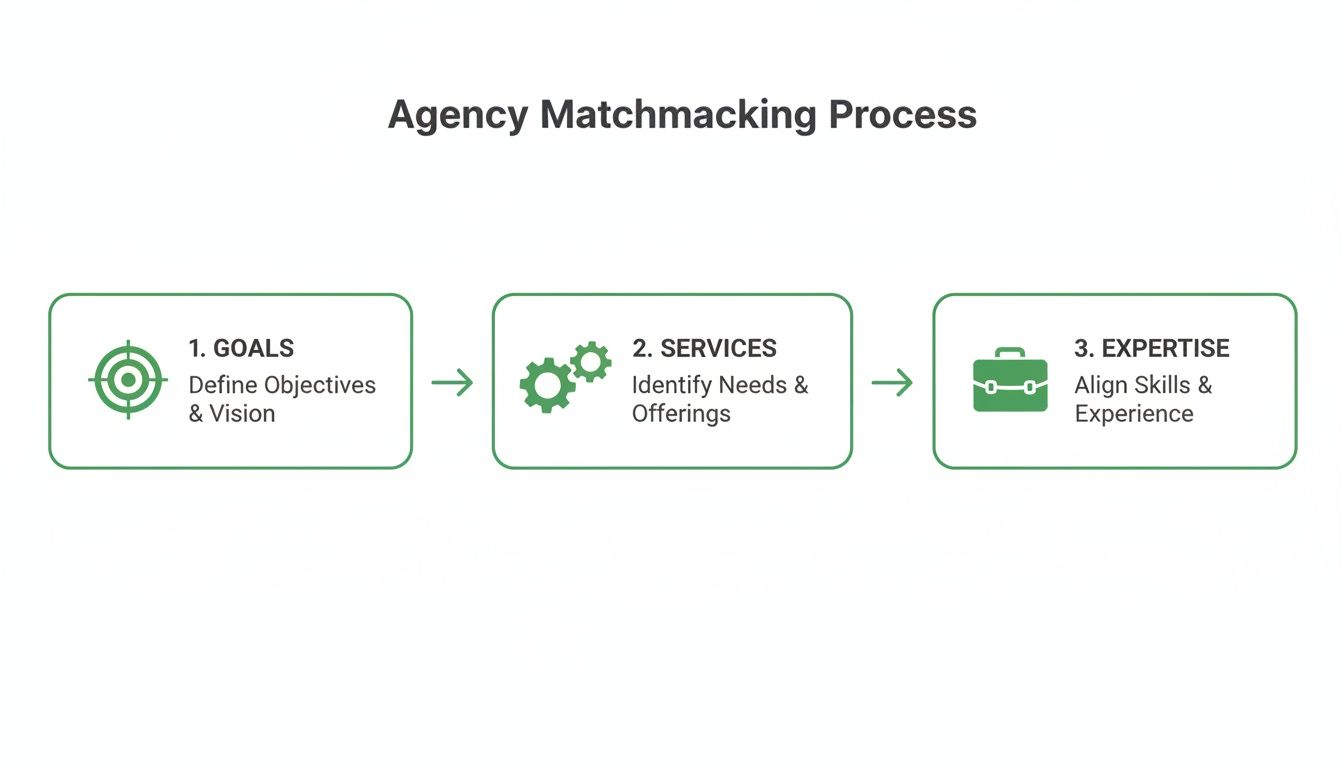
As you can see, a successful partnership starts with your own internal clarity and moves outward, making sure every choice is anchored to a real strategic need.
Ask Questions That Go Beyond the Pitch
Anyone can answer, “What are your prices?” But the answers to tougher questions reveal an agency’s true character, process, and resilience. Your discovery calls should feel less like a sales pitch and more like a friendly interrogation.
Here are the questions that will help you look under the hood:
- “Can you walk me through a campaign that failed? What did you learn from it?” This is my absolute favorite. An agency that can’t admit failure is one you can’t trust. You’re not looking for perfection; you’re looking for accountability, humility, and a commitment to learning when things don’t go as planned.
- “Who, specifically, will be working on my account? Can I meet them?” You’re not hiring a logo; you’re hiring a team of people. Don’t let yourself get wooed by the senior partners only to be handed off to a junior account manager once the ink is dry. An agency proud of its team will be happy to make those intros.
- “How do you handle communication and reporting when a campaign is underperforming?” This reveals their commitment to transparency. The best partners over-communicate when things get tough, providing analysis and a clear action plan. The wrong partners go quiet.
- “Based on our goals, what’s the first problem you’d want to tackle in the first 30 days?” This tests their strategic thinking on the spot. Do they jump straight to generic tactics, or do they show they’ve been listening and can identify the highest-impact starting point for your business?
How to Choose a Marketing Agency – Dissect Their Case Studies and Past Work
Case studies are an agency’s highlight reel, so you need to look at them with a critical eye. A good case study does more than just show off a flashy result—it tells a compelling story about how that result was achieved. To get a better sense of what to look for, you can see the breadth of solutions marketing agencies provide and check if their case studies align.
When reviewing their portfolio, ask yourself these three questions:
- Is the ‘Before’ State Relatable? Does the client’s initial problem sound a lot like the one you’re facing right now?
- Is the ‘After’ State Desirable? Are the results they achieved the exact kinds of outcomes you’re looking for? Don’t be wowed by a “150% increase in traffic” if your real goal is qualified leads.
- Is the ‘How’ Clearly Explained? The best case studies don’t just present impressive numbers. They explain the strategy, the process, and the specific actions that led to the outcome. If the “how” is vague, the results might not be repeatable.
A great case study proves two things: the agency achieved a result, and they understand why they achieved it. The first shows capability; the second shows mastery.
How to Choose a Marketing Agency – The Art of Checking References
Finally, don’t skip the reference check. It’s often the single most honest source of feedback you’ll get. But don’t just ask, “Were you happy with them?” That’s a softball question that won’t give you much insight.
Instead, ask targeted questions to get a real feel for the partnership:
- “What was their communication like on a day-to-day basis?”
- “Can you describe a time when there was a disagreement or a challenge? How did they handle it?”
- “What is the one thing they could have done better during your time together?”
- “What was the most valuable part of their service to your business?”
The answers will paint a vivid picture of what it’s truly like to work with the agency—the good, the bad, and the in-between. Getting this kind of unfiltered feedback is invaluable. If you feel your business could benefit from this level of deep analysis, consider starting with our free digital marketing audit services to get a baseline before you even start your search.
How to Choose a Marketing Agency – Decoding Agency Proposals and Pricing

This is the moment of truth. The proposals start hitting your inbox. One is a slick, 30-page novel packed with charts, while another is a simple one-pager that cuts right to the chase. So how do you compare these apples and oranges?
This is where you have to slice through the sales pitch and figure out what actually matters. A great proposal isn’t just a price tag; it’s a blueprint for the partnership. It needs to show that the agency didn’t just hear your goals—they genuinely understood them. And if it feels like a copy-paste template, it probably is.
Getting this part right is what separates a smart hire from a costly mistake. It takes the guesswork out of the equation so you can make a decision based on substance, not just the slickest presentation.
What a Good Proposal Actually Contains
Don’t get distracted by flashy graphics or bloated documents. A truly valuable proposal is built on substance, not fluff. It should feel like a direct response to your discovery calls, hitting on the specific challenges and ambitions you discussed.
Here’s your checklist:
- A Clear Grasp of Your Goals: The proposal should lead by re-stating your objectives in their own words. This is the first and most important test—it proves they were actually listening.
- A Defined Strategy: It needs to outline the “how” and “why” behind their approach. A good agency doesn’t just throw a list of tactics at you; they connect each action back to a specific goal you defined.
- Specific, Tangible Deliverables: Vague promises are a massive red flag. The proposal must clearly list what you’re paying for—things like “12 optimized blog posts per quarter,” “a monthly PPC ad spend of $5,000,” or “one comprehensive SEO audit.“
- Realistic Timelines: Look for a high-level timeline or a 30-60-90 day plan. This shows they’ve thought through the execution and helps set clear expectations from day one.
- Key Performance Indicators (KPIs): How will you know if it’s working? A strong proposal will define the exact metrics that matter, whether it’s Cost Per Lead, Conversion Rate, or Return on Ad Spend (ROAS).
If any of these key pieces are missing, it’s a sign that the agency’s process might be just as disorganized as their proposal. A lack of clarity upfront almost always leads to frustrating and expensive problems later on.
How to Choose a Marketing Agency – Understanding the Different Pricing Models
Agency pricing can feel all over the map, but most models fall into one of three buckets. Each has its pros and cons, and the best one for you comes down to your needs and cash flow.
Let’s break them down.
- Monthly Retainer: The most common model you’ll see. You pay a fixed fee each month for an agreed-upon scope of work. It’s predictable for budgeting and works perfectly for ongoing, long-term efforts like SEO and content marketing.
- Project-Based Fee: This is a one-time fee for a specific, well-defined project, like a website redesign or a new brand launch. It’s great when you have a clear start and end date. The only catch? Scope creep can get expensive fast if you don’t manage it carefully.
- Performance-Based Pricing: This is where the agency’s pay is tied directly to the results they generate—think a percentage of revenue or a fee per lead. It sounds like a dream, but these deals are complex to structure and often require a higher base fee to offset the agency’s risk.
There’s no single “best” model—the right fit depends on your goals. For steady, compounding growth, a retainer is often best. For a singular, defined need, a project fee makes more sense.
How to Choose a Marketing Agency – Create a Scorecard to Compare Objectively
It’s human nature to gravitate toward the prettiest proposal or the friendliest salesperson. You need a system to fight that bias. A simple scorecard forces you to compare each agency using the same exact criteria, making your choice objective and rooted in data.
Here’s a simple template you can adapt. Just rate each category from 1 (poor) to 5 (excellent) for your top contenders.
Agency Scorecard Template
This simple exercise will help you look past the fluff and score each agency based on what truly matters for your business.
| Evaluation Criteria | Agency A (Score 1-5) | Agency B (Score 1-5) | Agency C (Score 1-5) | Notes |
|---|---|---|---|---|
| Understanding of Our Goals | ||||
| Strategic Approach | ||||
| Relevant Case Studies | ||||
| Clarity of Deliverables | ||||
| Pricing & Value | ||||
| Team & Expertise | ||||
| Cultural Fit & Communication | ||||
| TOTAL SCORE |
This exercise instantly cuts through the noise. It helps you quantify your gut feelings and gives you a clear, defensible reason for your final decision. The agency with the highest score isn’t automatically the winner, but this process will highlight the strengths and weaknesses you might have otherwise missed.
How to Choose a Marketing Agency – Spotting Red Flags Before You Sign
You’re close. You’ve gone through proposals, scored the agencies, and one is pulling ahead of the pack. But this is the absolute worst time to let your guard down. Now is when you need to be extra vigilant, because the small details you notice now can become major headaches later.
This is where you have to trust your gut. If something feels even a little off during these final stages—it probably is. This final check is all about mitigating risk and making sure you’re not just signing a contract, but starting a true partnership built on trust.
The Big Promises That Should Make You Nervous
Be deeply skeptical of any agency that guarantees specific outcomes, especially in channels like SEO. If you hear phrases like “guaranteed page-one rankings in 90 days” or “we’ll double your leads overnight,” you should run, not walk, in the other direction.
Marketing isn’t a vending machine where you put money in and a guaranteed result pops out. It’s a dynamic process influenced by market shifts, competitor moves, and algorithm updates completely out of anyone’s control.
A confident, experienced agency will talk about:
- Benchmarks and Forecasts: They’ll show you what’s possible based on data, not iron-clad promises.
- A Disciplined Process: They’ll commit to a rigorous process of research, smart execution, and constant optimization.
- Transparent Measurement: They’ll focus on tracking what matters and being honest about what’s working—and what isn’t.
Guarantees are a sales tactic, not a strategy. The best partners promise a rigorous process and transparent reporting, not a specific, uncontrollable outcome.
How to Choose a Marketing Agency – Vague Strategies and Cookie-Cutter Solutions
One of the most telling red flags is the “one-size-fits-all” approach. If an agency jumps straight to a pre-packaged solution without digging deep into your business, your audience, and your unique challenges, they aren’t a strategic partner. They’re just a tactic reseller.
This usually shows up as a generic-feeling proposal or a conversation where they talk more about their services than your problems. A true partner leans in. They ask sharp questions. They want to understand the nuances of your business because they know that’s where the real opportunities are found.
In today’s market, multi-channel expertise is vital. A whopping 75% of marketers now use more than five distinct channels to connect with their audience. With global digital marketing spend projected to top $800 billion by 2026, you need a partner who can show real ROI across the channels that matter to you. For example, can they explain the performance difference between a standard email campaign (averaging a 1.29% CTR) and a finely tuned automated flow (which can see a 4.67% CTR)? For more insights, check out these digital marketing statistics.
How to Choose a Marketing Agency – High-Pressure Sales Tactics and Zero Transparency
This one is simple. The best partnerships are built on mutual respect and alignment, not on cheap sales tricks.
Watch out for these classic moves:
- Artificial Urgency: Phrases like “this offer expires today” or “we only have one spot left” are designed to rush you into a decision before you’ve done your homework. A great agency will always respect your timeline.
- The Bait-and-Switch Team: You have incredible calls with the senior partners, but the proposal is mysteriously vague about who will actually be doing the work. Insist on knowing who your day-to-day contact will be and what their experience is. You’re hiring a team, not just a logo.
- Hidden or Confusing Pricing: If you can’t get a straight answer on how they charge, what’s included, or how they handle out-of-scope requests, that’s a massive problem. Financial surprises are one of the fastest ways to destroy trust.
Ultimately, this comes down to a simple gut check. Good partners make you feel confident and informed. The wrong ones make you feel pressured and uncertain. Don’t ignore that feeling—it’s your best defense against making a costly mistake right at the finish line.
Common Questions About Hiring an Agency
You’ve made it this far, which tells me you’re taking this decision seriously. Good. Even with a solid framework, a few nagging questions always pop up—especially if this is your first time bringing on a marketing partner.
Let’s tackle some of the most common ones I hear from business owners who are right where you are now.
How Long Should I Expect to Wait for Results?
This is the big one, and the only honest answer is: it depends. Anyone promising you immediate, overnight success is selling you a fantasy. Real marketing momentum is built over time, not flipped on like a light switch.
Here’s a realistic (but general) timeline to set your expectations:
- PPC and Paid Social: You can often see initial data and even some leads within the first 30-90 days. This period is all about testing—finding the right creative, audiences, and bids. It’s about learning what works, fast.
- SEO and Content Marketing: This is a long-term investment, plain and simple. You should start seeing early positive signs, like ranking for longer-tail keywords, in about 4-6 months. More significant, business-driving results often take 6-12 months or more to fully kick in.
Think of it like planting a garden. Paid ads are like fast-growing annuals—you get color pretty quickly. SEO, on the other hand, is like planting an oak tree. It takes time, but the payoff is enormous and built to last.
What’s a Reasonable Marketing Budget?
This is impossible to answer without knowing your goals, your industry, and how fierce your competition is. A better question to ask is, “What am I willing to invest to achieve my goals?”
A small local business might see great results with $2,500 – $5,000 per month, which includes agency fees and ad spend. But a national e-commerce brand or a B2B company in a crowded space might need to invest $15,000 – $50,000+ per month just to move the needle.
Don’t focus on finding a “cheap” agency. Focus on finding one that can deliver the best ROI for the budget you actually have.
The right agency won’t just spend your money. They will invest it strategically, treating every dollar as if it were their own and focusing on the activities that drive the highest possible return for your business.
Agency vs. Freelancer vs. In-House: What’s the Difference?
This is a critical strategic decision, and each option has its place. It really boils down to your needs for expertise, scope, and resources.
- Freelancer: Perfect for a specific, well-defined task. Need a great copywriter for a one-off website project? Hire a freelancer. They’re specialists but usually lack the broad strategic oversight of an agency.
- In-House Hire: An excellent choice when marketing is a core, daily function of your business. This gives you total control and deep institutional knowledge, but it’s expensive, and finding one person who’s a true expert in everything is nearly impossible.
- Agency: The best move when you need a diverse team of specialists—an SEO expert, a PPC analyst, a content strategist, a designer—without the massive cost and headache of hiring them all full-time. You get an entire team for roughly the price of one or two senior hires.
Choosing the right partner is all about finding the model that best fits your current stage of growth and your specific business objectives.
Ready to stop guessing and start growing? The team at Mr. Green Marketing, LLC combines data-driven strategy with expert execution to help businesses like yours stand out online. Request your free audit and performance report today.
Leave a Comment
sing in to post your comment or sign-up if you dont have any account.