
Digital Marketing Strategy For Startups! A digital marketing strategy for startups isn’t about having a massive war chest. It’s a focused, data-driven plan that uses budget-conscious tactics to win customers and grow efficiently. Really.
And think of it less as a rigid manual and more as a nimble game plan. You’ll be testing channels like SEO and social media, obsessively measuring what moves the needle, and quickly pivoting to double down on what works.
Why Your Startup’s Marketing Playbook Must Be Different

Let’s get one thing straight right away: building a marketing strategy for a startup today is a completely different ballgame than it was even a few years ago. You can’t just “boost posts” and cross your fingers.
We’re all playing in a new arena now—one where being the smartest with every single dollar beats having the biggest budget. It’s all about building a foundation that doesn’t just chase vanity metrics but actually creates a sustainable customer acquisition machine from day one.
1. Ditch the Big Brand Playbook
Copying a big corporation’s marketing strategy is the fastest way to burn through your runway. A fatal mistake. Established companies can afford to spend millions on broad brand awareness campaigns because they have years of market presence and deep pockets.
Startups simply don’t have that luxury.
Your playbook has to be different for a few critical reasons:
- Limited Budget: Every dollar you spend must be accountable. And the focus has to be on channels that deliver a measurable—and profitable—return on investment (ROI), not just impressions.
- Need for Speed: You don’t have years to wait for results to roll in. Your strategy needs to balance long-term foundational work (like SEO) with quick-win tactics that generate immediate data and traction.
- No Brand Recognition: Let’s be honest, nobody knows who you are yet. Your marketing has to do all the heavy lifting of building trust, educating the market, and proving your value—all at the same time.
To thrive, your startup needs a distinct approach to growth. Understanding proven strategies for growing an online business gives you the crucial context for why a unique playbook is non-negotiable.
2. Recognize That Attention is Finite
The digital world is getting more crowded and more expensive by the day. Simply throwing money at ads is a losing game when you realize that human attention is the scarcest resource.
Recent data shows a troubling trend for anyone relying on old tactics—engagement is dropping across major social platforms. For a startup, paying more each quarter for fewer clicks is a recipe for disaster. This is where a sharp strategy becomes your most valuable asset.
Shockingly, a huge chunk of marketing budgets—up to 30%—is still wasted on ineffective activities, according to surveys of global marketers. Eliminating that waste can be the difference between a profitable Customer Acquisition Cost (CAC) and a failed growth experiment.
Your goal isn’t just to be seen; it’s to be chosen. This requires a shift from ‘spray and pray’ marketing to a disciplined cycle of ‘test, measure, pivot.’ It means being obsessed with data and ruthless with your focus.
Build Your Foundation Before Spending A Dime

Look, before you even think about logging into an ad platform or writing a single line of copy, we need to get the story straight. This part is non-negotiable.
So many startups get this wrong. They rush into spending money, excited to get their product out there, but they skip the most critical step. It’s like trying to build a house on a shaky foundation—expensive, messy, and guaranteed to fail.
This discovery work isn’t just fluffy branding exercises; it’s the raw intelligence that will fuel every marketing decision you make. What problem do you actually solve? Who are you solving it for? And why should they care enough to stop scrolling and pay attention?
3. Nail Your Unique Selling Proposition
Your Unique Selling Proposition (USP) is the one thing that makes you the only logical choice for your ideal customer. It’s not just a list of cool features. It’s the piercingly clear answer to the question, “Why should I pick you over every other option, including just doing nothing?”
A weak USP sounds like this: “We sell high-quality, affordable widgets.” A strong one sounds like this: “We’re the only widget maker that offers a lifetime guarantee and 24/7 support, so you never have to worry about downtime again.”
See the difference? One is a bland description; the other is a powerful promise that addresses a real fear.
To find your USP, get brutally honest with these three questions:
- What does my product do that nobody else’s does? Be specific and unforgiving.
- What deep pain point does that solve for my customer? Think about their emotions, not just the function.
- Can I actually prove it? This is where social proof, data, and guarantees come into play.
Your USP becomes the north star for your messaging, from your website headline all the way to your ad creative.
A great USP isn’t about being different just for the sake of it. It’s about articulating a specific value that your target audience desperately needs and can’t easily find elsewhere. It’s your competitive moat.
This core message is also vital for your SEO. A clear value proposition helps search engines understand what you’re about, which is a key part of our guide on how to rank #1 on Google. Getting your on-site messaging right can have a direct impact on your visibility.
4. Build Personas That Actually Work
Now that you know what you’re saying, you need to figure out who you’re saying it to. And I don’t mean some vague demographic like “Millennials in urban areas.” Completely useless for marketing.
We’re talking about building customer personas that are so real you could almost grab a coffee with them. A good persona digs deep into the psychographics—the human stuff that drives decisions.
We need to understand their world:
- Pain Points: What keeps them up at night? What are the little frustrations in their day that your product can solve?
- Motivations: What are their biggest goals and dreams? What does success look like for them?
- Watering Holes: Where do they really spend their time online? Is it a specific subreddit, a few LinkedIn groups, TikTok, or a niche industry forum?
- Language: What jargon do they use? How do they describe their problems in their own words?
You don’t need expensive tools to get this information. Just start talking to people.
- Interview 5-10 of your perfect customers (or potential ones). Ask open-ended questions and just listen.
- Send out a simple survey. Use Google Forms and offer a small gift card as an incentive.
- Lurk on social media. Go to those “watering holes” and read the comments. A goldmine of raw, unfiltered customer language.
Going through this process turns your marketing from shouting into a void into having a meaningful one-on-one conversation. Every piece of content, every ad, and every email will feel like it was written just for them—because, thanks to this groundwork, it was.
Use this simple checklist to make sure you’ve covered your bases before moving on. Skipping these steps is the fastest way to waste your marketing budget.
Digital Marketing Strategy – Startup Discovery & Persona Checklist
| Discovery Step | Key Question to Answer | Why It Matters |
|---|---|---|
| USP Definition | What single, compelling promise can we make that our competitors can’t? | This is the core of your messaging and your primary defense against competition. |
| Problem/Solution Fit | What specific pain point are we solving, and is it a “hair on fire” problem? | Your marketing has no power if you’re selling a solution to a problem nobody cares about. |
| Ideal Customer Profile | Who feels this pain most acutely and has the ability to pay for a solution? | This focuses your efforts on the people most likely to buy, saving you time and money. |
| Psychographics | What are their goals, fears, and motivations related to our product? | This helps you write copy that connects emotionally, not just logically. |
| Online Behavior | Where do they hang out online to learn and share information? | This tells you exactly which marketing channels to prioritize and which to ignore. |
| Customer Language | What specific words and phrases do they use to describe their problem? | Using their language makes your marketing feel authentic and builds instant trust. |
Completing this table with real, data-backed answers gives you a powerful strategic advantage. You’ll know who to target, what to say, and where to say it—the three pillars of any successful marketing campaign.
Digital Marketing Strategy – Choose Your Battleground Wisely
Here’s a secret that could save you a small fortune: you don’t have to be everywhere. In fact, you absolutely shouldn’t be. So many founders fall into the trap of trying to have a presence on every single platform, spreading their limited resources so thin they make zero impact anywhere.
This isn’t about chasing whatever’s trending this week. It’s about relentless focus. Pick one or two battlegrounds where you know your ideal customers are congregating and go all-in to win there first. And only after you’ve established a beachhead should you even think about expanding.
5. Find Your Primary Channel
Instead of a generic list of platforms, let’s use a framework for deciding which channels give you the best leverage for your startup. The right choice depends entirely on your business model, your customer, and your product.
A B2B SaaS company selling complex software will find its home in a different corner of the internet than a direct-to-consumer brand selling a fun, visual product.
- For B2B SaaS Startups: Your best friends are long-form content and targeted SEO. Your customers are looking for solutions to complex problems, meaning they are actively searching for in-depth articles, guides, and whitepapers. Dominating search results for high-intent keywords is a powerful, long-term moat.
- For D2C E-commerce Brands: The game is often more visual and immediate. Platforms like Instagram, TikTok, and Pinterest are where your customers discover new products. And this is the world of performance marketing, influencer collaborations, and authentic, user-generated content.
- For Local Service Businesses: Your world is hyperlocal. Dominating your Google Business Profile, collecting reviews, and running geo-targeted ads on Facebook are non-negotiable. Your battleground is a five-mile radius, not the entire internet.
This focus allows you to become an expert in the nuances of a single channel. You learn its algorithm, its culture, and what kind of creative truly resonates.
The goal isn’t to be a jack-of-all-trades. It’s to be a master of one. Find the single channel where you have an unfair advantage—whether it’s deep industry knowledge for content or a uniquely visual product for social—and dominate it.
Digital Marketing Strategy – SEO and Content Marketing: The Long Game
For many startups, especially in B2B, Search Engine Optimization (SEO) and content marketing are the ultimate engines of sustainable growth.
Why? Because they create assets that appreciate over time. An ad stops working the second you stop paying for it. And a blog post that ranks on page one can bring in qualified leads for years.
This approach centers on solving your audience’s problems through valuable content. Think of it as attracting customers with a magnet instead of chasing them with a net. The data backs this up. In 2024, organic channels like websites and blogs were among those with the highest marketing ROI. As the content marketing industry grows, the game is changing. By 2026, analysts expect most searches to be at least partially answered by AI summaries, which pushes startups to optimize for what’s being called GEO (SEO for AI).
Your content needs to be so credible and machine-readable that AI systems cite it directly. Discover more about how digital marketing is evolving in these marketing statistics from seoprofy.com.
Digital Marketing Strategy – PPC and Paid Social: The Accelerator
What if you need data and results now? That’s where paid channels come in. Pay-Per-Click (PPC) advertising on platforms like Google or paid social ads on Facebook and LinkedIn can act as a powerful accelerator.
Paid channels are not about blindly boosting posts—that’s a great way to burn money. They are a tool for precision targeting and rapid testing.
Here’s how a smart startup uses paid ads:
- Test Messaging: Quickly find out which value propositions and headlines resonate with your audience by running small A/B tests.
- Validate Personas: Target your ads to different customer segments to see which one converts at the most efficient cost.
- Drive Immediate Traffic: Send highly qualified visitors to a new landing page or product launch to gather data and generate initial sales.
Think of it as paying for speed and data. The key is to have a crystal-clear objective for every dollar you spend. If you want to dive deeper into getting started, check out our guide on how PPC marketing can work for your business.
Digital Marketing Strategy – The Power of Email Marketing
Finally, regardless of which primary channel you choose to attract customers, email marketing is the channel you use to keep them. It’s the only direct line of communication you truly own. You’re not at the mercy of an algorithm change.
Building an email list from day one is one of the smartest moves any startup can make. It’s your owned audience—a group of people who have explicitly raised their hand and said they want to hear from you.
Use it to nurture leads, share valuable content, announce new features, and build a loyal community around your brand. It’s cheap, effective, and delivers one of the highest ROIs in marketing. Don’t neglect it.
Digital Marketing Strategy – Your First 90 Days: A Practical Marketing Roadmap
Theory is great. But execution is what separates a startup that makes it from one that becomes another statistic. This section lays out a tangible 90-day roadmap to turn your strategy into real-world action.
Don’t think of this as some rigid, one-size-fits-all plan you have to follow to the letter. It’s a flexible framework—a blueprint you can adapt to your specific needs without getting completely overwhelmed. We’ll break it down into three focused 30-day sprints.
This simple process flow shows how core marketing activities like SEO, Content, and PPC work together to create a growth engine for your startup.
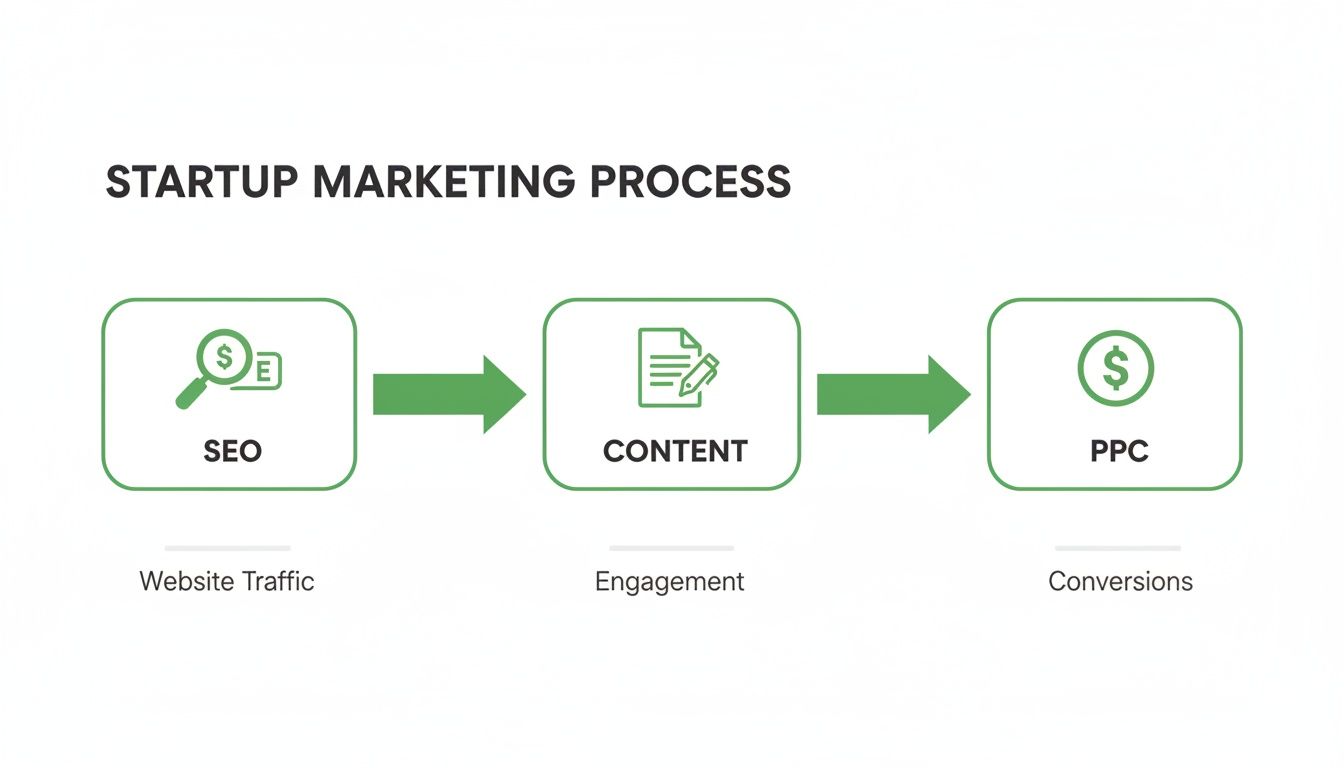
The key takeaway is that these channels aren’t silos. They should feed each other to build momentum and drive the conversions your startup needs to survive and thrive.
6. Execute Your First 90-Day Sprint
To make this even more concrete, here’s a sample roadmap outlining what those first three months could look like. Think of this as a starting point—your actual priorities might shift based on your industry and initial results, and that’s perfectly okay.
| Phase | Focus | Key Actions | Primary Goal |
|---|---|---|---|
| Days 1-30 | Foundation & Quick Wins | • Install Google Analytics 4 with conversion tracking. • Claim social media handles & Google Business Profile. • Launch one small-scale paid ad campaign. |
Establish a baseline and gather initial user data. |
| Days 31-60 | Momentum & Asset Building | • Analyze Month 1 data and refine ad campaigns. • Publish first pillar blog post. • Start building an email list. |
Create core marketing assets and begin iterating based on real feedback. |
| Days 61-90 | Scaling & Systemization | • Double down budget/effort on the top-performing channel. • Build a content calendar around the winning pillar post. • Develop a repeatable process for customer acquisition. |
Create a predictable, scalable marketing engine for consistent growth. |
This sprint-based approach keeps you focused on what matters most at each stage, preventing you from trying to do everything at once and accomplishing nothing.
Month 1: The Foundation And Quick Wins (Days 1-30)
The first month is all about getting your house in order and generating your first trickles of data. We’re not trying to boil the ocean here. The goal is focused, foundational work that will pay off massively down the road.
Your priorities should be crystal clear.
First, get your analytics set up correctly so you can actually trust the numbers you see. Then, claim all your social media profiles—even if you don’t plan to use them all right away—to secure your brand handle before someone else does.
Finally, you’ll launch one “low-hanging fruit” campaign. This isn’t about hitting a home run. It’s about getting valuable data flowing so you can make smarter decisions in month two.
- Set Up Analytics: Install Google Analytics 4 correctly and, most importantly, set up conversion tracking for key actions like form submissions or free trial sign-ups. You can’t improve what you don’t measure.
- Secure Your Digital Footprint: Claim your brand name on all relevant social platforms (LinkedIn, X, Instagram, Facebook, TikTok). Create a complete Google Business Profile if you have any local component at all.
- Launch One Test Campaign: This could be a small Google Ads campaign targeting a few high-intent keywords or a hyper-targeted Facebook ad campaign aimed at one of your core personas. The goal is learning, not scaling.
Month 2: Building Momentum (Days 31-60)
Now that you have a foundation and some initial data, month two is about building on that momentum. You’ve learned something from your first campaign—maybe a specific message resonated, or one audience segment was way more responsive. Time to put that intelligence to work.
This is where you start creating your first real marketing assets.
The focus shifts from pure setup to content creation and refinement. This is where you might write your first pillar blog post—a substantial piece of content designed to rank for a core keyword. You’ll also start tweaking your ad campaigns based on what you learned in the first 30 days.
The second month is where the feedback loop truly begins. You’re not just guessing anymore; you’re making informed hypotheses based on real user behavior and iterating to improve performance. This is the heart of a nimble startup marketing approach.
This is also the perfect time to start your email list. Add a simple signup form to your website with a compelling reason for people to subscribe, like a free checklist or guide. Even if you only get a few subscribers a day, you’re building an asset you completely own.
Month 3: Scaling What Works (Days 61-90)
Welcome to month three. By now, you should have a much clearer picture of what’s working and what isn’t. One channel is likely outperforming the others, whether it’s organic search, a specific social platform, or your paid ads.
This final sprint is all about scaling and systemizing. Time to pour gasoline on the fire.
You’ll double down on the winning channel. Did that pillar blog post start getting some traction? Build out a content calendar with related “spoke” topics. Are your Google Ads profitable? Carefully increase the budget and expand your keyword list. If you need fresh ideas to keep the momentum going, exploring various digital marketing strategies for small business can spark inspiration for your next move.
The ultimate goal is to establish a repeatable process for growth. By day 90, you should have a system—a marketing engine that you can consistently fuel to acquire new customers. You’ve officially moved from chaos to a structured, data-driven operation.
Measure What Matters Without Drowning in Data
This is where so many startups trip up. Vanity metrics will absolutely kill your business. Seriously.
Thousands of likes, clicks, and impressions feel great—they give you a nice little dopamine hit—but they don’t pay the bills. Clicks don’t equal customers. Likes don’t equal revenue. It’s time to get brutally honest about the Key Performance Indicators (KPIs) that actually signal business health.
The goal is to cut through the noise and build a simple, powerful feedback loop. You launch something, you measure its true impact on the business, and you make a smarter decision next time. That’s how you build a real data-driven marketing engine, not just a marketing department that makes pretty charts.
7. Move Beyond Vanity Metrics
First, let’s clearly define the enemy. Vanity metrics are the numbers that are easy to measure and look impressive on the surface, but they offer zero real insight into your startup’s performance or profitability.
Obsessing over them is like rearranging deck chairs on the Titanic. It keeps you busy, but it does absolutely nothing to solve the real problems.
Here are the common culprits to watch out for:
- Total Page Views: High traffic is great, but it’s worthless if those visitors bounce immediately and never come back.
- Social Media Follower Count: A huge following doesn’t automatically translate to sales, especially if most of them aren’t even your ideal customers.
- Number of Email Subscribers: A massive list means nothing if your open rates are in the single digits and nobody ever clicks through.
These numbers aren’t completely useless—they can indicate top-of-funnel awareness—but they are not the metrics that should drive your strategy.
Digital Marketing Strategy – KPIs That Actually Pay the Bills
So, what should you obsess over instead? Actionable metrics. These are the numbers that tie directly to your business goals, like generating revenue and acquiring customers you can actually profit from. And they tell a story about what’s working and what’s a complete waste of money.
Let’s break them down by their place in the funnel.
Digital Marketing Strategy – Top of Funnel (Awareness & Discovery)
This is all about getting on your ideal customer’s radar. Instead of just “traffic,” we need to look at the quality of that traffic.
- Organic Traffic & Keyword Rankings: How many people find you through search engines for terms that matter? A steady climb here means your SEO is building a long-term, valuable asset.
- Share of Voice (SOV): How visible is your brand in the market compared to your competitors? It’s a bit more advanced but gives you a true sense of your market presence.
- Branded Search Volume: Are people searching for your company name directly? This is a fantastic indicator that your brand recognition is growing.
Middle of Funnel (Consideration & Engagement)
Okay, they know you exist. Now, are they actually interested in what you have to offer?
- Conversion Rate (by channel): What percentage of visitors take a specific action, like signing up for a newsletter or starting a free trial? Track this for each channel (organic, paid, social) to see where your best leads come from.
- Lead-to-Customer Rate: Of all the leads you generate, what percentage actually become paying customers? This tells you everything about the quality of your leads.
- Cost Per Lead (CPL): How much are you spending to get one qualified lead? You have to know this number to manage your ad spend effectively.
Bottom of Funnel (Conversion & Revenue)
This is where the rubber meets the road. Honestly, these are the two metrics every founder should have tattooed on their brain.
Customer Acquisition Cost (CAC): The total cost of sales and marketing to acquire one new customer. You get this by dividing your total spend by the number of new customers you brought in over a specific period.
Lifetime Value (LTV): The total revenue you can reasonably expect from a single customer over their entire relationship with your business. For a SaaS company, this might be the average monthly revenue multiplied by the average customer lifespan.
Your entire business model lives or dies by the relationship between these two numbers. A healthy startup has an LTV that is at least 3x its CAC. If it costs you $300 to acquire a customer who will only ever spend $150 with you… well, you have a very expensive hobby, not a business.
To make sure your content efforts are actually delivering value without getting lost in spreadsheets, having a clear framework for measuring content marketing ROI is essential. It helps you connect the dots between the articles you publish and the revenue they generate.
Digital Marketing Strategy – Common Founder Questions, Answered
I get it. You’re building a product, hiring a team, and trying to steer the ship, all while figuring out how to get your first customers. It’s a lot.
Over the years, I’ve heard the same handful of questions from founders trying to navigate the marketing maze. Here’s some straight talk based on years in the trenches—no fluff, just what actually works.
Digital Marketing Strategy – How Much Should We Even Be Spending on Marketing?
This is the big one, and the honest answer is… it depends. You’ll hear benchmarks like 10-20% of revenue, but those numbers are almost useless when you’re just starting out.
Forget the benchmarks for a second. The real, smarter answer is this: start small.
Your first goal isn’t to hit some arbitrary spending target. It’s to find a profitable Customer Acquisition Cost (CAC). And you need to test a few channels with a tiny budget, get hard data on what it costs to land one customer, and only then do you start scaling the winners. Don’t commit a big budget until you have that proof.
Digital Marketing Strategy – Should I Hire an Agency or Build an In-House Team?
Hiring your first marketer is a huge step. Get it right, and you accelerate. Get it wrong, and you burn precious time and capital.
Early on, it’s almost always more capital-efficient to work with a specialized freelancer or a small, focused agency. Why? Because you get instant access to deep expertise in a specific channel—like PPC or SEO—without the massive overhead of a full-time salary, benefits, and training. It’s expertise on demand.
The time to bring marketing in-house is after you have a proven, repeatable channel. Once you know that, say, content marketing is your golden goose, you hire someone to own and scale that specific function.
What’s the Single Most Important Thing We Should Be Doing?
With a million things to do, what’s the one thing you absolutely cannot skip? It’s not launching an ad campaign. It’s not trying to create a viral video.
It’s talking to your customers.
Before you spend a single dollar on ads, your most critical marketing activity is to deeply, obsessively understand your user’s pain points. This customer intelligence is the bedrock of everything else.
- Effective messaging? It comes from using their exact language.
- High-converting ads? They speak directly to a frustration they’ve told you about.
- Content that actually ranks? It answers the questions they are already asking.
Everything else comes second. Customer obsession is your greatest competitive advantage, and best of all, it’s free. Treat every customer conversation like a gold-mining expedition, because for your marketing strategy, that’s exactly what it is.
Leave a Comment
sing in to post your comment or sign-up if you dont have any account.