
What Does a Digital Marketing Agency Do? You’re probably here because marketing has started leaking into every part of your week.
A campaign needs attention. The website needs updates. Leads are coming in, but not enough of them. Or they’re the wrong leads. You post on social media when you can, boost a few posts, maybe test Google Ads, then try to make sense of rankings, conversion rates, and what your competitors are doing better.
That’s usually the point where a business asks an important question. Not “how do I post more?” but what does a digital marketing agency do, exactly, and do I need one?
The short answer is this. A good agency helps a business turn scattered marketing activity into a coordinated system built to generate leads, sales, and repeatable growth. Not just more noise online. Better outcomes.
What Does a Digital Marketing Agency Do? Your Business Is Growing But Are You Overwhelmed
Growth creates a strange kind of pressure.
You wanted more visibility, more inquiries, more opportunities. Then it arrived, and now your team is trying to answer leads, fulfill work, manage staff, and somehow keep the marketing machine moving too. Social posts get rushed. The website sits half-finished. Ads run longer than they should because nobody has time to review search terms, landing pages, or conversion paths.
And that is a common breaking point. Not because the business lacks demand, but because marketing became a side job for people who have a real job.

A digital marketing agency steps in when that DIY approach stops being efficient. It gives the business a team that can handle strategy, execution, reporting, and course correction without dragging the owner into every tactical detail.
The timing matters because the market is not slowing down. The digital marketing industry is projected to reach $786.2 billion by 2026, with digital channels capturing 72% of total marketing budgets, and 63% of businesses have recently increased digital spend, according to Insivia’s 2025 digital marketing statistics roundup. If more companies are putting more money into digital channels, sloppy execution gets expensive fast.
What overwhelm looks like in practice
A local service company often has this pattern:
- Leads come inconsistently: One month feels strong, the next goes quiet.
- The website exists but does not sell: It looks acceptable, but visitors do not know what to do next.
- Ad spend lacks control: Campaigns run, but nobody is sure which keywords or audiences are producing real customers.
- Marketing depends on one exhausted person: Usually the owner, office manager, or a junior marketer with too many responsibilities.
An agency changes that by creating structure. Clear priorities. A reporting rhythm. Actual ownership.
A business usually does not hire an agency because it wants “marketing.” It hires one because it wants predictable lead flow, stronger sales support, and less wasted time.
Why this moment matters
When a company waits too long, it keeps paying hidden costs.
It wastes budget on channels that are not aligned. It sends traffic to weak pages. It measures activity instead of outcomes. And, yes, this part gets missed a lot, internal teams start resenting marketing because it feels busy but not useful.
A strong agency partner removes that drag. The best ones do not just add tactics. They make the whole system easier to run.
So What Is a Digital Marketing Agency Exactly
A digital marketing agency is an external growth partner that helps a business attract attention online and convert that attention into revenue.
That sounds broad because the work is broad. But the role is specific. An agency studies the business, identifies the most valuable channels, builds a plan, executes it with specialists, and keeps improving it based on performance.
Consider this: A good agency is part architect, part operator.
The architect side defines the blueprint. Which audiences matter. Which offers should lead. Which channels deserve budget. Which pages need to rank, convert, or support sales.
The operator side handles the work. SEO, paid ads, landing pages, content, analytics, creative, reporting, testing. The stuff that must happen every week if marketing is going to produce business results.
More than a vendor
A weak agency acts like an order taker.
“Need social posts?” They make posts.
“Need ads?” They launch ads.
“Need SEO?” They add keywords to title tags and send a report.
That is not real partnership. That is task fulfillment.
A serious agency asks harder questions first:
- What are you trying to grow?
- Which offer drives the best margins?
- Where do leads stall before they become customers?
- Is the sales process strong enough to support paid traffic?
- Does the website help conversion or hinder it?
Those questions matter because digital marketing is not one channel. It is a connected system. If the search campaign is strong but the landing page is weak, lead quality suffers. If content is good but the website is slow or confusing, rankings alone will not save it. If social engagement rises but the offer is fuzzy, traffic will not turn into pipeline.
What an agency brings that one hire usually cannot
An in-house marketing manager can be excellent. Many are. But one person rarely covers every discipline at a high level.
A typical agency engagement gives a business access to several functions at once:
- Strategic planning: Market positioning, channel selection, offer development, campaign structure
- Technical execution: Site fixes, analytics setup, tracking, SEO implementation
- Creative production: Copywriting, design, video, ads, brand assets
- Media management: Google Ads, paid social, retargeting, budget allocation
- Performance analysis: Dashboards, attribution review, optimization decisions
That mix matters because growth problems are rarely isolated. They usually cut across website experience, messaging, channel choice, and follow-up.
The difference between activity and progress
This is the distinction most business owners care about once they have been burned.
An agency should not just “do marketing.” It should help answer practical questions like:
| Business question | What the agency should do |
|---|---|
| Why are leads inconsistent | Audit channels, seasonality, conversion paths, and demand capture gaps |
| Why is traffic not turning into calls or sales | Review pages, forms, offers, UX friction, and message match |
| Where should budget go first | Prioritize the channels closest to revenue or fastest to validate |
| What should happen next month | Present a clear plan with owners, timing, and expected direction |
And that is the core answer to what a digital marketing agency does. It turns disconnected tools and tactics into a managed growth program.
If an agency cannot explain how its work connects to leads, sales, retention, or margin, it is probably selling tasks instead of results.
What Does a Digital Marketing Agency Do? The Core Services That Drive Growth
Most agencies offer similar labels. SEO. PPC. Social. Web design. Content. Email. Analytics.
The difference is not the menu. It is whether those services work together.
According to the 2025 Digital Agency Industry Report from Promethean Research, web development is offered by 69% of agencies and web design by 67%, while higher-performing firms increasingly blend those foundations with SEO and paid media. The same report notes that AI-related services rose from 10% of agencies in 2023 to 17% in 2025, which points to a wider shift toward integrated, data-driven work.
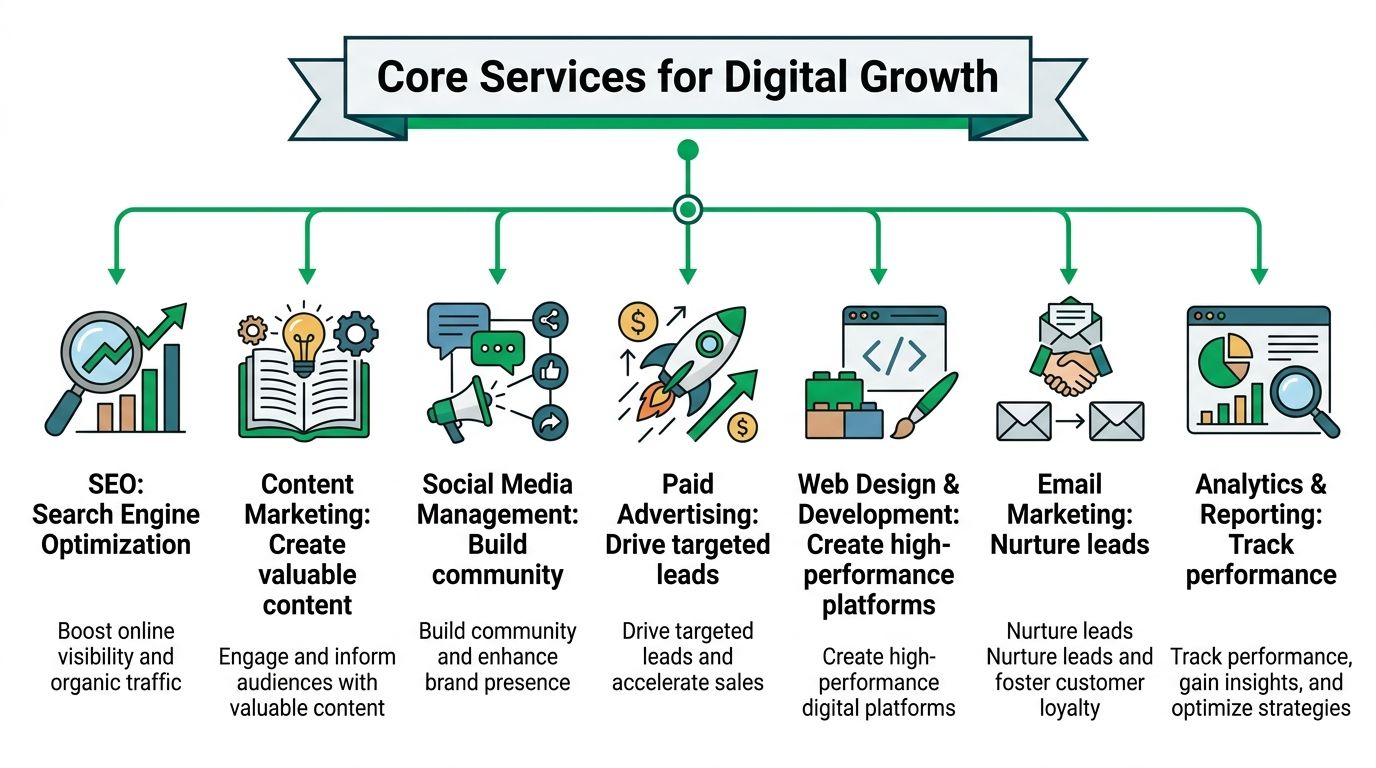
What Does a Digital Marketing Agency Do? SEO that turns your site into an asset
Search engine optimization is not just “ranking higher on Google.” It is the process of making your site easier to find, easier to understand, and easier to trust.
In practice, agencies handle work like:
- Technical fixes: Improving crawlability, internal linking, mobile usability, page speed, schema markup, and site structure
- On-page optimization: Refining title tags, headers, copy, service pages, collections, category pages, and local intent signals
- Content strategy: Mapping topics to search intent, building supporting articles, and strengthening topical authority
- Measurement: Using tools like Google Analytics and SEMrush to track traffic, engagement, and conversions so the strategy can be refined over time
Strong SEO solves a specific business problem. It reduces dependency on paid traffic and helps your business show up when buyers are already looking.
Some agencies also extend SEO into AI search visibility. If you want a practical look at that shift, this guide on how to optimize for AI search is useful because it frames GEO work around discoverability, not hype.
Paid media that buys speed
SEO compounds over time. Paid media creates speed.
This usually includes Google Ads, paid social campaigns, remarketing, shopping campaigns, and marketplace ads depending on the business model. The goal is not to buy clicks. The goal is to buy qualified attention and move that traffic into a page that can convert.
Behind the scenes, agencies are usually doing several things at once:
- Building account structure around intent
- Matching offers to campaigns
- Writing ad copy and testing variants
- Excluding weak traffic
- Aligning landing pages with keyword or audience intent
- Adjusting bids, budgets, and creative based on performance
What does not work? Sending paid traffic to a generic homepage. Running broad campaigns with no negative keywords. Judging success by impressions instead of leads or revenue.
Good paid media management is disciplined. Small changes matter.
What Does a Digital Marketing Agency Do? Web design and development that supports conversion
A website should do more than look current.
It should answer questions fast, guide the next action, and remove doubt. That means clear messaging, logical navigation, mobile performance, persuasive page structure, trust signals, and forms or checkout flows that do not create friction.
Agencies often redesign sites when traffic is not the problem. The site is.
A few common examples:
- A local service business gets visits but very few form fills because the page buries contact options
- An e-commerce brand attracts traffic but loses shoppers with weak product detail pages
- A B2B company has credible offers but unclear messaging, so visitors bounce without understanding the value
This is why web development and design remain such common agency services. They are foundational.
Content that supports the full funnel
Content marketing gets oversimplified.
It is not just blogging for the sake of blogging. It is creating pages and assets that move buyers from question to confidence. That can include service pages, category copy, comparison pages, guides, email sequences, FAQs, product education, and video scripts.
Content does several jobs at once:
- It gives SEO something valuable to rank
- It helps paid traffic convert with stronger message match
- It supports sales conversations
- It builds trust before a prospect ever talks to your team
And content only works when it is tied to intent. Publishing random articles because “content is good for SEO” usually produces a library nobody uses.
Social media and video that build familiarity
Social media rarely closes every sale on its own. It does shape perception.
For many businesses, social does its best work when paired with stronger channels like search, paid traffic, and email. It keeps the brand visible, gives proof of activity, shows the people behind the business, and creates repeated touchpoints.
Video strengthens that effect. A walkthrough, a founder explanation, a customer education clip, a short product demo. Those assets help buyers understand the offer faster than text alone. Channel coordination is important here. Teams that think in terms of multi-channel marketing campaigns tend to make better use of content because each asset has a role across search, social, paid, and email instead of living in one silo.
Branding and creative that sharpen the message
Branding is not just a logo file and color palette.
It is the way the business sounds, looks, and positions itself so people remember it. Agencies help shape that through message development, visual identity, campaign creative, offer framing, and consistency across pages and channels.
Weak branding creates practical problems. Ads get ignored. Landing pages feel generic. Social content blends in. Sales conversations start cold every time because the business has not established a recognizable point of view.
Specialized services for niche growth
Some agencies also support channels beyond the standard list. Amazon marketplace management, podcast promotion, local SEO, franchise lead generation, and AI search optimization all fit here.
That is where firms like Mr. Green Marketing, LLC can make sense for businesses that need strategy-led execution across web design, SEO, PPC, Amazon marketing, branding, social media, podcast promotion, video production, and logo creation.
The best service mix is not the biggest one. It is the smallest set of channels that can reliably move the business toward revenue goals.
What Does a Digital Marketing Agency Do? How The Agency Partnership Works?
The part many businesses worry about is not signing. It’s what happens after.
They do not want to send over access, answer a few questions, and then disappear into a fog of vague updates and screenshots. Fair concern. A healthy agency relationship should feel structured, visible, and calm.

Discovery and audit
The first phase is listening.
A good agency starts by learning how the business makes money, which offers matter most, what the sales cycle looks like, who the main competitors are, and where current marketing is breaking down. Then it audits the existing digital presence.
That audit usually looks at:
- Website performance: Messaging, page structure, speed, mobile experience, calls to action
- Traffic sources: Search, paid media, social, referral, direct, marketplace traffic
- Lead flow: Form quality, call quality, sales follow-up, booking friction
- Visibility gaps: Rankings, local presence, content holes, weak landing pages, underused channels
At this stage, quick wins often show up. A broken form. Poor tracking. A service page with strong intent but weak copy. Paid campaigns pointing to the wrong destination. Small issues, real impact.
What Does a Digital Marketing Agency Do? Strategy and planning
Once the audit is complete, the agency should hand back more than opinions.
It should present a plan with priorities, timing, channel roles, and a clear reason behind each recommendation. Not a giant wish list. A roadmap.
That roadmap should answer questions like:
| Planning question | What the strategy should clarify |
|---|---|
| What comes first | The highest-impact actions for the next stretch of work |
| What can wait | Lower-priority ideas that should not distract budget or focus |
| Which channels support which goals | Lead generation, e-commerce sales, brand lift, retention, or visibility |
| How success will be evaluated | The business metrics and channel metrics everyone will track |
A serious strategy also respects trade-offs. If budget is tight, the agency may prioritize one main acquisition channel and one support channel instead of trying to do everything at once. That is usually smarter.
Execution and launch
Then the work starts.
This can include campaign builds, SEO implementation, design revisions, new landing pages, content creation, analytics cleanup, tracking setup, and creative production. The exact mix depends on the engagement, but the pattern is the same. The strategy turns into assets, changes, and live campaigns.
Clients often underestimate how much coordination happens here. Copy has to match targeting. Tracking has to match forms and calls. Creative has to reflect the offer. The website has to support the traffic being sent to it.
Here’s a quick visual example of how agencies explain that workflow to clients:
What Does a Digital Marketing Agency Do? Reporting and optimization
This phase matters more than launch.
A campaign going live is not the finish line. It is the beginning of feedback. Agencies should review what happened, identify friction, test changes, and keep tightening the system.
The reporting process should be transparent and useful. Not bloated.
Clients should understand:
- What was done
- What changed
- What improved
- What underperformed
- What happens next
If reports are full of platform jargon but do not help the client make business decisions, the reporting is failing.
Good optimization is usually quiet work. Search term reviews. audience exclusions. ad copy tests. internal link improvements. page edits. form refinements. Better structure, less waste.
That is how agency work compounds. Not through a one-time burst, but through repeated rounds of informed adjustment.
What Does a Digital Marketing Agency Do? Understanding Agency Pricing and Expected Results
Agency pricing feels confusing because different firms package work in different ways.
Some price around deliverables. Some around access to a team. Some around time. And some mix all three. The mistake is focusing only on the fee without asking what kind of work the pricing model encourages.
What Does a Digital Marketing Agency Do? The three models you’ll see most often
Here’s the simple breakdown.
| Pricing Model | Best For | Pros | Cons |
|---|---|---|---|
| Monthly retainer | Ongoing SEO, PPC, content, social, web support, multi-channel management | Consistent support, continuous optimization, easier planning, stronger long-term accountability | Can feel expensive if scope is vague or priorities are not clear |
| Project-based fee | Website redesigns, brand work, audits, tracking setup, one-time launches | Clear deliverables, defined timeline, easier to compare scope | Often ends when the project ends, limited ongoing optimization |
| Hourly rate | Consulting, overflow work, troubleshooting, specialist support | Flexible, useful for defined tasks, good for short bursts | Harder to forecast cost, can reward time spent over outcome |
No model is automatically better. The right fit depends on the business problem.
If you need a new site, project pricing often makes sense. If you need ongoing lead generation and regular optimization, a retainer usually fits better. If you already have an internal team and just need outside expertise now and then, hourly support can work.
What drives the cost
Pricing rises or falls based on scope and complexity.
A local business with one location and one main service line is different from an e-commerce brand with many products, active ad accounts, marketplace listings, and multiple creative needs. A franchise with location pages, local SEO issues, paid media needs, and call tracking will require more coordination than a business that only wants blog support.
Common cost drivers include:
- Channel count: SEO alone is simpler than SEO plus paid media plus content plus social
- Creative needs: Video, design, landing pages, ad variations, brand work
- Technical work: Site fixes, analytics setup, event tracking, reporting infrastructure
- Business model complexity: Local, e-commerce, B2B, franchise, Amazon, multi-location
- Speed and responsiveness: Fast-moving campaigns demand more hands-on management
A good agency should be able to explain why the scope costs what it costs in plain English.
Stop asking only what it costs
Ask what it is supposed to produce. Many companies get stuck here. They compare agency fees the way they compare software subscriptions. But agencies are not just tools. They are operating partners. The fundamental question is whether the work can support profitable growth.
That means expected results should be framed around metrics that matter to the business, not vanity numbers.
Look for reporting around:
- Qualified leads
- Sales or revenue contribution
- Conversion rate trends
- Cost per acquisition
- Return on ad spend
- Channel efficiency
- Landing page performance
- Pipeline quality
Some channels move faster than others. Paid search can generate signal quickly. SEO takes longer. Website improvements may raise the performance of every traffic source at once. Email and remarketing often improve the value of traffic you already paid for.
That is why realistic expectations matter. Good agencies do not promise magic. They define leading indicators, watch the business outcomes, and adjust.
What good expectations sound like
A healthy agency conversation sounds like this:
- We expect to identify the biggest leaks first.
- We expect some early wins from fixing tracking, pages, and campaign structure.
- We expect certain channels to need time before they mature.
- We expect reporting to show direction, not just activity.
- We expect the plan to change as data comes in.
That is normal. And better than a grand promise.
If an agency sells certainty in a channel that depends on testing, market conditions, creative quality, and sales follow-up, be cautious.
What Does a Digital Marketing Agency Do? How to Choose the Right Agency For Your Business
The wrong agency can keep you busy for months without moving the business forward.
The right one makes things clearer. Priorities sharpen. Reporting gets easier to trust. Teams know what they are doing and why. That fit matters more than polished sales language.
One reason boutique agencies often win here is personalization. Contrarian data cited by Digital Agency Network says boutique firms outperform large agencies by 35% in client retention for niche markets, and only 22% of small businesses report receiving personalized onboarding and initial audits. That tracks with what many business owners feel after working with a generic provider. They were sold a package, not a plan.
Questions worth asking before you sign
Do not stop at “what do you charge?”
Ask better questions.
- How do you learn the business before making recommendations
- What does your audit process include
- Who will work on the account
- How often will we talk
- What will reporting look like
- How do you decide what to prioritize first
- How do you handle underperforming campaigns
- What do you need from our team to succeed
- Have you worked with businesses like ours
- How do you define success for this engagement
The answers should sound practical, not theatrical. If an agency cannot explain its communication rhythm, optimization process, or prioritization logic, that is a problem.
Red flags that show up early
A few warning signs usually appear before the contract is signed.
- One-size-fits-all packages: If every business gets the same plan, the agency is not diagnosing the problem.
- Too much platform talk: Lots of jargon, not much connection to leads or sales.
- No audit or discovery step: They prescribe before they understand.
- Reporting promises without business context: Pretty dashboards, weak insight.
- Overconfidence: Big guarantees, no discussion of trade-offs or variables.
And there is another useful angle here. Sometimes a business may not need a full agency at all. If your need is narrow and highly specialized, reviewing reasons to hire an SEO consultant over an agency can help clarify whether you need a dedicated specialist, a consultant, or a broader team.
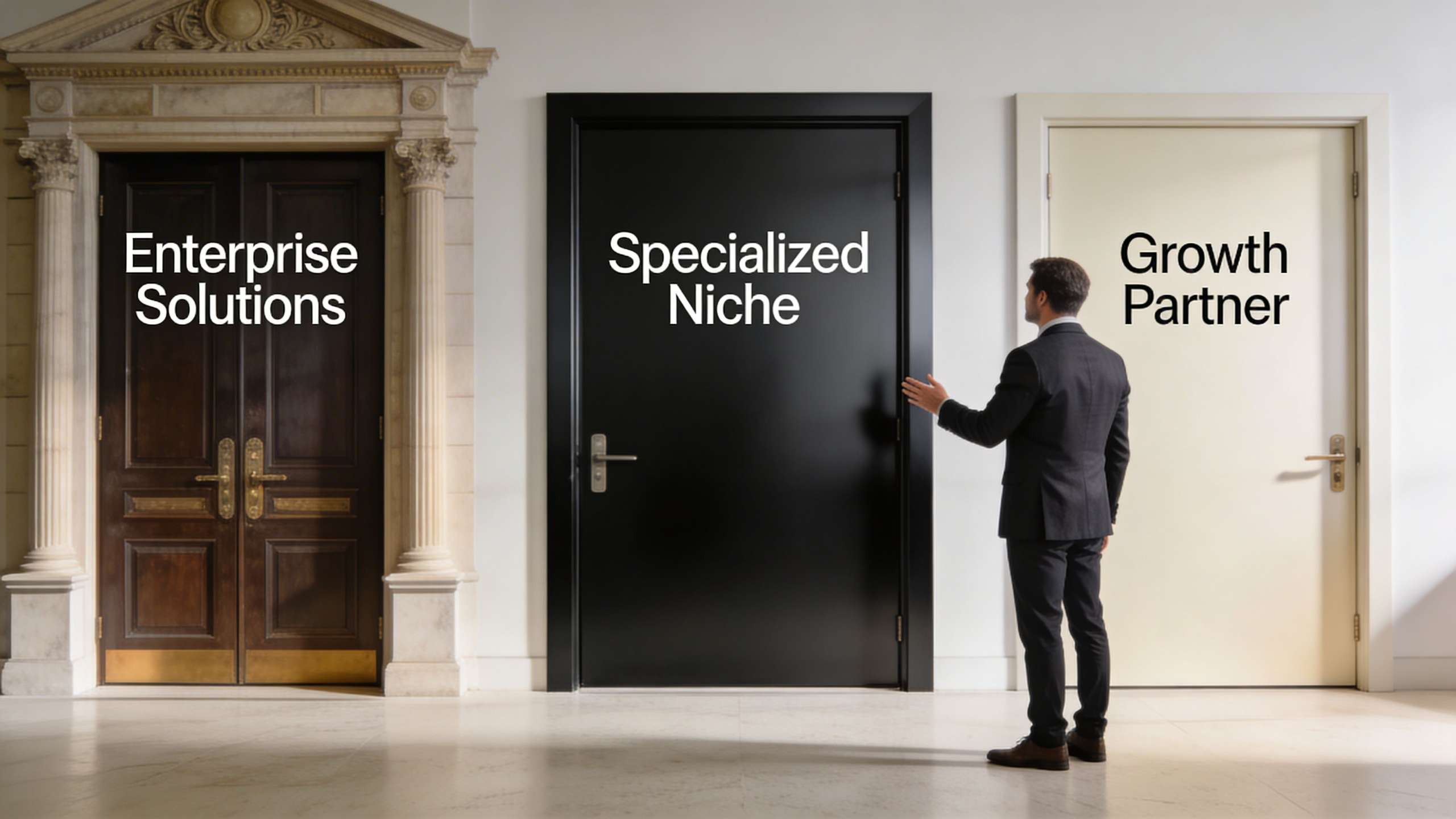
Boutique, niche, or enterprise
The best fit often comes down to how much complexity you need managed.
| Agency type | Usually a fit for | Typical trade-off |
|---|---|---|
| Boutique growth partner | SMBs, local service providers, e-commerce brands, startups | More direct attention, but sometimes a narrower bench than a giant firm |
| Specialized niche agency | Businesses with one urgent channel need | Deep expertise, but less help across the broader funnel |
| Large enterprise agency | Bigger brands with internal teams and broad campaign demands | More resources, but often less flexibility and less senior attention day to day |
If you want a broader vetting framework, this guide on how to choose a digital marketing agency lays out the decision criteria in a straightforward way.
What the right fit feels like
It feels specific.
The agency understands your business model. It asks sharp questions. It talks about quick wins and long-term levers in the same conversation. It does not try to impress you with complexity. It reduces complexity.
That’s usually the signal.
What Does a Digital Marketing Agency Do? Your First Step A Free Digital Audit
So, what does a digital marketing agency do?
At its best, it becomes a growth partner that finds the leaks, prioritizes the right channels, builds the assets, manages the campaigns, and keeps improving the whole system over time. It helps a business stop guessing and start operating with a plan.
For a local service company, that may mean stronger lead generation. For an e-commerce brand, it may mean better product visibility and more efficient acquisition. For a startup, it may begin with brand clarity, site structure, and a launch roadmap. Different situations, same principle. Clear strategy first.
The smartest first step is not a long contract. It is a clear view of where you stand now.
A free audit can show where visibility gaps, conversion friction, and fast improvements are hiding. If you want that kind of starting point, review these digital marketing audit services and use the findings to decide what deserves attention first.
Mr. Green Marketing, LLC works with businesses that need strategy-led support across SEO, PPC, web design, branding, social media, Amazon marketing, video, and related growth channels. If you want an outside team to review your current marketing and identify practical next steps, visit Mr. Green Marketing, LLC.
Leave a Comment
sing in to post your comment or sign-up if you dont have any account.