
Video Production for Marketing: You’ve approved the campaign, the landing page is ready, and the paid social budget is already allocated. Then a competitor publishes a sharp product demonstration, and your ads suddenly look like static brochures beside it. The question isn’t whether video belongs in your marketing plan anymore. It’s whether you’ll produce it as a measurable business asset or keep treating it as an expensive creative experiment.
And the difference shows up before the camera turns on. Strong video production for marketing starts with a funnel job, a distribution plan, and a measurement model. The footage matters, but so do the hook, the edit, the captions, the landing page, and the action you want viewers to take.
Video Production for Marketing: Table of Contents
- Why Video Production Has Become a Marketing Channel, Not a Creative Expense
- What Video Production for Marketing Actually Means
- The Main Types of Marketing Videos and When to Use Each
- How the Video Production Workflow Actually Runs
- Budgeting Video Production for Real Business Goals
- Distributing Marketing Videos and Making Them Findable
- Measuring Whether Your Marketing Videos Are Working
- Agency Versus In-House and How to Choose the Right Model
Why Video Production Has Become a Marketing Channel, Not a Creative Expense
A mid-market e-commerce owner sees a competitor consistently winning paid social auctions with product demonstrations. The owner has two choices: approve a $15,000 production outlay or accept another quarter of flat return on ad spend. The production line feels risky until the comparison becomes clearer. The cost isn’t only the video. It’s also the cost of continuing to buy attention with a weaker creative asset.
Video now sits beside search, email, paid media, and conversion-rate optimization as a channel with identifiable inputs and outputs. By 2026, 91% of businesses use video as a marketing tool, and 93% of marketers call it important to their overall strategy, according to HubSpot’s marketing statistics. The same reporting says 82% of marketers believe video delivers good ROI, while 67% use views as their top KPI. Views alone aren’t enough, but the fact that teams track them alongside engagement and action metrics shows how video has moved into normal performance reporting.

Video Production for Marketing: The four jobs a marketing video must do
A useful video portfolio gives each asset one primary job:
- Capture attention: Short, native-feeling creative interrupts scrolling and introduces a problem or point of view.
- Build trust: Customer interviews, founder videos, and behind-the-scenes footage make the company easier to believe.
- Explain complexity: Demonstrations, screen recordings, and animated explainers show how a product works without forcing a sales call.
- Convert intent: Retargeting cuts, comparison videos, and product proof help a qualified viewer take the next step.
Digital video advertising has also reached media-buying scale. Industry projections place global digital video ad spending at about $223.5 billion in 2026 and $241.9 billion by 2028, while another 2026 estimate puts spending at about $230 billion in 2026, up from the previous year, as summarized by Kapwing’s video marketing statistics. That budget supports production, distribution, testing, and paid amplification.
The practical takeaway is simple. Video isn’t a brand flourish that gets published when the team has time. It’s a portfolio of assets designed to earn attention, reduce uncertainty, clarify value, and create action. For a broader explanation of why video has become powerful for businesses, see this overview of video marketing’s business impact.
What Video Production for Marketing Actually Means
Video production for marketing is the end-to-end process of planning, scripting, recording, editing, packaging, distributing, and measuring video assets against a business objective. That definition matters because a beautifully shot film can still fail if it targets the wrong audience, uses the wrong format, or asks for an action the viewer isn’t ready to take.
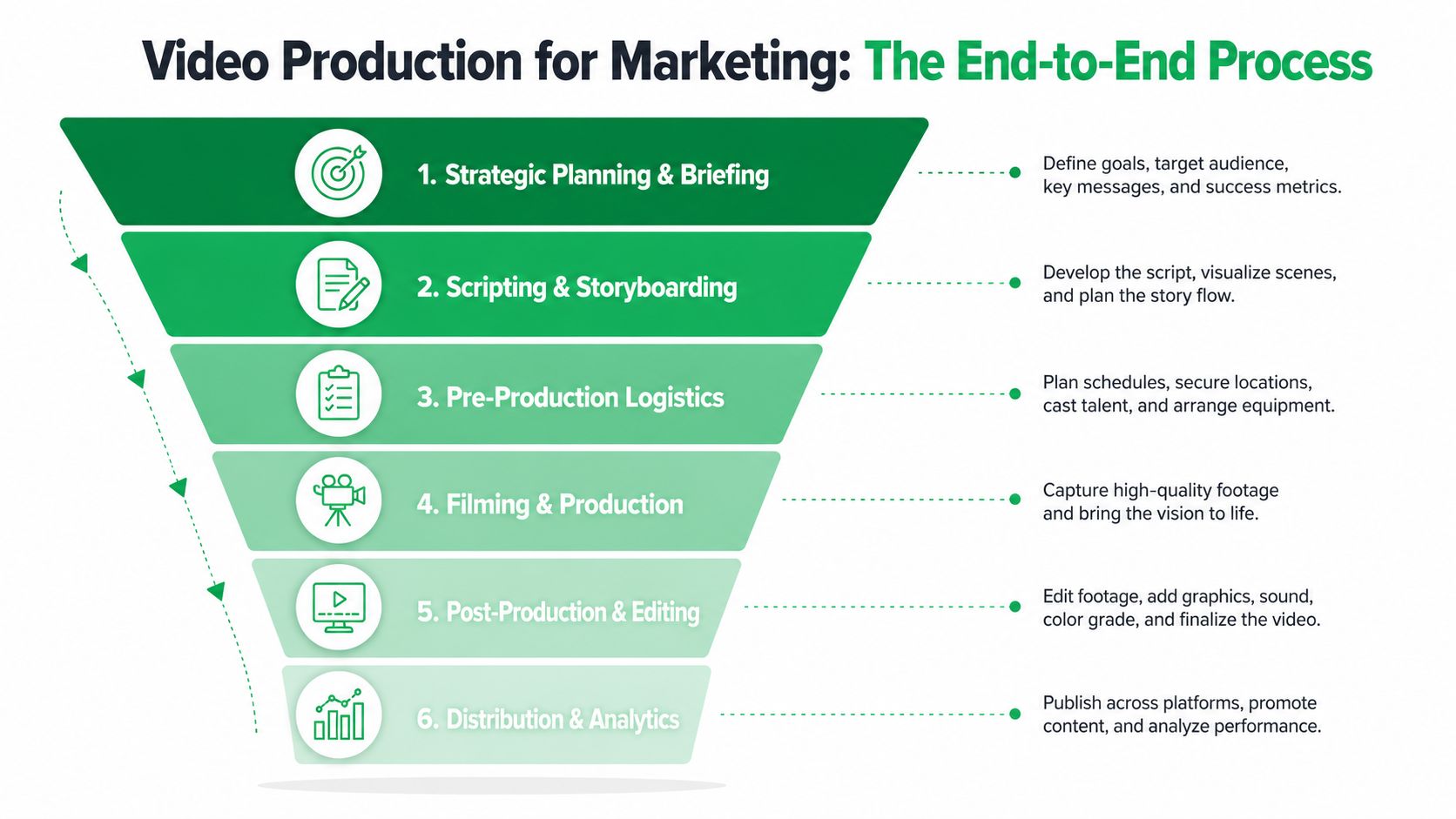
The process usually follows six operational stages:
- Strategic planning and briefing: Define the audience, funnel stage, offer, message, platform, and KPI.
- Scripting and storyboarding: Turn the message into spoken lines, visuals, proof points, and a clear sequence.
- Pre-production logistics: Confirm talent, locations, releases, equipment, schedule, shot list, and delivery requirements.
- Filming or creation: Capture live action, screen recordings, interviews, animation, or a combination.
- Post-production: Edit the story, refine sound, add graphics, color-correct footage, and prepare captions.
- Distribution and analytics: Publish the correct versions, track behavior, and use the findings to improve the next asset.
One format can’t do every job
A short social clip can earn awareness, but it rarely carries all the proof needed for an expensive considered purchase. A product demo can answer objections, but it may be too slow for a cold audience. A customer testimonial can establish credibility, while a founder video can put a human voice behind the company’s position.
Consumer preference supports a concise starting point. 63% of online users prefer learning about a product through a short video, and 69% of video marketers create social media videos, according to Wix’s video marketing statistics. That doesn’t mean every asset should be short. It means the first contact should respect the viewer’s context and earn the right to ask for more attention.
A marketing video portfolio therefore needs intentional variety. Start with one or two formats that match the immediate funnel problem, then create cutdowns and adaptations from the same production session. The efficient approach isn’t producing one giant master video. It’s designing a group of related assets that each have a clear role.
Video Production for Marketing: The Main Types of Marketing Videos and When to Use Each
The right format depends on what the viewer needs to understand next. A cold prospect may need a sharp problem statement. A sales-qualified buyer may need proof, product detail, and a credible reason to act.
Match the format to the funnel
| Format | Typical Length | Funnel Stage | Complexity | Best Use Case |
|---|---|---|---|---|
| Short-form social clip | 15 to 60 seconds | Awareness | Low to medium | Hook-driven discovery, paid social, Reels, TikTok, and Shorts |
| Explainer video | 60 to 180 seconds | Consideration | Medium | Clarifying a service, platform, or unfamiliar process |
| Product demo | 60 to 180 seconds | Consideration and decision | Medium | Showing a product in use and answering practical objections |
| Testimonial or case study | 2 to 5 minutes | Decision | Medium to high | Adding customer proof to sales pages and campaigns |
| Founder or thought leadership video | 1 to 10 minutes | Awareness and consideration | Low to medium | Establishing authority on LinkedIn, YouTube, or email |
| Brand anthem or hero film | 60 to 180 seconds | Awareness | High | Emotional positioning and major campaign launches |
| Tutorial or how-to video | 2 to 10 minutes | Discovery and retention | Medium | Search-led education, onboarding, and customer support |
| Launch or event video | 30 seconds to 5 minutes | Campaign-specific | Medium to high | Concentrated announcements, events, and product releases |
Short-form social clips deserve early attention because they’re easy to test and adapt. A vertical clip might open with a product failure, show the fix, and end with a simple invitation to see the full demonstration. The production doesn’t need a large crew, but it does need a strong first beat, readable captions, and footage that feels native to the platform.
Explainers and product demos work better when the viewer has an active question. A software company might record the exact workflow that eliminates a familiar administrative task. A physical-product brand might show setup, use, and the result in one continuous sequence. Screen recordings can reduce production overhead, but poor pacing still makes them feel like training material.
Video Production for Marketing: Trust needs evidence, not polish
Testimonials and case studies should focus on the customer’s problem, decision process, experience, and outcome. The strongest interviews don’t sound like a script. They include specific context and allow the viewer to recognize their own situation.
Founder videos and thought leadership work when the speaker has a useful position, not merely an announcement. A founder explaining why a common industry practice fails can create more authority than a polished company overview.
Tutorials serve both discovery and retention. They answer practical questions, create a library for future viewers, and can support sales without sounding like a sales pitch. A deliberate portfolio usually combines two or three formats, rather than producing a thin version of everything. For small-business planning considerations, see this guide to video marketing for small businesses.
Video Production for Marketing: How the Video Production Workflow Actually Runs
Production problems rarely begin on shoot day. They begin when a team starts filming before it agrees on the message, approval process, and final deliverables.
Video Production for Marketing: Stage one and two establish the creative boundary
The brief should identify the audience, business objective, offer, distribution surfaces, primary message, supporting proof, CTA, and success metric. The creative concept then turns that brief into a treatment, script, storyboard, or interview plan.
The people involved may include a marketing owner, producer, strategist, writer, subject-matter expert, and creative director. The common bottleneck is unresolved stakeholder disagreement. If the founder wants a brand film, sales wants a demo, and paid media wants short-form ads, the producer can’t solve that conflict with better lighting.
Practical rule: Approve the message before you spend money capturing it.
Video Production for Marketing: Stage three locks the shoot
Pre-production covers the operational details that make filming possible:
- Talent: Confirm speakers, contracts, usage rights, wardrobe, and availability.
- Locations: Secure permissions, location releases, access times, power, sound conditions, and contingency plans.
- Shot list: Specify every essential angle, product action, interview setup, and cutaway.
- Approval chain: Name one final decision-maker and define how feedback reaches the editor.
- Delivery spec sheet: Confirm aspect ratios, resolution, caption files, thumbnails, platform cutdowns, and naming conventions.
The shoot day involves the producer, director, camera team, sound professional, lighting crew, talent, and client representative, depending on scope. The biggest risk is trying to improvise essential coverage. A shot list should allow creative flexibility, but it shouldn’t leave the editor without the product close-up or proof point the campaign requires.
Stage four through six protect the investment
Post-production combines editing, color, sound, motion graphics, music, captions, and versioning. Review and delivery then convert one timeline into usable campaign assets. Contractual edit rounds should typically be capped at two rounds, with consolidated feedback from the client. Unlimited review sounds collaborative, but it creates scope creep and turns a defined project into an open-ended one.
The delivery package should be agreed before production begins. Teams using Adobe Premiere Pro can also improve speed through deliberate editing workflows, including the Premiere Pro keyboard shortcuts covered here. Small process decisions matter because every avoidable revision consumes budget that could have funded another cut, caption pass, or distribution test.
Budgeting Video Production for Real Business Goals
The budget should follow the marketing job, not the other way around. A short performance clip doesn’t need the same crew, location, or post-production treatment as a hero campaign film. The useful question is what the asset must accomplish and how many versions the campaign needs.
The following ranges are practical planning bands for 2026. They aren’t universal quotes. Location, talent, travel, animation, legal requirements, and revision scope can move a project substantially.
| Video Type | Budget Range (USD) | Typical Deliverables | Primary Cost Drivers |
|---|---|---|---|
| Single talking-head social clip | $1,500 to $5,000 | One short clip, basic edit, captions, simple graphics | Crew size, setup time, editing, graphics, captions |
| Mid-tier brand or product video | $8,000 to $25,000 | Main film, cutdowns, sound mix, color, captions | Script, crew, shoot days, location, product staging, revisions |
| High-production hero campaign film | $40,000 to $150,000+ | Hero film, campaign cutdowns, premium finishing | Creative development, cast, locations, crew, animation, music, post |
| Ongoing monthly retainer | Project-dependent | Recurring social, educational, or campaign assets | Production cadence, output volume, strategy, travel, editing capacity |
Where the money goes
Crew size is often the first major lever. A solo operator may handle a simple interview, while a complex production needs separate roles for directing, cinematography, sound, lighting, production management, and art direction. Shoot days, location fees, talent, travel, insurance, music licensing, animation, visual effects, and revision rounds add further cost.
AI tools can reduce labor in selected tasks such as rough cuts, repurposing, transcription, and caption creation. The current adoption gap matters here. Only 18% of businesses were using AI tools for video creation in one 2025 to 2026 data set, while 55% of marketers still produce videos in-house and 59% use automated captions or transcripts, according to VideoScribe’s video marketing statistics. The numbers point to an emerging workflow, not a fully automated replacement for production judgment.
Use AI for repetitive work, not for the decisions that establish trust. A human should still own the positioning, interview direction, factual review, brand voice, edit rhythm, and final accessibility check. Hero pieces especially need human craft because generic generated footage can make a premium brand feel interchangeable.
Don’t forget paid distribution. A finished asset that never reaches the intended audience hasn’t generated a return. Budget for media, landing-page implementation, tracking, and creative testing alongside production.
Video Production for Marketing: Distributing Marketing Videos and Making Them Findable
A finished video is a source file, not a marketing result. Distribution determines where people encounter it, while packaging determines whether they choose to watch.
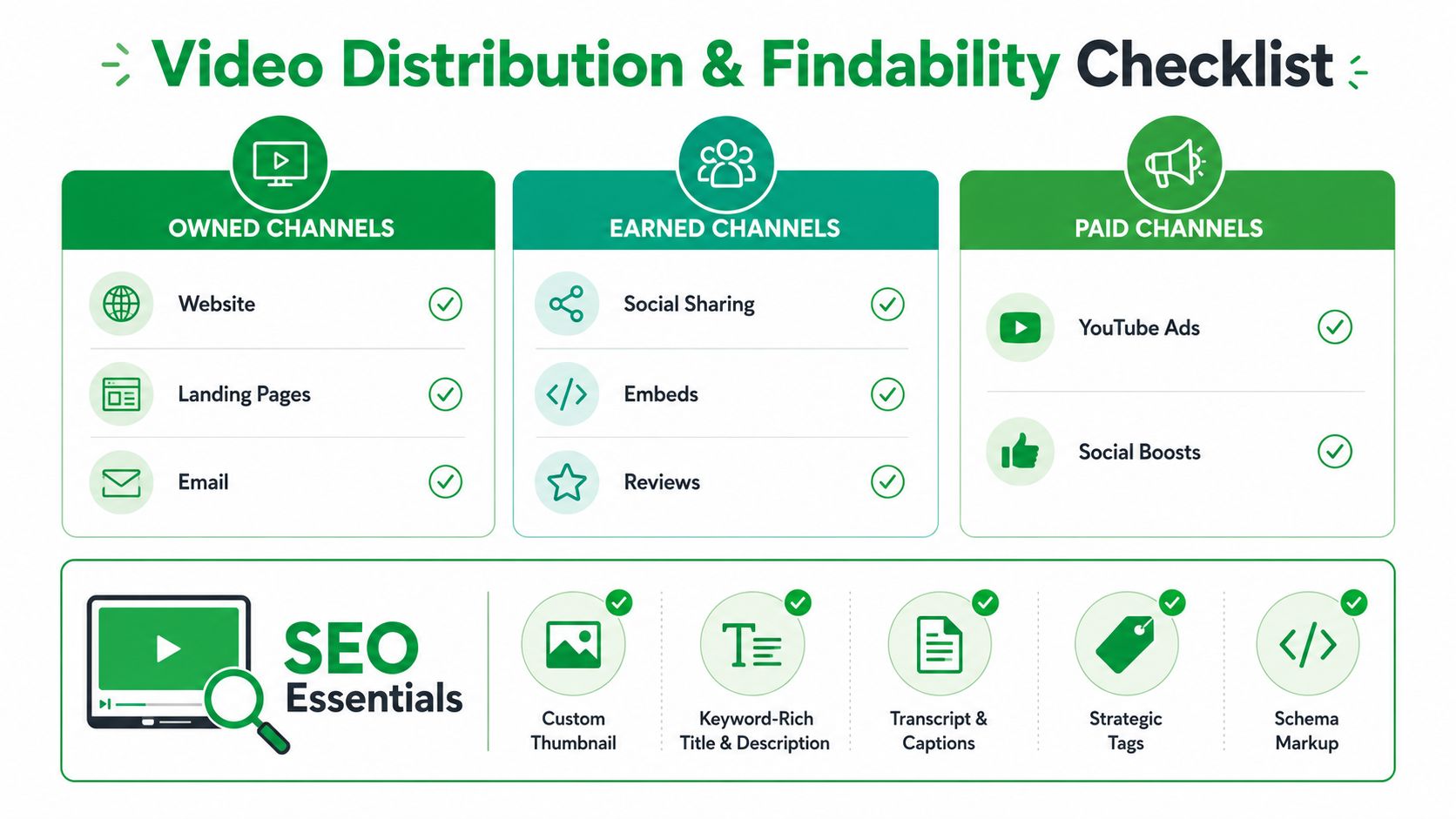
Use three distribution surfaces
Owned channels include product pages, landing pages, email, sales enablement libraries, and customer portals. These environments give you more control over context and conversion. A product demo beside pricing, FAQs, and a clear CTA has a different job from the same demo uploaded without context.
Earned channels include YouTube, TikTok, Instagram Reels, LinkedIn, embeds, reviews, and customer sharing. Upload platform-native versions instead of sending every audience to an external link. A vertical social cut needs its own opening, captions, framing, and pacing.
Paid channels include boosted posts, pre-roll, social ads, and connected TV. Paid placement can provide reach, but it also makes weak hooks expensive. Test the first seconds and the offer before increasing spend.
Build the search package around the video
For YouTube, write a specific title that reflects the viewer’s query, use the description to explain the promise and next step, add relevant tags, and create a thumbnail that communicates one clear idea. The first 30 seconds deserve disproportionate attention because the viewer decides quickly whether the video is worth continuing.
Wistia’s benchmark data shows average engagement near 50% for videos under five minutes, falling to 38% for five to 30 minute videos, 25% for 30 to 60 minute videos, and 15% for videos longer than 60 minutes, according to Wistia’s State of Video report. The practical response is to front-load the core value, proof, and CTA where appropriate. Longer assets should use clear chapters and produce shorter cuts for discovery.
On a website, add a transcript, captions, descriptive surrounding copy, and VideoObject schema where appropriate. The page still needs a useful text experience. Video supports the page, but it shouldn’t be the only way a visitor can understand the offer. A structured content distribution strategy helps connect the production plan to the channels that can carry it.
Video Production for Marketing: Measuring Whether Your Marketing Videos Are Working
A view is an exposure signal. It isn’t proof that the viewer understood the message, trusted the brand, or took action.
Use three core measures, then connect each one to the funnel job:
- Play rate: The share of unique page loads or impressions that become plays. This helps diagnose whether the thumbnail, placement, and opening frame earn attention.
- Engagement rate: The percentage of the video viewers watch. Wistia defines engagement in terms of watched video, making it useful for identifying where attention declines.
- Action rate: The share of viewers who interact with a CTA, form, link, or other defined conversion action.
Wistia also distinguishes play rate from engagement rate and provides second-by-second replay, device, and referral breakdowns in its average user engagement analytics documentation. Those details let a team compare a landing-page embed with a social referral, or mobile behavior with desktop behavior, instead of treating every view as identical.
Read the retention curve as a diagnosis
A steep drop in the first three seconds usually points to a weak hook, a confusing opening frame, or a mismatch between the ad promise and the video. A steady decline after the introduction often indicates slow pacing, repeated context, or delayed proof. A late drop around the CTA can signal that the ask arrives after the viewer has already made a decision, or that the CTA doesn’t match the value demonstrated.
YouTube Studio, Meta’s platform breakdowns, and Wistia heatmaps each expose different parts of the picture. Use UTM-tagged links for campaign traffic, connect landing pages to GA4, and account for post-view behavior where the platform supports it.
Measurement discipline: Decide what success means before launch. A reach asset needs an attention metric. A demo needs watched proof and qualified action. A sales asset needs a conversion path.
The team should review the retention curve with the script and edit open beside it. If viewers leave immediately before the price explanation, the issue may be the explanation. If they replay the product interaction, that moment may deserve a dedicated cut.
Agency Versus In-House and How to Choose the Right Model
There are three viable operating models, and each fails in a different way.
A full in-house team gives the brand direct control, fast access to subject-matter experts, and strong institutional knowledge. It works well for businesses that publish frequently and can keep producers, editors, and creative leads busy. The hidden cost is idle capacity during quiet periods, gear depreciation, software, freelancer coverage, training, and creative tunnel vision.
A specialist agency brings production leadership, broader crew access, repeatable systems, and the ability to scale for campaign work. It’s usually more expensive per asset and requires time for the agency to learn the brand. The client also needs a clear internal owner, otherwise feedback becomes fragmented and revisions expand.
A hybrid model keeps strategy, brand governance, subject-matter access, and quick-turn content in-house while outsourcing complex shoots, campaign concepts, animation, sound, or overflow editing. For many growth-stage companies, this balances speed with specialist craft.
| Factor | In-House Team | Specialist Agency | Hybrid Model |
|---|---|---|---|
| Control | Direct daily control | Defined through briefing and approvals | Internal control with external execution |
| Institutional knowledge | Strong | Must be developed | Strong internal context |
| Capacity | Limited by staff and workload | Scales by project | Flexible across recurring and complex needs |
| Cost pattern | Fixed staffing and overhead | Project or retainer fees | Mixed fixed and variable costs |
| Best fit | Consistent publishing cadence | Campaigns requiring specialist craft | Growth teams with a core marketing staff |
| Common failure | Idle capacity or repetitive creative | Ramp-up time and higher per-asset cost | Unclear ownership between teams |
Make the choice with four questions
- How many assets will you publish? High recurring volume can justify internal roles, while occasional campaigns may favor outsourcing.
- What’s the budget per project? Match the operating model to the complexity you can sustain, not the most ambitious concept in the pitch deck.
- Does your marketing team have production ownership? Someone must manage briefs, approvals, rights, deadlines, and distribution.
- Is the work brand-building or performance-driven? Brand films benefit from specialist creative leadership. Performance programs need fast testing, versioning, and measurement.
The honest answer isn’t always in-house or always agency. Many teams need an internal strategist who understands the business and an external production partner who can deliver the craft and capacity the campaign requires. Before selecting a partner, use a structured evaluation process such as this guide to choosing a marketing agency.
Mr. Green Marketing, LLC offers strategy-led digital marketing services that include video production, SEO, PPC, branding, social media, and conversion-focused web work. If your team needs help turning video into a measurable channel, visit Mr. Green Marketing, LLC to request a free audit and performance report, then identify the production and distribution gaps worth fixing first.
Leave a Comment
sing in to post your comment or sign-up if you dont have any account.