
Video marketing for small business – Let’s get straight to it. And I mean straight to it. Video marketing for small business isn’t some “nice-to-have” luxury anymore—it’s the single most powerful tool you have to get noticed, build real trust, and actually drive sales. Think of it as your digital handshake, your best storyteller, and your hardest-working salesperson. All operating 24/7.
Video Marketing for Small Business – Why Video Is Your Small Business Superpower
You’re running a small business. That means every dollar and every minute you put into marketing has to pull its weight. It’s easy to look at video and think it’s just a flashy gimmick for giant corporations with bottomless budgets. A distraction.
But that couldn’t be further from the truth. In fact, video has become the great equalizer.
It’s your secret weapon for connecting with customers on a human level, something that faceless corporations struggle with. A great video can explain a complicated service in 60 seconds, show off the quality of your product in a way that flat photos never could, and forge an emotional bond that turns a one-time buyer into a loyal fan. For life.
Stop the Scroll and Start a Conversation
Think about your own social media habits. As you’re scrolling through your feed, what makes you stop? It’s almost always a video. A moving image, a human face, a story unfolding—these are the things that cut through the endless noise.
For a small business, that moment of captured attention is everything. You’re not just collecting views; you’re earning a genuine connection.
Video isn’t just about showing people what you do; it’s about showing them why you do it. It’s the fastest way to transfer your passion and expertise directly to a potential customer, building a rock-solid foundation of trust before they even think about clicking “buy now.”
And the data backs this up, big time. The numbers don’t lie: recent studies show that a staggering 90% of marketers see a positive return on investment from video. On top of that, 87% say video directly increased their sales, and an incredible 88% credit it for generating new leads. The best part? Nearly half of businesses that saw huge gains spent less than $5,000 on their videos.
Making the Complex Simple
What if you sell a service that’s tough to explain in a few bullet points? Or a product with features that really need to be seen to be understood?
This is where video truly shines.
- Explainer Videos: Break down your complex software or specialized accounting services into a simple, two-minute animated clip.
- Product Demos: Show your handcrafted leather wallet actually being used—don’t just let it sit on a sterile white background.
- Behind-the-Scenes Content: Introduce the team, give a tour of your workshop, or share a “day in the life.” This kind of content humanizes your brand instantly.
To really make video a superpower, you need a modern video content marketing strategy. It’s not about just making a video; it’s about making the right video that speaks directly to your ideal customer and solves their problems. This is how you start punching way above your weight class.
Video Marketing for Small Business – Finding Your Audience and Choosing Your Platform
So, you’re ready to press record. But hang on a second. Before you even think about hitting that button, we need to answer two make-or-break questions: who are you talking to, and where are they hanging out online?
Making a video without knowing the answers is like shouting into the void. You might make some noise, but the people who actually matter won’t hear you.
Effective video marketing isn’t about chasing a million views. It’s about getting the right views from people who are genuinely interested in becoming customers. That all starts with getting crystal clear on your audience.
First, Know Who You Are Talking To
Forget about broad, useless demographics like “women, 25-54.” That’s a statistic, not a person. To make videos that truly connect, you need to build a simple customer persona—a fictional character who represents your ideal buyer.
Give them a name. A job. A problem that keeps them up at night. What does “Marketing Manager Molly” need to impress her boss? How can “Contractor Dave” finish his jobs faster? When you create content for a specific person, your videos instantly become more focused, relatable, and powerful.
Creating a persona isn’t just a fluffy marketing exercise. It’s a filter for every single decision you make. Once you know exactly who you’re talking to, you know what jokes to tell, what problems to solve, and what language to use.
This deep understanding of your audience is the first domino in a powerful social media strategy. To go a level deeper, you can check out our complete guide on building a social media marketing strategy for small business that drives real growth.
Once you’ve nailed down your “who,” it’s time to figure out the “where.” You wouldn’t put a billboard for a high-end steakhouse in the middle of a vegan neighborhood, right? The same exact logic applies online.
This decision path shows how your business goals flow directly into tangible outcomes with video.
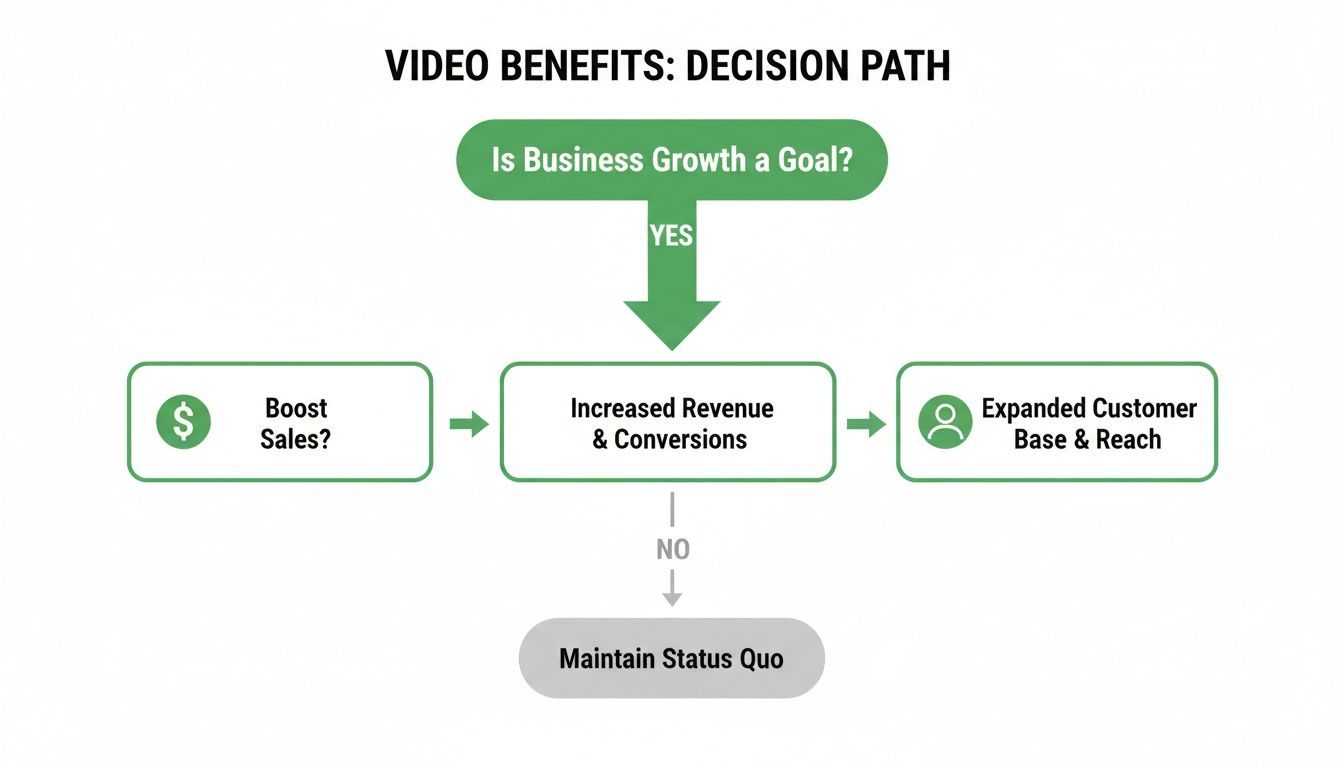
Whether you’re aiming to boost sales or get more leads, video gives you a direct line to making it happen.
Match Your Message to the Right Platform
Not all video platforms are created equal. Each one has its own unique audience, its own culture, and its own content style. Trying to be everywhere at once is a surefire recipe for burnout.
Instead, pick one or two platforms where your ideal customer actually spends their time.
To help you decide, here’s a quick-reference table breaking down the major players.
Choosing Your Video Platform
| Platform | Best For (Business Type) | Audience Demographics | Key Content Format |
|---|---|---|---|
| YouTube | Service-based businesses, educators, product companies | Broad; skews male (18-49) | How-to guides, product demos, educational deep dives |
| TikTok | B2C brands, personality-driven businesses, e-commerce | Primarily Gen Z & Millennials (16-34) | Short, entertaining, trend-based clips (15-60 seconds) |
| Lifestyle brands, e-commerce, visual-heavy businesses | Millennials & Gen Z (18-35), slightly female-skewed | Polished short-form Reels, stories, and live video | |
| B2B companies, professional services, consultants | Professionals, decision-makers (25-55+) | Industry insights, company culture, client testimonials | |
| Local businesses, community-focused brands | Broadest demographic reach, especially 35+ | Community updates, customer stories, targeted video ads |
Here’s a bit more on what that means in practice:
- YouTube: Think of it as the king of video search. It’s the perfect home for educational how-to videos, in-depth product walkthroughs, and building a library of helpful content that works for you for years to come. For most businesses, hubs like YouTube are a foundational piece of the puzzle.
- Instagram Reels & TikTok: These platforms are all about short, snappy, attention-grabbing content. They’re perfect for showing off your brand’s personality, jumping on fun trends, and sharing quick, authentic behind-the-scenes moments.
- LinkedIn: The vibe here is strictly professional. This is where you post industry insights, showcase your company culture to attract talent, or share powerful client success stories. It’s the go-to platform for B2B businesses looking to build authority.
- Facebook: With its massive and diverse user base, Facebook is a versatile player. It’s great for building a local community, running highly targeted video ads, and sharing customer testimonials that build trust.
When you choose the right platform, your videos feel like a natural part of the conversation, not an awkward, out-of-place advertisement. It’s all about meeting your customers where they are and speaking their language.
Video Marketing for Small Business – The Five Essential Videos Every Small Business Needs
Okay, so you get why video is crucial and you know where your audience is hanging out. Now for the fun part—what kind of videos should you actually be making?
Forget the idea of just churning out ads. A smart video strategy is like a well-stocked toolkit; you need the right tool for the right job, depending on where your customer is in their journey. Some videos are for grabbing the attention of total strangers, others are for building trust with folks who are curious, and some are designed to give that final nudge to someone ready to buy.
So, let’s build that toolkit. Here are the five foundational videos that will give your small business a massive head start.
1. The Brand Story Video
Think of this as your digital handshake. The brand story video isn’t about making a hard sell; it’s about making a human connection. Its only job is to answer the question: “Why should I care about you?”
This is your chance to show the passion behind your business, introduce your team, and share the mission that gets you out of bed in the morning. It’s how you build an emotional connection and make your brand stick. It’s the difference between being just another contractor and being “Dave, the guy who got into construction because he loves building safe homes for families.” See the difference?
- Business Goal: Build brand awareness and forge an emotional connection.
- Creative Prompt: Film a short “About Us” video explaining why you started your business. Let your personality shine through!
2. The Product or Service Demo
Facts tell, but showing sells. A demo video is your opportunity to prove that your product or service actually works and will make your customer’s life easier. Forget boring feature lists—this is all about showing the outcome.
Instead of just claiming your new software is “easy to use,” show a 90-second screen recording of someone solving a huge pain point with it. Don’t just post a picture of your handcrafted coffee mug; show a video of it keeping coffee steaming hot for hours. This kind of video crushes doubt and builds the confidence needed to make a purchase.
3. The Customer Testimonial
You can talk about how great you are all day, but it will never be as powerful as when a happy customer says it for you. Testimonial videos are the ultimate form of social proof.
And they don’t need to be fancy. In fact, a raw, authentic video shot on a customer’s phone often feels more genuine than a polished, studio-produced piece. Hearing a real person share their positive experience builds a level of trust that no marketing copy can ever replicate.
A customer testimonial video works because it shifts the focus from “what the company says” to “what a peer experiences.” It validates your claims through a relatable, unbiased voice, which is incredibly persuasive for potential buyers on the fence.
It directly answers the prospect’s silent question: “Has someone like me had success with this?”
4. The How-To or Educational Video
Want to become the go-to expert in your niche? Start giving away your knowledge for free. How-to and educational videos are one of the best ways to build authority and attract customers who are actively searching for solutions.
A plumber could create a video on “Three Simple Ways to Prevent Clogged Drains.” A financial advisor could shoot a short clip on “Understanding Compound Interest in 60 Seconds.” This content is a goldmine for video marketing for small business because it builds goodwill and puts you top-of-mind when that viewer eventually needs to hire a pro.
The key here is that you’re not just selling; you’re helping.
- Business Goal: Generate leads and establish your business as a trusted authority.
- Creative Prompt: What’s the #1 question you get from new customers? Film a simple video answering it clearly and concisely.
5. The Behind-the-Scenes Video
People do business with people, not logos. Behind-the-scenes (BTS) content is your chance to pull back the curtain and show the human side of your brand.
It could be a quick tour of your workshop, an intro to a new team member, a look at how your product gets made, or even a funny outtake from another video shoot. This content doesn’t need to be perfect. In fact, its unpolished nature is what makes it feel so authentic and relatable. It’s what makes your business feel real.
Your Production Playbook: DIY vs. Hiring a Pro
This is the big one. It’s the part where most small business owners get stuck, picturing expensive cameras, baffling editing software, and complicated lighting rigs. The whole idea of video production can feel like an impossible mountain to climb.
But it doesn’t have to be.
The truth is, there are two perfectly good ways to get this done. You can take the scrappy, get-it-done-now DIY approach, or you can go the professional, let’s-do-it-right agency route. Neither one is inherently “better”—the right choice just depends on your budget, timeline, and goals. At this very moment.
Let’s break them down.
Video Marketing for Small Business – The DIY Approach: Get It Done Now
Don’t let perfection become the enemy of good. Seriously. The most important video you’ll ever make is the one you actually finish and post. And the good news? You already have a professional-grade camera sitting in your pocket.
Yes, your smartphone. With just a few key accessories and a little know-how, you can create surprisingly polished videos that get real results. The secret is to nail the fundamentals: good lighting and clear audio. These two things have a much bigger impact on quality than the camera itself.
Here’s what you need for a basic DIY video starter kit:
- Your Smartphone: Set it to the highest resolution possible (4K is great if you have it) and always film horizontally. Always.
- A Simple Tripod: Nothing screams “amateur” like shaky footage. A small, affordable tripod for your phone is a non-negotiable for getting stable, professional-looking shots.
- An External Microphone: Your phone’s built-in mic picks up every single background noise. A simple lavalier (lapel) mic that clips to your shirt costs less than $30 and will instantly make your audio 10x clearer.
- Good Lighting: You don’t need a Hollywood set. A simple ring light can work wonders, but honestly, just facing a bright window is often all you need. Natural light is your best friend.
When it’s time to edit, there are dozens of user-friendly apps that make it painless. Tools like CapCut or Descript let you trim clips, add text, and drop in music with minimal fuss. The goal here isn’t to win an Oscar; it’s to create clean, valuable content quickly.
Video Marketing for Small Business – Hiring a Professional: When to Call in the Experts
The DIY approach is fantastic for getting started and staying consistent, but there comes a time when you need to level up. Maybe you’re launching a major product, running a big ad campaign, or just need a level of polish that DIY can’t quite deliver.
This is when you hire a pro.
Partnering with a video production agency isn’t just about getting a prettier video. You’re paying for strategy, efficiency, and expertise. A good agency saves you dozens of hours in planning, shooting, and editing, and they know how to build a video that isn’t just visually stunning but is engineered to hit a specific business goal.
They handle everything from scriptwriting and storyboarding to location scouting and post-production. This frees you up to do what you do best—run your business. This is the path you take for high-stakes projects like your main brand story video or a series of commercials where every single second has to count.
For small businesses curious about what that next level looks like, exploring professional video production services can give you a much clearer picture of the possibilities.
So, how do you decide? Let’s put it all side-by-side to help you figure out which path is right for you right now.
Video Marketing for Small Business – DIY vs. Agency Video Production
Deciding whether to produce video in-house or bring in the experts often comes down to balancing cost, time, and quality. This table breaks down the key differences to help you make the right call for your business.
| Factor | DIY Approach | Hiring an Agency |
|---|---|---|
| Budget | Minimal (under $200 for starter gear). Your main cost is your time. | A significant investment ($2,000 – $10,000+ per project). |
| Speed | Fast for simple projects. You can have an idea and post the video on the same day. | Slower turnaround. A professional project can take 4-8 weeks from concept to completion. |
| Quality | Good enough to be effective, but often lacks a high-end, cinematic feel. | Polished, professional, and high-resolution. Superior sound, lighting, and graphics. |
| Best For | Social media shorts, behind-the-scenes content, quick how-to videos, and building authenticity. | Brand anthems, product launch videos, customer testimonials, and paid ad campaigns. |
Ultimately, the best approach is often a hybrid one. You can use the DIY method for your day-to-day social content while calling in a professional agency for those cornerstone projects that need to make a lasting impact.
Video Marketing for Small Business – Promoting Your Videos for Maximum Reach
You did it. You planned, shot, edited—and now you have a great video ready to go. You upload it, hit “publish,” and… crickets.
If this sounds familiar, you’re not alone. Hitting publish isn’t the finish line; it’s the starting gun. A brilliant video that no one ever sees is just a file taking up space on your hard drive. The real work begins after you create the content. It’s all about smart distribution and promotion.
Let’s make sure your hard work actually gets in front of the right people.
Video Marketing for Small Business – Optimize Your Video for Search Engines
Just like a blog post, your videos need to be optimized so search engines—especially Google and YouTube—can understand what they’re about and show them to interested people. This is often called video SEO.
Think of it this way: YouTube is the second-largest search engine in the world. People are constantly typing in questions and problems they need solved. Your job is to make your video the answer they find.
Here’s your 4-step SEO checklist:
- Keyword-Rich Titles: Don’t get cute or clever. Be clear and direct. Instead of “A Morning at Our Shop,” a much better title is “How to Brew the Perfect Pour-Over Coffee | Step-by-Step Guide.”
- Detailed Descriptions: The description box is prime real estate. Write a few solid paragraphs summarizing the video, naturally weaving in your main keywords, and adding links back to your website or relevant products.
- Strategic Tags and Hashtags: Use relevant tags on YouTube that cover your main topic and related subtopics. On platforms like Instagram and TikTok, a smart mix of popular and niche hashtags is key to expanding your reach.
- Custom Thumbnails: This might be the most important part. Create a bright, engaging thumbnail with a human face and clear text. A great thumbnail is often the single biggest reason someone clicks on your video instead of a competitor’s.
Video Marketing for Small Business – Repurpose Everything, Don’t Just Post Once
Creating a high-quality, five-minute video takes a lot of effort. The biggest mistake small businesses make is posting it once on YouTube and moving on. Don’t do that. That one video is a goldmine of content you can repurpose for weeks.
Think “create once, distribute forever.”
The goal of repurposing is to squeeze every drop of value from your core content by adapting it for different platforms and audiences. One long video can be sliced into a dozen pieces of micro-content, each reaching new people in the format they prefer.
Here’s how to slice and dice a single video:
- Create Vertical Shorts: Pull out the best 30-60 second clips and reformat them vertically for Instagram Reels, TikTok, and YouTube Shorts.
- Embed in a Blog Post: Write a blog post that expands on the video’s topic and embed the full YouTube video right in the article. This is fantastic for SEO and gives your readers a much richer experience.
- Share Clips in Your Newsletter: Send an email to your subscribers with a compelling clip or even just a GIF from the video, encouraging them to click through to watch the whole thing.
- Make Quote Graphics: Grab a powerful quote from the video, pop it on a branded background, and share it on Instagram or Facebook.
This approach not only saves you a ton of time but also ensures your message gets seen across multiple channels. To keep all this straight, it’s a good idea to map it out. You can learn more about how to do that in our guide on how to create a content calendar.
Video Marketing for Small Business – Amplify Your Best Content with a Small Budget
Finally, let’s talk about paid promotion. You don’t need a massive budget here. A small, strategic boost can make a huge difference.
Once you see a video performing well organically—getting good watch time and engagement—that’s a clear signal that the content resonates. This is the perfect time to put a little money behind it.
Boosting a video on Facebook or running a YouTube ad for as little as $5 a day can amplify its reach to a highly targeted audience, driving a surge of new viewers. And the payoff is huge. Websites with video see 157% more organic traffic from search engines, and embedding a video on a landing page can increase conversions by up to 80%. The simple act of adding video keeps people on your site longer—a critical signal for search rankings.
Video Marketing for Small Business – Measuring Success with Metrics That Matter
So, you’ve shot some fantastic videos and pushed them out across your channels. Now what? How do you know if any of it is actually working? I’m not talking about collecting a few likes for an ego boost—I mean results that pay the bills.
This is where we cut through the noise. Successful video marketing isn’t about chasing vanity metrics. It’s about tracking the right numbers, the ones that connect directly to your bottom line. We’re going to skip the confusing analytics dashboards and focus on the key performance indicators (KPIs) that truly move the needle.
Aligning Metrics with Your Business Goals
First thing’s first: stop lumping all your video data into one big pile. The metrics you track should depend entirely on what that specific video was designed to do. Were you trying to get your name out there, or were you trying to get someone to book a call? The goal dictates the metric.
Here’s a simple way to think about it:
- Goal: Brand Awareness. If you just want to introduce your brand to new people, your focus should be on reach and engagement.
- Impressions/Reach: How many unique eyeballs saw your video? This tells you how far your message is spreading.
- Watch Time & Audience Retention: Are people sticking around or clicking away after three seconds? High retention is gold—it means your content is genuinely connecting.
- Goal: Lead Generation. If you want viewers to take the next step, your metrics need to be action-oriented.
- Click-Through Rate (CTR): What percentage of viewers actually clicked the link in your video’s description or call-to-action? This is a direct measure of how compelling your offer is.
- Conversion Rate: Of those who clicked, how many filled out your form, downloaded your guide, or made a purchase? This is the ultimate proof that your video is generating qualified leads.
Don’t get lost in a sea of data. Pick one or two primary KPIs for each video that directly reflect its specific job. A brand story video’s success is measured by watch time, while a product demo’s success is measured by clicks to the sales page.
Connecting Video Directly to Your Bottom Line
It’s one thing to see your metrics improve; it’s another to see your revenue climb. The good news is, the connection is incredibly strong and proven.
For small businesses, video delivers clear, bottom-line results. Data shows 83% of video marketers report direct sales increases, 85% generate more leads, and they see 66% more qualified leads annually. It gets even better for B2B: firms using video grow their revenue 49% faster.
And if you need one killer tactic, placing a video on a landing page can lift conversions by a staggering 80%. That’s a direct link between your content and your bank account. You can dig into more of these stats over at leverdigital.co.uk.
This isn’t just theory—it’s a repeatable process. By tracking which videos drive the most clicks, landing page visits, and sales, you start getting powerful insights. You learn which topics resonate, which formats kill it, and where you should double down.
A simple report connecting these dots is the most valuable tool you have. It lets you make smart, data-driven decisions that fuel real growth. It’s how you stop guessing and start winning.
Common Questions About Video Marketing
Alright, let’s tackle a few of the big questions that always come up when small business owners start thinking about video. Getting clear on these will help you move forward with a lot more confidence.
How Long Should My Marketing Videos Be?
This is a big one. The honest answer? It depends entirely on the platform and the job you want the video to do. There isn’t a single magic number that works for everything.
For fast-scrolling platforms like Instagram Reels or TikTok, you have to earn attention immediately. Aim for 15-60 seconds—just quick, valuable, and straight to the point.
But for more in-depth content on your website or YouTube—like a product demo or a tutorial—you have more room to breathe. The sweet spot is often 2-5 minutes. The main rule is to deliver on your promise and cut out any fluff that might cause viewers to drop off.
What’s the Best Type of Video to Start With?
If you’re staring at a blank slate, the best way to start is simply by being helpful. Don’t try to make a big, splashy brand anthem video on day one.
Instead, create a video that answers a common customer question or solves a specific problem. A simple “how-to” video or a quick product walkthrough is perfect. Why? Because it provides immediate value, positions you as the expert, and is relatively simple to produce. Plus, it’s content your audience is likely already searching for.
How Much Should a Small Business Budget for Video?
This is the question that stops most people in their tracks. But you can genuinely start with almost no budget. Your smartphone, a sunny window, and a clear idea are all you really need to get going.
If you want to level up slightly, you can get a great microphone and user-friendly editing software for a couple hundred dollars. For a more polished set of starter videos with a freelancer or small agency, a budget might range from $1,000-$5,000. It’s all about matching your investment to your current goals.
Ready to see where your biggest video marketing opportunities are hiding? The team at Mr. Green Marketing, LLC can help you build a video strategy that gets results. Request your free audit and performance report to get started. Find out more at Mr. Green Marketing LLC.
Leave a Comment
sing in to post your comment or sign-up if you dont have any account.