
You're preparing a franchise-wide local search rollout, but the location spreadsheet doesn't match what customers see online. Operators have their own logins, legal wants approval rights, and the CFO wants to know whether the work will bring people through the door. Meanwhile, someone has changed a branch's hours without telling the store manager.
Local SEO for franchises is a governance problem first and a marketing problem second. Better pages and profiles matter, but they won't rescue a program where nobody knows who can change what. Establish ownership, give franchisees meaningful responsibilities, and measure performance at the branch level.
Table of Contents
- Why Local SEO for Franchises Breaks Without Governance
- Setting Up Google Business Profiles the Right Way
- Building Location Pages That Actually Rank
- Citation Management and NAP Consistency at Scale
- Review Generation Without Running Afoul of the FTC
- Local Schema, AI Visibility, and the Measurement Layer
- A 90-Day Rollout Plan for Franchise Local SEO
Why Local SEO for Franchises Breaks Without Governance
Consider a hypothetical rollout across 50 locations. Corporate marketing wants to standardize profiles, a franchisee's legal team blocks centralized edits, and operators worry that headquarters will overwrite services they sell. Nobody is arguing about keywords yet. They're arguing about authority.
The wrong response is to buy software and force everyone into it. Centralized access isn't the same as an agreed operating model. Before anyone edits a listing, corporate and franchisees need to agree on decision rights, approval routes, and responsibility for correcting mistakes.
Set decision rights before editing profiles
Create an ownership register that connects each location to its operator, approved account administrators, marketing contact, and escalation owner. Have legal review the arrangement against franchise agreements rather than assuming corporate can control every digital asset.
Then separate decisions by their consequences:
- Corporate-controlled standards: Brand identity, account security, approved templates, and compliance requirements.
- Operator-confirmed facts: Actual services, customer access, temporary closures, and operational changes.
- Shared decisions: Local promotions, disputed business details, and changes that affect customer expectations.
Build those boundaries into your franchise brand guidelines. A logo manual won't tell an operator what to do when a storm closes the branch or a service becomes unavailable.
Make local participation worth the effort
Franchisees shouldn't become unpaid data-entry clerks for a corporate dashboard. Give them a short submission process, a visible correction queue, and a clear way to challenge inaccurate edits. Explain which decisions they retain and which require approval.
And don't make every routine update wait for headquarters. Require approval for consequential changes, but let designated operators submit time-sensitive operational information through a documented route.
Practical rule: Centralize standards and security. Keep factual accountability close to the people running the location.
Agree on funding, too. Specify who pays for baseline optimization, additional local content, and remediation when a branch's records are wrong. Otherwise, every exception becomes a budget negotiation.
A useful governance document also defines what happens when a franchisee exits: account access, listing administration, content rights, and responsibility for closure information. Uncomfortable paperwork. Necessary paperwork.
The executive sponsor should sign off on this model before the rollout begins. Marketing can coordinate the program, but it shouldn't have to arbitrate contractual disputes while trying to publish accurate opening hours.
Setting Up Google Business Profiles the Right Way
And shortcuts become compliance problems. A franchise territory doesn't automatically justify a profile, and a mailing address isn't proof of an operating location.
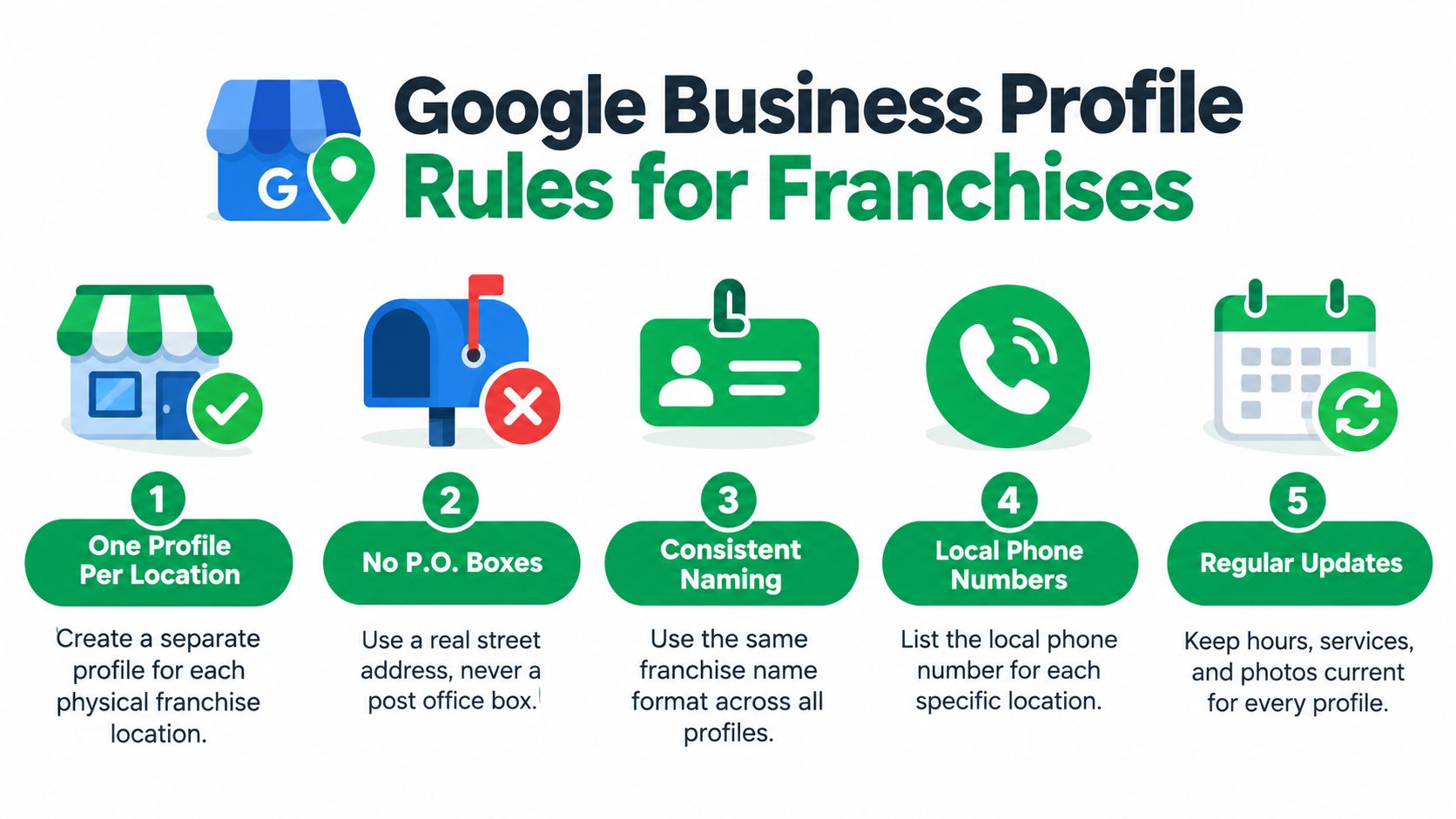
Google's business representation guidelines generally allow one Business Profile per location, require a real-world address rather than a P.O. box or remote mailbox, and say service-area boundaries should generally extend no farther than roughly two hours of driving time from the base. They also call for consistent names and categories among franchise locations providing the same service, with contact information representing the individual branch.
Verify the operating reality first
Start with evidence from the operator, not an old territory spreadsheet. Confirm the operating address, customer-facing business name, contact details, available services, and whether customers visit the premises.
Use this setup sequence:
- Check existing profiles: Look for an existing branch listing before creating another. Resolve ownership questions rather than building around them.
- Confirm the business model: Establish whether the branch receives customers, travels to customers, or does both. Configure its address visibility and service area accordingly.
- Apply naming standards: Use the official business name. Don't append a list of nearby cities or promotional claims.
- Choose accurate categories: Standardize categories for equivalent operations, while documenting legitimate differences in services.
- Connect the branch: Use its approved phone number and location-specific website destination, then confirm that both work.
Complete the remaining profile information from approved branch records. Assign an operator to confirm changes before corporate publishes them, especially around holiday schedules and temporary closures.
Send edge cases to an exception queue
Co-located franchises deserve individual eligibility reviews, not automatic approval because they have separate franchise agreements. Ask what operates at the address and document the distinction before proceeding.
For mobile-only operators, establish the actual operating base and service model. Don't substitute a rented mailbox to create an appearance of coverage. Google's guidance permits separate service-business locations only when they have separate staff and service areas.
Seasonal locations need their own documented review and update process. Avoid copying settings from a year-round branch without checking the applicable requirements.
When corporate records conflict with an operator's address, pause the submission and reconcile the evidence. A consistent mistake is still a mistake. The standard should help staff publish correct information, not encourage them to force every branch into an unsuitable template.
Building Location Pages That Actually Rank
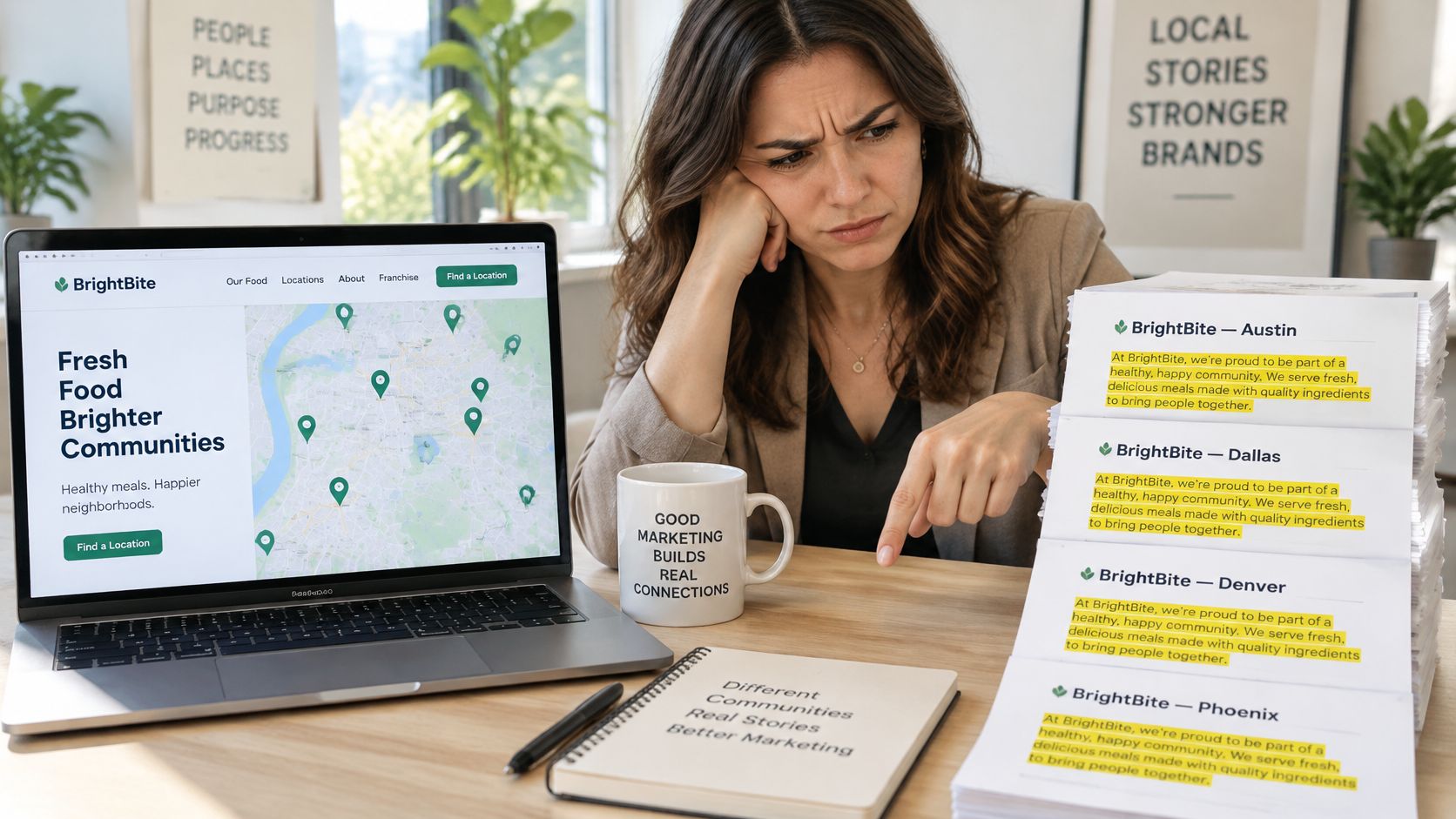
A city name inserted into corporate copy isn't meaningful localization. It's a label. The page still needs to explain why a customer should choose that particular branch and how to use it.
Google identifies relevance, distance, and prominence as its primary local ranking factors. Its local ranking guidance connects prominence with signals including links, review quantity, and ratings, while recommending complete business information to support relevance. My recommendation is to treat a thin location page as unfinished customer information, not as a finished SEO asset.
Standardize the structure, not the local evidence
Use a shared page system on the main brand website unless there's a clear contractual or operational reason not to. Give each branch a stable destination and make it reachable through a browsable location directory, not just an interactive locator.
The template should distinguish reusable components from information operators must supply:
| Standardize centrally | Require branch-specific content |
|---|---|
| Navigation and accessible page components | Address, contact details, and operating hours |
| Brand service descriptions | Services actually available at that branch |
| Booking and enquiry components | Local booking destination and availability information |
| Photography standards | Current premises and team photographs |
| Content review process | Access instructions, parking, and local questions |
For example, a restaurant page could explain its actual pickup entrance and whether catering is available from that branch. A service franchise could describe its genuine coverage area and how customers arrange an appointment. These are editorial examples, not claims about a particular business.
Build a useful local destination
Use local SEO keyword research to identify the language customers use for the branch's services. Then answer the underlying questions rather than repeating place names throughout the copy.
Include a working map, useful driving directions, and accurate neighborhood references where they help customers arrive. Display the same approved contact and operating details customers encounter on the branch's profile. Give mobile visitors obvious calling and booking options.
A location page should answer the questions an operator hears before a customer visits.
Link relevant service pages to the branches that provide those services, and connect location pages back to useful service information. Keep those links selective and understandable.
Let franchisees contribute through structured fields and editorial review. Their local knowledge is valuable; unrestricted publishing access isn't a content strategy. Finally, feed the page's structured data from its approved location record so technical implementation doesn't become another independent version of branch information.
Citation Management and NAP Consistency at Scale
Citation management is maintenance, not a submission campaign. Treat every listing as a customer-facing record with an owner, a correction process, and a history of changes.
NAP means name, address, and phone number. Start by establishing an approved location record that also includes the branch's website destination, operating status, and hours. Don't ask a vendor to distribute information until someone accountable has confirmed it.
Prioritize customer consequences
Audit the platforms customers use to find or contact your branches, such as Google Maps, Apple Maps, Bing, Yelp, and relevant industry directories. Assess aggregators by the destinations they supply and the corrections you can verify, not by the size of a distribution package.
Use this Citation Audit Priority by Data Point table as a triage framework. The ranking column deliberately avoids invented impact scores.
| Data Point | Common Drift | Ranking Impact | Fix Effort |
|---|---|---|---|
| Business name | Old branding or added keywords | Relevance concern; no fixed lift assumed | Straightforward if access is available |
| Address | Previous premises or missing suite | Location ambiguity; investigate promptly | May require ownership resolution |
| Phone number | Former operator's contact details | Don't assume a ranking effect; prioritize lost-contact risk | Simple after control is established |
| Website destination | Corporate homepage or retired page | Relevance concern, not a guaranteed ranking change | Usually straightforward |
| Hours and status | Incorrect closures or holiday hours | No standalone ranking claim | Requires operator confirmation |
For the initial audit, compare exported or manually collected records against the approved branch register. Categorize exceptions by customer harm and access difficulty. A disconnected phone deserves attention before harmless punctuation differences.
Make corrections survive staff changes
A repeatable local SEO citation management process needs more than a spreadsheet of submissions. Require proof that a correction is live and record unresolved dependencies.
- Use organizational access: Avoid relying on a former employee's personal account.
- Record listing ownership: Identify whether corporate, the franchisee, or a provider administers each record.
- Separate supplied listings: Distinguish corporate-managed directories from listings an operator created independently.
- Trigger lifecycle updates: Include relocations, ownership transfers, rebrands, and closures in the correction workflow.
- Schedule recurring audits: I recommend a quarterly review, supplemented by immediate checks after material changes.
Don't turn citation work into a race to accumulate obscure directory placements. Accurate records on relevant destinations are a more defensible priority than a large submission count.
Give procurement the same instruction. A vendor's job isn't finished when it sends data; your team needs visibility into rejected edits, inaccessible listings, and unresolved duplicates. Otherwise, corporate pays for distribution while operators continue fielding complaints about incorrect information.
Review Generation Without Running Afoul of the FTC
A review program belongs partly to marketing and partly to operations. Marketing can send requests and manage responses. Only the operator can fix the service issue behind a recurring complaint.
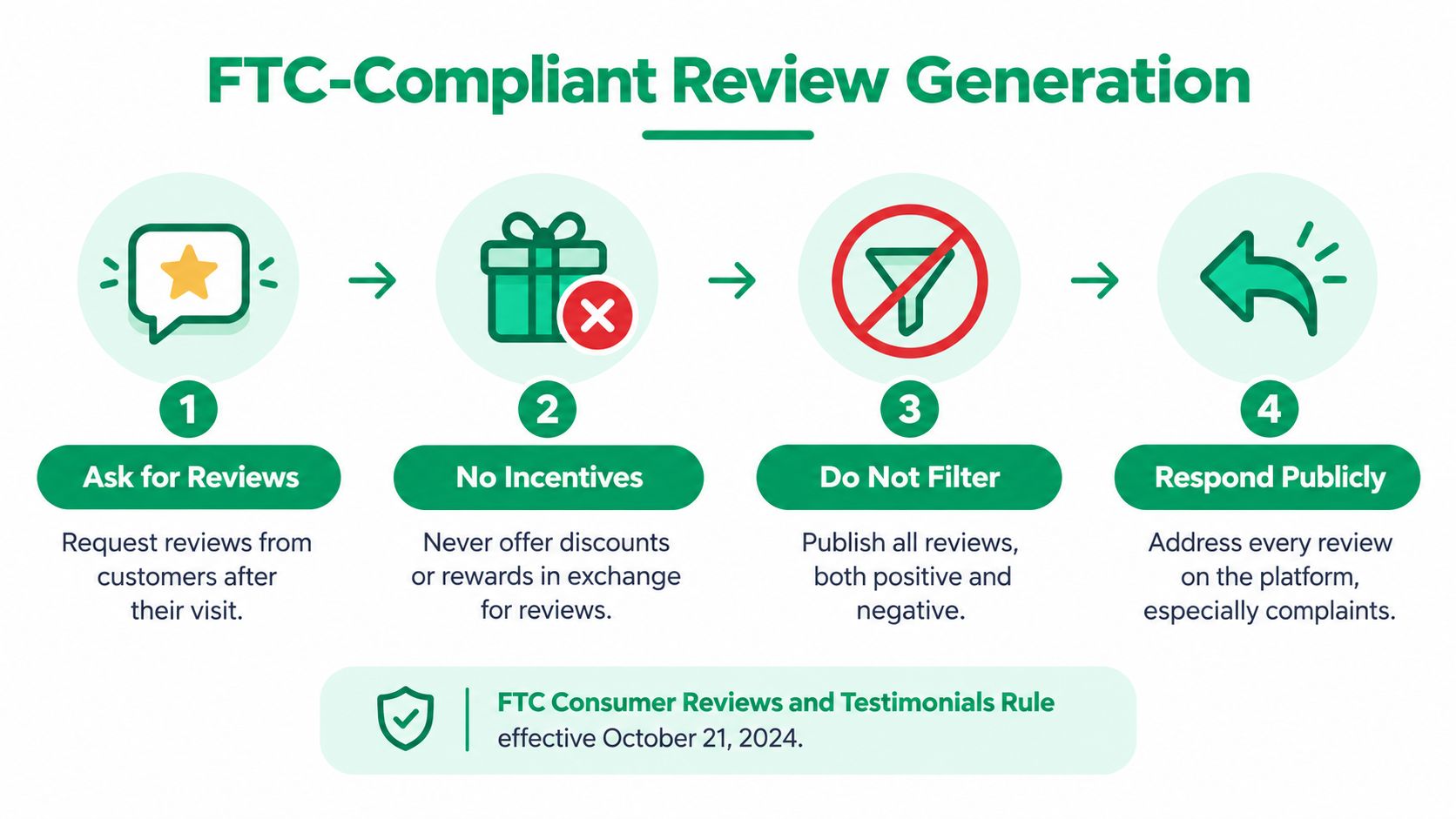
The FTC's Consumer Reviews and Testimonials Rule took effect on October 21, 2024. It prohibits fake-review practices, compensation conditioned on positive or negative sentiment, and certain forms of review suppression through threats or intimidation, with civil penalties possible for knowing violations.
Ask consistently without steering sentiment
My recommendation is stricter than the rule's sentiment-conditioned incentive prohibition: offer no review incentives at all. That simplifies franchise training and avoids arguments about whether an offer influenced the outcome. Check each platform's requirements as well.
Use neutral post-transaction requests, appropriate email follow-ups, and in-location signage. Don't screen customers by satisfaction before deciding who receives the public review invitation.
Give operators a location-specific Google review link and approved request language. Make the invitation easy to use, but leave the customer free to describe the experience.
The FTC's infographic-level principles need practical interpretation: don't selectively suppress legitimate criticism, but don't treat obvious spam or unlawful content as something you must republish. Route disputed material through a documented moderation process.
Put freshness and response ownership into the SLA
Review freshness deserves its own reporting field, separate from lifetime rating. SOCi's local SEO statistics compilation reports that 74% of consumers trust reviews from the previous three months and 47% won't use a business with fewer than 20 reviews.
Set a location-level service-level agreement, with workload-appropriate deadlines agreed by operators and marketing:
- Request ownership: Identify who triggers invitations after eligible transactions and who checks whether the process is working.
- Recency monitoring: Review recent activity and unexplained gaps, without imposing quotas that encourage pressure.
- Response responsibility: Assign a responder, an agreed response deadline, and backup coverage.
- Escalation: Send safety, discrimination, privacy, and legal concerns to designated specialists.
- Operational follow-through: Categorize recurring complaints and assign corrective actions to the branch manager.
Don't ask marketing to repair a service failure with a better-written apology.
Use response templates as prompts, not scripts. Staff should acknowledge the actual issue, avoid exposing personal information, and explain an appropriate next step.
Finally, document suspicious-review escalation. The FTC's explanation of knowing violations says businesses don't have a general duty to investigate every review, but obvious warning signs matter. Don't republish questionable praise because it improves a branch's average.
Local Schema, AI Visibility, and the Measurement Layer
Don't let AI discovery become an excuse to abandon conventional local search. BrightLocal's research on AI and local-business discovery reports that 45% of consumers used AI tools for local-business recommendations in 2026, while 75% of AI users checked Google or Google Maps before contacting a business.
That calls for cross-channel measurement, not a wholesale budget transfer. Compare what customers can discover, whether the information is accurate, and what happens after they engage.
Connect structured data to approved records
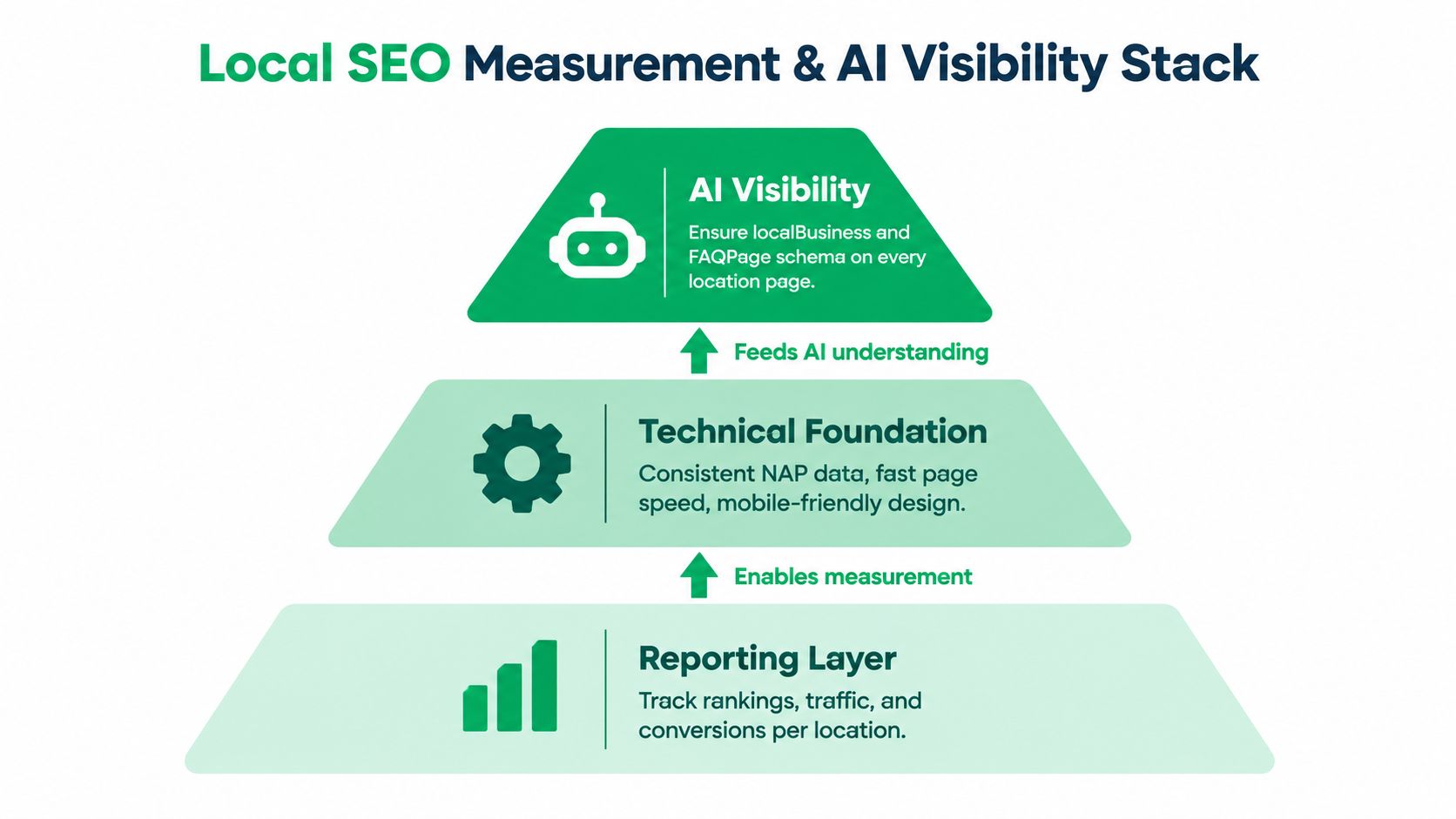
Implement LocalBusiness structured data appropriate to each location, using the same approved details displayed on the page. Maintain a branch-specific service catalog and reconcile it with available Business Profile services and attributes.
Use FAQPage markup only where the page contains suitable, visible questions and answers. Don't add it mechanically to every page or promise special search treatment. Treat schema markup for SEO as a technical representation of real content, not a substitute for it.
Validate the implementation after template changes. Keep mobile usability, page performance, booking functionality, and accessible contact options in the same technical quality-assurance process.
Separate discovery from business outcomes
Create a shared reporting dictionary so corporate and operators mean the same thing when they discuss a lead or visit. Keep these measurement layers distinct:
- Discovery: Local search visibility, branded searches, and AI recommendation appearances.
- Engagement: Profile interactions, location-page sessions, calls, and direction requests.
- Business outcomes: Qualified enquiries, bookings, and visits recorded through an appropriate operational system.
A direction request isn't a confirmed store visit. A call isn't automatically a qualified lead. Label those distinctions plainly instead of inflating the executive report.
For AI monitoring, maintain a repeatable set of local recommendation questions across markets. Record the tool, query wording, location context, date, recommendation, and factual errors. Treat the result as an observed sample, not a definitive ranking or a guarantee of what every customer sees.
Corporate should see exceptions, regional comparisons, compliance status, and outcome trends. Franchisees need their own branch's unanswered reviews, inaccurate records, lead quality, and outstanding actions.
Resolve attribution rules before presenting results to finance. Where call tracking is appropriate, preserve a documented mapping to the branch's approved contact record. Compare marketing activity with bookings or transaction records where feasible, but label uncertain attribution clearly.
A credible dashboard distinguishes what you observed from what you inferred. That's how you prevent a metrics argument from replacing an operating decision.
A 90-Day Rollout Plan for Franchise Local SEO
Use the following as a proposed implementation schedule, not a promise of ranking improvements. Start with the dependencies that could block publication, then expand only when operators can sustain the work.
Sequence the work around accountable owners
- Weeks 1–2, governance and eligibility: Corporate marketing, legal, and franchisee representatives approve decision rights. Confirm account access, location records, profile eligibility, and the exception queue.
- Weeks 3–6, pages and data cleanup: Web, SEO, and operators publish approved location content, validate structured data, and complete the citation baseline audit. Fix customer-blocking errors before polishing optional content.
- Weeks 7–10, review operations: Customer-experience staff, legal, and branch managers implement neutral requests, response training, and complaint escalation. Test the workflow with real operational handoffs.
- Weeks 11–12, reporting and adjustment: Analytics and marketing reconcile definitions, establish AI visibility observations, and deliver an executive read-out with branch-level actions.
Protect the launch from predictable delays
Plan contingency time for inaccessible accounts, disputed address information, and missing operator approvals. These are dependencies to assign and escalate, not tasks to leave in an agency's backlog.
Until the final phase, deprioritize elaborate AI dashboards, optional content expansions, and exhaustive directory coverage. Don't postpone compliance, security, or corrections that affect customers.
Early progress should look operational: operators can submit changes, administrators can publish them correctly, review complaints reach responsible managers, and reporting distinguishes enquiries from completed business. Rankings remain useful, but they aren't the only evidence that the program is becoming manageable.
And don't declare victory because everything launched. Assign ongoing owners before the project team disbands. The rollout succeeds when branches can maintain the system without another corporate rescue campaign.
For strategy-led SEO, location-page development, and transparent reporting support, consider Mr. Green Marketing, LLC alongside your internal team or specialist providers. Request a free audit and performance report to identify franchise visibility gaps and prioritize the profile, website, and measurement work your operators can realistically maintain.
Leave a Comment
sing in to post your comment or sign-up if you dont have any account.