
A potential customer finds your business on Google, checks the listing on Yelp, and notices that the phone number is different. They try the first number, reach a disconnected line, and call the competitor that appears next in the results. You may never know the lead was lost.
That small mismatch is a citation problem. Local SEO citations form the quiet infrastructure behind local discovery, customer trust, and business verification. Yet many owners treat them like a one-time directory submission project. They add a few listings, forget about them, and move on.
Business information changes. Locations move, hours shift, phone systems get replaced, services expand, and old profiles stay online. A citation strategy needs to account for those changes.
Table of Contents
- Introduction
- What Local SEO Citations Actually Are
- Why Citations Matter for Local Rankings
- Where to Build Citations for Your Business
- NAP Consistency and Your Website as the Source of Truth
- How to Audit and Clean Up Your Citations
- Citations in the Age of AI Answers and Your Next Steps
Introduction
A local citation is more than a business profile sitting on a directory. It's a public reference to your business that helps customers and search systems answer basic questions: Who are you? Where are you located? How can someone contact you? What do you offer?
If those answers vary from one platform to another, people have to work harder to trust the information. Search engines also have to decide whether several listings refer to the same real-world business. That uncertainty can affect how confidently your business appears in local results.
The practical solution isn't to publish your details everywhere without a plan. It's to create a dependable business record, place it on the sources that matter, check how those details are represented, and correct conflicts when they appear.
This guide treats citations as an ongoing entity-data governance task, not a set-and-forget checklist. You'll learn what citations are, how structured and unstructured mentions differ, where to build them, which source should be corrected first when platforms disagree, and how to connect citation management with reviews, website relevance, links, and AI-generated local answers.
A simple cycle works well:
- Build accurate profiles on relevant sources.
- Audit every important listing and business attribute.
- Fix errors from the most authoritative source outward.
- Monitor changes before customers discover them.
Not glamorous work. Important work.
What Local SEO Citations Actually Are
A local SEO citation is an online reference to a business's core identity details, usually its name, address, and phone number, often shortened to NAP. Citations can appear on directories, review platforms, mapping services, chambers of commerce, local news sites, industry publications, and community websites.
Think of each citation as one piece of a concept map. Your business is the central entity. The surrounding references should point to the same name, location, phone number, website, hours, categories, and service information. The more clearly those references describe one real business, the easier it is for customers and search engines to reconcile them.
Citations usually fall into two groups.
Structured citations
A structured citation is a formal listing with dedicated fields for business information. A profile on Yelp, Nextdoor, or TripAdvisor might include the business name, address, phone number, opening hours, category, website, photos, and service description.
For example, a local landscaping company may have a Yelp profile that identifies it as “Green Valley Landscaping,” lists its street address and phone number, and places it in a landscaping category. That standardized format makes the information easy for customers to scan and for platforms to process.
Unstructured citations
An unstructured citation is a business mention within content that wasn't created as a directory record. A local newspaper might mention the landscaping company while covering a neighborhood improvement project. A gardening association might name it in an article about native plants. A community blog could list it among local service providers.
The mention may not contain every NAP field. Its value comes from context, such as the business being discussed in relation to a particular place, industry, service, or community.
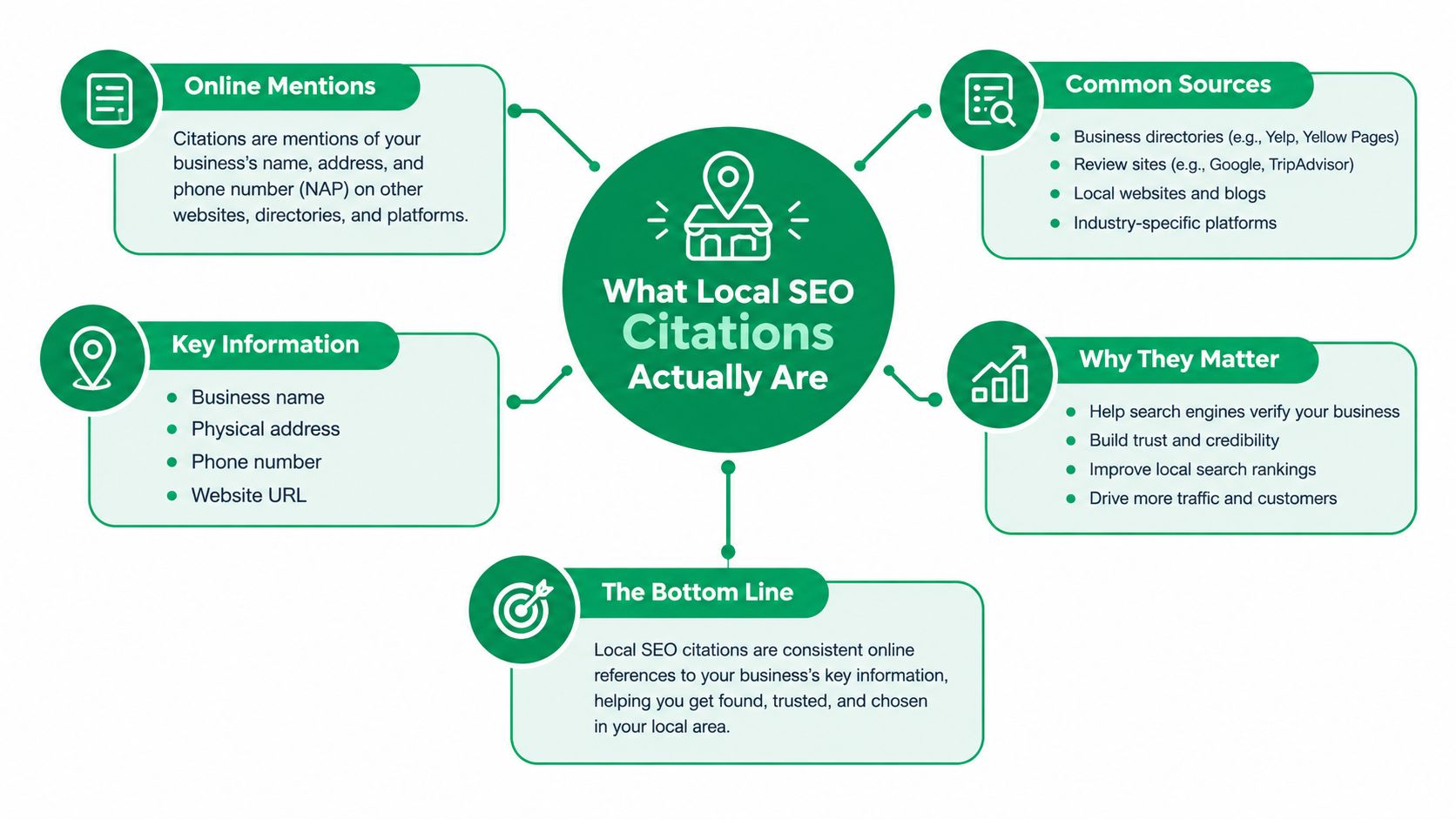
Search engines assess citation quality through four practical dimensions, accuracy, distribution, source quality, and topical or geographic relevance, as outlined in Moz's explanation of local ranking factors.
That explains why a large collection of weak listings isn't automatically useful. A handful of accurate profiles on respected, locally relevant, and industry-specific sources can provide a clearer entity record than a mass of incomplete or outdated submissions.
Why Citations Matter for Local Rankings
Google says local search rankings are based primarily on relevance, distance, and prominence. Relevance asks whether a Business Profile matches what someone searched for. Distance considers the searcher's location or a location included in the query. Prominence reflects how well known the business is.
Citations fit most naturally into prominence and entity understanding. Google says prominence can be informed by web-wide signals such as links, articles, directories, review count, and review scores, as explained in its official guidance on local search ranking. An accurate mention on a credible chamber website or industry directory can help corroborate that the business exists, serves a particular market, and is represented consistently across the web.
That doesn't make citations a magic ranking shortcut. Google doesn't publish a fixed number of citations required to rank, and citations can't compensate for an irrelevant website, poor reviews, weak service information, or a location that is too far from the searcher.
The ranking factors in context
| Ranking Factor | What Google Measures | How Citations Contribute |
|---|---|---|
| Relevance | How closely the business profile matches the search | Accurate categories and service descriptions reinforce what the business offers |
| Distance | How far the business is from the searcher or the location in the query | Consistent location details clarify where the business operates |
| Prominence | How well known the business is across web-wide signals | Credible directories, articles, and local mentions support broader recognition |
Citations are best understood as the hygiene floor. Before a business competes strongly through reviews, relevance, prominence, and customer experience, its basic identity data needs to be dependable. Correcting a wrong address won't automatically put a business at the top of the map results, but leaving conflicting addresses in place creates avoidable friction.
That friction affects people as much as algorithms. BrightLocal's 2024 survey of 1,141 U.S. consumers found that 36% used two review sites when deciding whether to use a local business, while 41% used three or more. In total, 77% used at least two review platforms, and 75% always or regularly read online reviews in 2024, according to the BrightLocal local consumer review survey.
A customer may discover you through Google, verify your reputation on a review site, check directions in a map app, and visit your website before making contact. If the phone number, opening hours, or address changes between those steps, the customer has to resolve the contradiction. Many won't.
For a broader look at how local visibility fits into search strategy, see local search optimization guidance.
Where to Build Citations for Your Business
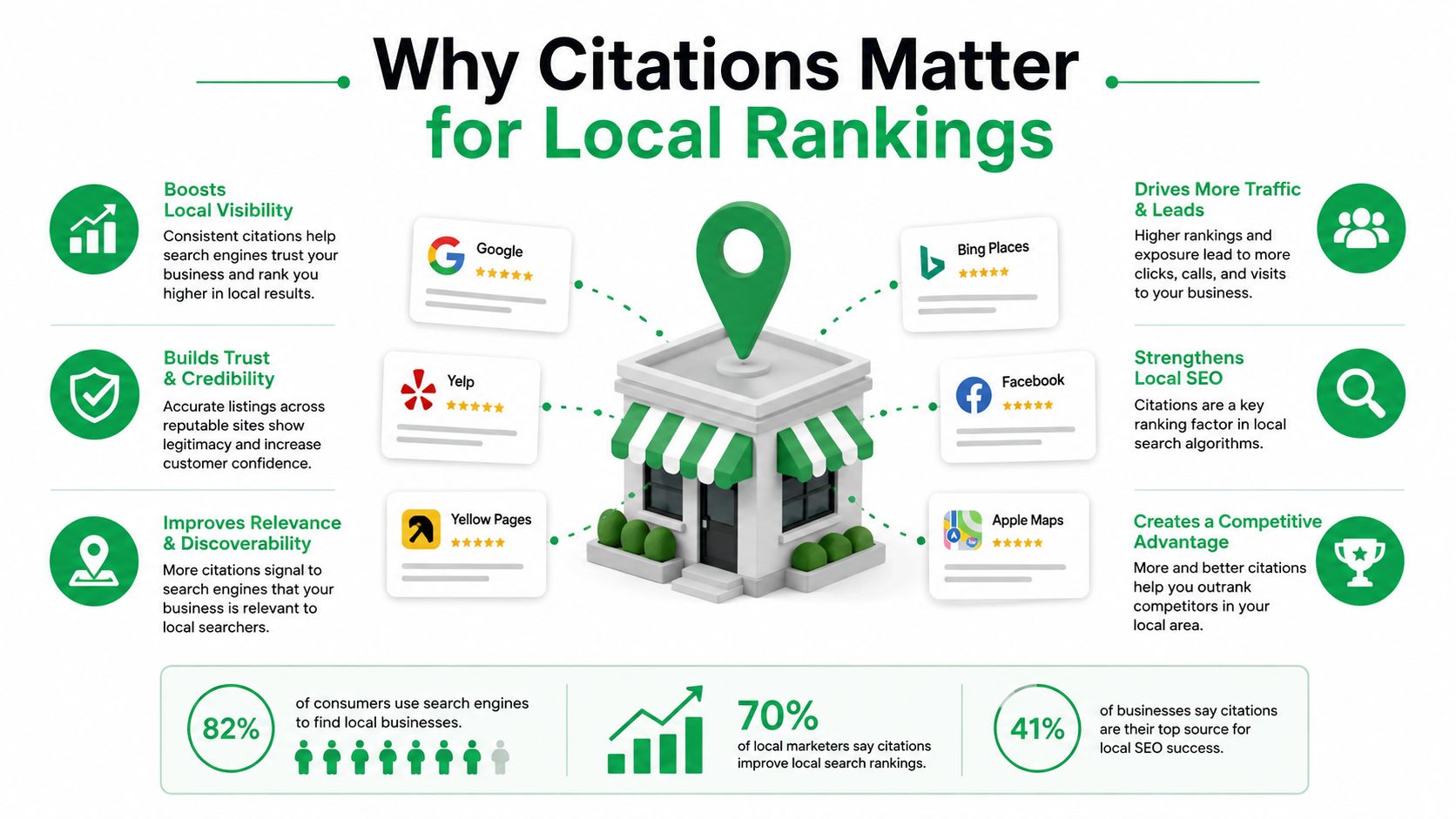
You don't need to list your business on every website that accepts submissions. Start with the platforms customers use and the sources that best describe your location or industry.
A useful approach is to work through three tiers.
Tier one includes major map and discovery ecosystems
Begin with your Google Business Profile and the other major map ecosystems relevant to your customers. These profiles often provide directions, calls, website visits, opening hours, categories, and customer reviews in one place.
Your core profile should contain more than a name, address, and phone number. Check the primary and secondary categories, service descriptions, hours, holiday hours, website URL, photos, and location-specific information. A profile with a correct address but outdated hours still gives customers a misleading answer.
Tier two adds local and industry relevance
Next, identify sources that carry meaning in your market. A plumber may look for home-service directories and local trade associations. A law firm may prioritize legal organizations and regional business directories. A restaurant may need food, hospitality, tourism, and neighborhood platforms.
Chambers of commerce and local business organizations can be useful because they connect the business to a specific place. Trade associations can reinforce the connection between the company and its service category. You can find additional perspective on location-based visibility in this guide to GEO SEO.
Tier three covers local editorial mentions
Local news stories, neighborhood blogs, event pages, and community websites create unstructured citations. You can't always manufacture these mentions, and you shouldn't try to manipulate them with repetitive business details. Instead, participate in activities that create legitimate local context, such as community events, educational contributions, partnerships, and newsworthy projects.
| Platform tier | What to list or pursue | Why it matters |
|---|---|---|
| Major map ecosystems | Name, address, phone, hours, categories, website, photos, and services | Customers use these platforms to find, contact, and navigate to businesses |
| Industry directories | Business identity, specialties, service areas, credentials, and relevant categories | Topical context helps clarify what the business does |
| Chambers and local directories | Canonical business details, location, website, and organization membership | Geographic relevance connects the entity to its service market |
| Local media and community sites | Accurate business name, location, services, and editorial context | Unstructured mentions can add local and topical context |
The quality-over-quantity rule matters throughout this process. An accurate profile on an authoritative, locally relevant source is more defensible than a large batch of thin listings with missing fields, wrong categories, or outdated information.
A directory that nobody uses and no relevant organization recognizes may deserve less attention than the chamber page, trade association profile, or map listing customers check every day.
NAP Consistency and Your Website as the Source of Truth
NAP consistency means maintaining one canonical version of your business name, address, and phone number across important listings. The same discipline should extend to hours, website URLs, categories, service areas, and service descriptions.
Choose the official format first. Decide whether the business name includes a legal suffix, how the street address is written, how suite information appears, and which phone number customers should use. Then record those choices in a master document that staff and vendors can follow.
Small differences deserve attention when they create genuine confusion. A missing suite number can send a customer to the wrong office. An old phone number can route a lead to nowhere. A tracking number that appears on one listing but not another can make the business look like separate entities.
Use the website as the canonical record
Your own website should clearly identify each location and reflect the same information published elsewhere. For businesses with physical locations, Google's LocalBusiness documentation requires each location to be defined as a LocalBusiness entity and recommends the most specific available subtype, such as Restaurant, DaySpa, or HealthClub, for eligibility for Local Business rich results. The Google LocalBusiness structured-data documentation also makes clear that implementing markup doesn't guarantee that rich results will appear.
Structured data supports machine-readable interpretation, but it doesn't replace visible, accurate page content. A location page should show the business name, address, phone number, hours, services, and any relevant service-area details in a way customers can understand.
Handle exceptions deliberately
A rebrand, relocation, or phone-system change needs a controlled update rather than improvised edits. Update the canonical website record, then work outward through the highest-impact profiles and relevant directories.
Service-area businesses need particular care. Their mailing or office address may not describe the communities they serve, so their website and profiles should explain service areas accurately without presenting an ineligible or misleading storefront location.
When a platform disagrees with your master record, don't create a different version just to fit that platform.
Practical rule: Fix the canonical record first, then make every important listing match it.
If you're troubleshooting missing visibility at the same time, this guide to why a business may not show up in Google Search can help separate citation issues from broader local SEO problems.
How to Audit and Clean Up Your Citations
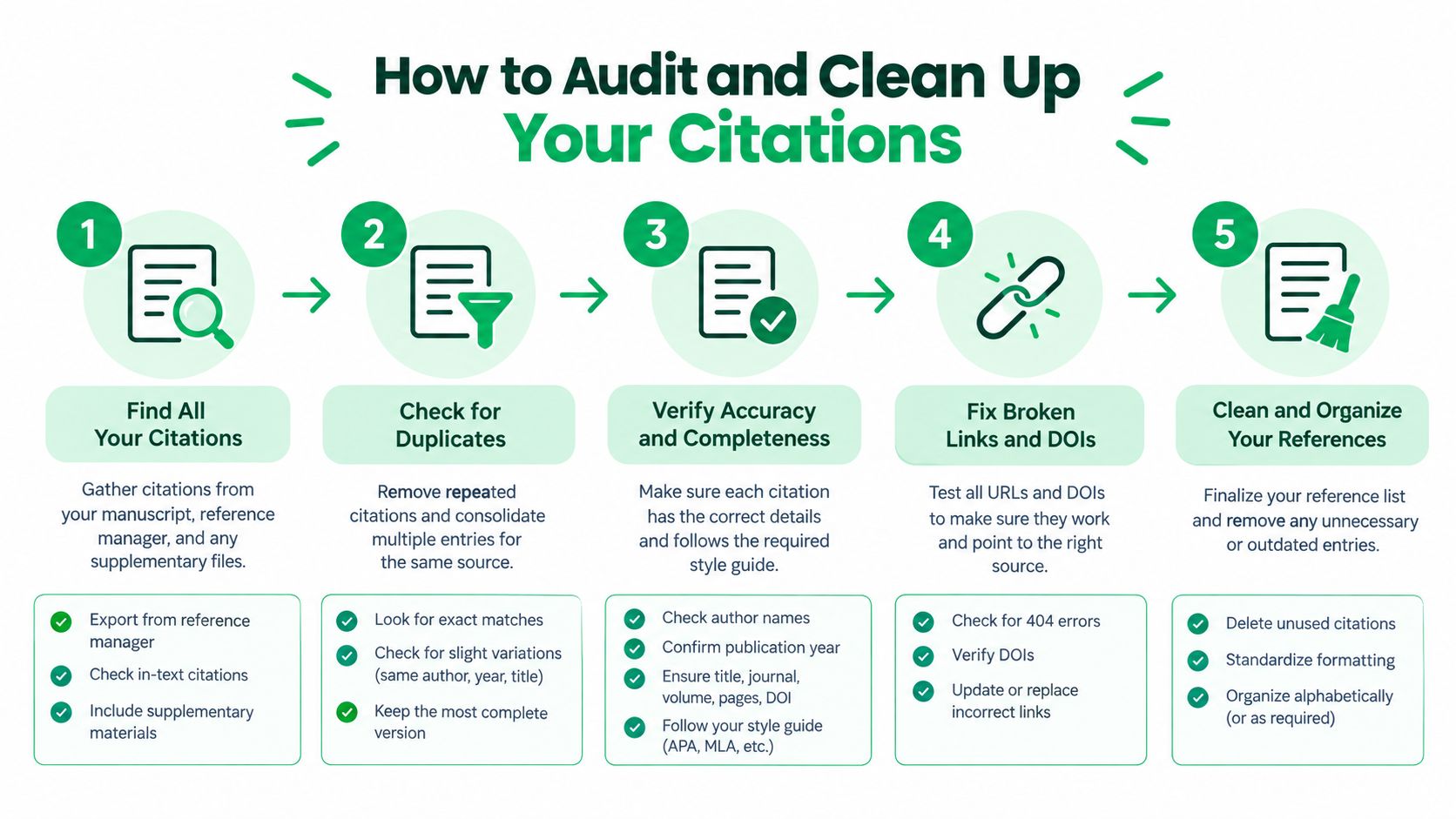
A citation audit should produce a working correction list, not a vague feeling that your listings look fine. Start with a spreadsheet or database for every location. Record the business name, address, phone, hours, categories, service descriptors, website URL, source, profile status, and correction notes.
Build the inventory
Search for the business name, old business names, old addresses, phone numbers, and location-specific variations. Review the major map ecosystems, review platforms, chambers, trade associations, industry directories, social profiles, and relevant local websites.
For each result, label the information as correct, incomplete, outdated, duplicate, or uncertain. Don't rely on the first page of Google alone. An old profile may not rank prominently but can still be found by customers or reused by another platform.
Use this local SEO audit checklist as a reference for organizing the wider review.
Classify by authority and relevance
Not every error deserves the same response time. Assign each source an authority and relevance level based on factors such as its role in local discovery, geographic connection, industry fit, and ability to influence other listings.
A major map profile, chamber record, or trade association entry should usually outrank a low-value directory in your correction queue. A niche platform can also be high priority if your customers use it to compare providers.
The historical context supports a proportional approach. A 2026 synthesis citing LocalSEOGuide's 2019 correlation study reported analysis of more than 300 factors across 200,000 businesses, while noting that citation-signal weight declined across Whitespark's expert surveys from 2018 through 2023 as review signals increased. Those findings don't make citation accuracy irrelevant. They show why businesses should clean up important sources instead of spending unlimited effort chasing volume. See the synthesis of local SEO ranking factors for that context.
Resolve conflicts in the right order
When two platforms disagree, correct the highest-authority source that you control or can verify first. Then use that corrected record to guide updates on the remaining profiles.
Fix the highest-authority source first, then work down the list by authority and relevance.
Claim duplicate listings where possible, merge them when the platform supports that action, and request removal or suppression when a duplicate creates real confusion. Don't delete a profile blindly if it contains reviews, ownership history, or useful customer information.
Create a monitoring routine
Citation cleanup isn't finished when the spreadsheet is marked complete. Business details change, platforms alter profile fields, and old pages can reappear. Review priority listings on a recurring basis and check them after a move, rebrand, phone change, new location, or major change in hours.
A practical monitoring routine includes:
- Recheck canonical details: Confirm the website and internal master record remain current.
- Review major profiles: Inspect maps, review platforms, and high-value local listings.
- Scan for duplicates: Look for old addresses, former names, and duplicate location records.
- Track unresolved cases: Keep ownership requests and platform disputes in one place.
- Update customer-facing attributes: Verify hours, service areas, categories, and URLs, not just NAP.
The aim is not perfect control over every mention on the internet. It's a dependable, prioritized system that catches meaningful conflicts before they become customer problems.
Citations in the Age of AI Answers and Your Next Steps
Local citations now matter beyond map results. AI assistants answer questions about nearby businesses by drawing on information from websites and other online sources. If your hours, service area, address, or eligibility details conflict across those sources, an AI-generated answer may repeat the wrong information or leave your business out of consideration.
A 2025 study analyzing 6.8 million citations from 1.6 million responses across ChatGPT, Gemini, and Perplexity found that websites supplied more than 40% of citations, while local websites contributed roughly 8% to nearly 20% in some query types. The same available research reported that 40% of local consumers don't rigorously fact-check AI sources, as described in research on AI citations and local user queries.
That makes your website part of the citation ecosystem, not just a destination for visitors. Clear location pages, accurate service descriptions, structured data, and consistent external profiles give systems better material to interpret. Answer engine optimization builds on that broader shift.
Start with this short checklist:
- Lock the canonical record: Confirm the official name, address, phone, hours, service areas, and descriptions.
- Correct the major map ecosystems: Prioritize profiles customers use for discovery and directions.
- Audit on a recurring basis: Recheck important listings after business changes and as part of routine maintenance.
- Connect the signals: Manage citations alongside reviews, website relevance, links, and customer experience.
Citations aren't a standalone tactic. They're the data-quality layer that helps customers, search engines, and AI systems understand the same business consistently.
Mr. Green Marketing, LLC offers audit-driven local SEO support that identifies citation and profile gaps, checks NAP consistency, and helps synchronize business information across important platforms. If you want an outside review of your local visibility, request a free audit and performance report through Mr. Green Marketing, LLC.
Leave a Comment
sing in to post your comment or sign-up if you dont have any account.