
What Is GEO SEO? Generative Engine Optimization, or GEO SEO, is the practice of positioning a brand and its content so AI platforms such as Google AI Overviews, ChatGPT, and Perplexity cite, recommend, or mention it in answers. AI discovery currently accounts for only about 0.13% of total sessions in a study of 1.96 million sessions, but that traffic is concentrated on high-intent pages, so referral volume alone can hide its commercial value.
That’s the counterintuitive part. GEO SEO isn’t necessarily valuable because it sends a flood of visits. It matters because a citation can influence a buyer before that buyer ever reaches your analytics platform, especially when the question involves a complex service, a trusted local provider, or a product comparison.
For local businesses, the phrase also overlaps with geographic SEO, the work of making a business visible for city, neighborhood, map, and “near me” searches. The modern practitioner has to manage both meanings. AI systems need clear, authoritative information about your brand, while local discovery systems need accurate location data, reviews, prominence, and engagement signals.
The result is a new operating model for search. Rankings still matter, but they’re no longer the finish line. You also need to know whether AI systems retrieve your business, describe it correctly, cite your pages, and contribute to leads or sales.
What Is GEO SEO: Table of Contents
- Why Traditional SEO Is No Longer Enough
- The Two Meanings of GEO SEO Explained
- How AI Search Engines Use Geographic and Content Signals
- Real Business Use Cases for GEO SEO
- The Measurement Gap Most Guides Ignore
- Practical Implementation Checklist for GEO SEO
- Making GEO SEO a Strategic Layer Not a One-Time Fix
What Is GEO SEO? Why Traditional SEO Is No Longer Enough
Traditional SEO is built around a familiar outcome: earn a strong position in the blue links, attract a click, and convert the visitor on your website. That model still deserves investment. Technical accessibility, useful content, internal linking, and authority remain foundational. But a user who asks ChatGPT, Perplexity, Gemini, or Google AI Overviews for a recommendation may receive a synthesized answer before seeing a conventional result.
The visibility target has changed from ranking alone to inclusion in the answer. Princeton researchers describe GEO as an optimization framework designed to improve visibility in generative engine outputs, where systems select, summarize, and cite information from multiple sources. Their description of the discipline is available through the Princeton publication on GEO.
That creates a practical distinction. SEO asks, “Can this page rank for the query?” GEO asks, “Can an AI system understand this page, trust its claims, extract a useful passage, and associate it with the right entity?” A page can perform well on one question and poorly on the other.
Practical rule: Don’t replace SEO with GEO. Make your existing SEO assets easier for both search engines and answer-generating systems to understand.
The discipline was formally introduced in the arXiv paper “GEO: Generative Engine Optimization,” first posted on November 16, 2023, by researchers associated with Princeton University, Georgia Tech, the Allen Institute for AI, and IIT Delhi. The paper marked an important expansion of SEO thinking, from indexing and ranking toward visibility inside generated answers. A useful history of that development appears in this overview of generative engine optimization.
For an SMB, the risk isn’t losing a position. It’s becoming absent from the shortlist that an AI assistant presents to a ready-to-buy customer. A plumbing company, law firm, medical practice, or software vendor might have a technically sound website, yet fail to appear because its service area, expertise, differentiators, and evidence aren’t stated clearly enough for retrieval and synthesis.
That’s why answer engine optimization and GEO belong in the same strategic conversation. Search now includes pages, maps, conversational interfaces, summaries, and recommendations. Businesses that measure only organic clicks will miss part of the buying journey.
What Is GEO SEO? The Two Meanings of GEO SEO Explained
“GEO SEO” creates confusion because it commonly describes two related disciplines.
The first is Generative Engine Optimization. This focuses on making a brand, page, product, or expert more likely to be selected and cited in AI-generated responses. The work centers on clear claims, explicit entities, useful structure, trustworthy evidence, and content that answers a question without forcing an interpretation.
The second is geographic SEO, often called local SEO. This focuses on location-based discovery through Google Business Profile, Google Maps, local landing pages, reviews, business directories, service-area information, and location-specific relevance.
They overlap because AI systems need geographic context when answering questions such as:
- Which dentist serves a particular neighborhood?
- What roofing company works near a specific city?
- Where can a buyer find a product locally?
- Which agency supports businesses in a defined market?
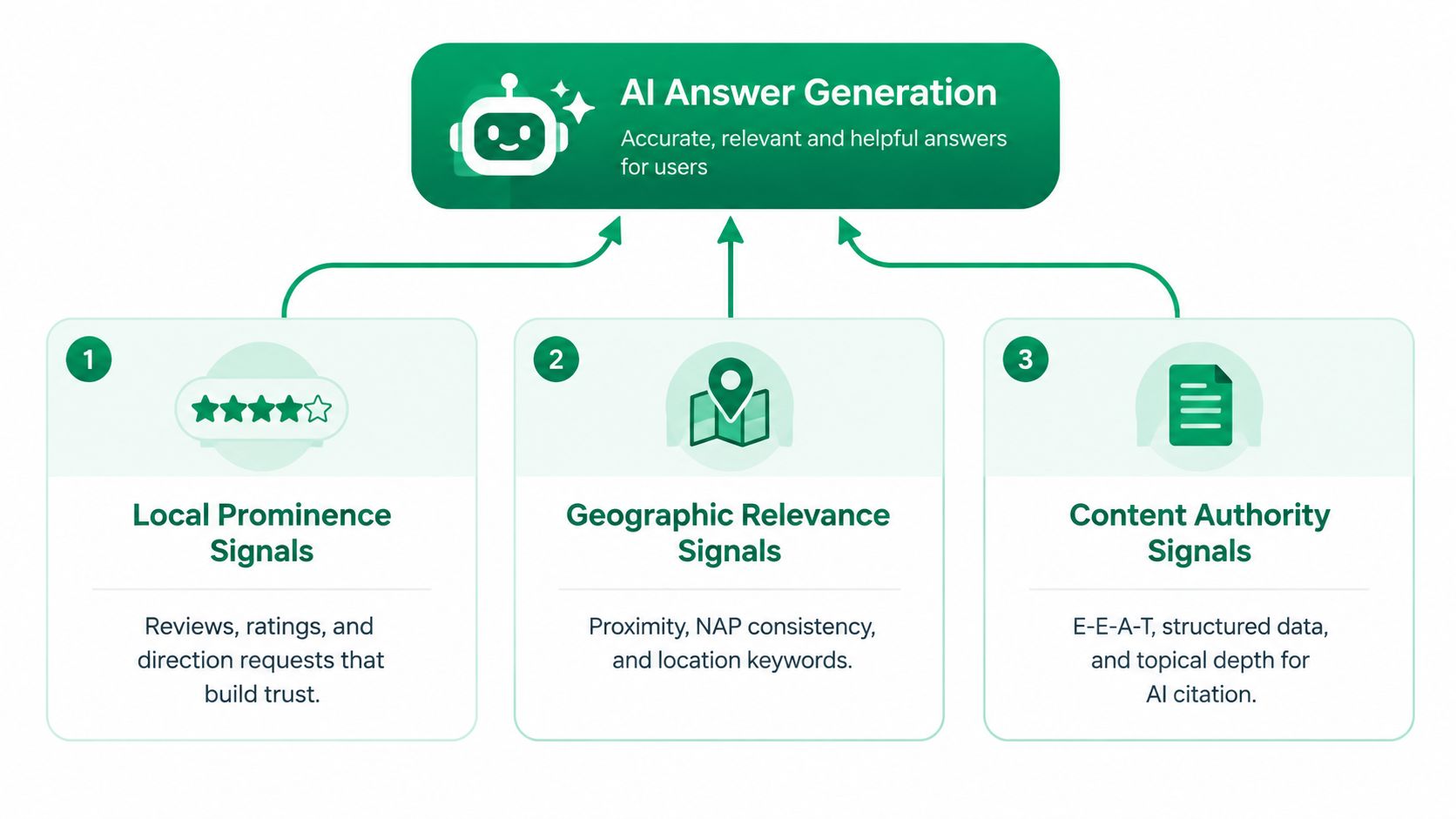
Generative optimization versus geographic optimization
| Discipline | Primary question | Useful assets |
|---|---|---|
| Generative Engine Optimization | Can an AI system accurately understand and cite the business? | Definitive service pages, expert content, structured claims, consistent entity descriptions |
| Geographic SEO | Can nearby searchers discover and trust the business? | Google Business Profile, reviews, local pages, citations, map signals |
| Combined GEO SEO | Can the business become a credible answer for a location-specific need? | Accurate location data paired with answer-ready, authoritative content |
The distinction matters because each discipline has different failure modes. A company may have excellent local visibility but weak explanatory content. It might appear on Maps yet fail to answer an AI question about pricing factors, service qualifications, or the difference between two solutions. Another brand may publish authoritative content but provide inconsistent addresses, incomplete service areas, or an unmanaged Google Business Profile.
Google Business Profile is especially important because it supplies local information across Search, Maps, and AI surfaces. More than 200 million businesses have listings globally, about 76% of those profiles are verified, and the Map Pack appears in roughly 93% of local searches, according to this Google Business Profile and local search guide.
The practical takeaway is simple: generative authority without geographic accuracy is incomplete, and geographic presence without useful authority is fragile. A local business needs both.
For a deeper local foundation, review this guide to local search optimization. It treats location visibility as an operating system rather than a page-level keyword exercise.
What Is GEO SEO? How AI Search Engines Use Geographic and Content Signals
AI search engines don’t rely on a single “GEO tag.” They assemble an answer from multiple signals, and those signals need to agree.
Start with the business entity. Your official name, service category, locations, contact details, expertise, and relationships should be easy to identify across your website, Google Business Profile, reputable directories, social profiles, and relevant third-party mentions. Inconsistent naming or vague service descriptions create ambiguity. A model may understand that a company exists while failing to connect it with the specific problem or market a customer is asking about.
Next, make important passages directly answerable. Put the answer near the question. State who you serve, where you operate, what you do, and why the service is relevant. Use descriptive headings, short paragraphs, lists, comparison sections, and clearly attributed evidence. Keyword repetition doesn’t compensate for unclear writing.
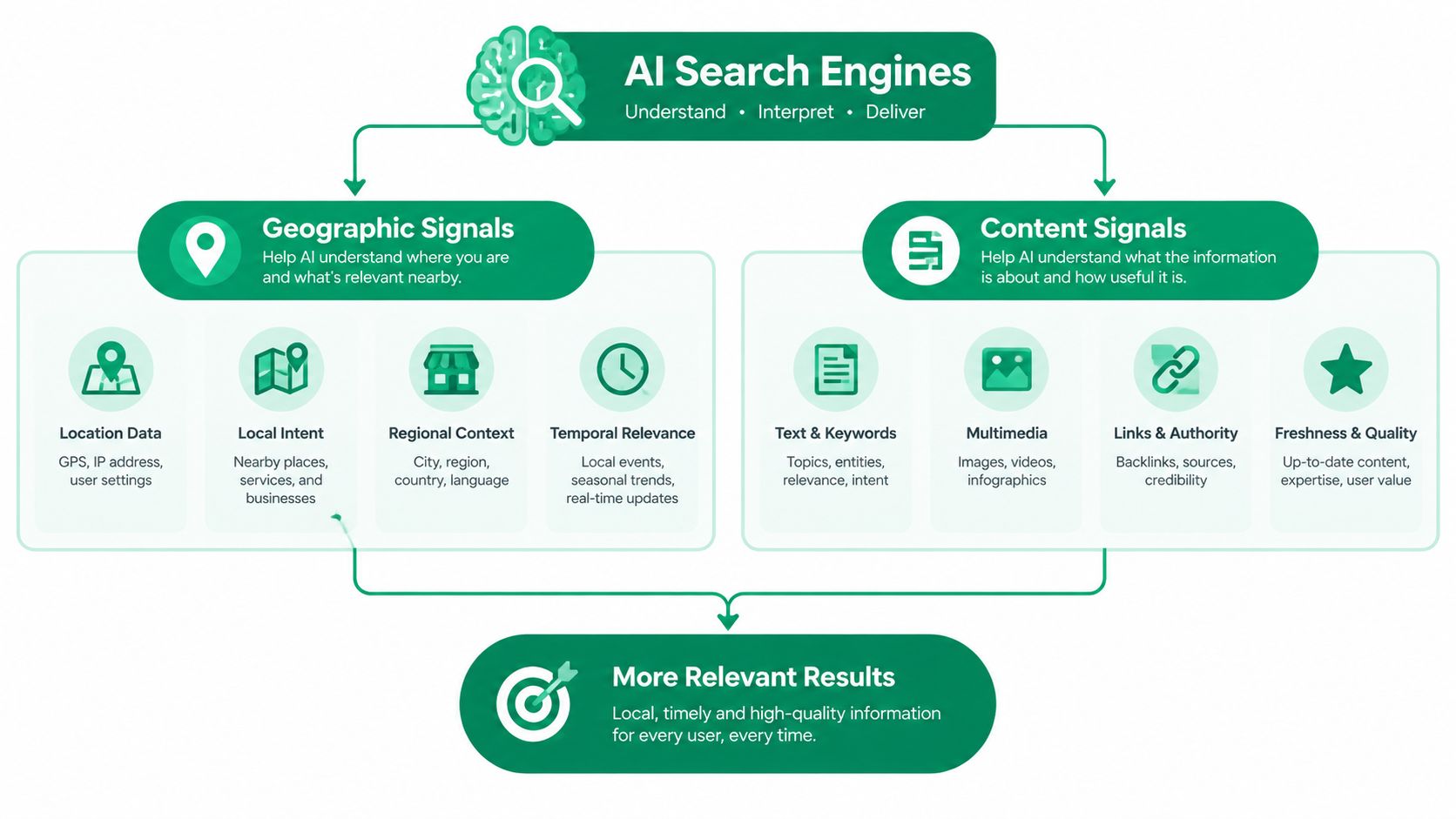
The local signals behind geographic visibility
Local prominence is compound rather than singular. Coverage of Google Maps signals identifies inputs including reviews, web query volume, listing impressions, direction requests, website clicks, chain membership, landmark information, and prominence. These signals don’t work as a checklist where one perfect field guarantees visibility. They collectively help systems assess whether a business is relevant, recognized, and useful for a local need. The details are discussed in this analysis of Google Maps ranking signals.
A practical workflow looks like this:
- Align the business entity. Use the same real-world business name and core details across important profiles. Don’t create artificial location pages or duplicate listings that confuse users and platforms.
- Strengthen the service-area relationship. Explain the locations you serve in natural language, connect each location to a real offering, and describe local customer needs rather than inserting city names mechanically.
- Earn and manage reviews. Ask customers for honest feedback, respond to concerns professionally, and watch for recurring service issues. Reviews contribute both trust and language that can clarify what customers associate with your business.
- Improve extractability. Use pages that answer specific questions about services, products, qualifications, availability, and selection criteria. Add relevant structured data where it accurately describes the page.
Google AI Overviews appeared in approximately 40% of local searches in a May 2025 study, according to this guide to Google AI Overviews and local visibility. That doesn’t mean every local query produces the same experience, but it does show why businesses should evaluate AI answer surfaces rather than treating them as a distant possibility.
Google AI Overviews also may not behave like a conventional proximity-based map result. A local-business whitepaper found effectively no correlation between distance from the searcher and ranking position inside AI Overviews once a business appears, with a reported correlation coefficient of 0.001. The finding suggests that relevance and authority can matter more than physical proximity within that specific AI surface, as described in this local AI Overviews visibility whitepaper.
That’s the important trade-off. You can’t abandon proximity and accurate local data, but you also shouldn’t assume distance alone will make an AI system recommend you. Strong GEO SEO combines location relevance with content that gives the system a defensible reason to include your business.
For implementation ideas that connect these principles to content and technical work, see how to optimize for AI search.
What Is GEO SEO? Real Business Use Cases for GEO SEO
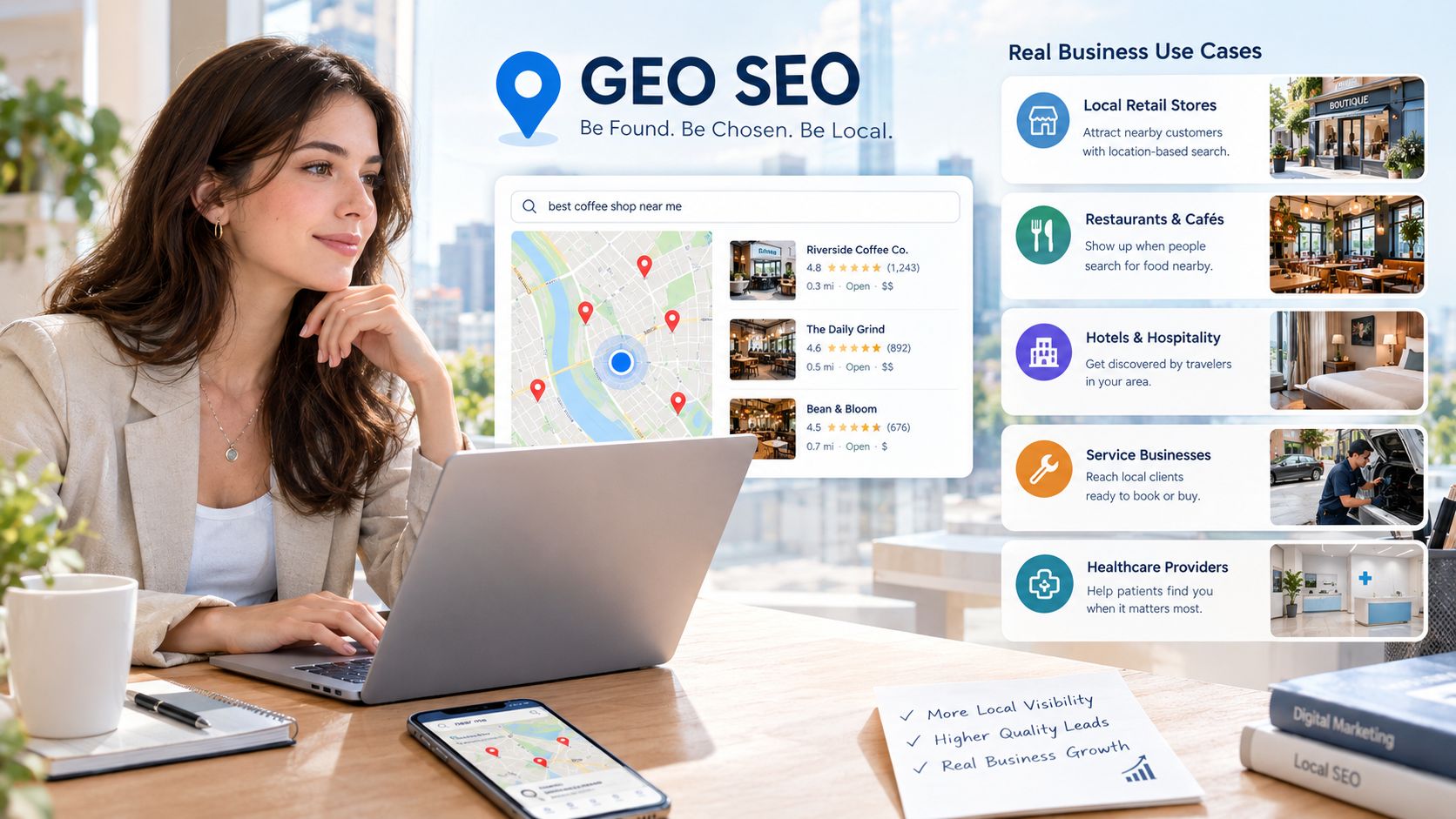
A local service provider might begin with a narrow question: “Who offers emergency HVAC repair near me?” The business needs more than a city keyword on its homepage. It needs a verified profile, accurate service areas, current hours, reviews that describe the relevant work, and a page that clearly explains emergency availability, equipment types, and what customers should do next.
The content should answer the questions an assistant is likely to synthesize:
- What emergency services does the company provide?
- Which communities does it serve?
- Can customers request service after normal business hours?
- What information should a customer provide when calling?
That structure gives local signals and generative systems usable material. It also creates a better landing experience for people who do click.
Product discovery for ecommerce brands
An ecommerce seller faces a different problem. Its products may be relevant to an AI shopping recommendation, but the model needs to distinguish the product from similar items. Product names, specifications, use cases, compatibility details, care instructions, and availability should remain consistent across product pages and important marketplace profiles.
A vague description such as “premium solution for everyday needs” gives an AI system little to work with. A precise description identifies the product, its intended buyer, the problem it solves, meaningful limitations, and the conditions under which another product may be a better fit. That candor can reduce immediate promotional language, but it improves decision usefulness.
The trade-off is between broad claims and specific utility. Broad claims sound polished. Specific facts are easier for a system and a buyer to verify.
What Is GEO SEO? Multi-location and franchise visibility
A franchise needs a shared brand entity and locally distinct evidence. Each location should have accurate address and contact information, a properly managed profile, location-specific services, local reviews, and a page that describes the market without copying the same text across every city.
Centralized templates help control quality, but excessive duplication weakens differentiation. Local teams should contribute genuine details, customer questions, community context, and operational updates. Corporate teams can maintain brand standards, technical structure, and measurement.
A multi-location strategy fails when every market looks like a renamed version of the same page.
The best use case is the one tied to a real customer decision. Don’t optimize for an abstract AI mention. Optimize for the questions that precede a call, appointment, purchase, store visit, or request for a quote, then measure whether those decisions move.
What Is GEO SEO? The Measurement Gap Most Guides Ignore
AI citations can influence revenue without appearing as referral traffic. In a study of 1.96 million sessions, AI discovery represented about 0.13% of total sessions, yet those sessions concentrated on high-intent pages and grew fastest in complex categories. The findings are summarized in a 2025 study tracking how AI discovery sessions distribute across high-intent pages.
A dashboard that sees a small AI referral line may recommend ignoring GEO. That conclusion misses how buyers behave. A person can encounter a citation, search the brand directly, return through another browser, call from a mobile device, or convert after several interactions. Last-click reporting assigns little or no value to that earlier exposure.
Change the measurement question from “How many AI visits did we get?” to “Which AI-visible pages assist valuable actions?”
Build an attribution system around intent
Track the journey at several levels:
- Citation visibility: Record whether priority prompts mention the brand, which competitors appear, and which pages or facts receive citations.
- Landing-page intent: Separate service, product, location, pricing, comparison, and contact pages from general informational content. These page types sit closer to a commercial decision.
- Assisted actions: Monitor phone calls, form submissions, appointment requests, quote requests, store visits, and purchases alongside direct referral sessions.
- Platform behavior: Segment ChatGPT, Perplexity, Google AI Overviews, Gemini, Claude, and other identifiable sources instead of placing every AI interaction in one bucket.
- Brand demand: Compare branded searches, direct visits, returning users, and conversion paths before and after meaningful GEO work.
ChatGPT accounted for 84.2% of AI referrals in that dataset, according to the same study. That concentration supports platform-specific monitoring, but referral traffic still cannot measure every useful interaction. Some interfaces answer the user without creating a trackable website session.
What not to do
Do not promise revenue from a citation that has no connection to a business action. A single prompt check cannot prove durable visibility, and a branded mention is not the same as a qualified recommendation.
Set a baseline, test a defined group of pages and prompts, annotate major content and profile changes, and review assisted conversions with sales or operations teams. This guide to measuring marketing campaign effectiveness offers a practical framework for connecting activity data with outcomes.
Strong GEO reporting may look less dramatic than a traffic screenshot. It identifies which pages became citation candidates, which queries led to commercial conversations, and whether those conversations produced qualified opportunities. For SMBs, that evidence supports budget decisions and separates useful visibility from attention that never reaches the business.
What Is GEO SEO? Practical Implementation Checklist for GEO SEO
Begin with the pages closest to revenue. A small business usually gets more useful insight from improving a service page, product page, location page, or comparison page than from publishing a broad article with no clear next step.
Make the answer easy to extract
Write a concise answer near the top of each priority page. Then add context, qualifications, examples, and next steps. Name the business, service, product, market, and relevant expertise explicitly. Avoid burying the key point beneath a long brand story.
Use headings that reflect real customer questions. Add tables or bullet lists where a buyer needs to compare options. Cite authoritative material when a claim depends on external evidence, and keep authorship and business credentials clear.
Schema markup for SEO can help search systems interpret page entities when the markup accurately matches visible content. It won’t manufacture authority, fix inaccurate information, or guarantee an AI citation.
Clean up local infrastructure
Audit Google Business Profile first. Confirm the category, business description, hours, service areas, contact details, photos, products or services, and review responses. Then check important third-party listings for inconsistent business information.
Ask customers for honest reviews that reflect actual services and locations. Don’t script testimonials or offer incentives that undermine trust. Review language can reveal the terms customers naturally use, which can inform service pages without forcing awkward keyword placement.
Decide what crawlers can access
Robots.txt can communicate crawler preferences, but it’s a request rather than enforcement. The file belongs at the root of each host, should be served as text/plain over HTTP 200, and compliant bots follow its User-agent and Disallow directives. Non-compliant scrapers can ignore it, as explained in this AI crawler robots.txt guide.
Before blocking an AI crawler, decide what you’re protecting and what visibility you may be giving up. Review server logs, access rules, important page status codes, XML sitemaps, and structured data. Don’t block access accidentally through a staging rule copied into production.
What Is GEO SEO? Test what systems can verify
Focus on questions where an AI system can retrieve and support an answer, such as service availability, location coverage, product attributes, qualifications, and clear comparisons. Search-agent reliability varies by query type, so test the queries that matter commercially rather than chasing every possible phrase.
Keep a record of prompts, dates, platform, answer wording, citations, and the page a user would need next. Fragments are useful here. A prompt log. A citation log. A conversion annotation.
Making GEO SEO a Strategic Layer Not a One-Time Fix
GEO SEO changes as your business changes, platforms change, and third-party information changes. A one-time content edit won’t maintain accurate locations, current services, review context, product details, or citation-worthy evidence.
Build a recurring process around three questions: Where are we being mentioned? What information is being repeated incorrectly? Which AI-visible journeys assist qualified revenue? Assign ownership for profile updates, content revisions, prompt testing, technical access, and conversion reporting.
Treat GEO as a layer across SEO, content, local operations, digital PR, analytics, and sales feedback. The practical outcome isn’t just more visibility. It’s a clearer understanding of how customers discover and evaluate your business when an AI system becomes the intermediary.
If you want to turn that framework into an operating plan, Mr. Green Marketing, LLC offers GEO audits, benchmarking of prompt visibility and citation share, content strategy, SEO, PPC, web design, and related digital marketing services. Visit Mr. Green Marketing, LLC to request a free audit and performance report focused on your visibility gaps and measurable growth opportunities.
Leave a Comment
sing in to post your comment or sign-up if you dont have any account.