
Local Search Optimization: 80% of local searches result in a purchase or direct customer action, and 76% of people who perform a local search on a smartphone visit a business within 24 hours, while 28% of those searches result in an immediate purchase. Those numbers turn local search optimization from a nice-to-have into a revenue channel.
This is the core understanding. This isn’t just about “ranking on Google.” It’s about showing up at the exact moment someone nearby wants what you sell, needs what you fix, or is comparing businesses before making a fast decision. If your business is hard to find, inconsistent, or thin on trust signals, you’re not just losing clicks. You’re losing ready-to-buy customers.
Local search optimization works a lot like being the most recommended business on the block. Your storefront has to be visible. Your business details have to match everywhere people look. And your reputation has to hold up when a customer checks reviews on their phone in the parking lot.
Local Search Optimization: Why Local Search Optimization Matters Now More Than Ever
When a person searches “near me,” “open now,” or “best [service] in [city],” they usually aren’t doing casual research. They’re trying to act. That’s why local search optimization produces such strong commercial outcomes. Local search optimization drives exceptionally high conversion rates, with 80% of local searches resulting in a purchase or direct customer action; 76% of people who perform a local search on a smartphone visit a business within 24 hours, and 28% of those searches result in an immediate purchase (Google local search data discussed here).
That behavior changes how you should think about marketing. A local searcher isn’t like someone browsing social media with half their attention on the couch. They’re closer to a customer standing outside your door, checking whether you’re open, legit, and worth calling.
It’s visibility plus trust plus convenience
A lot of business owners reduce local search optimization to city keywords on a website. That’s too narrow.
It’s better to think of it as your digital storefront across three places:
- Google Business Profile for maps, calls, hours, photos, and reviews
- Your website for proof, service detail, and conversion
- Third-party mentions for consistency and credibility
If one of those is weak, the whole system gets sloppy. A wrong phone number in a directory. Empty photos on your profile. Thin location pages copied across cities. Small problems, but they stack up.
Practical rule: If a customer has to work to understand who you are, where you serve, or how to contact you, local search optimization is already underperforming.
Local Search Optimization: Local intent is different from general SEO
Traditional SEO often chases broader informational traffic. Local search optimization is narrower and more urgent. That urgency is what makes it valuable.
Someone searching “how does HVAC work” may read for ten minutes and leave. Someone searching “AC repair near me” wants a provider. Fast. The businesses that win are the ones that remove friction: accurate profile, clear service area, strong reviews, working phone number, and a site that confirms the business is real.
Ignoring local search is like opening a great shop and forgetting to put up a sign. People may still find you. But many won’t bother.
Local Search Optimization: The Core Components of Local Search Dominance
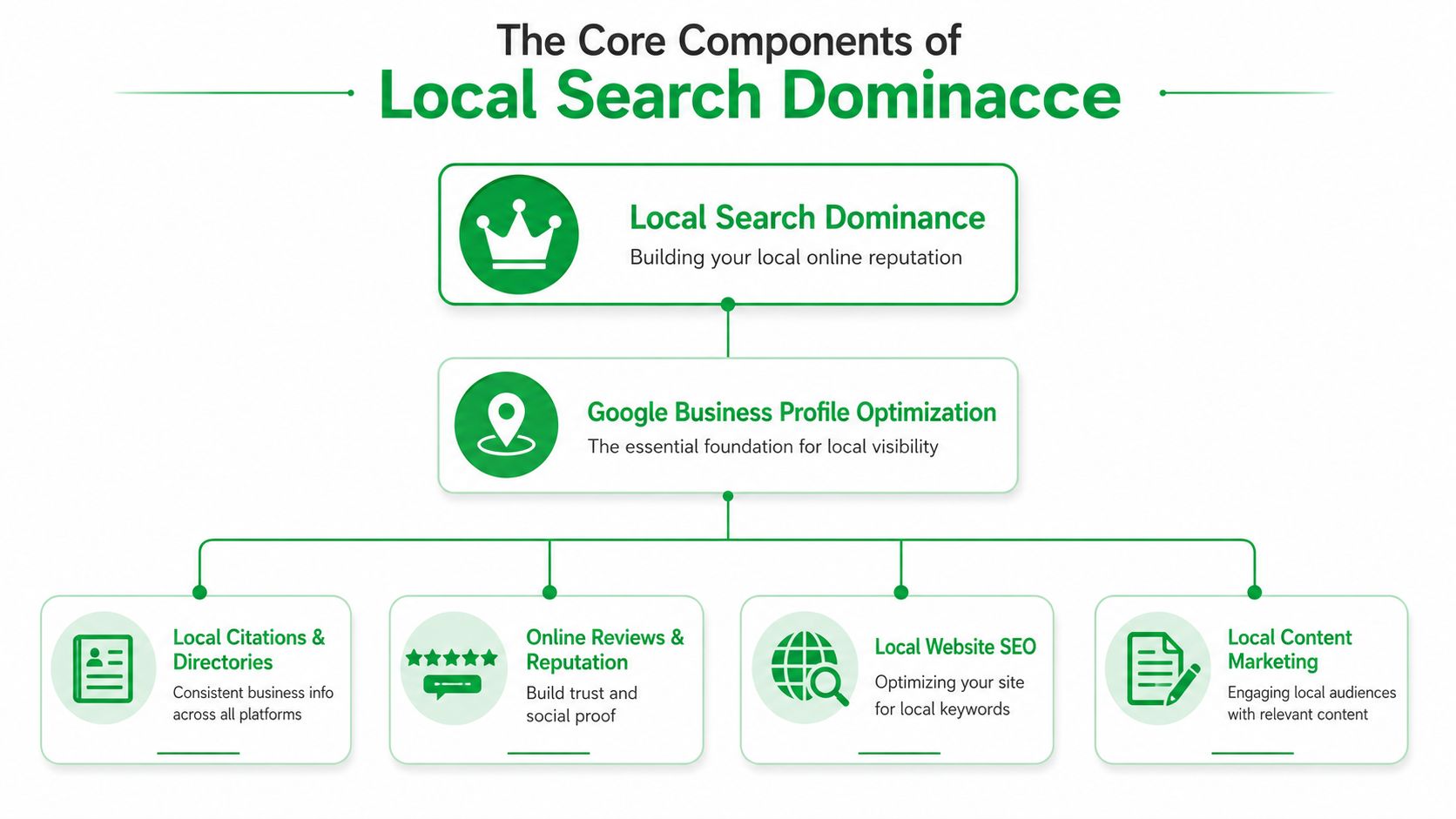
Local search dominance isn’t built from one trick. It comes from a few core assets working together. It’s similar to running a respected business in a small town. Your storefront matters. The local listings matter. And word of mouth matters.
Google Business Profile is the foundation
Your Google Business Profile is the center of gravity. It’s where prospects check your hours, read reviews, request directions, click to call, and compare you to nearby competitors.
And the ranking impact is hard to ignore. The Google Business Profile is the single most critical factor for visibility in the Local Pack, accounting for 32% of ranking influence. Businesses with a claimed and fully optimized listing receive 7x more clicks than those with unclaimed or incomplete profiles.
That gap is why I usually tell business owners to stop worrying about minor blog tweaks until their profile is fully built out. If your profile is incomplete, your website can’t carry the whole load.
A strong profile usually includes:
- Accurate basics such as business name, primary category, phone, address, hours, and service area
- Real business assets like current photos, services, attributes, and a business description
- Ongoing management including review responses, Q&A monitoring, and routine updates
Local Search Optimization: Citations are your consistency check
Citations are mentions of your business information across directories and platforms. Not glamorous. Still useful.
They work like the old phone book system, except now Google and customers are cross-checking everything. If your business name is spelled one way on your website, another way on a directory, and your old phone number still appears on a stale listing, you create confusion.
Here’s the trade-off. Citation work is usually not where the biggest upside lives after the basics are handled. But bad citation hygiene can erode trust. For small businesses, the goal isn’t to chase every obscure directory. It’s to standardize the important ones and clean up obvious errors.
| Component | What it does | What goes wrong when ignored |
|---|---|---|
| Google Business Profile | Drives map visibility and customer actions | Low visibility, weak engagement |
| Citations | Confirms business identity across platforms | Mismatched details, trust issues |
| Reviews | Builds credibility and influences choice | Lower conversion, weaker reputation |
Reviews are modern word of mouth
Reviews do two jobs at once. They influence customer choice, and they reinforce your local authority.
What works is simple. Ask consistently. Make it easy. Respond like a real person. What doesn’t work is waiting for reviews to appear on their own or using generic replies that sound copied and pasted.
A local profile with accurate details and no reputation management is like a clean storefront with nobody vouching for the business.
Local Search Optimization: Your website still matters
A business profile can get the click, but the website often closes the trust gap. Customers want to confirm services, pricing approach, neighborhoods served, and whether the company looks credible.
Through local website SEO and local content marketing, the core pillars receive support. Service pages, local FAQs, neighborhood references, and clear contact paths help validate everything your profile claims.
If your profile says one thing and your site says something vague, Google gets mixed signals. So do customers.
Your Quick-Start Local SEO Implementation Plan
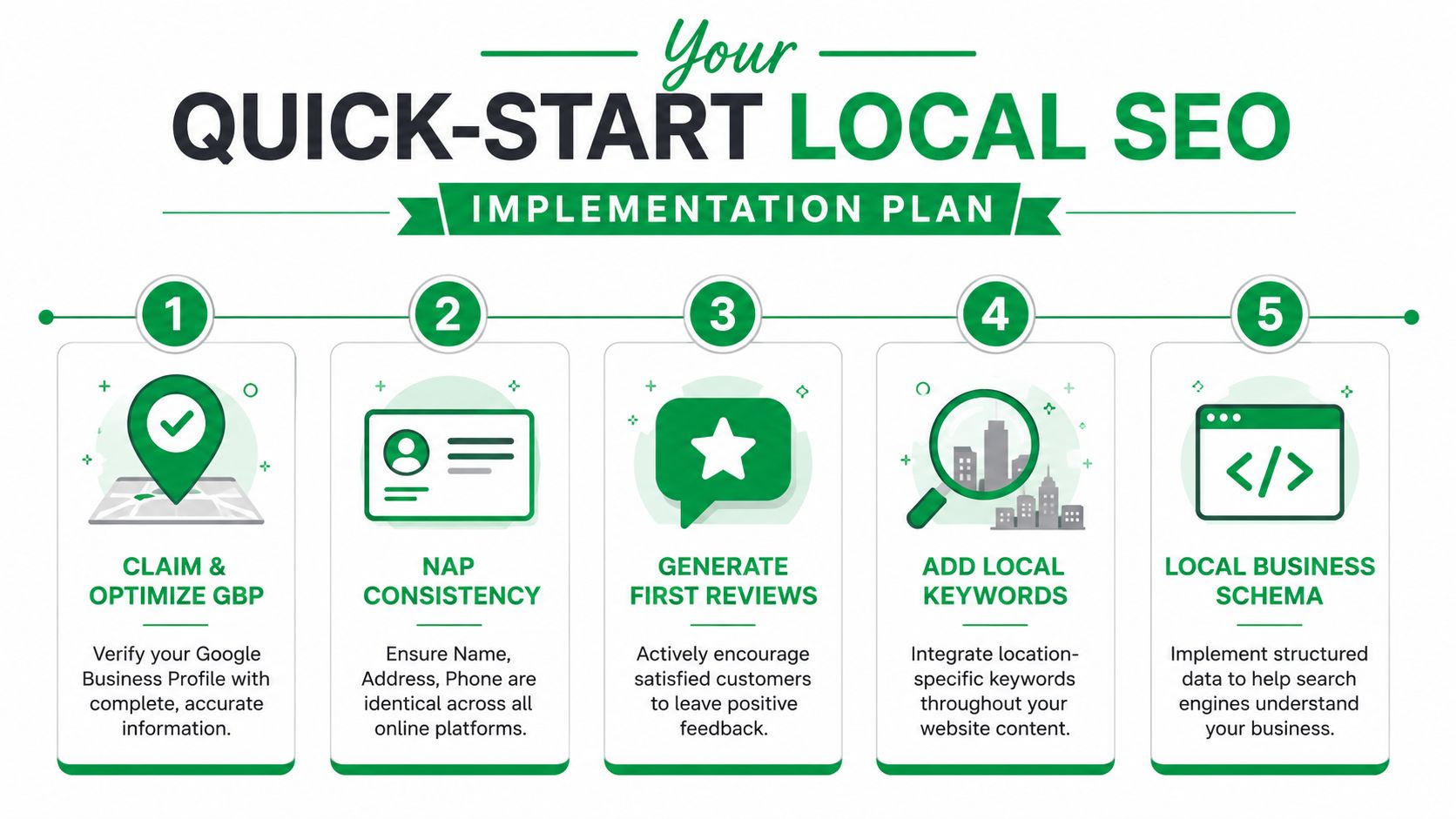
Most small businesses don’t need a giant local SEO playbook on day one. They need an order of operations. Start with the changes that affect visibility fastest, then build the foundation underneath.
Local Search Optimization: First fix the assets customers see immediately
If you only have a few hours this week, put them here.
- Claim and complete your Google Business Profile
Fill in every field that affects buying decisions. Categories, hours, services, phone number, business description, photos, and service area. Incomplete profiles leave money on the table. - Standardize your NAP everywhere
NAP means name, address, and phone. Pick the exact format and use it consistently on your website, Google Business Profile, Facebook, Yelp, Bing Places, Apple Maps, and major industry directories. - Set up a review request process
Don’t overcomplicate it. Ask satisfied customers soon after the service is complete. Use email or text. Make sure the request points them to the right profile.
These are quick wins because they affect both discovery and conversion. They also force you to clean up the basics that many businesses neglect for years.
Then strengthen your website for local relevance
After the profile and citation basics are handled, turn to the site. At this stage, many businesses either overbuild or underbuild.
You do not need fifty low-value pages stuffed with city names. You do need pages that clearly explain:
- What you do
- Where you do it
- Why someone should choose you
- How to contact or book you
For a single-location business, that usually means a solid homepage, clear service pages, a contact page, and at least some localized copy that reflects the actual market you serve.
For example, a dentist shouldn’t rely on a homepage that just says “quality care for your family.” That says almost nothing. A stronger version identifies the city, the specific services, and the patient concerns the office handles.
Field note: Local relevance comes from specificity, not repetition. Mentioning real neighborhoods, service details, and customer concerns beats stuffing the same city phrase into every paragraph.
Local Search Optimization: Add structured data early, not last
This is one of those technical tasks that sounds optional until you see how much context it gives search engines.
Implementing LocalBusiness schema with precise fields (name, address, phone, service area, and specific category like Dentist) directly increases a search engine’s ability to identify your location and display your business in the local pack, as newer AI Overviews rely on this structured data to validate geography (TerraHQ checklist on local schema).
In plain English, schema is a translator. Your website may be obvious to a human visitor, but search engines still benefit from structured confirmation about who you are and where you operate.
A clean starter stack looks like this:
- Homepage schema with business identity details
- Service page alignment so page copy matches your stated categories and services
- Location or service-area clarity so geography isn’t vague
If you’re using WordPress, tools like Rank Math or Yoast can help with parts of the setup, though custom implementation is often cleaner for multi-location businesses. For businesses that want outside support, Mr. Green Marketing, LLC offers local SEO and GEO work that includes technical SEO and AI-aware optimization.
Local Search Optimization: A simple self-prioritization checklist
Use this as your order of execution:
- Week one
Claim profile, verify details, upload photos, correct hours - Week two
Audit NAP across key directories, fix duplicates and inconsistencies - Week three
Build a review request routine and respond to current reviews - Week four
Tighten service pages, add local references, implement LocalBusiness schema
That’s enough to create a real foundation. Not perfect. But real.
Local Search Optimization: Advanced Strategies for Multi-Location and Service-Area Brands
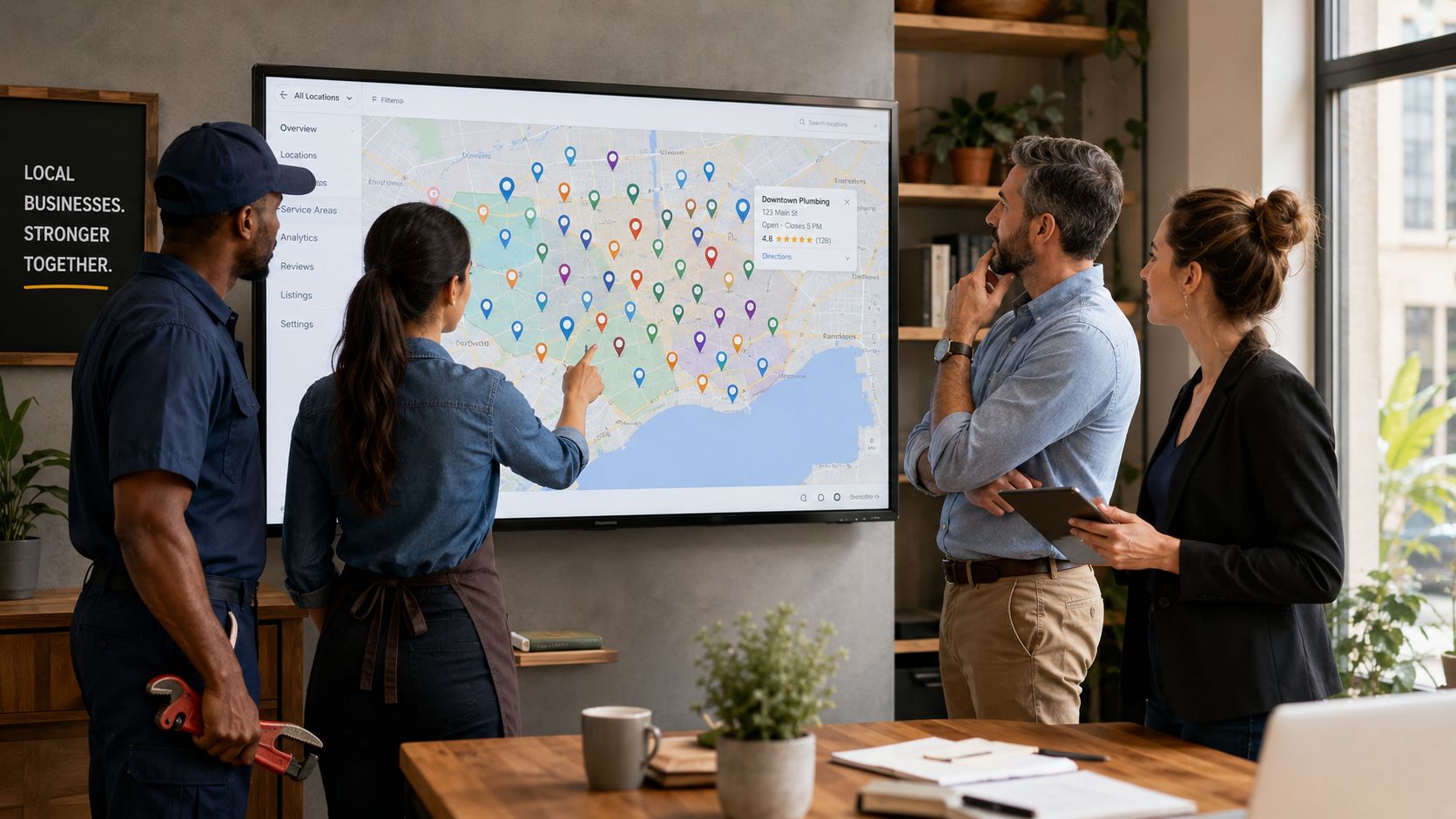
Once you move beyond one storefront, local search optimization gets more complicated fast. A ten-location brand can’t manage every market with copy-paste pages. And a service-area business can’t pretend it operates like a retail store with a visible address in every neighborhood.
Service-area businesses need a different playbook
This is the mistake I see all the time. A plumber, roofer, or cleaning company copies the local landing page strategy used by storefront businesses and ends up with thin city pages that don’t help.
The distinction matters. A critical, often-missed nuance is the difference between service-area businesses and physical-location brands. 78% of SABs rank worse when using generic location pages, whereas they gain 2.3x more conversions with hyper-local content mentioning specific neighborhoods or landmarks (Hill Media Group on service business local strategy).
That means generic “Plumber in Phoenix” pages often underperform for SABs. A stronger page sounds more like the market it serves. Neighborhood names. Familiar landmarks. Actual service context. Local testimonials, if you have them.
A physical clinic or restaurant can often succeed with more standardized location pages because each address is a distinct business presence. A service-area brand needs proof of relevance without faking a physical footprint.
Local Search Optimization: Multi-location brands need controlled variation
For franchises and regional brands, scale creates a different problem. Consistency is necessary, but sameness kills local relevance.
The pages that usually work best combine shared brand elements with local proof:
- Core service copy that stays aligned with the parent brand
- Location-specific details such as staff, parking, neighborhood references, or local offers
- Unique reviews and FAQs tied to the actual branch
- Market-level internal linking so users and search engines can move logically between service and location pages
If you manage franchise growth, local SEO should also sync with lead generation strategy. Teams looking at expansion models, location rollouts, or centralized sales systems may find a specialized franchise lead generation company useful because local discoverability and franchise lead flow usually affect each other.
What scales well, and what breaks
Here’s the quick diagnostic:
| Scenario | Usually works | Usually fails |
|---|---|---|
| Single storefront | Strong profile plus solid service pages | Thin site with no local proof |
| Multi-location retail | Unique location pages with branch-level details | One template duplicated everywhere |
| Service-area business | Hyper-local service pages tied to real areas served | Generic city pages with no specificity |
A helpful reference for operational scaling is this guide to SEO for multi-location business, especially if you’re trying to balance central brand control with local market visibility.
The video below is worth watching if you’re planning local strategy across multiple service areas or branches.
Reviews and Q&A need local ownership
At scale, reputation management gets messy unless someone owns it. Corporate marketing can create templates, but branch managers often need to handle the actual responses. That’s especially true when customers mention specific staff, timing, or service issues.
And Q&A matters more than many brands think. Customers ask highly local questions. Parking. Response times. Whether a tech serves a nearby suburb. If those answers aren’t present, your page or profile feels generic.
The businesses that pull ahead in multi-location local search optimization usually aren’t doing magic. They’re just better at operational detail.
Local Search Optimization: How to Measure Local SEO Success and KPIs That Matter
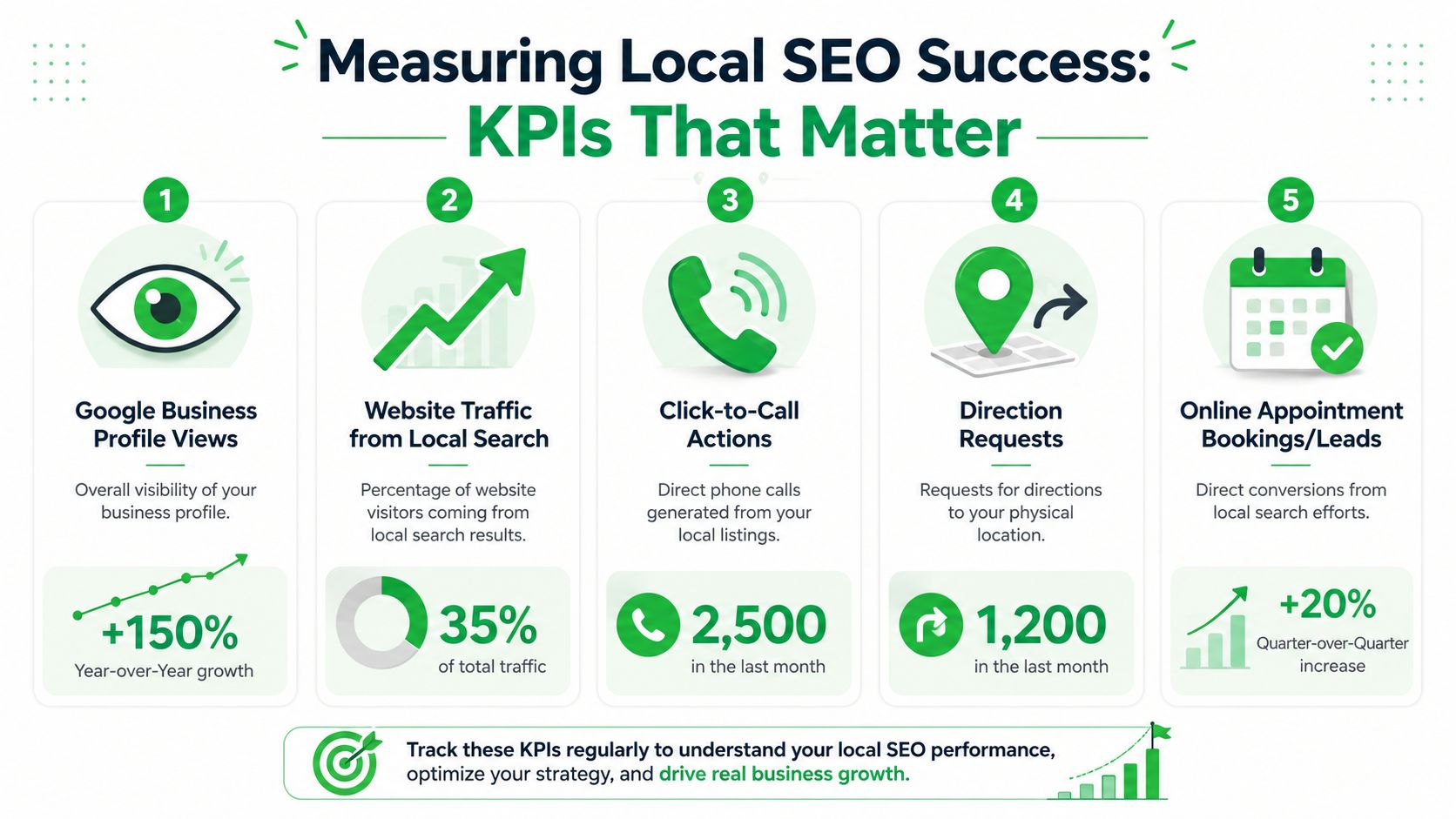
If you want to know whether local search optimization is working, don’t stop at rankings. Rankings matter, but they don’t pay the bills on their own. Calls, direction requests, booked appointments, and qualified leads do.
Start with action metrics, not vanity metrics
A business owner doesn’t need a dashboard full of noise. The useful view is tighter:
- Google Business Profile actions such as calls, website clicks, and direction requests
- Local landing page traffic from search
- Lead quality from local pages and local profile visits
- Review flow and response consistency
- Click-through rate for high-value local queries
These tell you whether visibility is turning into intent, and whether intent is turning into business.
Local Search Optimization: Use CTR targets as a reality check
CTR is one of the clearest signals that your visibility is either compelling or underperforming. For core local queries, you must set a monthly Click-Through Rate target between 7% and 9%. Critically, you should aim for a CTR above 15% in the Local Pack and 25–30% for the position #1 ranking spot (CTR benchmarks for local SEO).
That benchmark matters because it exposes hidden weakness. If you rank well but people still don’t click, something is off. Usually it’s one of these:
- Weak profile presentation with poor photos or incomplete details
- Unconvincing reviews or a thin review profile
- Mismatched intent where the page ranks for a query it doesn’t satisfy
- Bland title tags and meta descriptions on local organic results
A top ranking with a weak CTR is like having the best storefront on the street with a dirty front window.
Build a small dashboard you’ll actually use
You don’t need enterprise reporting software for this. Google Search Console, Google Analytics, Google Business Profile performance data, and a rank tracker are enough for most SMBs.
A practical monthly review should answer:
- Are we showing up for the right local searches?
- Are searchers clicking at the rate they should?
- Are those clicks producing calls, forms, visits, or booked jobs?
- Which location pages or service pages are creating real business outcomes?
If you run multiple locations, compare branch performance side by side. One branch may have stronger reviews and weaker page content. Another may rank well but convert poorly because the local profile is neglected. The point is diagnosis, not reporting theater.
Local Search Optimization: What to ignore
Don’t get distracted by vanity spikes. A temporary jump in impressions means very little if qualified actions stay flat.
Also, don’t treat every keyword equally. Track the terms tied to actual buying behavior, not just broad informational phrases that look good in reports.
Your Simple Local Search Audit and Final Takeaways
Local search optimization is manageable when you strip it down to the signals that matter. Accuracy. Relevance. Trust. Consistency.
If you want a quick gut check, run through this list:
- Business profile complete
Categories, hours, phone, services, photos, and service area are accurate - NAP consistent
Your name, address, and phone match across your site and major directories - Service pages clear
Each core service has a page that explains what you do and where you do it - Schema in place
Your site helps search engines identify the business correctly - Reviews managed
You ask for them consistently and respond like a real business owner or manager - Location strategy fits the model
Storefront brands and service-area businesses are not using the same page strategy - KPIs tracked monthly
You review calls, clicks, direction requests, CTR, and local landing page performance
If you want a more structured version, this local SEO audit checklist is a useful starting point.
The businesses that win local search rarely win because of one secret tactic. They win because their digital footprint looks credible everywhere a customer checks. Their profile is complete. Their website supports the claim. Their reviews sound current and human. And their local pages reflect the market they serve.
That’s what local search optimization is. Not gaming the system. Building a trustworthy local presence that’s easy to find and easy to choose.
If you want help turning this into an execution plan, Mr. Green Marketing, LLC works with businesses on strategy-led local SEO, technical cleanup, content structure, and performance reporting so teams can prioritize the fixes most likely to drive qualified local demand.
Leave a Comment
sing in to post your comment or sign-up if you dont have any account.