
Schema Markup for SEO: You’ve probably searched your own service, product, or category and seen two very different realities on the same results page.
One listing is plain. Blue link, short description, nothing else.
Another listing has stars, pricing, availability, extra questions, maybe a cleaner brand presentation. It looks more trustworthy before the click even happens. That gap matters. In competitive search, attention is often won before a visitor ever reaches your site.
That’s where schema markup for SEO stops being a technical side task and starts acting like a visibility lever. Used well, it helps Google understand what a page is, what a business is, and what details deserve enhanced treatment in search. And lately, it matters beyond rich snippets. It also supports the entity clarity that can influence how brands show up in AI-driven search experiences.
Why Some Google Results Get All the Attention
A lot of business owners think those enhanced search listings are reserved for major brands. They aren’t.
A local service company can earn more visual space with properly matched markup. An ecommerce store can make product listings clearer. A publisher can help article details surface more cleanly. The difference usually isn’t luck. It’s implementation.
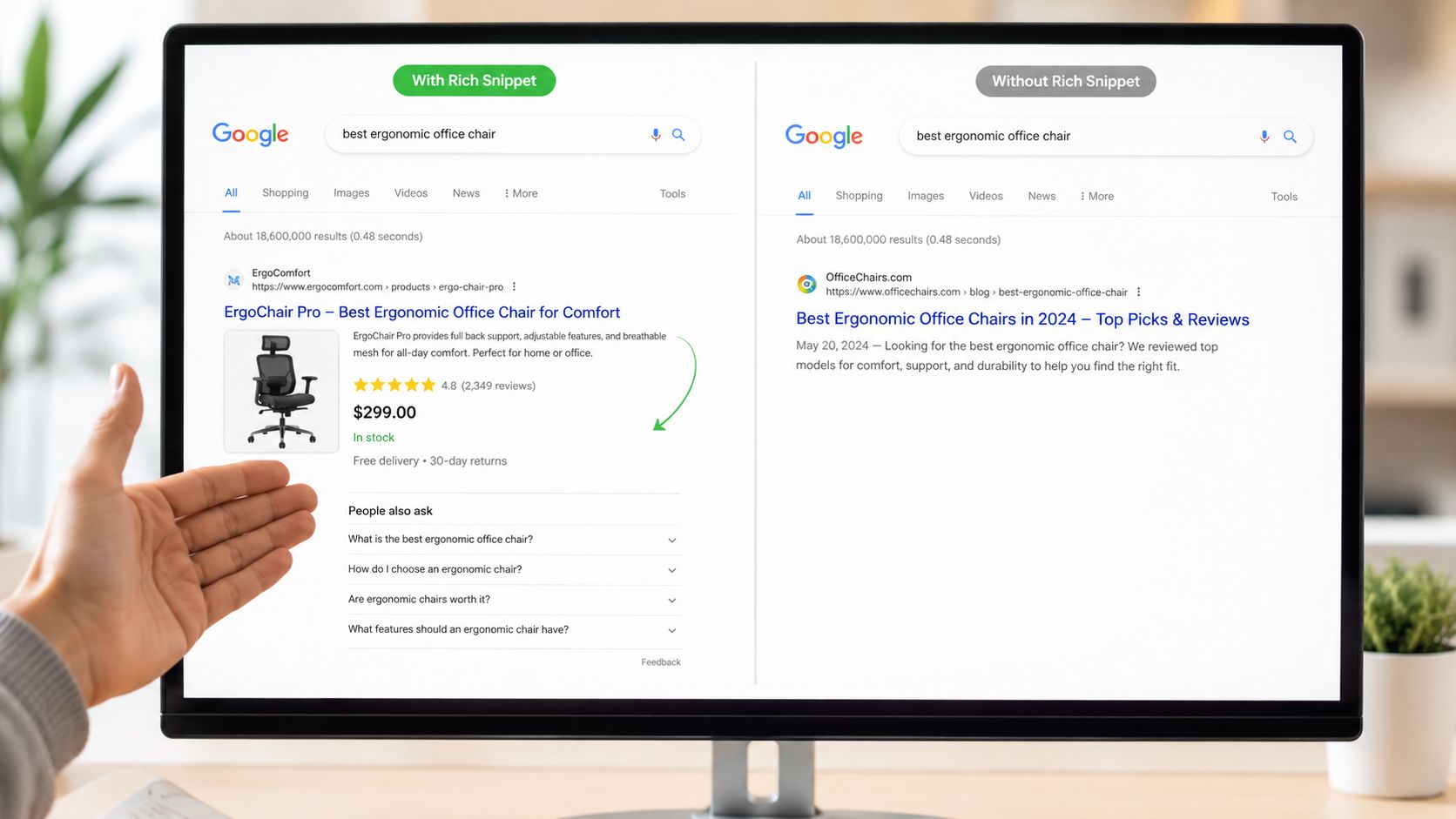
Schema Markup for SEO: The before and after in real search behavior
Here’s the practical version.
A plain result asks the searcher to do more work. They have to guess whether you sell the product, serve their area, answer their question, or have any proof of quality.
A rich result reduces that friction. It can show review signals, product details, business information, or FAQs right in the results. More context. Better qualification. Often, better clicks.
For merchants trying to sharpen product visibility, I like how Yassine Malti’s Google Shopping strategies connect feed quality, structured product data, and search presentation. Different channel, same principle. Search systems reward clarity.
Why this matters for smaller brands
Schema markup gives search engines a cleaner read of your page. Think of it as labeling the important parts of the page so Google doesn’t have to infer everything from surrounding copy.
That matters because implementation depth is still thin across the web. As of May 2026, only 12 specific schema types are deployed on 10 million or more domains globally, with dominant usage concentrated in broad types like WebSite, WebPage, Organization, Person, and Product, according to Sixth City Marketing’s schema markup statistics summary. In plain English, structured data is common, but many sites still stop at the basics.
What this means in practice: a lot of competitors have “some schema,” but not necessarily the schema types that make their most important pages more compelling in search.
That’s the opening. Not everyone needs every schema type. But almost every serious site has pages that could communicate more clearly than they currently do.
What Schema Markup Actually Is And Is Not
A page can have strong copy, solid links, and a real offer, then still show up in search like a plain blue link while a competitor gets review stars, pricing, availability, or FAQ detail. The difference is often structure. Search engines need clean labels, not just readable prose.
Schema markup is code that tells search engines what key elements on a page represent. It identifies a product, a business, an author, an event, a FAQ, a review, or an offer in a format machines can process with less guesswork.
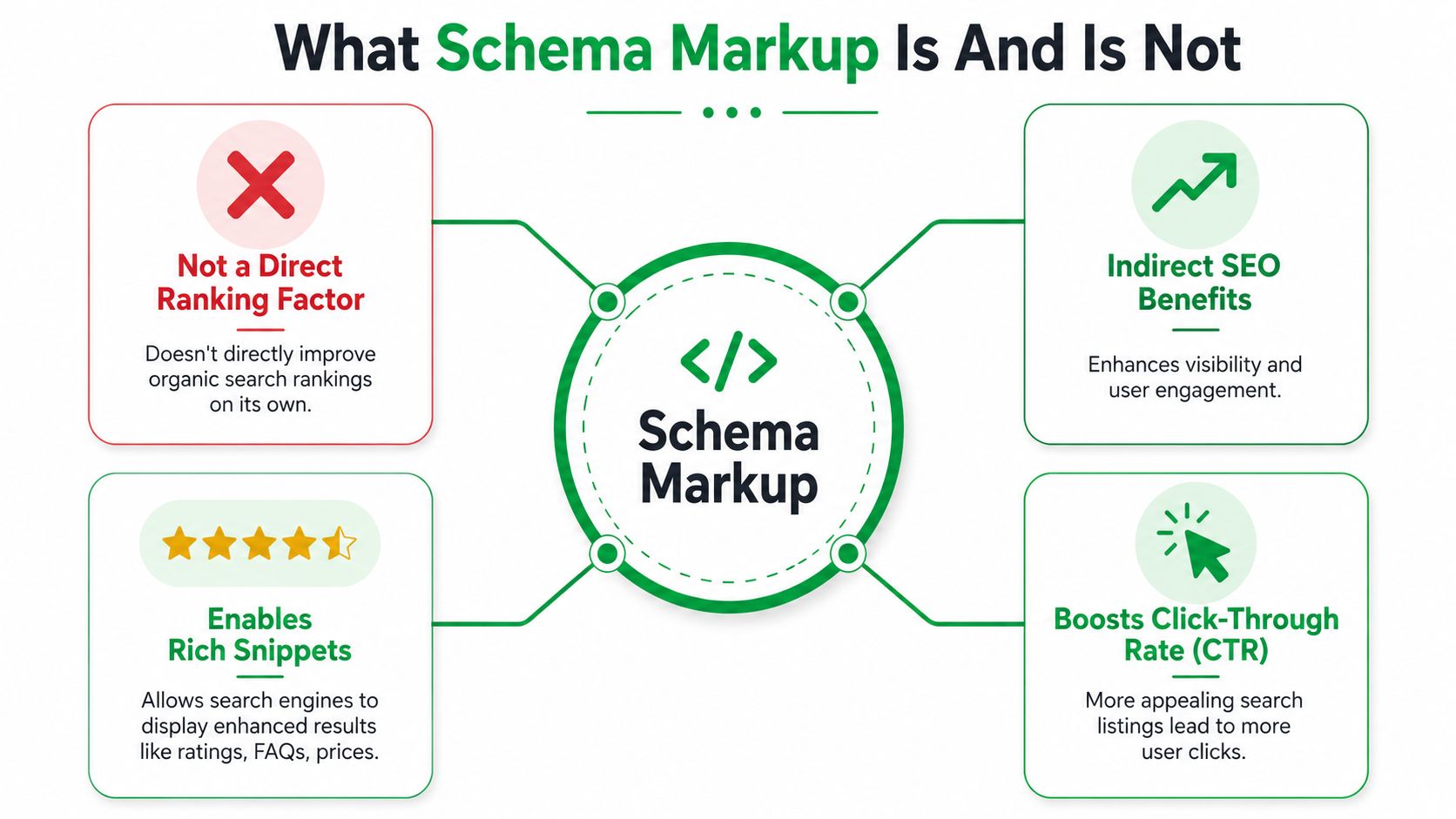
Schema Markup for SEO: Schema works like a product label for search engines
Your page might say:
- We’re open Saturdays
- This item is in stock
- This article was written by a real person
- This address belongs to our office
A customer reads that in seconds. Google can often infer it from the page, but inference is less reliable than explicit markup, especially at scale across hundreds or thousands of URLs.
Schema removes ambiguity. Instead of leaving Google to interpret a sentence, you define the meaning of that sentence in a machine-readable format. That is the practical SEO benefit.
What schema does, and what it does not do
Schema does not give weak pages a free pass. It will not fix thin content, poor internal linking, slow pages, or a page that does not match search intent. It also is not a direct ranking boost from code alone.
Its value is more operational than magical. It improves how search engines classify the page, can increase eligibility for rich results, and helps them connect your site to known entities such as your company, your authors, your products, and your locations.
That last point matters more now than it did a few years ago. Rich snippets are still useful, but schema also helps build the entity layer behind your brand. That can support how your business is understood in AI Overviews and other AI-driven search experiences, where search systems need confidence about who you are, what you sell, and whether your claims map to a real entity.
A concise external explainer worth skimming is Netco Design’s guide to schema. It’s useful if you want a plain-language companion to the more technical documentation.
Schema Markup for SEO: Where the business upside comes from
The return usually shows up in three places:
- Stronger search presentation
Rich results can make listings more noticeable and answer basic questions before the click. - Clearer brand and page-level entities
Search engines get cleaner signals about your business, products, services, people, and locations. - Better-qualified traffic
Users know more before they visit. That often means fewer low-intent clicks and more visits that can turn into leads or sales.
I tell clients to treat schema as infrastructure. Good infrastructure rarely gets applause on its own, but it makes every important system around it work better. In SEO, that means cleaner interpretation today and a stronger foundation for AI-driven search tomorrow.
Schema Markup for SEO: Key Schema Types for Driving Business Growth
There are a lot of schema types. Too many, if you approach this like a checklist.
The better way is to match markup to the business outcome you want. More calls from local search. Better product visibility. Stronger article presentation. More qualified clicks from question-driven searches.
Schema Markup for SEO: For local leads
If you run a service business, medical practice, office-based company, or brick-and-mortar location, local schema should sit near the top of your list.
The key is specificity. Don’t stop at Local Business if a better subtype exists. A dentist should use Dentist. A legal office should use the most relevant legal subtype available. A restaurant should be marked as a restaurant, not just a generic business.
That matters because the most effective schema implementation strategy involves selecting the most specific schema type from Schema.org, and Best Version Media notes that industry studies indicate CTR improvements of 15–30% for rich-result-enabled pages when the markup is valid and well aligned with the content.
Schema Markup for SEO: For ecommerce sales
If you sell products online, Product schema is hard to ignore.
It helps search engines understand core product details like name, brand, availability, and offer information. When it’s implemented correctly and supported by the visible content, it can make product listings more useful before the click.
That doesn’t mean every product page will earn a rich result. It means you’re giving the page a better chance to qualify, while also clarifying exactly what the page represents.
A few practical notes:
- Use it on actual product pages: Not category pages pretending to be products.
- Keep offer details current: If your visible price or availability changes, your markup needs to change too.
- Match reviews carefully: Only include review-related markup where it accurately reflects what’s on the page.
Schema Markup for SEO: For content authority
If your site publishes original articles, guides, or news content, Article schema helps search engines understand authorship and content structure more clearly.
This won’t rescue a weak blog post. But for strong content, it can reinforce what the page is, who published it, and why it belongs in search results tied to informational queries.
For brands trying to build topical authority, this matters because search visibility increasingly depends on entity clarity, not just keywords.
Schema Markup for SEO: For question-driven SERP real estate
FAQPage can be useful, but only when the page contains those questions and answers in visible form.
Businesses often get sloppy. They generate a block of schema for every possible question, attach it to thin service pages, and expect Google to reward the effort. It usually doesn’t work well.
Used properly, FAQ schema can help a page surface more context in search. Used carelessly, it becomes noise.
Practical rule: the page itself should deserve the markup before the markup deserves the page.
Schema Markup for SEO: A simpler way to choose
Use this decision lens:
| Business goal | Schema type to prioritize | What it supports |
|---|---|---|
| More local calls and form fills | LocalBusiness or a more specific subtype | Clear business identity, location details, hours, local relevance |
| More product clicks | Product | Product understanding, purchase-related context |
| Stronger editorial visibility | Article | Better classification of published content |
| More question-based visibility | FAQPage | Expanded context when page content directly supports it |
If you serve local markets and want broader context around Maps and local visibility, Digital Skyrocket’s guide to local SEO is a useful companion read. Schema won’t replace local SEO fundamentals, but it can sharpen them.
Schema Markup for SEO: How to Write Your First Schema Markup Snippet
A business owner sees a competitor showing hours, location details, and richer search presentation while their own result looks plain. In many cases, the gap is not better copy. It is better structured data.
Writing your first schema snippet is usually less intimidating than people expect. Google generally supports JSON-LD because it is easier to add, easier to edit, and less likely to create messy dependencies in the page HTML. That matters if the goal is to improve search presentation now while also giving search engines and AI systems cleaner entity signals later.
Schema Markup for SEO: A simple Local Business example
Here’s a stripped-down example for a local business page:
<script type="application/ld+json">
{
  "@context": "https://schema.org",
  "@type": "LocalBusiness",
  "name": "Green Street Dental",
  "url": "https://www.example.com",
  "telephone": "+1-555-555-5555",
  "address": {
    "@type": "PostalAddress",
    "streetAddress": "123 Main Street",
    "addressLocality": "Pensacola",
    "addressRegion": "FL",
    "postalCode": "32501",
    "addressCountry": "US"
  }
}
</script>
This code does one job well. It tells Google and other systems what the business is, what it is called, and where it is located.
What each part is doing
A few lines carry nearly all the meaning:
@contextpoints to the schema vocabulary.@typetells search engines which entity you are describing.name,url, andtelephoneconfirm business identity.addresspackages the location details in a format machines can process reliably.
That structure is what makes schema useful. Search engines do not have to infer as much. AI-driven search products also have a cleaner foundation for understanding the brand as an entity instead of treating the page as a loose collection of text.
For implementation, JSON-LD is usually the cleanest option because it can sit in a single script block instead of being threaded through visible HTML. If your site has broader technical issues, a quick SEO audit process for finding implementation problems will often catch the same page-level inconsistencies that break schema accuracy.
Schema Markup for SEO: What people usually get wrong
The failure points are usually operational, not advanced development problems.
- Using the wrong type:
LocalBusinessworks, but a more specific subtype can give better context. - Marking up details that are missing on the page: if users cannot see it, schema should not invent it.
- Adding review, rating, or FAQ properties as bait: this creates trust issues and often gets ignored.
- Letting business details drift: an old phone number in schema can weaken both search trust and lead quality.
I see this mistake often with templates. A plugin generates valid-looking code, the page passes a basic test, and everyone assumes the job is done. But valid code is not the same as accurate markup.
That trade-off matters. Automation speeds up deployment across dozens or hundreds of pages, but it also makes it easy to publish the same bad assumptions everywhere. Schema helps performance when it reflects reality on the page and in the business. That is how it supports richer results today and stronger eligibility for AI Overview visibility tomorrow.
A Simple Workflow for Schema Implementation and Testing
Most schema problems come from one of two issues. Teams either overcomplicate the rollout or they skip validation because the code “looks right.”
Neither approach holds up well.
A repeatable workflow keeps this manageable, especially if you’re rolling schema across service pages, product pages, articles, or location pages.
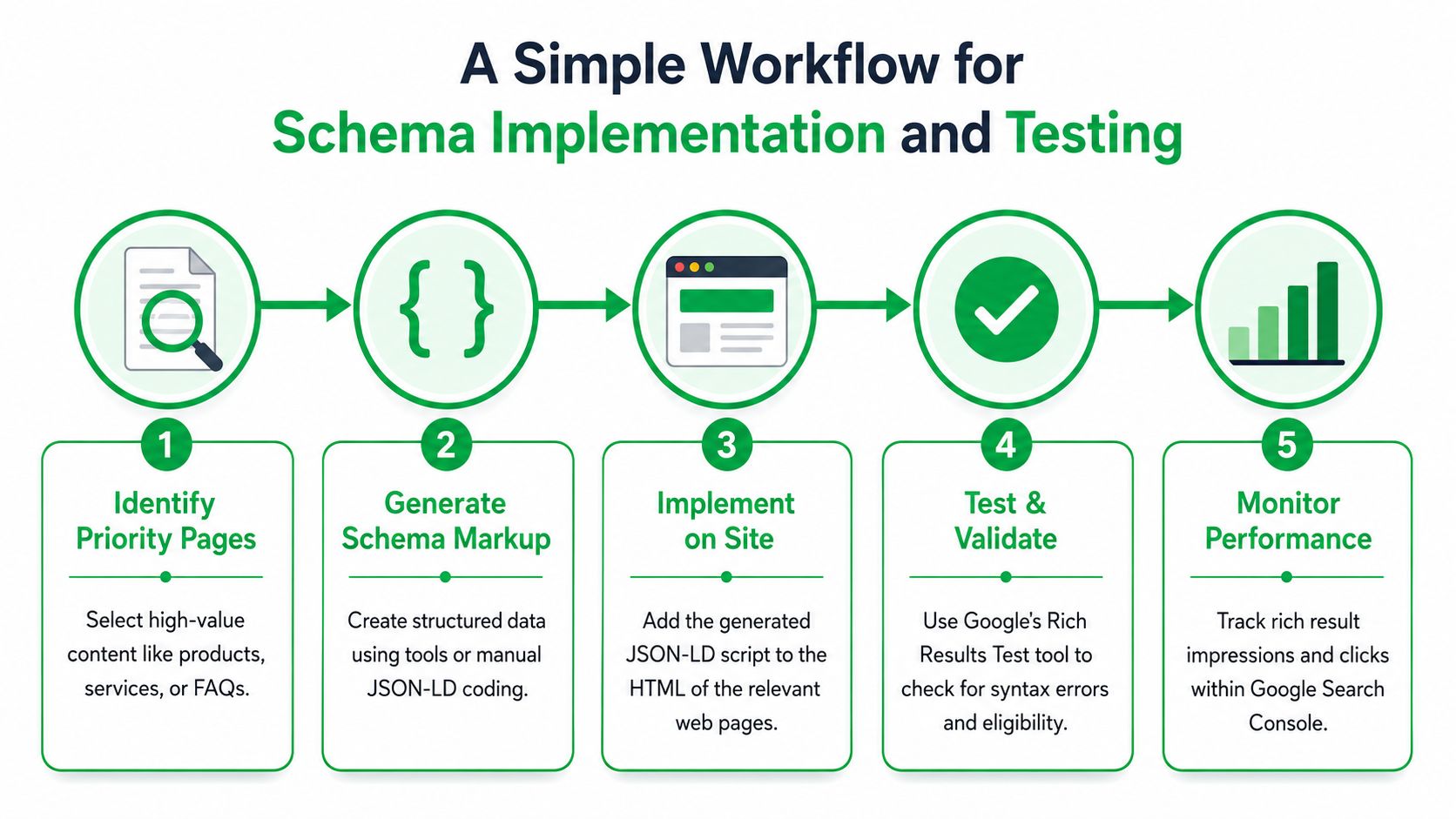
Schema Markup for SEO: Step 1 and Step 2
Start with page priority, not schema ambition.
Pick the URLs that already matter to revenue or lead generation. Product pages, top service pages, location pages, high-traffic articles. If a page has no business value, it doesn’t need to be first in line.
Then choose the schema type that best matches the page’s primary purpose.
- Service page for a practice location: likely a local business subtype
- Purchase-ready product page: product schema
- Editorial guide: article schema
- Visible question section: FAQPage, if the content supports it
Schema Markup for SEO: Step 3 and Step 4
Generate the JSON-LD. You can do that manually, through a plugin, or with a schema generator.
Then place it on the page. Generally, JSON-LD is put in the <head>, though Google supports placement in the body as well when implemented correctly.
And now the part people rush past. Testing.
According to the cited guidance in this schema validation video reference, you should validate schema weekly using Google’s Rich Results Test and Schema.org’s validator, because Google Search Console will flag 90% of syntax errors post-deployment, and untested markup expires eligibility within 30 days. Whether you manage five pages or five thousand, that makes validation essential.
Schema Markup for SEO: Step 5
Monitor what happened after deployment.
Look in Google Search Console for enhancement issues, eligibility changes, and performance trends. If your site already has technical debt, fold this into a broader audit process. If you need a framework, this walkthrough on how to do an SEO audit gives you a practical way to catch related content and indexing issues at the same time.
A clean five-step workflow looks like this:
- Identify high-value pages
Start where visibility ties directly to leads, sales, or important traffic. - Map each page to the right schema type
Use the most specific valid type possible. - Create and implement JSON-LD
Keep it readable and aligned with visible content. - Test before and after publish
Use Google’s Rich Results Test and the Schema.org validator. - Review regularly
Recheck when content changes, and audit on a schedule.
One practical note. Mr. Green Marketing, LLC includes Q&A schema as part of its AI SEO and GEO work, which is useful when a site needs structured answers tied to visible page content. That’s one option among several. The point is the same either way: choose markup that reflects the actual page, then validate it.
How to Prove Schema Is Working for Your SEO
Schema work shouldn’t live in the “technical improvements” bucket forever. It needs to show up in reporting.
The cleanest place to measure impact is Google Search Console, because that’s where you can see search appearance, impressions, clicks, and click-through rate tied to eligible result types.

Where to look in Search Console
Open the Performance report and look for Search Appearance filters. If Google is recognizing the structured data in a way that affects presentation, you may see result categories tied to that appearance.
That lets you isolate how those enhanced listings perform compared with standard results.
What you’re trying to answer is simple:
- Are the marked-up pages earning impressions?
- Are rich-result appearances showing up?
- Is CTR improving after valid implementation?
- Are there warnings or eligibility losses in Enhancements?
What a useful comparison looks like
Don’t evaluate schema by ranking position alone. That’s the wrong lens.
Instead, compare a page or page group before and after implementation. Hold the query set as steady as you can. Look at impressions and clicks together. If impressions are similar but clicks rise, the listing likely became more attractive or more informative in the search result.
For teams that need cleaner client or stakeholder reporting, this guide to an SEO monthly reporting format is a practical way to present rich result performance without burying the signal.
Good schema reporting answers one business question: did the same visibility produce more qualified traffic?
There’s also a helpful walkthrough here if you want to see the mechanics of schema testing and result checking in action:
What counts as success
Success isn’t “Google found our code.”
Success looks more like this:
| Signal | What it suggests |
|---|---|
| Rich result impressions appear | Google recognizes valid structured data on eligible pages |
| CTR improves on marked-up pages | Search presentation is doing more work |
| Warnings decrease over time | Implementation quality is improving |
| Traffic quality improves | Users arrive better informed and closer to intent |
If none of those move, inspect the basics again. Wrong type. Weak content. Invalid markup. Or the page just may not be a strong candidate for enhanced search treatment.
Schema Markup for SEO: Future-Proofing Your SEO with Schema for AI Search
Schema used to be discussed almost entirely in terms of rich snippets.
That’s too narrow now.
Search is moving toward entity understanding and AI-mediated answers. In that environment, structured data helps define who your brand is, what you offer, and how your content should be interpreted. That doesn’t mean schema directly powers AI answers. It means the systems feeding those answers rely on cleaner understanding.
According to 12AM Agency’s analysis of schema and AI search, schema markup’s role in AI Overviews is still poorly explained, yet 2025 to 2026 data indicates AI search engines often ignore unstructured content, and 78% of marketers still use only basic markup, which can lead to brand misclassification. That tracks with what many SEO teams are seeing. Brands say plenty on their sites, but they don’t define themselves clearly enough for machines.
Why entity clarity matters now
If Google, Gemini, or another AI-assisted interface has weak confidence in your organization, author, product, or service relationship, your content is easier to overlook or misread.
And that’s the twist. Schema may not move a ranking position by itself, but it can still influence what search systems confidently surface.
If you’re working on broader AI visibility, this guide on how to optimize for AI search connects schema with the wider content and entity signals that matter.
Short version. Rich results are today’s payoff. Entity definition is tomorrow’s insurance.
Frequently Asked Questions About Schema Markup
These are the questions that usually come up after a site owner realizes schema is not a checkbox. It is a publishing standard. Done well, it helps search engines qualify your pages for richer presentation now and understand your brand with more confidence as AI-driven search expands.
Common Schema Questions
| Question | Answer |
|---|---|
| Does schema markup directly improve rankings? | Usually, the business impact shows up through better eligibility for rich results, clearer interpretation of the page, and stronger click-through rates. That can mean more qualified traffic even if rank stays the same. |
| Does adding FAQ or Review schema guarantee a rich result? | No. Google still decides what to show. Proper implementation does improve your chances, though. The Lumar article on using structured data to drive more organic traffic explains why complete, accurate properties matter for eligibility. |
| Should every page have schema? | No. Add it where it supports a clear search outcome. Product pages, service pages, location pages, articles, and FAQs usually deserve attention first. Utility pages and thin content usually do not. |
| Is JSON-LD the right format for most sites? | Yes, for most teams. It is easier to deploy, easier to audit, and less likely to break during design or CMS changes than inline markup. |
| How often should schema be checked? | Check it whenever the page content, pricing, availability, author details, reviews, or business information changes. A quarterly audit is a sensible baseline for active sites. |
One practical rule matters more than any plugin setting. The schema has to match what a user can see on the page. If your markup says you offer a service, carry five-star reviews, or answer a question, the page needs to support that claim clearly.
That is why schema works best on pages that already do their job. Strong content plus accurate markup can improve how your result looks, how your business is classified, and how confidently search systems connect your brand to the topics you want to own. Weak content with aggressive markup usually creates cleanup work later.
Mr. Green Marketing, LLC helps businesses connect technical SEO work to measurable outcomes like richer search presentation, stronger entity clarity, and cleaner reporting. If you want a second set of eyes on your current implementation, the team can review schema opportunities alongside content, local SEO, ecommerce visibility, and AI search readiness at Mr. Green Marketing, LLC.
Leave a Comment
sing in to post your comment or sign-up if you dont have any account.