
What Is Answer Engine Optimization: Answer engine optimization is the practice of structuring content so AI-powered search engines can retrieve it, trust it, and cite or summarize it in generated responses. It emerged as a distinct discipline in 2024 and 2025, as Google AI Overviews, AI Mode, ChatGPT, Perplexity, and voice assistants became mainstream.
But what changes when success no longer means earning the highest position on a results page? The answer is more than “add an FAQ” or “put schema on every page.” AEO changes the target from ranking for a query to becoming a source an answer engine can find, verify, reuse, and attribute.
Google AI Overviews launched in May 2024. Google later reported that AI Mode reached 1 billion monthly active users, while AI Overviews reached about 2.5 billion people per month. When an AI Overview appears, the number-one organic result loses about 58% of its clicks, and the zero-click rate rises to roughly 83%, according to the AEO statistics summary from InstantPress.
That’s why the practical question isn’t only, “How do I rank?” It’s also, “Can an AI system confidently use my page as evidence?”
What Is Answer Engine Optimization: Table of Contents
- What Answer Engine Optimization Actually Means
- How AEO Differs From Traditional SEO
- How AI Answer Engines Choose and Cite Sources
- Tactics That Make Content Retrievable and Citable
- Adapting AEO for Local, E-Commerce, and Amazon Sellers
- Measuring Whether You Are Actually Getting Cited
- A Practical AEO Roadmap for Small Businesses in 2026
What Answer Engine Optimization Actually Means
Answer Engine Optimization is the practice of structuring, writing, and signaling content so AI-powered search systems retrieve it, trust it, and either cite it directly or paraphrase it inside a generated answer. In plain English, you’re making your content easier for an answer engine to locate, understand, justify, and attribute.
Think of a librarian helping someone answer a difficult question. She doesn’t recommend the loudest book in the room. She chooses the book she can locate quickly, verify against reliable information, and quote without changing the meaning. AEO applies that locator-and-verifier mindset to web content.
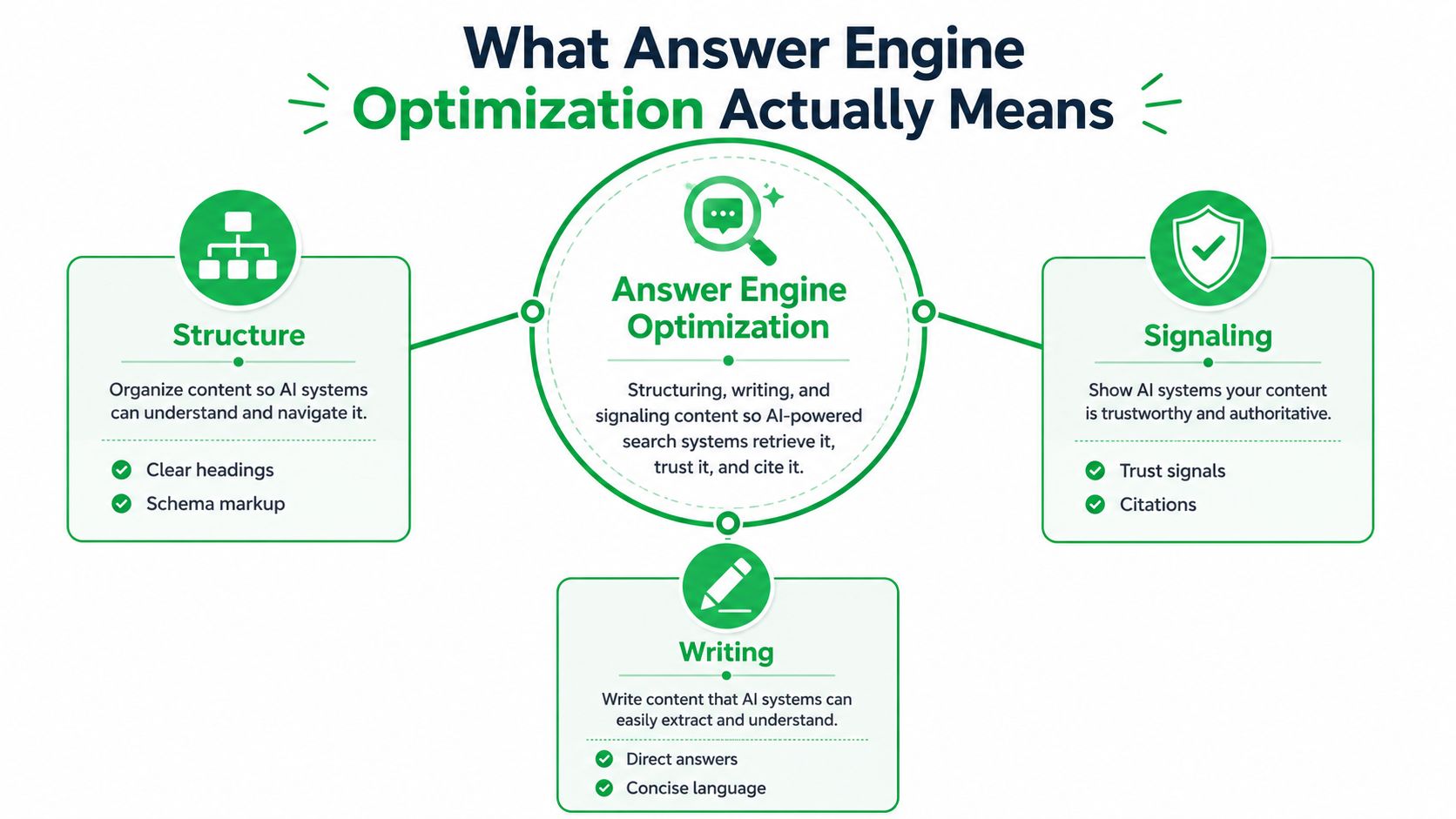
The shift from links to answers
Traditional search generally presents a list of pages. Your page competes for a position, and the user decides whether to click. AI search changes the visible output. The engine may select passages from multiple pages, combine them, and present one conversational response with citations.
You’ll encounter this shift across three practical answer surfaces:
- Google AI Overviews and AI Mode, where generated summaries appear within Google Search.
- ChatGPT and Perplexity citations, where an answer includes linked references to web sources.
- Voice assistants, where the system may read or summarize one response instead of presenting a page of options.
That doesn’t make classic SEO irrelevant. A technically sound website, clear topical organization, and credible content still help search systems discover and interpret your pages. AEO adds another layer, one focused on whether a particular passage can survive retrieval and appear in the final response. Guidance on optimizing for AI search can help connect those layers without treating them as separate marketing worlds.
Practical rule: Every AEO tactic should answer one question, “Will this make a useful passage easier for an answer engine to retrieve, verify, and cite?”
What Is Answer Engine Optimization: How AEO Differs From Traditional SEO
A page can rank well and still fail to supply a usable answer. Traditional SEO usually competes for a position in a list of results, while AEO competes for inclusion in a generated response through a passage, fact, definition, or product explanation that an engine can retrieve and attribute.
The difference becomes clearer when comparing what each approach treats as the working unit. SEO often evaluates the page as a whole. AEO examines smaller units, such as a paragraph answering “What does this service include?” or a product explanation that supports one specific claim.
| Dimension | Traditional SEO | Answer Engine Optimization |
|---|---|---|
| Primary goal | Rank in search results and earn clicks | Become a cited or summarized source in an AI answer |
| Unit of optimization | The page, title, headings, links, and content | Passages, claims, entities, and extractable answer blocks |
| Success metric | Rankings, impressions, clicks, and click-through rate | Citation frequency, branded mentions, linked references, and AI referral traffic |
| Output format | A list of organic results | A synthesized response that may include several sources |
| Content structure | Broad topic coverage, pillar pages, and clusters | Question-shaped sections with direct, self-contained answers |
| Technical emphasis | Crawlability, architecture, indexation, and page performance | Those same foundations, plus machine-readable context and retrievability |
| User behavior | The user visits a result | The user may receive the answer without clicking |
Page optimization versus passage optimization
A long-form page can support both approaches when its sections stand on their own. Each heading should identify the question or topic that follows, and the opening sentences should resolve that question directly. Evidence belongs close to the claim it supports, so the relationship remains clear to readers and retrieval systems.
A long introduction that postpones the answer until the middle of the page creates a weaker retrieval target. A person may keep reading, but an answer engine can select another passage that resolves the query more directly. Guidance on featured snippet optimization provides a useful model for organizing concise, extractable answers without reducing the page to disconnected fragments.
What Is Answer Engine Optimization: Rank and citation are related, not identical
AEO adds a retrievability and verifiability layer to the SEO foundation. Ranking signals still help a system discover and interpret a page, yet citation depends on whether a specific passage is clear, self-contained, relevant to the question, and supported by identifiable context.
The practical target is therefore twofold: improve ranking position so the page can enter consideration, and improve citation probability so a passage can survive selection into the final answer. A page-level SEO plan may organize a broad topic, while an AEO plan also tests individual claims, definitions, and answer blocks for retrieval.
For a business owner, the distinction is similar to stocking a well-organized reference shelf versus preparing labeled index cards. SEO helps the system find and understand the shelf. AEO makes the specific answer easy to select, check, and credit.
What Is Answer Engine Optimization: How AI Answer Engines Choose and Cite Sources
Suppose someone asks, “What is the safest car seat for a newborn in 2026?” An answer engine doesn’t search for the exact phrase and copy the first page it finds. It processes the question, retrieves possible sources, evaluates their passages, synthesizes an answer, and assigns citations.
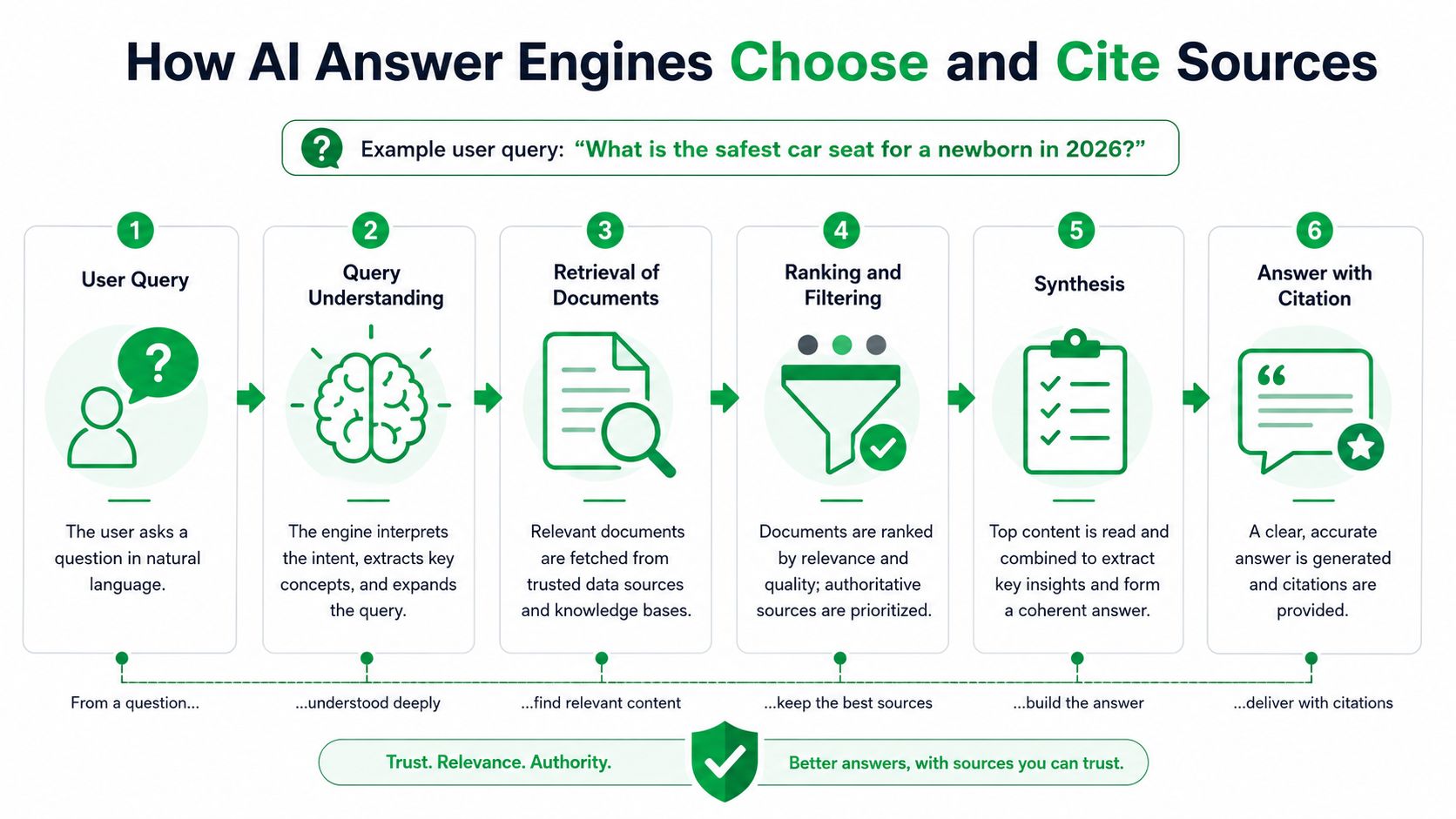
From a question to a source
The first stage is query understanding. The engine interprets the user’s intent and may rewrite the question into related searches, such as newborn safety requirements, rear-facing use, installation, product testing, or current recommendations.
Next comes retrieval. The system searches its index for pages and passages connected to those concepts. Clear entities matter here. A page that identifies the product category, intended age range, safety criteria, manufacturer, and supporting authority gives the system more usable context than a page filled with vague marketing language.
The engine then applies filtering and reranking. A survey of retrieval-augmented generation systems identifies five optimization areas, retrieval, filtering, efficiency, strength, and reranking, as described in this RAG optimization survey. A recent enterprise guide also discusses testing chunk sizes of 256, 512, and 1024 tokens, using 10% to 20% overlap, retrieving 50 to 200 candidates, and reducing them to 5 to 12 final context passages. Those figures describe system-tuning approaches, not a universal publishing formula.
Where a page gets included or dropped
During synthesis, the language model combines the strongest available evidence into a response. A passage is easier to reuse when it states one clear claim, defines its terms, and avoids wording that could distort the meaning.
Citation attribution comes last. The engine connects specific claims to pages that appear authoritative, consistent, and relevant. That’s where an article with a clear author, transparent business identity, supporting references, and stable facts has an advantage over anonymous copy.
A useful human-controlled checklist includes:
- Topical clarity: State exactly what the page covers and who it serves.
- Supporting sources: Link important factual claims to credible references.
- Structured data: Describe visible content with appropriate markup, rather than adding labels that the page doesn’t support.
- Distinctive evidence: Include original observations, carefully documented data, or expert commentary that adds something worth citing.
Schema markup for SEO can support machine-readable interpretation, but markup doesn’t guarantee selection. Retrieval comes first.
What Is Answer Engine Optimization: Tactics That Make Content Retrievable and Citable
AEO becomes practical when you translate the retrieval pipeline into editorial decisions. Start with the answer, separate claims cleanly, make entities consistent, and ensure the page is technically readable.
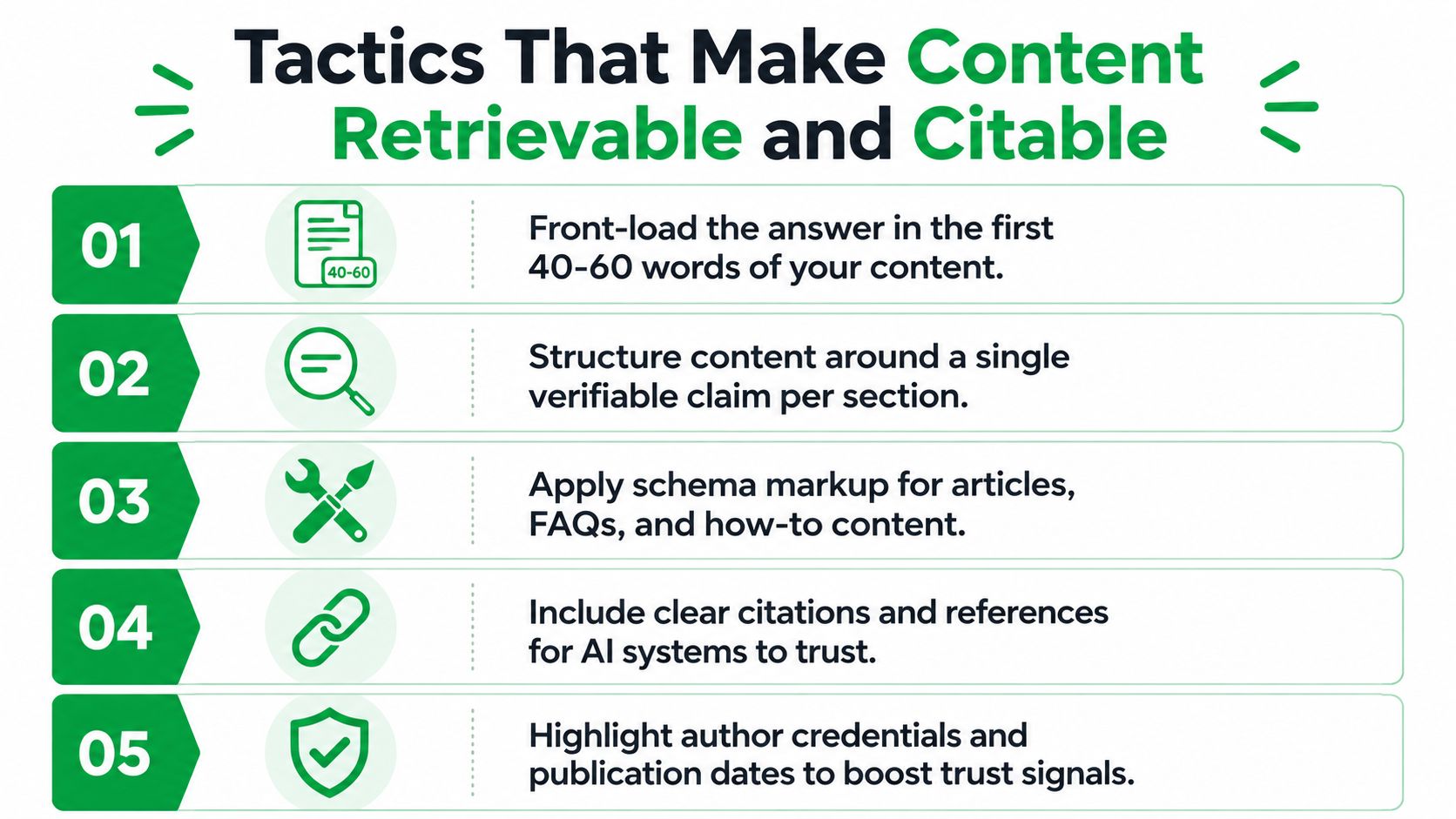
Put the answer before the background
For important pages, front-load the direct answer in the first 40 to 60 words. That doesn’t mean every paragraph should sound abrupt. It means the reader shouldn’t need to wade through general context before finding the claim the page is supposed to support.
A strong section usually follows this pattern:
- Question-shaped heading: Use the question a customer would ask.
- Direct answer: State the conclusion immediately.
- Qualification: Explain limits, exceptions, or context.
- Evidence: Provide references, examples, or details that support the answer.
Keep each paragraph focused on one verifiable claim. If a paragraph explains what a service does, its limitations, and three unrelated benefits, an answer engine has to separate the ideas before it can reuse them. Give it cleaner material.
What Is Answer Engine Optimization: Strengthen structure and entity signals
Use a logical heading hierarchy, declarative sentences, short paragraphs, tables, and lists where they clarify the subject. FAQ and HowTo schema can help describe visible question-and-answer or process content, but the markup must match what users can read.
Entity consistency also matters. Your official business name, service descriptions, address information, product specifications, author identity, and publication details should agree across your website and other credible references. An author bio and an About page won’t manufacture authority, but they help clarify who stands behind the information.
Technical access is just as important. Slow server responses, blocked crawling, poor internal linking, and content that appears only after complex JavaScript rendering can prevent an engine from reading the passage in the first place. Technical SEO best practices provide the foundation for making content accessible to both users and retrieval systems.
The useful distinction: Schema describes the page. The page’s content, evidence, and reputation determine whether the described information is worth citing.
Adding structured data to thin content doesn’t manufacture citability. Retrievers score available passages, not markup alone. If the visible answer is vague, unsupported, or contradictory, a schema label won’t repair it.
What Is Answer Engine Optimization: Adapting AEO for Local, E-Commerce, and Amazon Sellers
The same retrieval principles produce different work for different business models. A local plumber, an online furniture store, and an Amazon vendor aren’t competing for the same answers, even when all three are told to “add FAQs and schema.”
| Business Model | Primary Retrieval Target | Key Content Move | Schema or Markup Focus |
|---|---|---|---|
| Local business | Service, location, availability, and trust questions | Build pages around service areas, customer questions, access details, and local proof | LocalBusiness, Service, FAQ, and review-related markup when accurate and eligible |
| General e-commerce | Product suitability, comparison, use, and buyer-support questions | Put material specifications, fit guidance, comparisons, and objections directly on product pages | Product, Offer, FAQ, and review markup that matches visible product information |
| Amazon seller | Marketplace product discovery and purchase assistance | Phrase titles, bullets, A+ content, and customer answers around real buying questions | Accurate marketplace product fields, compliant structured product information, and clear content hierarchy |
Local businesses need place-based clarity
A local business should make its service area unmistakable. Name the communities served, the specific service, the customer situation, and relevant business attributes. A page titled “Emergency HVAC Repair in Pensacola” can answer a different retrieval need than a generic “HVAC Services” page.
Review-derived questions can reveal what customers need to know, such as arrival expectations, appointment types, financing availability, or whether a technician handles a particular issue. Use those questions as content inputs, but don’t invent answers or inflate review language.
Multi-location businesses need consistency without creating duplicate pages. Each location should have useful local details, not a city name swapped into the same template.
E-commerce pages should resolve hesitation
An e-commerce product page shouldn’t force shoppers to open several tabs to find essential buying information. Answer questions about dimensions, compatibility, materials, care, intended use, delivery conditions, and comparisons close to the product decision.
For Amazon sellers, the retrieval environment is more controlled by the marketplace. AEO there means clarifying product titles, writing A+ content as useful answers, framing backend search terms around customer language, and mining reviews for recurring questions. Claims still need to match the product and marketplace rules. SEO for Amazon sellers provides a relevant marketplace-specific context.
The key is choosing your lane. Generic markup advice is less useful than identifying the exact answer your buyer needs and the system most likely to deliver it.
What Is Answer Engine Optimization: Measuring Whether You Are Actually Getting Cited
A ranking proves that a search engine displayed your page. It doesn’t prove that an AI answer engine used your content. Citation measurement asks a narrower question, “When a relevant prompt produces an answer, does the system name, link, or paraphrase my business or page?”
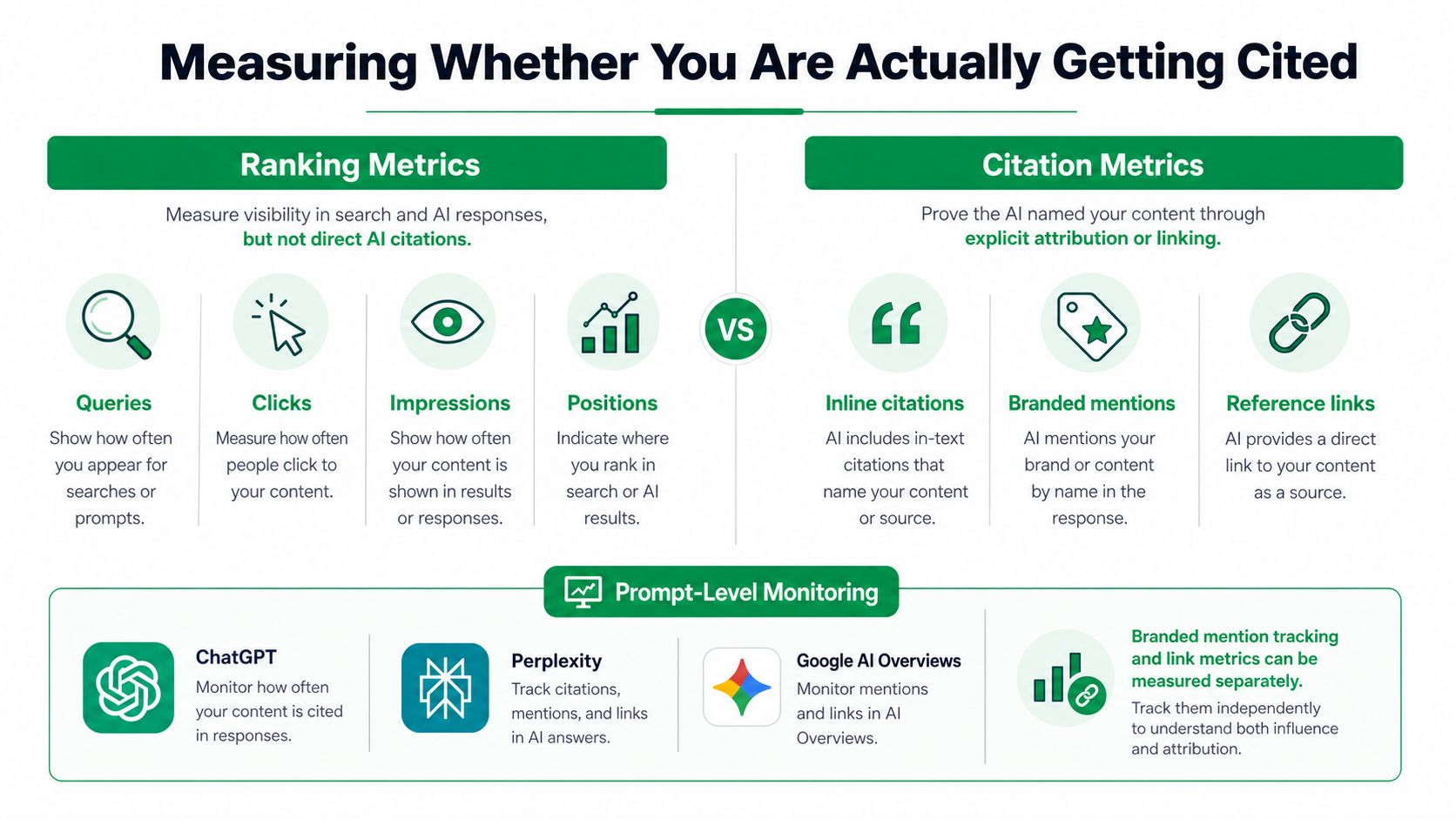
Separate visibility from attribution
Track both sides, but don’t confuse them.
- Ranking metrics: Search Console impressions, positions, clicks, and click-through rate show organic visibility and site visits.
- Citation metrics: AI references, linked citations, brand mentions, and the specific pages used show whether an answer engine attributed information to you.
- Referral metrics: GA4 can reveal visits from answer engines when those platforms pass referral information.
- Share of voice: Compare how often your brand appears against named competitors for the same prompts.
- Sentiment and accuracy: Log whether the answer describes your business correctly, not merely whether it mentions your name.
Search Console impression data no longer tells the whole story when an answer absorbs the user’s question above the traditional results. A page may receive fewer clicks while still influencing a buyer through a citation or branded recommendation. That exposure can matter even when no link is followed.
A 2026 summary reports that when an AI Overview appears, the zero-click rate rises to roughly 83%, which makes citation and mention tracking especially important for evaluating visibility beyond visits. The underlying figures are available in InstantPress’s AEO statistics overview.
Use a repeatable prompt log
Choose 20 commercial prompts that reflect your products, services, locations, and comparisons. Each month, test them across ChatGPT, Perplexity, and Google AI Overviews, then record:
- Whether your brand appeared.
- Whether your page was cited.
- Which competitor appeared instead.
- Which page or passage the engine referenced.
- Whether the description was accurate and favorable.
That simple record turns AEO from a writing belief into a measurable retrieval problem. Track changes over time, then improve the pages answer engines use or the gaps they repeatedly expose.
A Practical AEO Roadmap for Small Businesses in 2026
Small businesses don’t need to rebuild every page at once. They need a sequence that creates evidence quickly and protects time for normal operations.
Weeks one and two establish the foundation
Start by checking how your business appears in knowledge panels and answer engines. Verify core identity details, audit existing pages for passages that answer customer questions, and add appropriate Article, FAQ, HowTo, LocalBusiness, or Product markup where the visible content supports it.
During the first month, overhaul the pages closest to revenue. Replace vague headings with real customer questions, move direct answers upward, clarify your services or products, and add concise FAQ blocks. Tighten the connections between your business name, authors, locations, offerings, and supporting references.
Month two builds authority
Pursue relevant digital PR and mentions from publications or organizations that answer engines can crawl and evaluate. Refresh weak articles by adding original observations, documented customer questions, or useful comparisons. Prune thin pages that compete with one another for the same intent.
Month three is for measurement. Set up prompt-level citation tracking, compare changes in organic and AI referral traffic, and identify which formats produce answer inclusions. Keep the winners. Rewrite the pages that remain visible in rankings but absent from citations.
Three high-impact moves are often overlooked:
- Customer-question mining: Turn sales calls, support tickets, reviews, and consultations into structured answer content.
- Expertise verification: Add author credentials and a detailed About page that explain who created the information.
- Content pruning: Remove or consolidate thin pages that blur your topical signals.
And if you’re managing marketing alongside fulfillment, sales, or client work, specialized AEO support can shorten the testing and measurement curve without replacing your existing SEO foundation.
Mr. Green Marketing, LLC helps businesses audit AI visibility, map important prompts, improve citable content, and connect GEO with SEO, local search, e-commerce, and Amazon marketing. Visit Mr. Green Marketing, LLC to request a free audit and performance report that identifies visibility gaps and practical next steps.
Leave a Comment
sing in to post your comment or sign-up if you dont have any account.