
Multi Location SEO Strategy: And the regional marketing manager has just opened Search Console. Houston and Dallas are ranking for the same head term, neither page is clearly winning, and leadership is asking why the brand needs another location page for every city in the service area. Sales wants visibility everywhere. Operations wants leads routed to the right branch. The SEO team is stuck explaining why more URLs may create less visibility.
That’s the multi-location SEO problem. It isn’t a publishing checklist. It’s a portfolio decision about where the brand has enough local demand, evidence, and operational support to earn a dedicated search asset. Local search moves quickly. 80% of U.S. consumers search online for local businesses at least once a week, 32% search daily, and 75% decide which business to use in under 30 minutes, according to BrightLocal’s local SEO statistics. Every location page, listing, and review profile has to be accurate and ready to convert.
Multi Location SEO Strategy: Table of Contents
- Why Multi-Location SEO Is a Strategy Problem First
- Choosing Your Site Architecture Across Locations
- Building Local Landing Pages That Earn Rankings
- Running Google Business Profiles at Scale
- Citations and NAP Consistency Across the Web
- Localized Content, Schema, and Canonical Controls
- Tracking, Attribution, and a 90-Day Governance Plan
Why Multi-Location SEO Is a Strategy Problem First
The Houston page isn’t failing because someone forgot a keyword. It’s competing with Dallas because the company gave both pages the same service language, the same page structure, and nearly the same search intent. Google has to choose which URL best answers the query, while the leadership team sees two assets that appear equally valuable.
That confusion usually starts upstream. Executives expect a page for every served city because a complete market list looks like progress. Sales teams push for coverage across every service area because prospects can come from anywhere. Both pressures are understandable. Neither is a sufficient publishing strategy.
A stronger filter asks three questions before a page enters production:
- Demand: Do relevant local searches exist for the service and market?
- Intent: Does the search indicate that people want a nearby provider, branch, appointment, quote, or visit?
- Traction: Does the brand already receive impressions, calls, visits, or other organic signals from that market?
The decision isn’t “Can we swap the city name into a template?” It’s “Can this page help a real customer choose this location?” If the answer is no, route the market to a regional hub or the nearest supported branch. A useful hub can explain service coverage without pretending that every city has its own local operation.
Strategic rule: A location deserves a dedicated page when the business can prove local relevance, serve the customer clearly, and add evidence that doesn’t belong on another branch page.
This is also where local SEO and national SEO diverge. National content can consolidate broad expertise at the corporate level. Local pages need branch-specific information, customer pathways, and geographic context. Google’s local system centers on relevance, distance, and prominence, so one generic brand page can’t communicate the same local signals as a properly differentiated page and profile for each physical location (Google local ranking factors explained).
The strategic call comes first. Site architecture, Google Business Profile setup, citations, schema, internal linking, and reporting all follow from the decision about which locations merit investment.
Multi Location SEO Strategy: Choosing Your Site Architecture Across Locations
For most brands operating under one name in one country, use subfolders. Put Dallas at /locations/dallas/, not dallas.brand.com. A subfolder keeps location pages inside the main domain, simplifies internal linking, consolidates authority, and gives one SEO team a clearer governance model.
Subdomains can work, but they create separation where most growth-stage brands need connection. Each location still needs content, links, technical maintenance, and GBP management. A subdomain may be appropriate when a regional operation has a distinct brand identity or a legacy setup already carries strong authority. It’s rarely the smart default for a new rollout.
Country-code top-level domains serve a different purpose. They can support country-specific entities, localized products, legal requirements, and market expectations. They also introduce more engineering, content, and international SEO coordination, including hreflang management where appropriate.
| Factor | Subfolder (/locations/dallas) |
Subdomain (dallas.brand.com) |
ccTLD (brand.de) |
|---|---|---|---|
| Authority consolidation | Strongest connection to the main domain | More separated from the main domain | Country-specific domain authority |
| Crawl efficiency | Centralized structure and governance | Requires separate subdomain oversight | Separate country properties to manage |
| Link-building effort | Links support the main domain and location page | Local authority building is more isolated | Links need country relevance |
| GBP linking | Straightforward link to the location URL | Works, but adds structural complexity | Appropriate for the matching country |
| Hreflang requirements | Usually unnecessary within one country | Usually unnecessary within one country | Often relevant across localized countries |
| Engineering cost | Lowest for most rollouts | Moderate, especially at scale | Highest when multiple markets and systems are involved |
| Best use | One brand serving multiple locations | Distinct regional identity or strong legacy authority | Country-specific legal entities and localized offerings |
Use this decision rule:
- One country, one brand: Choose subfolders.
- Multiple countries with localized product lines: Use subfolders where appropriate, plus ccTLDs when country separation helps.
- Distinct brand identities: Use separate domains.
Three exceptions override the subfolder default: regional brand separation, country-specific legal entities, and legacy subdomain migrations with strong authority. Don’t move a powerful legacy property because a diagram looks cleaner. Migration risk, redirects, internal links, and lost local signals can outweigh theoretical consolidation.
The architecture should also make GBP linking obvious. Each profile should point to its corresponding location page, not the homepage or a general locations directory. That structure gives users a direct path and gives the search engine a consistent relationship between the branch, its URL, and its local evidence.
Multi Location SEO Strategy: Building Local Landing Pages That Earn Rankings
A local landing page should earn its URL. Before publishing, apply a demand threshold of roughly 50 to 100 monthly relevant local searches, a real office or staffed service area, and at least one unique local proof point. The search range is a planning filter, not a guarantee. The page still needs a useful customer experience and a location the business can serve responsibly.
Start with the page’s job. If the branch handles emergency plumbing, the page should explain that branch’s service coverage, response pathway, parking or access details, and local experience. Don’t turn the homepage into a city page by replacing one geographic term with another.
The page elements that matter
A defensible page usually includes:
- A direct H1: Combine the city and service naturally, such as “Commercial Roofing Services in Dallas.”
- A matching NAP block: Show the exact name, address, and phone format used in the location’s listings.
- An embedded map: Help visitors understand where the branch is and how to reach it.
- Local proof: Add staff photos, branch-specific case studies, neighborhood references, transit details, parking information, or local partnerships.
- Service-specific copy: Explain what this branch provides instead of copying the homepage’s service paragraph.
- A clear conversion path: Give visitors the right phone number, form, booking route, or directions.
- Location-specific schema: Mark up the branch details so the page and profile reinforce one another.
The templated city-page trap is simple to spot. If the copy remains accurate after changing “Dallas” to “Houston,” it probably isn’t local enough. Recent industry guidance warns that simple name-swap pages are increasingly filtered or deranked in AI-driven local search, particularly when they add no meaningful local proof (Entrepreneur’s 2026 multi-location SEO coverage).
Use this pre-publish scorecard:
- Does the market show meaningful local demand?
- Does the business have a real location or staffed service presence?
- Is the page’s primary service specific to the branch?
- Does the NAP match the source-of-truth record?
- Is the GBP linked directly to this URL?
- Does the page include original local evidence?
- Are the title, H1, and metadata location-specific?
- Is the page internally linked from the locations hub and relevant service pages?
- Is the schema accurate for this branch?
- Can a visitor take the next step without searching for contact details?
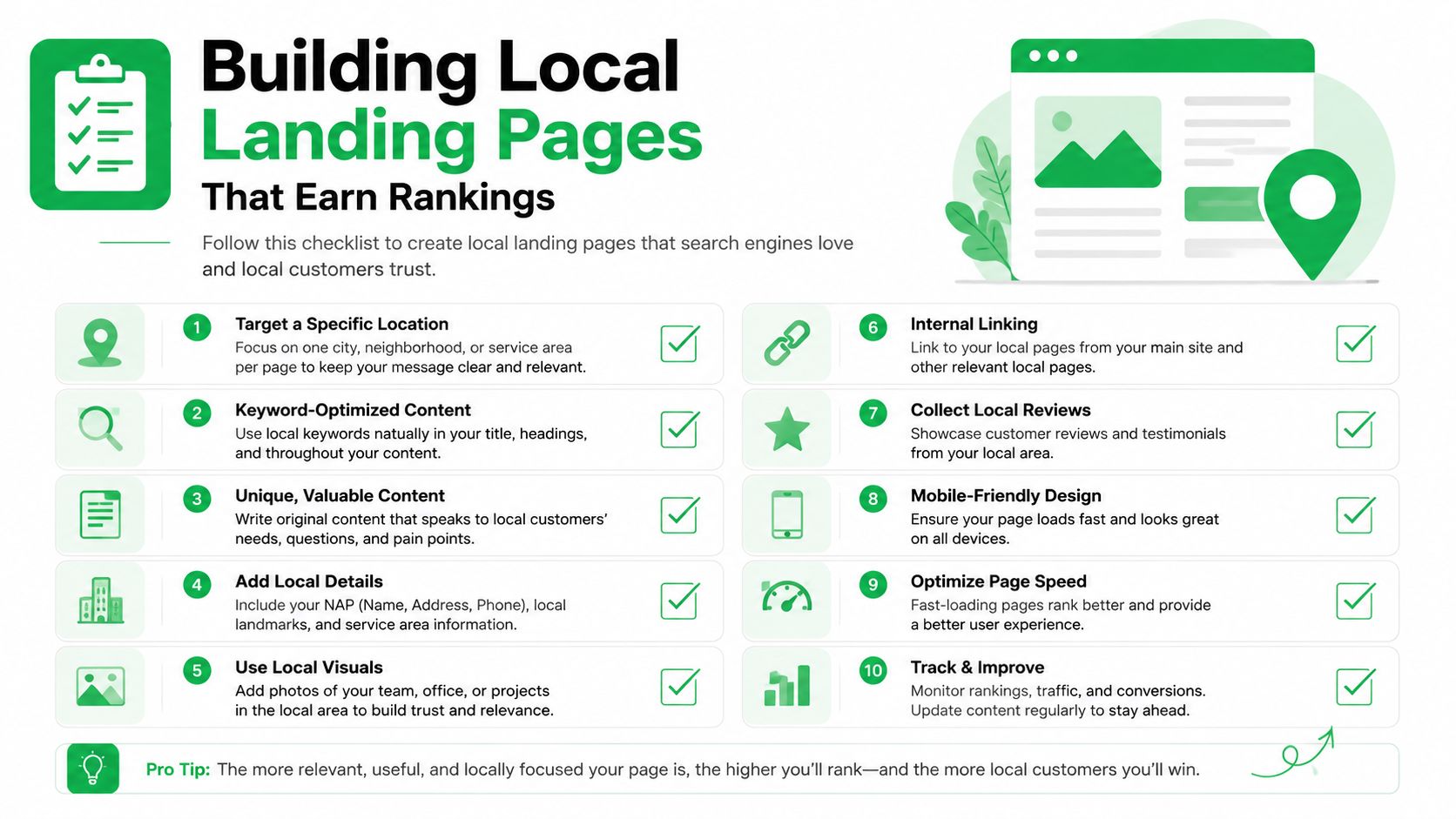
A page that passes this test has a reason to exist. A page that fails should remain part of a regional hub until the business can add real value. For execution support, custom local SEO landing pages can provide a structured way to build pages for single-location and multi-address businesses without treating every URL as interchangeable.
Multi Location SEO Strategy: Running Google Business Profiles at Scale
Treat Google Business Profile as an operating system, not a setup task. Every branch needs an accurate profile, a dedicated landing page, an accountable owner, and a repeatable maintenance routine.
Begin with one verified profile for each real, customer-facing location. Google requires accurate address or service-area information, and its address guidance calls for a complete street address, including suite or floor details when they form part of the official address (Google Business Profile address guidelines). A storefront should use its actual address. A service-area business may hide its address when eligible.
Bulk verification can simplify administration where it’s available, but centralized verification doesn’t remove local responsibility. Choose each primary category based on the branch’s actual service and local demand, not a corporate preference designed to make every profile look identical. Complete services with useful descriptions, add appropriate photos, maintain posts, and seed relevant Q&A that staff can answer accurately.
Suppress duplicates before they split signals
Duplicate profiles create customer confusion and violate Google’s policy. Google specifically flags multiple profiles that represent the same business, including profiles sharing an address (Google’s duplicate profile policy).
Use the correct remedy for each situation:
- Practitioner listings: Keep a distinct listing only when the practitioner qualifies independently. Otherwise, request a merge or removal.
- Service-area businesses: Hide the address when the business meets Google’s service-area requirements.
- Former franchisee ownership: Document the business relationship, request access through the profile workflow, and escalate ownership disputes rather than creating a replacement listing.
- Overlapping listings: Consolidate duplicates so the legitimate branch retains the history and customer pathway.
Reviews need a steady operating rhythm tied to transaction moments. Ask customers after a completed service, visit, or appointment, and give each location its own review link. The recommended operating cadence in the rollout guidance is a minimum of two reviews per month, with responses within 24 hours (Flento’s multi-location local SEO workflow). Don’t confuse a short-lived spike with a healthy process.
Each manager should own a weekly checklist covering profile edits, hours, photos, unanswered questions, new reviews, review responses, and calls that failed to connect. Corporate dashboards can hide weak branches inside a healthy rollup. Review location-level performance, not just the brand average. A branch buried in the aggregate still loses customers.
For a broader operating framework, see this guide to local search optimization.
Citations and NAP Consistency Across the Web
Citations still matter, but they’re a data-control problem before they’re a link-building project. A branch with the wrong phone number or an outdated suite identifier creates friction for customers and ambiguity for search engines.
Independent guidance places citation consistency at roughly 9% of local algorithm weighting and describes a meaningful gap between highly consistent and less consistent NAP profiles in competitive local results (multi-location citation consistency guidance). Treat that as a reason to control the data, not as a promise of a fixed ranking gain.
Start with a canonical NAP record for every branch. Store the approved business name, street address, suite format, phone number, landing-page URL, hours, categories, and ownership notes in one source-of-truth spreadsheet or platform. If a branch changes from “Suite 200” to “#200,” update the record and propagate the approved format everywhere. A quiet mismatch can split trust across profiles that appear to describe the same location.
Audit sources by business value
| Source Type | Examples | Priority | Fix Approach |
|---|---|---|---|
| Data aggregators | Data Axle, Localeze, Foursquare | Highest | Correct the source record first because downstream directories may reuse it |
| Vertical platforms | Avvo for lawyers, Healthgrades for clinics, Yelp for restaurants | High | Claim, verify, and align branch-specific details |
| Tier-one citations | The top 30 core directories relevant to the market | High | Standardize NAP, category, URL, and hours |
| Local and niche directories | Chamber, neighborhood, and industry listings | Medium | Fix authoritative or high-traffic entries before lower-value profiles |
| Duplicate or unmanaged listings | Old brands, former addresses, duplicate branches | Immediate | Merge, remove, or reclaim ownership through the platform |
Run the audit quarterly. Pull the top 50 citations per location, compare every field against the approved record, log discrepancies by severity, and fix aggregators first. A practical triage rubric is:
- Critical: Wrong phone, wrong address, duplicate profile, or incorrect branch URL.
- High: Incorrect business name, suite format, category, or hours.
- Medium: Missing photos, description, attributes, or service details.
- Low: Formatting differences that don’t alter customer identification.
The rule that prevents most drift is organizational, not technical. One person owns NAP, and field staff submit changes through that owner instead of editing listings independently.
Multi Location SEO Strategy: Localized Content, Schema, and Canonical Controls
Weak templates die. A location page doesn’t need every sentence to be unique, but it does need enough branch-specific evidence to answer a local customer’s real question better than a generic page can.
Write the service description from the location outward. Mention the neighborhoods served, local conditions that affect the work, access or scheduling realities, and the staff who handle the account. Add a branch-specific case study, a local testimonial, staff bios with relevant credentials, and FAQs drawn from calls to that location. A corporate boilerplate, shared service list, legal disclaimer, and standard call to action can remain consistent. The proof cannot.
Build the page around local evidence
A strong content set may include:
- Branch expertise: Explain which local team members deliver the service and what experience they bring.
- Geographic context: Reference neighborhoods, landmarks, parking, transit, weather, regulations, or service-area boundaries when they affect the customer.
- Proof from the branch: Use testimonials, photos, awards, community relationships, and case studies tied to that location.
- Local questions: Answer the concerns customers ask that branch staff hear repeatedly.
- Conversion clarity: State where the customer should call, visit, book, or request a quote.
LocalBusiness schema should describe the actual branch, not the brand in the abstract. Include the location’s name, address, phone number, URL, opening hours, and relevant service or area information. Add optional properties such as geo coordinates, image, price range, department, and accepted payments only when they’re accurate and supported by the page. Review markup requires particular care. Don’t use structured data to imply ratings or reviews that the page doesn’t legitimately represent.
The NAP properties in schema must match the GBP and citation record exactly. A schema address with one suite format, a profile with another, and a directory with a third create unnecessary ambiguity.
Use canonical tags with intent
A distinct location page should usually self-canonicalize. A near-duplicate page that adds no independent value should point to the preferred parent or be removed from the index strategy. Google’s canonical guidance recommends identifying a preferred version for duplicate or near-duplicate URLs so ranking signals can consolidate (canonical tag guidance for duplicate content).
A self-referencing canonical on every page isn’t a cure for duplication. If Dallas and Houston target overlapping service areas with nearly identical copy, both self-canonicals merely tell search engines that two weakly differentiated pages are preferred versions of themselves. Decide whether both pages deserve to exist, then support that decision with unique content, internal links, and local evidence.
AI-driven discovery raises the standard. Search systems can ignore pages that repeat the same template without adding a reason to trust the branch. Keyword density won’t rescue a page that lacks local proof. For implementation details, use this guide to schema markup for SEO.
Multi Location SEO Strategy: Tracking, Attribution, and a 90-Day Governance Plan
A multi-location program fails when the brand reports one blended number. Leadership needs to know which branches earn visibility, which pages generate demand, and which locations consume resources without producing a defensible return.
Segment rank tracking by city and ZIP code. Pull GBP insights for each profile. Use Google forwarding numbers or another approved call-tracking setup to connect calls to the correct branch, and tag conversions from each location URL. A lead from the Austin GBP, the Austin location page, or an Austin Yelp listing should resolve to Austin in the CRM, not disappear into a national brand total.
Track the portfolio with a small set of location-level measures:
- Visibility: Rankings and impressions for mapped city and service queries.
- Profile health: Verification, accuracy, reviews, responses, calls, direction requests, and website visits.
- Page performance: Organic entrances, engagement, form submissions, booked appointments, or quote requests.
- Data integrity: NAP discrepancies, duplicate listings, schema errors, and unowned profiles.
- Business value: Qualified leads and revenue attribution where the CRM supports it.
The 90-day operating plan
| Phase | Days | Key Workstreams | Owner | Exit Criteria |
|---|---|---|---|---|
| Baseline | 1 to 30 | Audit rankings, citations, GBP health, landing pages, schema, ownership, and attribution | Marketing lead with regional managers | Each location has a documented baseline and issue priority |
| Fix and deploy | 31 to 60 | Correct NAP, suppress duplicates, improve profiles, publish qualified pages, repair schema, and configure tracking | SEO and web teams, supported by operations | Critical data issues are resolved and approved pages are live |
| Measure and decide | 61 to 90 | Compare location performance, review lead quality, inspect underperformers, and prepare investment decisions | Marketing, sales, operations, and finance | Each branch has a continue, reinvest, or prune recommendation |
Assign roles clearly. Marketing owns strategy, keyword mapping, reporting, and content standards. Operations validates addresses, service areas, hours, and branch capabilities. Regional managers collect proof, approve local details, and respond to operational changes. Sales confirms whether leads are qualified and routed correctly. One accountable owner should approve every location-page and NAP change.
Use a quarterly business review to make decisions, not just present dashboards. A location should justify its continued page and GBP presence by demonstrating a real operating footprint, accurate data, local demand, and a measurable customer path. If it can’t, merge it into a regional hub, correct the service-area model, or stop investing in a page that exists only to satisfy a spreadsheet.
The analytics and reporting framework should support those decisions with branch-level evidence. The hardest governance call is knowing when to cut. A smaller portfolio of useful, well-supported pages will outperform a bloated directory of interchangeable URLs.
Mr. Green Marketing, LLC helps multi-location businesses audit local visibility, build conversion-focused landing pages, manage SEO and PPC, and improve reporting across branches. Visit Mr. Green Marketing, LLC to request a free audit and performance report, then identify which locations deserve investment first.
Leave a Comment
sing in to post your comment or sign-up if you dont have any account.