
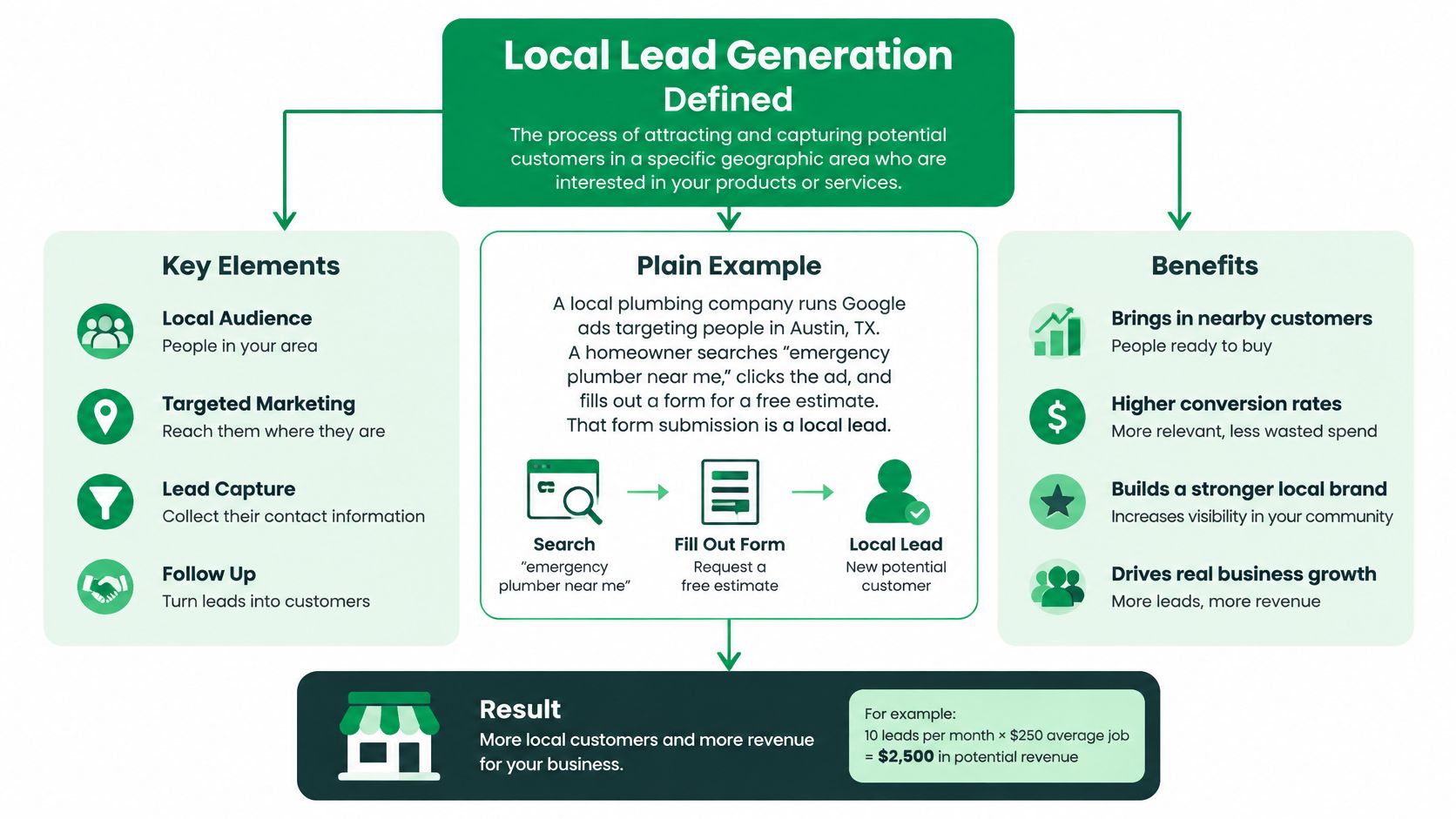
Local lead generation is the process of attracting and converting prospective customers inside a defined geographic area through search visibility, local ads, listings, calls, directions and forms.
You might already be paying for ads or updating your business profile, yet still struggle to explain where your next booked job will come from. The phone rings, someone submits a form, and another prospect asks for directions. Which activity produces customers?
And sometimes the problem isn't getting found. It's the outdated opening hours, the unanswered call, or the inquiry nobody connects to a sale.
Table of Contents
- Local Lead Generation Defined With a Plain Example
- How a Local Search Turns Into a Measurable Lead
- What Decides Whether Your Business Shows Up Locally
- Channels That Build a Local Lead Program
- Why Cost per Lead Replaces Cost per Click
- Metrics That Show Whether Leads Pay Off
- Reputation and Listing Accuracy After the Click
- Set Up Your First Local Lead Program This Quarter
Local Lead Generation Defined With a Plain Example
A bakery's sign on a busy street catches people walking past. Local lead generation serves a similar purpose for someone typing bakery near me into a phone. Instead of noticing a storefront, that person encounters a map listing, checks the hours, and decides whether to visit.
Geography is the filter. A bakery wants nearby shoppers. A plumbing company wants inquiries from households it can serve. A cheap contact outside that boundary isn't a qualified local lead.
Google's U.S. consumer research found that 4 in 5 consumers used search engines to find local information, with 88% conducting local searches on smartphones and 84% on computers or tablets, according to its local search infographic. Those searches involved practical details such as hours, directions, addresses, and product availability.
The same research found that 50% of consumers who searched locally on a smartphone visited a store within one day, compared with 34% who searched on a computer or tablet. It also found that 18% of local smartphone searches resulted in a purchase within one day, versus 7% of non-local smartphone searches.
Practical rule: Be findable when a nearby customer is deciding where to call, visit, request a quote, or buy.
That's the useful answer to what is local lead generation? It's not just attracting attention in your town. It's making nearby demand easier to act on, then identifying which actions become business.
How a Local Search Turns Into a Measurable Lead
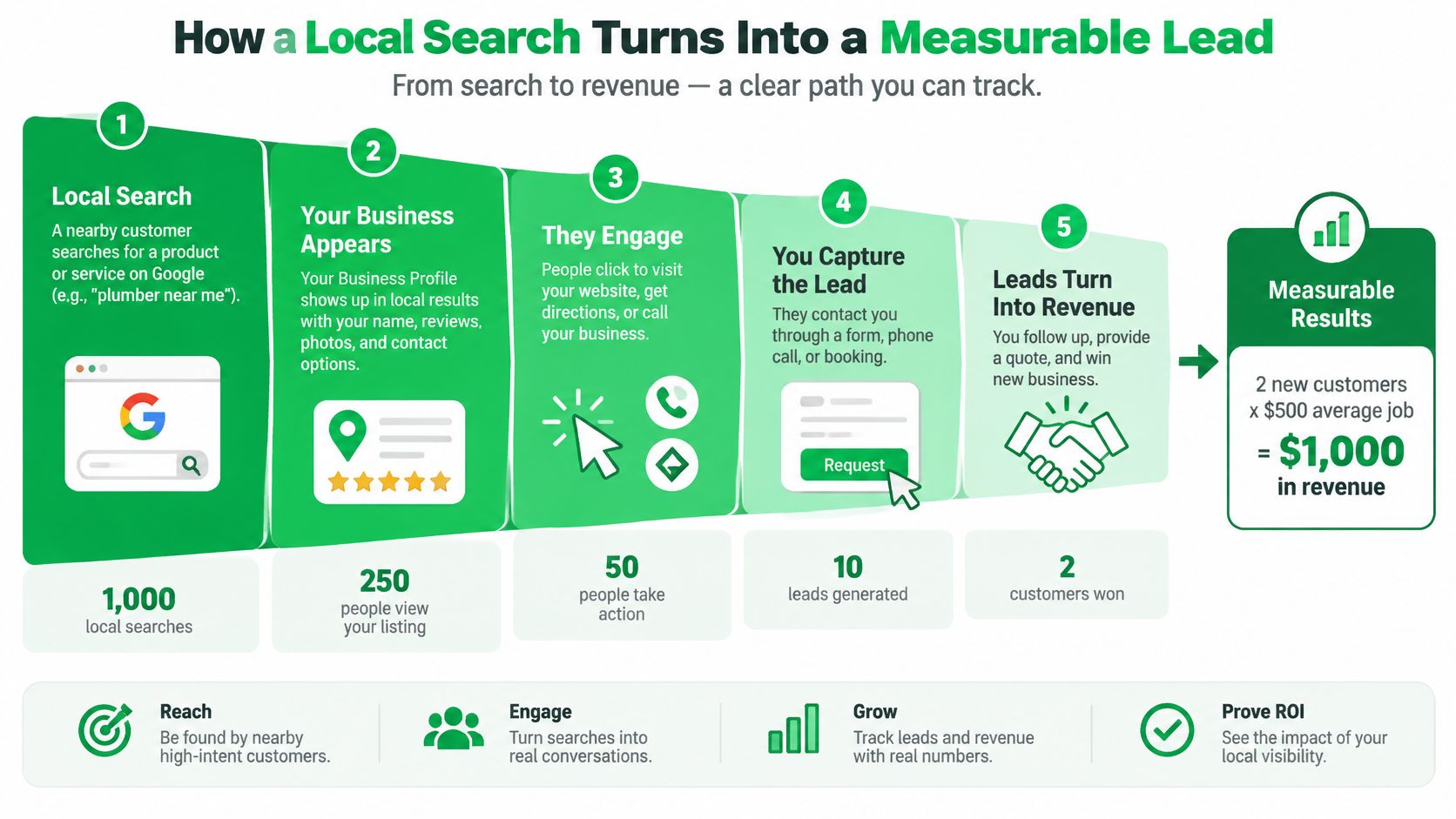
Visibility and action aren't the same thing. A profile view tells you someone encountered your business. A call or booking tells you they took a further step, although you still need to establish whether the inquiry fits your services.
Google Business Profile performance reporting distinguishes discovery information, including views and searches, from interactions such as calls, website clicks, and direction requests. Read both, but don't count every interaction as a qualified opportunity.
Lead actions and how to track them
| Lead Action | What It Signals | How You Track It |
|---|---|---|
| Phone call | Prospect is ready to speak with someone | Call tracking number and call log |
| Direction request | Prospect plans to visit the location | Google Business Profile action metrics |
| Website click | Prospect wants more detail before deciding | Tagged landing page in analytics |
| Appointment booking | Prospect has committed to a time | Booking system connected to the CRM |
| Quote or form submission | Prospect is asking for pricing or a service | Form tool connected to the CRM |
A direction request suggests interest in visiting, not proof of arrival. Likewise, a phone-number click isn't necessarily a completed conversation. Keep those distinctions visible in your reports.
The useful chain is local queries → profile views → calls, clicks or bookings → qualified opportunities → closed revenue. Calculate the conversion rate between stages wherever you have reliable records, rather than assuming every step represents the same person.
Your website conversion funnel should preserve that trail through the landing page, inquiry, and customer record. A CRM, or customer relationship management system, gives staff somewhere to record service requested, location, status, and outcome.
For a multi-location company, assign results to the branch handling the inquiry. Choose a primary lead action for each location and connect it to completed business wherever attribution permits. Everything else remains a supporting signal.
What Decides Whether Your Business Shows Up Locally
Google identifies relevance, distance, and prominence as its principal local ranking factors in its guidance on improving local rankings. Each suggests a different kind of work, although distance isn't something you can optimize away.
Relevance means how closely your Business Profile matches the search. Select accurate primary and secondary categories, describe the services you provide, and keep your website consistent with those details. Don't add unrelated services just to attract more searches.
Distance concerns how far your business is from the searcher or the location specified. Use accurate service-area settings and eligible profiles for genuine branches, but don't assume expanding a service-area setting makes you rank across that entire territory.
Build recognition without confusing it with advertising
Prominence reflects how well-known the business is. Google describes signals including links, articles, directories, review count, review score, and the business's position in ordinary web results.
Google also states that businesses can't request or pay for better local rankings. Buying an ad creates a separate route to visibility; it doesn't purchase an organic map position.
Treat local search optimization as foundational maintenance rather than a ranking trick. Start with this checklist:
- Complete the profile. Use accurate categories, services, hours, and business details.
- Standardize business information. Keep your name, address, and phone number consistent across relevant directories, respecting address-display rules for service-area businesses.
- Request genuine reviews. Ask customers consistently and respond thoughtfully, including when feedback is critical.
- Earn local mentions. Seek relevant links through community organizations, suppliers, local publications, or legitimate partnerships.
A complete profile won't guarantee placement. It does give search platforms and prospective customers a clearer account of what you offer and where you operate.
Channels That Build a Local Lead Program
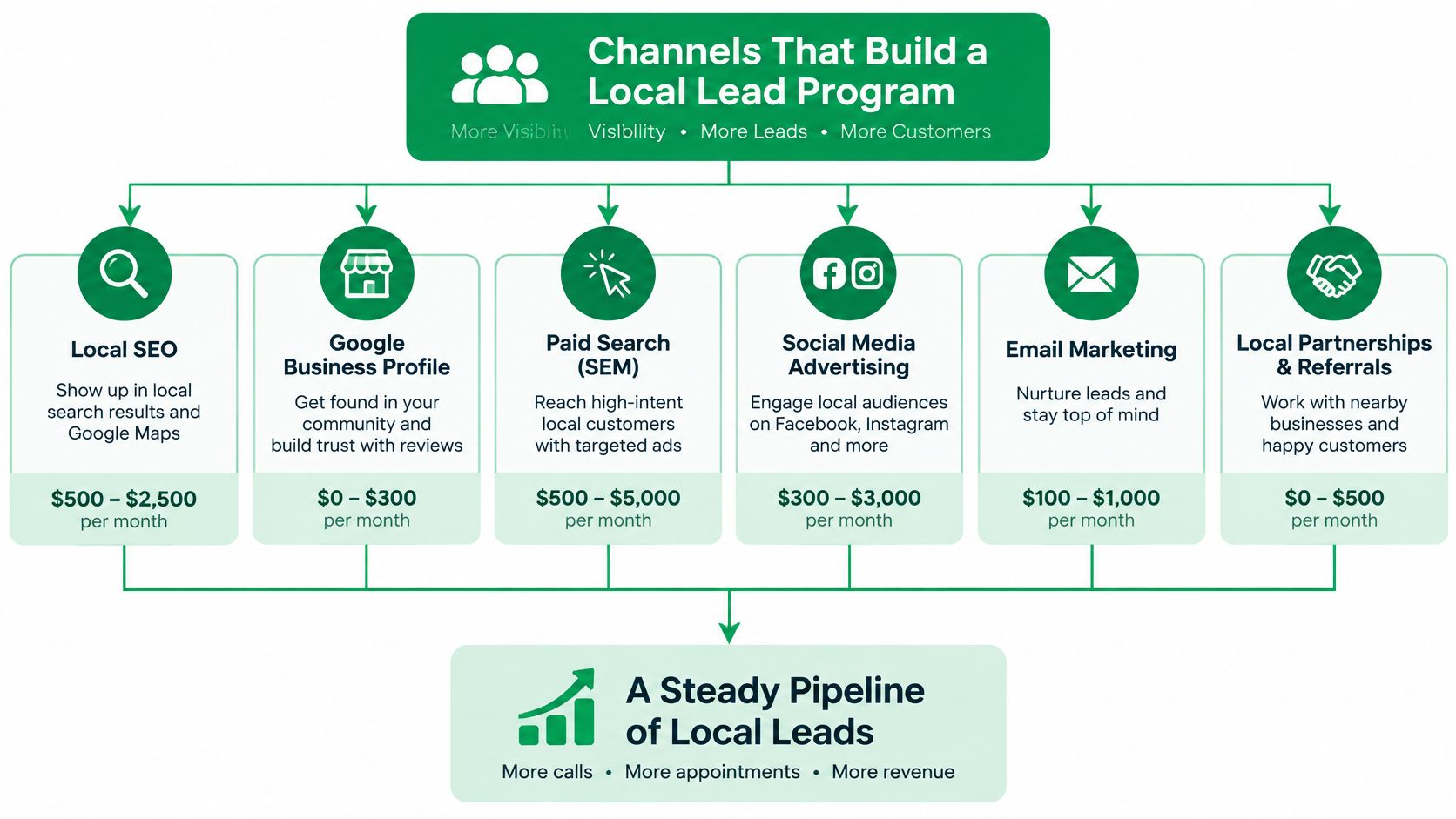
Think of local channels as layers, not rivals. Your website, Business Profile, and listings establish the foundation. Paid campaigns can add visibility while organic work develops, while reviews and referrals help prospects evaluate whether they trust you.
The right mix follows how customers buy. Someone with a broken water heater searches differently from someone browsing restaurants for a weekend gathering.
Local lead channels compared
| Channel | Typical Lead Type | Cost Model | Best Fit |
|---|---|---|---|
| Local SEO and Google Business Profile | Calls, direction requests, site clicks | Staff or agency time, no per-lead fee | Businesses with a physical address or service area |
| Paid search ads | Calls, form fills | Usually per click, with conversion-focused bidding options | Businesses selling a clearly defined, higher-value service |
| Local Services Ads | Valid calls, messages, bookings | Per valid lead | Eligible home services, legal, healthcare and trades |
| Social media with geographic targeting | Messages, bookings, event sign-ups | Per click or per thousand impressions | Retail, hospitality and events |
| Directory and citation listings | Calls, direction requests | Free or paid listing | Businesses needing consistent information across the web |
| Referrals and reviews | Calls and referred inquiries | Staff time; optional referral-program incentives | Repeat-service businesses with loyal customers |
These are cost models, not price quotes. Market competition, service category, campaign settings, and management requirements all affect what you spend. Conversion-focused bidding also doesn't necessarily mean an advertising platform bills only when a conversion occurs.
Keep referral incentives separate from review requests. Don't pay for favorable reviews or make rewards conditional on positive feedback.
For urgent services, a focused PPC lead generation campaign can send searchers to a page about the exact service they need. For hospitality, geographically targeted social advertising might be better suited to introducing an event or showing the experience.
Start with an owned asset, such as your service landing pages, and a paid channel. Maintain your Business Profile alongside them. Add more channels only when you can identify where inquiries came from and what happened afterward.
Why Cost per Lead Replaces Cost per Click
Treating a click as the result is an expensive habit. A click can help diagnose an ad, but it doesn't tell you whether someone needs your service, lives within your territory, or ever contacts you.
In Local Services Ads, advertisers are charged for valid leads, with contact routes including calls, messages, and bookings, according to Google's lead-charge documentation. A billable platform lead still isn't a guaranteed customer or necessarily a sales-qualified opportunity.
Google's Local Services Ads overview explains that bidding can influence ad position and offers target cost-per-lead bidding. In plain language, you set a lead-acquisition objective, and the system works toward it. It's an objective, not a promise about every contact.
Follow the money beyond the inquiry
Say a business spends $600 in a hypothetical week, receives 20 valid leads, and books 6 jobs. Its cost per lead is $30, but its cost per booked job is $100.
Those figures answer different questions. The first measures inquiry acquisition; the second helps assess whether the business can afford that acquisition.
Cheap contacts aren't a bargain when your team can't turn them into suitable work.
Use a short operating checklist:
- Define qualification. Specify the service, geography, and genuine customer need.
- Track contacts. Record calls and messages with their sources and outcomes.
- Remove reporting noise. Separate spam, repeated contacts, and duplicate records.
- Compare commercial results. Review booked jobs and closed revenue alongside cost per lead.
Keep cost per click for troubleshooting. Use cost per qualified lead to compare acquisition efficiency, then check whether those leads become profitable customers.
Metrics That Show Whether Leads Pay Off
| Metric | Formula |
|---|---|
| Cost per lead | Total spend divided by valid leads |
| Lead-to-customer conversion | New customers divided by leads |
| Customer acquisition cost (CAC) | Total acquisition spend divided by new customers |
| Lifetime value (LTV) | Average order value times purchases per year times years retained |
| LTV to CAC ratio | LTV divided by CAC |
Consider a hypothetical monthly program costing $1,800, with 60 valid leads and 12 new customers. Cost per lead is $30, lead-to-customer conversion is 20%, and customer acquisition cost is $150.
For the same illustrative business, assume an average order of $450, 3 purchases per year, and 2 years retained. Revenue-based lifetime value is $2,700, giving an 18-to-1 revenue LTV-to-CAC ratio. That's arithmetic, not a benchmark or a forecast.
Separate revenue from profit
The simple LTV formula measures revenue unless you adjust it for margin. Deduct the cost of delivering the work and account for retention uncertainty before deciding what you can afford to pay for a customer.
Include acquisition costs consistently, too. Comparing ad spend alone for one channel against advertising, agency fees, and staff time for another produces a misleading result.
Your marketing ROI calculation should connect those costs to attributable financial returns. A favorable-looking ratio can still create cash-flow problems if customers pay slowly or repeat purchases don't materialize.
Decision check: Compare channels using the same cost definitions, qualification rules, and customer-outcome window.
Review results by location and channel, so a productive branch doesn't conceal an unproductive one. Track time from inquiry to first human contact and use revenue per local website session as a supporting measure of traffic quality.
Don't judge a long-consideration service solely on newly received leads. Allow enough time for the sales cycle, distinguish open opportunities from lost ones, and avoid treating a small sample as a dependable pattern.
Reputation and Listing Accuracy After the Click
A campaign can fail after the click. Prospects don't necessarily take a listing at face value; they check whether your contact details, hours, reviews, and website tell a consistent story.
In 2025, 85% of surveyed U.S. consumers considered accurate contact information and opening hours important, while 67% often or always checked reviews after a local search, according to BrightLocal's consumer search behavior study. That makes information accuracy part of customer acquisition, not just administrative housekeeping.
Give someone ownership of accuracy
Build a listing register containing the platforms you use, login owner, published phone number, hours, service area, and last review date. Schedule a quarterly audit, but update holiday hours, relocations, and service changes when they happen.
Your local SEO citations should help customers verify the business rather than send them toward disconnected numbers or old addresses.
Use an operational checklist:
- Assign an information owner. Make someone responsible for publishing changes across platforms.
- Create a review-response workflow. Acknowledge feedback, address specific concerns, and move private customer matters out of public replies.
- Route new inquiries. Name the person responsible for responding and provide backup coverage.
- Log missed opportunities. Track missed calls, response time, unresolved questions, and reasons prospects decline.
Say an ad promotes emergency repairs, but the landing page lists conflicting hours and the phone goes unanswered. Rewriting the ad won't resolve that mismatch.
Fixing trust signals may produce more additional inquiries than publishing another batch of location pages. Not because content is useless, but because prospects who already found you still need a reason to proceed. Check the information and follow-up experience before concluding that the lead source is broken.
Set Up Your First Local Lead Program This Quarter
Start with a manageable program, not a presence on every platform. Give each task an owner and keep the definitions stable enough that you can compare results.
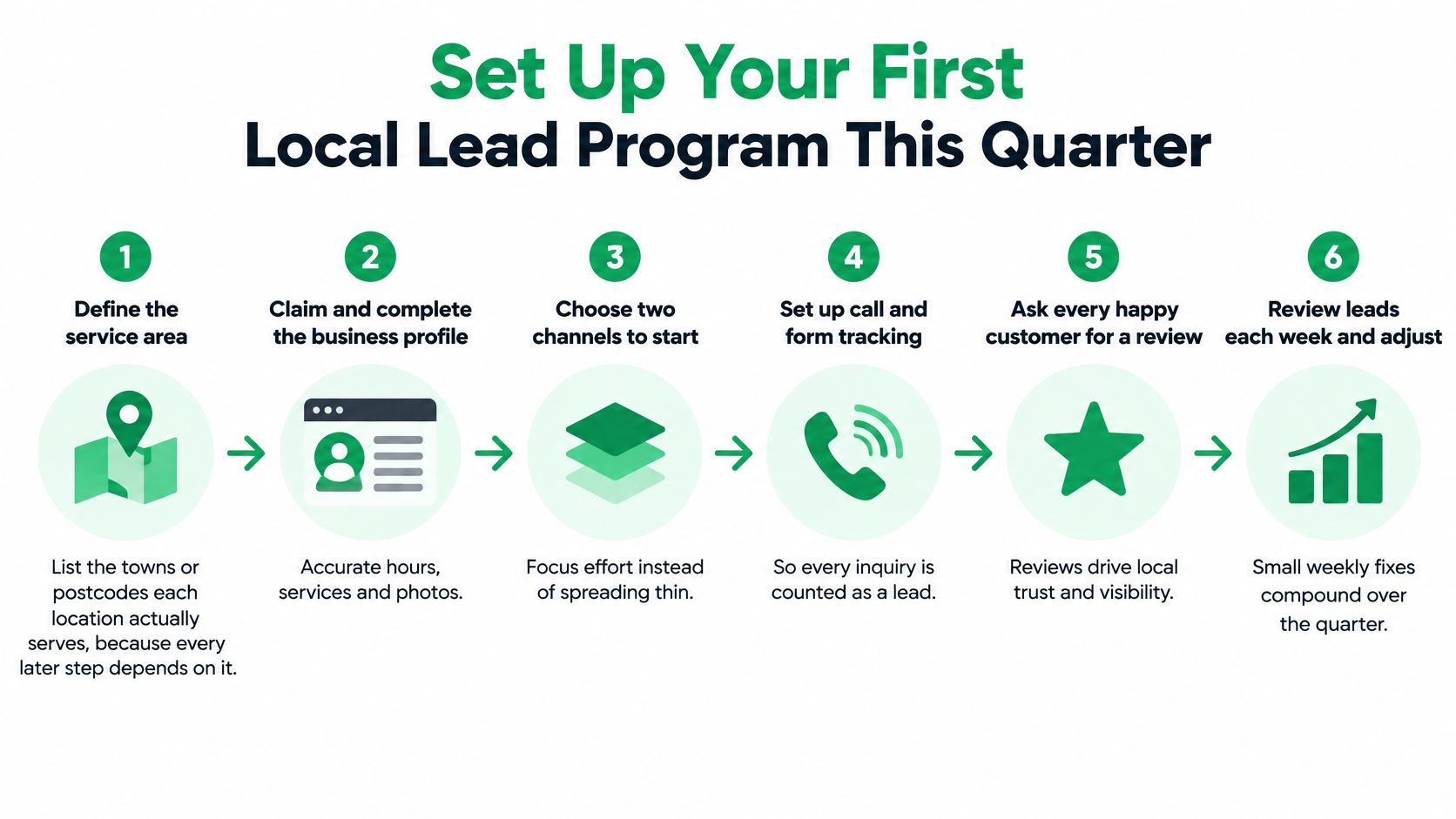
Define the actual service area. Mark the towns or postcodes each branch serves on a map. Include travel constraints and service exclusions so marketing doesn't promise work your team can't deliver.
Audit profiles and listings. Check business name, address, phone number, hours, categories, and services against an approved master record. Correct discrepancies before buying more traffic.
Choose a focused channel mix. Pair an owned channel, such as service-page SEO, with paid search or eligible Local Services Ads. Select channels you have the capacity to manage and measure.
Write the lead definition and install tracking. Connect call logs, tagged landing pages, and forms to your CRM. Record source, branch, requested service, qualification, and eventual outcome rather than collecting contact details alone.
Set an affordable target cost per lead. Multiply allowable customer acquisition cost by your realistic lead-to-customer conversion rate. Use margin and cash-flow constraints to establish the acquisition limit, not a competitor's apparent spending.
Review by location and channel. Check handling problems weekly and financial results monthly. As a starting management rule, investigate and consider pausing a channel that exceeds target across two review cycles, while allowing for sales-cycle length and incomplete attribution.
At our boutique agency, we work hands-on and tailor the work to each business. Our regular analytics and reporting include website traffic, leads generated, conversion rates, and other goal-specific performance indicators.
Export your last 90 days of lead data now. Calculate cost per lead by channel and location, mark records with unknown sources, and use that baseline for your first review.
We offer marketing strategies for local service businesses seeking more leads, calls, and jobs, and ecommerce brands seeking more traffic, conversions, and sales. Visit Mr. Green Marketing, LLC to request a free audit and performance report and identify the visibility, conversion, and tracking gaps to prioritize in your local lead program.
Leave a Comment
sing in to post your comment or sign-up if you dont have any account.