
PPC for Lead Generation: You’re probably in one of two spots right now. Either you’ve run PPC before and got a pile of form fills that sales hated, or you’re about to launch and you’re trying not to burn budget on clicks that never turn into revenue.
That’s a core problem with most advice on PPC for lead generation. It stops at the conversion. It celebrates the form fill. It reports the call. Then everyone acts surprised when the pipeline is weak.
A lead gen campaign only works when it attracts the right people, qualifies them fast, and feeds enough truth back into the ad platform that it can find more buyers like them. That’s the job. Not traffic. Not vanity metrics. Revenue.
PPC for Lead Generation: Laying the Foundation for Profitable Leads
Most wasted ad spend starts before the first ad goes live. The campaign isn’t broken. The definition of a good lead is.
If your only goal is “get more leads,” Google Ads will often do exactly that. You’ll get more submissions, more calls, more top-of-funnel activity. And a lot of it won’t close. That’s why the first move in PPC for lead generation is setting a lead quality definition before choosing campaign types, keywords, or bidding strategies.
PPC has a real advantage here. PPC traffic converts 50% better than organic traffic, but that edge only shows up when campaigns are built around measurable objectives such as cost per lead and conversion rate from the start, according to WSI’s breakdown of PPC lead generation fundamentals.
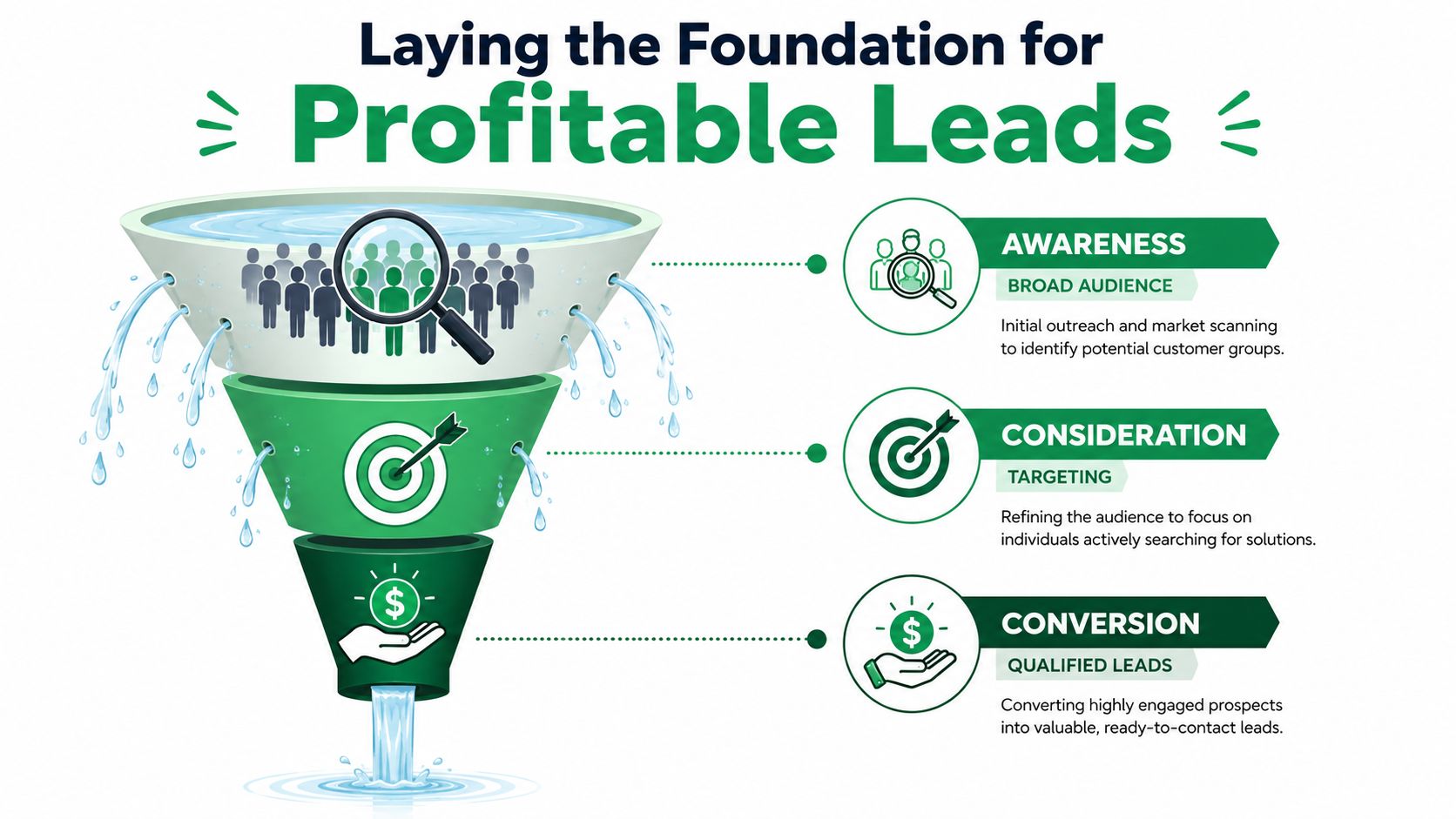
Define a qualified lead before platform setup
A form fill isn’t a qualified lead. It’s a contact event.
A qualified lead usually includes some mix of fit and intent. Fit means the account, person, or location matches who you want. Intent means they’re showing buying behavior, not casual curiosity. For a local service business, that could mean service area, job type, and urgency. For B2B, it often means company type, role, and need.
Start with a short internal checklist:
- Buyer fit: Industry, company size, location, service need, or household profile
- Commercial intent: Urgency, budget signal, request type, or sales-readiness
- Sales acceptance: Whether the sales team would call this person first
- Revenue potential: Whether this lead type tends to become high-value work
Practical rule: If sales wouldn’t be disappointed to lose a lead type, don’t train your campaign to chase it.
PPC for Lead Generation: Pick the campaign type based on control
New advertisers often jump into whatever campaign format looks easiest. That’s usually a mistake.
For most lead generation accounts, Search is the cleanest starting point because it gives you tighter control over keyword intent, ad copy, and landing-page alignment. You can see what people searched, which queries drove leads, and where budget leaks.
Performance Max can work, but it needs cleaner inputs. If your conversion tracking is weak, your lead qualification process is fuzzy, or your creative is generic, it can scale the wrong thing fast. That’s not a platform issue. It’s a signal issue.
Set objectives that finance can respect
The objective shouldn’t be “more volume.” It should be a target the business can act on.
That usually means working backward from:
| Metric | Why it matters |
|---|---|
| Cost per qualified lead | Tells you whether lead quality and acquisition cost are aligned |
| Lead-to-opportunity rate | Shows whether the campaign is feeding sales useful conversations |
| Sales acceptance | Filters out junk volume early |
| Pipeline contribution | Connects ad spend to business value |
And yes, this part is slower. It requires alignment with sales, operations, or whoever owns follow-up.
But it’s the difference between a campaign that looks efficient in-platform and one that earns budget month after month.
PPC for Lead Generation: Finding Your Ideal Customers and Keywords
Keyword research starts with the customer, not the tool.
When advertisers skip that step, they build campaigns around what sounds relevant instead of what buyers actually search when they’re ready to act. That’s how budgets get chewed up by broad, low-intent traffic that looks busy and performs badly.

Build the profile first
A usable customer profile needs more than demographics. You need the pressure points behind the search.
Ask questions like these:
- What problem triggered the search? A breakdown, a compliance issue, a growth bottleneck, a time-sensitive purchase
- What language does the buyer use? Not your internal jargon. Their words.
- What does hesitation sound like? Price concern, trust concern, timing concern, complexity concern
- What separates buyers from researchers? Urgency, service area, product specificity, commercial wording
If you need a structured way to tighten that profile, a practical starting point is this guide to buyer persona development.
PPC for Lead Generation: Use lead scoring to shape targeting
Often, too many PPC accounts drift. They treat every conversion as equal.
That’s backwards. Lead scoring gives structure to who matters most. According to Weave’s lead generation best practices, characteristics such as demographic fit and behavioral signals can be assigned numerical values so teams can prioritize high-intent prospects and avoid wasting budget on unqualified traffic.
A simple example:
| Signal | Stronger or weaker |
|---|---|
| Lives in target market | Stronger |
| Requested pricing or quote | Stronger |
| Viewed key service pages | Stronger |
| Used vague educational query language | Weaker |
| Requested unsupported service | Weaker |
That scoring model should influence ad groups, audience layers, form questions, and remarketing logic. Not later. Right now.
Turn pain points into search intent
Once the profile is clear, keywords get easier.
Start with high-intent terms that reflect a problem and a desired solution. Commercial modifiers usually matter more than sheer volume in lead gen accounts. Terms like service, agency, company, consultant, near me, quote, estimate, repair, provider, and demo often reveal stronger action intent than purely informational language.
Then defend the budget.
Negative keywords are one of the simplest ways to improve lead quality because they remove searches from people who were never likely to buy. Students, job seekers, freebie hunters, DIY searchers, and irrelevant geographies can drain a large share of spend if you let them in.
The fastest way to lower lead quality is to widen targeting before you understand who keeps disqualifying themselves.
PPC for Lead Generation: Layer audiences without replacing intent
For Search, audience data is a filter and insight layer, not a substitute for buyer intent. In-market audiences, custom segments, first-party lists, and CRM-based remarketing can all help narrow traffic to people with a higher probability of becoming revenue.
When you want a faster workflow for prospect discovery, tools focused on AI-powered audience generation can help surface audience patterns you may not have considered, especially when you’re translating customer traits into campaign targeting.
And one more thing. Don’t build a giant keyword list because it feels thorough. Build a useful one. Tight themes. Clear intent. Obvious exclusions. That’s what holds up under budget pressure.
PPC for Lead Generation: Crafting Ads and Landing Pages That Convert
Good ad copy gets the click. Good message match gets the lead.
That distinction matters because most conversion problems don’t begin on the landing page alone. They start with a mismatch between what the ad promised and what the page delivered. If the search says one thing, the ad says another, and the page says something broader, conversion rates fall because the buyer has to do too much interpretive work.
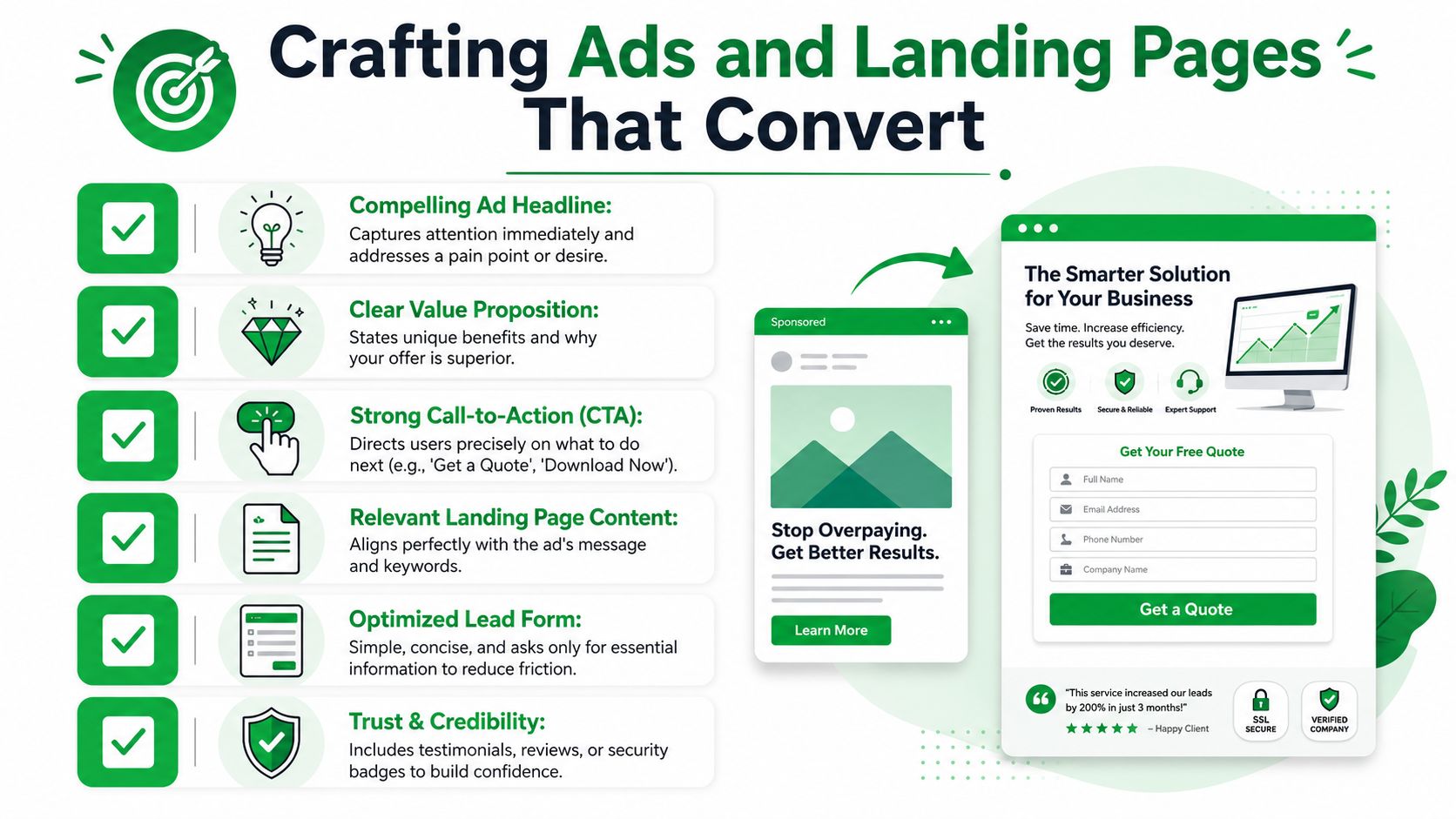
Message match is the whole game
Say someone searches for emergency AC repair. They click an ad about fast emergency HVAC service. Then they land on a homepage talking broadly about residential comfort solutions. That page might be well designed. It still leaks conversions.
The fix is simple, but not easy to execute consistently:
- Search term: Specific problem
- Ad copy: Direct answer to that problem
- Landing page headline: Same promise, same context
- Form CTA: The next logical step, not a generic action
That continuity lowers friction. It reassures the visitor they’re in the right place.
PPC for Lead Generation: What actually belongs on the page
A lead gen landing page doesn’t need to say everything. It needs to move one decision forward.
Use this as the working structure:
- Headline that mirrors intent: Match the problem and offer, not just the brand
- Hero section with a clear value proposition: Explain why this option is worth contacting now
- Focused CTA: Quote request, consultation booking, audit request, or demo
- Short form at the top: Keep initial fields lean unless qualification absolutely requires more
- Trust elements: Reviews, certifications, partner logos, process clarity, guarantees if applicable
- Reinforcement blocks: Pain points, proof, objections, next steps
If you want additional design patterns to boost landing page conversions, that resource is useful for pressure-testing structure and usability choices. For more applied examples, this collection of high-converting landing pages is worth reviewing against your own pages.
This walkthrough is also useful if you want to review page fundamentals in a more visual format before revising creative.
Tailored pages beat generic ones
There’s a reason vertical-specific campaigns often outperform broad ones. In high-value categories, customization changes the economics. Databox reports that HVAC companies using PPC have seen conversion rates exceeding 13%, showing how customized ad copy and landing pages can perform at a much higher level than generic campaigns.
One page, one audience, one offer. When a page tries to serve everyone, it usually converts no one particularly well.
That doesn’t mean every campaign needs dozens of pages. It means each page should be tightly aligned to a search theme or audience segment with distinct buying intent.
And yes, sometimes the best-performing page is less polished than the brand team wants. Fewer navigation options. Less storytelling. More clarity. That’s normal. Conversion pages aren’t brochures.
PPC for Lead Generation: Tracking What Matters for True ROI
If you only measure form submissions, the platform will optimize for form submissions. That’s exactly why so many accounts look healthy inside Google Ads and weak inside the CRM.
Real PPC for lead generation requires a closed loop between ad click, lead creation, qualification, sales outcome, and revenue. Without that loop, you’re training the algorithm on shallow signals.
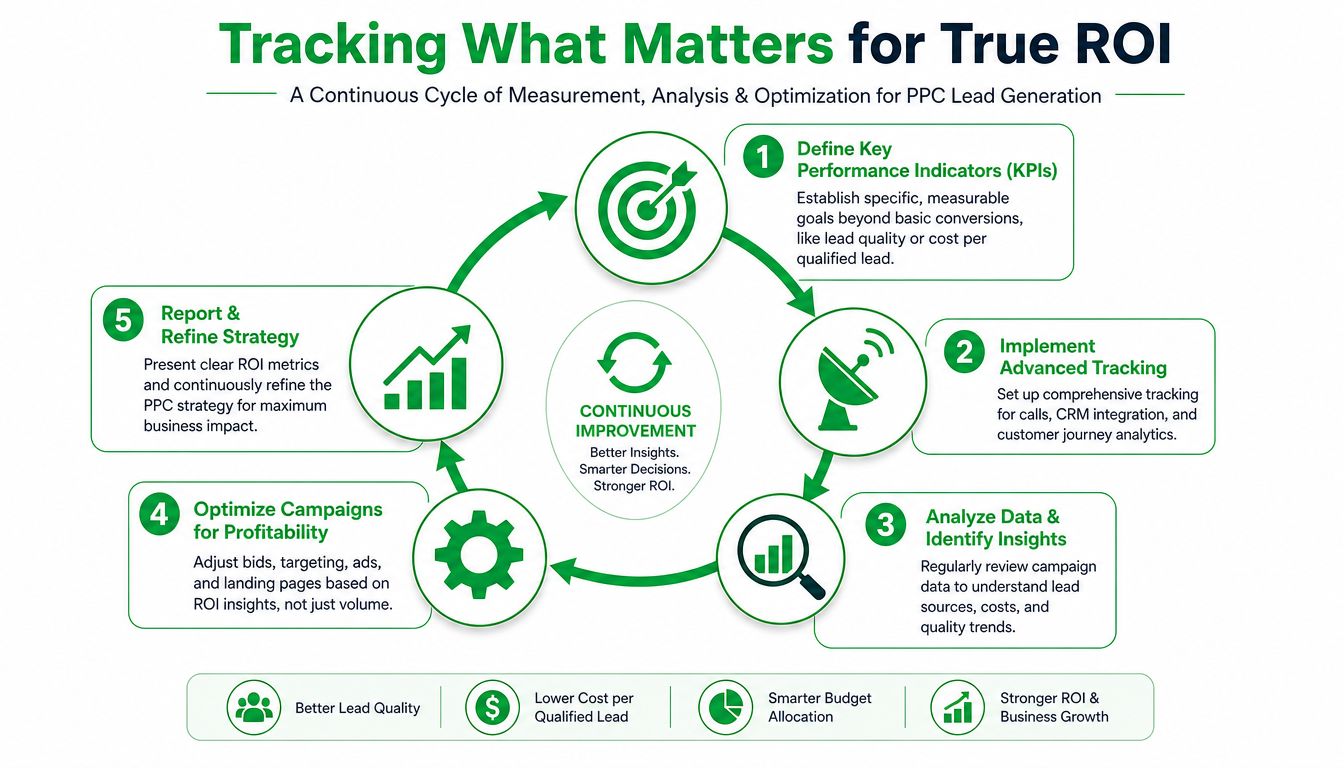
Track the conversion path in layers
The first layer is basic. Thank-you-page submissions, tracked calls, booked meetings, chat starts.
The second layer is where things improve. Sales-accepted leads, qualified consultations, opportunities created, proposals sent. These are better optimization signals because they filter out bad leads earlier.
The final layer is revenue outcome. Closed-won deals, retained accounts, valuable service lines. That’s what tells the platform who your real buyers are.
Here’s the practical stack:
| Tracking layer | What it tells you |
|---|---|
| Initial conversion | Who took action |
| Qualified conversion | Who was worth follow-up |
| Pipeline stage movement | Which leads progressed |
| Revenue outcome | Which traffic turned into business |
PPC for Lead Generation: Move from CPL to qualified lead economics
This is the shift most accounts need. Cheap leads are often expensive once sales gets involved.
WordStream’s analysis of PPC lead generation highlights the move from cost per lead to cost per qualified lead, backed by offline conversion data. Businesses using offline conversion imports saw a 20–35% improvement in ROI because the ad platform learned from high-value outcomes instead of top-of-funnel form fills.
That matters because bidding systems are literal. If you upload every form fill as success, they’ll find more people who like filling out forms. If you upload only the leads that become real pipeline, they’ll look for people who behave like buyers.
Most accounts don’t have a traffic problem. They have a feedback problem.
Keep attribution useful, not theatrical
Attribution can get messy fast. Different stakeholders want different stories. Paid search gets credit for the last click. Organic helped educate the buyer. Remarketing kept the conversation warm. Fine.
What matters operationally is knowing which campaigns move leads to the next meaningful stage. That’s the standard worth reporting on.
For teams trying to connect channel data with actual business outcomes, this guide to measuring marketing campaign effectiveness is a practical reference.
If you need help putting the pieces together, platforms like HubSpot, Salesforce, CallRail, and Google Ads can all play a role. Some businesses also use service providers such as Mr. Green Marketing, LLC to manage PPC and lead generation workflows while tying campaign reporting back to measurable business goals.
PPC for Lead Generation: Managing Budgets and Optimizing Performance
Underfunded PPC campaigns rarely fail because the market rejected the offer. They fail because the account never collected enough data to learn.
That’s the part many businesses resist. They want proof before committing budget. Reasonable instinct. Bad campaign logic.
Treat the test budget as data acquisition
If your target cost per lead is $100 and the goal is 20 qualified leads per month, the initial test budget needs to be at least $2,000 per month, according to Cometly’s PPC lead generation guidance. The math is plain. If you fund below that threshold, the campaign often won’t gather enough conversion data to stabilize and optimize.
That doesn’t mean every business should force that exact model onto every account. It means the test budget has to match the lead target closely enough for the algorithm to learn.
A small budget can still work if the scope is narrowed hard enough. Fewer services. Tighter geography. One offer. One audience cluster. One landing page path. That’s very different from spreading a thin budget across multiple campaigns and hoping the machine figures it out.
PPC for Lead Generation: What to optimize once traffic starts
After launch, the work gets more surgical.
- Search terms: Cut irrelevant queries early. Wasted spend often hides within them.
- Ad copy tests: Compare different angles such as urgency, trust, speed, or cost framing.
- Device behavior: Mobile and desktop users often convert differently, especially for calls versus forms.
- Lead form friction: If submission quality is poor, review both messaging and form design.
- Geographic segments: Some locations attract demand that looks similar but closes differently.
If you want a clean framework for segmenting marketing spend per lead, that resource is useful for aligning budget decisions with real acquisition economics instead of gut feel.
Choose bidding based on signal quality
Manual bidding gives you tighter control when data is thin or conversion quality is uncertain. Automated bidding becomes more useful when your tracking is strong and the system has enough high-quality conversion input.
And. It is here people rush.
They switch to automation before fixing qualification, tracking, and message match. Then the account scales noise. Not because Smart Bidding is bad, but because the campaign fed it weak signals.
Reporting and Scaling Your Lead Generation Engine
Most PPC reports are too busy and not useful enough. They tell you what happened inside the ad platform, but not whether the campaign is producing business value.
A report worth reading should center on lead quality progression. Which campaigns produced qualified leads. Which search themes created sales conversations. Which landing pages brought in people who moved through the pipeline. That’s the material stakeholders can act on.
Report on movement, not just volume
A clean reporting view usually includes:
- Qualified leads by campaign: Not just total conversions
- Sales acceptance patterns: Which sources produce leads worth pursuing
- Pipeline stage movement: Where leads stall or advance
- Cost per qualified lead: More useful than raw CPL in most service businesses
- Revenue-linked winners: Campaigns that deserve more budget
That kind of report changes the internal conversation. Teams stop asking, “How many leads did we get?” and start asking, “Which campaigns bring in buyers?”
A campaign is ready to scale when the quality pattern is repeatable, not when one month looked exciting.
Scale by widening proven paths
Once a campaign is producing qualified demand consistently, scale it through controlled expansion.
That can mean launching adjacent service campaigns, duplicating top performers into nearby geographies, adding remarketing sequences, or testing additional platforms that fit the same buyer profile. For saturated markets, there’s also a tactical split worth using. LinkedIn’s 2025 PPC strategy roundup notes that 2026 strategies for crowded audiences recommend putting 60% of budget toward cold audiences and 40% toward retargeting rather than just piling on more keywords.
That’s a smarter scaling posture because it acknowledges saturation as an audience problem, not just a keyword problem.
Scaling also requires restraint. Don’t expand three variables at once. Add one new geography, one new audience layer, or one new offer path at a time. Otherwise, you won’t know what improved performance and what diluted it.
If your PPC campaigns are generating clicks and form fills but not enough qualified pipeline, Mr. Green Marketing, LLC can help you audit the gaps, tighten targeting, improve landing-page alignment, and build a reporting setup that ties ad spend back to real business outcomes.
Leave a Comment
sing in to post your comment or sign-up if you dont have any account.