
Your logo looks dated. Your best customers describe you one way, your website says something else, and a newer competitor just launched with cleaner pricing and a clearer promise. So a rebrand sounds logical.
And it might be. Or it might be an expensive way to confuse people who already buy from you.
That's the call you have to make first. How to rebrand your business well isn't mainly about design. It's about protecting recognition, search visibility and trust while you change the parts that are holding you back.
Table of Contents
- The Rebrand Process at a Glance
- Define the Problem and Baseline Before Any Design
- Set Positioning and Target Audience Before Naming
- Naming and Identity Tested With Real Customers
- Messaging That Keeps Customers Through the Change
- Legal, Domain and Listing Updates to Make First
- Website Migration, Redirects and Accessibility Checks
- Launch in Phases and Decide Your Next Move
The Rebrand Process at a Glance
Most owners picture a logo, a website refresh and new social banners. Then they start counting. Invoices, vans, packaging, email templates, sales decks, uniforms, help centre articles, marketplace listings. It adds up fast.
The 2023 Bynder rebranding study of 1,002 marketers found a typical rebrand involved updating approximately 215 brand assets and lasted about seven months from initial discussions through rollout, and 8% of respondents said their rebrands lasted between one and two years. That's why I treat this as an operations project with design inside it, not the other way around.
The Seven Phases in Order
| Phase | Main output | Typical duration |
|---|---|---|
| 1. Audit and baseline | Problem statement and baseline metrics | 2-4 weeks |
| 2. Positioning and strategy | Positioning statement and target audience | 2-4 weeks |
| 3. Naming and identity | Name shortlist, logo system and brand guidelines | 6-10 weeks |
| 4. Messaging and transition | Announcement, FAQ and 'formerly known as' rules | 3-4 weeks |
| 5. Legal and listing updates | Trademark check, domain plan and profile changes | 4-8 weeks |
| 6. Website and SEO migration | Redirect map, updated templates and accessibility tests | 6-12 weeks |
| 7. Phased launch and measurement | Launch calendar and 3, 6 and 12 month reviews | 12 months |
These phases overlap in practice. Legal checks start during naming, for example, and messaging should start before identity is final. But don't skip ahead just because design feels more tangible than an audit.
Scope matters too. A branding project can be scaled to fit a client's needs, from a small logo to a complete rebrand, and each choice changes how many phases apply. A logo refresh may not need new positioning. A new name almost always does.
If you can't name the business problem in one sentence, you're not ready to brief a designer.
Start there. Is there a commercial reason for the change, or is this cosmetic? Cosmetic isn't wrong, but call it what it is and budget accordingly.
Define the Problem and Baseline Before Any Design
A rebrand doesn't fix a weak offer, slow follow-up or unclear pricing. It can, however, make a good business easier to choose. You need to know which problem you're solving before you change anything people recognise.
Write the trigger in one sentence. Outdated positioning. Entry into a new market. Weak lead quality. Then tie it to one measurable goal, such as more qualified leads, a higher conversion rate, better retention or expansion into a defined segment.
What a Real Baseline Looks Like
A peer-reviewed study on corporate rebranding identifies Burberry in 2002, when the company repositioned its brand to appeal to a younger luxury audience and reported sales increased by 46% within one year. The same review documents British Airways' attempt to create a more international image by altering its logo and Royal Mail's expensive transition to the name Consignia. The difference wasn't taste. Burberry changed positioning, targeting and experience together.
Before you touch a name or colour, record where you stand:
- Awareness and associations: aided and unaided awareness, plus the words customers use unprompted
- Perceived quality and consideration: how you rank against two or three named competitors
- Search behaviour: branded-search volume, direct traffic and impressions for your current name
- Commercial results: conversion rate, retention, repeat purchase and revenue by channel
Pull this from customers, not the leadership team. Owners routinely overestimate how clearly their brand lands. Staff hear the internal story every day. Customers hear an ad, see a van, read two reviews. Different picture entirely.
Say a local service firm wants more booked calls. For three months it logs call volume by source, branded search impressions in Search Console, and the exact wording in reviews. It discovers prospects praise speed but can't tell if the firm serves homeowners or commercial sites. That's a positioning problem you can measure. A new font won't touch it.
The Test Before You Proceed
Gate check: Can you state the business problem in one sentence and name the number it should move?
If yes, you've got a brief. If not, pause. Spending two to four weeks on a baseline feels slow. It isn't. It's what lets you tell, six months later, whether the rebrand worked or you just got used to the new logo.
Set Positioning and Target Audience Before Naming
Naming before positioning is putting a sign up before deciding what the shop sells. You'll get names, plenty of them. You just won't know how to judge them.
Write a positioning statement in one sentence. Who you serve, the problem you solve, why you're the right choice. Keep it plain enough that a customer could repeat it without help.
A Simple Way to Lock It
- Draft three versions: Make each one differ on audience, promise or proof, not just wording.
- Test in interviews: Ask customers and prospects to describe the business back in their own words.
- Score against the baseline: Pick the statement that addresses the conversion or retention gap you measured.
- Lock three to five attributes: Words like dependable, plain-spoken or specialist that will guide naming, visuals and copy.
- Write what you'll stop saying: Old claims, vague quality language and competitors you'll stop comparing yourself to.
Choose your target audience from evidence, not aspiration. The segment you wish you served is a growth plan, not a positioning shortcut. If you need help defining that segment properly, work through a proper buyer persona development process before you shortlist names.
Your outputs here are small but load-bearing. One positioning statement. One target audience profile. One short attribute list. Expect two to four weeks if decision makers show up to the meetings, and that's usually the bottleneck, not the writing.
Can a new staff member repeat the statement after one reading? If not, rewrite it. Don't move to naming with a statement only the founder understands.
Naming and Identity Tested With Real Customers
Branding work starts with the business's values and identity, and Mr. Green Marketing guides clients through developing a set of logos and branding guidelines. That order matters. Values tell you what a name must protect. The logo comes last in the decision chain, even if it's first in everyone's imagination.
Build a shortlist of three to five names. Screen every one early, before anyone falls in love with it.
- Trademark search: Clear the obvious conflicts in your category and neighbouring ones
- Existing business names: Check local and national registers for soundalikes
- Domain availability: Secure a workable domain, not a clever misspelling you'll explain forever
- Social and marketplace handles: Confirm you can claim consistent names where customers find you

Test for Trust, Not Taste
Show your top two or three options, the positioning line and early visual directions to existing customers, prospects and frontline staff. Don't ask which logo they like. Ask about credibility, consistency and confidence. Would they call this company? Does it sound like the business they already trust? What do they think it sells?
Read the answers. A name people can't pronounce, spell after hearing it, or distinguish from a competitor is a warning sign. A name customers repeat back accurately, and can explain to someone else, is doing real work. This kind of structured brand identity development keeps taste debates from overruling customer evidence.
Lock a Usable System
Your finished identity should include a primary logo with light and dark versions, a colour palette with hex codes, a type scale, and a one-page usage guide. Add one thing most guides miss. State when the old mark may still appear during transition, and where it may not.
Then run the go or no-go check. If testers still can't explain what the business does after seeing the new name and identity, go back to positioning. Approving design at that point just makes the confusion prettier.
Messaging That Keeps Customers Through the Change
Rebrands often lose money here. Not in the design file. In the inbox, on the invoice, in the moment a loyal customer wonders if they've landed on the wrong company.
Recent Clutch consumer research on rebranding found 98% of consumers notice when a familiar brand changes, 87% form assumptions about why it changed, and 44% say excessive rebranding reduces their trust. If you don't explain the change, customers will invent a reason. New owners. Trouble. Not for people like me anymore.
Build the Transition Kit
- Announcement: One sentence giving the business reason, written for customers, not investors
- Formerly known as line: For the website, invoices, email signatures and marketplace listings, with a retirement date
- FAQ and phone script: Short answers support staff can give without improvising
- Channel versions: Email to existing customers, packaging inserts, social bios, directory listings and sales decks
Decide what stays. A recognisable colour, a tagline, a product name, a mascot. Keeping one familiar asset signals continuity, and saying so openly helps. People attached to the old brand need a bridge, not a surprise. A phased change that retains selected assets is often safer than replacing everything on one Monday morning.
Your narrative matters here too, which is why it's worth shaping how to write your brand story around what isn't changing as much as what is. Same team, same service, clearer name. Whatever's true, say it plainly.
Track two signals in the first 30 days. Branded-search volume and support questions about the name. Rising confusion is a messaging problem you can still fix.
A template you can adapt:
We're now [New Name], formerly [Old Name]. Same team and same service, with a clearer name for [reason]. Nothing about your account, pricing or contact details changes.
Two sentences. No drama. That's usually enough if you repeat it everywhere customers look.
Legal, Domain and Listing Updates to Make First
A single directory listing can undo months of work. Local customers meet your Google Business Profile before they meet your website, and the name on that profile is the part of a rebrand that gets reviewed most closely.
Google's Business Profile name rules are strict about what counts as the same business. Check your proposed name against the current guidelines before launch, and plan for the possibility that a substantial change needs a new profile rather than an edit to the existing one. A closed profile takes its reviews and its history with it, and rebuilding both takes far longer than the rebrand itself.
Checks to Finish Before Launch
- Trademark clearance: search properly and get legal advice before printing anything
- Business name registration: file with the state and confirm the name matches across documents
- Domain plan: buy the new domain, set renewals, and keep the old domain live for redirects
- Handles and seller names: claim social profiles and update marketplace storefronts in a planned order
- Citation consistency: work through directories methodically, the way you would handle local SEO citations, so name, address and phone details match everywhere
Trademark clearance is usually the longest item on that list, so open it first and treat the domain purchase and handle grabs as a holding action until it clears. Buying a domain you later have to abandon is a cheap mistake. Printing signage before clearance is an expensive one.
Take a franchise with twelve locations that adds a word which is not a proper noun and shifts its service emphasis. That is not a single profile edit. It needs a location-by-location transition plan with dates, named owners, and a check on each category and service description.
Log every listing change with its date. When rankings shift three weeks later, that log is how you work out why.
Run this pass before you announce anything. Confirm the category, check every service description, review each location on its own, and put trademark and registration in front of a lawyer. I would rather delay a launch by two weeks than rebuild local visibility from a closed profile.
Website Migration, Redirects and Accessibility Checks
Your website carries search equity you've already earned. Treat the migration carelessly and you'll pay to win back traffic you had for free.
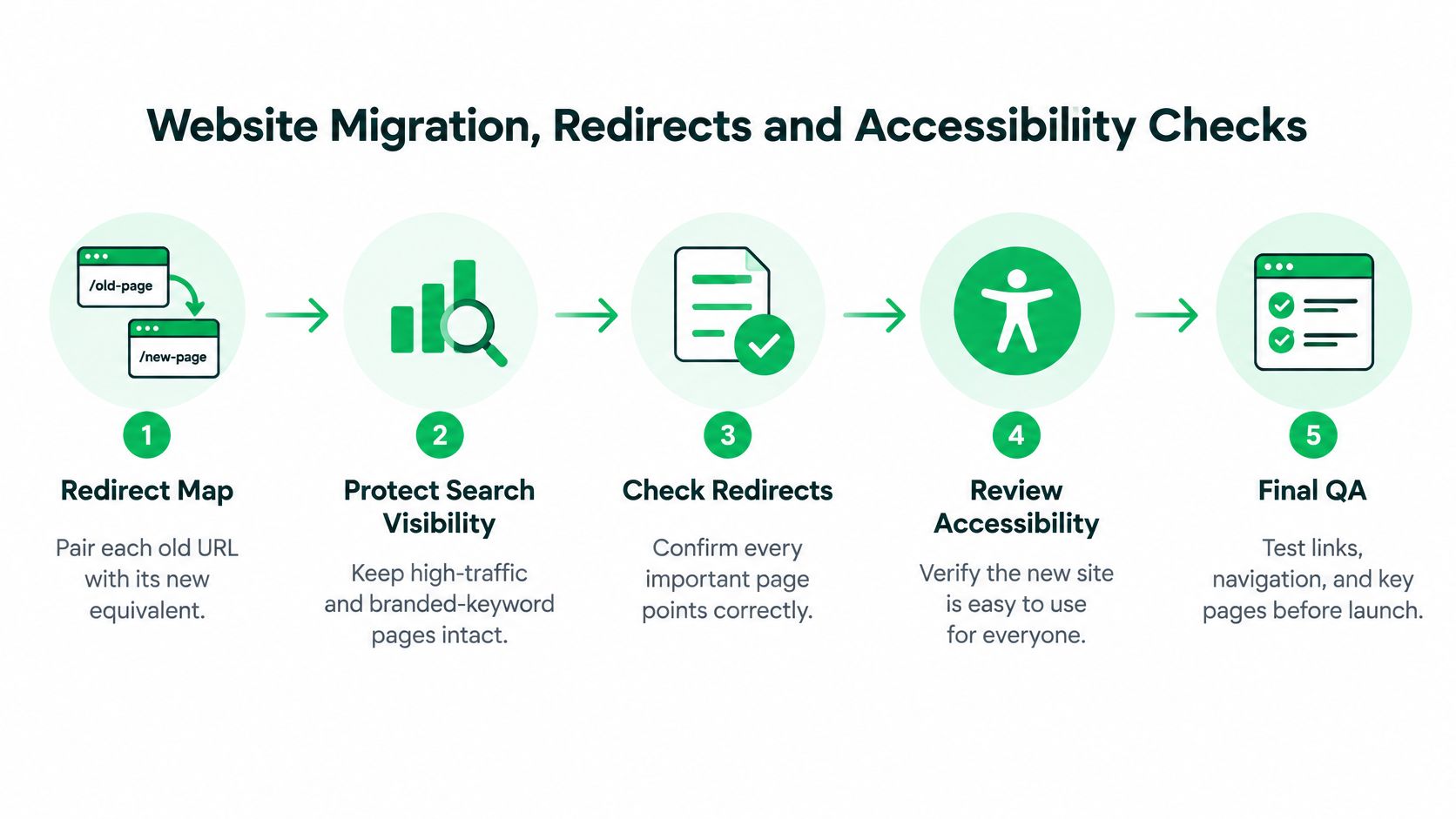
Start with a redirect map. Pair each old URL with its closest new equivalent, protect high-traffic and branded-keyword pages, use permanent redirects, and update your sitemap and structured data. A documented SEO migration strategy keeps this from becoming guesswork on launch night.
Run the Migration in Order
- Export every live URL: Include traffic, rankings and conversions so you know what's worth protecting.
- Build and test the redirect map: Click through priority redirects on staging, not after launch.
- Rebuild templates: Set spacing, contrast and type rules in the design system itself.
- Test accessibility: Check colour contrast, captions, form labels and image alt text.
- Launch and crawl: Run a full site crawl looking for broken links, chains and orphan pages.
- Monitor for 90 days: Watch rankings, 404 errors and form completions weekly.
Accessibility belongs in a rebrand because new colours, type and templates can unintentionally break it. The WCAG 2.2 specification requires text alternatives for non-text content so information can be converted into formats such as large print, braille, speech, symbols, or simpler language, and its text-spacing criterion specifies line height of at least 1.5 times the font size, paragraph spacing of at least 2 times the font size, letter spacing of at least 0.12 times the font size, and word spacing of at least 0.16 times the font size.
| Text property | Minimum (WCAG 2.2) |
|---|---|
| Line height | 1.5 times font size |
| Paragraph spacing | 2 times font size |
| Letter spacing | 0.12 times font size |
| Word spacing | 0.16 times font size |
Check your redesigned templates against those minimums, then apply the same discipline beyond the site. Branding services cover brand design across customer communication, including websites, packaging, social media and collateral assets, so PDFs, video captions and printed forms need the same pass. A beautiful palette that fails contrast on a phone in sunlight isn't a brand asset. It's a barrier.
Launch in Phases and Decide Your Next Move
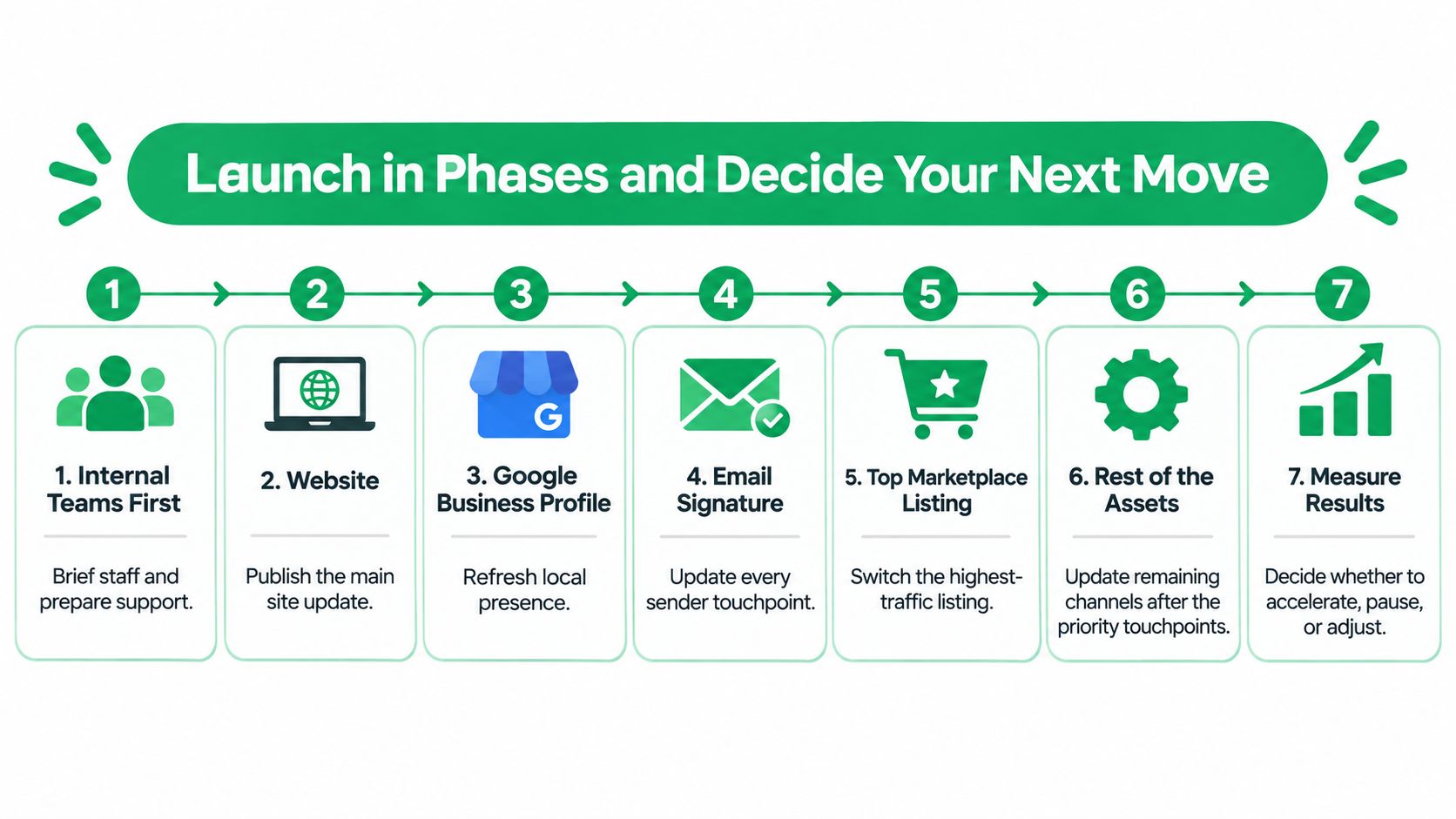
Don't launch everything at once unless you have to. A phased rollout lets you catch confusion while it's still cheap to fix.
Brief internal teams first, with scripts, templates and answers ready. Then switch priority touchpoints, the website, Google Business Profile, email signatures and your top marketplace listing. Work through the rest of the asset inventory after that, in order of customer traffic.
Review at 3, 6 and 12 Months
| Metric | Where to find it | Signal to refine |
|---|---|---|
| Branded search volume | Search console and analytics | Falls for two review periods after launch while awareness holds |
| Conversion rate | Analytics by landing page | Drops after a template change |
| Repeat purchase or rebooking rate | CRM or order data | Falls among existing customers |
| Support questions about the name | Support inbox and call logs | Keeps rising past the launch month |
| Reviews that mention the old name | Review platforms | Recurring confusion in reviews |
| Awareness | Survey or brand lift test | Rises while consideration or conversion falls |
That last row is the trap. If awareness rises while consideration, conversion or retention falls, refine the messaging or identity. Don't assume louder promotion will fix it, and don't protect a decision that's hurting revenue just because it was expensive.
Say a regional ecommerce seller sees branded search climb but repeat purchases drop. It restores the earlier tagline on product pages, keeps the new logo, and retests. That's not failure. That's the measurement doing its job.
Your first action this week is small. Write the one-sentence problem statement and pull baseline numbers from the last 90 days. If those numbers are slow to pull, the free audit on the Mr. Green Marketing website, requested by entering a website, email and name in a form on the home page, is one quick way to get a starting baseline. Prospective clients start a branding project by filling in the contact form on the website.
If you're weighing a refresh against a full rebrand, Mr. Green Marketing, LLC can scale the work from a small logo update to a complete rebrand, starting with your values, baseline and customer evidence rather than a design file. Visit Mr. Green Marketing, LLC to request a free audit or start the conversation through the contact form.
Leave a Comment
sing in to post your comment or sign-up if you dont have any account.