
How to Write Brand Story: You’ve polished the About page, listed your services, added a founder photo, and still watched prospects skim past without remembering what makes the business different. The problem usually isn’t a lack of information. It’s that the information has no tension, viewpoint, or believable outcome.
A strong brand story gives buyers a reason to recognize themselves in your business. It turns scattered claims into a structured narrative, then supports that narrative with behavior and proof. That matters even more now, when AI-assisted content can sound polished while buyers are actively looking for a human point of view.
How to Write Brand Story: Table of Contents
- Why Your Brand Story Matters More Than Your About Page
- Start With Your Audience Not Your Origin
- Shape Your Core Narrative Arc and Roles
- Frameworks Prompts and Templates You Can Use Today
- Make It Sound Human Credible and Consistent Everywhere
- Launch Test and Keep Your Story Alive
Why Your Brand Story Matters More Than Your About Page
An About page answers, “Who are you?” A brand story answers a more useful question: Why should this audience care, believe you, and act?
Consider a local service company that opens with its founding date, lists its certifications, and describes every service in equal detail. Nothing is necessarily wrong. The copy may even be accurate. But a prospect who arrived with a specific problem still has to work out where they fit in the story.
Brand story writing gives that prospect a path. The narrative establishes a beginning, introduces a conflict, and moves toward a resolution. Academic marketing research defines brand narratives as stories describing events in a specific order, “with a beginning, a middle and an end,” which supports the idea that a brand story is deliberate sequencing rather than decorative copy. The foundational research on brand narratives also connects narrative structure with social presence, self-brand connection, and audience identification.

Facts inform, stories organize meaning
Facts still matter. A story without evidence is just a promise dressed up as emotion. But facts alone make buyers assemble the meaning themselves, and many won’t do that while comparing several similar providers.
Industry benchmark data reports that 92% of consumers prefer ads that feel like a story, while 55% are more likely to buy from a brand whose story they love. The same brand storytelling statistics summary reports that storytelling can produce a 22x higher recall rate than facts alone, alongside a reported 20% average increase in favorability. These figures aren’t a substitute for strategy, but they show why narrative form deserves attention.
At Mr. Green Marketing, the practical distinction is simple. The brand story isn’t a sentimental founder biography added after the strategy is complete. It’s the organizing system behind the website, SEO content, paid campaigns, social posts, and sales conversations. The brand awareness strategy guidance is useful here because awareness grows more efficiently when every touchpoint reinforces the same recognizable idea.
Practical rule: If a prospect can repeat your features but can’t explain the problem you help solve, your story hasn’t done its job.
A persuasive story makes the customer’s situation visible, gives the brand a credible role, and shows what changes after the customer takes action. That’s the standard to use before writing a single polished paragraph.
How to Write Brand Story: Start With Your Audience Not Your Origin
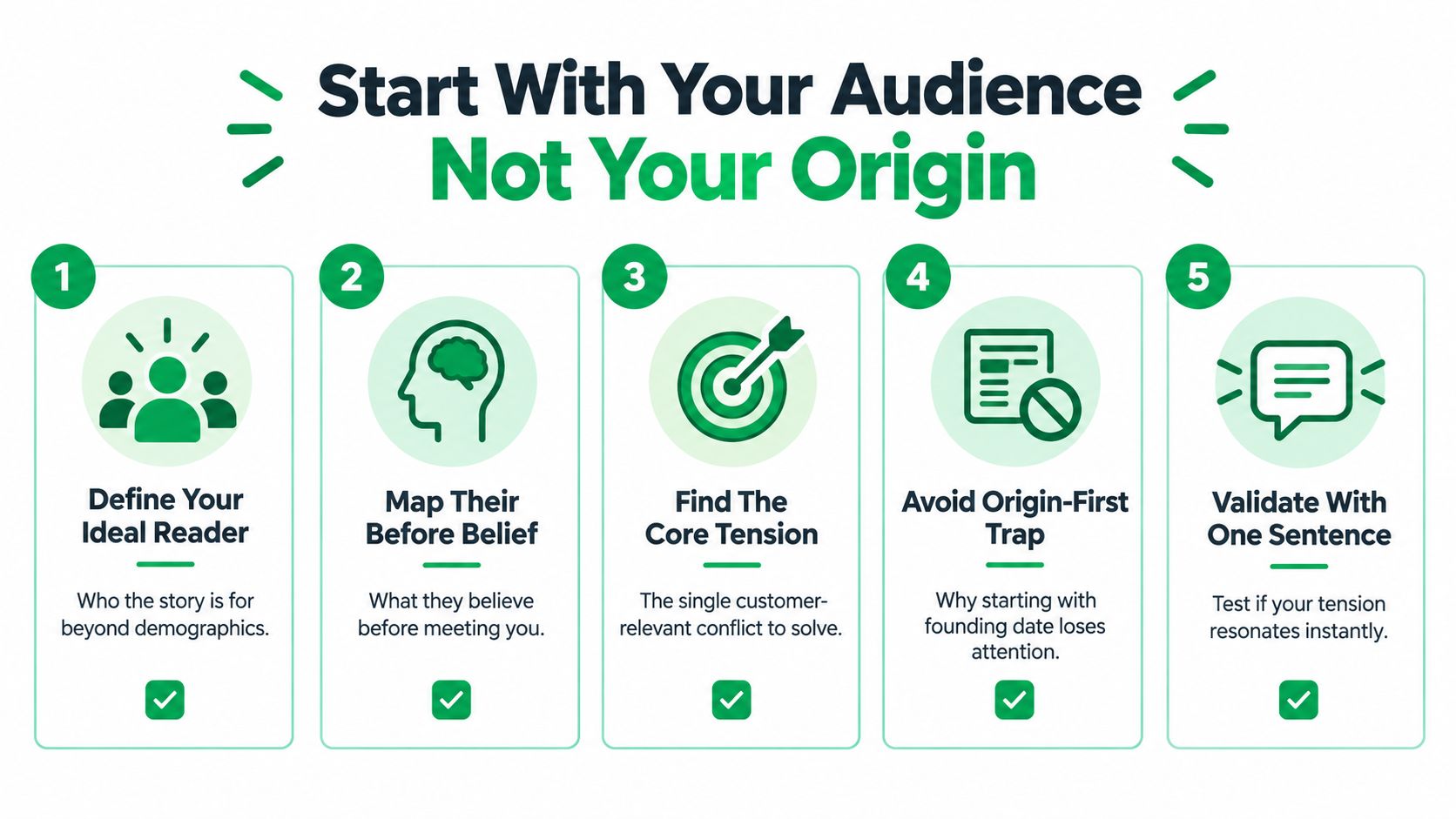
Most businesses begin with the origin story because it feels safe. The founder had an idea, spotted a gap, worked hard, and built the company. Sometimes that history is relevant. It becomes useful only when it explains a problem the audience already recognizes.
Start by defining the person who needs the story. Demographics alone won’t help you choose the right language. Identify their context, pressure, prior experience, and desired outcome. A local contractor may serve homeowners, but the meaningful audience is more specific: people who need a reliable project outcome and don’t want to manage uncertainty themselves.
Listen for the belief beneath the request
Before drafting, collect language from sales calls, support conversations, reviews, search queries, and customer interviews. Use prompts that expose the customer’s starting point:
- Before belief: What does this person believe about the problem before meeting us?
- Previous disappointment: What have they already tried, and what failed to reassure them?
- Desired change: What would feel different after the problem is handled?
- Decision anxiety: What might make them delay, compare, or distrust the offer?
- Proof requirement: What would they need to see before believing our claim?
Reviews are especially valuable because customers often describe the experience in plain language. Separate repeated complaints from isolated preferences. Note the verbs they use, such as “chasing,” “guessing,” “waiting,” or “sorting out.” Those words reveal tension more clearly than an internal positioning workshop often does.
A jobs-to-be-done lens adds another layer. Ask what the customer is trying to accomplish functionally, emotionally, and socially. A business owner hiring an SEO agency may want more qualified leads, but they may also want confidence in the marketing budget and a clearer explanation for the leadership team.
How to Write Brand Story: Write one tension sentence
Reduce your research to a sentence with this shape:
“Our audience wants [desired outcome], but [obstacle or fear] keeps getting in the way, so they need [credible kind of help].”
This isn’t your final brand story. It’s a filter. If a proposed detail doesn’t sharpen the tension, support the desired outcome, or establish your ability to help, leave it out.
The buyer persona development process can help organize these observations into a usable audience profile. Keep the output practical, though. A persona that contains only age, job title, and location won’t tell you what conflict your story should resolve.
Finish discovery with a short proof inventory. Include only evidence you can substantiate, such as a documented process, a real customer quote you have permission to use, a visible operating principle, an authentic founder decision, or a specific deliverable. Don’t claim a transformation you can’t demonstrate.
A credible story begins with the customer’s unresolved tension, not the company’s preferred introduction.
How to Write Brand Story: Shape Your Core Narrative Arc and Roles
Once the audience tension is clear, sequence the story. The most reliable architecture is setup, tension, and resolution. The setup introduces the customer and the situation. The tension names what makes progress difficult. The resolution shows the change your brand helps create.
The role split matters just as much. The customer is the hero. The brand is the guide, bringing empathy, expertise, a plan, and proof. When the company casts itself as the hero, the copy often becomes a parade of achievements that leaves the buyer outside the frame.
How to Write Brand Story: Use the seven beats as a working outline
A practical seven-beat model gives the arc enough detail to draft without turning it into a rigid formula:
- Hero introduced: Show the customer with a meaningful desire, not just a demographic label.
- Challenge defined: Name the external problem and the internal frustration or uncertainty attached to it.
- Guide appears: Present the brand’s relevant empathy and authority.
- Plan offered: Explain the steps, method, or decision path that reduces risk.
- Call to action: Invite a specific next move, such as an audit, consultation, demo, or purchase.
- Stakes clarified: Show what remains difficult if the customer does nothing, without manufacturing fear.
- Resolution achieved: Describe the practical and emotional transformation in believable terms.
This role assignment aligns with expert guidance on brand narrative structure, which emphasizes the hero, challenge, guide, plan, call to action, success state, and failure state. It also prevents a common error: treating the founder’s struggle as the entire plot when the buyer’s problem should drive the narrative.
How to Write Brand Story: Attach mission, vision, and values to behavior
Mission explains what the business does now. Vision describes the future it wants to help create. Values matter only when they influence choices.
Map each one to the arc rather than placing all three in a separate paragraph. If transparency is a value, show how the brand communicates pricing, limitations, timelines, or reporting. If accessibility matters, show how the service or experience accommodates different users. If craftsmanship is central, identify the process that protects quality.
Use this worksheet:
| Story element | Drafting question |
|---|---|
| Customer desire | What does the customer want to make possible? |
| Conflict | What blocks progress or creates doubt? |
| Brand role | Why is this business qualified to guide the customer? |
| Meaning | Why does solving this problem matter beyond the transaction? |
| Proof | What visible behavior supports the claim? |
| Resolution | What can the customer do, feel, or achieve afterward? |
Recognizable cues should survive every adaptation. Keep the central promise, role split, values, and proof logic stable even when the format changes. Your homepage can be concise, a sales deck can add detail, and a video can rely on a customer’s voice. The underlying story shouldn’t become a different story.
For more context on connecting narrative with brand identity development, treat visual identity, language, and customer experience as expressions of the same positioning. A green color palette cannot compensate for an unproven sustainability claim. The behavior has to carry the meaning.
How to Write Brand Story: Frameworks Prompts and Templates You Can Use Today
A framework earns its place when it helps you make decisions. It shouldn’t produce interchangeable copy that could belong to any competitor.
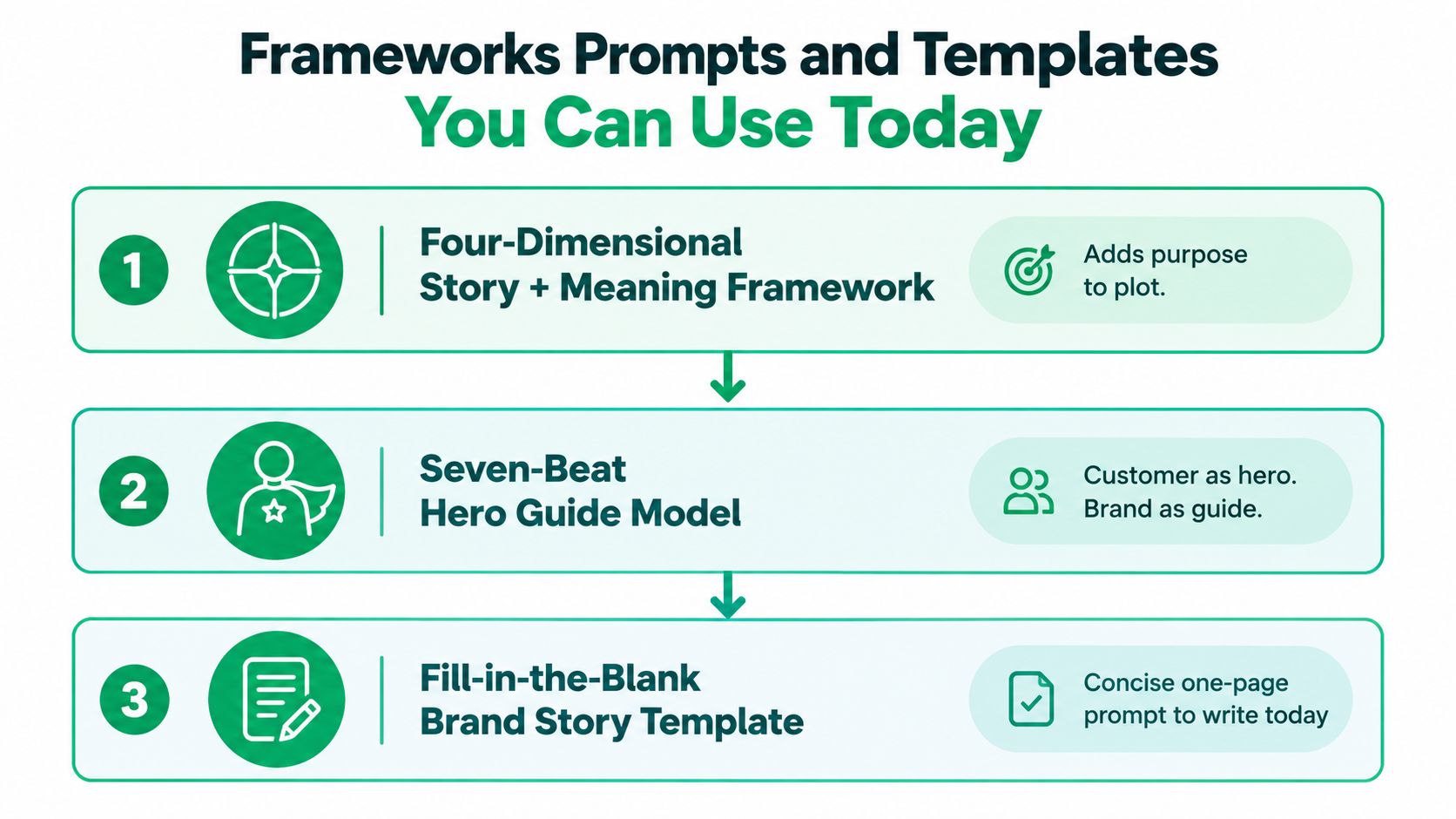
Use three tools together. The first protects meaning, the second protects narrative roles, and the third gets words onto the page quickly.
How to Write Brand Story: The four-dimensional story and meaning framework
A 2024 analysis of online brand stories found “story + meaning” in 93.75% of the cases studied, making meaning a useful design variable rather than a cosmetic addition. The analysis of storytelling marketing statistics describes four practical dimensions:
- Purpose and values: Define what the brand stands for and why the work exists.
- Audience meaning: Connect the storyline to a concern, aspiration, or identity the audience recognizes.
- Channel deployment: Make the story usable across owned, earned, and paid media.
- Recognizable cues: Preserve the language, ideas, and signals that help people identify the brand over time.
The common failure is feature accumulation. A software company may describe dashboards, integrations, automation, and reporting, yet never explain what those features help a customer stop worrying about. Meaning answers that question.
The seven-beat hero and guide model
Use the seven beats from the previous section as a diagnostic, not a fill-in exercise. If your draft contains three paragraphs about the founder and one sentence about the customer, the role balance is wrong. If the plan is vague, the brand hasn’t earned its guide position.
How to Write Brand Story: A concise core-story template
Draft a 150-word core story using these prompts:
- Our customer is trying to…
- They’re frustrated by…
- We understand this because…
- Our company exists to…
- We help by…
- The principle that shapes our work is…
- Customers can expect…
- The next practical step is…
Then create two variations. For a website, explain the problem, method, and proof with enough context for a skeptical reader. For social media, keep one tension, one human detail, and one action. Don’t shrink the website version by deleting random sentences. Rebuild it for the channel.
Drafting test: Remove the company name from the first sentence. If the audience and problem disappear, you opened with the brand instead of the buyer.
Voice prompts keep the draft from sounding machine-made:
- What would our founder say plainly to a confused prospect?
- Which words would our customers use, and which would only appear in an internal presentation?
- What claim are we tempted to make because it sounds impressive?
- What limitation or trade-off would make the story more believable?
- Where can a real person, process, artifact, or example carry the meaning?
Use your value proposition statement as a supporting asset, not a replacement for the story. The value proposition clarifies the offer. The brand story gives that offer context, stakes, and a reason to matter.
How to Write Brand Story: Make It Sound Human Credible and Consistent Everywhere
A story can be emotionally appealing and still fail a skeptical buyer. The editing standard should be substantiation, contextual integrity, and audience respect. In plain terms, prove the important claims, make sure the story matches the actual experience, and don’t use fear, vulnerability, or personal hardship as decoration.
That standard matters because the believability gap is real. A 2026 U.S. consumer study reports that 62% of consumers weigh brand values when buying, while only 43% believe brands live the purpose they claim. The study on values, trust, and the believability gap suggests that purpose language needs visible follow-through.
Replace polished claims with observable proof
Weak: “We’re passionate about helping businesses grow.”
Stronger: “We start by reviewing your current visibility, identify the clearest gaps, and turn the findings into a prioritized plan.”
The second version isn’t automatically true. It becomes credible when the business follows that process and can show the resulting audit, workflow, or reporting approach. Specificity makes a claim testable.
Weak: “Our team puts customers first.”
Stronger: “Customers receive a named point of contact, plain-language reporting, and a documented next step after each review.”
Again, only use details that reflect reality. The goal isn’t to make copy sound concrete at any cost. It’s to make the narrative match how the company behaves.
Adapt the expression, not the identity
AI-assisted production creates a consistency problem. A 2026 trend report says 94% of marketers use generative AI, while 78% of consumers prefer human-made content. The report on brand development and storytelling trends frames the tension clearly: teams can produce more content, but volume doesn’t prove humanity.
Use AI for rough alternatives, summaries, and repurposing. Keep the decisive work human: choosing the tension, rejecting inflated claims, adding lived details, and checking whether the story sounds like a real person who accepts responsibility for the offer.
A website version can explain the method. A short social post can show one customer tension. A video can let a founder or team member speak naturally. A multilingual version may need cultural adaptation, not literal translation. The core promise and proof remain stable, but rhythm, examples, and emphasis should fit the channel.
Run a short peer review
Ask someone outside the writing process to answer:
- Viewpoint: Who is the story about?
- Believability: Which claim needs proof?
- Voice: Does this sound like a person or a category?
- Experience: Would the customer encounter what the story promises?
- Respect: Does the story treat the audience as capable people?
- Consistency: Would the same brand be recognizable on the website, in a sales call, and in a video?
Watch for weak presentation, forced authenticity, and a missing character or viewpoint. If every sentence sounds polished but no sentence sounds specific, edit toward evidence and lived detail.
Launch Test and Keep Your Story Alive
A finished brand story becomes useful only when it appears where decisions happen. Put the core version on the About page, then adapt its essential tension and proof for the pitch deck, social bios, proposal language, sales calls, and customer onboarding.
Use a simple launch checklist:
- Placement: Confirm that every major customer touchpoint reflects the same central narrative.
- Proof: Attach each meaningful claim to an example, process, result, artifact, or customer voice you can substantiate.
- Recall: Ask a small group what they remember after reading the story once.
- Response: Ask what they think the company helps people do and why it seems credible.
- Friction: Note where readers become confused, skeptical, or unsure what to do next.
- Maintenance: Review the story when the offer, audience, operating model, or customer evidence changes.
Benchmark data reports that 68% of consumers say brand stories influence purchasing decisions, while companies using storytelling often see a 10% to 20% lift in engagement rates. The same industry source reports about a 20% increase in customer loyalty for brands with compelling stories. These brand storytelling benchmarks are directional, not guarantees. Your own tests matter more than a benchmark.
Plan the story’s distribution with the same care as the copy itself. A content calendar strategy can help you turn one core narrative into a consistent sequence rather than publishing a single announcement and letting the idea disappear.
A brand story isn’t a paragraph you publish once. It’s a promise you keep proving wherever customers meet you.
Mr. Green Marketing, LLC can audit your existing brand story, identify visibility and credibility gaps, and connect the narrative to SEO, GEO, PPC, web design, branding, social media, and conversion-focused content. Visit Mr. Green Marketing, LLC to request a free audit and performance report, then use the findings to turn your story into a consistent growth system.
Leave a Comment
sing in to post your comment or sign-up if you dont have any account.