
Value Proposition Statement: You know this moment.
Someone asks, “So, what does your company do?” and instead of a clean answer, you give them the full tour. Services. Process. Backstory. Maybe a few buzzwords you’d never say out loud in normal conversation. By the time you land the plane, they nod politely and look for an exit.
That’s not a speaking problem. It’s usually a value proposition statement problem.
When the core promise of the business is fuzzy, everything downstream gets fuzzy too. Website headlines drift into generic copy. Sales calls get longer than they need to be. Ads talk about features buyers don’t care about yet. And your team starts describing the company five different ways.
Look, this is what it really comes down to. A value proposition statement is the clearest explanation of why the right customer should choose you. Not in theory. In a competitive market, against existing alternatives, with financial stakes involved.
And in a world full of polished AI-generated copy, that statement has to do more than sound good. It has to be provable.
Value Proposition Statement: The Awkward Elevator Pitch Problem
A business owner at a networking event gets a simple question: “What do you do?”
He starts with, “We’re a full-service provider,” then adds a few service lines, then talks about how long the company has been around, then pivots to customer service, then says they “really care about results.” Nothing he says is false. None of it is memorable either.
That happens every day.
The problem isn’t that owners don’t know their businesses. They know them too well. They’re carrying the whole internal map around in their heads, so when someone asks for a quick answer, they dump the map on the table instead of giving directions.
What people actually want to hear
Most buyers aren’t asking for your company history. They want three things, fast:
- Who it’s for: Are you talking to someone like me?
- What problem you solve: Do you fix something I care about?
- Why you over someone else: Is there a reason I should remember you?
If your answer misses those three points, people fill in the blanks themselves. Usually badly.
A weak pitch sounds like a brochure. A strong one sounds like relief.
That’s why businesses with solid operations still struggle to convert attention into action. Their offer may be good, but the message forces the buyer to do interpretation work. And buyers rarely volunteer for extra work.
Value Proposition Statement: What the awkward pitch is really telling you
A rambling answer is usually a symptom of one of these issues:
- You’re leading with capabilities: You describe what you do, not what changes for the customer.
- You’re trying to appeal to everyone: The message gets broader and weaker at the same time.
- You haven’t chosen a sharp angle: You want to sound flexible, so you end up sounding interchangeable.
A value proposition statement fixes that. It gives you the short, confident version. The version that works in a sales meeting, on a homepage, in an ad, and yes, in that elevator pitch you keep fumbling.
What a Value Proposition Statement Actually Is
A value proposition statement is a clear promise about who you help, what result you deliver, and why your offer is the smart choice over the alternatives.
That sounds simple. It usually isn’t.
Plenty of businesses can write a polished sentence. Far fewer can support that sentence with proof. That distinction matters. In a market flooded with AI-written copy, buyers have learned to ignore language that sounds good but says nothing they can verify.
A strong value proposition statement gives a buyer a reason to keep reading. A strong business backs that statement with evidence from customer results, product truth, and real-world fit.
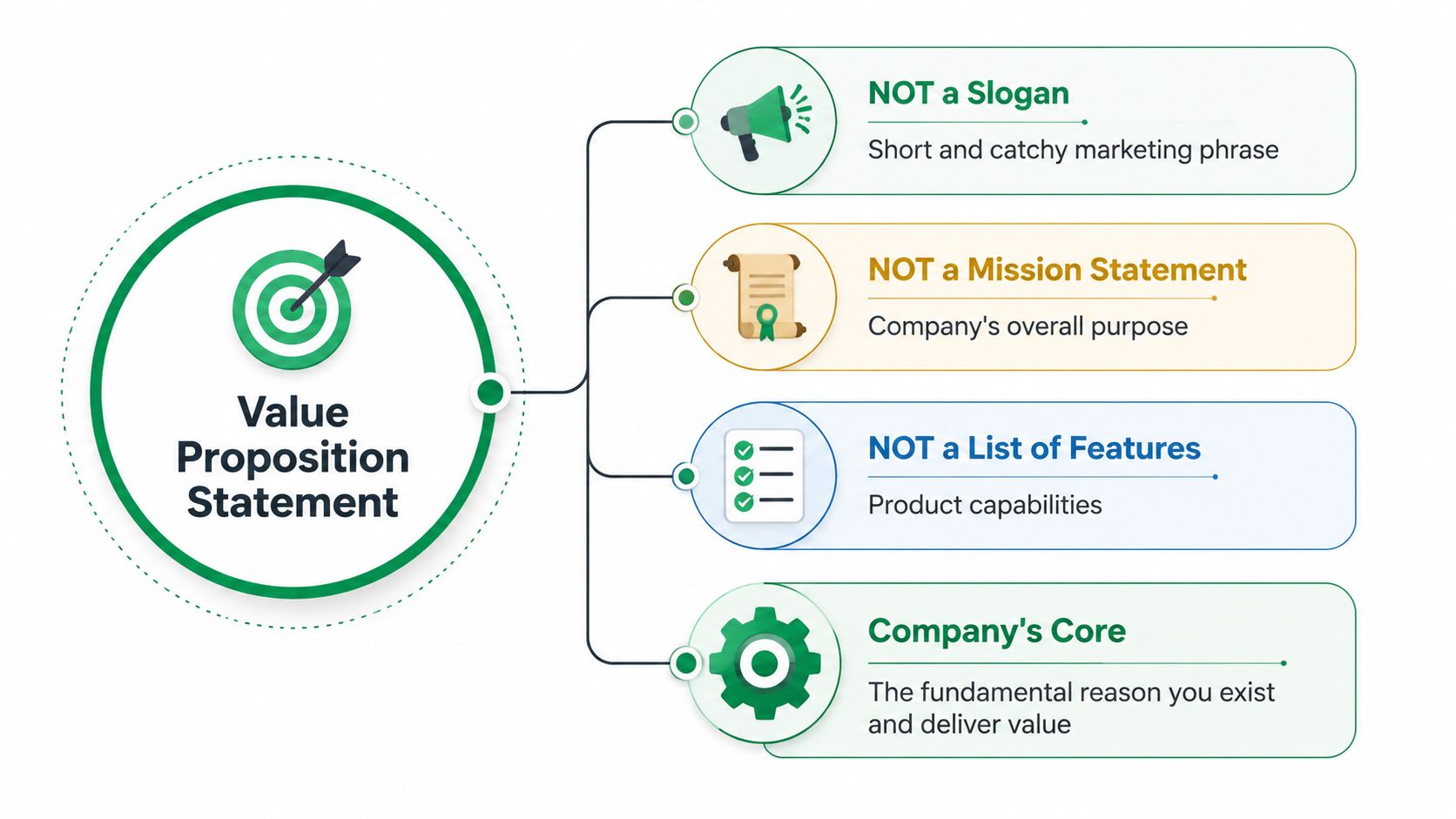
What it is not
Teams often confuse a value proposition statement with other messaging assets. That confusion leads to vague copy, weak positioning, and sales conversations that start from scratch every time.
| Message type | What it does | What it misses |
|---|---|---|
| Slogan | Gives you a catchy phrase | Usually too short to explain real value |
| Mission statement | Explains your purpose | Often inward-facing and broad |
| Feature list | Shows what the product does | Doesn’t explain why the buyer should care |
| Value proposition statement | Connects customer problem, solution, and reason to choose you | This is the one that drives buying clarity |
“Fast. Friendly. Reliable.” is not enough. Neither is “We enable innovation through excellence.” A list of features is useful later, once the buyer cares. The value proposition comes earlier. It answers the practical question in their head: Is this for me, and is it worth my time?
Look, this is what it really comes down to. A value proposition statement is not copy for applause. It is copy that makes the next step easier.
Value Proposition Statement: What it needs to do
A useful statement connects four ideas in one tight message:
- Audience: who this is for
- Pain or job: what they need solved
- Outcome: what changes for them
- Difference: why your offer is the better fit
If one of those pieces is missing, the statement gets slippery. You may sound broad, but broad usually means forgettable. You may sound polished, but polished without proof is just decoration.
Here’s the practical test I use. If a close competitor could paste your statement onto their homepage and no one would notice, you do not have a value proposition. You have generic marketing language.
The best value propositions hold up under pressure. Sales can use them. Paid ads can use them. Your homepage can use them. And when a prospect asks, “Why you?” the answer does not depend on a charismatic founder filling in the gaps live.
Value Proposition Statement: The Three Essential Elements of a Powerful Value Prop
Most bad value propositions fail for one reason. They try to sound impressive instead of making a buying decision easier.
A strong one does three jobs well: it matches a real customer problem, it promises a concrete outcome, and it explains why your business is the right source of that outcome.
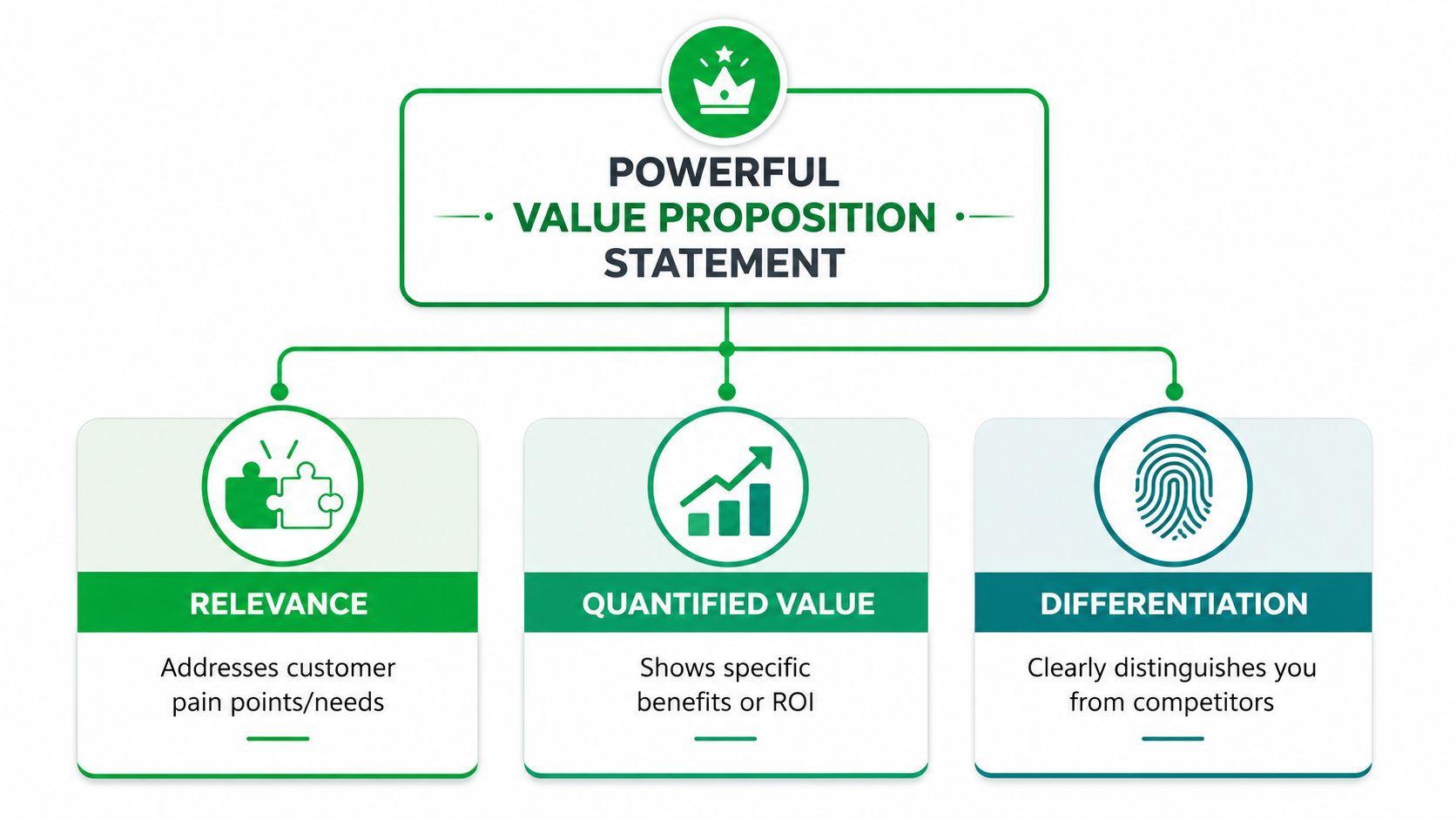
Harvard Business School Online recommends building a value proposition from customer pain points, a specific solution, and a measurable promise, using the Jobs To Be Done lens to identify what the customer is “hiring” the brand to do, as explained in HBS Online’s guide to creating a value proposition.
Relevance
If the statement doesn’t connect to a specific buyer and a specific problem, the rest doesn’t matter.
A local plumber doesn’t need to say, “We deliver full-scope residential infrastructure solutions.” The buyer wants to know, “Can you stop this leak quickly and do the repair correctly?” A bookkeeper doesn’t need to say, “We optimize financial visibility.” The buyer wants to know, “Will you help me stop making a mess of my books?”
Weak: We provide business solutions.
Stronger: We help growing service businesses clean up inconsistent lead follow-up so fewer qualified inquiries go cold.
Relevance starts with the customer’s job, not your internal org chart.
Later in the section, this short explainer is useful for grounding the idea in real language:
Quantified value
Many statements often collapse into adjectives. “Better.” “Easier.” “Premium.” “Smooth.” Those words aren’t useless, but on their own, they’re not convincing.
A value proposition gets stronger when the promise points to something observable or measurable. That doesn’t always mean a public statistic. It can mean a timeframe, a reduction in effort, a clearer process, fewer moving parts, or a defined business result you can later validate.
| Weak claim | Better claim |
|---|---|
| Save time | Cut the back-and-forth involved in scheduling, approvals, or reporting |
| Get better service | Get one point of contact and a faster path to resolution |
| Improve marketing | Turn more of the traffic you already pay for into qualified leads |
The point isn’t to invent numbers. It’s to replace fluffy language with outcomes a buyer can picture and later verify.
Buyers trust what they can inspect. They ignore what sounds inflated.
Value Proposition Statement: Unique differentiation
A statement also needs a reason your business is the better fit. Not “we care more.” Everyone says that. Not “high quality.” That’s table stakes. Real differentiation comes from the angle, the model, the expertise, the delivery method, the speed, the depth, the niche focus, or the economics of the offer.
Here’s where businesses often make the wrong trade-off. They try to sound broad so they won’t exclude anyone. But broad language strips out the very detail that would make the right customer lean in.
Some examples:
- Weak differentiation: Experienced team with customized solutions
- Better differentiation: Built for Amazon sellers who need marketplace growth without managing ad chaos across listings, content, and PPC
- Weak differentiation: Affordable legal support
- Better differentiation: Flat-fee contract review for small agencies that can’t justify big-firm billing
And yes, sometimes the edge is simple. Local presence. Faster turnaround. Deep category expertise. A more transparent process. A narrower specialty. Those all count if the buyer cares.
Value Proposition Templates and Real-World Examples
Most businesses don’t need a burst of inspiration. They need a structure that stops them from wandering.
A good template gives you guardrails. It won’t write the final statement for you, but it will keep you from defaulting to broad, forgettable language.
Two templates that actually help
Here are two starting points I use because they force clarity.
Template one
- For [specific customer], we help solve [specific problem] by providing [solution], so they can [desired outcome].
Template two
- [Brand or offer] helps [customer] who struggle with [problem] achieve [result] through [distinct approach or advantage].
Both formats do the same thing. They force you to name the buyer, the pain, the fix, and the payoff.
If you want more examples of concise brand messaging formulas, this collection of sample branding statements is useful for seeing how short positioning language can be shaped for different business types.
Example for an e-commerce brand
Let’s say you sell kitchen storage products on Amazon.
A weak version sounds like this: “Premium storage solutions for modern homes.”
That sounds polished. It also sounds like half the category.
A stronger version:
We help busy home cooks reduce kitchen clutter with stackable storage products designed to save cabinet space and make daily cooking simpler.
Why this works:
- Specific customer: busy home cooks
- Problem: clutter and wasted space
- Solution: stackable storage products
- Outcome: simpler cooking and better organization
If you have proof points, they belong nearby. Product testing details, verified review themes, return-rate patterns, material durability, setup speed. Not adjectives.
Value Proposition Statement: Example for a local service business
Take a plumbing company.
Weak:
Reliable plumbing with quality service.
That says nothing distinctive.
Stronger:
We help homeowners fix urgent plumbing problems fast, with licensed local technicians who explain the repair clearly and do the job right the first time.
That statement works because it answers the hidden objections. Speed. trust. local presence. clarity. competence.
A local service buyer often isn’t shopping for “innovation.” They’re buying reduced stress. Reduced uncertainty. Reduced risk of paying twice for the same problem.
The best local-service value propositions sound like the customer’s internal monologue after a bad experience with someone else.
Example for a SaaS company
Now a SaaS example.
Weak:
An all-in-one platform that streamlines workflows.
Every category page on the internet has a version of that.
Stronger:
We help operations teams replace messy spreadsheet-based approvals with one workflow system that gives managers visibility, accountability, and fewer manual handoffs.
Notice what changed. The statement doesn’t try to describe the whole platform. It focuses on the painful before-state and the improved after-state.
The underserved customer angle
One of the more strategic approaches comes from the Harvard Business School Institute for Strategy and Competitiveness, which notes in its work on unique value propositions that some strong value propositions win by serving customers who are underserved or underpriced by existing options.
That’s a different game than claiming you’re “better.”
A few examples of that logic:
- A bookkeeping firm for very small businesses that don’t meet the minimums of larger providers
- A skincare brand for a neglected skin concern large brands barely address
- A software tool for smaller teams priced out of enterprise systems
- A local agency offer designed for single-location businesses that don’t need enterprise complexity
In those cases, the statement shouldn’t pretend the company serves the whole market. It should lean into the neglected segment.
That often produces stronger messaging than trying to out-shout bigger competitors with prettier copy.
Value Proposition Statement: How to Craft and Test Your Own Value Proposition
A business owner rewrites the homepage headline six times, shows it to the team, and gets a round of polite approval. Then prospects still ask, “So what do you guys do?”
That happens because a value proposition statement is only useful if buyers recognize themselves in it and believe the claim. Good phrasing helps. Evidence wins.
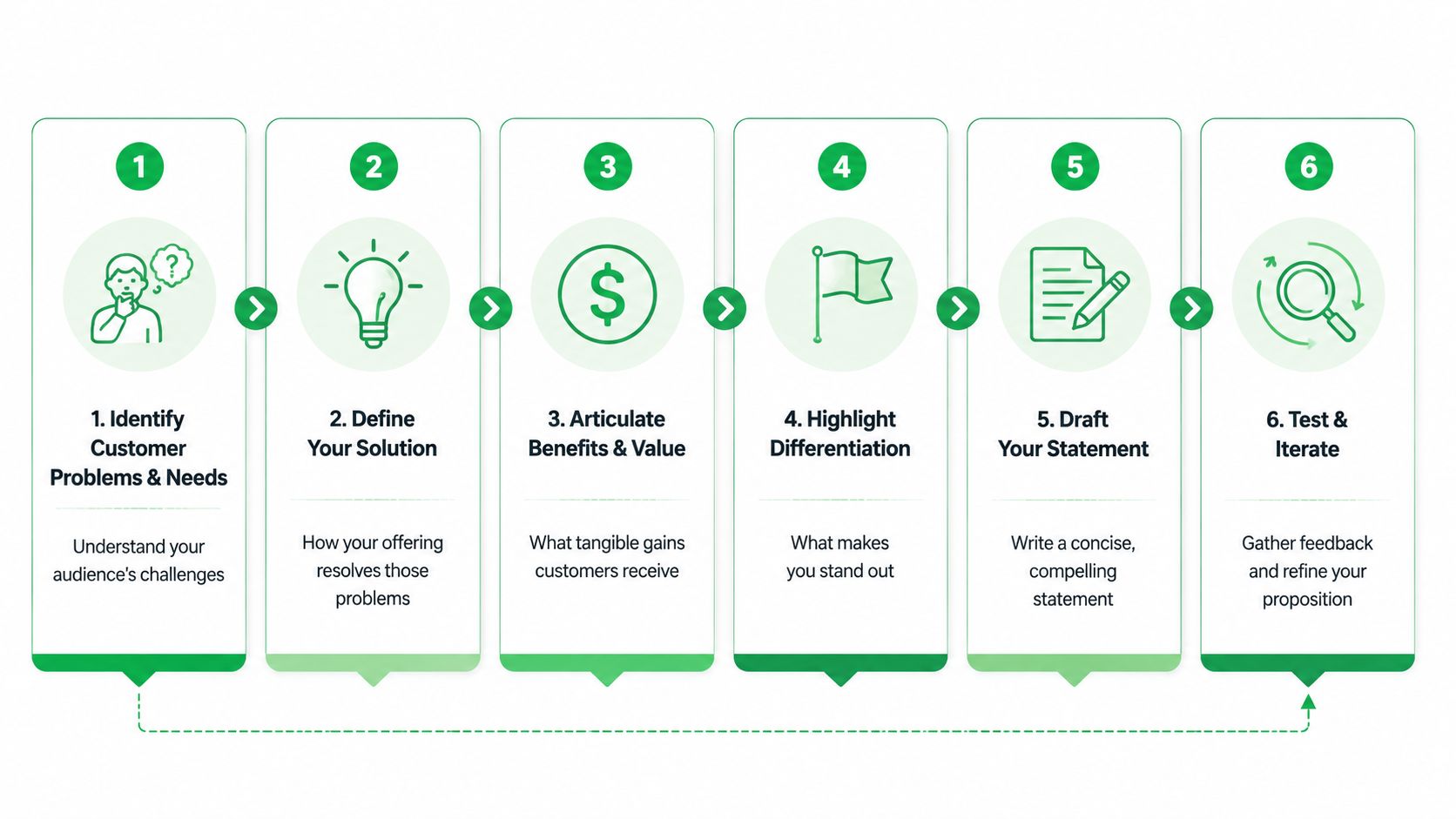
Look, this is what it really comes down to. Your statement is a hypothesis until customers prove it. In a market full of AI-generated copy, that distinction matters. Anyone can produce a polished sentence. Fewer businesses can back that sentence with customer language, response data, and consistent sales conversations.
Start with customer evidence
Skip the brainstorming session for a minute and gather raw material first.
Useful sources include:
- Sales call notes: Repeated objections, buying triggers, and the words prospects use when they describe the problem
- Customer support tickets: Friction points, unmet expectations, and the issues people care enough to complain about
- Reviews and testimonials: Unprompted proof of what customers valued after the sale
- Lost-deal notes: Reasons buyers stalled, picked a competitor, or decided the offer was not a fit
- Search queries and on-site search terms: Plain-English language from people trying to solve the problem
Write down exact phrases. If several buyers describe the same pain in similar words, keep that wording close to the final draft. Polished brand language often sounds better internally and performs worse externally.
Draft three options with different strategic angles
One version rarely gets you to the best answer. Write at least three.
| Version | Main angle |
|---|---|
| Option A | Speed and convenience |
| Option B | Risk reduction and trust |
| Option C | Specialized expertise for a niche buyer |
This step forces a smart trade-off. You cannot lead with every benefit at once. A statement built around speed will feel different from one built around lower risk or niche expertise. Testing helps you find which angle gets recognition fastest from the right buyer.
If you want to connect your value prop to your broader positioning, content, and visibility strategy, this archive on how to build a brand online is a useful next layer.
Test it where buying decisions start
Conference-room feedback is weak. Live response is better.
Use the statement in places where prospects have to react:
- Homepage headline test
Run different versions on key landing pages, either in sequence or through an A/B test, and watch how visitors behave. - Sales call opening test
Give reps two or three approved ways to frame the offer and track which one gets immediate recognition instead of follow-up explanation. - Email response test
Put different value angles into outbound emails or nurture sequences and compare reply quality, not just open rates. - Customer interview test
Show prospects multiple versions and ask two blunt questions: “Which one feels most relevant?” and “Which part sounds vague or generic?”
If a prospect says, “That sounds nice,” the statement still lacks weight. If they say, “That’s our problem,” you are getting closer.
Watch behavior, not compliments
Praise is easy to get. Clarity is harder.
The strongest signals are operational:
- Sales conversations get shorter at the start
- Prospects need less explanation
- Lead expectations match the offer more closely
- One message angle produces better response than the others
- Customers repeat your wording back to you
That last one matters. When buyers start using your language on calls, in replies, or in demos, the message is no longer just clever copy. It is becoming a provable position in the market.
Be willing to cut lines your team loves. Some of the best-performing value proposition statements are plain on purpose. They win because they are specific, believable, and easy for a real customer to verify.
Your Final Value Proposition Statement Checklist
By the time you’ve drafted and tested a few versions, the last step is brutal honesty.
Most weak statements aren’t bad because of grammar. They’re bad because they dodge specificity. They hide behind safe language. They sound polished enough to pass internally, but not clear enough to win externally.
As buyers become more skeptical of vague claims, especially with the rise of AI-generated content, the advantage shifts toward concrete evidence and testable outcomes, as discussed in EBQ’s guidance on writing a value proposition statement.
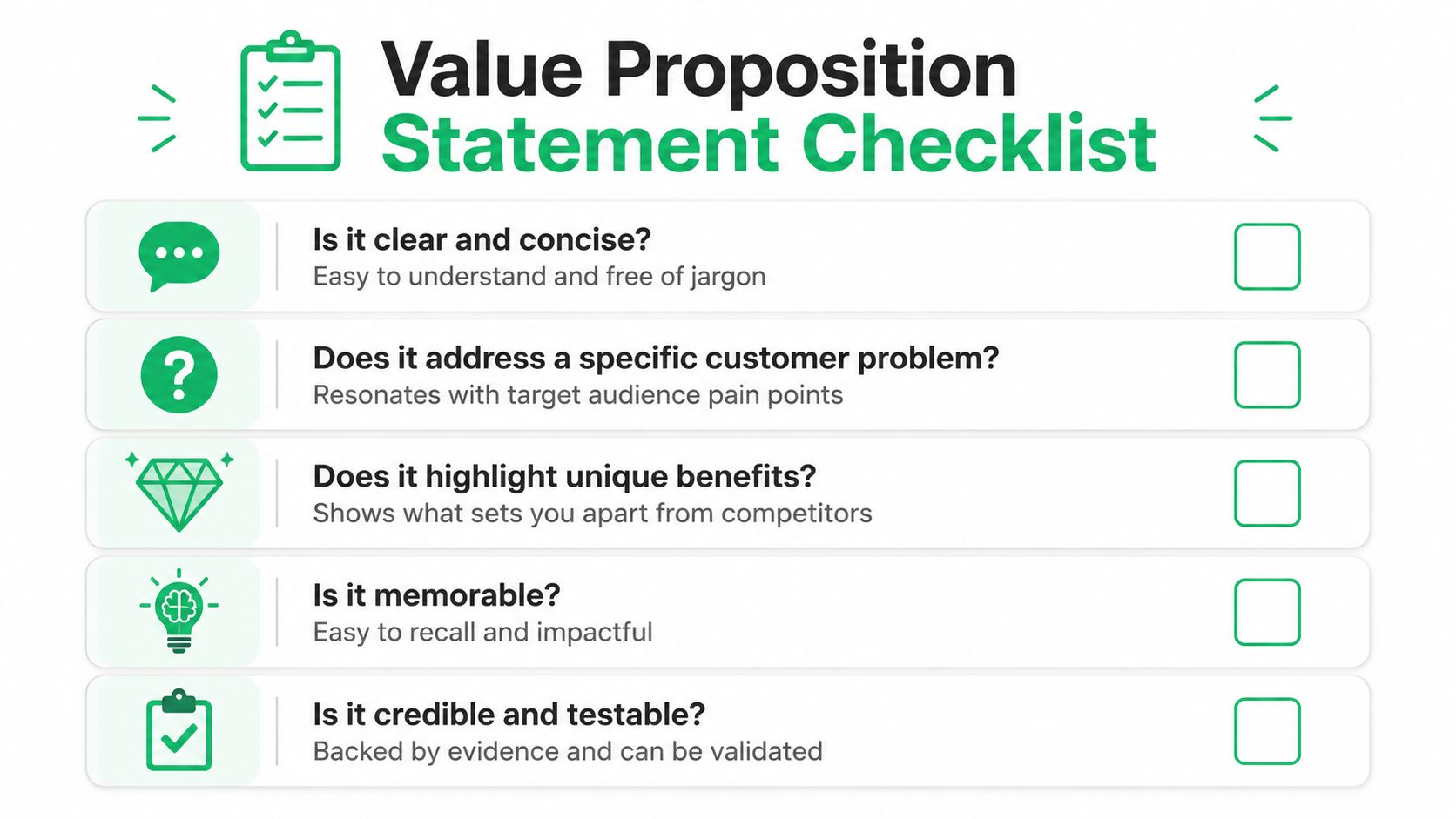
Use this checklist before you put the statement on your homepage, sales deck, Amazon content, or ad campaigns.
Ask these five questions
- Is it instantly clear: Could a first-time visitor understand it without needing a follow-up explanation?
- Does it name a real problem: Not a broad aspiration, but a friction point the buyer already feels?
- Does it describe the outcome: Can the customer picture what changes after choosing you?
- Does it explain why you: Is there an actual difference in your approach, niche, economics, speed, or expertise?
- Can you prove it: Do you have evidence, customer language, results, process detail, or validation to support the claim?
A value proposition statement that passes all five is usually in good shape.
If it fails one or two, keep working. And if you want to measure whether the revised message is improving response, lead quality, or conversions, this guide on how to measure marketing campaign effectiveness is a smart next step.
Good messaging doesn’t ask buyers to trust your adjectives. It gives them a reason to believe your offer.
The companies that win with messaging aren’t always the loudest. Often, they’re just the clearest. They know exactly who they help, exactly what problem they solve, and exactly how to back that claim up.
If your business needs help turning a vague offer into a clear, testable market message, Mr. Green Marketing, LLC can help you tighten positioning, improve conversion-focused copy, and align your website, ads, SEO, and brand strategy around a value proposition that drives action.
Leave a Comment
sing in to post your comment or sign-up if you dont have any account.