
Most agencies charge 10% to 20% of ad spend for PPC management, or a flat monthly fee instead, and your real monthly outlay is that fee plus the media budget you pay the ad platform. That second part is where comparisons fall apart, because two quotes can show the same management number and leave you with very different totals, work, and results.
Say you're a plumber, a dentist, or a store owner with three proposals open in tabs. One says 15%. Another says $1,200 a month. A third bundles everything into one figure and doesn't separate labor from clicks. And you – understandably – want to know which one is fair.
I would not judge any of them on the headline. Judge PPC management pricing by the total cost to get a qualified lead or a profitable sale, the work included, and whether your conversion data is clean enough to prove the fee is working. The fee is only one line. The auction decides the rest.
Table of Contents
- Three Pricing Models and What Each Costs
- Sample Fee Calculations at Three Budget Levels
- Benchmarks That Shape a Fair Management Fee
- How to Test Whether a Fee Pays Off
- What the Fee Buys and What to Ask Before Signing
- Choose the Model That Fits Your Budget
Three Pricing Models and What Each Costs
Start by sorting every quote into one of these buckets. If a proposal won't tell you which model you're on, that's a problem already.
PPC management pricing models at a glance
| Model | How the fee is set | Typical range | Best fit |
|---|---|---|---|
| Percentage of ad spend | Share of monthly media spend | 10%–20% of spend (15%–20% common for Google Ads) | Growing, steady budgets |
| Flat monthly fee | Fixed retainer by scope | $501–$5,000 per month for many businesses | Modest or predictable spend |
| Performance-based | Base fee plus bonus or per-lead or per-sale charge | Base fee plus an agreed dollar amount per qualified lead or sale | Accounts with reliable conversion tracking |
| Hybrid | Base fee plus percentage of spend | Flat base plus a percentage above a set spend level | Mid-sized accounts wanting predictability and scale |
Percentage of Ad Spend
This model rises and falls with your budget, which suits accounts that spend steadily and expect to grow. It's simple to calculate, and the agency's pay scales with account size. The risk is obvious. Spend more and the fee grows, even if the extra work doesn't, so you need efficiency targets and not just a bigger budget. If you're comparing this against broader retainers, it helps to understand how agencies bundle services in their digital marketing agency pricing packages before you decide what's PPC work.
Flat Monthly Fee
A flat fee is a fixed retainer set by scope, not by clicks. It suits modest or predictable spend because you know the labor cost each month. It also removes the reward for increasing spend. The catch sits in the scope. A cheap retainer might buy bid tweaks and a report, while a higher one might include tracking checks, search-term cleanup, testing, and landing-page advice. Same label. Very different product.
Performance-Based and Hybrid Fees
Performance pricing sounds clean. Pay for leads or sales. In practice, it only works when conversion tracking can be trusted, a qualified lead has an agreed definition, and both sides know what a lead is worth. If calls aren't recorded or form fills are double-counted, you're arguing over a bonus instead of improving the account.
A hybrid tries to split the difference, a base fee for core work plus a percentage as spend grows. I like it for mid-sized accounts that want predictability without pretending scale costs nothing.
One boundary should never blur. According to Google's guide to how much Google Ads costs, Google Ads does not charge a mandatory flat platform fee or monthly subscription, advertisers set an average daily budget for each campaign, and Search campaigns generally charge when someone clicks the ad. Your media money goes to Google. The management fee pays people to plan, build, monitor, and improve what that money buys.
First check on any quote: Is it a percentage, a flat fee, or a mix, and is there a minimum monthly fee that overrides the math at your budget?
Sample Fee Calculations at Three Budget Levels
Run your own number first, then read the pitch. It changes the conversation.
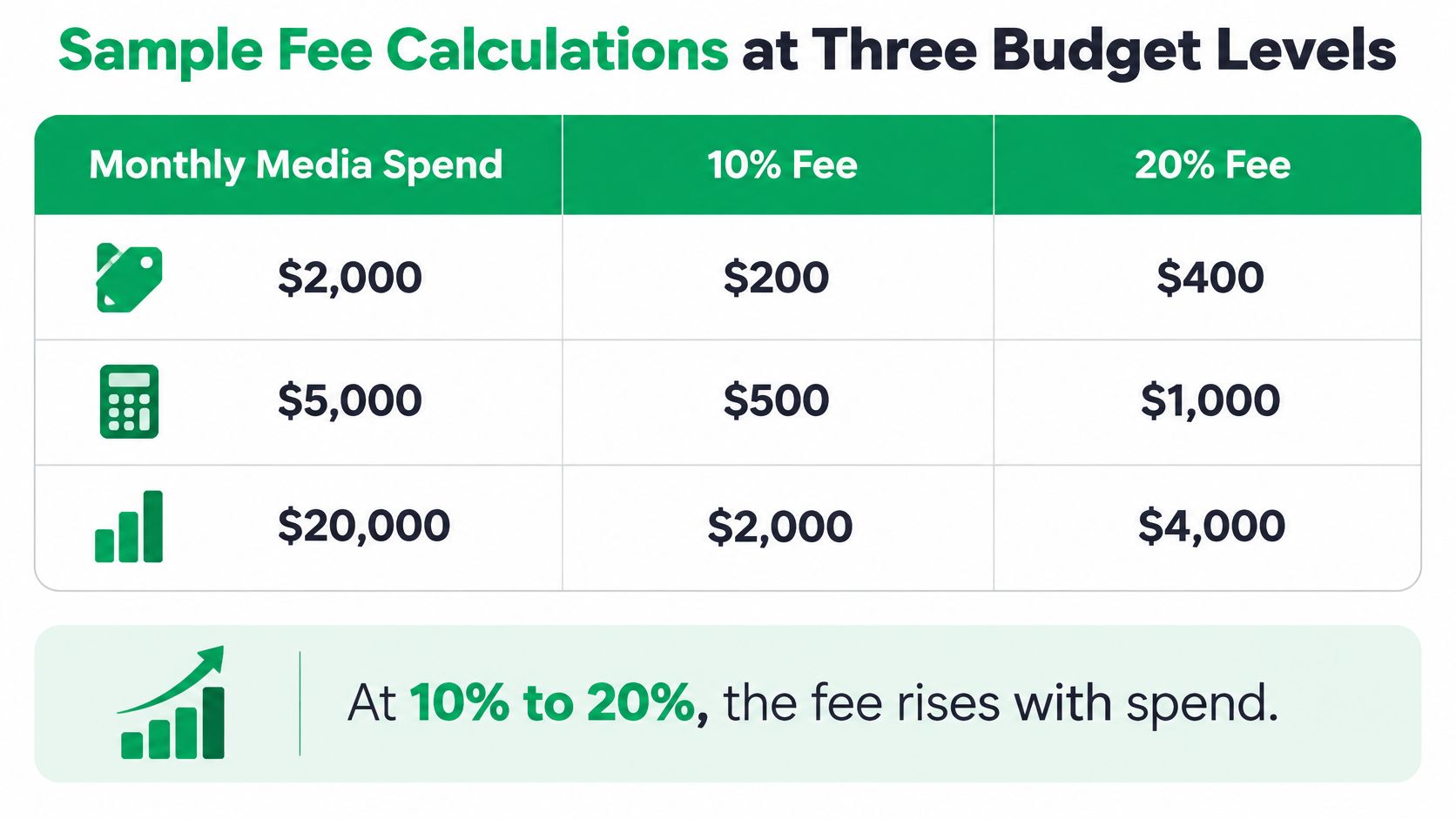
Monthly management fee at three budget levels
| Monthly media spend | Management fee at 10%–20% | Combined monthly outlay |
|---|---|---|
| $2,000 | $200–$400 | $2,200–$2,400 |
| $5,000 | $500–$1,000 | $5,500–$6,000 |
| $20,000 | $2,000–$4,000 | $22,000–$24,000 |
A 2026 industry pricing analysis reported that agencies commonly charge 10% to 20% of advertising spend for management, with 15% to 20% described as common for Google Ads. At $5,000 in media, that means $500 to $1,000 in fees and a combined $5,500 to $6,000 before landing-page, creative, analytics, or software costs.
How to Read the Table
Divide the fee by media spend and you'll see the rate you're paying, even on a flat quote. Then look at the dollar jump. At the same percentage, a $20,000 account pays four times the fee of a $5,000 account. Fair enough, if the work grows with it. More campaigns, more geographies, more products, more tests. If the scope stays flat while the fee quadruples, ask why.
Minimums matter most at the small end. A 15% rate on $2,000 is $300, which may sit below an agency's floor, so the minimum often sets your actual price. That's not automatically a rip-off. Setup, tracking, and reporting take time whether you spend $2,000 or $10,000. But you should see that floor in writing.
Flat fees need the same test. Say a business pays a $1,500 retainer on $2,000 of media. That's 75% of spend, which looks steep until you learn it includes conversion tracking repair and landing-page work the account badly needs. Or it doesn't. That's the question. When you're budgeting the media side itself, our guide on how much it costs to advertise is a useful next read.
Build Your Own Version in Three Steps
- List monthly media using the monthly cap, not a hopeful daily number.
- Apply the rate range or quoted flat fee, then check it against any minimum.
- Add separate charges for creative, landing pages, feed work, or software if they're billed outside management.
That monthly cap point catches people out. Google explains in its average daily budget guidance that a campaign may spend up to twice its average daily budget on a high-demand day, while monthly charges won't exceed the average daily budget multiplied by 30.4. A $50 daily budget can therefore reach $100 on a busy day with a $1,520 monthly charging limit. Use the monthly figure in your table, or you'll understate the media line.
Benchmarks That Shape a Fair Management Fee
A fee doesn't exist in a vacuum. It sits on top of an auction, and that auction is cheap in some markets and brutal in others.
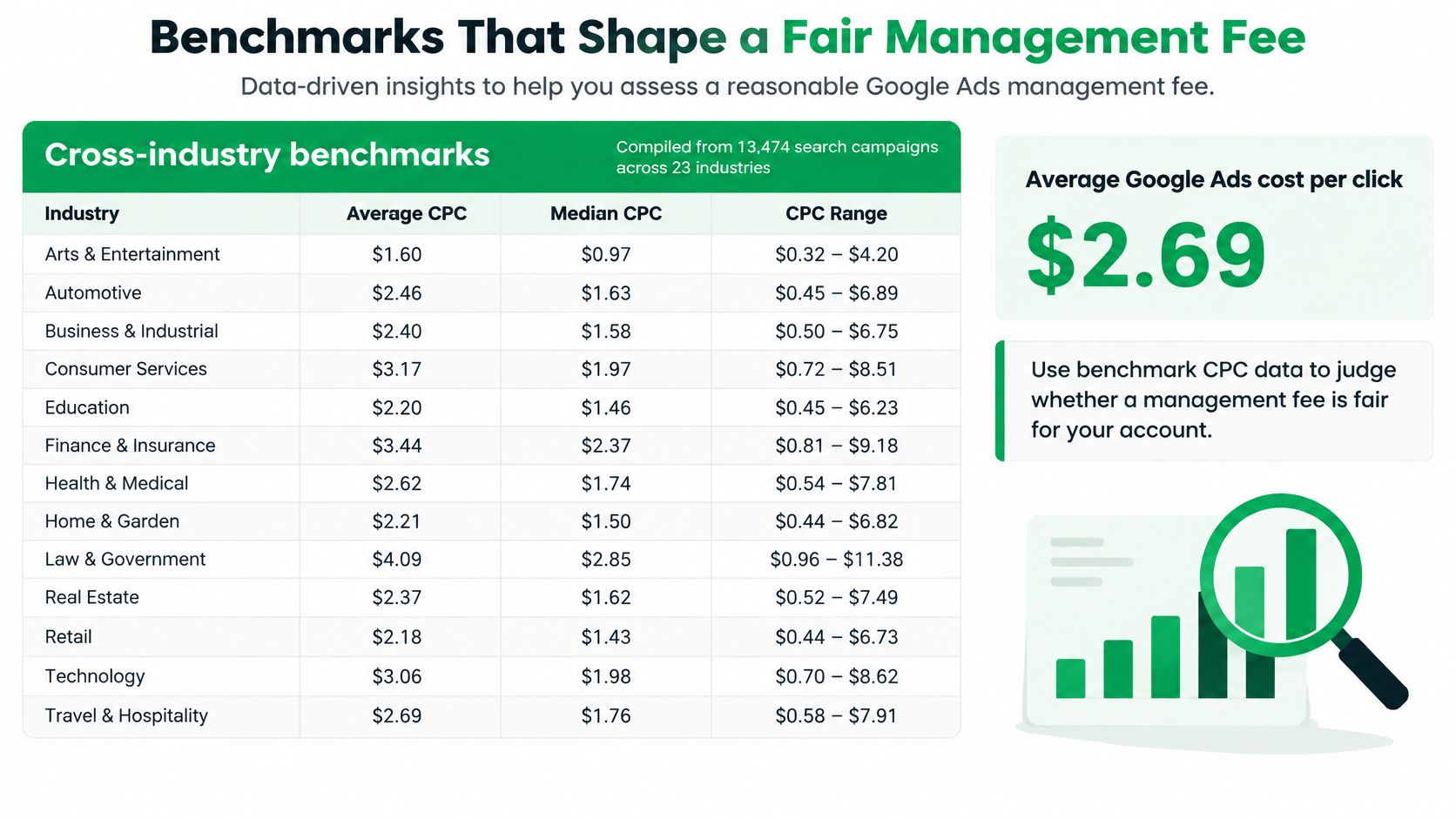
Google Ads benchmark costs
| Benchmark | Average CPC | Conversion rate | Cost per lead |
|---|---|---|---|
| Google Ads average, 2016 | $2.32 | Not reported | Not reported |
| Cross-industry average, 2025 | $5.26 | Not reported | Not reported |
| Cross-industry average, 2026 | $5.42 | 8.18% | $66.69 |
| Legal services, 2025 | $8.58 | Not reported | Not reported |
Recent U.S. benchmark data referenced in Google's actual cost-per-click guidance was compiled from 13,474 search campaigns across 23 industries and reported an average Google Ads CPC of $5.42, an average conversion rate of 8.18%, and an average cost per lead of $66.69. Google defines actual cost per click as the final amount charged for a click, while placement depends on Ad Rank and clearing the required threshold.
What Those Numbers Do to a Fee
Legal services ran at $8.58 per click in the 2025 benchmarks, against a cross-industry average of $5.26. Same budget, fewer clicks, less room for sloppy targeting. A wasted click in legal costs more than a wasted click in a low-cost retail niche, so search-term control, geographic discipline, and landing-page fit carry more weight. That extra care can justify a higher management fee. Only if it shows up in conversion rate or cost per lead, though.
Two $1,000 fees can look identical on an invoice. In a low-CPC market, one might oversee cheap, plentiful leads. In legal, healthcare, or competitive local services, the other might oversee a small number of expensive leads where one bad broad-match keyword burns real money fast. Judging both by the fee alone tells you almost nothing.
Costs also keep moving. Benchmark reporting found that nearly 87% of industries experienced year-over-year CPC increases in 2025. That's why set-it-and-forget-it management is hard to defend. Competitors enter, bids rise, queries shift, and last quarter's efficient campaign drifts. Active work isn't a nice extra in that environment. It's the product.
Pull your own CPC and conversion rate from your platform reports and set them beside any quote. If the fee dwarfs the cost of winning a lead, or looks tiny in a very expensive category, either way you have a question to ask.
I would compare total operating cost, fee plus spend, against qualified leads, sales, revenue, and return on ad spend. Clicks are just the input.
How to Test Whether a Fee Pays Off
Start with arithmetic, not opinions. Say you spend $5,000 on media and pay a $750 management fee. That's $5,750 in total cost. If the account produces 40 qualified leads, your true cost per lead is $143.75. Not the platform's cost per conversion. The actual one, fee included.
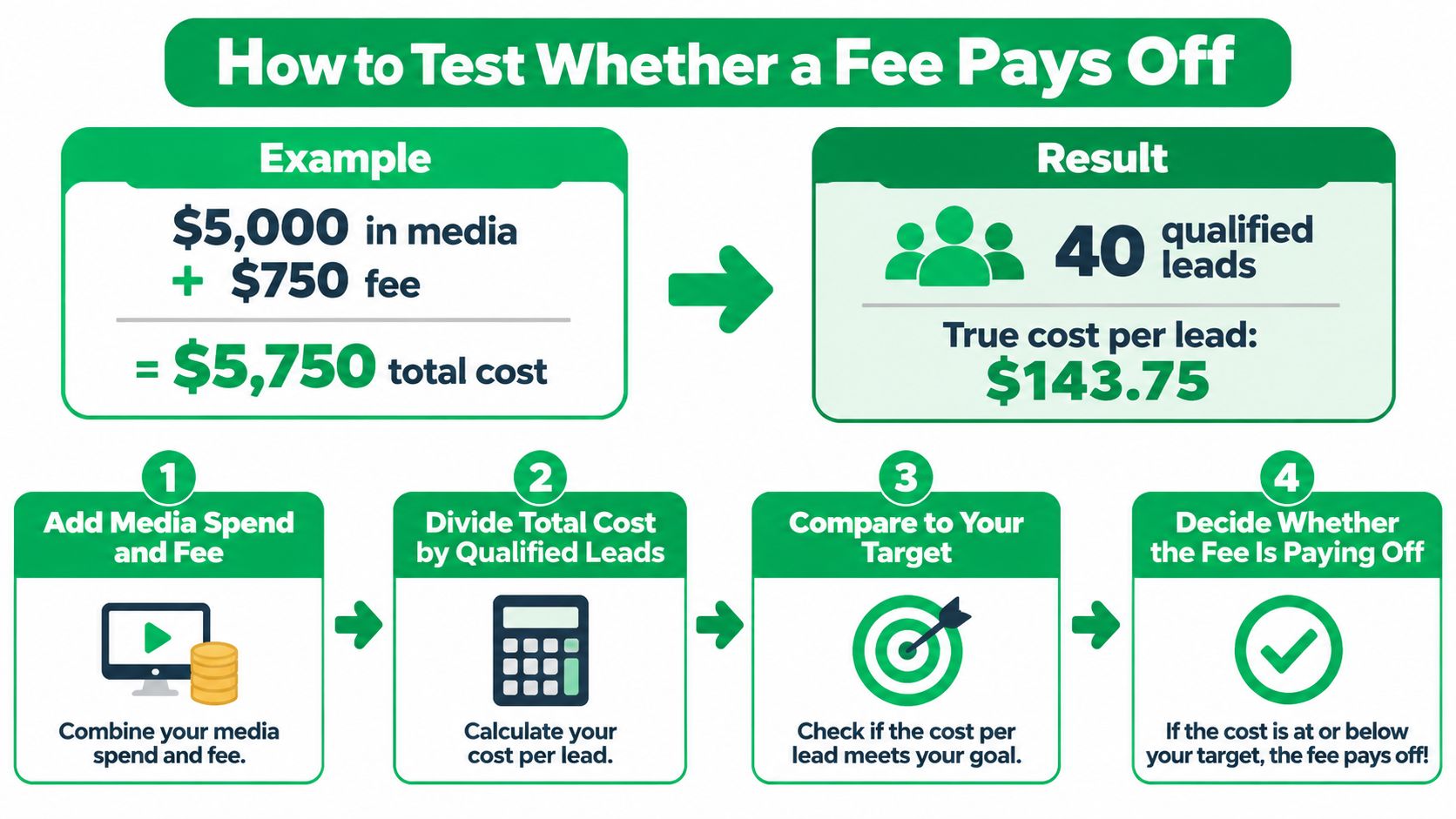
Six Steps to Judge the Fee
- Add fee to media spend for the month to get total cost, because a lead bought with managed spend costs both.
- Divide by qualified leads or sales, not clicks and not raw conversions, since unqualified inquiries inflate the result.
- Work out break-even from margin. A product earning $60 profit per order has a break-even cost per acquisition of $60 before you hope for profit.
- Compare true cost with break-even or with the known value of a lead, using close rate and average job value for service businesses.
- Check the conversion data behind the numbers, because missed calls, broken tags, and duplicate form events make every calculation unreliable.
- Allow a learning period, usually a few months, and write its length into the contract so neither side judges week one like a finished account.
Google explains in its actual CPC and Ad Rank guidance that actual CPC is determined by the auction, Ad Rank thresholds, and competing advertisers, and the final CPC can be below the advertiser's maximum bid. That volatility is exactly why a percentage quote can't answer the central question. What budget and fee are rational for your target cost per qualified lead or profitable order?
Why Cheap Can Fail the Test
Cheap management looks safe. It isn't always. An account with very few conversions gives whoever is optimizing it – human or automated bidding – too little signal to learn from. Thin margins make it worse. If a lead is worth $80 to your business and your true cost is $143.75, a lower management fee won't rescue the economics unless conversion rate, targeting, or offer quality improves enough to close the gap.
And weak tracking makes it worse still. You'll cut campaigns that were driving calls and keep campaigns that look busy but produce junk. Fix measurement before you negotiate the last $100 off a fee. If you want the broader return calculation, our walkthrough on how to calculate marketing ROI pairs well with this test.
A good result is plain. True cost per lead sits below the value of that lead, and the trend holds steady or improves as spend grows, over a fair learning period.
If true cost rises while lead quality falls, the fee isn't paying off, whatever model you're on. Change the scope, the offer, the tracking, or the manager. But change something measurable, not just the billing label.
What the Fee Buys and What to Ask Before Signing
Two agencies both charge $1,000 a month. The first adjusts bids and sends a monthly report. The second audits conversion tracking, reviews search terms every week, runs two tests a month, and checks landing pages against the ads sending them traffic. One of these is expensive. One might be cheap. You can't tell from the price.
That gap is the whole problem with most PPC management pricing. A survey-based source cited in WebFX's ecommerce PPC pricing guide reports that 67% of businesses pay $501–$5,000 per month for professional PPC management, yet that figure doesn't separate strategy, campaign buildout, creative production, landing-page work, conversion tracking, feed management, reporting, or ongoing optimization.
What a Full Scope Usually Covers
- Account build: campaign structure, keyword research, match-type decisions, and ad copy that matches search intent instead of stuffing every service into one ad group.
- Conversion tracking: setup and recurring checks for forms, calls, purchases, and imported offline outcomes where they matter.
- Search-term review: weekly or regular query analysis, negative keywords, and cutting spend that brings clicks you'll never sell to.
- Bid, budget, and audience work: allocation across campaigns, bid strategy oversight, audience and geographic or device segmentation, and pausing what's wasting money.
- Testing: ad variations, landing-page hypotheses, offer tests, and enough discipline to let a test gather data before calling a winner.
- Reporting tied to outcomes: leads or sales, conversion rate, and cost per result, explained in plain language with next actions attached.
Separate one-time onboarding from recurring management in the quote. Audits, builds, tracking repair, and historical cleanup happen once, or at least not every month. Ongoing optimization is the retainer. If a proposal blends them, ask for the split.
Also flag what's commonly billed outside the fee. Creative production, landing-page builds, product feed work, and sometimes call-tracking software often sit outside management. None of that is unreasonable. Surprising you with it in month two is.
Questions to Ask Before You Sign
- What's inside the base fee, line by line, and what's billed separately?
- What's the minimum monthly fee, and how much notice do you need to cancel?
- Who owns the accounts and data, including the ad account, conversion tags, audiences, and reporting history if you leave?
- How many campaigns are in scope, since separate Search, Shopping, or geographic campaigns carry their own budgets and day-to-day workload?
- How often do reports arrive, and do they show leads, conversion rates, and revenue rather than impressions alone?
- Who does the work, and how many accounts does that person run at once?
That last reporting question matters more than people think. Our clients receive regular analytics and reporting, including data on website traffic, leads generated, conversion rates, and other key performance indicators, because a fee you can't connect to outcomes is just a subscription. After our initial consultation, we develop a customized digital marketing strategy and proposal that outlines our recommended services and approach, so scope is written down before work starts. If you want the service itself defined clearly, start with what PPC campaign management includes and compare proposals against it.
The three answers that matter most: written scope, minimum fee, and ownership of accounts and data. Get those wrong and the monthly price is the least of your problems.
Request the scope in writing and check it line by line against the list above. An agency that itemizes deliverables is telling you how your money turns into labor. One that won't is asking you to trust a number. Don't.
Choose the Model That Fits Your Budget
There's no universally correct model. There's a correct fit for your budget, margins, and data quality, and those three things decide it.
If your budget is modest or brand new, I'd start with a flat fee for predictability. Just confirm that conversion tracking and search-term review sit inside it, because a predictable fee for bid tweaks alone is predictable waste. At small spend, fixed foundational work matters more than a clever percentage.
If spend is growing and steady, a percentage fee scales naturally with the account, provided you agree on a minimum, a written scope, and efficiency targets. Do the scale math carefully. At $20,000 a month, a 15% rate means $3,000 in fees, so the workload, testing cadence, and reporting depth should grow with that check.
If you have clean tracking and a known value per lead, a performance-based or hybrid model can tie pay to results. It needs definitions both sides trust, a qualified lead spelled out in the contract, and enough conversion volume to judge fairly. Without that data, you're building an argument into the agreement.
Three Steps to Take This Week
- Rerun the fee table with your real media spend, using the monthly charging cap rather than a daily guess.
- Run the break-even test on your last three months of qualified leads or orders, fee included.
- Ask two or three agencies to quote the same written scope, line by line, so you're comparing work and not sales pages.
Pricing on our side is provided after a consultation, and we'd rather quote against your actual goals, market, and account condition than hand you a generic tier. If you're still narrowing down partners, our guide on how to choose a marketing agency will help you structure those conversations.
Pick the model by one number in the end. True cost per lead or sale after the fee, measured over a fair learning period. If that number works for your margins, the model works. If it doesn't, no billing structure will save it.
If you're weighing quotes and want the math run against your own budget, margins, and lead value, we can build that comparison with you and show exactly what our PPC management would include before you commit. Visit Mr. Green Marketing, LLC to request a consultation and get pricing based on a written scope, not a generic package.
Leave a Comment
sing in to post your comment or sign-up if you dont have any account.