
How Much Does It Cost to Advertise? So, you want to know the magic number for advertising costs. And the honest answer? It really depends. A small local shop might get traction with $500-$1,000 per month on a single channel, while a startup in growth mode could be investing $5,000-$25,000+ monthly across several platforms.
How Much Does It Cost to Advertise? The Real Answer to Your Advertising Budget Question
Let’s get one thing straight: there’s no universal price tag for advertising. Anyone who gives you a flat number without asking about your business, your industry, or what you’re trying to achieve—well, they aren’t giving you the full story.
That’s like asking, “How much does a vehicle cost?” A used scooter and a new fleet of commercial trucks are worlds apart. But both are technically correct answers.
The real question isn’t just “how much does it cost,” but “how much should I invest to actually hit my goals?” This one simple shift turns advertising from an expense into an investment. You’re not just spending money; you’re putting capital to work to generate leads, drive sales, and grow your brand. A subtle but crucial difference.
Budget Benchmarks for Your Business
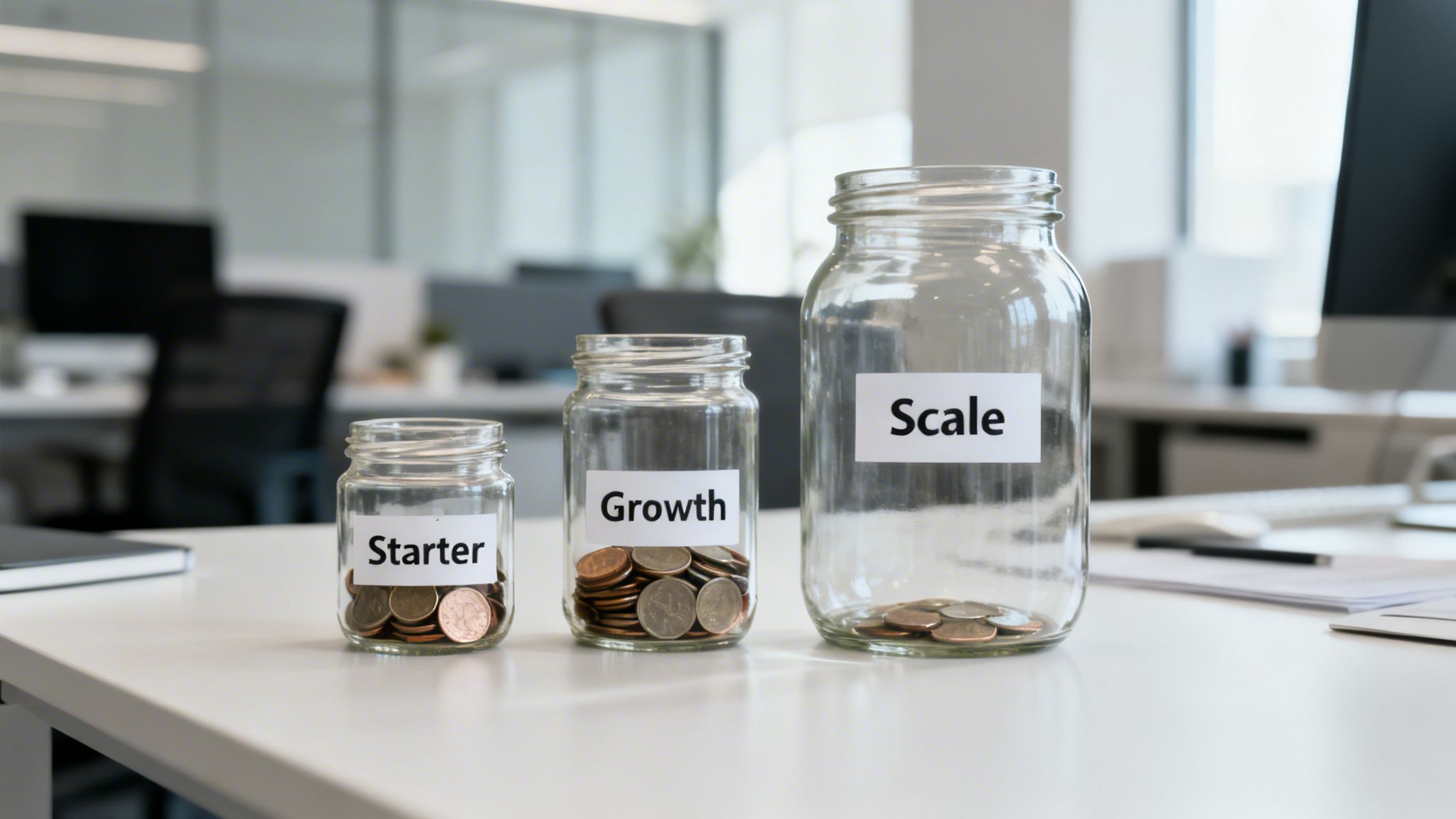
To get past the vague “it depends,” we need to tie your budget to your business stage and your ambition. A brand-new startup trying to get noticed for the first time has completely different needs—and resources—than an established company defending its market share.
Think of it in these three stages:
- Awareness: You’re just getting your name out there. The primary goal is for people to discover that you exist. You’re planting seeds.
- Lead Generation: You need a consistent, predictable flow of interested customers. This requires more targeted and sustained spending.
- Aggressive Growth: You’re ready to scale. Fast. The mission is to capture significant market share and dominate your niche, which demands the largest investment.
The most common mistake we see is underfunding. Spreading a tiny budget across five different platforms is like trying to water a giant garden with a single spray bottle—nothing really grows. It’s far better to own one channel than to be invisible on five.
To give you a concrete starting point, we’ve put together a table with realistic monthly ad spend ranges based on what’s working for businesses right now in 2026.
Sample Monthly Digital Advertising Budgets for 2026
This table provides estimated monthly ad spend ranges for different business types, helping you benchmark your own budget.
| Business Type | Conservative Budget (Awareness) | Moderate Budget (Lead Gen) | Aggressive Budget (Growth/Scale) |
|---|---|---|---|
| Local Service Business | $500 – $1,500 | $1,500 – $4,000 | $4,000 – $10,000+ |
| E-commerce / Amazon | $1,000 – $3,000 | $3,000 – $10,000 | $10,000 – $50,000+ |
| B2B / SaaS Startup | $2,000 – $5,000 | $5,000 – $15,000 | $15,000 – $75,000+ |
Use this table to find where you fit. Are you just planting the seeds, or are you ready for rapid expansion? Your answer will point you toward a realistic starting budget.
Keep in mind, these numbers reflect your ad spend—the money paid directly to platforms like Google or Meta—and don’t include fees for agency management or creative production, which we’ll cover later.
How Much Does It Cost to Advertise? What Actually Drives Your Advertising Costs?
So, what are you actually paying for when you run an ad? It’s not like buying a billboard where you pay a flat fee and just hope for the best. The final number on your advertising invoice is the result of a dynamic, real-time auction where platforms like Google and Meta are constantly judging your every move.
Think of it like trying to buy front-row seats to a concert. If the artist is a global superstar (like a competitive industry such as insurance or law), the demand will be insane, and ticket prices will shoot through the roof. For a niche local band, those same seats will be far more affordable. The same logic drives advertising costs.
The Core Cost Drivers
Your ad cost isn’t one single number; it’s a blend of several key variables. A local plumber will pay way less for a click than a national law firm, simply because the competition—and the potential value of a single customer—are worlds apart.
Here are the main factors that dictate what you’ll ultimately spend:
- Your Industry: This is the big one. Highly competitive fields with high-value customers, like legal services or finance, can see Cost Per Click (CPC) rates over $50. In contrast, less competitive spaces like local retail or hobbies might only pay a dollar or two per click.
- Audience Targeting: The more specific you get with who sees your ad, the more you can expect to pay. Targeting a high-income executive in a specific zip code is a premium action. But that precision often leads to much better results, making the higher cost completely worth it.
- The Platform: Costs vary wildly from one platform to the next. A click from a LinkedIn ad targeting a specific job title will almost always be more expensive than a click from a broad campaign on Facebook.
- Ad Placement: Where your ad shows up matters. An ad at the very top of Google’s search results or the first video in a user’s TikTok feed is prime real estate. And it’s priced accordingly.
The game isn’t just about outspending your competition. Digital ad platforms literally reward better, more relevant ads with lower costs and better placements. A great ad can beat a mediocre ad, even with a smaller budget.
Ad Quality and The Auction System
This is where things get really interesting. Platforms like Google use what’s called a Quality Score to figure out how relevant your ad is. It looks at things like your ad’s expected click-through rate, its relevance to the search term, and the user’s experience on your landing page.
A high Quality Score acts like a discount. A low score is a tax.
Let’s break down the two main ways you’ll be charged:
- Cost Per Click (CPC): You pay every time someone clicks on your ad. This is the most common model for search ads, like on Google, where your main goal is to drive traffic to your site. You’re bidding for the click itself.
- Cost Per Mille (CPM): “Mille” is just a fancy word for a thousand. You pay a flat rate for every 1,000 times your ad is shown (an “impression”). This model is popular on social media and for display ads where brand awareness is the primary goal.
Getting a handle on how these pieces fit together is the first step toward building an ad strategy that actually works. To see how these factors play out in the real world, check out a realistic Google Ads cost breakdown. It peels back the curtain on the world’s biggest ad platform and shows you what really goes into your final bill.
How Much Does It Cost to Advertise? A Breakdown of Advertising Costs by Channel
So, let’s talk numbers. This is where most business owners get stuck when trying to create an advertising budget. While your final spend will always depend on your industry, audience, and goals, each channel has its own baseline costs and pricing models.
Think of it like buying real estate. A storefront on Rodeo Drive is going to cost a whole lot more than a spot in a quiet suburban strip mall—the price is all about location and the potential value of the customers walking by. Advertising is no different.
The digital ad market is growing at a staggering rate. In 2025, global spending shot past $740 billion, marking a massive 10% increase from the previous year and accounting for almost 69% of all advertising worldwide. Search ads still dominate with a 40% share ($295 billion), but social media isn’t far behind at $210 billion, and video now commands a huge 35% of budgets with $110 billion in spend.
This chart helps visualize how the key factors we’ve discussed—your platform choice, industry, and targeting—all work together to determine what you’ll ultimately pay.
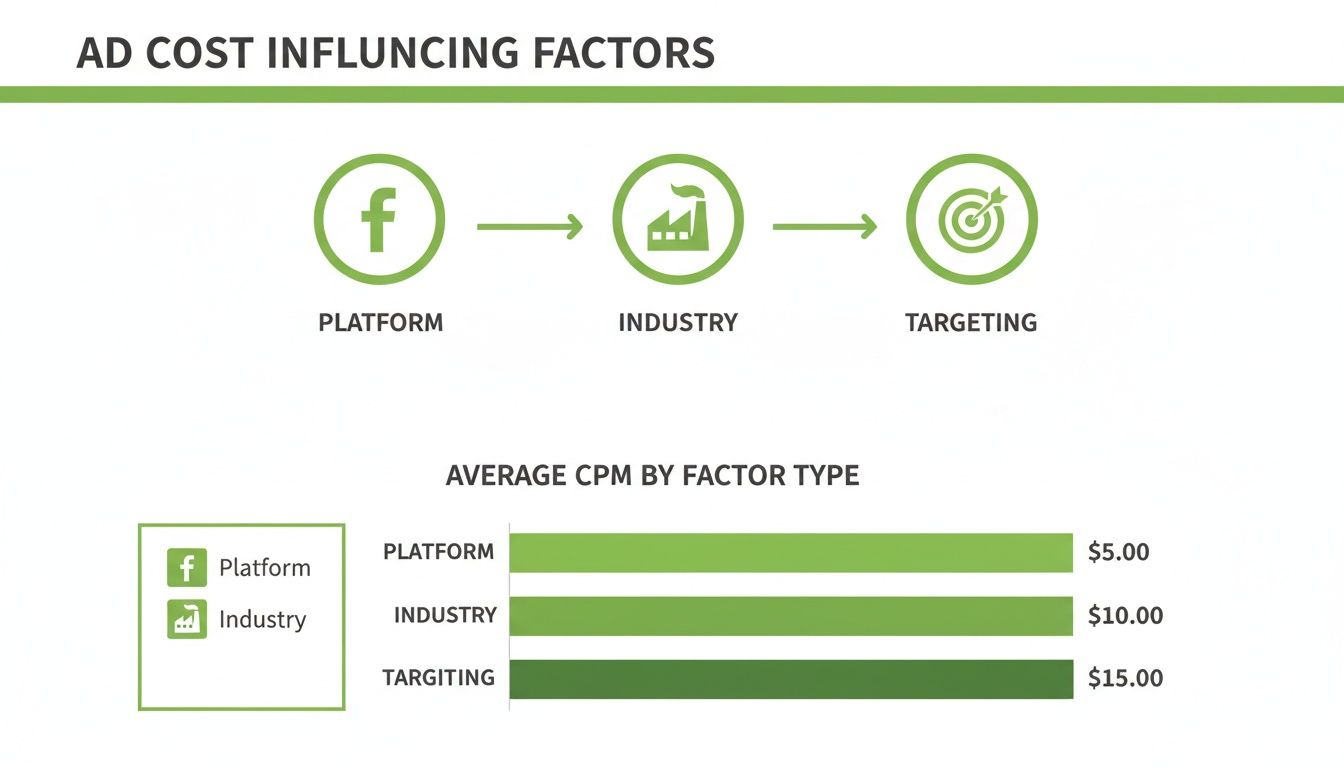
Remember, no cost exists in a vacuum. These three elements are in constant interplay, defining the price for every impression and click you buy.
Search Engine Advertising (Google and Bing)
When someone needs an answer or is ready to buy right now, they turn to Google. This is the definition of high-intent marketing, and you pay a premium for that direct access to motivated customers.
The primary model here is Cost-Per-Click (CPC), where you bid on keywords and only pay when someone is interested enough to click your ad.
- Average CPC: Across all industries, a typical CPC on Google Ads lands somewhere between $1 and $5. But don’t let that average fool you.
- Industry Extremes: Clicks in highly competitive, high-value fields can be astronomical. A click for “local bakery” might be $2, while a click for “personal injury lawyer” could easily top $100. The bid always follows the potential value of the lead.
- Starting Budget: A small local business might start seeing results with a budget of $500–$1,000 per month. A national e-commerce brand will likely need $3,000+ just to get meaningful data.
To really get under the hood of how this works, check out our in-depth guide to PPC marketing. It breaks down the entire process from keyword research to campaign launch.
How Much Does It Cost to Advertise? Social Media Advertising (Meta, TikTok, LinkedIn)
Social media is where you find new customers and build brand affinity, often before they even realize they have a need. But the audience—and the cost to reach them—varies dramatically from one platform to the next.
Meta (Facebook & Instagram):
Still the undisputed king of social advertising. Costs are typically measured in Cost Per Mille (CPM), which is the price you pay for one thousand impressions.
- Average CPM: You can expect to pay anywhere from $5 to $15 per thousand impressions, but this can swing wildly based on how narrow your audience targeting is.
- Link Clicks: If you optimize for clicks instead, the average CPC often lands between $0.50 and $2.50.
LinkedIn:
This is the premier platform for B2B advertisers. You’re paying for access to an exclusive audience of decision-makers, and the price reflects that.
- Average CPC: It’s completely normal to see CPCs in the $8 to $15 range for well-defined professional audiences.
- CPM: Costs can easily surpass $30 if you’re targeting specific job titles, like C-suite executives or VPs of procurement.
LinkedIn is expensive for a reason. One click from the right person—a VP of Operations with purchasing power—can be worth a hundred clicks from a general audience on Facebook.
TikTok:
The undisputed champion of engagement. TikTok is an incredible tool for top-of-funnel brand awareness, particularly if you’re trying to connect with a younger audience.
- CPM: TikTok’s impression costs are often more affordable than Meta’s, sometimes falling as low as $3 to $8.
- Campaign Minimums: Just be aware that TikTok requires minimum daily budgets for certain campaign types, often starting at $50/day.
Other Important Channels to Consider
Your options extend far beyond Google and Meta. For many businesses, some of the highest returns come from these other specialized channels.
- Retail Media (Amazon Ads): If you sell products online, advertising on Amazon is non-negotiable. You’re reaching people who are actively shopping with their credit card in hand. CPCs are competitive, often $0.75 to $3.00, but the conversion rates are usually much higher than on other platforms.
- Connected TV (CTV): This is your chance to get on the big screen through streaming services like Hulu, YouTube TV, and Peacock. It offers the storytelling power of a TV commercial combined with the precision of digital targeting. Costs are CPM-based, typically in the $20 to $50 CPM range, and you benefit from nearly 100% view-through rates.
- Traditional Advertising: Don’t write off offline methods. For many local and service-based businesses, traditional channels still drive incredible results. Things like direct mail services have costs tied to printing, postage, and list acquisition. Likewise, local TV and radio spots can be surprisingly effective, with prices ranging from a few hundred dollars to tens of thousands depending on the market and time slot.
How Much Does It Cost to Advertise? Budgeting Examples for Different Businesses
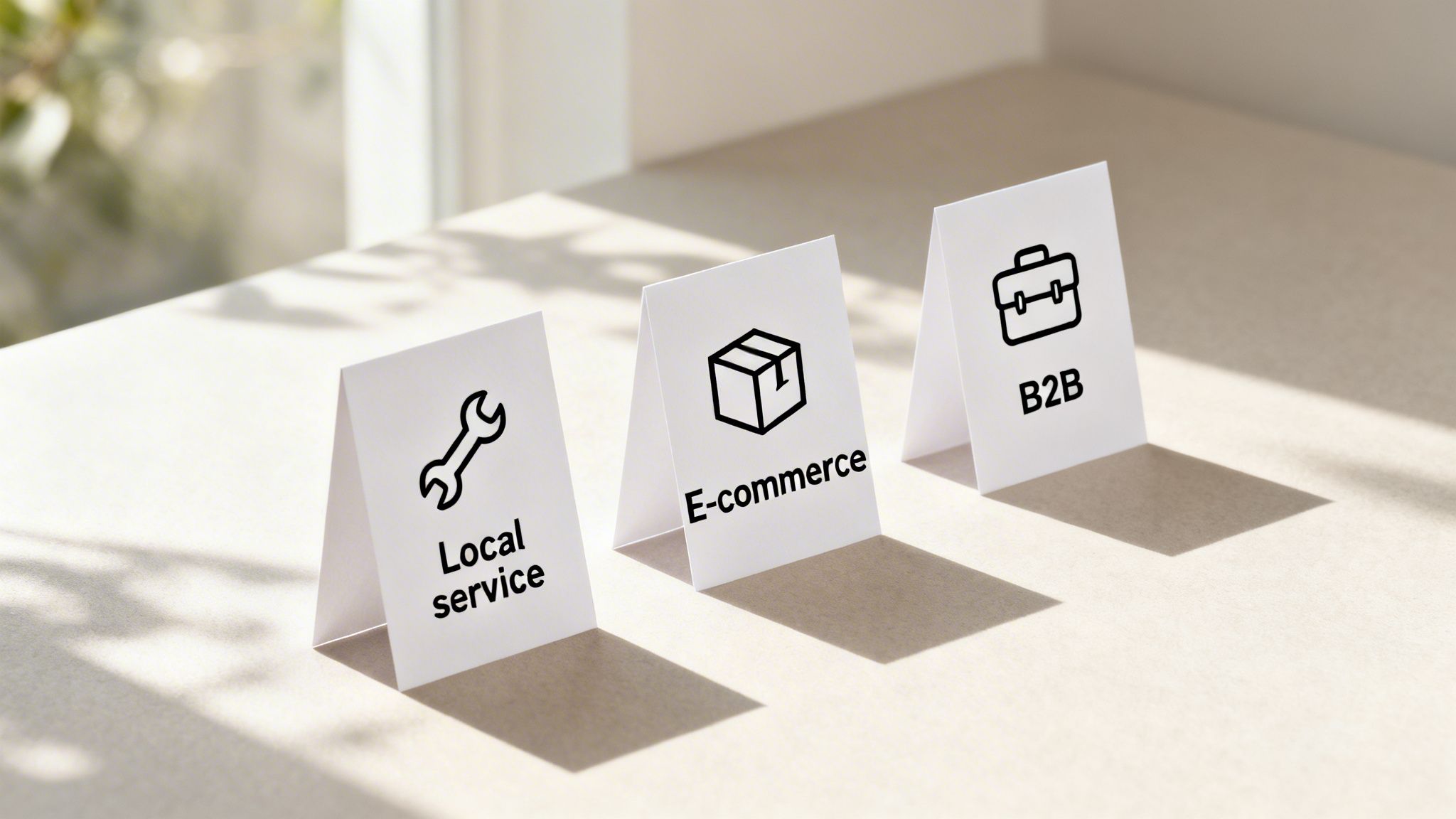
Theory is one thing, but seeing how a budget works in the real world is where the strategy clicks. A generic spending recommendation won’t work because your business isn’t generic. Your goals, customers, and profit margins demand a tailored approach.
Let’s walk through three distinct business models. And these aren’t just numbers on a page; they’re strategic roadmaps showing how and where to invest your ad dollars to get the results that actually matter to your bottom line.
Scenario 1: How Much Does It Cost to Advertise? The Local Service Provider
Imagine a local business, “Emergency Electric.” Their goal isn’t to become a household name across the country. They just need the phone to ring with profitable service calls from customers in their immediate area—people with a real problem who need a pro, now.
Goal: Generate 15 qualified leads per month with a target Cost Per Lead of $80.
Total Monthly Budget: $2,000
Here’s how we’d put that budget to work:
- Google Local Services Ads (LSA): $800
For a local service, this is non-negotiable. You pay per lead, not per click, and earn the “Google Guaranteed” badge that builds instant trust. This is where you catch the person whose power just went out. - Google Search Ads (PPC): $700
This is for capturing everyone else searching for an immediate solution. We’d target high-intent keywords like “emergency electrician near me” and use negative keywords to filter out searches from DIYers. The entire focus is on driving calls and form submissions. - Facebook/Instagram Ads (Remarketing): $250
This isn’t for finding new customers. This small, targeted budget is only for showing ads to people who already visited your website but didn’t book a call. It’s a simple, effective reminder that keeps you top-of-mind. - Management & Optimization: $250
A budget is useless without oversight. This sliver is for active campaign management, A/B testing ad copy, and refining landing pages to make sure every click has the best possible chance of converting.
The entire strategy revolves around capturing immediate demand. You spend the most where intent is highest (Google) and use social media as a safety net to recapture attention, not to generate it from scratch.
Scenario 2: How Much Does It Cost to Advertise? The E-commerce Brand
Now, picture “Glow Up,” a direct-to-consumer brand selling organic skincare on their Shopify store and Amazon. They need to drive sales while building a community of repeat buyers.
Goal: Achieve a 4x Return on Ad Spend (ROAS) and grow their customer list.
Total Monthly Budget: $8,000
A multi-channel presence is key for e-commerce. It looks something like this:
- Meta Ads (Facebook & Instagram): $3,500
This is the engine for growth, used for both finding new customers (prospecting) and reminding old ones to come back (retargeting). We’d lean heavily on video ads and user-generated content (UGC) to attract new buyers and use dynamic product ads to reel in cart abandoners. - Amazon Ads: $2,500
You have to pay to play on Amazon. This budget is dedicated to Sponsored Products and Sponsored Brands, bidding on specific keywords to show up at the very top of the search results—right when someone is ready to buy. - Google Shopping & Performance Max: $1,500
This is for capturing shoppers who start their journey on Google. Performance Max is a powerful tool that automates ad placements across Google’s entire ecosystem, from Search to YouTube, to find buyers wherever they are. - Influencer & UGC Seeding: $500
This isn’t a direct ad spend, but it’s a critical investment. We’d use this to send products to micro-influencers, generating authentic reviews and content that we can then repurpose in our Meta ads. It’s a smart way to create high-performing ads without expensive creative production.
Social media ad costs remain competitive. Recent reports show Meta’s average CPM at $6.59, with Cost Per Link Click (CPLC) on TikTok as low as $0.38. This makes hyper-precise targeting absolutely essential for maximizing your return. You can explore more data on how social ad costs are trending to guide your own e-commerce strategy.
Scenario 3: How Much Does It Cost to Advertise? The B2B Startup
Finally, let’s look at “ConnectSphere,” a B2B SaaS startup selling project management software to marketing agencies. The sales cycle is long, the deal sizes are large, and the audience is incredibly specific. The goal isn’t an instant sale; it’s getting a foot in the door.
Goal: Book 10 qualified product demos per month.
Total Monthly Budget: $12,000
- LinkedIn Ads: $6,000
This is where the money goes. LinkedIn is unmatched for targeting by job title, industry, and company size. We’d run campaigns promoting a valuable lead magnet—like a guide on “How to Improve Agency Profitability”—to capture emails from decision-makers. - Google Search Ads: $2,500
We’re not targeting broad terms here. This budget is for very specific, long-tail keywords like “project management software for marketing agencies.” The search volume is low, but the intent is off the charts. - Podcast Advertising: $2,000
Sponsoring niche podcasts that agency owners already listen to and trust is a brilliant play for building credibility. It drives high-quality, referral-like traffic. To get this right, you need to understand the cost to advertise on podcasts and how to pick the right shows. - Content & SEO: $1,500
While not a direct “ad,” this is a fundamental part of the acquisition budget. Creating in-depth blog posts that solve the problems of your target audience is a long-term strategy that attracts highly qualified organic leads for years to come.
How Much Does It Cost to Advertise? How to Calculate and Maximize Your Ad Spend Return
Spending money on ads is easy. Turning that spend into actual profit? That’s the real skill. Pouring cash into campaigns without measuring what comes back is like sailing without a compass—you’re moving, but you have no clue if you’re getting any closer to your destination.
This is where Return on Ad Spend, or ROAS, becomes your north star. It’s the simple, direct answer to the most important question you can ask: “Is this actually working?”
How Much Does It Cost to Advertise? Calculating Your Return on Ad Spend
At its core, calculating ROAS is refreshingly straightforward. It’s simply the total revenue you brought in from your ads divided by how much you spent to run them.
How Much Does It Cost to Advertise? The formula is: ROAS = Total Revenue from Ads / Total Ad Spend
So, if you spend $1,000 on Google Ads in one month and those ads generate $4,000 in direct sales, your ROAS is 4x (or 400%). For every dollar you put in, you got four dollars back. Simple enough, right?
But this brings up a much more critical question: what is a “good” ROAS?
A 4x ROAS might be phenomenal for an e-commerce brand with healthy profit margins. But for a business with high overhead and slim margins, a 4x ROAS could mean they’re actually losing money after factoring in the cost of goods, shipping, and other expenses. For a deep dive, check out our guide on how to calculate marketing ROI in a way that truly reflects profitability.
A “good” ROAS isn’t a universal number; it’s the number that keeps your business profitable. A brand awareness campaign might be thrilled with a 2x ROAS, while a direct-response campaign might need an 8x ROAS just to break even.
How Much Does It Cost to Advertise? Expert Tactics for Improving Your ROAS
Getting a better return isn’t black magic. It’s about making systematic, data-driven improvements. A small tweak here and a minor adjustment there can snowball into massive gains.
Here are the levers our team pulls every day to turn a decent ROAS into a great one:
- Refine Your Audience Targeting: Stop showing your ads to everyone. Get granular. Use lookalike audiences built from your best customers, create hyper-specific retargeting lists, and aggressively use negative keywords to stop wasting money on people who will never buy.
- Optimize Your Landing Pages: Your ad is just the handshake; the landing page is where the real conversation happens. It needs to be fast, mobile-friendly, and laser-focused on a single action. If your ad promises a “50% Off Sale,” that message had better be the first thing a user sees when they land on the page.
- A/B Test Your Creative Relentlessly: Never assume you know what works best. Continuously test every single element—your ad copy, headlines, images, videos, and call-to-action buttons. Even a tiny 0.5% improvement in your click-through rate can have a huge impact on your final ROAS.
- Embrace High-ROI Channels: Not all channels are created equal. For e-commerce and Amazon sellers, the explosion in retail media advertising is a game-changer. This space is projected to soar to over $190 billion globally by 2026, with some platforms delivering returns 200-400% higher than traditional channels. To see more on this, you can read the full research about global advertising spending.
Common Questions About Advertising Costs
Let’s clear the air. After all this talk of budgets and channels, you probably still have some questions. It’s a complex world, and even seasoned business owners need clarity. Here are the most common questions we hear when it comes to the real cost of advertising.
How Long Does It Take to See Results?
This is the big one, isn’t it? The honest answer is you’ll see data almost immediately, but you’ll see real, profitable results on a different timeline. It all depends on the channel.
For platforms like Google Ads, where you’re capturing existing demand, you can see leads or sales within the first week. But for channels built around awareness, like social media ads or content marketing, it can take 3-6 months to build momentum. Patience isn’t just a virtue here; it’s a core part of the strategy.
Is It Better to Hire an Agency or Run Ads Myself?
Going the DIY route can save you on management fees upfront—no question. It’s a great way to learn the ropes, especially if you have a very small budget and a lot of time to invest in learning.
However, hiring an agency gives you immediate access to expertise. A good agency has already managed millions in ad spend, made the expensive mistakes, and knows the subtle platform changes that can make or break a campaign. You’re not just paying for management; you’re paying for speed and to avoid a very costly learning curve.
How Much Does It Cost to Advertise? What Are the Hidden Costs of Digital Advertising?
The price you pay Google or Meta is just the beginning. The other costs aren’t really “hidden”—they’re just often forgotten during budgeting.
- Creative Production: Who is making your videos, designing your ad images, and writing your copy? This requires either your time or your money.
- Management Fees: Whether it’s an agency’s retainer or the salary of an in-house marketer, someone has to be paid to manage the campaigns.
- Tools and Software: Subscription fees for analytics platforms, keyword research tools, and landing page builders are part of the operational cost.
Forgetting to budget for these is like buying a car and forgetting about insurance and gas. Your ad spend is the engine, but these other costs are what keep it running on the road to profitability.
Ready to turn these questions into a clear action plan? The team at Mr. Green Marketing, LLC specializes in crafting advertising strategies that align with your real-world business goals. Get your free audit today and discover your biggest opportunities for growth.
Leave a Comment
sing in to post your comment or sign-up if you dont have any account.