
Don't hire the agency with the longest service menu. That's the popular advice, and it's backwards for a startup. The widest menu usually means the vaguest diagnosis, the most channels opened at once, and the fastest way to burn runway while learning almost nothing. Hire for cash efficiency and measurement first. Channels second. And if an agency won't talk about activation, retention, and payback before it talks about spend, walk away.
Table of Contents
- Start With the Startup's Real Growth Problem
- Identify the Agency Skills You Actually Need
- Evaluate Agency Fit With Evidence
- Run a Strong RFP and Interview Process
- Onboard the Agency and Set the Operating Rhythm
- Troubleshoot Common Growth Agency Problems
- Make the Final Agency Decision
Start With the Startup's Real Growth Problem
Most founders shop for a growth marketing agency for startups like they're shopping for software. SEO? Check. Paid social? Check. Content? Check. That checklist tells you nothing about whether the next dollar should go to any of those things.
Take a founder I see constantly. Traffic is coming in, demos trickle through, but almost nobody reaches the core product moment and sticks around. She doesn't have an acquisition problem. She has an activation and conversion problem. Buying more traffic just sends more people into a leaky funnel. Faster leakage. Not growth.
Your real problem sits in one place right now, even if several things feel broken. Name it before you request a single proposal, because that constraint decides what kind of help you need, and a solid digital marketing strategy for startups starts from that diagnosis, not from a channel list.
Why the Clock Matters More Than the Pitch
Startups don't get endless quarters to figure this out. OECD research covering 21 countries and other economies found the typical survival rate for new firms is slightly above 60% after three years, about 50% after five years, and just over 40% after seven years, with exit risk generally highest when a firm is two years old. Survival also isn't scale. Staying alive while staying flat still loses.
So treat selection as a business decision with evidence thresholds. What must be true before you scale spend? What result makes you pause? What would make you kill a channel?
If you can't state your constraint in one sentence, you're not ready to brief an agency. You're ready to do diagnostic work.
Work through these questions as you read:
- What's constrained? Reach, conversion, activation, retention, or revenue per customer?
- What evidence will you demand? Starting conditions, intervention, timeframe, and business outcome, not just activity.
- When should you start with measurement? Often, when tracking is shaky, the right first engagement is an audit, not media buying.
That sequence, from needs analysis through evaluation, RFP, onboarding, KPIs, reporting, and troubleshooting, is how you avoid paying tuition twice.
Identify the Agency Skills You Actually Need
Vague ambition produces vague proposals. "We need more growth" will get you five identical decks. You need a brief built from diagnostic inputs, gathered before outreach, even if some numbers are rough.
Gather These Inputs First
Pull what you have. Note what you don't. Missing data is itself useful information, and a good agency will tell you so.
- Target customer: Who buys, who uses, and who churns fastest? Segment by company type, role, or use case.
- Activation event: The one action that signals a user got value. Completed onboarding. First integration. First paid invoice sent.
- Current funnel baselines: Acquisition volume by source, landing page conversion, activation rate, and a retention signal by cohort.
- Unit economics: Your best current read on CAC, LTV, and payback period, plus the budget you can allocate to testing without threatening runway.
- Sales feedback: Why non-converters said no, in their words, from calls and lost-deal notes.
If you can't instrument the funnel from acquisition through retention yet, say that plainly. Don't pretend.
Let the Constraint Pick the Skill Set
Weak conversion with decent traffic points to measurement, positioning, and landing page work. Healthy activation and retention with too little reach points to acquisition testing, which might include SEO services for startups if search intent matches your buyer, or tightly scoped paid tests on Google Ads or LinkedIn. Weak retention points somewhere else entirely. That's often product and onboarding, and no agency should sell you top-of-funnel volume to fix it.
Context matters too. The OECD's cross-country entrepreneurship data shows more than half of startups failed to survive their first five years in most countries examined, with five-year survival ranging from below one in five firms in Lithuania to approximately two-thirds in Sweden. Local market conditions shape outcomes, so a single universal playbook is unlikely to work globally. Ask how an agency adapts to your market, not just your category.
Early on, prioritize learning velocity and cash efficiency over channel volume. A small, well-instrumented test that tells you which segment converts beats three channels reporting impressions. And that diagnostic pack becomes the raw material for a useful RFP later, instead of a generic shortlist built on logos and awards.
Evaluate Agency Fit With Evidence
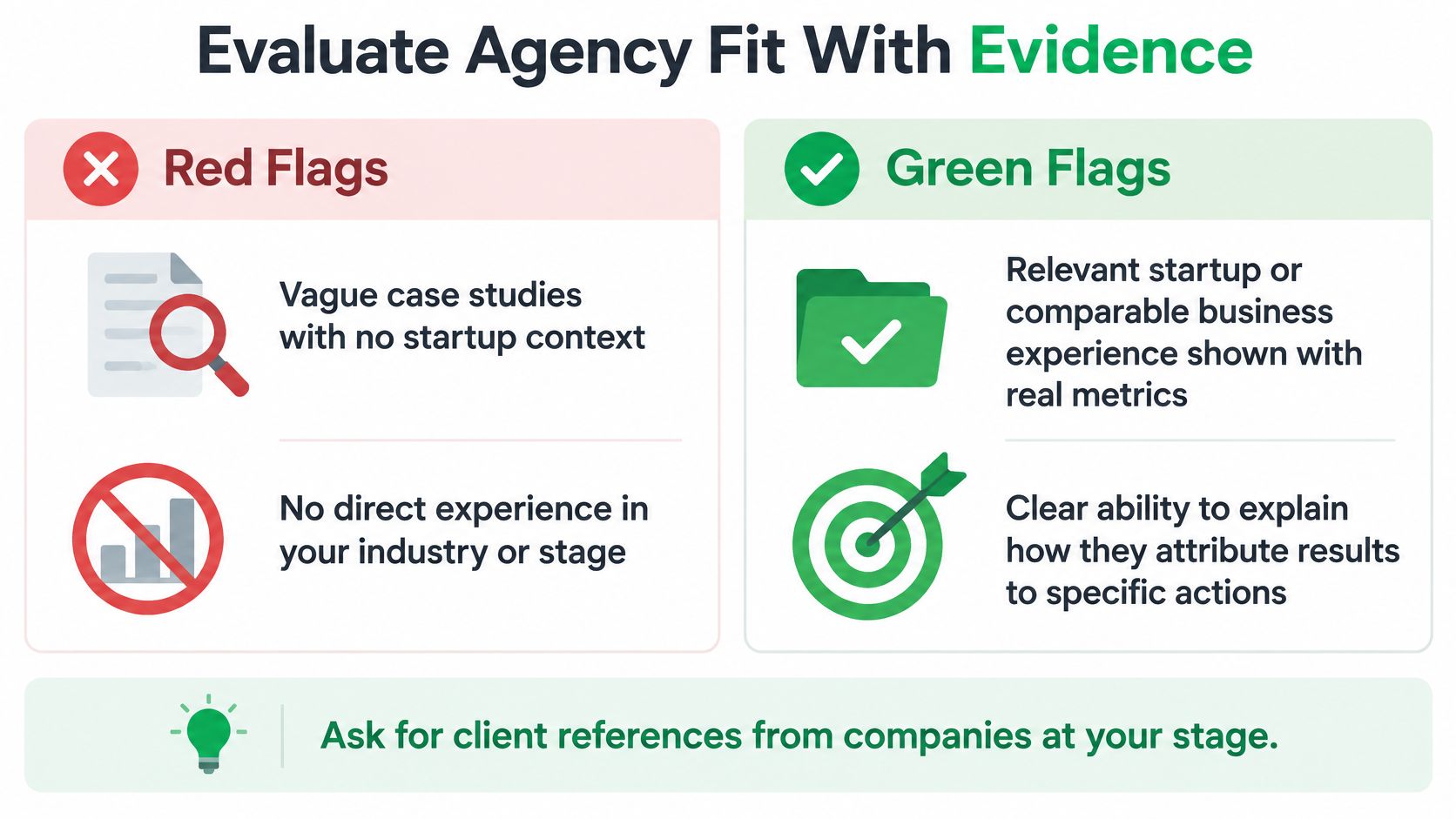
Glossy credentials are easy to buy. Evidence is harder to fake. Evaluate every growth marketing agency for startups the same way, against the same criteria, or you'll end up choosing whoever presented last and sounded most confident.
What to Probe Beyond the Case Study Deck
Relevant experience means comparable stage, sales motion, and budget, not just a famous logo. An agency that scaled a funded consumer app may flounder with your sales-led B2B motion and long cycle. Ask who did the work, who owns measurement, and who you'll talk to each week.
Then test whether they connect activity to money. Clicks and leads are diagnostics. Qualified pipeline, activation, retention, and revenue are outcomes. A credible team explains that chain without hand-waving, and they'll reference tools they work in, whether that's GA4, HubSpot, Salesforce, Segment, or your product analytics.
For calibration, a 2024 SaaS benchmark summary on acquisition efficiency reports a median New Customer CAC Ratio of $2.00 in sales and marketing expense for each $1.00 of new ARR, while bottom-quartile companies spent $2.82 for each $1.00. You don't need to match a benchmark on day one. You do need an agency that judges spend against revenue added and payback, not cost per lead alone.
How to Read a Case Study Like a Skeptic
Good case study marketing shows its work. Look for five things every time: the starting condition, the specific intervention, the timeframe, the business outcome, and the limitations. Missing any two? Treat the claim as marketing, not evidence. Ask what didn't work, too. Agencies that only report wins are curating, and you'll get the same curation in your monthly report.
Agency evaluation scorecard
| Evaluation criterion | Evidence to request | Founder interpretation |
|---|---|---|
| Diagnostic ability | Written funnel diagnosis from your data | Can they find the constraint before prescribing? |
| Measurement ownership | Sample tracking plan and dashboard | Will reporting connect spend to activation and revenue? |
| Experimentation discipline | Prioritized backlog with hypotheses | Do they test one change with a predeclared metric? |
| Relevant proof | Case studies at your stage and motion | Have they solved a problem like yours? |
| Commercial transparency | Scope, fees, media markup, exit terms | Do you know what you're paying for and how to leave? |
| Communication fit | Named lead, cadence, response norms | Will decisions move at startup speed? |
Score it in writing. If two agencies tie, pick the one whose diagnosis you'd act on even if you hired nobody. That's usually the honest one.
Run a Strong RFP and Interview Process
A strong RFP doesn't need to be long. It needs to be specific enough that weak agencies self-select out and strong ones can show you how they think. Send the same document to a short list, set one deadline, and compare answers side by side using a structured marketing request for proposal format.
What to Put in the RFP
Include these elements, briefly:
- Business context and stage: What you sell, who buys, current traction, and runway reality.
- Problem to solve: Your named constraint and the evidence behind it.
- Available data: Analytics, CRM, product usage, sales notes, and known gaps.
- Budget range and engagement length: A range is fine. Silence invites fantasy pricing.
- Deliverables and access: What you expect produced, and what systems they'll need.
- Reporting expectations and decision timeline: Cadence, metrics, and when you'll decide.
Ask each agency to respond with a diagnosis of your funnel, their first experiments, and what they'd deliberately not do yet. That last answer reveals discipline.
Interview Questions That Expose Channel-First Thinking
Push on method, not enthusiasm. A sound approach, as outlined in guidance on avoiding wasted startup marketing spend, is that a technically sound program should begin with product-market-fit validation, define one measurable activation event, instrument the funnel, establish baseline conversion and unit economics, and prioritize experiments using expected impact, confidence, and implementation effort before scaling channels. Ask candidates to walk you through exactly that sequence for your business.
Then go deeper:
- On analytics: How would you audit our attribution in week one? What breaks most often?
- On experimentation: How do you rank tests and decide when a result is real?
- On premature scaling: What signal would make you tell us to stop spending?
- On ownership: Who owns strategy, who executes, and what stays in-house?
- On creative and channels: What do you produce directly, and where are you thin?
Rejection rule: Guaranteed outcomes, undefined deliverables, channel-first prescriptions, or reluctance to discuss measurement. Any one of those ends the conversation.
Pay attention to questions they ask you. Strong agencies interrogate your retention, your sales cycle, and your margins. Weak ones ask about your ad budget and your logo files – in that order, usually.
Onboard the Agency and Set the Operating Rhythm
Selection gets the attention. Onboarding decides the results. The first 30 days should produce shared definitions, clean measurement, and a ranked experiment backlog. Not a brand refresh. Not five campaigns.
A Practical First 30 Days
Week one is access and alignment. Grant analytics, ad accounts, CRM, product, and website access, plus brand assets and customer research. Introduce the agency to sales, because sales hears objections your dashboard never will.
Week two is definitions. Agree on the activation event, funnel stages, qualified lead criteria, and source and cohort segmentation. Document it in a shared measurement plan that names every event, owner, and QA step. If tracking is broken, fix it now and delay scaling until you trust the numbers.
Weeks three and four produce the backlog. Rank experiments by expected impact, confidence, and effort, then launch the first low-cost test, usually messaging or a landing page. Set the communication calendar at the same time, weekly working sessions for decisions and a monthly business review for budget and strategy, supported by transparent reporting everyone can read without a translator.
Separate Retention From Acquisition in Every Report
Track retention separately, always. Amplitude's benchmark for startup technology B2B SaaS reports a 31% retention-rate benchmark, while noting retention varies by product category, cohort definition, time window, and whether it's customer, account, or user retention. Use it as a comparison point, not a universal target. What matters is whether users from a given channel come back, because that's how you learn if a campaign produced durable engagement or expensive signups.
Startup agency KPI starter sheet
| Measurement layer | Example measures | Decision supported |
|---|---|---|
| Business outcomes | Revenue, new ARR, payback period | Scale, hold, or cut spend |
| Funnel health | Conversion, activation rate, qualified pipeline | Where the constraint sits now |
| Retention by cohort | Returning users by source and segment | Which channels bring durable customers |
| Channel diagnostics | CAC, click-through rate, cost per qualified action | Budget reallocation within a channel |
| Learning outputs | Tests shipped, hypotheses validated or archived | Whether the program is actually learning |
Agree in advance what happens on a weak, inconclusive, or costly result. Weak means iterate or archive with a written learning. Inconclusive means extend only if sample was inadequate. Commercially positive but operationally expensive – heavy support load, poor lead quality – means renegotiate scope before scaling. Decide the rule before emotions arrive.
Troubleshoot Common Growth Agency Problems
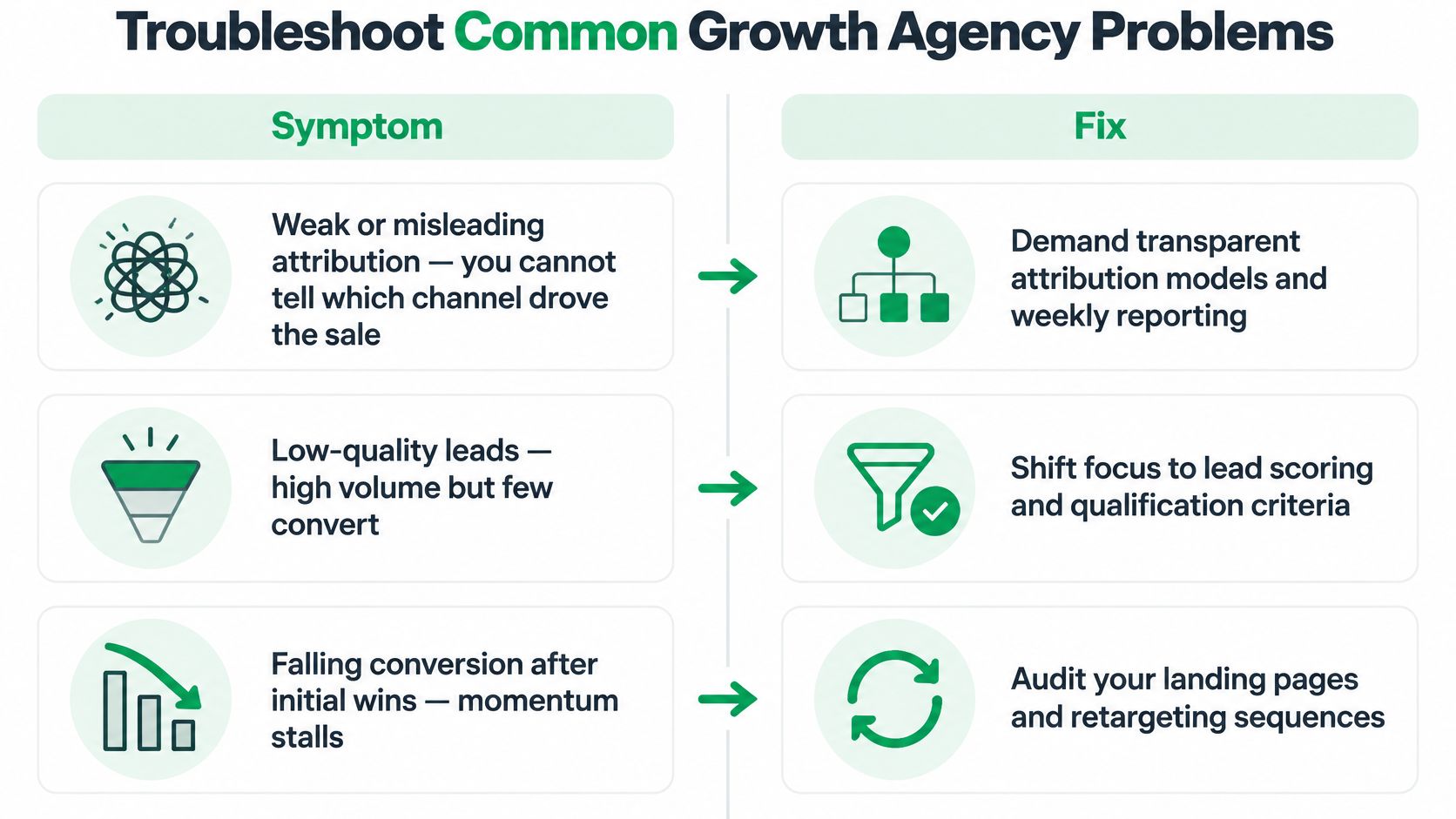
Most struggling engagements don't fail loudly. They drift. Reports stay green, activity stays high, and revenue stays flat. Diagnose by symptom, and separate measurement problems from product problems from channel problems before you blame anyone.
Start With the Evidence, Not the Argument
Noisy experiments are normal, which is worth remembering before you fire anyone. An analysis of 28,304 experiments found only about 20% reached the 95% statistical-significance threshold, which highlights the importance of predeclared hypotheses, adequate sample sizes, consistent exposure, guardrail metrics, and a documented learning backlog. A test that loses cleanly still pays. A test stopped early on a lucky Tuesday teaches you nothing.
Growth agency troubleshooting guide
| Symptom | Likely cause | Corrective action |
|---|---|---|
| Attribution you can't trust | Broken events, mismatched CRM and ad data | Pause scaling, audit tracking, rebuild the measurement plan |
| Plenty of leads, few close | Broad targeting, weak qualification criteria | Tighten audience and offer, judge channels on qualified pipeline |
| Conversion falls as traffic rises | Lower-intent traffic meeting an unchanged page | Segment by source, revisit page, message, and landing experience |
| Tests never conclude | Tiny samples, overlapping changes, early stopping | Predeclare metric and sample, run one change at a time |
| Activity up, revenue flat | Reporting optimizes for clicks and cheap leads | Reset KPIs to activation, retention, and payback |
| Slow decisions, unclear ownership | No named lead or decision cadence | Assign one owner per side, restore weekly working session |
| Scaling before users stick | Acquisition spend ahead of activation health | Pause spend, fix onboarding, retest with a small budget |
Pause spend when you can't measure. That's not pessimism, it's cash discipline. Restarting the measurement foundation feels slow for two weeks and saves you a quarter of arguing about whose numbers are right. Keep the tone factual with your agency. Request the underlying data, the QA record, and the archived learnings. A good partner hands them over without drama.
Make the Final Agency Decision
Compare finalists on evidence, not chemistry alone. Chemistry matters, you'll talk weekly, but it can't rescue a weak measurement plan.
Run this checklist before you sign:
- Credible diagnosis: Did they name your constraint and back it with your data?
- Measurement plan: Are events, cohorts, guardrails, and owners documented?
- Experimentation discipline: Predeclared metrics, adequate samples, one change at a time?
- Transparent ownership: Do you know who decides, who executes, and what you keep in-house?
- Cash-efficiency expectations: Are payback and stop rules agreed in writing?
- Reporting rhythm: Does reporting connect activity to qualified demand and retention?
Then choose the shape of help, not just the vendor. A full growth marketing agency for startups fits when you need strategy plus multi-channel execution. A narrow specialist fits one proven constraint. A fractional lead fits when you have executors but no prioritization. And delaying fits when retention is broken, because no agency fixes that with ads.
Here's my contrarian recommendation, and I'll stand on it. For many early teams, the best first engagement is a measurement and conversion-readiness audit, not media buying. Some teams, including Mr. Green Marketing, LLC, structure early work around audits, strategy, and conversion-focused web and campaign execution, which is the right shape when you need evidence before scale. Buy clarity first. Scale second.
The right partner isn't the one promising the fastest growth. It's the one that helps you learn what works, then invest the next dollar with confidence.
If you're weighing agencies and want evidence before you commit budget, Mr. Green Marketing, LLC offers strategy-led digital marketing across web design, SEO, PPC, and analytics, starting with a free audit and performance report to surface visibility gaps and prioritize quick wins. Bring your funnel data, your activation definition, and your hardest questions, and you'll leave with a custom plan tied to measurable goals instead of a channel checklist.
Leave a Comment
sing in to post your comment or sign-up if you dont have any account.