
A marketing request for proposal – or RFP, if you’re into acronyms – is the formal doc your company puts together to get detailed proposals from marketing agencies. And it’s not just a shopping list. It’s a strategic brief that lays out your project goals, scope, and requirements, allowing agencies to map out a specific plan and price for their services.
Getting this right is your first step to finding a true strategic partner. Maybe the most important one.
Before You Write a Single Word
So, you’re ready to find a new marketing agency. Big decision. And writing an RFP is a smart way to go about it.
But let’s be honest, staring at a blank page can feel…daunting. The key is to see your RFP as more than a form to fill out. Think of it as your single best tool for finding a genuine partner, not just another vendor who will check boxes. It’s the pre-flight check before you launch a major initiative.
Before you even think about typing, you need to do some internal homework. This first phase is all about getting your own team aligned on what really matters—the business goals, not just vanity metrics.

1. Marketing Request for Proposal: Get Your Internal House in Order
First things first: who actually needs to be involved in this? Is it strictly a marketing project? Or do sales, product, and leadership have a stake in the outcome? Get all the key players in a room (virtual or otherwise) and get on the same page.
The entire point here is alignment. A marketing RFP written in a silo is almost guaranteed to fail. You absolutely need consensus on what you’re trying to achieve.
A lack of internal alignment is the number one reason RFPs fall flat. If your own team can’t agree on what success looks like, how can you expect an outside agency to figure it out for you?
This process ensures you present a united front and a clear objective. And it stops the goalposts from moving halfway through the selection process—an experience that frustrates everyone and wastes a ton of time.
2. Marketing Request for Proposal: What Problem Are You Actually Trying to Solve?
This is the most critical question. It’s surprisingly easy to jump straight into tactics (“We need a better social media presence!”) without ever defining the core business problem.
Push your team to answer these kinds of questions honestly:
- Are we struggling to generate enough qualified leads for our sales team?
- Is our brand awareness nonexistent in a key market we’re trying to enter?
- Are our top competitors consistently outranking us on search engines?
- Is our customer churn rate climbing because our messaging isn’t connecting?
Your marketing request for proposal has to articulate this core problem clearly. Don’t just ask for a list of services; explain the pain point you need an expert to solve. Giving agencies this context is what helps them move past generic, cookie-cutter proposals and offer real strategic solutions. Ones that fit your unique situation.
After all, an agency that truly understands your why will always deliver a better how.
The prep work you do now pays off tenfold when insightful, on-target proposals start landing in your inbox. It’s the difference between a frustrating search and finding a partner who can truly accelerate your growth.
Marketing Request for Proposal: Crafting the Core of Your Marketing RFP
A great marketing request for proposal is all about detail—but only the right details. This is your chance to paint a crystal-clear picture for prospective agencies, giving them everything they need to propose a truly thoughtful strategy.
This isn’t about writing a novel. It’s about being concise, clear, and direct. Let’s break down the essential components that will make or break your RFP.

3. Marketing Request for Proposal: Tell Your Company’s Story
First, give them context. Don’t assume agencies know who you are or what you do. Share a brief history of your company, what you sell, and who you serve. An agency can’t build a marketing plan until they understand your business model and mission.
But don’t stop there. The most important part is your vision for the future. Are you a legacy brand trying to connect with a younger audience? A fast-growing startup aiming for market leadership? This forward-looking context gives agencies the “why” behind your request.
4. Marketing Request for Proposal: Define Clear, Measurable Project Goals
This is the single most critical section of your entire marketing RFP. You have to be brutally honest about what success looks like. Vague goals like “increase brand awareness” or “improve social media” are a recipe for disappointment. A wish. Agencies can’t build a strategy around a wish.
Instead, define your objectives using the S.M.A.R.T. framework. This forces you to get concrete by making goals Specific, Measurable, Achievable, Relevant, and Time-bound.
For example, which goal is more powerful?
- Vague: “We want more leads.”
- S.M.A.R.T.: “Increase marketing qualified leads (MQLs) from organic search by 40% over the next 12 months.”
The second one gives an agency a clear target. They can now calculate what it will take in terms of traffic, conversion rates, and content to hit that number.
Your goals are the foundation of the entire partnership. If they’re shaky, the whole project will be, too. Spend the time to get them right—it forces internal alignment and sets clear expectations from day one.
To ensure your marketing RFP is comprehensive, consider answering common questions upfront. Addressing the top 10 request for proposal questions shows you’ve done your homework.
5. Marketing Request for Proposal: Outline a Detailed Scope of Work
Once an agency knows your goals, they need to understand the “what.” The scope of work outlines the specific marketing activities you expect them to handle. This is where you clarify what’s on the table and—just as importantly—what’s not.
Being specific here prevents scope creep later. If you need a website redesign, for example, your scope should detail everything from wireframing to development to post-launch support. For a deeper dive on web projects, our guide on writing an RFP specifically for website design offers more targeted advice.
Don’t be afraid to break it down. Here are a few real-world examples.
Example Scope for SEO:
- Technical SEO Audit: A full site audit to identify and prioritize technical issues impacting performance.
- Keyword Strategy: Research and identify primary and secondary keywords, including competitor analysis and content gap opportunities.
- On-Page Optimization: Optimize title tags, meta descriptions, headers, and internal links for 25 core pages.
- Link Building: Execute a strategy to acquire 10-15 high-quality backlinks per month from relevant industry websites.
Example Scope for Content Marketing:
- Content Strategy: Develop a quarterly content plan based on audience personas and keyword research.
- Content Creation: Produce four 1,500-word blog posts and one long-form guide (3,000+ words) per month.
- Content Distribution: Promote all created content across LinkedIn, Twitter, and the company newsletter.
This level of detail in your marketing request for proposal helps agencies provide an accurate quote and a realistic timeline. It shows them you’re a serious, organized client who knows what they need. And that’s exactly the kind of partner top agencies want.
Alright, you’ve told your company’s story and laid out the big-picture goals. Now comes the part that separates a wish list from a real, actionable plan. This section is all about the brass tacks: what you’ll get, how you’ll measure it, and what you’re willing to pay.
Frankly, this is where most RFPs fall apart. People get vague, and that’s a huge problem. If you don’t define what you expect the agency to produce—or how you’ll measure success, or what you’re ready to invest—you’re just asking them to throw darts in the dark.
Getting crystal clear here is your best move. It guarantees the proposals you get back are grounded in reality and directly tied to the business goals we just talked about.
6. Marketing Request for Proposal: Spell Out Your Expected Deliverables
First things first: what, exactly, do you expect the agency to create for you? Deliverables are the tangible things you’re paying for. Think of them as the line items on their invoice. Being wishy-washy here is a surefire recipe for scope creep and major headaches later.
So, don’t just say “content marketing.” Break it down into what that actually means for your business.
Common Deliverables by Marketing Function:
- For SEO: This could mean a full technical audit report, a prioritized keyword strategy, monthly backlink reports, and quarterly performance reviews.
- For PPC/Paid Media: A complete campaign build in Google Ads, weekly ad creative refreshes, a monthly budget and performance report, and a new landing page template.
- For Content Marketing: Maybe a quarterly editorial calendar, four 1,200-word blog posts per month, one gated asset (like an ebook or whitepaper) per quarter, and a content performance dashboard.
- For Social Media: A monthly content calendar with copy and visuals, daily community engagement, and a weekly analytics report covering engagement and growth.
The more specific you are, the better. If you need a report, what metrics must be in it? If you need blog posts, what’s the word count and frequency? This level of detail ensures the agency’s proposal—and their pricing—will be accurate from the start.
7. Marketing Request for Proposal: Identify KPIs That Actually Matter
Now for the big one: Key Performance Indicators (KPIs). It’s not enough to get a list of deliverables; you have to know if they’re actually moving the needle. I’m going to challenge you to think beyond vanity metrics. Clicks, impressions, and likes are nice, but they don’t keep the lights on.
Your KPIs have to tie directly back to your core business objectives. We’re talking about the numbers your leadership team cares about. The ones that prove marketing is a revenue engine, not just a cost center.
Try tying your KPIs to the marketing funnel:
- Top of Funnel (Awareness): Focus on metrics like organic keyword rankings for your main topics, share of voice against key competitors, and referral traffic from new sources.
- Middle of Funnel (Consideration): Here, you should track things like new marketing qualified leads (MQLs), conversion rates on key landing pages, and email subscriber growth.
- Bottom of Funnel (Decision): These are the money metrics. We’re talking about Cost Per Acquisition (CPA), Customer Lifetime Value (CLV), and the total marketing-attributed sales revenue.
When you’re ready to dive deep, our guide on how to measure marketing campaign effectiveness will help you build out a reporting framework that top agencies will love to see.
8. Marketing Request for Proposal: Let’s Talk About the Budget
Finally, the topic everyone gets weird about: the budget. I’ll be blunt: hiding your budget is the single biggest mistake you can make in an RFP. Full stop.
It forces a guessing game that wastes everyone’s time. You’ll get proposals that are completely disconnected from your financial reality—some so low they can’t possibly deliver, and others so high you’ll wonder if they even read your document. This is a massive turn-off for the best agencies. They’d rather focus on serious, qualified opportunities.
You don’t need to give one precise number. A realistic range works perfectly.
How to Frame Your Budget:
- “We have allocated a project budget in the range of $50,000 – $70,000 for this initial 6-month engagement.”
- “We are looking for a monthly retainer, and our budget is approximately $8,000 – $12,000 per month.”
- “Please provide a tiered proposal with options for a $15,000, $25,000, and $40,000 investment, outlining what can be achieved at each level.”
Being upfront about your budget signals that you’re a serious buyer. It lets agencies propose a scope of work that is both ambitious and achievable within your means. It kicks off the relationship with honesty—and that’s exactly what you want in a long-term partner.
Marketing Request for Proposal: Running an Effective Agency Selection Process
You’ve done the hard work. The marketing RFP is polished and sent. Now comes the flood of responses, questions, and follow-ups. And this part can quickly feel like a full-time job.
Let’s be honest: a chaotic selection process completely undermines all the strategic clarity you just built. It frustrates great agencies and makes your brand look disorganized. A smooth, transparent process, on the other hand, signals you’re a fantastic client from day one.
Here’s how to create a playbook for a fair and effective agency selection process.
9. Marketing Request for Proposal: Establish a Clear and Realistic Timeline
The first thing you need is a firm timeline with clear dates. This isn’t just for your internal team; it’s a sign of respect for the time and effort agencies are about to invest in their proposals. A vague or shifting timeline is a major red flag for any top-tier agency.
You absolutely must assign a single point of contact for all communications. Non-negotiable. Having one person—let’s call them the RFP Manager—prevents conflicting answers, lost emails, and general chaos. It guarantees every agency gets the same information at the same time.
Your timeline should lock in these specific milestones:
- RFP Distribution Date: The day you send the document out.
- Deadline for Questions: A set date for agencies to submit clarifying questions in writing.
- Q&A Response Date: When you’ll send a consolidated document with all questions and answers to all participating agencies. This is critical for fairness.
- Proposal Submission Deadline: Be firm. A hard deadline is crucial for keeping the process on track.
- Shortlist Notification Date: The day you’ll inform the finalists who made the cut.
- Finalist Presentations: The scheduled window for presentations or pitch meetings.
- Final Decision Date: The day you notify the winning agency (and just as importantly, the others).
A structured timeline shows you’re organized and serious. That’s exactly the first impression you want to make.
10. Marketing Request for Proposal: Create a Vendor Scoring Matrix
This is your secret weapon for making an objective, data-backed decision. A vendor scoring matrix is a simple spreadsheet that lets you evaluate every proposal against the same criteria. It helps remove emotion and personal bias from the equation, giving you a logical basis for your final choice.
To help you navigate the complexities of agency selection, you can also implement various decision-making frameworks to guide your evaluation. The best part? You decide what matters most by assigning a weight to each criterion before you even open the first proposal.
Here’s how you build one.
1. Define Your Evaluation Criteria
First, list out exactly what you’ll be judging. This should be a mix of hard skills and softer, “fit” based factors. Think about what truly matters for this partnership.
- Understanding of Our Goals: Did they just copy and paste our RFP, or do they truly grasp our business challenges?
- Strategic Approach: Is their proposal a disconnected list of tactics, or is it a sound, creative, and connected plan?
- Industry Experience: Have they worked with companies like ours? Do they speak our industry’s language and understand its nuances?
- Case Studies & Results: Can they show proven, measurable results that align with the KPIs we defined?
- Team and Expertise: Who would actually be working on our account? What’s their background and seniority?
- Cultural Fit: Do their values and communication style seem compatible with our team?
- Pricing and Value: Is their pricing clear and transparent? Does the proposed value justify the cost?
2. Assign Weights to Each Criterion
Next, decide what’s most important and assign a percentage to each criterion, totaling 100%.
For example, if your biggest concern is finding a partner with deep experience in your niche, you might give “Industry Experience” a weight of 25%. But if you’re desperate for fresh ideas, “Strategic Approach” might get 30%.
3. Score Each Proposal
Now for the easy part. As you and your selection committee review each proposal, score every criterion on a simple scale (like 1-5 or 1-10). Your spreadsheet will do the math, multiplying the score by the weight to generate a final, objective number for each agency.
This structured process is more important than you might think. While the average RFP win rate is a solid 45%, an astonishing 20% of RFPs are abandoned every year. This is often due to a messy, unclear process on the client’s side, which leads to huge missed opportunities. A scoring system keeps you focused and moving forward.
This diagram shows how the core elements of your RFP feed directly into a fair evaluation.
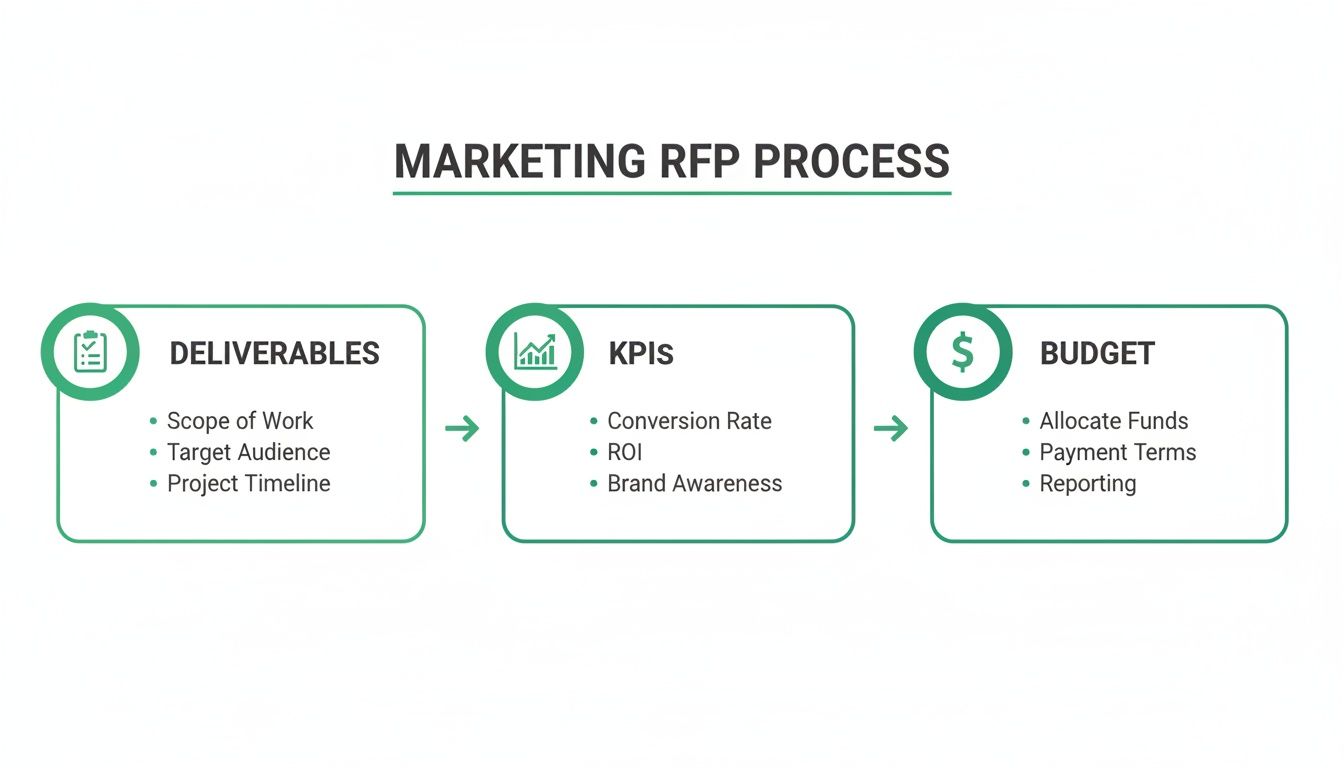
As the visual highlights, clear deliverables, KPIs, and budget ranges are the foundation for a good decision. Armed with a scoring matrix, you have a defensible system to confidently choose the right partner.
For more detailed advice on this stage, check out our guide on how to choose a digital marketing agency.
Common RFP Mistakes That Repel Top Agencies
I’ve seen hundreds, if not thousands, of RFPs over the years. After a while, you start to see the same patterns—the same well-intentioned mistakes that end up sabotaging the entire search for a great agency partner.
This isn’t about pointing fingers. It’s a friendly warning to help you run a process that attracts, not repels, your future A-team.
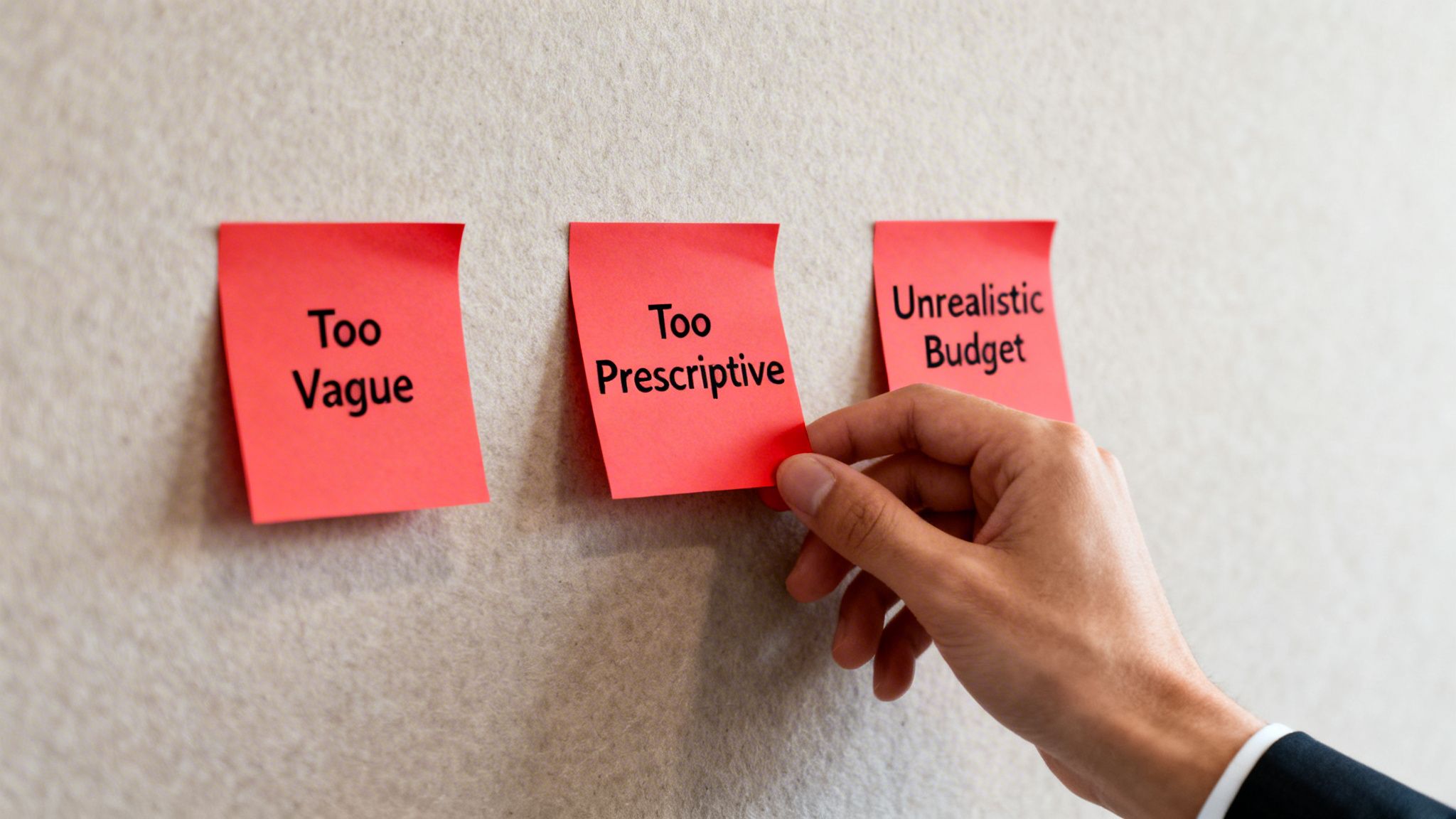
The best agencies are busy. They have choices. A poorly constructed marketing request for proposal is their first clue that an engagement might be more trouble than it’s worth. Here are the biggest blunders to avoid.
The Danger of Being Too Vague
This is mistake number one, hands down. A vague RFP is an open invitation for vague, copy-pasted proposals. When you write goals like “increase brand awareness” or list a scope of “do our social media,” you give agencies nothing real to work with.
You’re essentially asking them to read your mind. They can’t. So, they’ll respond with a generic pitch that lists their services without connecting them to your actual business problems. You’ll be left feeling frustrated when none of the proposals feel right.
The Trap of Being Too Prescriptive
And then you have the flip side—being so overly prescriptive that you crush the very expertise you claim you want to hire. This happens when a company dictates every single tactic and tool down to the last detail. The RFP reads more like a task list than a request for a partner.
- “You will post on Facebook 3 times a day and on Instagram 5 times a week.”
- “You must use [Specific Software Tool] for all project management.”
- “You will write exactly two 1,200-word blog posts and one 800-word post each month.”
When you hire a top-tier agency, you’re paying for their strategic thinking, not just their hands to execute your pre-made plan. An RFP that’s a rigid to-do list tells them you don’t actually value their expertise, and the best strategists will simply walk away.
Setting Unrealistic Expectations
This one’s a classic and usually shows up in two forms: impossible timelines and shoestring budgets.
Unrealistic Timelines:
A rushed RFP process is a major red flag for any good agency. Asking for a complex, strategic proposal back in just three days tells an agency you don’t respect their time or the thought that goes into building a real plan. Good strategy takes time.
Unrealistic Budgets:
This is even more common. Stating a goal like “double our revenue” while offering a budget that can barely cover a part-time intern is an immediate dealbreaker. It signals a fundamental disconnect from the investment required to achieve real results. A lowball budget is a magnet for low-quality, desperate agencies. The ones you actually want to work with will politely decline.
Creating an Overly Complex Process
Finally, don’t make agencies jump through a dozen flaming hoops just to submit a proposal. I’ve seen RFPs that demand custom video introductions, require responses in a proprietary software portal that keeps crashing, or include 50+ open-ended essay questions.
Remember, agencies are evaluating you just as much as you are evaluating them. The best ones are looking for organized, respectful partners. If your process is a convoluted mess from the start, they’ll assume working with you will be, too. Keep it simple and focused on what truly matters: their strategy, their experience, and their plan to help you grow.
Your Questions About Marketing RFPs Answered
Even with a solid template, a few questions always come up during the marketing RFP process. It’s a common part of vetting a new partner.
To wrap up, I’ve answered the three most frequent questions I get from businesses about to send out their RFP. These are the straightforward answers you need to finalize your document and move forward.
How Long Should My Marketing RFP Be?
Clarity beats length. Every time.
Your goal is a document that’s thorough but not exhausting, usually landing around 10-20 pages. You have to provide enough detail for a top-tier agency to build a real strategy—that means including your company background, clear goals, scope, budget, and timeline.
A well-organized, scannable RFP is far more effective than a rambling one. Give them the “what” and the “why,” and let the best agencies show you the “how.”
A concise, clear RFP signals respect for the agency’s time. A 50-page epic often signals disorganization, which can scare away the very partners you want to attract.
How Many Agencies Should I Send My RFP To?
This is a critical step. The sweet spot is sending your marketing RFP to between 3 and 5 agencies.
Sending to fewer means you won’t have enough options for a true comparison. Sending to more—say, 10 or more—creates a mountain of work for your team and signals to agencies that their odds of winning are slim. This is known as a “cattle call,” and the best agencies will often decline to participate.
Do your homework first. Before sending anything:
- Pre-qualify agencies based on their published case studies and results.
- Check their industry focus to confirm they have relevant experience.
- Look into their reputation through reviews and client testimonials.
This upfront research ensures every proposal you review comes from a serious contender. It’s about quality over quantity.
Should I Really Include a Specific Budget?
Yes. Absolutely. Hiding your budget is one of the biggest mistakes you can make.
I know it feels counterintuitive, like you’re giving away negotiating power. But in reality, it forces agencies to guess. This leads to proposals that are wildly out of sync with what you can actually spend, wasting everyone’s time.
You don’t need a single, exact number. A realistic range is perfect and shows you’re a serious buyer.
Example Budget Statements:
- “Our project budget is in the range of $75,000 – $95,000.”
- “We are seeking a monthly retainer between $5,000 and $8,000.”
- “Please provide tiered options at the $60k, $90k, and $120k annual levels.”
Being transparent allows agencies to propose a practical scope of work that fits your investment. It starts the relationship with honesty—which is exactly what you want in a partner.
A great marketing RFP isn’t a test; it’s an invitation to build a relationship that can genuinely grow your business.
Ready to stop guessing and start growing? At Mr. Green Marketing, LLC, we skip the fluff and build data-driven strategies that deliver measurable results. Request your free audit and performance report today to see exactly where you stand and how we can help you stand out.
Leave a Comment
sing in to post your comment or sign-up if you dont have any account.