
A familiar scene: you need a video for your website or ads, three vendors send quotes, and the cheapest one promises a polished film with everything included. But “everything” could mean a single edited file, while your marketing team needs captions, vertical cuts, usage rights, and a way to tell whether the video helped generate business. The price alone can't tell you if you're comparing like with like.
A beautiful video can still be an expensive distraction. Production quality matters, but distribution, measurement, and speed determine whether the work supports a business goal. Before you hire, decide what job the video needs to do, what deliverables you'll use, and how you'll judge its results.
Table of Contents
- What This Guide Will Help You Decide
- What a Video Production Service Actually Delivers
- Video Types and Where Each One Belongs
- How Pricing Actually Works and What Drives It Up
- Proving ROI Without Guessing
- How to Evaluate a Video Production Vendor
- Putting It All Together and Your Next 30 Days
What This Guide Will Help You Decide
A low quote isn't automatically a bargain, and an expensive quote isn't automatically a safer choice. The difference is usually scope. One vendor may include planning, a crew, editing, captions, and platform-ready versions. Another may quote for a shoot and one cut, then charge extra for every change or format.
Start with the business problem, not the camera. Are potential customers unsure what you sell? Do they need to see a product in use? Are prospects hesitating because they don't trust the claims? Each calls for a different video, distribution plan, and measurement approach.
The practical test: Before approving a shoot, finish this sentence: “This video should help [audience] do [next action], and we'll evaluate it using [metric].”
This guide helps you work through the decisions in order:
- Choose the format: Match a brand film, product demo, testimonial, short-form ad, or training video to the audience's stage in the buying journey.
- Understand the quote: Identify what's included in pre-production, the shoot, post-production, accessibility, and final delivery.
- Compare vendors: Look past polished reels and check their process, rights terms, revision limits, and measurement thinking.
- Set expectations for results: Decide which signals matter, what tracking needs to be in place, and what platform analytics can't prove on their own.
And if you already have a video that looks good but isn't doing much, start with its distribution and tracking before ordering another one. The camera may not be the problem.
What a Video Production Service Actually Delivers
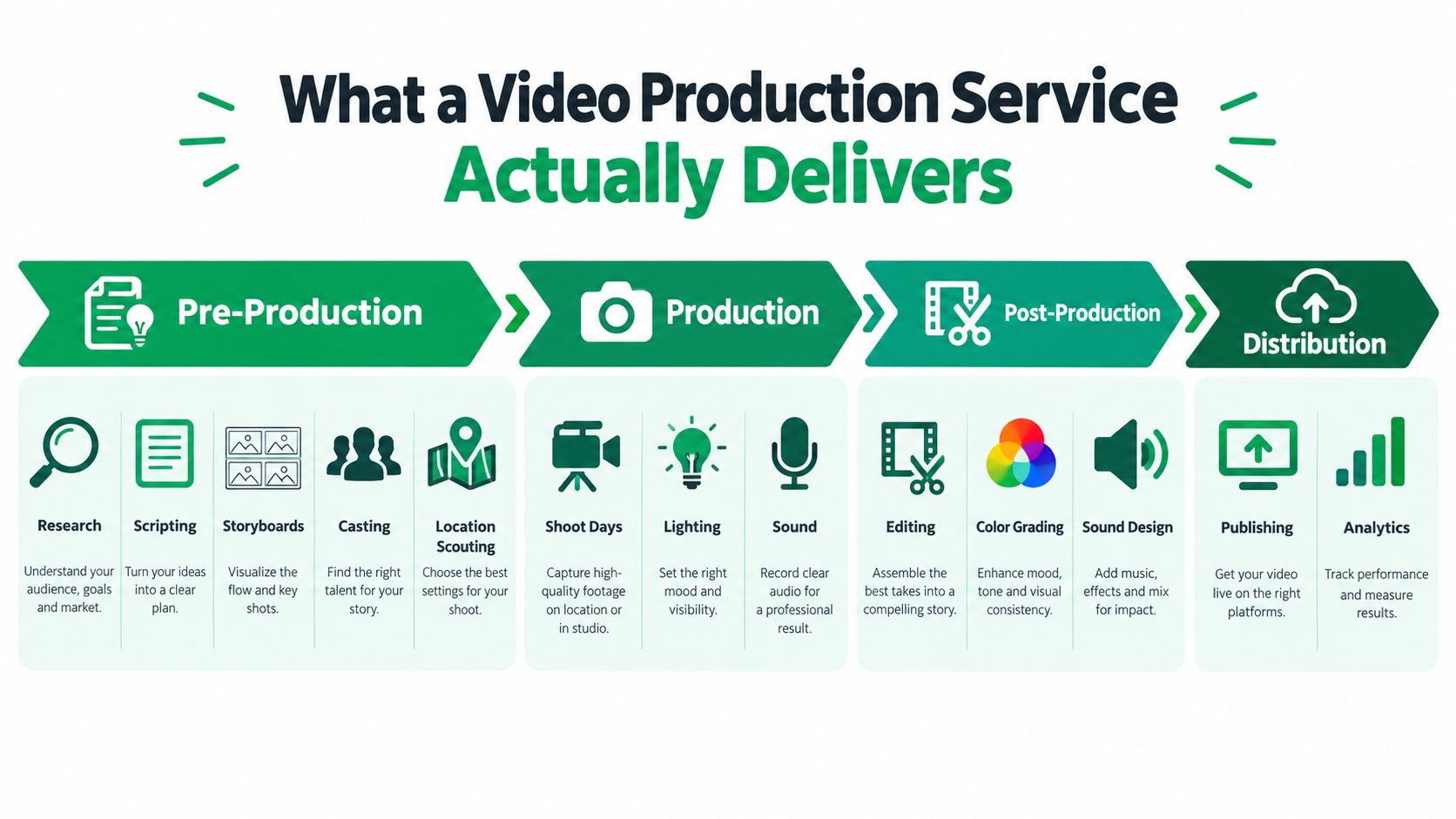
Professional video production services should take a project from a business brief to usable, organized files. That pipeline has distinct stages, and each one creates work you should see in the scope of work.
Pre-production decides what the shoot is for
The team reviews your audience, offer, and distribution plan, then develops the concept and script. Depending on the project, it can also include storyboards, casting, location scouting, shot lists, interview questions, and a production schedule. If the script needs work, use a specific example to align your team before filming, such as this ad script example.
Treat this stage as more than paperwork. Clear decisions in advance reduce avoidable shoot-day changes and give the editor a purposeful structure to follow.
Production captures the planned material
On set, the director guides performance and coverage; camera operators frame and capture shots; lighting and sound specialists help make the footage usable. A reliable crew doesn't just record what's in front of them. They also gather alternate takes and supporting footage the edit may need.
That work involves specialized labor. In May 2023, U.S. camera operators for television, video, and film had a mean annual wage of $71,890, while film and video editors earned a mean of $83,470, according to Bureau of Labor Statistics occupational data. A production budget pays for skilled people, preparation, and finishing, not just equipment time.
Post-production and delivery make the footage usable
Editing shapes the story; color work and sound mixing make the final cut cohesive. Motion graphics, music licensing, captions, transcripts, and format variations may also belong here. Ask how many review rounds are included and who supplies consolidated feedback.
The final delivery shouldn't be an unexplained folder with one file. Request named exports for the platforms you use, caption files or captioned versions, a transcript where appropriate, and a high-quality master for archiving. Clarify whether you'll receive source files and which usage rights apply.
Video Types and Where Each One Belongs
Don't ask a vendor for “a video.” Ask for a format that fits a buying problem. A landing-page demo and a short paid-social ad might feature the same product, but they need different pacing, framing, and calls to action.
The cost bands below are relative, not price quotes. A simple interview-based testimonial may take less production work than an animated explainer, while a heavily directed brand film may require more planning, crew, and post-production than either. Complexity, locations, talent, motion graphics, and the number of versions all affect the estimate.
| Video Type | Funnel Stage | Typical Length | Cost Band | Primary Use |
|---|---|---|---|---|
| Brand film | Awareness | Around one to two minutes | Medium to high | Website, campaign landing pages, presentations |
| Product demo | Consideration | Around one to two minutes | Medium | Product pages, Amazon listings, email |
| Explainer animation | Awareness to consideration | Around one to two minutes | Medium to high | Landing pages, sales follow-up, onboarding |
| Customer testimonial | Consideration | Around one minute | Low to medium | Case-study pages, paid campaigns, sales emails |
| Social short | Awareness | Around 15 to 30 seconds | Low per cut, more for a new shoot | Organic social, vertical paid ads |
| Direct-response ad | Conversion | Around 15 to 60 seconds | Low to high, depending on production | Paid social, product pages, retargeting |
| Training or internal video | Retention and enablement | As long as the instruction needs | Low to medium | Staff training, onboarding, internal knowledge bases |
A brand film introduces your business and its point of view. It's useful when unfamiliar audiences need context, but it's a weak substitute for a product page that needs to answer practical buying questions.
A product demo shows the product working. For an e-commerce seller, it can clarify features and use cases; for a local service provider, it might show the process customers can expect. A testimonial adds another person's experience, but the interview should focus on a specific problem and decision, not generic praise.
Short ads should lead quickly with the customer problem, product, and next step. Explainer videos help when the offer is difficult to understand, while training videos should prioritize clarity and navigation over cinematic polish. For a video podcast, plan clips and distribution before recording, not as an afterthought. This guide to starting a video podcast channel can help you think through that format.
One anchor video with useful cutdowns usually gives a small team more to distribute than several unrelated shoots.
How Pricing Actually Works and What Drives It Up
Video production pricing usually comes in three forms, and each suits a different buying pattern.
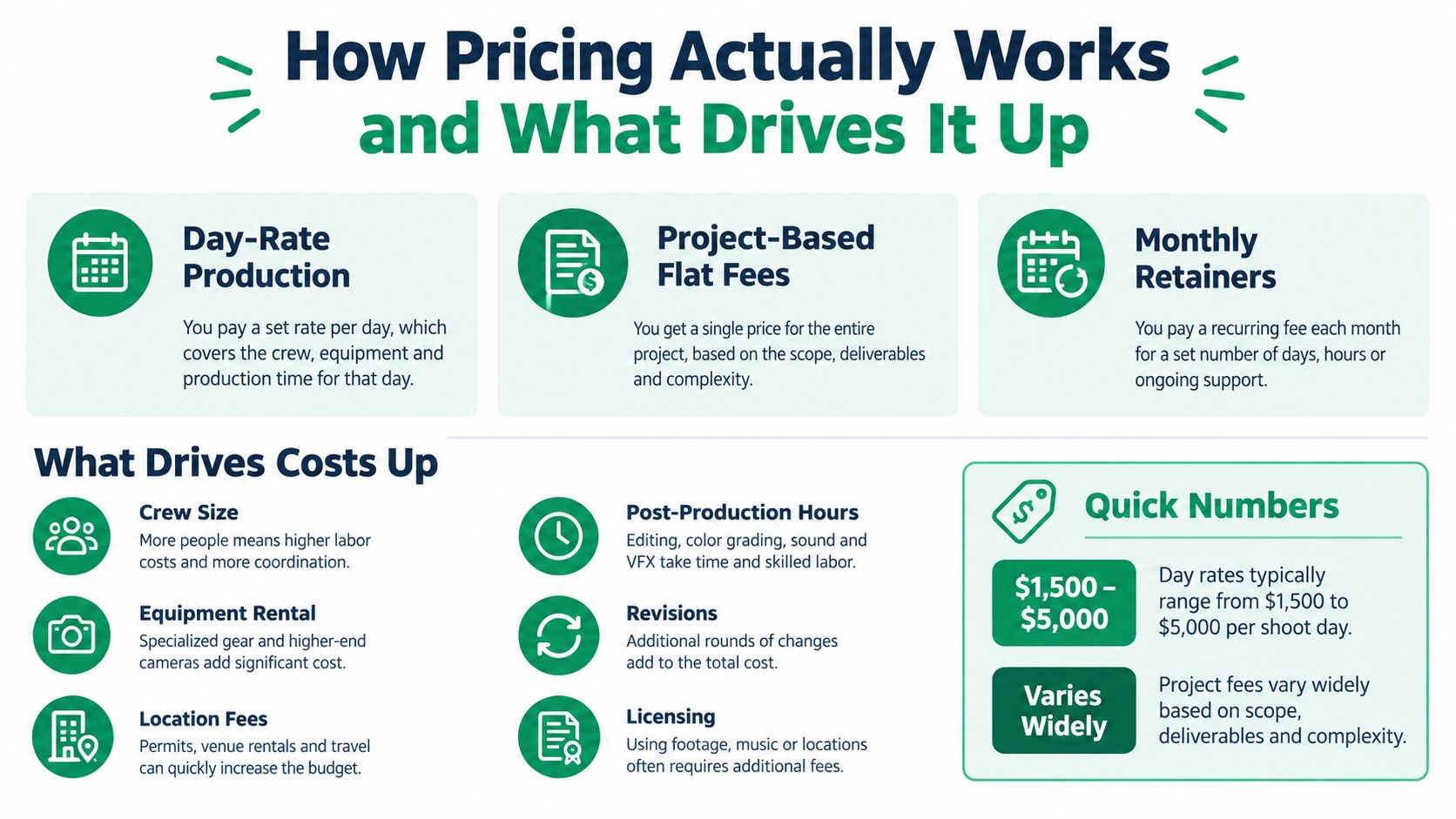
A day rate covers a defined crew or production service for a shoot day, but it may not include scripting, editing, talent, travel, or licensing. A project fee bundles agreed work into a set scope, which makes comparison easier only if the deliverables and revision limits are equally clear. A monthly retainer supports repeat production and ongoing versions, but it needs a planned workload and approval process. Otherwise, you can pay for capacity your team doesn't use.
Read the line items, not just the total
Ask whether the quote includes:
- Planning: Research, scripting, storyboards, casting, and location coordination.
- Production: Crew size, shoot days, equipment, travel, location fees, and talent.
- Post-production: Editing, color, sound mix, animation, music or stock licensing, and revision rounds.
- Delivery: Captions, transcripts, platform-specific exports, and master files.
International feature-film production provides useful historical context for why this is a mature, specialized field, not a local craft. UNESCO reported that production worldwide grew 64% between 2005 and 2013, with 7,478 feature films produced by companies in 88 countries in 2012, according to its analysis of film statistics. Those figures concern feature films, not the entire commercial-video market, but they underscore the breadth of production expertise available.
Cut waste, not the parts that make the video work. A sharper brief, fewer locations, planned interviews, and a modular shot list can reduce production complexity. Cutting sound checks, useful captions, or essential editing usually creates visible problems or leaves you with assets you can't confidently publish.
Build a budget from the job
There isn't a responsible universal price for a video. Instead, budget by funnel need: an awareness piece may require stronger creative development and broad cutdowns; a consideration asset may need a clear demo or customer interview; conversion content should answer objections and guide the next action. Ask vendors to price each deliverable and explain what changes the cost, then compare scopes rather than headline totals.
Proving ROI Without Guessing
Video ROI isn't unknowable. It becomes hard to assess when teams publish without a defined goal, rely on views as the main success measure, or fail to connect campaign data to leads and sales.
Recent video-marketing research found that just 28.2% of surveyed teams were very confident they could prove video ROI, while 42.2% had no clear KPIs. Fragmented data was the leading measurement barrier for 47.1%. The same video-marketing research reported that teams publishing within 24 hours were nearly five times more likely to report confidence in ROI than teams taking over a week.

Speed isn't a substitute for strategy. It does make it easier to test an idea, learn from the response, and adjust while the campaign is still active.
Match the metric to the video's job
Choose one primary KPI and a small set of supporting measures before production. For awareness, track qualified reach or completed views alongside what happens after exposure. For consideration, examine product-page visits, demo requests, or assisted conversions. For conversion, connect the campaign to form submissions, calls, purchases, or revenue where your systems allow.
Then prepare the tracking:
- Use campaign-specific links: Agree on consistent UTM naming so traffic from each placement can be identified.
- Instrument the destination: Confirm that forms, calls, checkout events, or landing-page actions are recorded.
- Connect lead data: Where your CRM supports it, preserve the original source and campaign details through the sales process.
- Set a baseline: Compare performance with a relevant prior period or an equivalent campaign before expanding spend.
Platform dashboards can show activity on their own networks, but they don't automatically capture every assisted sale or account for all cross-platform exposure. Agree on what each report can and cannot attribute. A reporting cadence that records the metric definitions, campaign dates, and data sources will remain useful even if the person running the campaign changes. For a structured method, use this guide to calculate marketing ROI.
How to Evaluate a Video Production Vendor
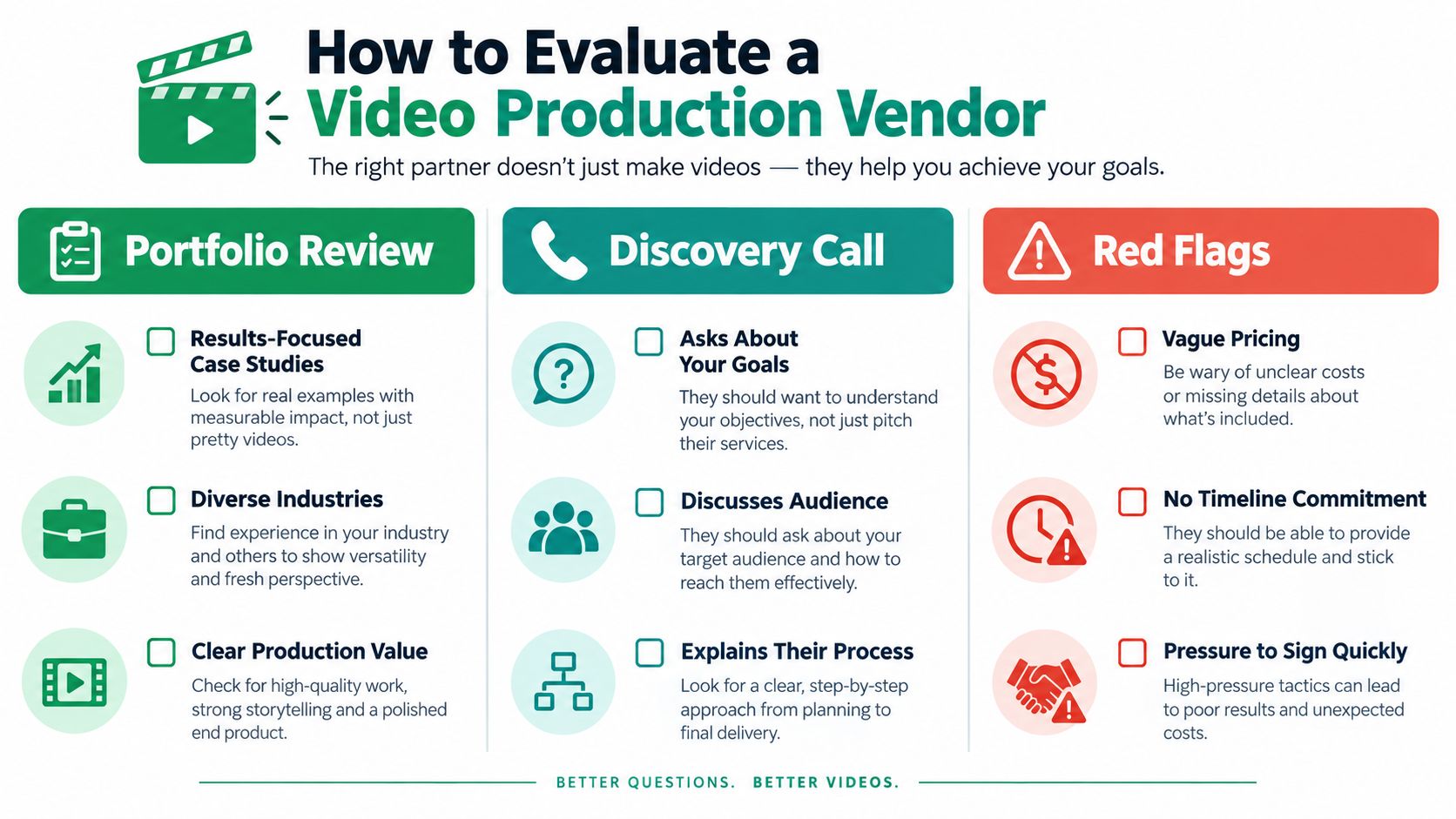
A good vendor asks what the video needs to accomplish before recommending a camera setup. Use the evaluation call to see whether they can connect the creative work to your audience, distribution, and reporting needs.
Look beyond the reel
A polished montage shows craft, but not whether the vendor can solve your problem. Ask to see work that resembles your format and audience. Then ask what the client needed, what the vendor delivered, and how the video was used. If the vendor can't discuss goals or distribution, the portfolio doesn't answer the questions you need answered.
On the discovery call, notice what they ask you. A serious partner should explore your audience, offer, business goal, distribution channels, and measurement plan. They should also explain the production process plainly, including who approves scripts, how feedback is consolidated, and who manages revisions.
Put the full scope in writing
Before signing, confirm:
- Deliverables and formats: Name every cut, aspect ratio, caption file, transcript, and platform-specific export.
- Rights and files: State usage rights, licensing restrictions, and whether source files are included.
- Revisions and approvals: Define what counts as a revision, how many rounds are included, and who signs off.
- Accessibility: Clarify who creates and checks captions, and whether audio description is needed for important visuals.
Accessibility belongs in the production scope. WCAG Success Criterion 1.2.2 requires captions for prerecorded audio content in synchronized media, except where the video is clearly labeled as a text alternative. Guidance also points to audio description when the soundtrack doesn't communicate important visual information. Read the WCAG guidance on prerecorded captions, then ask the vendor how those needs will be handled.
A transcript doesn't replace synchronized captions. For republished television content, the FCC also has specific rules for certain full-length Internet video and clips; broadcasters should review the FCC guidance on captioning Internet video programming.
Red flags: A vague scope, no revision terms, no delivery-format list, or no discussion of measurement. Don't sign based on a reel and a verbal promise. Use a clear marketing request for proposal to compare vendors on the same requirements.
Putting It All Together and Your Next 30 Days
Treat a production decision as a small marketing investment with a defined job. Pick the funnel stage first, choose a video format that suits it, and set the tracking plan before the shoot. In the contract, name the captions, versions, rights, and exports you need. Then evaluate the work against the KPI you chose, not just whether the finished edit looks impressive.
Here's a practical way to get moving:
- Audit what you have: List existing videos, where they're published, what formats are available, and whether the tracking still works.
- Write one brief: State the audience, buying problem, message, call to action, destination, and primary KPI.
- Shortlist vendors: Compare a small group using the scope and accessibility checklist above. Ask each to price the same deliverables.
- Book discovery calls: Look for questions about your customers and distribution, not just shoot logistics.
- Prepare for launch: Confirm campaign links, destination tracking, captions, and approval ownership before production begins.
During the first four weeks after launch, keep a consistent record of distribution and results. That gives you a reasoned basis for deciding whether to change the creative, adjust placement, or commission another asset. A useful content distribution strategy makes the production investment work beyond the upload day.
The honest advice: video works best as a revenue asset, not a creative expense. If a video has no clear audience, distribution plan, or measurement approach, fix the brief before you book the shoot.
Mr. Green Marketing, LLC offers strategy-led video production alongside web, SEO, PPC, and Amazon marketing, with work spanning product videos, explainers, testimonials, training, and promotional content. If you want help shaping a brief around your business goals and distribution needs, request a free audit and performance report from Mr. Green Marketing, LLC.
Leave a Comment
sing in to post your comment or sign-up if you dont have any account.