
Ad Script Example: Tired of ads that don’t convert? Start here.
And you’re staring at a blank page again. Trying to write an ad script that grabs attention and gets people to click. The headline feels flat, the hook feels recycled, and every draft starts sounding like every other ad in your market.
It doesn’t have to stay that way.
A strong ad script isn’t magic. It’s structure, sequencing, and knowing what your buyer needs to hear next. The best-performing ads usually aren’t the prettiest or the most clever. They’re the ones that match message to intent, channel, and timing.
That’s the point of every good ad script example. Not to copy it word for word, but to see the mechanics underneath.
Below are 7 practical templates you can adapt across search, Amazon, social, video, email, display, and LinkedIn. Some are short. Some need more setup. Some are built to capture demand that’s already there, while others need to create it from scratch. Different jobs, different scripts. That’s where most campaigns go wrong.
1. Ad Script Example: Google Search Ads PPC Script Format
A buyer searches “emergency plumber near me” at 10:14 p.m. They do not want brand storytelling. They want proof you solve the exact problem, in the exact place, without wasting their time.
That is the job of Google Search ad copy.
Search ads work best when the message tracks tightly with intent. The closer your headline matches the query and the landing page, the easier the click feels. This holds whether you’re selling legal help, HVAC repair, CRM software, or a subscription coffee brand.

A workable template
Use this format for high-intent searches where the buyer already knows the category and is comparing options:
Headline 1: [Primary keyword]
Headline 2: [Main benefit or offer]
Headline 3: [Trust cue, urgency, or location]
Description: Get [solution] for [problem]. See [specific outcome, speed, or convenience]. [CTA].
Here is the same script in two very different markets.
A local service version:
- Headline 1: Pensacola Water Heater Repair
- Headline 2: Fast Scheduling. Trusted Local Team
- Headline 3: Book Service Today
- Description: Get help with a failing water heater before it turns into a bigger repair. Clear communication, prompt service, and options that fit your home.
A SaaS version:
- Headline 1: CRM for Small Sales Teams
- Headline 2: Track Leads Without the Clutter
- Headline 3: Start Your Free Demo
- Description: Manage contacts, follow-ups, and pipeline activity in one place. Built for teams that need speed and visibility.
The structure stays the same. The pressure point changes. Local services need speed and trust. SaaS often needs clarity, usability, and a low-friction next step.
Practical rule: Your search ad should feel like the first line of the landing page, not a separate idea.
Ad Script Examples: Why this format works
Google Search is usually demand capture, not demand creation. The buyer has already framed the problem. Good PPC scripts reflect that framing instead of trying to introduce a new angle too early.
That is why broad, feature-heavy copy underperforms so often. A headline that tries to say everything usually says nothing clearly. In practice, the strongest ads make one promise, support it with one trust cue, then ask for one action.
Responsive search ads give you room to test combinations. They do not remove the need for message discipline. If you load them with mismatched headlines, Google can assemble combinations that are technically valid and strategically weak.
What to adjust before you blame the bid
Poor search performance often starts upstream from budget.
Check the query-to-ad match. Check whether the landing page repeats the same offer and language. Check whether one ad group is mixing informational searches with ready-to-buy terms. I have seen expensive campaigns improve with no bid change at all, just tighter grouping and copy that matches what the searcher expected to see.
Keep the script narrow. One intent. One promise. One next step.
That is the primary benefit of a strong Google Search ad script example. It shows you what to write, why the sequence works, and how to adapt it without losing intent match.
2. Ad Script Example: Amazon Sponsored Products Ad Script
Amazon ad copy is less about poetic persuasion and more about controlled relevance. You’re not just writing for shoppers. You’re writing for the product title, image stack, review profile, price context, and competing listings sitting inches away.
That changes the script.
The Amazon-ready framework
For Amazon Sponsored Products, think in this sequence:
Product title signal
Core use case
Differentiator
Objection reducer
A simple ad script example for a kitchen brand might look like this in practice:
Title angle: Stainless Steel Milk Frother
Message angle: Make café-style foam at home in seconds
Differentiator: Easy-clean design with compact storage
Objection reducer: Built for daily use and small kitchens
For supplements, the same framework tightens further:
Title angle: Daily Electrolyte Powder
Message angle: Simple hydration support for workouts or busy days
Differentiator: Travel-friendly packets
Objection reducer: Easy to mix, easy to keep on hand
Ad Script Example: Where sellers usually lose the click
Most Amazon advertisers blame bids first. Sometimes that’s right. Often it isn’t.
If the listing title is muddy, the main image is weak, or the bullets bury the best reason to buy, the ad script can’t save it. Sponsored Products amplify your listing. They don’t replace it. That’s why the strongest Amazon campaigns usually pair keyword management with listing cleanup, review monitoring, and ongoing negative keyword pruning.
In large PPC markets, scripts and automation have become standard operating procedure. Verified background from the Google Ads script reference notes that in major markets such as the US and UK, PPC spend was projected to exceed $50 billion in 2025, with scripts and connected data sources playing a foundational role in campaign management through tools like Google Sheets and automated reporting. That matters on Amazon too, because disciplined advertisers win with systems, not one-off edits.
On Amazon, the ad gets the impression. The listing gets the sale.
If you’re protecting branded searches, script more defensively. If you’re launching a private-label product, script more directly around the use case and comparison behavior. “Best value” shoppers need reassurance. Repeat buyers need speed. Different click psychology.
3. Ad Script Example: Social Media Ad Script Facebook and Instagram Format
Social scripts have to stop the scroll first. Everything else comes after that.
And many brands become too polished. They write like a brand manager approved every syllable, then wonder why nobody reacts. Social ads usually work better when they feel native to the feed, even when the targeting and offer are highly structured.

A short-form social template
A practical ad script example for Meta looks like this:
Hook: Call out the pain, desire, or missed outcome
Bridge: Show the product or offer as the fix
Proof: Add one believable reason to trust it
CTA: Tell them exactly what to do next
Example for an e-commerce skincare brand:
Hook: Still layering products that don’t simplify your routine?
Bridge: Our daily serum was made for people who want one step that feels manageable.
Proof: Lightweight texture, easy daytime wear, and no complicated routine required.
CTA: Shop the formula and see if it fits your routine.
Example for a franchise location:
Hook: Need a cleaner home before the weekend gets away from you?
Bridge: Our local team handles the deep clean so you don’t spend Saturday catching up.
Proof: Easy scheduling and service built around your area.
CTA: Book your local appointment today.
Why this format keeps winning
Hook-driven creative became the dominant social format after 2018 alongside TikTok’s rise, and attention on social video was cited at an average of 1.7 seconds per video by 2020 in the verified data tied to Proom’s ad script examples. That’s why the opening line matters so much. You don’t earn attention on social. You interrupt for it.
A few tactical notes help:
- Lead with the problem: Buyers react faster to a familiar frustration than to a brand introduction.
- Keep proof concrete: Show the product, interface, result, or use case. Vague praise dies fast in-feed.
- Write for silent viewing: On-screen text supports comprehension on sound-off placements.
What doesn’t work. Long setup. Generic lifestyle language. “We’re passionate about quality” copy that could belong to any competitor in your category.
4. Ad Script Example: Video Ad Script YouTube and Connected TV Format
Video gives you room to build tension, but only if you don’t waste the opening seconds.
For YouTube especially, the first lines need to do heavy lifting. If the script meanders before the viewer understands the payoff, they’ll skip, tune out, or remember nothing except that your ad interrupted what they meant to watch.
Here’s a helpful visual reference before the template:
A 30-second video structure that travels well
Use this sequence:
0 to 3 seconds
Hook with tension, surprise, or a direct problem
4 to 12 seconds
Name the issue and show the solution entering frame
13 to 24 seconds
Demonstrate, explain, or validate
25 to 30 seconds
Close with a direct CTA
That hook-problem-demo-CTA structure is widely used in short-form social and video creative. In the verified material connected to social ad scripting, a 30-second framework built around those beats was described as a strong fit for TikTok, Instagram Reels, and YouTube Shorts.
A home services example:
Hook: Your AC always seems to quit when you need it most.
Problem and solution: Our team diagnoses the issue fast and gives you clear repair options.
Demo/proof: Show technician arrival, inspection, and homeowner relief.
CTA: Schedule service today.
If the viewer can’t tell what you’re selling within the opening beat, the script is already slipping.
What to keep, what to cut
Use captions. Use visible product or service action. Use a CTA that sounds like the next step a real person would take.
Don’t over-narrate footage that already explains itself. Don’t cram a manifesto into a bumper-length spot. And don’t rely on “brand vibes” alone if the campaign is meant to drive conversion.
The strongest short-form scripts usually pair a readable verbal hook with clean on-screen text. In the AIDA-based ad analysis verified data, short-form video retained attention best when the opening visual triggered immediate interest and when mobile-friendly text overlays supported comprehension. That’s a practical production note, not just a copy note. Script and edit have to cooperate.
5. Ad Script Example: Email Marketing Script Newsletter Format
Email is where you can afford a little more nuance. Not endless nuance. Just more than a search ad or a social hook.
The trap is writing email like a miniature blog post. Most promotional emails work better when they act like a guided next step. One reader, one problem, one action.
A simple email script that stays focused
Use this structure:
Subject line: Clear reason to open
Preview text: Reinforce the benefit or urgency
Body opening: Connect to the current need
Middle: Explain the offer or update plainly
CTA: One primary action
A practical ad script example for abandoned cart email:
Subject line: Still thinking it over?
Preview text: Your saved items are waiting.
Opening: You were close. If you’re still deciding, here’s an easy way to get back to your cart.
Middle: Review your items, check details again, and finish when you’re ready.
CTA: Return to your cart
For a SaaS onboarding sequence:
Subject line: Start with the feature you’ll use first
Preview text: A fast way to get value from your trial
Opening: Most new users don’t need every feature on day one.
Middle: Start with the dashboard, connect one data source, and invite one teammate. That’s enough to get momentum.
CTA: Set up your workspace
Trade-offs that matter in email
Email gives you segmentation power, but it also punishes clutter. If you add three offers, two side notes, and a soft CTA plus a hard CTA, you’ve made the reader do sorting work.
A few practical rules help:
- Match lifecycle stage: New lead emails should orient. Existing customer emails can move faster.
- Keep the CTA singular: If the goal is demo bookings, don’t split attention with a secondary download.
- Write like a person: Email copy that sounds spoken usually reads faster and earns more trust.
I also like using the body opening to acknowledge hesitation. Not aggressively. Just enough to show you understand the buyer’s moment. That tends to outperform polished-but-empty enthusiasm.
6. Ad Script Example: Display Banner Ad Script Programmatic Format
A buyer sees your banner for maybe a second. Sometimes less. If the message is vague, the impression is wasted before the page even finishes loading.
Banner scripts work under tighter constraints than almost any other ad format. You are writing for the headline, the supporting line, the button, the image, and the landing page all at once. Good display copy does not just sound sharp in isolation. It survives the actual environment it runs in: small placements, fast scrolling, mixed intent, and distracted audiences.
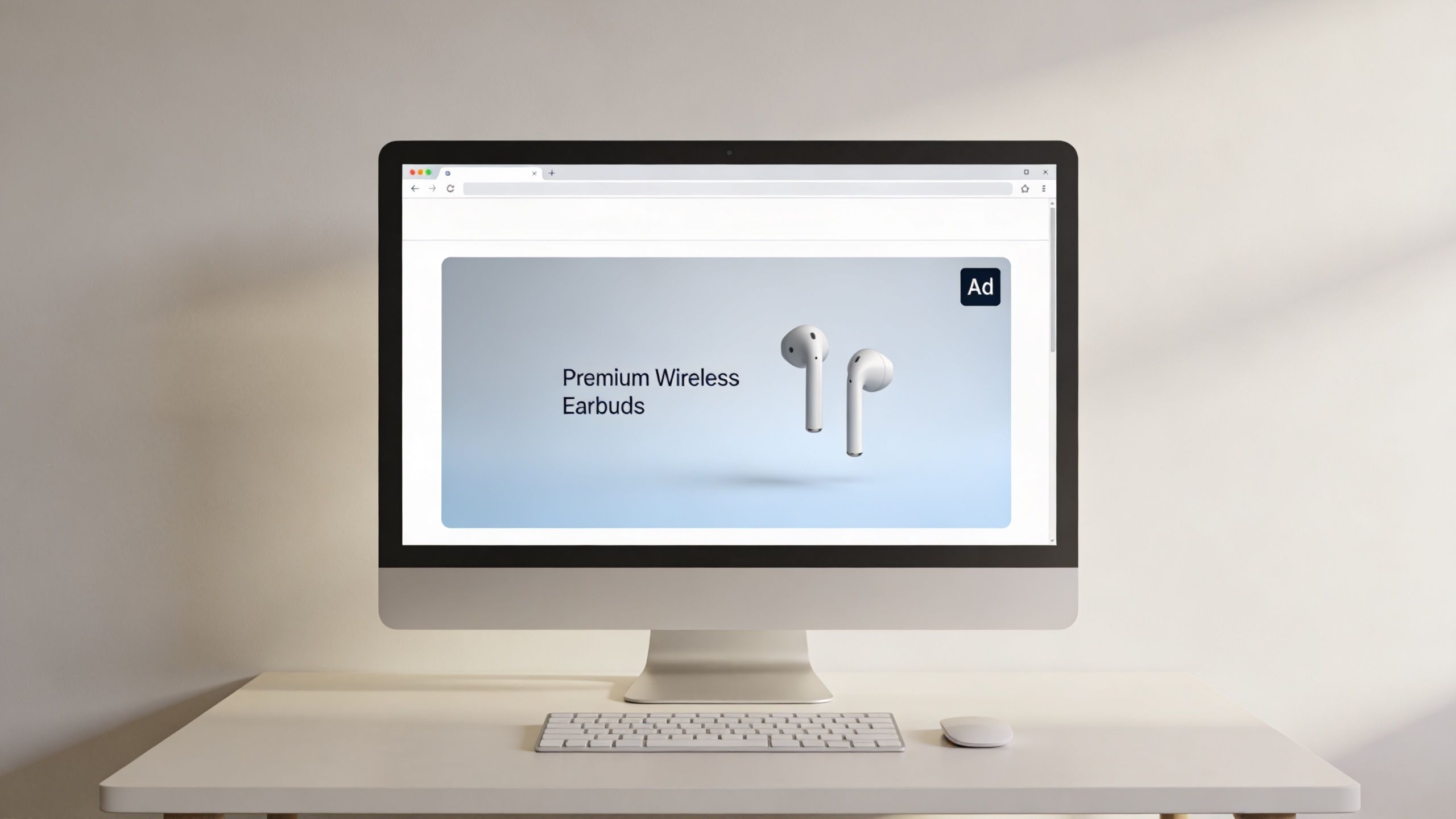
The banner formula
For programmatic display, keep the script structure tight:
Primary line: The offer, outcome, or product category
Support line: The reason this matters now
CTA button: One clear next step
That format works because each line does a separate job. The primary line gets recognition. The support line adds context. The CTA tells the user what happens after the click. If two lines try to do the same job, banner performance usually slips.
Example for retargeting abandoned product traffic:
Primary line: Better sleep starts here
Support line: Revisit the mattress you viewed and compare options
CTA: View Product
Example for SaaS awareness:
Primary line: Reporting without spreadsheet chaos
Support line: Give your team one dashboard for weekly updates
CTA: Learn More
Why some banner scripts fail
Display copy often breaks down for one simple reason. The script says something broad while the placement demands something concrete.
A line like “Innovate your workflow” asks the viewer to do interpretation work. A line like “Book local lawn care in minutes” gives them the offer, the use case, and the speed in one pass. That difference matters more in display than in search because the audience did not ask for you. You interrupted them. Your copy has to earn the next second.
The other common miss is message-to-landing mismatch. Upper-funnel banner traffic rarely responds well to a hard-sell page with too much detail, too many fields, or pricing shown before context. Programmatic campaigns perform better when the script matches the user’s awareness level. Curiosity clicks need an easy first step. Retargeting clicks can handle more product detail.
One practical rule I use. If a banner cannot be understood without the brand logo, the image, or prior knowledge of the offer, the script is still too weak.
The best banner script is usually the clearest one.
For franchises and local service brands, location-aware copy often helps. Keep it plain and useful: city name, service type, and one direct action.
Primary line: HVAC repair in Columbus
Support line: Book a local technician without the phone tag
CTA: Schedule Service
That is the larger pattern with display. The best scripts are not the cleverest. They are the easiest to process, the easiest to match to intent, and the easiest to adapt across objectives, from prospecting to retargeting.
7. Ad Script Example: LinkedIn Sponsored Content Text Ad Script
LinkedIn scripts need a different tone. More specific, less hype. You’re speaking to someone in-role, often mid-scroll between work tasks, and they’re quick to reject anything that sounds inflated.
That doesn’t mean boring. It means earned relevance.
A B2B script template that respects the audience
Use this sequence:
Role-based opener
Business pain
Practical promise
Next step
Example for B2B SaaS:
Opener: Operations leaders still managing reporting by hand
Pain: Manual reporting slows decisions and creates version-control issues
Promise: Centralize updates and give teams one source of truth
Next step: Book a demo
Example for professional services:
Opener: Finance teams preparing for audit season
Pain: Last-minute document collection creates avoidable stress
Promise: Streamline the prep process with a clearer system
Next step: Request a consultation
Where LinkedIn copy should go deeper
This is one of the few ad environments where a slightly more substantive script can help. Industry framing, role specificity, and a stronger problem statement often improve quality because the audience expects context.
That said, don’t confuse specificity with made-up proof. If you have a genuine client result and permission to use it, great. If you don’t, stay qualitative and focus on the operational problem.
For local and franchise businesses selling into multiple markets, hyperlocal relevance can matter outside consumer channels too. Verified material on underserved franchise scripting angles included data that geo-specific approaches improved conversion for franchises in BrightLocal’s Q4 2025 study and that many SMB searches were “near me” in 2025. The big takeaway isn’t the statistic by itself. It’s the writing implication. Generalized copy misses local context that buyers care about.
So if you’re targeting regional business owners, use the region. If you’re speaking to healthcare operators, say healthcare operators. If you’re offering an audit, make the audit sound concrete, not promotional fluff.
Ad Script Examples: 7-Format Ad Script Comparison
A good ad script example depends on the channel carrying it. The same offer can work in search, stall on Meta, and need a completely different opening in email. That is the essential comparison to make. Not just production effort, but how the script has to behave to match intent, placement, and decision speed.
Use the table below as a working guide. It shows what each format asks from the script, what you need to support it, and where each one tends to perform best.
| Format | Implementation Complexity | Resource Requirements | Expected Outcomes | Ideal Use Cases | Key Advantages |
|---|---|---|---|---|---|
| Google Search Ads (PPC) | Moderate, keyword research, bidding, ongoing optimization | Moderate budget, landing pages, analytics and tracking | Immediate high-intent traffic and measurable conversions | E-commerce product launches, local services, SaaS intent capture | Targets high-intent queries, measurable ROI, flexible budgets |
| Amazon Sponsored Products | Moderate to High, marketplace expertise, inventory and listing optimization | Ad spend plus inventory, optimized product pages, imaging and reviews | Direct marketplace sales, improved product visibility, measurable ACoS | Retail sellers, private label brands, seasonal product campaigns | High purchase intent, uses reviews and ratings, real-time pricing |
| Social Media Ads (Facebook/Instagram) | Moderate, creative production and audience testing | Image and video assets, audience data, moderate ongoing spend | Brand awareness, engagement, top-funnel conversions and retargeting | DTC brands, engagement campaigns, product discovery and retargeting | Precise audience targeting, visual engagement, cost-effective awareness |
| Video Ads (YouTube/CTV) | High, video production, creative direction, placement strategy | Higher production budget, editing, platform targeting expertise | Strong brand lift, high engagement and view-through metrics | Brand storytelling, product demos, broad awareness campaigns | Emotional storytelling, high shareability, cross-platform video reach |
| Email Marketing (Newsletter) | Low to Moderate, platform setup, segmentation, testing | Low ad spend, ESP subscription, content and list management | High ROI, retention, repeat purchases, measurable opens and clicks | Abandoned cart recovery, onboarding, customer retention | Strong ROI, direct opt-in audience, highly measurable and personalizable |
| Display Banner Ads (Programmatic) | Moderate, creative production, audience data, programmatic setup | Creative files (static/HTML5), programmatic budget, targeting data | Wide reach for awareness, effective retargeting, lower CTR than search | Retargeting, top-funnel brand building, regional campaigns | Broad publisher reach, cost-effective awareness, dynamic retargeting |
| LinkedIn Sponsored Content/Text Ads | Moderate, B2B audience targeting, professional creative | Higher CPC budget, professional creatives, account and lead data | Qualified B2B leads, account engagement, thought leadership outcomes | B2B SaaS, enterprise sales, recruitment and ABM campaigns | Precise professional targeting, high-quality leads, strong ABM tools |
A few patterns matter in practice.
Search and Amazon are intent-heavy formats. The script has less room to entertain and more pressure to match what the buyer already wants. Social, video, and display work earlier in the journey, so the script has to create interest before it can convert. Email and LinkedIn sit in the middle. They often reward more context, but only if the message earns attention quickly.
Resource trade-offs matter too. A weaker offer can sometimes survive longer in search because the user already has intent. The same weak offer usually falls apart in paid social or video, where the script has to stop the scroll first. That is why copying one ad script template across channels usually underperforms. The format changes the job. So should the writing.
From Script to Scale Making Your Ads Work Harder
You launch the ad. Click-through rate looks fine. Cost per click is reasonable. Then the campaign stalls because the landing page asks for too much, the offer feels generic, or the script pulled in the wrong audience in the first place.
That is the gap between writing an ad and scaling one.
A strong template helps you get to first draft faster. Scale comes from fit. The script has to match the channel, the audience, the offer, and the next step after the click. If any one of those pieces drifts out of line, performance usually gets expensive before it gets obvious.
This is why channel-specific ad script examples matter. The wording changes, but the bigger shift is strategic. Search copy needs intent match. Amazon copy has to reduce purchase friction fast. Social has to earn attention before it can ask for action. Video needs pacing and message order. Email and LinkedIn often need more context, but only enough to move the reader to the next decision.
Testing is where the script turns into a working asset. I usually look at one failure point at a time. Weak CTR often points to the hook, headline, or audience match. Strong CTR with weak conversion usually means the promise in the ad does not carry cleanly onto the landing page. Low volume can be a reach problem, a budget problem, or a sign that the script is too narrow for the market you’re trying to reach.
Structure helps, but it is not magic. Frameworks like AIDA still show up in good campaigns because they force message order. Attention. Interest. Desire. Action. That sequence works across formats, but the way you apply it changes by channel. In a YouTube pre-roll, attention may come from the first visual and first line. In email, it starts with the subject line and preview text. In search, it often starts with whether the headline reflects the query closely enough to earn the click.
Automation has a role too, especially once volume rises. It helps with bid rules, reporting, testing cadence, and budget control, as noted earlier. It does not fix a weak offer or vague positioning. Teams get into trouble when they automate distribution before they tighten the message.
The practical workflow is simpler than it sounds. Pick one format. Write to that format’s actual job. Launch with a clear hypothesis. Then review results without defending the draft.
Keep what matches buyer intent. Cut what creates friction. Rewrite what attracts clicks from people who were never likely to convert.
If you want help turning an ad script example into a full campaign that performs, Mr. Green Marketing, LLC can help. The team builds strategy-led campaigns across PPC, Amazon, SEO, GEO, social, video, and web, then backs the work with testing and transparent reporting. If you’re not sure where the leak is, start with a free audit and performance report. It’s a practical way to spot visibility gaps, prioritize quick wins, and build from there.
Leave a Comment
sing in to post your comment or sign-up if you dont have any account.