
You ask Google or ChatGPT for a nearby plumber, clinic, accountant, or shop. The answer appears before you've opened a website. It summarizes options, mentions reviews and services, and may cite a handful of businesses. Sometimes you never click at all.
That moment changes the job of search marketing. Your business doesn't only need to rank. It needs to be understood accurately, retrieved for the right question, cited in the answer, and trusted enough to influence a local decision.
Table of Contents
- Why Your Customers Meet AI Before They Meet You
- What Geo Generative Engine Optimization Really Means
- How AI Decides Which Local Businesses to Cite
- Creating Content AI Can Easily Quote and Trust
- Local and Multi Location GEO Tactics That Work
- Measuring GEO When Clicks Disappear
- Keep Winning With Simple GEO Maintenance
Why Your Customers Meet AI Before They Meet You
A customer in Pensacola might ask, “Who offers emergency air-conditioning repair near me?” A parent might ask for a pediatric clinic with weekend appointments. A buyer might ask which local store carries a particular product today. Instead of scanning ten blue links, they receive a short recommendation assembled from websites, business profiles, reviews, and other signals.
The customer may still visit your site later. They may also call, search your name directly, or mention your business to a colleague. But the first impression can happen inside an AI-generated answer, where your company appears as a sentence rather than as a web page.
That behavior is no longer limited to people experimenting with artificial intelligence. The Reuters Institute's 2025 international survey reported that the share of respondents who had ever used a standalone generative-AI system rose from 40% in 2024 to 61% in 2025 across six countries. Weekly usage increased from 18% to 34%, while 24% said they had used generative AI to obtain information during the preceding week, up from 11% in 2024.

For a local business, this creates an uncomfortable possibility. You can earn visibility without seeing a corresponding website session. An answer engine might use your service page, business details, or third-party references to shape a recommendation, then satisfy the customer before the customer reaches your domain.
The practical shift: Stop treating visibility as a synonym for traffic. In AI search, visibility also means being the accurate source behind a decision.
Geo generative engine optimization addresses that shift. It combines the work of making content easy for generative systems to retrieve and quote with the geographic signals that make a recommendation locally useful. This guide focuses on the parts an SMB or multi-location team can control, from indexability and location-page quality to citation tracking and maintenance.
What Geo Generative Engine Optimization Really Means
Start with the two halves of the phrase.
Generative engine optimization means improving the likelihood that an AI-powered search experience can discover, understand, reuse, and cite your content. Geographic optimization means making your business relevant to a particular place, service area, branch, or market. Together, geo generative engine optimization helps an AI system answer a local question with information that is specific enough to be useful and reliable enough to repeat.
Traditional SEO often asks, “Where does this page rank?” GEO asks a wider question: “When someone asks an answer engine about this need, does the system understand our business, select our information, and represent it correctly?”
Google introduced its Search Generative Experience in 2023 and expanded the product as AI Overviews in 2024. By March 2025, Pew Research Center's analysis of browsing activity from 900 U.S. Google users found that 58% had conducted at least one search that produced an AI-generated summary alongside traditional results.
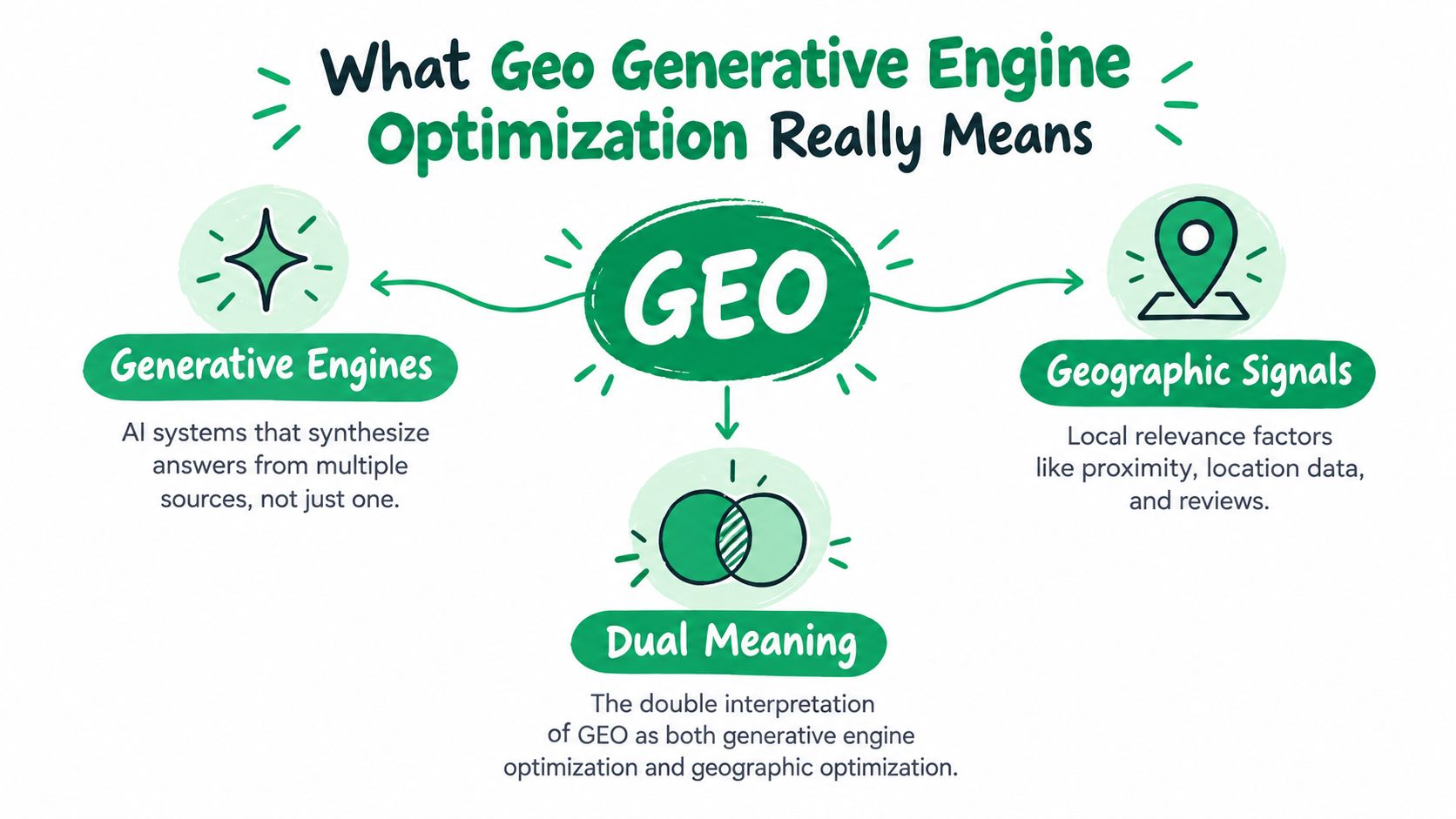
Think of an AI answer as a research assistant working from a messy folder of notes. The assistant looks for pages it can access, passages it can interpret, evidence it can verify, and local details that match the question. A vague page saying “we provide excellent service” gives the assistant little to work with. A clear page defining the service, naming the location, explaining availability, and supporting important claims gives it usable notes.
That doesn't mean a business can force a citation. It can improve the conditions for one.
A strong GEO page usually has:
- Clear definitions: Explain what the service or product is in plain language.
- Local context: State the communities served, branch details, hours, and relevant limitations.
- Extractable passages: Put direct answers under descriptive headings.
- Evidence: Support important claims with dated, verifiable information.
- Entity consistency: Use the same business name, services, locations, and contact details across important sources.
The term is still easy to confuse with ordinary SEO. A useful distinction is simple: SEO helps you earn a place in the list, while GEO helps you become usable source material inside the answer. For a deeper comparison, see what GEO SEO means.
How AI Decides Which Local Businesses to Cite
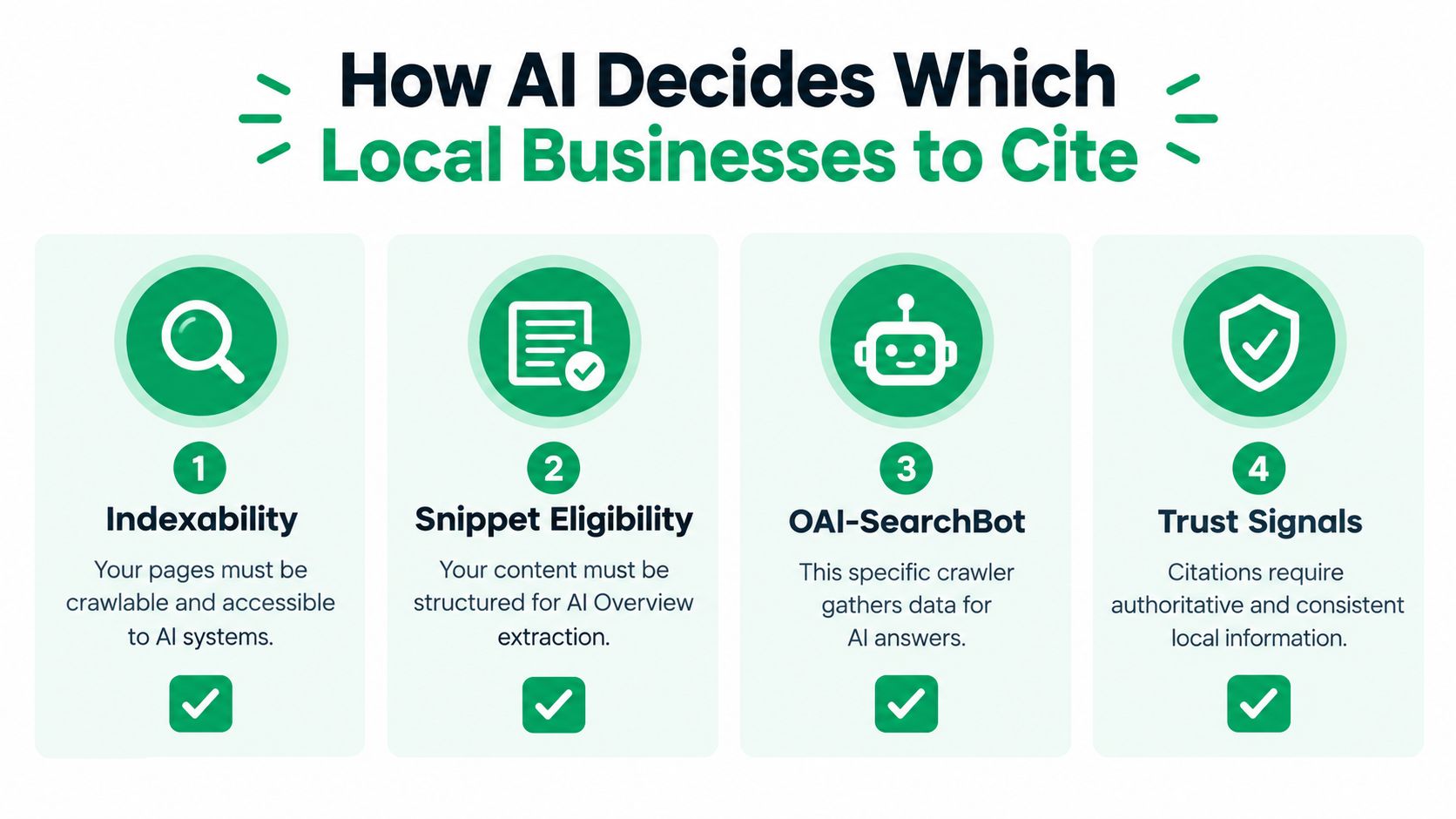
AI visibility starts with eligibility. Before a system can select your page as evidence, the page must be accessible, understandable, and available through the relevant search system. Clever wording can't rescue a page that search engines can't crawl or index.
Google's rule is concrete. According to Google's documentation for AI features, a page must already be indexed and eligible to appear in Google Search with a snippet before it can appear as a supporting link in AI Overviews or AI Mode. Google also says there isn't a special AI schema, AI text file, or new format that bypasses ordinary search requirements.
Start with crawlability and indexability
Check whether important service and location pages can be crawled. Review robots.txt, accidental noindex directives, broken internal links, canonical signals, and pages that depend on interactions a crawler may not complete. A location page shouldn't be buried behind a branch finder that search systems can't use.
Then confirm that the page appears in ordinary search. If Google can't produce a normal snippet, it isn't ready to serve as a supporting source in Google's AI features.
Audit ChatGPT crawler access separately
OpenAI uses different crawler controls for different purposes. OAI-SearchBot helps discover and surface websites in ChatGPT search, while GPTBot relates to using crawled content for training OpenAI foundation models. The settings are independent, so a publisher can allow OAI-SearchBot while disallowing GPTBot.
That distinction matters. A business may be comfortable appearing in ChatGPT search while holding a different policy about training use. OpenAI states that sites opted out of OAI-SearchBot won't be shown in ChatGPT search answers, although they may still appear as navigational links.
Check the local evidence
A page may be technically eligible and still be a poor local source. Compare the business name, address, phone number, hours, services, service areas, and appointment details across the website and major business profiles. Review branch pages for copied text that fails to explain what makes each location useful.
A practical audit should include:
- Robots controls: Confirm that the intended crawlers can access important pages.
- Location architecture: Give each genuine location a stable, useful page.
- Business facts: Match hours, contact details, services, and availability.
- Profile consistency: Resolve conflicting information across local listings.
- Snippet quality: Make sure page titles and visible descriptions explain the actual offer.
For a focused look at the off-site side of this work, review local SEO citations. The point isn't to collect listings mechanically. It's to give answer systems a consistent set of facts to reconcile.
Creating Content AI Can Easily Quote and Trust
A page becomes more citable when its important ideas can stand on their own. That means fewer soft claims and more precise statements.
Compare these two service descriptions:
“We provide high-quality commercial plumbing for businesses in the area.”
“Our commercial plumbing team serves businesses in Pensacola and handles leak detection, fixture repair, and scheduled maintenance. Emergency availability and service coverage should be confirmed before booking.”
The second passage gives an answer system clearer entities, services, geography, and a sensible qualification. It doesn't promise what the business can't prove.
Use an answer-first pattern
Open each important section with the direct answer, then add context. If a page targets “How often should a clinic update its patient forms?”, the first paragraph should answer that question in plain language before discussing workflow, compliance, or implementation.
Descriptive headings help both people and machines. “Services for multi-location retailers” is more useful than “Our approach.” “Do you offer same-day appliance repair?” maps more naturally to a customer question than “Fast solutions.”
A repeatable page pattern looks like this:
- Define the subject: State what the service, product, or process is.
- Answer the local question: Explain who you serve and where.
- Add proof: Include dated data, qualifications, documented processes, or reputable sources.
- Clarify limits: State availability, exclusions, appointment requirements, or conditions.
- Offer the next action: Make it clear whether the reader should call, book, compare, or request information.
The order can change by intent. A product page may lead with specifications. A location page may lead with service coverage. The principle stays the same: make each important passage understandable without forcing the reader to reconstruct the meaning from elsewhere.
Make evidence specific and attributable
One reported analysis found that structured GEO elements represented 86.7% of cited media, with direct numerical data accounting for 37.8%. It also reported that high-authority earned media with domain authority scores of 80–100 produced 56.8% of citations. These are study-specific benchmarks, not universal outcomes, but they point to a practical direction: structure claims clearly and support them with evidence where evidence exists. The analysis is available here.
Don't add numbers merely to make a page look authoritative. Use dates, sources, and definitions that help someone verify what you're saying. If your business has original operational data, explain how it was collected and when it applies. If a claim comes from a public authority or professional organization, link to that source near the claim.
Add structure without hiding behind schema
Tables, FAQs, lists, and short answer blocks can make a page easier to scan. Structured data can help search engines interpret visible content, but it must match what users can see. It isn't a substitute for accurate writing.
Use schema markup for SEO to support ordinary search interpretation where appropriate, then review the rendered page as a customer would. If the schema says a location is open during certain hours while the page says something else, you've created ambiguity rather than trust.
Local and Multi Location GEO Tactics That Work
A single-location coffee shop and a national home-services brand shouldn't use the same local GEO plan. Both need accurate facts, but the priority pages and decision signals differ.
A single-location business should make one market unmistakable. Its website should explain where it is, what it offers, who it serves, when customers can reach it, and what makes the visit practical. A service-area company needs to distinguish its office address from the communities it serves. A clinic needs location-specific appointment details and provider information. A retailer needs accurate product availability without implying that every branch carries every item.
Multi-location brands have a different problem: scale can create contradiction. One branch may list old hours, another may use a different service description, and a third may have a thin page with no local detail. AI systems can only reconcile what the business publishes consistently.
GEO priorities by business type
| Business type | Top GEO focus | Example action |
|---|---|---|
| Single-location shop | Clear local identity | Publish a complete location page with services, hours, access details, and nearby service context |
| Service-area business | Coverage accuracy | Separate the office location from the cities and neighborhoods actually served |
| Clinic or professional practice | Expertise and appointment intent | Explain providers, services, accepted appointment types, and location-specific availability |
| Retailer with branches | Inventory and branch clarity | Connect each store page to accurate services, hours, and product or department information |
| Franchise or multi-location brand | Consistency at scale | Use a page template, then add genuinely local content and maintain each branch's facts |
Reviews can support local decision-making, but don't treat them as a replacement for first-party information. A review may mention a service, while the business page should define that service and confirm whether it remains available.
For brands with many branches, a multi-location SEO strategy should include ownership for updates. Someone needs to verify branch facts, not just publish a template and move on.
A useful priority order is straightforward. Fix pages that already attract search demand or represent high-value services. Then repair locations with conflicting information. After that, build pages for customer questions that repeatedly influence calls, bookings, and store visits.
If you can't tell which locations or prompts deserve attention first, a free audit from Mr. Green Marketing can help identify visibility gaps and practical quick wins without starting with a large content calendar.
Measuring GEO When Clicks Disappear
Traffic is still useful, but it can't carry the entire GEO report. An AI answer may introduce your brand, shape a comparison, or reassure a prospect without producing a session in analytics.
Pew Research Center's analysis found that when an AI-generated summary appeared, users clicked a traditional result in only 8% of visits, compared with 15% when no summary appeared. Direct clicks on links inside the AI summary occurred in just 1% of visits, while 26% of AI-summary visits ended the browsing session entirely.
That creates a measurement trap. A team may see fewer organic visits and conclude that its content failed, even when the content is helping the answer system resolve a buying decision earlier.
Measure the pipeline, not one score
Treat GEO as a sequence of separate questions:
- Discoverability: Can the target page be retrieved for a defined local prompt?
- Contextual relevance: Does the system connect the page to the right service, location, and intent?
- Citation: Is the page or business cited?
- Prominence: Does the citation appear as a primary source or a minor reference?
- Representation: Does the answer describe the business accurately?
- Decision influence: Do prospects mention AI, search for the brand, call, or convert later?
- Downstream traffic: Do cited sessions or conversions appear in analytics?
Improving one stage won't automatically improve every other stage. A page can be retrievable but misrepresented. It can be cited but buried among competitors. It can influence a call without producing a trackable referral.
Build a prompt-level scorecard
Create a test set organized by service, location, and intent. Include questions such as who offers a service nearby, which provider serves a particular area, what to compare before booking, and which option fits a specific need. Record the answer, cited URLs, competitors, wording about your brand, and any factual errors.
Then pair that qualitative record with business outcomes:
- Citation share: How often does your business appear against selected competitors?
- Brand accuracy: Does the answer state the right services, locations, and availability?
- Branded search lift: Do more people search for your business by name after visibility improves?
- Calls and bookings: Do phone logs or appointment systems show movement?
- Assisted conversions: Does the customer later convert through direct, organic, or paid channels?
Marketing campaign measurement becomes more useful when it includes these intermediate signals. Don't promise that every citation will generate a click. Ask whether the citation is accurate, prominent, and connected to a meaningful business action.
Keep Winning With Simple GEO Maintenance
Publishing more pages feels productive. For many SMBs, updating the pages that already matter is the better first move.
A 2026 analysis of 4,124 pages cited in ChatGPT, Gemini, and Perplexity responses found that 72% had been updated within the previous year, while only 42% had been published within the previous year. The distinction matters. Citation readiness may depend less on producing a constant stream of new text and more on keeping valuable pages accurate, current, and easy to interpret. See the analysis from Seer Interactive.
A lean maintenance cycle
Start with an inventory of pages that rank, attract qualified inquiries, describe important locations, or already appear in AI answers. Don't begin by rewriting everything.
Then work through the facts:
- Verify business details: Check services, pricing language, hours, locations, staff, availability, and contact paths.
- Refresh evidence: Replace outdated sources and add dated original information where the business has something useful to document.
- Tighten extraction: Improve headings, definitions, answer paragraphs, tables, and internal links.
- Preserve useful URLs: Avoid changing addresses without a clear reason and proper redirects.
- Test the answer: Ask target prompts and note whether AI systems describe the company correctly.
A small business might review its highest-value service and location pages during each quarter. A franchise may assign local managers to confirm branch facts while a central team controls templates and technical quality. The workflow should fit the organization, but the habit is the same: check what customers and AI systems are seeing before creating more material.
GEO maintenance is not glamorous. It is also where trust accumulates. A corrected service page, a clearer location description, and a current availability statement can make the next generated answer more useful than another broad article written for nobody in particular.
Start with the page most likely to influence a real decision. Update it, test the relevant prompts, record the representation and citation, then move to the next high-value page.
Mr. Green Marketing, LLC offers GEO audits, prompt and citation benchmarking, local SEO, content updates, and technical optimization for SMBs and multi-location brands. If you want to see how accurately AI search represents your business and which pages deserve attention first, visit Mr. Green Marketing, LLC to request a free audit and performance report.
Leave a Comment
sing in to post your comment or sign-up if you dont have any account.