
Inbound marketing waits for prospects to search for or ask for your business. Outbound marketing takes the message to people who have not asked for it, and on the benchmark most often quoted, inbound leads cost about $143 against $373 for outbound, a 62% gap.
The popular version of this topic says inbound is cheaper, outbound is dead, and you should pick one. Two of those three claims fall apart the first time you have to hit a launch date.
Outbound isn't dead. It's the only thing producing leads in week one when a client opens a second location or ships a product on a date somebody else chose. And inbound isn't free. It's front-loaded: you pay writers, designers and editors months before a single qualified lead shows up in the CRM.
What separates the two approaches is who starts the conversation. That's the whole distinction. Not the technology, not the channel, not whether traffic is organic or paid. A Google Ads campaign is placed and paid for by the business, yet the click comes from someone who typed a question into a search bar. Call it an outbound placement with an inbound response and most of the internet argument about which side it belongs to dissolves.
The useful question is narrower: which mix produces profitable demand at a payback period you can survive, and how do you measure it when the journey runs through search, email, a display ad and an AI answer before anyone converts?
Table of Contents
- Inbound and Outbound Marketing Compared at a Glance
- Why the Two Approaches Differ in Economics and Trade-Offs
- Channels and Tactics Each Approach Relies On
- What Each Approach Costs and How to Compare It Fairly
- Matching the Approach to Your Situation
- How AI Answers Blur the Inbound and Outbound Line
- Confirm the Right Mix Before You Spend
Inbound and Outbound Marketing Compared at a Glance
Inbound marketing waits: the prospect searches, reads, subscribes and makes first contact. Outbound marketing goes first: the business buys a placement, mails a list or picks up the phone.
| Criterion | Inbound marketing | Outbound marketing |
|---|---|---|
| Who starts the contact | Prospect searches, reads or subscribes | Business sends the message or reaches out first |
| Typical channels | SEO content, blogs, social posts, newsletters, video | Paid ads, cold calls, direct mail, purchased lists, event outreach |
| Cost pattern | Heavy upfront content work, lower cost per lead over time | Ongoing media or sales spend that stops producing when spend stops |
| Time to first results | Usually months, as content gets indexed and shared | Days to weeks once a campaign goes live |
| Main risk | Slow start and hard-to-attribute results | Rising costs, low response and compliance exposure |
| Best fit | Long buying cycles and research-driven buyers | Quick reach, product launches, named accounts, local saturation |
The vocabulary is younger than commonly assumed. HubSpot's account of the methodology credits co-founder Brian Halligan with coining and popularizing "inbound marketing" around 2005 to 2006, describing a shift away from cold calls, purchased lists and mass-media campaigns toward content that earns attention. The point of the word was never to sort channels into two boxes. It was to name two different communication logics.
Every row in the table above follows from that single difference in initiation. The cost pattern, the time to results and the main risk are consequences, not independent traits.
In practice, few programs pick a side. In a 2024 Databox survey of 278 contributors, 40.2% said inbound marketing produced their best performance, while 31% reported the best results from an equal mix of inbound and outbound tactics. Nearly a third of respondents got their best numbers by refusing the choice altogether.
The right answer depends on three things: how long your buying cycle runs, when your budget arrives, and how fast you need reach. Those three variables explain almost every disagreement in this debate, including the ones between people selling you one service or the other.
Why the Two Approaches Differ in Economics and Trade-Offs
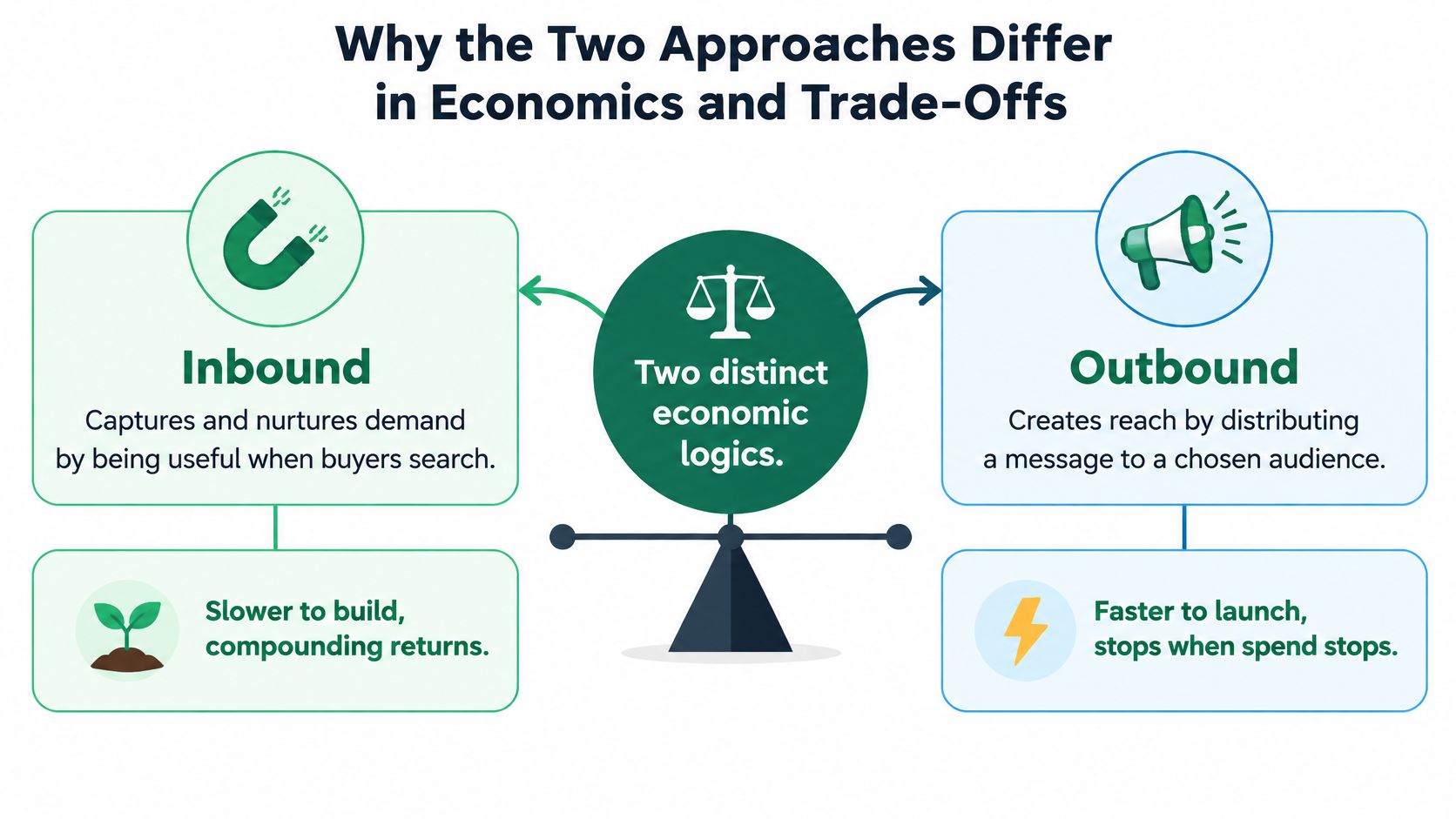
The labels describe who starts the contact. The economics describe something more useful: who pays, what the money buys, and when it comes back. Inbound spending goes into assets, the content, rankings and opted-in audiences that keep producing after the invoice clears. Outbound spending goes into distribution, the placements, lists and dial time that produce reach this week and stop the week you stop paying. That is closer to a capital expense versus an operating expense than a tug of war between pull and push, and it explains why the two models get measured on different clocks.
What the funnel evidence shows
In a Content Marketing Institute survey, 87% of B2B marketers said content marketing created brand awareness during the previous 12 months, 74% said it generated demand or leads, 62% said it nurtured subscribers, audiences or leads, and 49% said it generated sales or revenue. Read those figures in order and you see the shape of an inbound program: awareness first, lead capture second, nurture third, revenue last. Each rung sits further from the spend than the one before it. That ladder explains why inbound looks weak in a 30-day report and strong in a 12-month one, and why a team that only tracks last-touch conversions will always conclude outbound works better.
Lead quality is where inbound earns its reputation. In 2025, 70% of marketers rated their inbound leads as high quality, according to a GrowLeads survey statistic. Self-reported, collected from people already running inbound, so treat it as a signal rather than proof. It still matches what the mechanics predict: someone who typed a question has told you what they need before you say a word.
Where inbound quietly fails
Publishing is not the same as operating a system. Even among marketers who bother to document a content strategy, many still report mixed results, and the gap is usually operational rather than editorial. A calendar full of posts nobody searched for, published to a site with no internal links and no conversion path, is an expense rather than an asset. The inbound programs that stall usually don't have a writing problem. They have a research and conversion problem: no topic selection tied to real queries, no lead capture, nobody assigned to follow up.
The asset only compounds if someone maintains it.
The compliance bill on outbound email
Outbound carries a cost that never appears in a media plan. Commercial email is regulated down to the mechanics: accurate header information, no deceptive subject lines, a clear advertisement label, a valid physical postal address, and a working opt-out that stays live for at least 30 days and is honored within 10 business days, with a civil penalty of up to $53,088 per violating email, per the FTC's CAN-SPAM compliance guide.
That changes how you staff outbound. Suppression lists need a named owner. Unsubscribe processing needs to be documented and auditable. A recycled list from a purchased database can turn a routine follow-up sequence into a violation. Before the first send leaves, document where every list came from and who owns the opt-out, which is the same discipline that sits behind solid media planning and buying.
Weighing the trade-offs honestly
- Inbound compounds. A page that ranks keeps producing leads after the invoice is paid, so marginal cost per lead falls over time. The catch is that the first few months look like nothing is happening.
- Outbound controls timing. You can decide to be in front of a named account list this month. You can't decide to rank this month.
- Both decay without maintenance. Rankings sag when pages go stale, and response rates drop when the same audience sees the same creative for the fourth week.
- Both fail at the handoff. A lead nobody calls back within the hour is wasted money in either model.
Outbound buys attention you control. Inbound earns attention you have to keep deserving, and it's cheaper per lead only after you've paid for the privilege.
Channels and Tactics Each Approach Relies On
Classify a channel by who starts the contact and most of the list sorts itself. The interesting arguments live in the exceptions.
| Channel | Classification | Why it sits there |
|---|---|---|
| SEO content | Inbound | Captures demand that already exists in search |
| Blog posts and guides | Inbound | Educates prospects researching a problem |
| Opted-in email newsletters | Inbound | Nurtures people who asked to hear from you |
| Video on owned channels | Inbound | Attracts viewers who choose to watch |
| Paid search ads | Outbound placement, inbound response | You pay to place the ad, the click is user-initiated |
| Paid social advertising | Outbound | Pushes a message to chosen audiences |
| Cold calls and sales prospecting | Outbound | The business initiates contact |
| Direct mail | Outbound | Physical message sent to a selected list |
| Trade show booths and events | Mixed | Outbound presence, inbound conversations |
Paid search is the cleanest example of why the categories leak. You buy the placement, so the distribution is outbound. The visitor typed the query, so the behavior is inbound. Reporting those two facts as one number is how teams end up arguing about a channel that's doing two jobs.
Events split the same way. A booth is an outbound presence, a paid position in a hall full of people who didn't come to see you. The conversations that happen at that booth, with attendees who walked over and asked a question, are inbound. Same line item, two behaviors.
The Federal Trade Commission's analysis supporting the Telemarketing Sales Rule makes the point numerically: it counted 5,921,500 inbound debt-relief calls generated by advertising, including 4,666,142 attributed to general-media advertising, in a Federal Register notice on the rule. Advertising is outbound distribution. The phone ringing is inbound response. Both are true in the same campaign.
Investment plans reflect the same blend. In Content Marketing Institute's 2025 B2B benchmarks, 61% of respondents expected their organizations to increase spending on video, 52% on thought-leadership content, and 40% on paid advertising. Owned content and paid reach, funded in the same budget.
Label channels by the job they do for the business, which is what content marketing is supposed to accomplish in the first place, rather than by a fixed category someone published in 2011.
What Each Approach Costs and How to Compare It Fairly
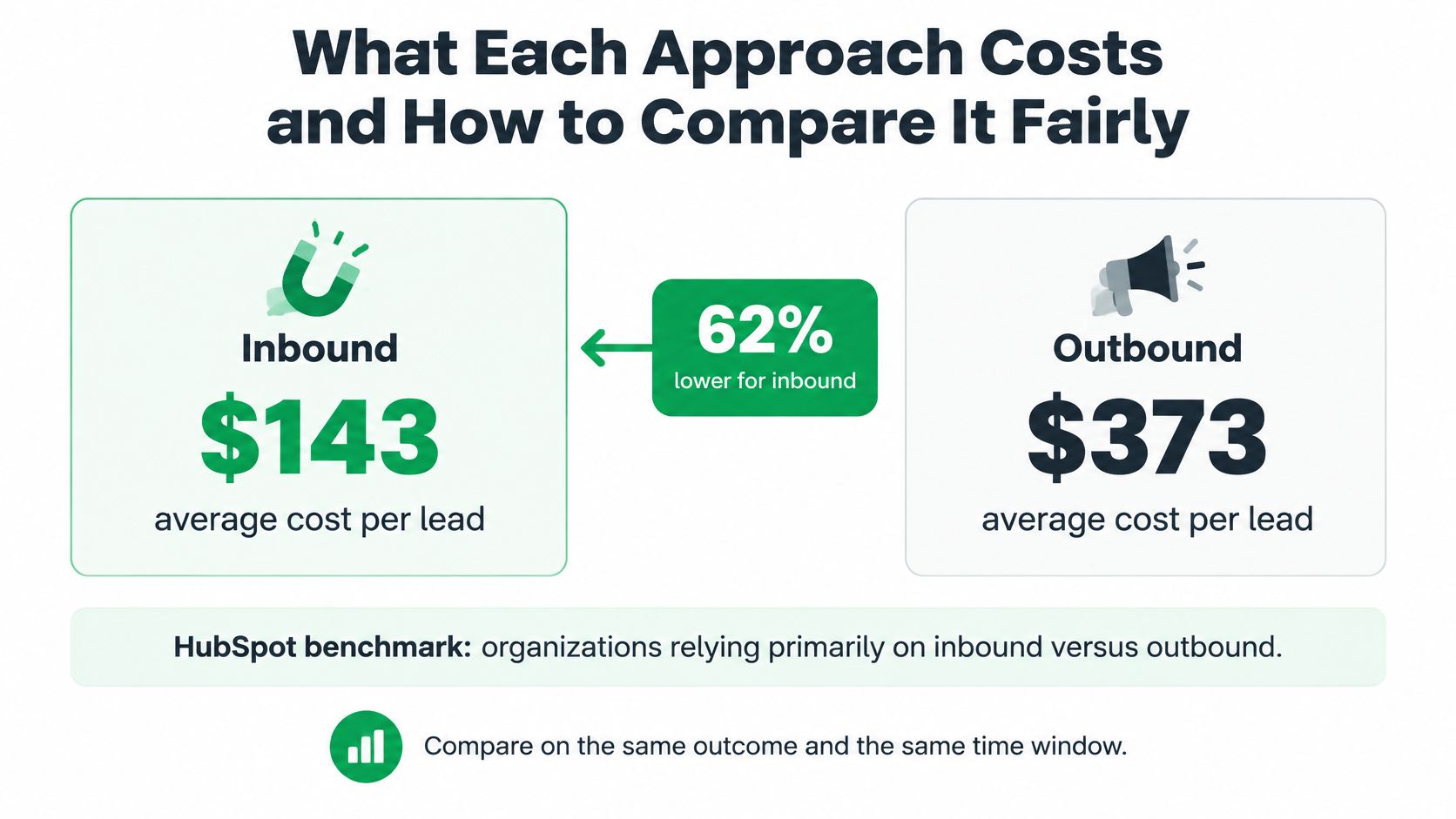
Start with the number everyone quotes. Historical HubSpot benchmark research found that organizations relying primarily on inbound reported an average cost per lead of $143, against $373 for outbound, a 62% lower inbound CPL. The same dataset found inbound-focused organizations generated 54% more leads in the marketing funnel and were twice as likely to report below-average cost per lead.
Now the caveat that the screenshots never include: those are historical benchmarks. Ad auctions, content saturation and industry economics have all moved since. Use them as a directional planning input, not a forecast for your account.
A fair comparison starts by counting everything on both sides, not just the invoice from the ad platform.
| Cost component | Inbound example | Outbound example |
|---|---|---|
| Production | Articles, video, design, editing | Ad creative, list purchases, mailers |
| Media spend | Promotion of content, sometimes paid | Ad placements, postage, paid data lists |
| Labor | Writers, editors, SEO specialists | Sales reps, prospectors, campaign managers |
| Tools | SEO platforms, CRM, analytics | Dialers, email platforms, data vendors |
| Payback pattern | Longer to build, compounds over time | Faster to launch, ends when spend stops |
Why cost per lead alone misleads
Last-click attribution hands all the credit to whichever interaction happened last. Google's own guidance on data-driven attribution for small businesses states plainly that last-click doesn't accurately represent the full customer journey and recommends models that weigh converting and non-converting paths together. That bias cuts in a predictable direction: outbound looks stronger when it captures demand that inbound content created three weeks earlier.
I would start with the cheapest fix, which is usually measurement, not media. Pull twelve months of closed deals, tag each one with first touch, lead creation, opportunity and revenue, and see which approach shows up in the winning paths.
The metrics worth tracking
- Organic sessions and content-assisted conversions for inbound, reviewed by content cluster rather than sitewide.
- Marketing-qualified leads and lead-to-opportunity rate, since cheap leads that never qualify are the most expensive kind.
- Payback period by channel, meaning how many months of gross profit it takes to recover what you spent acquiring the customer.
- Fully loaded CAC, including content production, sales labor, media costs and the conversion rate from lead to closed revenue.
Campaign success gets measured against key performance indicators set for each client's goals, which may include website traffic, leads generated, conversion rates and revenue generated. Those are the numbers that belong in the comparison, because they're the ones that survive a budget review. If you're still building the cost model, how much it costs to advertise covers the media side in more detail.
Matching the Approach to Your Situation
Channel choice follows goals, audience, budget and industry. There's no universal rule, but there are recognizable situations where the answer is obvious.
| Situation | Lean toward | Reason |
|---|---|---|
| Local service business with steady call demand | Inbound local search plus outbound call campaigns | Captures current searches and fills gaps |
| Ecommerce brand launching a new product | Outbound paid reach first, inbound content after | Immediate volume, then organic compounding |
| B2B firm with long sales cycles | Inbound research content | Buyers research for weeks before they contact anyone |
| Startup targeting named accounts | Outbound | Precise account targeting |
| Brand already ranking for core terms | Inbound, outbound for new markets | Existing assets keep working, outbound tests new areas |
| Seasonal retailer with a short window | Outbound | Speed matters more than compounding |
Take a plumbing company with four trucks and a service area of thirty miles. Inbound work looks like a page for every service and every suburb, plus a booking flow that works on a phone at 11pm. Outbound work looks like a seasonal postcard drop and a call campaign to property managers. Neither is optional if the phones are quiet in February: the search pages catch the emergencies, and the outbound effort fills the slow weeks. The mix shifts with the calendar, not with a philosophy.
For a B2B software firm, the logic inverts. Buyers do their reading long before anyone fills out a form. Google's research on the changing face of B2B marketing reported that 90% of online B2B researchers use search for business-purchase research, that they run an average of 12 searches before engaging a specific brand, and that about 71% begin with a generic, non-brand query. That last number is the one most sites get wrong. If your content only targets branded terms and bottom-funnel comparisons, you're invisible during the eleven searches that came first.
Different products, different answers at the same time
One business can need both approaches simultaneously and for defensible reasons. A regional services company with a mature residential line might run inbound content for the consumer side, where volume comes from search, and outbound account work for commercial contracts, where the buyer list is short and knowable.
That's why channel selection should follow the goals, audience, budget and industry of each client rather than a template applied across the book. Budget allocation then gets reviewed on the same cadence as performance, which is the argument for treating marketing budget allocation as a quarterly exercise rather than an annual one.
How AI Answers Blur the Inbound and Outbound Line
Inbound has always assumed a sequence: the buyer searches, clicks, and lands on something you own. That sequence is breaking. Bain reported that 80% of consumers rely on AI-written results for at least 40% of searches and estimated the shift could cut organic web traffic by 15% to 25%, with its release also citing HubSpot's 2025 consumer research finding that 72% of consumers plan to use generative-AI search for shopping, all detailed in Bain's release on AI search reliance.
The practical consequence is uncomfortable for anyone reporting on sessions. A buyer can read a summary that mentions your brand, form an opinion, and never generate a visit your analytics records. Fewer clicks do not prove less influence.
So what do you judge an inbound program by when the click disappears? Three signals, reviewed together:
- Branded-search lift. People who were persuaded somewhere unmeasurable still type your name into Google. That number moving up while sessions stay flat is a good sign, not a bad one.
- Direct and dark-social traffic. Untracked visits cluster in direct traffic. Watch the trend line, not the single-month dip.
- AI mentions and shortlists. Ask the major assistants the questions your buyers ask and record whether your business appears. Run it quarterly, same prompts, so you get a trend instead of a vibe.
At the same time, outbound now feeds the machine that summarizes you. Paid promotion, creator partnerships and email all seed the brand information that AI systems later repeat, which means a campaign can pay off in citations rather than clicks. Building the authoritative, well-structured pages those systems pull from is a different discipline from classic keyword targeting, and optimizing for AI search covers the mechanics.
A flat traffic line can hide growing influence. What it can't hide is a brand nobody mentions anywhere.
Confirm the Right Mix Before You Spend
The labels mislead the budget. Inbound and outbound are paid on different clocks, and a long buying cycle will make a cheap click look smarter than a page that closed the deal months later. I judge the mix by one shared outcome, not by which tactic sounds more current.
Three checks, before any spend moves.
- Name one outcome both approaches get judged against. Qualified pipeline, gross profit, or customer lifetime value. Pick one and hold it for four quarters. Traffic and cost per lead are inputs, not outcomes.
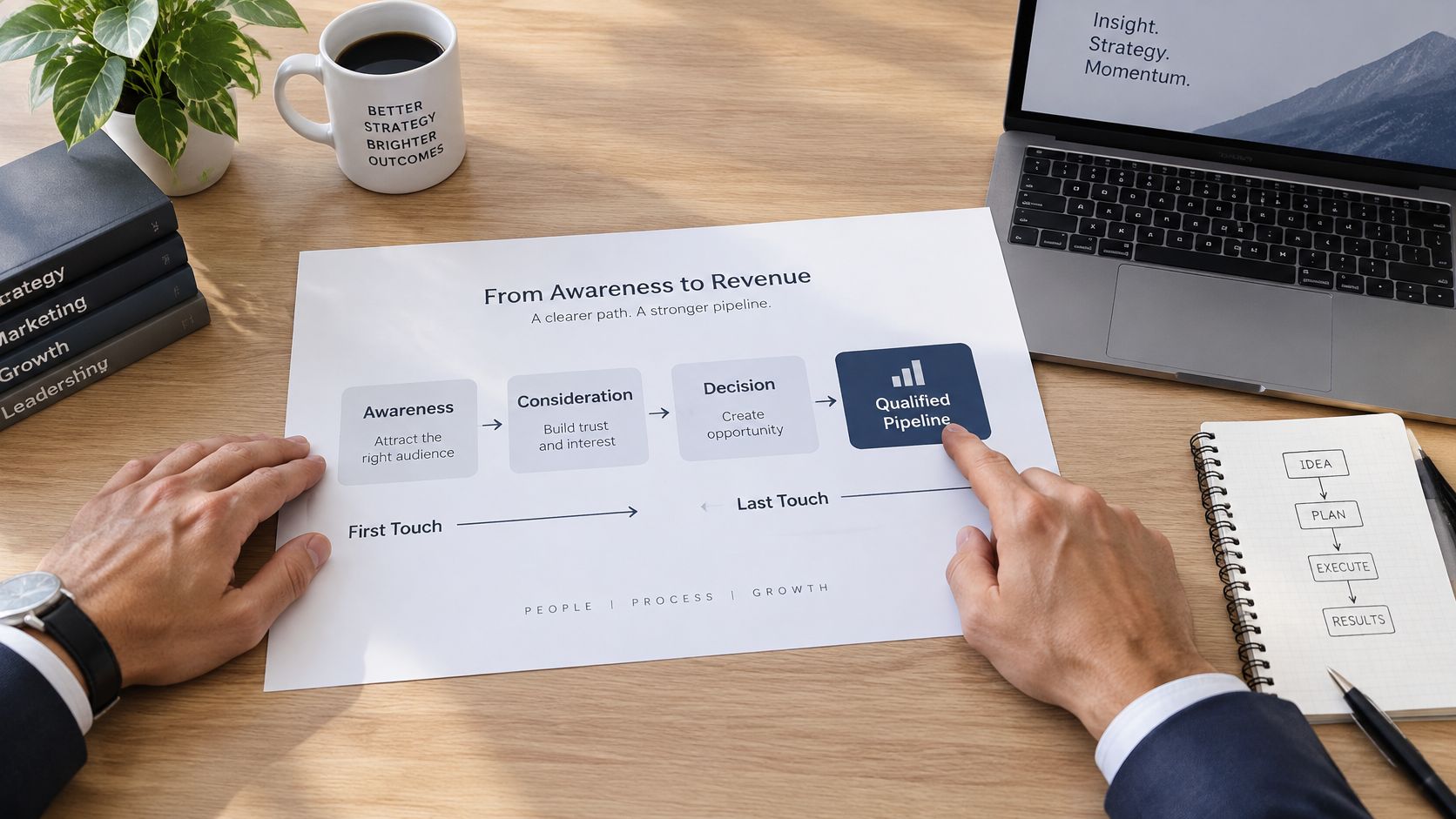
- Separate the attribution stages. First touch, lead creation, opportunity, and revenue should be four distinct fields in the CRM. Collapsed into one field, the channel present at the close takes credit for a journey that started much earlier.
- Run a controlled shift. Move a fixed slice of budget between approaches in one region or audience, keep a holdout where the budget allows, and compare assisted conversions and time to conversion rather than click counts. If a paid channel takes credit for leads that organic search was already generating, the holdout is what reveals it.
Influence that never creates a session still has to land on that outcome. A separate slide for it lets paid media win a comparison the revenue never supported.
Strategies for local service businesses aim at more leads, calls, and jobs. Strategies for ecommerce brands aim at more traffic, conversions, and sales. Channels follow the client's goals, audience, budget, and industry. The scoreboard stays the same.
Mr. Green Marketing, LLC builds custom strategies across SEO, PPC, content, email and web design, with KPIs set for each client's goals, so inbound and outbound work can be judged on the same scoreboard. A free audit and performance report shows which gaps exist before another month of spend is committed. Request it at Mr. Green Marketing, LLC.
Leave a Comment
sing in to post your comment or sign-up if you dont have any account.