
SEO Service Monthly Costs: The most popular advice about SEO service monthly pricing is also the least useful: choose a retainer, publish some content, and wait for rankings to rise. That approach ignores the buying decision. You aren’t paying for a recurring invoice. You’re paying for enough focused work to keep the site technically accessible, publish material that satisfies search intent, earn authority, and measure visibility in results where users may never click.
And a low monthly price can look efficient while removing the work your campaign needs. If the retainer only covers occasional recommendations, basic reporting, and a small amount of page editing, it may maintain a presence without creating meaningful momentum. The right question is not, “What does SEO cost?” It’s what scope can this budget sustain in this market?
SEO Service Monthly Costs: Table of Contents
- Why SEO Requires a Monthly Commitment
- Breaking Down Monthly SEO Pricing Tiers
- Core Deliverables in a Standard Retainer
- Redefining KPIs for AI and Zero-Click Search
- Agency Retainers Versus Freelance Providers
- How to Evaluate and Select the Right Partner
Why SEO Requires a Monthly Commitment
SEO used to look more like a one-time setup because search engines were simpler. The foundation of modern search began with BackRub, which was being built in 1996, followed by Google.com’s registration in September 1997 and the first Search Engine Strategies conference in 1999. Those milestones mark the shift from basic keyword directories toward a formal search marketing discipline, as outlined in HubSpot’s history of SEO.
A static optimization checklist can’t keep pace with that environment. Google’s Florida update in November 2003 addressed keyword stuffing, Panda in February 2011 targeted thin content, Penguin in April 2012 devalued manipulative links, Mobilegeddon arrived on April 21, 2015, and mobile-first indexing began rolling out in 2018. Each change pushed practitioners away from isolated page edits and toward ongoing technical maintenance, useful content, sound site architecture, and adaptation.
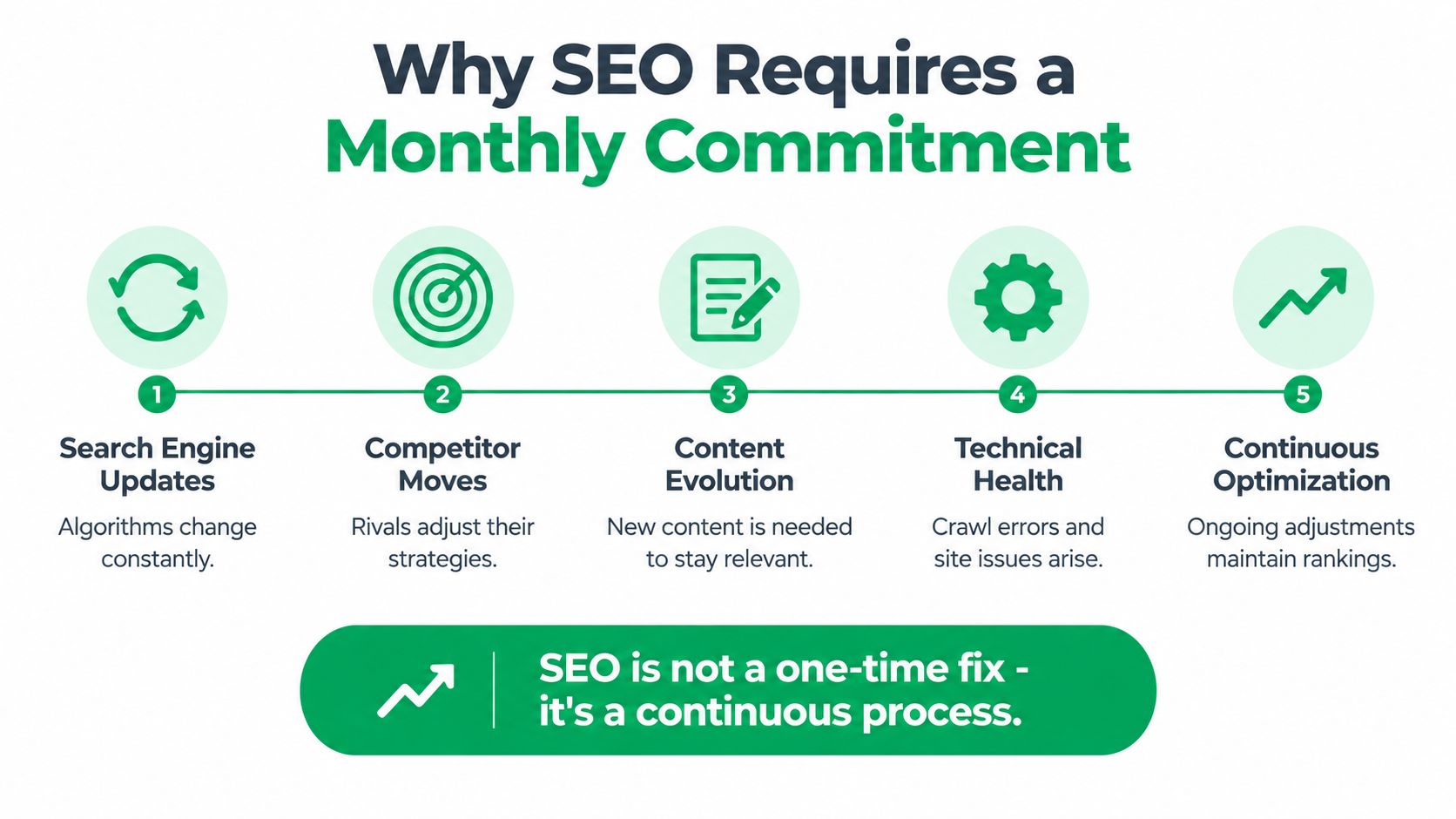
SEO Service Monthly Costs: What monthly work actually protects
A monthly SEO engagement gives a team time to respond to several moving parts:
- Search engine changes: A page can lose visibility after an update even if nobody changed the page itself.
- Competitor decisions: Rival businesses add pages, improve product information, earn mentions, and adjust internal linking.
- Content decay: Search intent changes, facts become outdated, and once-relevant pages need restructuring.
- Technical drift: Website releases can introduce broken links, indexing problems, slow templates, or duplicate content.
- Commercial priorities: A company may launch a service, expand into a location, or change which products deserve attention.
A one-time audit can identify problems. It can’t implement every fix, validate the result, update the content plan, and watch what happens next. Monthly SEO turns those activities into a feedback loop.
Practical rule: A retainer should fund repeated diagnosis, implementation, and measurement. If it only funds diagnosis, you have an audit subscription, not an optimization program.
That distinction matters for small businesses especially. A useful overview of the benefits of SEO for small business can help explain the channel’s value, but value doesn’t remove the need to define the work. The engagement still needs owners, priorities, deadlines, and a clear answer to what gets changed each month.
SEO Service Monthly Costs: Breaking Down Monthly SEO Pricing Tiers
And then there’s the budget question. Monthly SEO pricing is highly segmented because a single-location service business, a national ecommerce store, and a multinational enterprise don’t have the same page count, competition, technical risk, or authority requirements.
Neutral industry summaries place startups and local businesses around $750 to $3,000 per month, mid-sized companies around $1,500 to $15,000, and enterprise retainers as high as $5,000 to $50,000 per month. A separate survey-based estimate identifies $501 to $1,000 as the most common retainer band, selected by 20.4% of respondents, while the average U.S. agency charge was about $3,209 per month, according to this SEO services pricing and statistics summary.
| Business Size | Monthly Budget Range | Typical Scope and Capacity |
|---|---|---|
| Local or startup | $750 to $3,000 | Foundational technical work, local optimization, priority pages, limited content and reporting |
| Small to midsize | $1,500 to $5,000 | Ongoing technical fixes, content planning, on-page improvements, local or regional growth, selective authority work |
| Mid-market | $5,000 to $15,000 | Broader content production, iterative testing, stronger digital PR or link acquisition, deeper analytics |
| Enterprise | $5,000 to $50,000 | Multi-market governance, technical program management, large-scale content operations, complex reporting and coordination |
What the lower tiers can and can’t do
A lower retainer isn’t automatically poor value. It can suit a focused local campaign with a manageable site and a narrow competitive field. The constraint appears when the same budget is expected to cover a large technical backlog, frequent content creation, outreach, conversion analysis, and reporting.
Recent survey summaries put the average monthly SEO retainer at about $3,209, with 63% of providers charging between $500 and $5,000 per month, as reported in this SEO pricing and ecommerce benchmark overview. At the lower end, a provider may need to choose between crawlability fixes and new content. That isn’t a failure of strategy. It’s a capacity issue.
Mid-market budgets can support more iteration because the team has room to test page templates, develop supporting content, improve internal links, and pursue authority rather than stopping after technical cleanup. Before choosing a tier, compare the budget against the realities of small business SEO cost, then ask which deliverables will be deferred when priorities compete.
SEO Service Monthly Costs: Core Deliverables in a Standard Retainer
A healthy monthly retainer produces visible work, not just a dashboard. The provider should connect technical findings to business priorities, turn search demand into page decisions, improve existing assets, and explain what changed in language a commercial team can use.
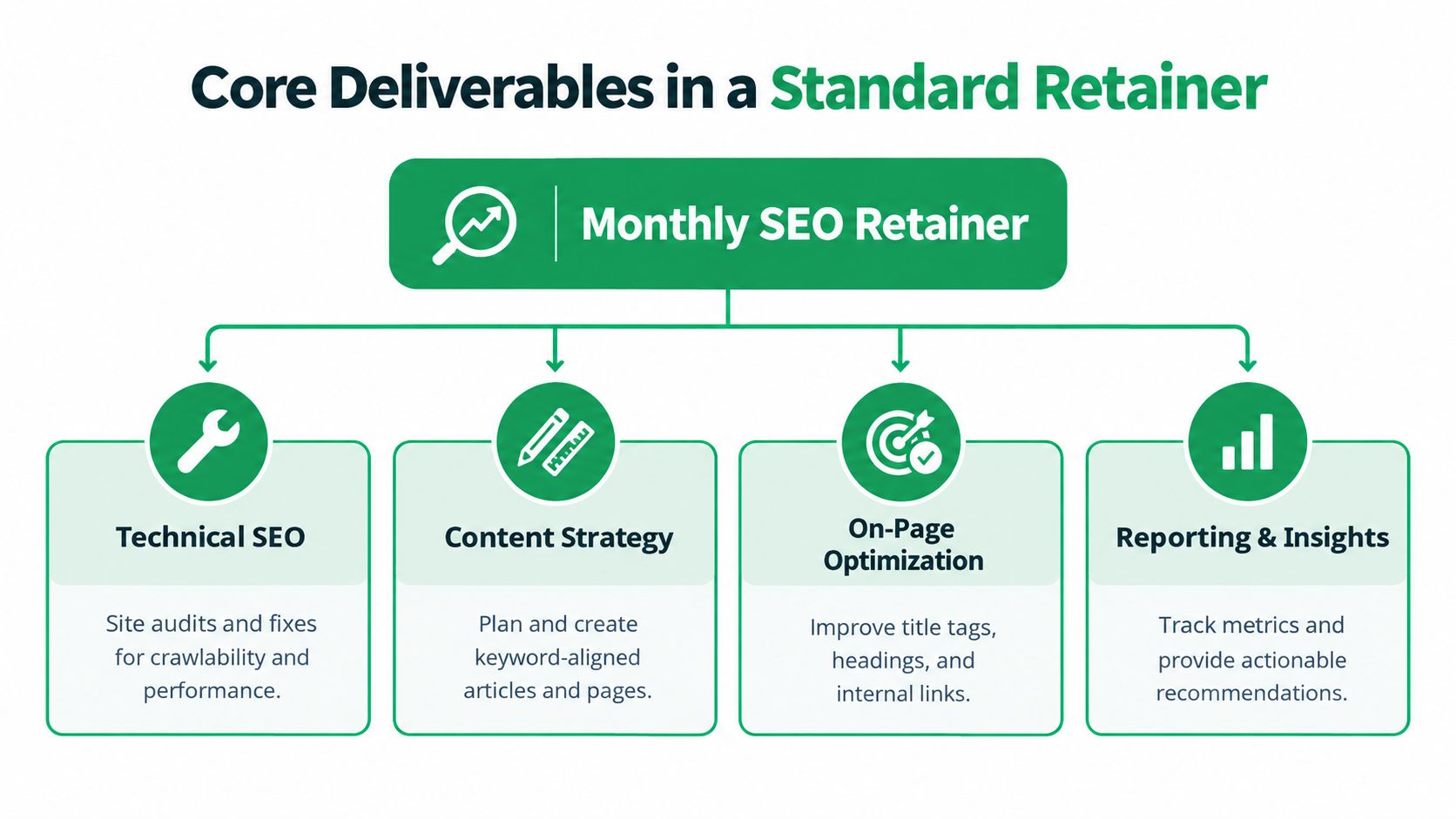
The four operating pillars
Technical SEO comes first when access is blocked. The work may include crawl diagnostics, indexation checks, broken internal links, duplicate page review, template performance, mobile usability, XML sitemap validation, and structured data testing. A good team doesn’t spend the month polishing metadata on pages search engines can’t reliably crawl or understand.
Content strategy decides where effort goes. The provider should map queries to existing pages, identify missing topics, distinguish informational from commercial intent, and prioritize updates or new pages. More publishing isn’t automatically better. A smaller number of well-matched pages can be more useful than a large batch of generic articles.
On-page optimization turns strategy into page-level changes. Titles, headings, descriptive copy, image context, internal links, product details, service information, and calls to action should support both search interpretation and user decisions. Internal linking deserves special attention because it helps users and crawlers discover related pages without relying on navigation alone.
Reporting and insights close the loop. A transparent report should show completed work, unresolved issues, changes in impressions and clicks, landing-page behavior, conversions where tracking is available, and next-month priorities. The SEO monthly reporting format should make it possible to distinguish activity from progress.
SEO Service Monthly Costs: How to tell maintenance from growth
Maintenance keeps the site stable. Growth work creates new opportunities or improves the commercial performance of existing ones. Both matter, but a campaign that spends every month fixing minor issues without a content or authority plan may never move beyond housekeeping.
Ask for a monthly work log with owners and outcomes. It should identify which pages changed, which technical fixes were implemented, what content was briefed or published, which links or mentions were pursued, and what the team learned from performance data. Without that record, “ongoing optimization” can become an empty label.
A useful report tells you what the team did, what the site did afterward, and what the team will change next.
SEO Service Monthly Costs: Redefining KPIs for AI and Zero-Click Search
Ranking position still has value, but it no longer tells the whole story. Search results increasingly answer questions directly through rich results, featured snippets, and AI-generated interfaces, so a monthly SEO program needs to measure whether the brand is understood, cited, discovered, and chosen.
Google AI Overviews reportedly appeared in 25.8% of U.S. searches in January 2026, compared with 6.49% in January 2025, according to this AI search and SEO pricing guide. The same source says monthly AI sessions were already 56% the size of search worldwide and 34% in the U.S., while one analysis places U.S. searches ending without a click at about 60%. These figures change the reporting question. “Did we rank?” is no longer enough.

SEO Service Monthly Costs: The KPI mix that matters now
A capable provider should connect classic SEO indicators with signals that show whether the content can support AI retrieval and user action:
- Intent alignment: Group queries by the problem the searcher is trying to solve, then assess whether the landing page answers that problem directly.
- Entity clarity: Make the organization, services, products, locations, authors, and relationships easy for systems to interpret consistently.
- Structured data coverage: Validate relevant schema and compare it with the information users need, especially for products, services, organizations, reviews, and FAQs.
- Citation and visibility presence: Track appearances in AI answers, featured results, knowledge features, and other search surfaces where available.
- High-intent sessions: Separate visitors arriving for commercial queries from broad informational traffic.
- Conversion quality: Review qualified leads, product actions, assisted conversions, and revenue signals instead of treating every organic session as equal.
For ecommerce, the downstream metric is particularly important. Independent 2026 benchmarks place organic conversion rates around 1.5% to 4.2%, and one large analysis cited non-branded organic traffic converting at 1.39% across 94 large ecommerce brands. Other benchmarks place ecommerce and retail organic search closer to 2% to 4%, as summarized by ClickRank’s SEO benchmarks.
What AI-aware execution looks like
AI visibility isn’t achieved by stuffing a page with repeated phrases. The monthly work may involve restructuring answers, clarifying definitions, strengthening supporting evidence, improving author and organization context, connecting related pages, and ensuring product or service details remain consistent. Fast mobile experiences and complete product schema also matter because a search visit has to become a usable session.
Read the practical guidance on how to optimize for AI search, then ask a prospective provider how it will measure visibility that produces no immediate click. If the answer is only a position tracker, the measurement model is behind the search environment.
SEO Service Monthly Costs: Agency Retainers Versus Freelance Providers
The choice between an agency and a freelancer isn’t a simple quality contest. It’s a capacity decision. A freelancer may be the right fit for a focused site with one clear priority, while an agency can make more sense when technical, content, analytics, design, and marketplace needs must move together.
A 2026 pricing guide reports average monthly retainers of $3,209 for agencies and $1,348 for freelancers, with the overall average across provider types at $2,917 per month. Those figures come from survey data summarized in this SEO pricing costs guide. The difference reflects provider structure and service depth, not a guarantee that one model will outperform the other.
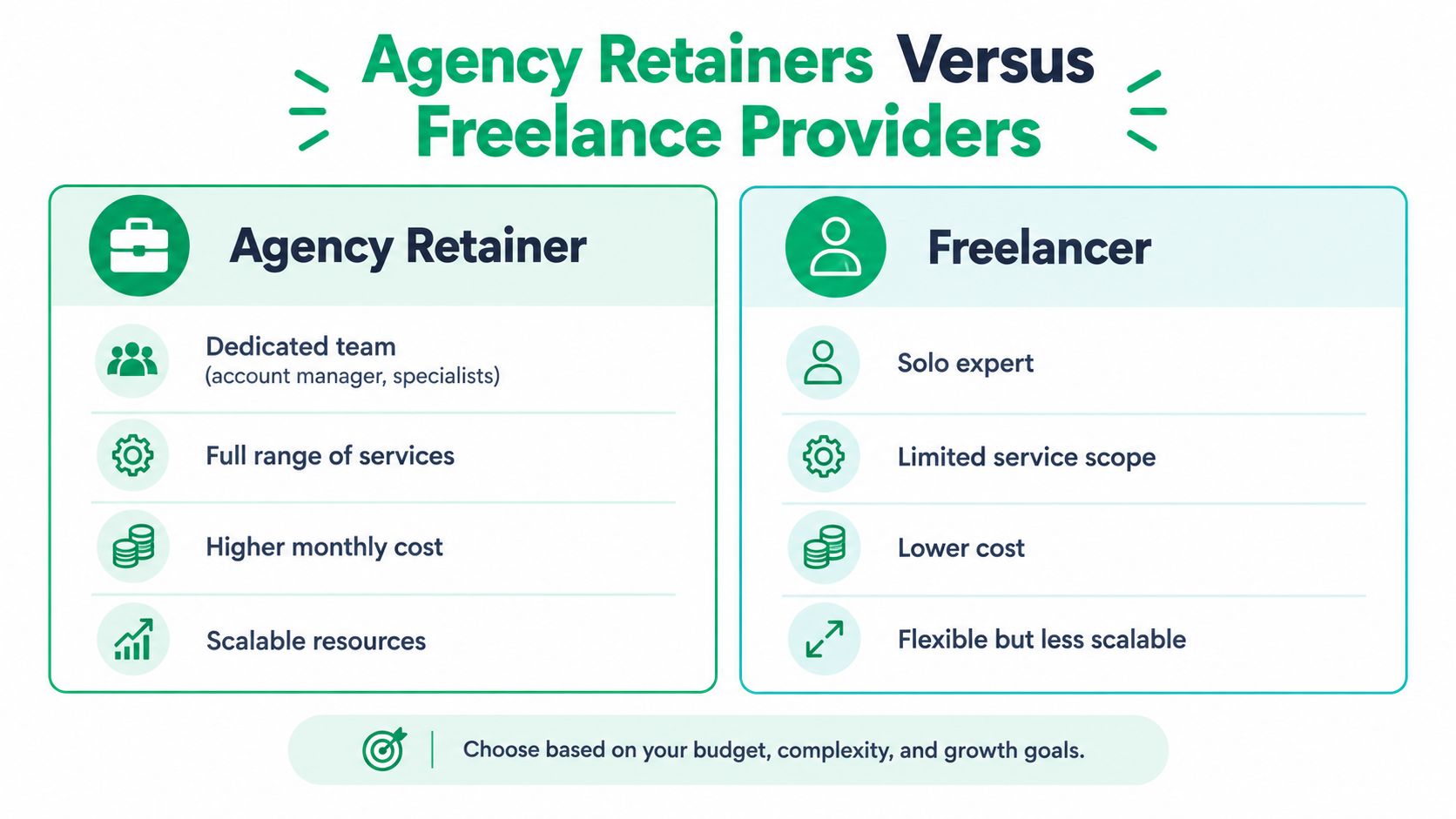
Where an agency earns its fee
An agency can divide responsibilities among an account lead, technical specialist, strategist, writer, outreach professional, designer, or developer. That structure helps when a recommendation requires implementation across several systems, or when a campaign needs content and technical work in the same month.
Agencies also tend to spread the cost of specialized tools, crawling platforms, rank tracking, analytics environments, and quality-control processes across multiple accounts. That doesn’t mean every agency uses better tools, and tool access alone doesn’t create results. The important question is whether the provider turns those tools into decisions and completed work.
Where a freelancer can be more efficient
A strong freelancer often offers direct access to the person doing the analysis and writing. Communication can be faster, the scope can be narrower, and the monthly investment can be easier for a small business to carry. For a local service company that needs page optimization and a practical content plan, a solo specialist may provide exactly the needed capacity.
The trade-off appears when the project requires development, large-scale content, digital PR, international coordination, or coverage during an absence. One person can’t provide unlimited execution in every discipline.
| Consideration | Agency retainer | Freelance provider |
|---|---|---|
| Team structure | Account lead plus specialized contributors | Direct work from one specialist |
| Scope | Broader service coverage | Focused expertise |
| Capacity | More scalable for complex programs | Flexible, but limited by one person’s availability |
| Cost structure | Usually higher | Usually lower |
| Best fit | Multi-channel or technically demanding growth | Narrow, clearly defined priorities |
The digital marketing agency pricing packages available to you should be compared by deliverables, access, and accountability, not just the invoice. A low price is useful only if the provider can complete the work your site needs.
SEO Service Monthly Costs: How to Evaluate and Select the Right Partner
A persuasive sales call can’t tell you whether a monthly SEO partnership will work. The proposal needs to show how the provider thinks. Start with the business problem, the pages that matter, the locations you serve, the products or services you want to grow, and the internal resources available for implementation.
Ask these questions before signing:
- What will you prioritize first, and why? A credible answer should connect technical barriers and commercial opportunities rather than promise to optimize everything at once.
- Who will perform the work? Know whether the strategist, writer, developer, and account contact are employees, contractors, or one person covering every role.
- What is included each month? Request concrete deliverables, revision rules, meeting expectations, implementation responsibilities, and reporting details.
- How will you handle AI search visibility? The provider should discuss intent, entities, structured data, citations, and zero-click measurement, not just keyword density.
- What happens when priorities change? A useful retainer can adapt to a product launch, site migration, location expansion, or technical incident without losing strategic direction.
Read the audit for judgment
A free audit should reveal prioritization, not overwhelm you with a long list of automated warnings. Look for evidence that the provider reviewed important templates, commercial pages, internal linking, content quality, conversion paths, mobile experience, and search intent.
Red flags include guaranteed rankings, unexplained packages, copied recommendations, an emphasis on keyword counts without user intent, and reports filled with impressions but no business outcomes. Another warning sign is a plan that assumes the same publishing volume or link strategy works for every company.
Demand custom scope and transparent reporting
The required monthly effort depends on the number of pages, target locations, and competitive intensity. A small local site and a large ecommerce catalog shouldn’t receive identical work plans. Ask the provider to explain what the available budget can accomplish, what it can’t cover, and which trade-offs will apply if the scope stays fixed.
Pricing guides report that 78.2% of providers use monthly retainers, 94.23% of monthly retainers remain below $5,000, and 42.5% of agencies charge under $1,000 per month, according to this SEO deliverables and pricing breakdown. Those figures show why buyers must inspect scope carefully. A common price point may still be too small for a technically complex or highly competitive campaign.
Choose a partner that reports completed work, meaningful visibility changes, qualified actions, unresolved risks, and the next set of decisions. Accessibility and inclusive design should also be part of the evaluation because a page that excludes users creates a poor experience regardless of its ranking.
Mr. Green Marketing, LLC provides strategy-led SEO, technical SEO, content creation, local SEO, and GEO optimization for businesses that need monthly work tied to measurable goals. Visit Mr. Green Marketing, LLC to request a free audit and performance report, review visibility gaps, and discuss a custom retainer built around your pages, markets, competition, and growth priorities.
Leave a Comment
sing in to post your comment or sign-up if you dont have any account.