
Featured Snippet Optimization: Most featured snippet advice is now too simple. “Answer the question clearly, win position zero, get more traffic” was never universally true, and in 2026 it’s actively misleading. AI Overviews have absorbed many broad informational searches, while some traditional snippets satisfy the query so completely that fewer people click.
And that doesn’t make featured snippet optimization obsolete. It makes query selection, format matching, and business intent more important than ever. The practical question isn’t “Can this page win a snippet?” It’s “If this page wins, will the visibility support discovery, qualified visits, or conversions?”
Featured Snippet Optimization: Table of Contents
- Why Featured Snippet Optimization Has Changed in 2026
- Which Snippet Types and Queries Still Deliver Results
- Finding Snippet Opportunities in Your Existing Rankings
- Formatting Content That Google Actually Extracts
- Technical Signals That Support Snippet Extraction
- Tracking Performance and Knowing When to Pivot
Why Featured Snippet Optimization Has Changed in 2026
Featured snippets became a formal Google search feature in January 2014, when Google began placing concise answers above standard organic results. Ahrefs analyzed roughly 112 million keywords and 2 million featured snippets, finding that about 12.29% of U.S. queries displayed one. The analysis also found that 99.58% of featured snippets came from pages already ranking in the top 10, while only 30.9% came from the number-one organic result. (Ahrefs’ featured snippet study)
The practical implication is clear. A snippet usually improves a page Google already considers relevant. It rarely rescues a page with weak topical coverage, poor intent alignment, or no established organic visibility. Start with pages that already rank, then improve the passage, structure, and answer format around the target query.
Visibility and traffic also diverge. Search Engine Land summarized Ahrefs data showing the first organic result averaged a 26% click-through rate without a featured snippet, compared with 19.6% when a snippet appeared, while the snippet itself received 8.6% of clicks. (Search Engine Land’s featured snippet analysis)
Practical rule: Treat snippet ownership as a visibility asset first, and a traffic asset only after the query’s intent and click behavior support it.
AI Overviews have made that qualification more important in 2026. Broad definitions and basic informational questions can receive a complete answer directly in the search results. Your page may still earn a traditional snippet or an AI citation, yet the resulting visit may carry little commercial value.
A page can therefore “win” and still disappoint. Someone searching for a basic definition may have no reason to continue to the source. Someone asking how to complete a task, compare alternatives, or choose a product has a stronger reason to visit. The same SERP feature can produce very different business outcomes depending on the query.
Google says featured snippets are selected programmatically, and publishers cannot request one. The result format places the descriptive passage before the normal listing. Google may display the feature at the top of results, within People also ask, or alongside Knowledge Graph information. (Google Search Central’s featured snippet documentation)
Segment opportunities by intent and snippet type instead of chasing every possible position zero result. Prioritize queries where the extracted answer establishes authority, supports a meaningful next step, or introduces a product and service comparison. For the wider relationship between traditional snippets and AI-generated results, see this guide to optimizing for AI search.
Featured Snippet Optimization: Which Snippet Types and Queries Still Deliver Results
Not all snippet formats deserve equal effort. Recent industry reporting puts overall featured snippet CTR at 8.2%, with paragraph snippets at 9.1%, list snippets at 7.8%, and table snippets at 6.4%. (Amra and Elma’s CTR analysis)
Those figures don’t mean every paragraph opportunity is valuable or every table should be ignored. They provide a useful starting point for segmentation. A paragraph answer may perform well when the searcher needs context before acting. A table may attract fewer clicks but still be ideal for a comparison query where the reader needs deeper evaluation.
| Snippet Type | Average CTR | Best Query Types | 2026 Viability |
|---|---|---|---|
| Paragraph | 9.1% | Specific explanations, focused definitions, direct questions | Strong when the query has depth beyond the extracted answer |
| List | 7.8% | How-to steps, processes, rankings, examples | Strong for procedural and commercial list queries |
| Table | 6.4% | Comparisons, specifications, structured alternatives | Selective, especially useful for clear commercial comparisons |
Paragraph snippets remain the strongest format by average CTR, but broad “what is” queries have become less attractive when an AI Overview can answer them without sending a visit. Specific definitions still have a better case, particularly when the search includes a platform, audience, use case, or operational qualifier.
List snippets are more compelling for “how to,” “steps,” “types of,” and “best” searches. A numbered process gives the user a preview, but the full page can still earn the click when the task involves caveats, screenshots, tools, or troubleshooting. A commercial list can also introduce multiple options without resolving the buyer’s decision completely.
Table snippets deserve careful testing. They’re useful for “X vs Y,” feature comparisons, specifications, and buying criteria. The format can communicate enough to earn visibility while leaving room for the user to inspect methodology, limitations, and recommendations. Pages using structured comparison content can support both traditional search presentation and broader structured-data work, which is why schema markup for SEO belongs in the technical workflow, not as a substitute for useful content.
A practical filter looks like this:
- Prioritize procedural queries: Focus on specific tasks where the visitor needs more than a short answer.
- Test comparison queries: Build clean tables and explain the differences beyond the extracted rows.
- Target commercial best-of searches: These often preserve a clear path from search visibility to evaluation.
- Deprioritize generic definitions: Keep them for topical coverage or authority, but don’t assume snippet ownership will produce valuable sessions.
- Review SERP reality first: If the query consistently shows an AI Overview instead of a traditional snippet, shift the objective toward citation, brand recall, or conversion content.
The winning question is not “Which format has the highest CTR?” It’s “Which format leaves enough unresolved intent for the right visitor to continue?”
Featured Snippet Optimization: Finding Snippet Opportunities in Your Existing Rankings
The best snippet targets are often already earning impressions. In 2026, that does not mean every page-one ranking deserves optimization. AI Overviews have reduced the value of many generic informational queries, so start with pages where a featured snippet can support evaluation, action, or a qualified visit. HubSpot’s snippet research also found that winning pages generally rank on page one, positions 1 through 10.
Export organic keywords from Ahrefs, Semrush, or another rank-tracking platform. Filter for pages ranking in positions 1 through 10, then separate the terms by intent and likely snippet type. Keep procedural, comparison, specification, and commercial evaluation queries in the active queue. Treat generic definitions as lower priority unless they support a broader topic or a clear conversion path.
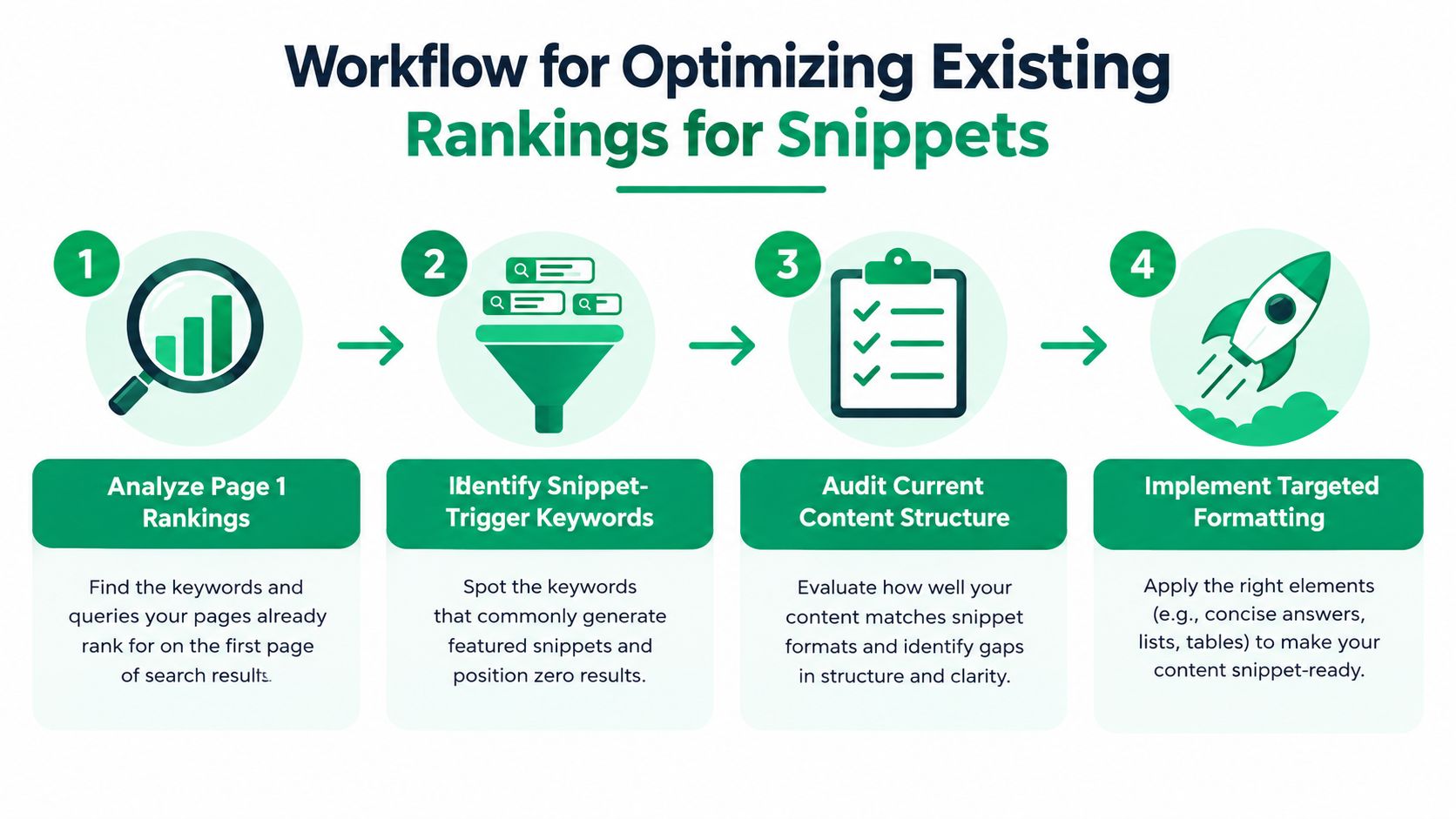
Build the opportunity set
In Ahrefs, inspect SERP features and identify queries where Google already displays a featured snippet. In Semrush, use the SERP features filter, then review the live result rather than relying only on historical data. Record whether the result is a paragraph, list, or table.
That format is a strong testing signal. Google has already matched the presentation to the query’s intent, giving you a practical model for the answer block. If the SERP has no featured snippet, do not force one into a question-shaped keyword. An AI Overview, video result, forum discussion, or product module may indicate a different opportunity.
Featured Snippet Optimization: Score relevance before difficulty
Ranking position is only one filter. Score each candidate for business relevance, conversion proximity, content fit, and the likelihood that a snippet will produce a useful visit. A low-value definition may be easy to improve, while a commercial comparison may justify more work even if extraction is less predictable.
The Ahrefs research found that featured snippets overwhelmingly come from pages already ranking in the top 10. Use that finding as a prioritization rule, not a promise of capture. Improving a visible page is usually a more controlled test than trying to move a buried URL into position zero.
For each candidate, record:
- Current organic position: Confirm that the page is visible on page one.
- Existing snippet format: Note whether Google favors a paragraph, list, or table.
- Intent strength: Classify the query as education, evaluation, or action.
- Content mismatch: Compare your answer with the passage Google currently extracts.
- Commercial fit: Check whether the page leads naturally to a product, service, signup, or consultation.
- SERP conditions: Note AI Overviews and other features that may reduce click value.
Inspect the winning result manually. Review the heading above the extracted passage, answer length, list markup, table structure, and supporting explanation. Do not copy its wording. Identify a clearer qualification, better organization, or missing decision detail that makes your page more useful.
A position-eight page with strong commercial relevance can beat a position-two page that earns little attention. Use an SEO audit workflow to check content, internal linking, indexing, and technical constraints before rewriting the answer block.
Featured Snippet Optimization: Formatting Content That Google Actually Extracts
Google doesn’t accept applications for featured snippets. Its systems select passages from indexed pages, often using the page’s own text, so the answer must work when extracted without the surrounding article. Google’s developer guidance states that the snippet is usually taken from an exact sentence or paragraph on the page. (Google’s featured snippet guidance)
The most reliable structure is simple:
- Put the target question, or a close natural version, in an H2 or H3.
- Place the direct answer immediately below it.
- Follow with explanation, examples, qualifications, and related questions.
- Keep the extracted passage self-contained.

Paragraph answers
For a paragraph snippet, write a 40 to 50 word answer directly under the question heading. Start with the answer, not an anecdote, qualification, or definition of the definition.
A useful template is:
[Target concept] is [direct explanation]. It helps [audience] achieve [outcome] by [mechanism]. Use it when [relevant condition], and evaluate it against [important limitation or alternative].
The template isn’t a reason to produce stiff copy. Rewrite it in the language your audience uses. The key is that the first paragraph should make sense on its own. “It depends” is rarely a useful opening. State what it is, how it works, or what the reader should do, then add nuance underneath.
Burying the answer in a long introductory paragraph creates extraction problems. Google may select an incomplete sentence, or another page may provide a cleaner passage. Answer-first writing helps both searchers and machines.
List answers
Use a native ordered list for sequential tasks, and an unordered list for collections, examples, or non-sequential options. Keep each item parallel, concise, and grammatically consistent.
For a how-to query, begin each item with an action. For a “best” query, begin with the option name and explain the selection criterion. Don’t create a visually styled list from unrelated div elements. The page may look organized to a visitor, but the underlying HTML won’t communicate the same structure clearly.
Google can also assemble list snippets from headings, which means your subheading hierarchy matters. Make each heading descriptive enough to stand alone, but don’t turn every paragraph into a pseudo-list.
Featured Snippet Optimization: Table answers
Use a real HTML table with clear headers and consistent cell content. Keep the comparison narrow, explain the table above or below it, and avoid putting several unrelated ideas in one cell.
A useful table might compare:
- Feature
- Option A
- Option B
- Best fit
The table should answer the query quickly, while the surrounding content explains trade-offs that don’t belong in a compressed grid. Tables fail when headers are vague, rows mix criteria, or the visual design hides the actual table structure.
The best formatting is not decoration. It’s a clean relationship between the question, the answer, and the supporting detail. For broader editorial standards, this guide to writing SEO-friendly blog posts provides useful context on organizing content for both readers and search systems.
Featured Snippet Optimization: Technical Signals That Support Snippet Extraction
A well-written answer can still underperform if Google struggles to parse the page. Technical SEO doesn’t directly request a featured snippet, but it determines whether the content is accessible, understandable, and structurally legible.

Make the hierarchy obvious
Use one clear page title, then organize the article with logical H2 and H3 levels. Don’t jump from an H2 to an H4 because the design looks attractive. A heading should describe the question or subject that follows, not serve as a decorative label.
Keep the target answer in ordinary page text. Content hidden behind interaction, loaded only after a user action, or rendered inconsistently on mobile is harder for search systems to interpret. Google needs to access the same meaningful answer that a visitor can read.
Semantic HTML helps communicate intent:
- Use
<ol>for ordered procedures. - Use
<ul>for non-sequential collections. - Use real table elements for comparisons.
- Use definition-style structures when the page presents terms and explanations.
- Keep headings outside lists and tables so the relationship remains clear.
Use schema as supporting context
FAQ, HowTo, and Article markup can help describe page content, but schema markup doesn’t directly trigger a featured snippet. It supports understanding and eligibility within the broader search ecosystem. The visible answer still needs to be accurate, useful, and placed in readable page content.
Review the rendered HTML, not just the content management system preview. Check for nested headings, malformed tables, duplicated titles, inaccessible text, and scripts that alter the answer after loading. Mobile rendering matters because Google evaluates pages in a mobile-first environment.
Page experience also supports the process. Slow rendering, layout shifts, intrusive interfaces, and blocked resources can make the content harder for both users and crawlers to consume. Technical cleanup won’t manufacture relevance, but it can remove obstacles from a page that already deserves to compete.
The practical audit is modest. Open the page on a mobile device, inspect the heading structure, view the source or rendered DOM, validate structured data where relevant, and confirm that the target passage appears as ordinary text without interaction. If the answer can’t be found cleanly in the rendered page, extraction is already working against you.
Featured Snippet Optimization: Tracking Performance and Knowing When to Pivot
A snippet win is a testable change, not a trophy. Track the query, the owning URL, the snippet format, the organic position, impressions, clicks, CTR, and conversions before and after the rewrite.
Google Search Console gives you query and page performance data, but it doesn’t clearly label every featured snippet appearance. Pair it with a rank tracker such as Ahrefs, Semrush, or Moz, then use a simple dashboard to connect SERP ownership with business outcomes. Analytics and reporting guidance can help structure that reporting layer.
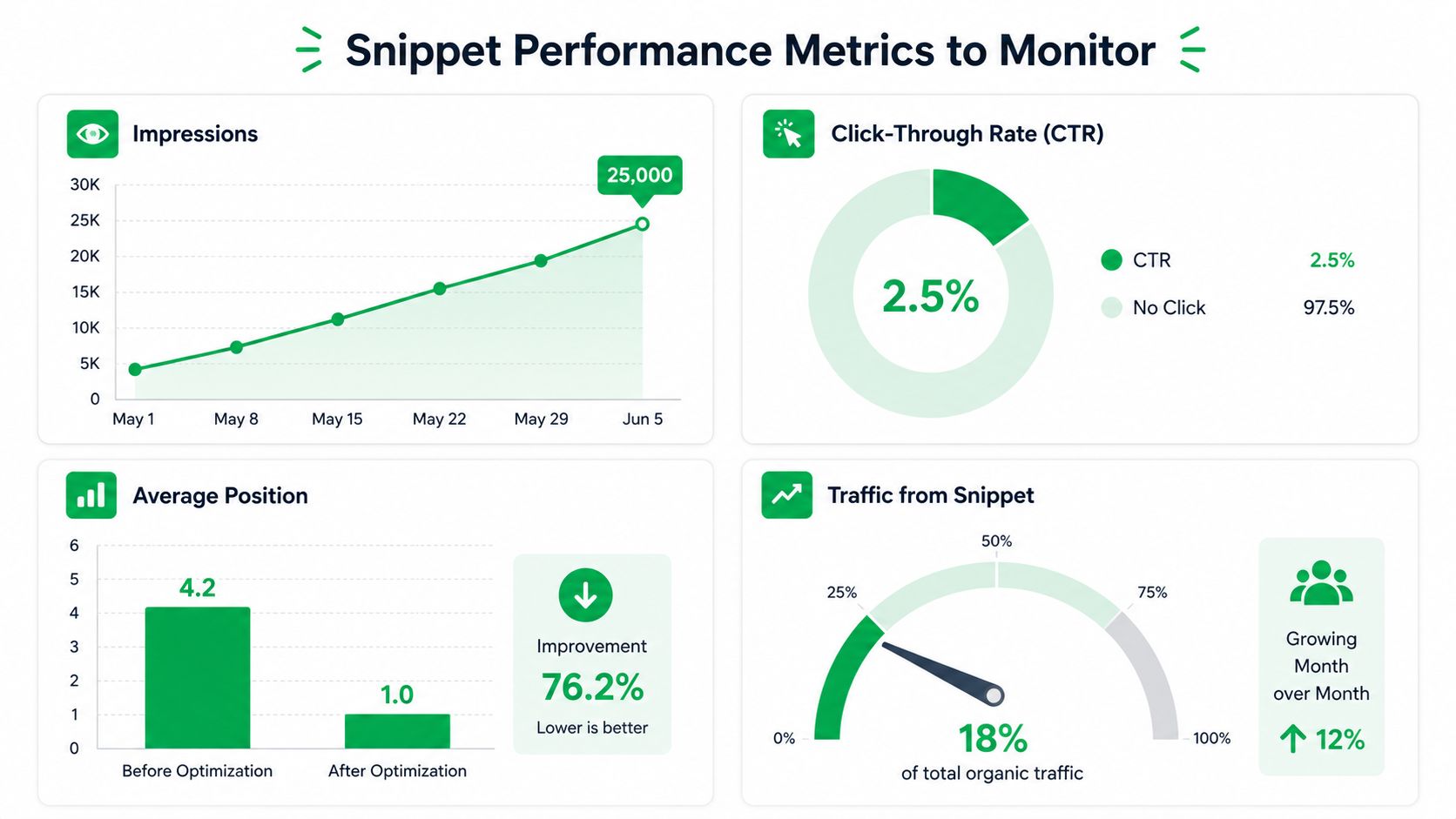
Featured Snippet Optimization: Measure the change, not just the placement
Record a baseline period, then compare the page after the optimization has had time to settle. Watch for:
- Impression movement: Did visibility increase for the target query and related searches?
- CTR movement: Did the page attract more clicks, fewer clicks, or a similar share?
- Organic position: Did the page retain its page-one placement?
- Engagement quality: Did visitors continue into relevant pages?
- Conversions: Did the traffic generate leads, purchases, calls, or other defined outcomes?
A snippet can reduce clicks when the extracted answer fully satisfies an informational search. That isn’t automatically a failure. If the feature increases branded recognition or supports later demand, it may still have strategic value. But don’t call it a success without defining the outcome first.
Decide when to stop
Keep refining when the query has strong commercial relevance, the page remains visible, and snippet ownership produces qualified engagement. Test the answer wording, heading alignment, list order, table clarity, and supporting detail one change at a time so you can identify what influenced retention.
Pivot when the query repeatedly produces an AI Overview, the snippet attracts no meaningful downstream action, or the optimization threatens the page’s broader conversion path. You may choose citation-focused content, a stronger product page, internal links, or a different query class instead.
The 2026 approach is selective. Keep the snippet targets that help people discover and choose your business. Release the ones that only decorate a report.
Mr. Green Marketing, LLC helps businesses identify page-one snippet opportunities, restructure answer-first content, and connect SEO visibility with conversion goals across traditional and AI-driven search. Visit Mr. Green Marketing, LLC to request a free audit and performance report, then turn your highest-value search opportunities into a focused optimization plan.
Leave a Comment
sing in to post your comment or sign-up if you dont have any account.