
The International Franchise Association's 2025 Economic Outlook projected the U.S. franchise sector would grow about 2.5%, to roughly 851,000 establishments, support more than 9 million franchise-related jobs, and produce about $936 billion in output, up 4.4%. That is not a niche channel you sprinkle ads on. It is a network of local doors that still have to look like one brand.
Digital marketing for franchise brands fails when headquarters treats every city as the same creative, or when a location rewrites the brand to sound neighborly. Nearby shoppers give trust to a place they think is theirs. A film that never names the street spends that trust. I would lock the rules that protect the name, then leave a narrow lane where a manager can sound like that store.
Table of Contents
- Two Campaigns Inside One Franchise Brand
- The National and Local Ownership Split
- How Nearby Search Becomes a Store Visit
- When Local Discovery Leaves Google
- Where Franchise Digital Budgets Actually Go
- Claims You Can Publish and Claims You Cannot
- Case Results Before You Add Spend
Two Campaigns Inside One Franchise Brand
In 2025, digital advertising represented 42% of franchise marketing budgets, according to Franchise Update Media's Annual Franchise Marketing Leadership Report. That is the main spend. Not a pilot.
Two jobs. One checkbook.
National work builds memory for the brand name, the offer architecture, and the look people should recognize in every city. Local work wins a geographically limited action: a near-me search, a call, directions, a booking, a visit. Those jobs do not share a scoreboard. A million branded impressions can look healthy while Tuesday's lunch trade at one address stays flat.
And those jobs collide – a polished national ad that never names the neighborhood, or a franchisee post that rewrites the brand.
Say a sandwich system ships one spring campaign. The film is tight, the price steps are locked, and every market gets the same end card. In one city the unit sits a mile off a commuter route. In another it sits beside a campus. The ad still never says which door. Meanwhile a manager posts “best in the state, and the owner prints money” on the brand page. The brand team hates the first miss. Legal hates the second.
Practical rule: If an asset cannot name its owner, its editor, and the unit a lead belongs to, it is not ready to receive budget.
What you need, in order, is the ownership split, how a nearby search becomes a visit, where the digital dollars tend to sit, which performance claims need proof, and what multi-unit capture has already shown. Before you add media, point at one asset and say who owns it, who may edit it, and which location the lead lands on.
The National and Local Ownership Split
| Asset | National HQ | Location | Shared rule |
|---|---|---|---|
| Brand name and logo | Sets the visual system | Uses approved assets | No local redraws |
| Core offer architecture | Sets offers and approved language | Runs approved local versions | Clear claims before publication |
| Google Business Profile | Sets naming and category standards | Manages its location's hours, photos, and replies | One profile per physical location |
| Paid search | Sets keywords, negatives, and territory rules | Funds or co-funds approved local offers | Prevent overlap between nearby units |
| Social | Sets the calendar and brand creative | Publishes local posts within the guidelines | Managers do not redesign brand assets |
| Website | Sets the design system | Maintains a page for its address | The corporate homepage does not replace a branch page |
| Reviews | Sets response guidance | Replies for that location | Avoid guarantees that cannot be substantiated |
| Reporting | Defines metrics and dashboards | Reviews its own unit's results | Tie every lead to a location ID |
Walk the rows before debating creative. Headquarters should control the brand name, logo, and offer framework. Local teams need room to add relevant details, such as a neighborhood event or a location-specific update, without changing the underlying promise. Too much freedom raises claim risk; too little can make a local message feel like a generic national ad.
Google Business Profiles need clear ownership. Google's Business Profile guidelines cover representation of businesses on Google, including profiles for eligible locations. Set one profile for each physical location, use consistent brand information, and link each profile to the page for that address. Local staff can keep hours and photos current and respond to reviews within the shared voice guide.
Paid search also needs shared rules. Headquarters can define keyword standards, negative keywords, and territory boundaries; local teams can contribute budget and use approved offers. Without clear territory rules, nearby units may compete for the same search. Social works similarly: national teams provide the calendar and brand assets, while managers publish locally relevant posts within defined limits.
A location page should identify its address and make the local offer clear. Reviews need guidance that helps staff respond naturally without promising results the business cannot guarantee. Reporting should connect each lead to a location ID, so a strong national average does not hide a branch that needs attention.
Why a locked brand can still lose the visit
A January 2025 survey of 503 franchisor and franchisee marketing decision-makers in the United States and Canada, published in the State of Franchise Marketing report, identified challenges including local tailoring, uneven tool adoption, compliance concerns, and weak buy-in. The report also found that 76% of consumers trust a business they perceive as local, even when it is not independent.
A rigid national template can preserve consistency while making a nearby location sound interchangeable with every other branch. Give local staff specific options: approved ways to mention a neighborhood event, update hours, or describe a location's service. Then mark each asset locked, editable with approval, or free to publish. Clear boundaries protect the brand while giving local teams room to earn trust. If you are sorting national search from city search, the same distinction applies to local SEO and national SEO.
How Nearby Search Becomes a Store Visit
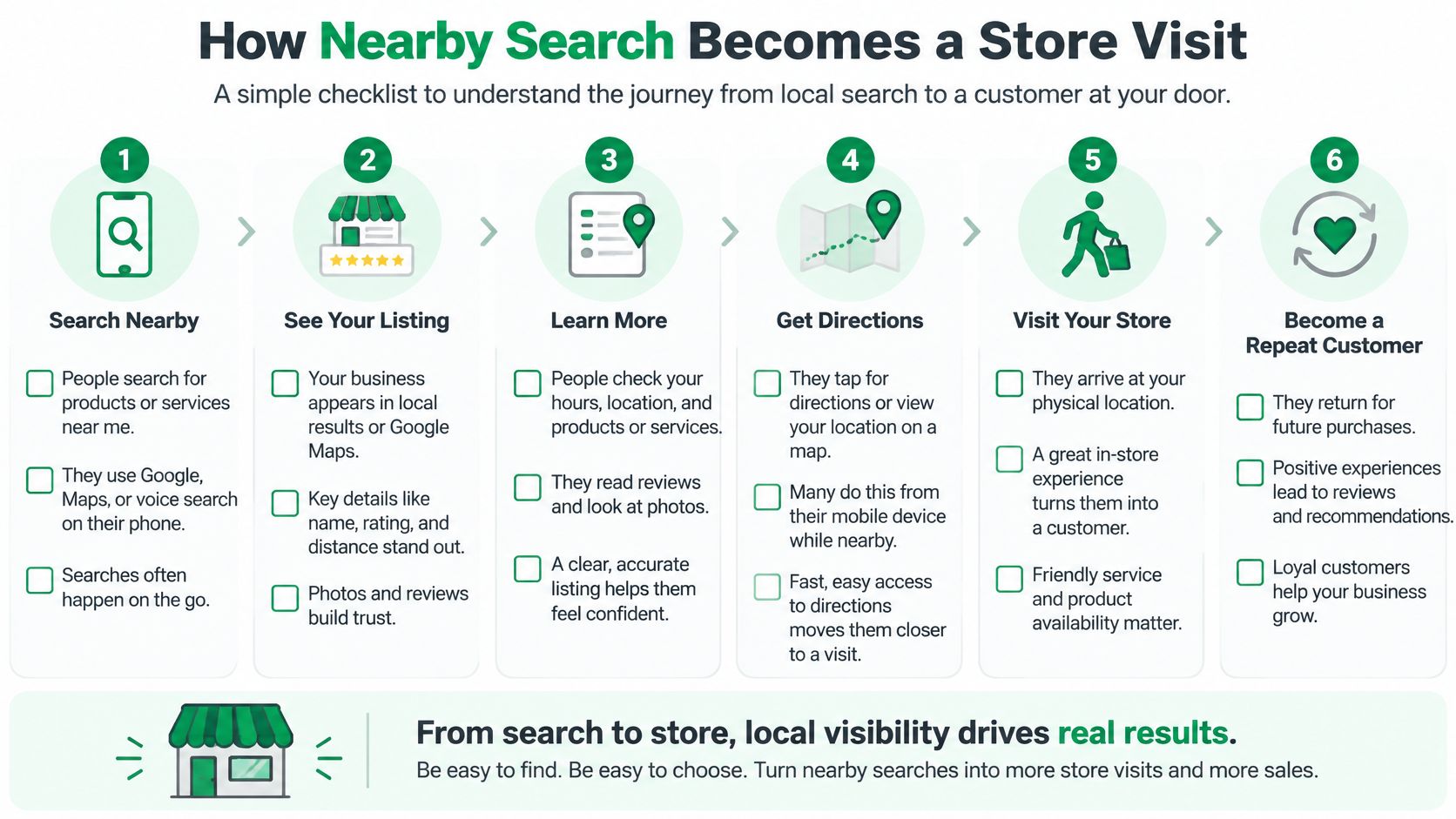
Across nine verticals, including restaurants, retail, finance, travel, and local services, Google's local search research found that 50% of people who ran a local search on a smartphone visited a store within a day, compared with 34% of people searching on a computer or tablet. Those smartphone local searches also produced a purchase within a day 18% of the time, versus 7% for non-local searches.
The person is often already close. They are checking hours, directions, or whether someone can take them today. Treat each branch as its own acquisition unit: one accurate profile, a page that names that address, a local phone number, hours, directions, and service-area or appointment detail when the concept needs it.
Presence beats a show of interest
Google Ads location settings default to people physically in a target area or people who have shown interest in it. Presence restricts delivery to people in, or regularly in, the selected locations. Radius targeting allows a minimum of 1 kilometer around a branch. Pair that ring with a separate budget, branch-specific copy, call assets, location assets, and negative locations so one franchisee's ads do not buy the next unit's trade area. Import offline conversions so a booking or in-store sale ties back to the ad and the unit.
A national average hides a dead territory and a star market in the same number. Compare impression share, direction requests, calls, booked appointments, and revenue by location. Clicks alone will not tell you which ring to fund.
This week, check three things.
- Profile accuracy: Name, category, hours, and phone match the door.
- A unique page: The address is on the page, not only on a map pin, and the corporate home is not doing that job.
- A unit-level report: You can see calls and visits for that branch before you raise its bid.
Store-radius bid adjustments belong on that same campaign, not on a national catch-all. If two units sit inside each other's ring, shrink the radius or exclude the other ZIP before you raise bids. The page and profile work that makes this hold up is the same discipline behind local SEO for franchises.
When Local Discovery Leaves Google
A lot of local intent never hits the brand site. In 2025 research of more than 1,000 consumers, covered in LT's franchise marketing study, 50% had used Instagram, TikTok, YouTube, or Reddit to find a local business. That rose to 77% of Gen Z and 65% of Millennials. Only 39% of franchisors planned to adopt AI tools within two years.
An SOCi Local Visibility Index, cited by Moon Sauce's multi-location benchmark, covered more than 350,000 locations and 2,751 multi-location brands. Average appearance in Google's local three-pack for priority terms was 35.9%, about one tracked search in three. In that same benchmark ChatGPT recommended 1.2% of brand locations, Gemini 11%, and Perplexity 7.4%.
| Surface | Result | Read for a franchise |
|---|---|---|
| Google local three-pack | 35.9% average appearance on priority terms | About one tracked search in three |
| ChatGPT | 1.2% of brand locations recommended | Rarely names a branch |
| Gemini | 11% of brand locations | Highest of the three answer engines in this index |
| Perplexity | 7.4% of brand locations | Midway among the three |
| Instagram, TikTok, YouTube, or Reddit | 50% of consumers, 77% of Gen Z, 65% of Millennials | Local search is not only Google |
| Franchisor AI adoption plans | 39% within two years | Most systems are not tooling for this yet |
And the operational read is blunt. Answer engines and social search repeat the location facts you already published. A wrong hour spreads faster than a national ad.
- Match the branch name, category, hours, and phone on the profile and the location page.
- Give that unit a small set of local posts, staff notes, and approved offers on the networks its age mix searches. Facebook still behaves like a local directory for plenty of neighborhoods, which is why Facebook search optimization belongs in the same cleanup.
- Record three-pack presence and any AI citation on that unit's row in the dashboard.
- Hold new AI software until duplicates and bad hours are gone.
Industry surveys around the same shift also describe system-integration trouble, thin skilled staff, and privacy worry once brands do turn AI on. Clean facts and a human check beat a pile of point tools. Consent stays with the person who opted in. Do not pipe a guest list into a model because a vendor demo looked clever.
Where Franchise Digital Budgets Actually Go
In 2025, pay-per-click advertising accounted for 36% of franchise digital-marketing spend, while social-media advertising accounted for 29%, according to Franchise Update Media. That finding does not break out SEO, email, or video, so those shares stay unnamed here.
| Channel | Share of digital spend | Primary job | Who steers it |
|---|---|---|---|
| Pay-per-click | 36% | Capture high-intent and near-me demand | Shared, with territory rules |
| Social media advertising | 29% | Discovery, offers, and local creative tests | Shared calendar, local posts |
Pay-per-click is the capture layer. Service terms, near-me queries, and location names, with budgets and negatives that respect territory. Social is the discovery layer. It is where local offers, staff stories, and community posts get tested without pretending every click was already in-market.
What the wider ad market is not
Those two slices lead inside franchise digital budgets. They are not the same thing as the whole internet ad market. The IAB/PwC Internet Advertising Revenue Report put U.S. internet advertising revenue at $258.6 billion in 2024, up 14.9%. Search produced $102.9 billion, 39.8% of that total. Social produced $88.8 billion, up 36.7%. Digital video reached $62.1 billion, up 19.2%, and retail media $53.7 billion, up 23.0%. Read those as channel scale. They are not the missing franchise budget shares.
A national team can set audiences, creative tests, and brand exclusions. A location or co-op fund should weight spend toward markets where calls and visits are thin, not toward the market where the brand video looks best. A blended click-through rate is a vanity read. Shift money on qualified leads or revenue per location.
Keep 36% and 29% as a benchmark, then move dollars only when a location report shows incremental leads. “More awareness” from a franchisee is not that report. If you need a working order for the rest of the mix, start from marketing budget allocation and refuse any line you cannot tie to a unit.
The spend split only stays useful if the words on the ad can survive a proof check. A cheap click that states a result you cannot document is more expensive than a missed impression.
Claims You Can Publish and Claims You Cannot
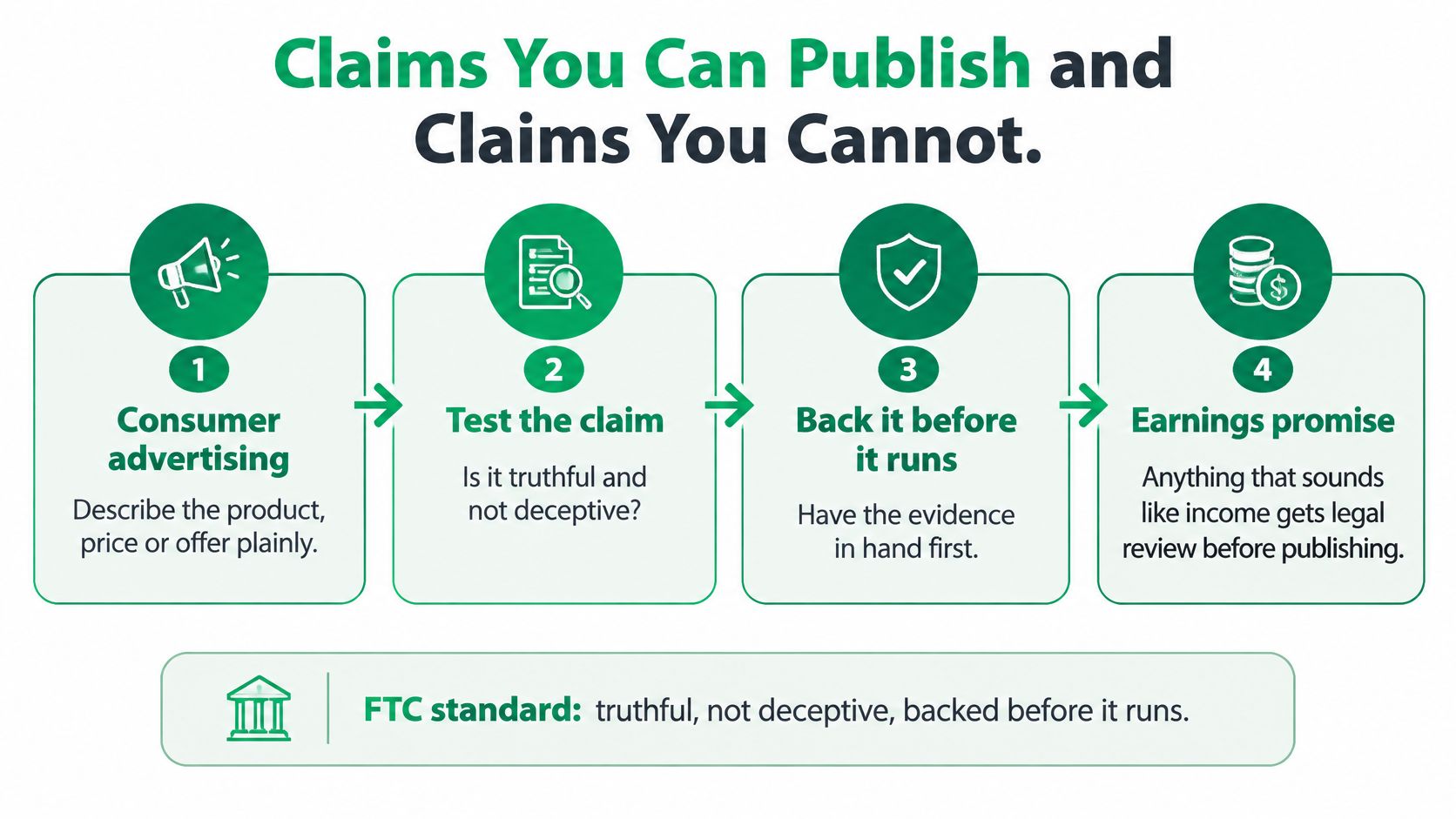
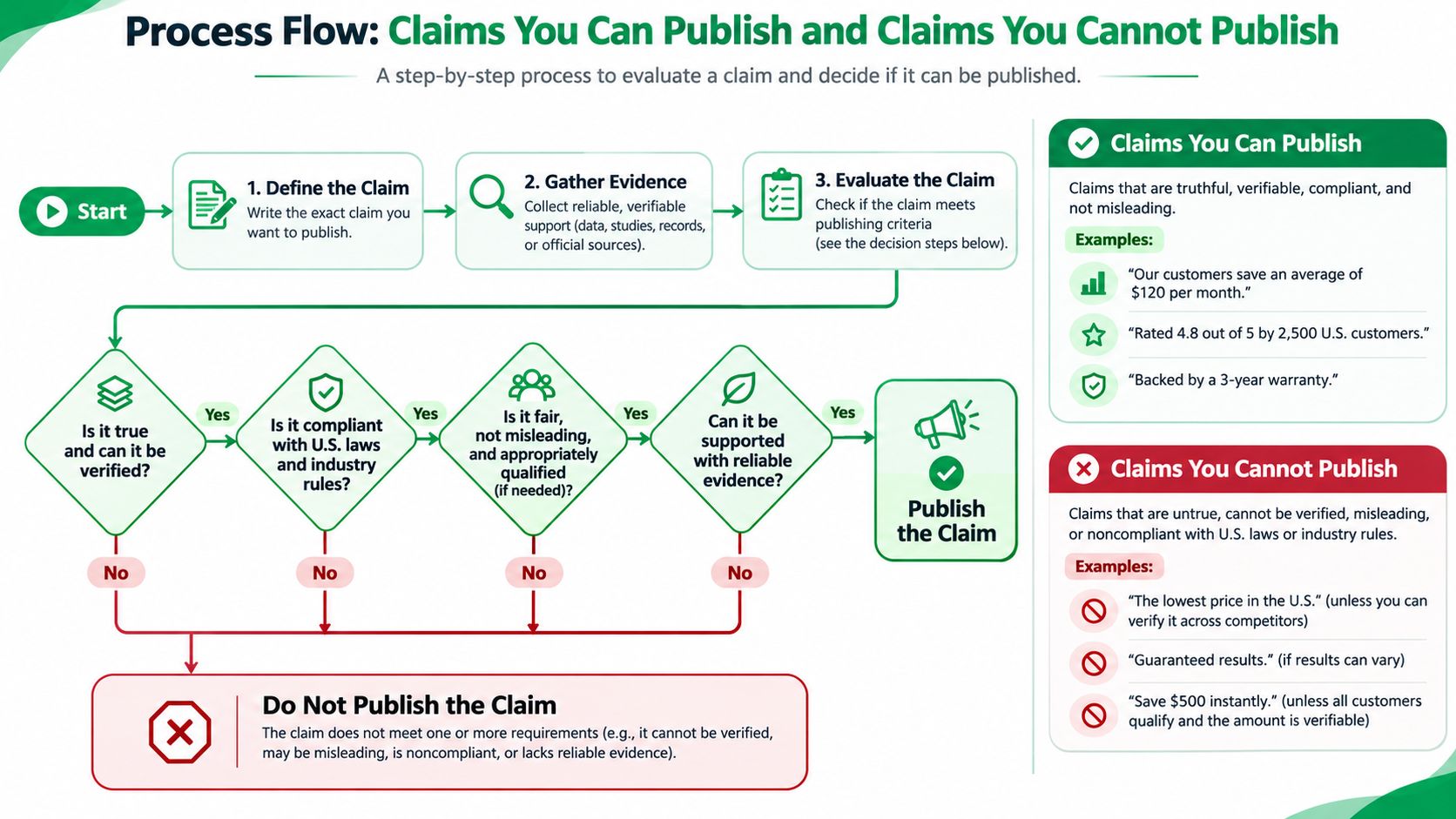
Consumer ads and earnings talk are different products. The FTC's Advertising FAQs require claims to be truthful, not deceptive, and backed by evidence before they run. The Franchise Rule adds a second bar for franchise sales: required disclosures, and substantiated earnings claims. Projected revenue, payback, growth rates, or “average franchisee” results are not ordinary promo lines. That rule hits whenever a campaign recruits owners. It is not the ad for tonight's dinner.
When a franchisor puts earnings information in general media, FTC staff guidance says there must be a reasonable basis, supporting material kept on file, underlying data prepared under generally accepted accounting principles, and a disclosure of the number and percentage of franchisees who reached the stated result in that period.
A stack that can carry a number
Build the proof before the headline.
- Systems: A location-level CRM, call tracking, ad-cost data, and point-of-sale or booking records, joined in a warehouse by franchise location ID.
- Every claim names its math: Time window, denominator, attribution rule, how many locations are in the set, and the source system. That covers revenue, leads, conversion rate, and return on ad spend.
- The dashboard tells the truth about thin data: Modeled conversions are labeled apart from verified sales. A small sample stays a small sample, not a fake systemwide average.
- Approval on creative and landing pages: A local operator cannot post a guarantee nobody can document, or edit a regulated line.
Optimize on incremental qualified leads or revenue per location. Impressions are not the decision.
Say the consumer ad reads “Most guests reorder within a week.” You need the window, the count of locations, and the sales system that produced it. Say the recruiting ad reads “Owners pay the buildout back in month eight.” That sentence waits for legal, the GAAP file, and the share of franchisees who hit it. If you cannot fill those fields, you do not have a claim. You have a wish.
Case Results Before You Add Spend

Two captures show what changed at the visit, not in a brand film. Mr. Green WiFi helped MK Investments, which operates eleven Pieology franchises in California, Minnesota, and Texas, collect 13,000 contacts in the first 10 months. In that Pieology work, special offers grew 35-40%. Jim Butler Chevrolet in Fenton, Missouri saw 6x lead generation and a 44% email open rate on the same approach.
What those operators added was a contact path at the visit, an offer a guest could redeem, and email that referred to that visit. WiFi demographics, a real read on Facebook ad return, a customer list, and automated notes for rewards or coupons are the machinery. The creative was the offer, not another national spot.
Not a forecast. Eleven restaurants are not a new franchisee's first ninety days, and a dealership's lead math is not a pizza shop's. Report contacts, offer uptake, leads, and open rate on the units that ran the offer. If you need the scorecard shape, use how to measure marketing campaign effectiveness on those units only.
The next decision is narrow. If the ownership split and the location report are already in place, fund the capture path that a unit will run. If they are not, more media only hides which location the lead belongs to.
Mr. Green Marketing, LLC builds the national and local split for multi-unit brands, from location pages and local SEO to PPC that respects territory and reporting you can read by unit. We start with a listen, then a plan tied to leads, calls, and sales rather than a blended vanity number. If you want that read on your own locations, visit Mr. Green Marketing, LLC.
Leave a Comment
sing in to post your comment or sign-up if you dont have any account.