
And there it is: a negative Google review, right beneath the photos you've worked hard to get right. You recognize part of the complaint, disagree with another part, and already have a reply forming in your head. Don't publish that version.
Knowing how to respond to negative Google reviews starts with a decision, not an apology: does this need a reply, a report, or both? Check that before drafting. Then write something the customer can act on and the next reader can trust.
Table of Contents
- Response Timing Standards to Start With
- A Five-Step Workflow for Every Negative Review
- When to Flag a Review Instead of Replying
- Reply Templates and Wording That Protects You
- Replying to Positive Reviews Too
- Set Up Your Reply Process This Week
Response Timing Standards to Start With
Say you own a bakery and notice a low-rated review late in the evening. The customer says their cake wasn't ready. You can check the collection record tomorrow, but you're wondering whether leaving the review unanswered overnight looks careless.
Morning is reasonable for an ordinary complaint. An emotional reply written without the records isn't. Still, don't let tomorrow become next week: in Customer Alliance's Online Review Survey 2024, 91% of respondents reported reading online reviews at least once a month.
Response targets for negative reviews
Use these as internal operating targets, not promises that every investigation will finish on schedule. The supporting consumer expectations come from BrightLocal's 2020 survey, where 20% expected a response within one day and only 39% were comfortable waiting longer than three days, and a summary of ReviewTrackers' 2022 survey, which reported about one-third expected a response within three days and 53% within one week.
| Stage | Target | Evidence |
|---|---|---|
| First acknowledgement | Within 24 hours | 20% expected a response within one day, BrightLocal 2020 |
| Substantive follow-up | Within 3 days | Only 39% were comfortable waiting longer than three days, BrightLocal 2020 |
| Reply to legitimate negative reviews | Within 3 days | About one-third expected a response within three days; 53% within one week, ReviewTrackers 2022 |
The same BrightLocal survey found 96% of local-business review readers read businesses' responses, 40% always did, and 70% were more likely to use a business that responded to negative reviews. The ReviewTrackers survey reported 45% were more likely to visit a business that responded to negative reviews.
That's why acknowledgement and resolution need separate deadlines. You can recognize the concern before you know whether a refund, replacement, or explanation is appropriate.
Practical rule: Respond promptly, but don't turn an acknowledgement into an unverified promise.
Route review alerts to an accountable person, using the same ownership discipline you'd apply to social media community management. Log the review's timestamp, set the acknowledgement deadline, and record when the private follow-up is due. Safety allegations or exposed personal information need immediate escalation, not the ordinary queue.
A Five-Step Workflow for Every Negative Review
A review reply is the visible part of a customer-service process. If nobody checks the records or owns the follow-up, polished wording just hides an unfinished job.
Use a repeatable sequence, with the reply-or-report decision before drafting. Google's guidance on responding to reviews recommends professional, relevant replies, timely responses, and private contact when a situation needs detailed discussion.
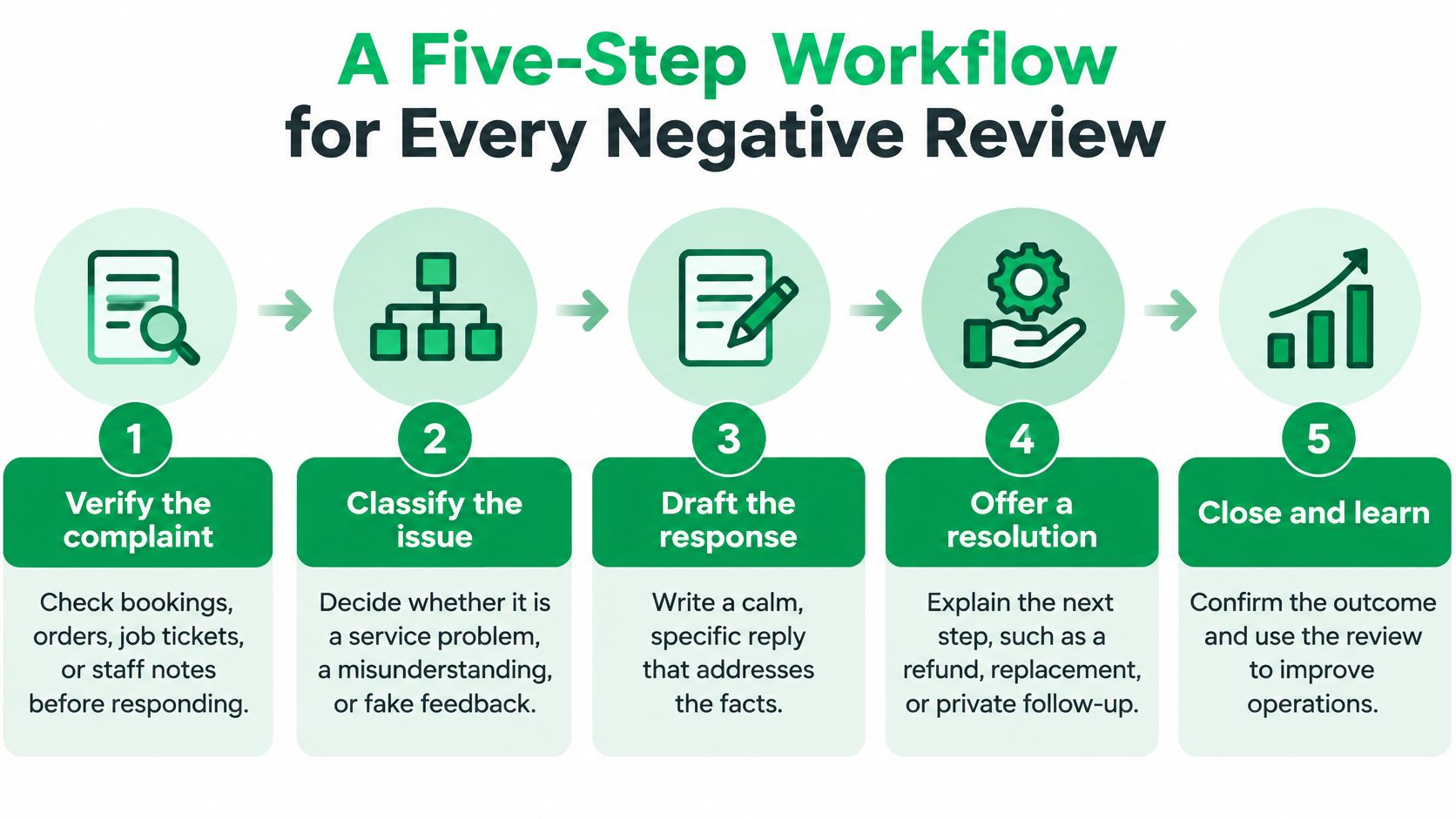
Check, classify, then write
Verify the complaint against internal records. Check bookings, orders, job tickets, delivery scans, and staff notes before confirming what happened. Skipping this can mean apologizing for an event you haven't established, but failing to match a public username to a record doesn't prove the review is fake.
Classify the issue. Mark it as a service failure, misunderstanding, policy dispute, or suspected content-policy violation. A genuine complaint needs service recovery; suspected spam needs evidence and a reporting decision, not a longer apology.
Publish a brief public response. Acknowledge the stated experience, explain the next verified action, and leave personal and transaction details out. The common slip is writing a defensive paragraph when a short acknowledgement would be clearer.
Move detailed resolution to a named private channel. Give the customer a monitored contact route and ask them to mention an existing case reference privately, if they have one. Assign the case before inviting contact, so the reviewer doesn't land in another unattended inbox.
Document the cause and corrective action. Record what failed, who owns the fix, and whether the customer received the outcome. “Reply posted” is a publishing status, not proof that the complaint is resolved.
The classification should remain provisional until the facts support it. Say a customer reports a missed contractor appointment, but the schedule shows a completed visit. Check whether the technician attended the wrong address or whether the complaint concerns a different booking before calling it a misunderstanding.
A starting template, not a finished answer
Adapt this acknowledgement to the actual complaint. Replace the placeholders, remove any claim you can't support, and use a real sign-off.
Thank you for sharing this. We're sorry the experience did not meet expectations. We're reviewing what happened and would like to look into the details privately. Please contact [named channel] and mention [reference]. – [name, role].
Don't say you're reviewing the incident unless someone has been assigned to do it. If the customer already contacted support, direct them to the existing case owner rather than asking them to restart.
Google notifies the reviewer when a reply posts, and the customer can subsequently edit their review. Treat that as an opportunity for continued communication, not an obligation to improve the rating.
A complete social reputation management process leaves a usable record behind. Each log entry should contain the classification, supporting records, reply time, private contact owner, follow-up deadline, and outcome. Another team member should be able to take over without asking the customer to explain everything again.
When to Flag a Review Instead of Replying
Disagreeing with a customer isn't a content-policy violation. Google's Maps user-generated content policies distinguish ordinary criticism from prohibited contributions, including fake engagement, paid or incentivized reviews, coordinated posting, competitor sabotage, promotional material, unauthorized personal information, harassment, personal attacks, and certain off-topic or defamatory content.
A missing customer record is a reason to investigate. Not a verdict.
Reply or flag decision for each review situation
| Situation | Action | Evidence to keep | Escalation owner |
|---|---|---|---|
| Genuine service complaint | Reply briefly and resolve offline | Reply text and internal ticket | Location manager |
| Factual dispute | Reply with what records show, without exposing private details, and invite a private check | Order or booking records | Owner or manager |
| Fake, copied or off-topic review | Flag it and post a factual reply | Screenshots and reviewer profile details | Marketing lead |
| Competitor sabotage or coordinated posting | Flag it and don't argue | Dates, post pattern and overlapping accounts | Owner, with counsel if needed |
| Harassment or personal attack | Flag it and keep any reply restrained | Exact offending text | Owner |
| Personal information posted without consent | Flag immediately and don't confirm details in the reply | Exact text and screenshot | Owner or privacy contact |
Preserve screenshots before reporting. Copy the exact problematic language, record posting dates, and retain relevant booking or order records internally. Google generally removes the whole contribution when part violates policy, so identify the specific offending content rather than submitting a complaint about the rating.
Keep escalation separate from public argument
Google's review-reporting guidance explains the reporting route and warns that a reply can take up to 30 days to be approved. Don't build an urgent incident plan around an immediate public response appearing; flag qualifying content first and submit a restrained factual reply when appropriate.
Use a clear escalation ladder:
- Location owner: Handles routine complaints and factual disputes when flagged internally.
- Manager: Takes over repeated attacks, competitor patterns, and refund disputes above the business's agreed approval limit.
- Counsel: Reviews threats, suspected fraud at scale, or personal-data exposure before further public discussion.
Assign an escalation owner at each location. Give staff and agencies explicit written authorization to reply or report on the business's behalf, and require every response to follow Google's prohibited-content rules.
If Google declines a flag, preserve the decision, date, and evidence. Keep any factual reply and don't re-argue publicly; repeated declines go to the manager, who can assess whether private contact is appropriate, without offers attached.
A missing response isn't necessarily an ignored complaint. Check publication status and possible causes of Google reviews not showing up before assigning duplicate replies.
Reply Templates and Wording That Protects You
A useful template reduces drafting time without replacing judgment. It should leave room for the actual problem, the verified next step, and the person authorized to act.
The wrong template creates extra trouble. An apology that admits an unverified failure, a refund promise nobody approved, or an accusation disguised as a correction can leave you with a second dispute.
Reply approach for each type of negative review
| Review type | Public reply should | Avoid |
|---|---|---|
| Service failure | Acknowledge the miss, apologize, offer a private contact | Excuses or naming staff |
| Misunderstanding | Restate what was agreed and explain the policy once | Arguing details in public |
| Policy dispute, such as refunds | Explain the policy calmly and invite a call | Promising a refund without authorization |
| Suspected fake or off-topic review | Give a brief factual reply, then flag the review | Accusing the reviewer of lying |
| One-line angry review | Thank them, apologize, invite contact | Matching their tone |
| Review quoting an order or contact detail | Reply without repeating the detail | Confirming the customer's order or account |
These are editable examples, not customer transcripts. Replace every bracketed field before publishing and confirm that the contact channel works.
Service failures and misunderstandings
Service failure
Thanks for letting us know about the collection delay. We're sorry your order wasn't ready when promised. Please contact [monitored channel] and ask for [manager], who can review what happened and discuss the available remedy.
Use that wording only when the delay is confirmed. Naming the failure shows attention; naming the employee responsible adds blame without helping the customer.
Misunderstanding
We're sorry the service scope wasn't clear. Our standard installation covers [verified scope]; additional work requires a separate agreement. Please contact [named contact] through [private channel] so we can compare the estimate with what you expected.
Explain the relevant scope once. Don't paste the customer's estimate or announce that they failed to read it – that turns clarification into a public reprimand.
Policy dispute
We understand you're unhappy with the refund decision. Our policy for [general service category] is [verified policy summary]. Please call [monitored number] and ask for [authorized role] to discuss how the policy applies and whether any other options are available.
A policy explains the decision; it doesn't end the investigation. Check which terms applied at purchase and whether the service was delivered as agreed before relying on the policy.
Unverified claims and limited-detail reviews
Suspected fake or off-topic review
We can't verify the experience described from the information in this review. Please contact [private channel] with the relevant details so [named role] can investigate.
Keep the reporting work separate. Don't describe the reviewer as a competitor, a scammer, or a liar because the account looks unfamiliar.
One-line angry review
Thanks for sharing your feedback. We're sorry the experience fell short. Please contact [monitored channel] and ask for [named role] so we can understand what went wrong.
There's no useful detail to correct here. Ask for the missing context privately rather than guessing which visit or employee the reviewer means.
Review containing an order or contact detail
We're sorry you've had difficulty getting this resolved. Please contact [private channel] and ask for [case owner], who can review the matter securely. Please keep any further account or contact information out of the public thread.
Don't repeat the exposed information to demonstrate that you found the account. If the post qualifies for reporting, preserve the evidence securely and follow the privacy escalation route.
Legal guardrails and the read-aloud test
The FTC's Consumer Reviews and Testimonials Rule questions and answers states that the rule took effect on October 21, 2024, permits public responses, and prohibits falsely accusing reviewers of lying or using physical threats or intimidation to force removal or changes. Courts can impose civil penalties for knowing violations.
Avoid claiming someone was never a customer unless reliable records support that claim. Even then, stating that you can't verify the described experience is usually more useful than making an absolute accusation.
Don't offer a discount or gift in exchange for changing a review. An incentive tied to revising negative feedback can create FTC compliance risk and conflict with Google's review-incentive rules; keep any legitimate service remedy independent of the review.
A remedy should address the customer's problem, not purchase a different public account of it.
If a customer threatens legal action, preserve the records, pause public replies, and bring in counsel. Leave legal threats and unsupported competitor accusations out of customer-service wording.
Read the draft aloud. Cut any sentence that defends your pride more than it helps the reviewer, particularly claims about how hard the team works or how nobody else complains.
Before publishing, check:
- Accuracy: Can you verify every factual claim?
- Privacy: Have you exposed or confirmed personal information?
- Access: Is there a named, monitored private contact?
- Authority: Can the assigned person deliver anything promised?
- Accountability: Would you be comfortable with a regulator reading the reply?
Replying to Positive Reviews Too
A profile where the owner appears only to rebut complaints can look defensive. Replying to praise shows that customer attention isn't reserved for people who threaten the rating.
In BrightLocal's 2022 survey of 1,124 U.S. consumers, 89% were fairly or highly likely to use a business that responded to all reviews, while 57% were not very or not at all likely to use one that didn't respond at all, and 52% would use a business whose owner responded only to negative reviews. In BrightLocal's 2024 survey, 88% were fairly to highly likely to use a business that responded to both positive and negative reviews.
Make praise replies specific
Thank the reviewer and mention a detail they chose to share. If they praised clear appointment updates, acknowledge that communication rather than adding a generic line about excellent service.
Keep it proportionate. A short thank-you doesn't need an upsell, a list of service keywords, or an invitation to disclose more about the job.
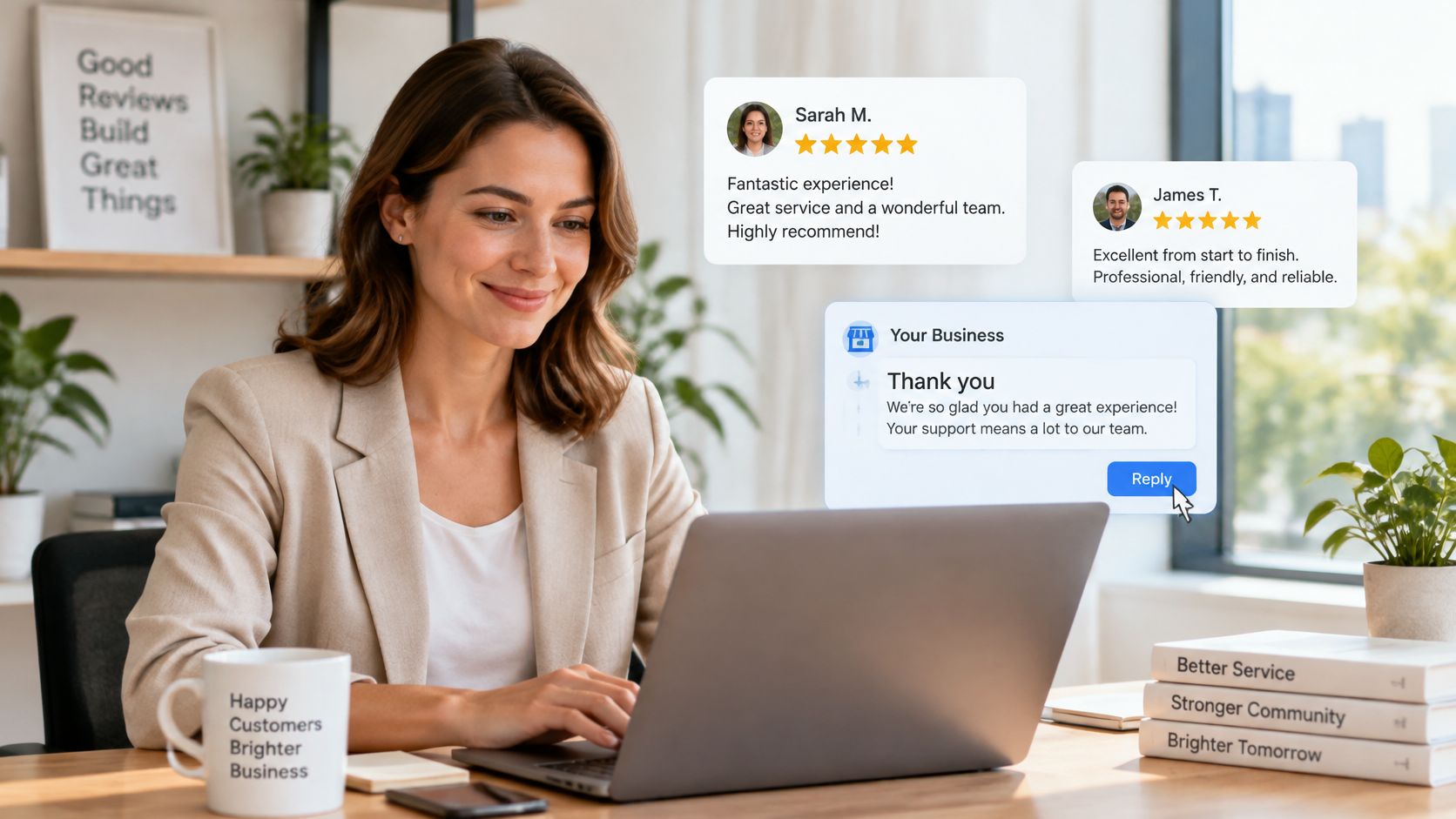
Make feedback easy to submit with a Google review link, but don't reserve invitations for customers you expect to praise you. A useful review program welcomes genuine feedback across the customer base.
Measure service outcomes, not just publishing
Track a small set of measures consistently:
- Median first-response time: Shows the typical wait without letting an unusual case dominate the result.
- Target compliance: Records the share answered within your acknowledgement deadline.
- Rating movement after resolution: Separates customer updates from the act of replying.
- Repeat-contact rate: Shows whether customers must chase an answer.
- Complaint themes by location or product: Identifies where operational changes are needed.
If response coverage rises while ratings stay flat, the publishing process may be improving while service problems remain. Don't assume staff need warmer apologies; check whether the promised corrective work happened.
Each month, send the leading complaint themes to training, fulfillment, or whoever controls website expectations. A clearer delivery promise or better booking handoff can be more useful than another template revision.
Set Up Your Reply Process This Week
Put the process somewhere staff can use it. A shared spreadsheet, approved template folder, and calendar appointment are enough to start.
- Name the owner. Assign responsibility at each location and write down who approves replies, authorizes remedies, and flags reviews. For trades businesses, make this part of the operating routine behind local SEO for contractors.
- Save the working templates. Keep the review-type examples and acknowledgement draft in an accessible folder. Add the monitored contact routes and approval names so nobody has to improvise.
- Schedule the open-case check. Give a named person responsibility for reviewing classification, reply time, follow-up deadlines, and outcomes weekly. If the backlog keeps growing, the escalation owner needs help.
Review results after the process has had time to run. A review update, returning customer, or follow-up question can indicate renewed engagement, but silence doesn't prove failure. Check that the private resolution reached the customer, then reopen unresolved cases and contact them through an appropriate existing channel.
Mr. Green Marketing, LLC offers a free audit and performance report to help identify online visibility gaps and prioritize improvements. Visit Mr. Green Marketing, LLC and enter your website, email, and name in the home-page form to request yours, then use those priorities alongside a review-response process your team can maintain.
Leave a Comment
sing in to post your comment or sign-up if you dont have any account.