
A study reported that targeted GEO changes improved visibility by up to about 40% under specific conditions, with results varying by subject area. Treat that as a possible gain, not a typical outcome.
AI answers can shape a shortlist before a customer visits any company website. GEO helps a brand earn visibility at that decision point, even when fewer people click through. Third-party sources that confirm a company's expertise may carry more weight than publishing another round of blog posts. The answer becomes a storefront window: customers can see who is mentioned before they step inside.
Table of Contents
- What Generative Engine Optimization Actually Means
- How GEO Differs From Traditional SEO
- Why AI Answers Are Reshaping Discovery
- Signals That Get Your Content Cited
- How to Start GEO Without Rebuilding Your Site
- How to Measure GEO Results Honestly
- GEO in Practice Across Three Business Types
- Run Your First GEO Baseline This Month
What Generative Engine Optimization Actually Means
Google searches do not always send people to websites. In March 2025, 18% of Google searches produced an AI-generated summary, according to Pew Research Center's analysis of Google AI summaries. For a business, GEO is a way to build visibility in those answers, including when a reader does not click through.
Traditional SEO can help put your book on a library shelf with a clear catalogue card. GEO asks whether the librarian can find a useful passage and quote it when someone asks a question. The two can support each other, but appearing in an answer is a distinct kind of visibility.

Where the Term Came From
The term gained a research definition in 2023 through the study “GEO: Generative Engine Optimization,” by researchers at Princeton University and other institutions. The study tested how changes to content affected its visibility in generated answers. It reported that some optimization methods improved visibility by up to 40% in its experiments. That is a maximum experimental result, not a typical outcome or a promise for every business.
The study's approach treats AI systems as something to test from the outside: researchers submit queries, change the content, and observe the answers. You do not need to know a system's internal workings to check whether your material is being cited or represented accurately. Results differed by subject, so a tactic that helps one type of page may have little effect on another. A universal checklist cannot account for those differences. The 2026 review published by Black Alpaca discusses the study's methods and findings.
Three Things GEO Is Not
- Not a replacement for SEO: AI systems still need to find and understand your pages, so clear structure and accurate content remain useful.
- Not a special file: There is no proprietary AI tag or new machine-readable file that guarantees inclusion.
- Not a guaranteed placement: Answers can vary across queries and engines. GEO is an effort to improve your chances of being included, not a promise of visibility.
Try a small baseline before spending on changes. Ask an AI assistant five questions a real customer might ask before buying. Record whether your business appears, which competitors are named, and which sources the answer cites. That gives you a starting point for checking visibility and accuracy, and may show whether third-party sources already provide the confirmation your own site lacks.
How GEO Differs From Traditional SEO
| Criterion | Traditional SEO | Generative Engine Optimization |
|---|---|---|
| Main goal | Rank a page in the list of blue links | Be selected, summarized or cited inside the generated answer |
| Where success appears | Position in the results list | Mention or citation inside the AI answer |
| Unit of work | Pages and keyword targets | Claims, entities and passages an AI can reuse |
| Typical query style | Short keywords | Longer, conversational and comparative questions |
| Core signals | Keywords, backlinks, page speed, internal links | Statistics, quotations, external citations, consistent business facts, third-party confirmation |
| Traffic outcome | Click through to the website | Can shape a decision before a click, or replace the click |
| Measurement | Rankings, organic sessions, conversions | Mention rate, citation rate, answer accuracy, branded searches |
The table looks neat. Practice is messier, because the two disciplines overlap heavily. Keywords and backlinks still matter, but they're necessary, not sufficient. A generative system has to retrieve material, verify it well enough to reuse it, synthesize several sources into one answer, and decide who gets attributed, as described in Princeton's record of the KDD 2024 GEO study. A page can satisfy a search engine and still give an AI system nothing clean to quote.
A Plumber Who Ranks but Disappears
Picture a hypothetical plumber whose service page ranks third for a local search term. Solid SEO work. Then a homeowner asks a longer question about emergency repair costs and response times, and the AI answer names three local plumbers. This plumber isn't one of them, and his page isn't among the sources.
Nothing is broken. The ranking is real, and the absence is also real. His page lists services but buries pricing, doesn't state response times plainly, and carries opening hours that conflict with a directory listing. The system picked sources it could summarize with confidence.
The Traffic Difference
SEO usually wins you a click. GEO can shape a decision before any click happens, or it can replace the click entirely because the answer satisfied the person on the spot. That's uncomfortable if you judge marketing only by sessions, but it's the honest trade. Visibility inside an answer can build awareness even when your traffic graph falls.
None of this means starting over. GEO builds on crawlable pages, accurate on-page text, and a clear site structure, which is why it belongs inside your thinking about what an SEO strategy should cover rather than beside it.
Rule of thumb: Keep SEO as the base. Add GEO as the layer that makes your facts easy to quote.
Why AI Answers Are Reshaping Discovery
Pew Research Center's browsing analysis recorded 68,879 Google searches and found an AI summary in 18% of them. In a separate survey of 900 U.S. adults, 58% had seen at least one summary. These are different measures: one tracks searches, the other people.
| Measure | Result |
|---|---|
| Google searches that showed an AI summary | 18% of 68,879 searches |
| Participants who saw at least one summary | 58% of 900 adults |
| Visits that clicked a traditional result, summary present | 8% |
| Visits that clicked a traditional result, no summary | 15% |
| Pages where the session ended, summary present | 26% |
| Pages where the session ended, no summary | 16% |
The click figures show why discovery is changing. When a summary appeared, people clicked a traditional result in 8% of visits, compared with 15% when no summary appeared. The session figures add context: people ended browsing on 26% of pages with a summary, versus 16% without one. An answer can resolve a question before a site visit.
That does not make visibility less valuable. It changes what visibility can do. Being named or cited in an AI answer may build awareness and shape a buyer's shortlist, even when fewer people click through. GEO is a channel for being present during research, not only a route to website sessions.
The shift also goes beyond Google's search page. McKinsey's 2025 survey of 1,927 U.S. consumers found that 50% intentionally sought AI-powered search, as summarized in a 2026 summary published by DeepSmith. A separate Pew Research Center survey found that 34% of U.S. adults had used ChatGPT, including 58% of adults younger than 30, according to Pew Research Center's survey of 5,123 U.S. adults. These figures describe different behaviors, but both point to people choosing AI tools to find answers.
Who Should Care Most
Businesses whose customers research before buying should pay attention. Local-service customers compare quotes and credentials. Ecommerce shoppers weigh products against alternatives. B2B buyers form shortlists before speaking with sales. In these cases, third-party corroboration can carry more weight than publishing another round of blog posts. Independent sources that confirm your expertise help an AI system present your business with confidence.
Signals That Get Your Content Cited
A page gives an AI system more to work with when its claims are specific, attributable, and easy to check. Three signals have research support: statistics, quotations, and external citations. A useful analogy is a well-labeled file: numbers make claims precise, named speakers show who said what, and citations let a reader trace the evidence. These signals can make a passage easier to identify and verify, though they do not guarantee a citation.
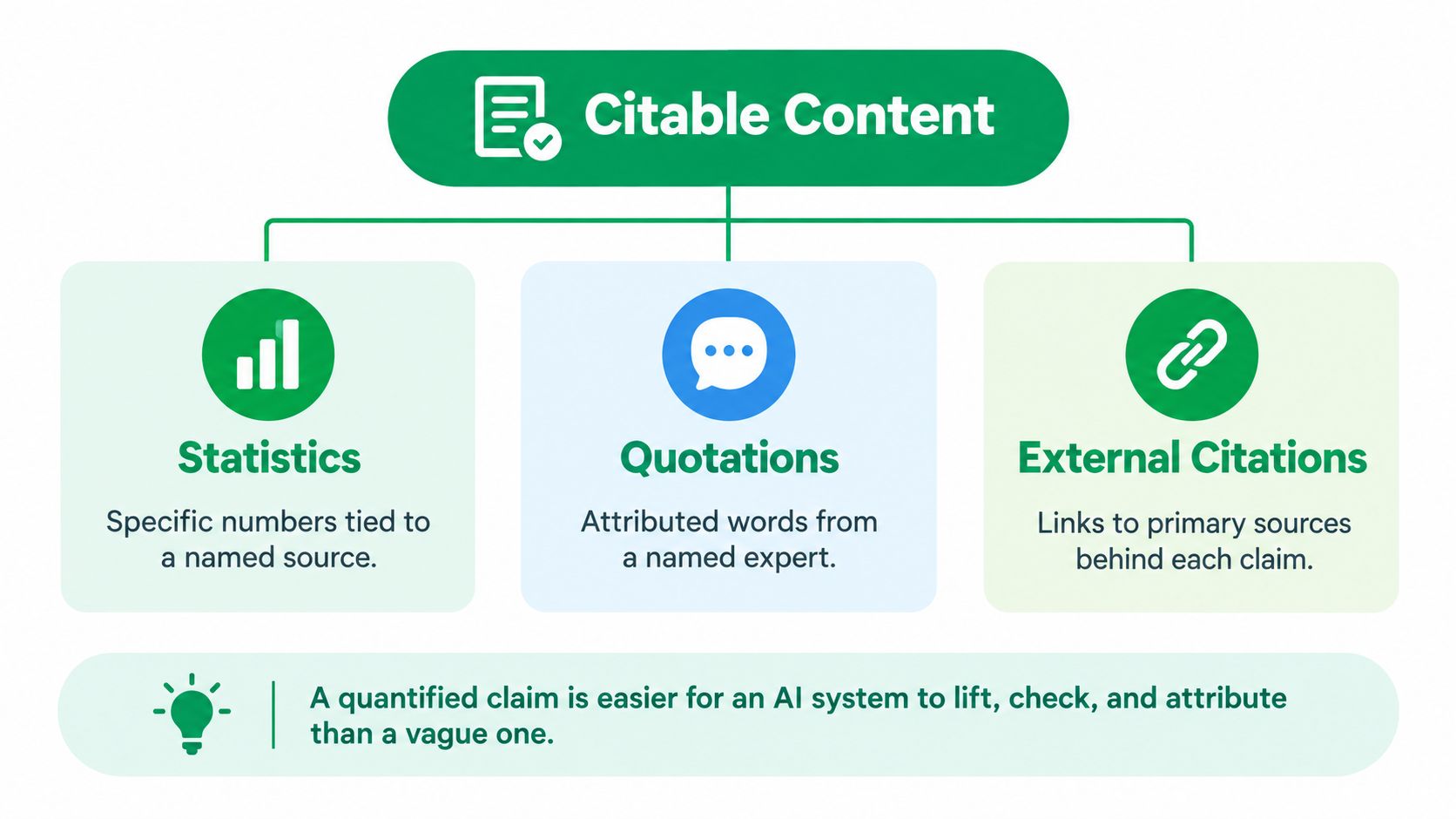
Compare a vague line such as “Trusted by many happy customers” with a claim that gives a specific, dated result and explains where it came from. The first is difficult to check or attribute. The second gives a system clearer material to work with, and gives a reader a way to assess the claim.
| Signal | What It Looks Like on the Page | What the Evidence Supports |
|---|---|---|
| Statistics | Specific, dated numbers placed beside the claim | The original GEO benchmark reported about 41% relative gain from statistics. |
| Quotations | Named expert speakers with credentials, quoted in full | The original benchmark reported about 28% relative gain from quotations. |
| External citations | A link to the original study or source beside each claim | The original benchmark tested source citations as a content feature. A later analysis reports a different estimate, which should be treated cautiously. |
| Direct answer block | A clear answer in the first two or three sentences under each question heading | The cited research does not quantify this as a separate effect. Test it on your own prompts. |
| Consistent business facts | The same name, address, hours, and prices on the site and in directories | No reliable figure is established here. Consistency still helps people and systems check basic details. |
| Third-party confirmation | Mentions in neutral publishers, trade groups, reviews, and public databases | A comparative study examines how generative search systems use different source types. Its findings support testing third-party visibility, not a universal preference claim. |
How to Read the GEO Figures
The original benchmark's reported effects are the clearest figures to use here: about 41% relative gain for statistics and about 28% for quotations, as summarized in Omnibound's roundup of answer engine statistics. A later secondary analysis gives larger estimates for statistics and citations, but those figures do not align with the benchmark summary or the article's broader account of the study. Without a matching primary-source breakdown, the larger estimates should not be presented as settled effects. The 2026 analysis of the study by Ken Imoto is useful context, not a reason to treat those estimates as definitive.
The practical lesson is more modest than a promise of a particular lift. Evidence-rich content is worth testing, while the size of any effect may vary by query and field. A comparative study of generative search systems examines the role of earned media and third-party sources, as described in the arXiv comparative study of generative search systems. That makes outside corroboration a sensible part of a visibility strategy. It also means publishing more blog posts is not always the best next move: an independent mention, review, or trade-group listing may add evidence your own site cannot provide.
Practices the Table Cannot Show
- Make claims specific and dated. Give figures context, including what they measure and when they apply. If you cannot support a number, leave it out.
- Put the source beside the claim. A citation immediately next to a material statement is easier to check than a source buried in a footer.
- Identify quoted experts. Include a speaker's name and relevant credentials. If you use structured data, keep it consistent with visible page content, following this guide to schema markup for SEO.
- Separate topics with clear headings. Give definitions, comparisons, methods, and limitations distinct sections so readers can find the answer they need.
The right mix may differ across health, finance, retail, and local services, so treat these practices as hypotheses to test, not a universal formula. Update one page with a specific statistic and a nearby citation, then compare how it appears for the same prompts after several weeks. A change in citations can build awareness even when it does not produce a click, but one test cannot establish a general effect.
How to Start GEO Without Rebuilding Your Site
You don't need a new website. You need a short list of real questions, a handful of upgraded pages, and facts that agree with each other everywhere they appear.
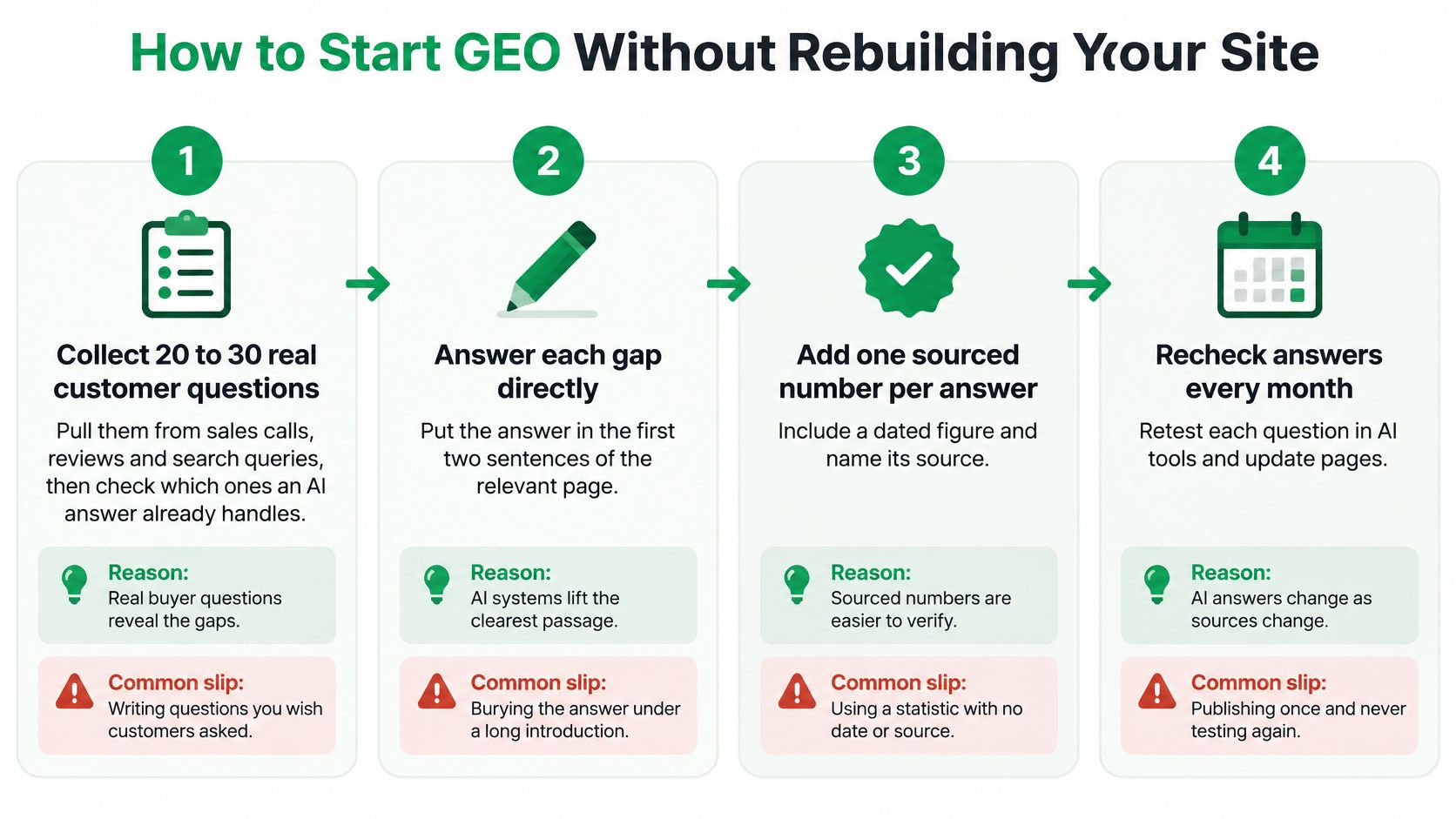
Write down 20 to 30 real customer questions. Pull them from sales calls, reviews, support tickets, and the search queries already reaching your site. Generic prompt lists miss your market, your prices, and your service area. Common slip: writing the questions you wish customers asked.
Pick the 5 to 10 pages that answer those questions. Rewrite the opening of each one into a direct answer, two or three sentences that stand on their own. A system lifts the clearest passage it finds. Common slip: burying the answer under a long, warm introduction about your company history.
Audit your business facts everywhere. Check your website, Google Business Profile, directories, and marketplace listings for mismatches in name, address, hours, service area, and pricing. Conflicting facts give a system a reason to distrust all of them. Fix every mismatch, even small ones.
Confirm your structured data matches your visible text. Google says publishers do not need to create new machine-readable files, AI text files, or special schema.org structured data for inclusion in AI features, per Google's documentation on AI features in Search. So skip invented markup. Ordinary technical accuracy beats speculative tags.
List five claims you want AI systems to repeat. Keep them narrow and provable, such as your licensing, your response time, your service area, or a product specification. Then identify neutral sources that could confirm each one, including trade associations, a local chamber, customer reviews, and industry publications. At this point, an SEO content strategy widens into an evidence strategy.
Earn at least three confirmations per claim over the quarter. Contribute expert commentary, supply data to a sector report, answer questions where buyers gather, and ask satisfied customers for reviews. Genuine contributions, not paid placements dressed up as consensus. Manufactured agreement tends to look exactly like what it is.
Re-run the prompt set monthly and log what changed. Same questions, same engines, dated notes. Answers drift as sources change, and you'll never spot the drift from memory.
A finished first cycle looks modest. A short list of upgraded pages with direct answers. A fact sheet that matches across your site and third-party listings. And a dated baseline you can compare against next month, which is worth more than a pile of new blog posts nobody tested.
How to Measure GEO Results Honestly
| Metric | How to Check It | What It Tells You |
|---|---|---|
| Mention rate | Run the same prompt set on each AI answer engine and count answers that name the brand | Whether you are part of the conversation at all |
| Citation rate | Count answers that link to your domain | Whether AI systems treat your pages as sources |
| Cited URL | Record which page each citation points to | Which content earns citations and which needs work |
| Answer accuracy | Compare each claim in the answer against your verified facts | Whether wrong information about your business is spreading |
| Competitor presence | Log which competitors appear in the same prompts | Your share of voice in the category |
| Branded searches | Track searches for your company name in Search Console or analytics | Awareness that may follow AI exposure |
| Direct traffic | Watch direct visits and returning visitors over time | Visits that may come from people who saw you in an answer |
| Calls and store visits | Use call tracking and location data | Actions that clicks alone would miss |
The method is unglamorous. Choose about 25 prompts that reflect real buying questions, run them on each major AI answer engine at the same interval, and log the results in a spreadsheet. Segment by market, device, and query type, because a single sitewide score hides exactly the differences you need to see.
Why One Run Proves Nothing
AI answers vary between runs. Ask the same question twice and you can get different sources, different orderings, sometimes different facts. So run each prompt more than once before you conclude anything, and record the variation instead of cherry-picking the run where you looked best. That's the part vendors skip.
The Click Problem, Stated Plainly
Pew data showed clicks on links inside AI summaries in only about 1% of visits, a figure reported in Mashable's coverage of the AI Overviews traffic study. Judging GEO on referral sessions alone will make good work look like failure. Judge it on inclusion plus downstream signals, branded searches, direct visits, calls, and sales, and keep that reporting discipline inside your regular analytics and reporting routine rather than in a separate dashboard nobody reads.
Being selected as an answer source and driving a click are two different outcomes. Report them on two different lines.
Keep owned-content visibility and third-party citation presence separate too, because they respond to different actions. Your page edits affect the first. Your outreach and reputation affect the second. And check your own analytics before accepting any platform's claim about click quality. Your numbers outrank their press releases.
GEO in Practice Across Three Business Types
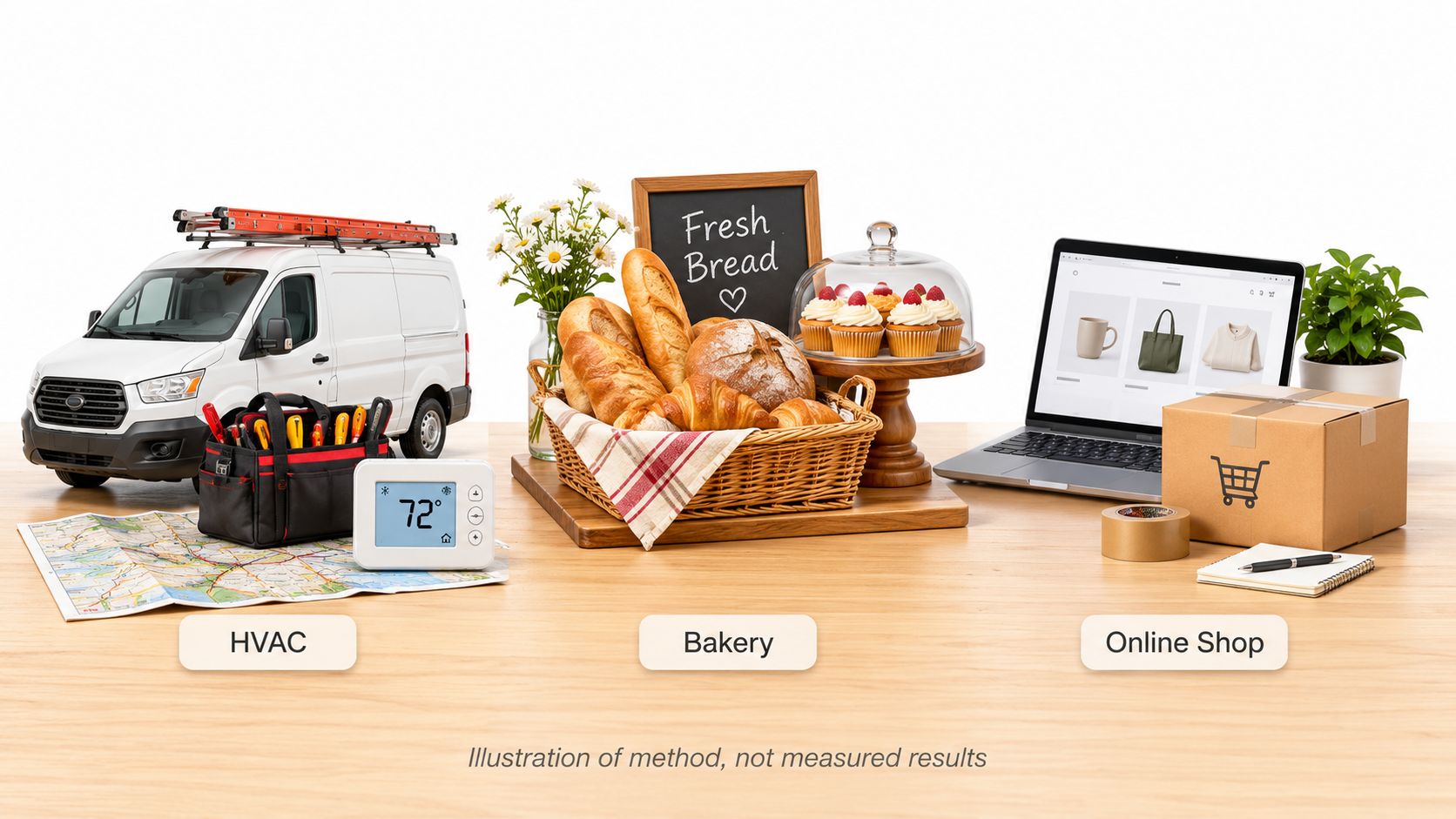
The three examples below are hypothetical. They're illustrations of method, not measured results, and each one shows a different kind of gap.
A Regional HVAC Company
A homeowner asks what an emergency furnace repair costs locally and who can come out today. The company's website is accurate, but its service area, pricing ranges, and licensing appear only on that site, while directories still list outdated hours. Nothing outside its own domain confirms the facts.
The fix is specific. Add a direct answer at the top of the main cost-of-repair page, correct the directory data, and secure a listing with a state trade association that repeats the licensing details. Track mention rate for local repair prompts. Problems like this are common in SEO for service-based businesses, where a single stale listing can undermine an otherwise accurate site.
An Online Seller of Cast-Iron Cookware
A shopper asks which cast-iron pans work on induction cooktops. The seller's listing describes the pan warmly but never states the material composition or heat-source compatibility, so answers recommend competitors whose specifications are explicit. The product was suitable all along. The page just never said so in a form a system could extract.
The fix: add a specification table to the product page covering material, base diameter, and compatible heat sources, then pursue a review in an independent cooking publication that tests induction performance. Track citation rate and branded searches, since a named recommendation may send people looking for the brand later rather than clicking immediately.
A B2B Software Startup
A buyer asks for tools that solve a narrow workflow problem. The startup's blog explains its product accurately, but no neutral source mentions the company at all, so answers list established rivals. Publishing ten more posts on its own domain wouldn't change that. The gap isn't content volume. It's corroboration.
The fix: contribute a dataset to an industry report, speak at a sector event, and get quoted in trade coverage so the company appears in third-party text tied to the problem it solves. Track mention rate across competitor prompts.
Notice the common thread. Each case started with a specific prompt, a specific gap, and a source outside the company's own website. None of them started with a content calendar.
Run Your First GEO Baseline This Month
Make one decision first. Spend nothing new until a baseline exists. A baseline turns GEO from an opinion into a measurement, and it costs you a few hours rather than a budget line.
- Run 25 buying-question prompts on at least three AI answer engines. Record the baseline mention rate, citation rate, cited URL, and answer accuracy for each one, with dates.
- Pick the single page that answers your most valuable prompt. Apply the signal fixes, a direct opening answer, one sourced statistic, one external citation, and correct any factual mismatch you find elsewhere.
- Re-run the same prompts after six weeks. Compare the results, segmented by query type, and note which answers changed and which stubbornly didn't.
Then let the baseline set your next move. If your business already appears in most answers with accurate facts, shift your effort toward conversion and branded demand, because visibility isn't your bottleneck. If it appears in none of them, prioritize third-party confirmation and fact consistency across directories and listings before you write anything new.
Measure what the AI says about you before you pay to change it.
If you'd like that baseline run for you, Mr. Green Marketing, LLC offers GEO work that maps the prompts your buyers ask, checks where your brand is mentioned or cited against competitors, and fixes the pages and third-party facts that keep you out of answers. Visit the site to request a free audit and see exactly what AI systems are saying about your business today.
Leave a Comment
sing in to post your comment or sign-up if you dont have any account.