
An SEO strategy is the coordinated, ongoing process of making a website easy for search engines to discover, understand, index, and rank while making sure people choose and engage with its listing. Google held 89.94% of worldwide search-engine market share in September 2026, which helps explain why businesses still build their strategy around search visibility.StatCounter
Table of Contents
- Introduction
- What Is SEO Strategy in Plain Terms
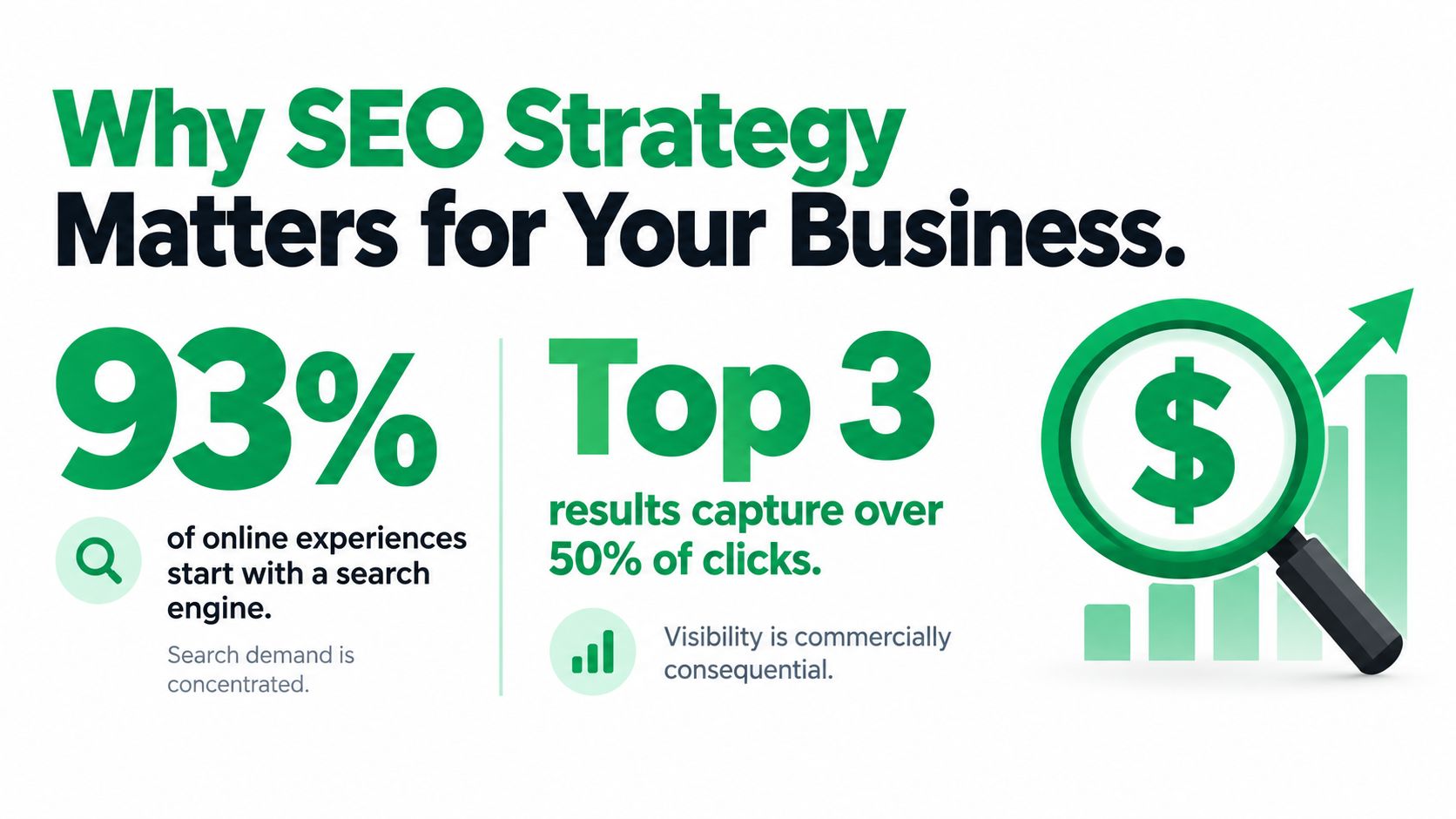
- Why SEO Strategy Matters for Your Business
- The Core Components of an SEO Strategy
- Building Content That Earns Trust and Rankings
- How to Prioritize Your SEO Efforts and Align With Business Goals
- Measuring SEO Success When AI Changes Search
- Conclusion and Your First Step Forward
Introduction
A local business owner publishes twenty blog posts, rewrites a few titles, and waits for visitors. The phone stays quiet. Search Console shows impressions, but the important service pages barely appear. After a while, the question becomes uncomfortable: is SEO a scam?
Usually, the problem isn't effort. It's the missing strategy behind the tactics.
SEO strategy connects technical access, useful content, search intent, internal links, user experience, and business measurement into one operating system. It helps search engines understand a site and helps people decide whether to visit it, which is how Google describes SEO in its starter guide.
That distinction matters. Publishing another article won't solve a page blocked from crawling. Ranking for a broad keyword won't help if the visitor needs a local service page. More traffic isn't automatically progress if those visitors never become leads, customers, or repeat buyers.
This guide builds the idea from the ground up. You'll see how search engines discover and process pages, which components depend on one another, how to prioritize work when resources are limited, and how AI-generated summaries are changing the way teams measure success. For a wider view of digital growth, learn how to grow your business online, but keep this principle close: SEO is a prioritization and measurement system, not a publishing quota.
What Is SEO Strategy in Plain Terms
Think of Google as the busiest street in your market. Your website is a storefront on that street. The pages are your displays, the technical setup is the building access, and your search listing is the sign that persuades someone to walk in.
SEO strategy is everything you coordinate to make that storefront discoverable, understandable, useful, and worth visiting.
Core definition: SEO strategy is a coordinated system for making a website discoverable, crawlable, indexable, understandable, and valuable for defined search intents.
Google's search engine is fully automated. Crawlers explore the web continuously, usually finding new pages through links from pages Google already knows. XML sitemaps identify URLs that matter and can help search engines prioritize crawling.Google's explanation of crawling and indexing describes three practical stages.
Discovery comes first
Search engines need a path to the page. Crawlable internal links and XML sitemaps provide that path. A page with no useful links pointing toward it can become an orphan, even if the page contains excellent writing.
This is why a strategy begins with access. Check robots.txt, internal links, redirects, status codes, and sitemap coverage before commissioning a large content campaign.
Indexing decides whether the page enters the library
After discovery, a search engine evaluates whether it can process and store the page. Canonical signals, noindex directives, duplicate URLs, blocked resources, and incomplete rendering all influence what gets understood and retained.
A service page marked noindex won't compete reliably. Neither will a page whose key content depends on resources Google can't access properly.
Ranking and presentation connect the page to a query
A page can be discovered and indexed without appearing prominently for a valuable search. Ranking depends on the page's relevance, usefulness, clarity, technical quality, and other signals. Presentation matters too. A descriptive title and a useful meta description can help a searcher choose your result over another listing.
Keywords are only one input. A working strategy also coordinates crawlability, information architecture, content quality, metadata, internal linking, technical performance, and measurement. The pieces reinforce one another. A clear site structure helps crawlers and visitors. Strong content needs an accessible page. Measurement tells you which work deserves more attention.
Why SEO Strategy Matters for Your Business
Demand in search is concentrated, but market share alone is not the business case for SEO. Search visibility can put a service, product, or explanation in front of people who are already looking for a solution. The strategic question is which searches deserve attention and whether those visits can support a real business outcome.
Organic search also offers a compounding acquisition channel. BrightEdge's 2019 channel analysis found that organic search generated 53.3% of average trackable website traffic, while organic and paid search together accounted for 68%.BrightEdge's channel analysis Treat those figures as a historical reference, not a current universal benchmark. Their lasting lesson is simpler: search can represent a substantial source of demand, but its value depends on relevance and conversion.
SEO is not a one-time website launch task. Search engines keep crawling, indexing, interpreting, and displaying changing content. Your business changes too. Services, inventory, competitors, customer language, and search results all shift over time.
AI-generated search summaries add another reason to measure carefully. A page may influence a decision without receiving a click, while a poorly aligned page can attract visits that never become inquiries. A strategy should therefore prioritize fewer, better-aligned assets over a large library built without a clear purpose.
The business case reaches beyond rankings. Connect impressions and clicks to qualified visits, leads, sales, revenue, and conversion rate. A high-ranking page that attracts people who cannot buy from you may be less valuable than a lower-volume query producing serious inquiries. For a practical look at outcomes, review the benefits of SEO for small businesses.
The Core Components of an SEO Strategy
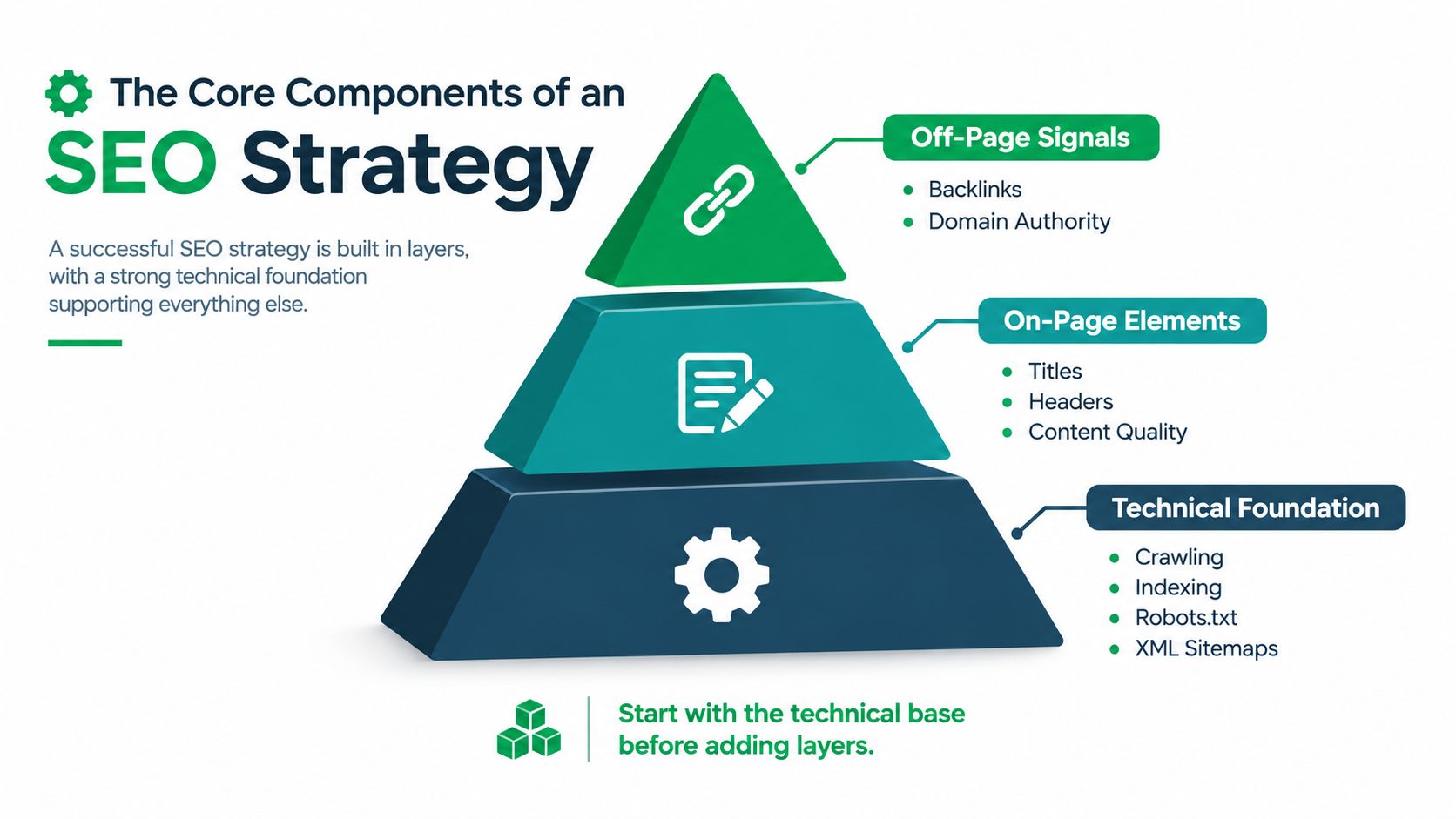
The best order follows dependency, not popularity. Start with the conditions that allow search engines to access a page. Then decide which searches matter, improve the page, create or update useful content, and build authority where it supports a real business objective.
1. Technical foundation
Audit crawling and indexing first. Review robots.txt, XML sitemaps, canonical URLs, redirects, HTTP status codes, internal links, and noindex directives. Google identifies crawlable links, valid metadata, robots meta directives, and X-Robots-Tag controls as central to discovery and indexing.Google's technical SEO guidance
A blocked, orphaned, incorrectly redirected, or noindex page can't reliably compete, no matter how polished the copy is.
2. Audience and query research
Research should answer more than “Which keyword has demand?” Ask what the searcher wants to do. A query may seek an explanation, a local provider, a product, a comparison, or a specific brand. Map those intents to pages that can satisfy them.
A plumber may need a service page for emergency repairs, not another general article about plumbing. An online retailer may need accurate product data and category navigation before it needs more blog content.
3. On-page optimization
Give each important page a clear role. Use a descriptive title, useful headings, concise metadata, a logical URL, relevant internal links, and copy that answers the searcher's question. Internal links also help distribute context and guide visitors toward the next useful action.
Structured data can make a page eligible for enhanced search features when implemented according to supported guidelines. It doesn't guarantee higher rankings. Google supports JSON-LD, Microdata, and RDFa, and marked-up pages must remain accessible to Googlebot.
4. Content aligned with intent
Content should solve a defined problem for a defined audience. That may mean a service page, product page, location page, comparison, guide, FAQ, or update to an existing asset. Word count isn't the strategy. Relevance, completeness, first-hand usefulness, and a clear next step matter more.
5. Authority and user experience
Relevant links from other sites can support authority, but link acquisition shouldn't become a numbers contest. Pursue recognition that makes sense for the business and topic.
Technical experience matters after the visitor arrives. Google's current Core Web Vitals targets are Largest Contentful Paint of 2.5 seconds or less, Interaction to Next Paint below 200 milliseconds, and Cumulative Layout Shift below 0.1.Google's current performance guidance Treat these as engineering targets, not a substitute for useful content or relevance.
| Component | What It Does | What Breaks Without It | Typical First Fix |
|---|---|---|---|
| Technical foundation | Makes priority pages accessible and processable | Pages remain undiscovered, excluded, or misunderstood | Audit crawl paths, directives, redirects, and sitemaps |
| Audience and query research | Connects pages to real search needs | Content attracts the wrong visitors | Group queries by intent and business value |
| On-page optimization | Clarifies each page's topic and action | Searchers and crawlers see an unfocused page | Rewrite the title, headings, metadata, and internal links |
| Content | Answers the searcher's problem | The site has no useful destination for important journeys | Improve or create the page with the clearest commercial role |
| Authority and experience | Builds confidence and reduces friction | Strong pages struggle to earn attention or convert | Demonstrate expertise, improve templates, and earn relevant mentions |
Building Content That Earns Trust and Rankings
Calling a page “expert advice” doesn't make it authoritative. Readers and search systems need evidence that the writer understands the subject and can help someone act on the information.
Google frames content quality through E-E-A-T, meaning experience, expertise, authoritativeness, and trustworthiness. The added experience element recognizes first-hand knowledge, such as using a product or performing a service.Google's guidance on helpful content and E-E-A-T
For a small business, first-hand experience can be concrete. A contractor can explain what happens during an installation. A retailer can compare products handled by its team. An accountant can clarify the questions clients repeatedly bring to consultations. Those details make content useful because they come from the work itself.
Google's August 2022 helpful-content guidance also applies a people-first test. A site should have an existing or intended audience, a clear primary purpose, evidence of first-hand expertise, and content that leaves readers able to accomplish their goal. It warns against producing material mainly to attract search traffic, chasing unrelated popular topics, or choosing a word count because a search engine supposedly prefers it.
A practical content filter
Do:
- Name the audience: Write for a customer you can describe, not an abstract traffic segment.
- Show experience: Include process details, constraints, examples, and decisions drawn from real work.
- Cite carefully: Support factual claims with trustworthy sources and keep information current.
- Give the reader a next step: Make it clear what to check, compare, prepare, or ask.
Don't:
- Publish unrelated topics: A popular query isn't automatically relevant to your business.
- Inflate thin pages: Extra paragraphs can't repair a missing answer.
- Hide authorship: Expertise is easier to evaluate when the author and business are identifiable.
- Confuse guidelines with rankings: Google's Search Quality Rater Guidelines help evaluators judge helpfulness, but Google says those guidelines don't directly change rankings.
A focused SEO content strategy gives every asset a job. Sometimes that job is attracting an early researcher. Sometimes it's answering a product question or helping a ready buyer contact the business. The strongest editorial calendar reflects those roles instead of treating every post as interchangeable.
How to Prioritize Your SEO Efforts and Align With Business Goals
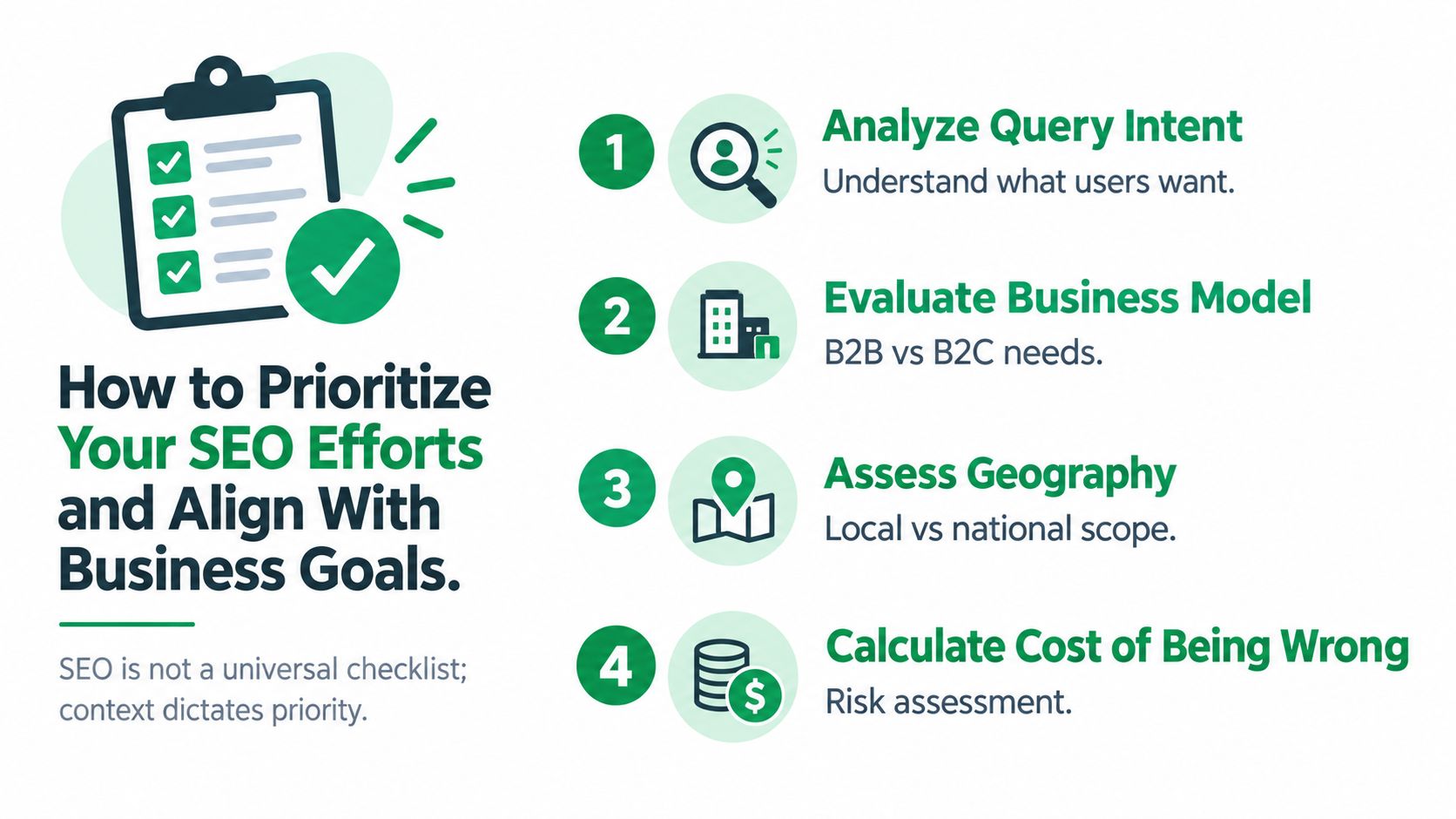
SEO isn't a universal checklist. The right next move depends on query intent, business model, geography, and the cost of being wrong.
Start by mapping the search journeys that matter. Informational searches may support awareness. Local searches may lead to calls or visits. Transactional searches may lead directly to a product or service decision. Marketplace, branded, and comparison journeys each need different page types and evidence.
Then estimate opportunity using the signals already available to you: impressions, conversion rate, margin, and customer lifetime value. You don't need a perfect forecast. You need enough commercial context to distinguish a high-value page from a distracting vanity project.
Choose the asset that removes the most friction
A service business with a weak core page may gain more by clarifying that page than by publishing another educational article. An ecommerce seller may need better product data, availability information, reviews, category structure, or checkout experience. A local provider may need consistent location relevance and a page that explains service areas clearly.
That doesn't make blog content unimportant. It makes content accountable to the journey. A guide can introduce a problem, but the service or product page must help the visitor make a decision.
Practical rule: Before creating a page, name the search journey, the business outcome, and the friction the page will remove.
For local and ecommerce businesses, SEO includes details that are often treated as post-publishing extras. Product information, availability, reviews, location relevance, accessibility, and conversion UX all affect whether a searcher can understand and act on the result.
Use a simple prioritization sequence
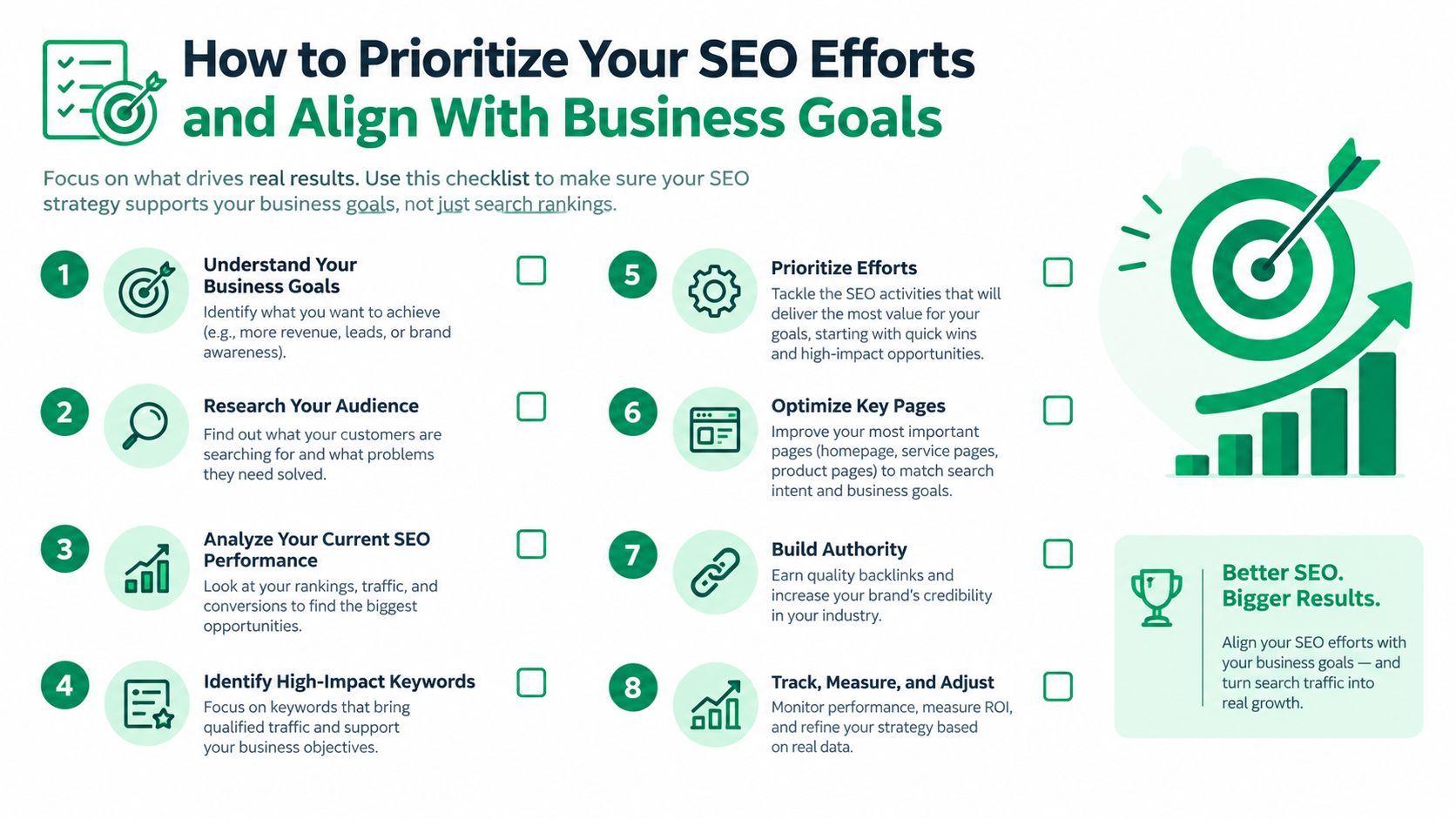
- Protect access: Fix pages that search engines can't crawl, process, or index.
- Protect revenue paths: Improve the pages closest to a lead, sale, booking, or inquiry.
- Match intent: Give each important query a destination that can satisfy it better than a generic article.
- Measure the result: Track impressions, clicks, qualified engagement, and conversions by page group.
A careful SEO audit can reveal that the biggest opportunity isn't a new content library. It may be a broken internal-link path, duplicate URLs, a vague title, missing location information, or a checkout experience that turns interested visitors away.
When resources are limited, fewer, better-aligned assets can outperform a large blog library. The strategy is choosing what not to build.
Measuring SEO Success When AI Changes Search
SEO no longer means only earning a blue-link click. Search engines increasingly answer questions directly, which changes the relationship between visibility and sessions.
Pew Research Center analyzed browsing activity from 900 U.S. adults and nearly 69,000 Google searches in March 2025. The analysis found that 58% of respondents encountered at least one search with an AI-generated summary. When an AI Overview appeared, users clicked a traditional result in 8% of searches, compared with 15% without one. 26% of AI Overview searches ended the browsing session, compared with 16% without one.Pew Research Center's analysis of AI summaries in search
That creates a measurement problem. A strong SEO program may increase brand inclusion, citations, branded searches, qualified engagement, and conversions while organic sessions decline. Raw traffic can tell an incomplete story.
Track the journey, not just the visit
Use Search Console and analytics to segment performance where possible. Compare queries that trigger AI summaries with those that don't, then examine:
- Assisted conversions: Did organic visibility influence a later inquiry or purchase?
- Branded demand: Are more people searching for the business after seeing it elsewhere?
- Impression share: Is the brand appearing for the searches that matter?
- Qualified engagement: Do visitors reach service, product, booking, or contact pages?
- Conversions: Which query groups and landing pages produce business outcomes?
High-intent pages deserve protection. Add clear authorship, original experience, proof, useful comparisons, and a direct conversion path. An AI summary can answer a general definition, but it can't replace the specific reason a buyer should trust your business.
Learn how to optimize for AI search without chasing every new feature. The sensible response isn't panic or blind experimentation. It's stronger differentiation and better measurement.
Conclusion and Your First Step Forward
SEO strategy is a coordinated, prioritized, measured system. Technical access comes first because search engines need to discover and process the page. Content follows business goals and search intent, rather than a publishing quota. Measurement reaches beyond rankings and sessions to qualified engagement, leads, sales, and visibility in search experiences that may not produce a click.
Strategy beats a checklist because your next move depends on the business. One company needs crawlability repairs. Another needs three stronger service pages. An ecommerce seller may need better product information and category structure. A mature brand may need to understand how AI summaries affect branded demand and assisted conversions.
Start this week with a focused audit. Check whether your highest-value pages are linked, indexable, technically accessible, aligned with real search journeys, and connected to a measurable business action. Then choose one fix that removes the most friction instead of opening another content document.
A free audit can help reveal visibility gaps and prioritize quick wins. The goal isn't to do everything at once. It's to make the next SEO decision with evidence.
Mr. Green Marketing, LLC helps businesses connect technical SEO, content strategy, conversion-focused websites, PPC, and GEO optimization to measurable growth goals. Visit Mr. Green Marketing, LLC to request a free audit and identify the search visibility gaps worth fixing first.
Leave a Comment
sing in to post your comment or sign-up if you dont have any account.