
How to grow my business online: So, you want to grow your business online. Your first move shouldn’t be launching some flashy new ad campaign or just posting more on social media. Nope. The most powerful first step is a brutally honest audit of where you stand right now. It’s about taking a hard look at your digital presence to find what’s actually working, what’s a complete waste of money, and—most importantly—where the quick wins are hiding.
Without this clear starting point, you’re just guessing.
1. How to Grow My Business Online: Your Digital Foundation: A Brutally Honest Audit

The whole “digital audit” thing sounds intimidating, I know, but it doesn’t have to be. Forget about drowning in massive spreadsheets or technical jargon. At its core, an audit is just a structured review of your online assets. A way to build a solid foundation before you spend another dollar on marketing.
I’ve seen businesses double their website leads just by changing a single button. A button they discovered was confusing during a simple review. That’s the power of this process.
What to Look For in Your Audit
Your goal here is to hunt for low-hanging fruit—the opportunities you’ve completely overlooked.
Start by focusing on these critical areas:
- Website Performance: Is your website mobile-friendly? Seriously, pull it up on your phone right now. Does it load in under 3 seconds? A slow site is a business killer. Research shows 40% of users will bail if it takes longer than that to load.
- User Experience (UX): Imagine you’re a first-time visitor. Can you tell what the business does and who it’s for within five seconds? Is the primary call-to-action (CTA) like “Request a Quote” or “Shop Now” obvious and easy to find?
- Local SEO Vitals: Go to Google and search for your business name. Does your Google Business Profile pop up? Check every detail: is the address, phone number, and operating hours 100% accurate? For local businesses, this is non-negotiable. An absolute must.
An audit isn’t about finding flaws; it’s about finding potential. It shifts your mindset from “what’s broken?” to “what’s our biggest opportunity right now?” This is the single most powerful first step you can take.
How to Grow My Business Online: Identifying Quick Wins for Fast Results
Okay, now that you have a baseline, it’s time to find those quick wins. These are the high-impact, low-effort fixes that can give you a noticeable bump in traffic or leads in the next 30 days.
A bakery client of mine recently updated their Google Business Profile with new photos and added keyword-rich descriptions to their menu. The result? A 25% increase in calls from their profile in just one month. A free, simple action that took less than an hour.
To help you get started, I’ve put together a list of some of the most common quick wins we find for our clients.
Digital Growth Quick Wins Checklist
Here’s a simple checklist to run through. Tackling even a few of these can make an immediate difference in your online performance.
| Area | Quick Win Action Item | Potential Impact |
|---|---|---|
| Google Business Profile | Respond to all reviews (good and bad). | High |
| Website UX | Make your phone number clickable on mobile devices. | High |
| Website SEO | Fix any broken links using a free tool like Broken Link Check. | Medium |
| Website UX | Add a clear Call-to-Action (CTA) button “above the fold.” | High |
| Google Business Profile | Upload at least 10 high-quality, recent photos. | Medium |
| Website SEO | Ensure every page has a unique and descriptive title tag. | Medium |
This initial review gives you a clear, prioritized to-do list instead of a vague goal to “grow online.” And now you have a data-backed plan.
Of course, if you want a team of experts to handle this and uncover deeper opportunities, you can explore our professional digital marketing audit services. The whole point is to stop guessing and start acting with purpose.
How to Grow My Business Online: Build a Website That Actually Sells for You
Let’s get to the fun part—your website. It’s not a digital business card. Not an online brochure. It should be your hardest-working employee, operating 24/7 to attract, engage, and convert visitors into paying customers. Too many businesses settle for a site that just looks okay. We’re aiming for a site that sells.
The success of your site all comes down to User Experience (UX). It’s the feeling someone gets when they interact with your pages. Are they delighted? Or are they confused and annoyed? That feeling has a direct impact on your bottom line.
A site that’s slow to load or a pain to navigate doesn’t just frustrate people; it sends them straight to your competitors. A bad user experience is like hiring a salesperson who ignores customers and can’t find the register. Completely useless.
Think Like Your Customer
To fix your website’s UX, you have to get out of the business owner’s mindset and think like a customer. Customers land on your site with a problem they need to solve. Your job is to make the solution painfully obvious and easy to get.
What’s the very first thing they see? Do they instantly get what you do and who you do it for? Is the path to buying your product or booking your service crystal clear? Any friction—any moment of confusion or hesitation—is a lost sale.
Let’s break down what turns a basic website into a sales machine.
- Clarity Above Everything: Your main headline needs to hit your customer’s pain point or desire head-on. A local plumber’s site should say “Fast, Reliable Plumbing in [City],” not some vague tagline like “Excellence in Fluid Dynamics Since 2005.”
- Simple, Obvious Navigation: Keep your menu simple. Don’t use clever terms like “Musings” for your blog or “Our Manifesto” for the About page. Just use “Blog” and “About Us.” People know what those mean.
- A Blazing-Fast Site: Every single second matters. In fact, a 1-second delay in mobile load times can crush conversion rates by up to 20%. People have zero patience for slow websites.
Your website isn’t an art project. Every button, every image, and every line of text needs a purpose. Its primary goal is to guide the user on a journey that ends in a sale.
To truly build a website that drives revenue, learning How to Increase Sales Conversion Rate: A Modern Playbook is essential for turning those visitors into loyal customers.
Beyond the Basics: Accessibility and Trust
Building a website that sells also means building one for everyone. Web accessibility isn’t just a compliance box to check; it’s a core part of modern UX and a massive signal to search engines that you know what you’re doing.
This means making sure your site can be used by people with disabilities. Simple things like adding descriptive alt text to your images, using high-contrast colors, and making sure your site works with just a keyboard are huge wins. It makes your site better for every single user—and Google rewards you for it.
Finally, you have to build trust. Without it, no one will ever click “Buy Now.”
How to Build Instant Trust: A Quick List
- Showcase Social Proof: Get those customer testimonials, reviews, and client logos on your site. This proves other people trust you, so new visitors can, too.
- Be Transparent: Have a clear “About Us” page with real photos of your team. Show your pricing clearly if you can. Don’t make people guess.
- Secure Your Site: An SSL certificate (that little padlock in the browser bar) is non-negotiable. It tells visitors their data is safe and that you’re a legitimate business.
By focusing on user experience, speed, and trust, you can turn your website from a passive brochure into an active, lead-generating powerhouse. If you want to go deeper, you might find our guide on how a website design for lead generation can become your best sales tool.
How to Grow My Business Online: Master Modern SEO and GEO to Dominate Search
SEO. You’ve probably heard the acronym a thousand times. But what does it really mean for growing your business today? Simply put, it’s the engine that drives online visibility.
In 2026, it’s so much more than just jamming keywords into a webpage. Modern SEO is about context, authority, and anticipating what your customers are asking—especially now that AI-powered search is fundamentally changing how people find information.
This is where a concept I call GEO (Generative Engine Optimization) becomes critical. It might sound complex, but the idea is simple: optimize your entire digital footprint so that AI assistants and search engines see you as the most helpful, authoritative answer.
This isn’t just some passing trend; it’s the core of modern growth. SEO is responsible for a massive 93% of all web traffic across the globe, making it the most powerful customer acquisition channel for small and mid-sized businesses. As the digital ad market barrels toward $786.2 billion and over 66,000 agencies fight for attention, mastering your own SEO is how you rise above the noise.
Answering Questions Before They’re Asked
The new name of the game in SEO is becoming the undisputed go-to resource in your niche. You have to answer your customers’ questions better, more clearly, and with more expertise than anyone else. This is the secret to winning in an AI-first search landscape.
Think about it from your customer’s perspective. What problems are they facing? What questions do they type into Google or ask their smart speaker? Your website content—from blog posts to service pages and FAQs—needs to address these queries directly.
Here’s a real-world example: A roofer we started working with was only getting leads from people searching for “roof replacement.” We shifted their strategy to create in-depth articles answering questions like “how to spot hail damage on a shingle” and “what’s the average cost to fix a small roof leak?”
The result? They started capturing customers much earlier in the buying process, building trust long before a competitor ever had a chance to get in front of them.
How to Grow My Business Online: The New Rules of On-Page SEO
On-page SEO refers to all the optimizations you make directly on your website’s pages. The fundamentals are still important, but the focus has evolved from just pleasing algorithms to genuinely helping humans—which, in turn, is exactly what the new AI-driven algorithms want to see.
Here’s what you need to focus on:
- Write for Intent, Not Just Keywords: Don’t just target a generic term like “best coffee beans.” Get specific and target the intent behind the search. Create content for “best coffee beans for a French press” or “what are the best low-acid coffee beans for acid reflux?”
- Use Natural, Conversational Language: The era of robotic, keyword-stuffed sentences is over. Write like you speak. Modern search engines understand conversational language, so your content should feel natural and easy to read.
- Structure Content for Scanners: Let’s be honest—people don’t read every word online. They scan. Use short paragraphs, bold key points, and clear subheadings (like the ones in this guide!) to break up your text and guide the reader’s eye.
The goal is no longer to just rank for a single keyword. It’s to own the entire conversation around a topic. When someone searches for anything related to your field, your business should be the one providing the answer.
Winning the Local Search Game
For any business that serves a specific geographic area—from a single retail shop to a multi-state service provider—local SEO is your lifeline. This is how you show up for all those critical “near me” searches that customers perform every single day.
Mastering local SEO is how you plant your flag and claim your digital territory. It’s not overly complicated, but it demands consistency and attention to detail.
Your Local SEO Action Plan:
- Perfect Your Google Business Profile (GBP): We touched on this in the audit phase, but it’s so important it’s worth repeating. Your GBP is your digital storefront on Google. Fill out every single section, upload new, high-quality photos weekly, and use the Q&A feature to proactively answer common customer questions.
- Build Consistent Local Citations: A citation is any online mention of your business’s Name, Address, and Phone number (NAP). You need this information to be perfectly consistent across every single online directory, from Yelp to industry-specific sites. Even a small inconsistency can hurt your local rankings.
- Encourage and Manage Reviews: Online reviews have become the new word-of-mouth. You need to have a process for asking happy customers to leave a review. Just as importantly, you need to respond to all of them—both good and bad. A thoughtful response to a negative review can actually build more trust than ten 5-star reviews.
Getting this right will make your business the obvious choice for local customers. To really dig in, check out our complete guide on how to supercharge your local SEO for lead generation. It’s a game-changer.
How to Grow My Business Online: Fuel Your Growth with Smart Paid Advertising
While SEO is your long-term growth engine, paid advertising is the rocket fuel. It’s the absolute fastest way to jump the line, get in front of your ideal customers, and start generating leads. Today.
But it’s also the fastest way to burn through your budget if you don’t know what you’re doing. I’ve seen countless businesses throw thousands at ads with nothing to show for it but a massive credit card bill. That’s not what we’re doing here.
This is your playbook for smart, strategic paid media—the kind that delivers a real, measurable return on your investment.
Paid Media Is Not a Slot Machine
The single biggest mistake I see is business owners treating Google Ads or Facebook Ads like a slot machine. They just put money in, pull the lever, and hope for a jackpot. That’s a recipe for disaster. Every single time.
Smart paid advertising is all about precision and control. You’re not just buying clicks; you’re buying access to a specific person, with a specific problem, at the exact moment they need a solution.
The goal isn’t just to get clicks—it’s to acquire customers profitably. If you spend $10 to make a $5 sale, you don’t have a marketing strategy. You have a very expensive hobby.
Global digital ad spend is set to blow past $1.02 trillion in 2026, making up over 65% of all media budgets. For agencies like Mr. Green Marketing, LLC, this means helping small and medium businesses tap into channels like paid search, which is on track to hit $260 billion globally in 2026. With North America leading at $350 billion in digital ad spend next year and the Asia-Pacific market surging 17% YoY, the opportunity is massive.
How to Grow My Business Online: Defining Your Audience with Laser Precision
Before you spend a single dollar, you have to know exactly who you’re talking to. “Everyone” is not a target audience. That’s how you waste money.
Let’s say you run a local meal prep service. Instead of a broad target like “people who like healthy food,” you need to get surgically precise.
- Platform: Focus on Instagram and Facebook, where visual food content performs best.
- Demographics: Target women, aged 28-45, living within a 10-mile radius of your kitchen.
- Interests: They follow accounts like Whole30 and Gimme Some Oven, shop at Whole Foods, and have shown interest in fitness apps.
This is the level of detail that turns a generic ad into a message that feels like it was made just for them. It’s how you get someone to stop scrolling and actually pay attention.
How to Grow My Business Online: Choosing Your Channels: Paid Search vs. Paid Social
Not all paid platforms deliver the same results. Your choice depends entirely on your business model and—more importantly—where your customers are actually spending their time. It really boils down to two main camps.
1. Paid Search (Google Ads, Bing Ads)
This is all about capturing intent. You’re targeting people who are actively searching for a solution you provide right now. Think of it as setting up a shop right in front of someone who’s already walking in your direction.
- Best for: Service-based businesses (plumbers, lawyers), B2B companies, and e-commerce stores with specific products people search for by name. Someone typing “emergency plumber near me” isn’t just browsing—they’re ready to buy.
2. Paid Social (Facebook, Instagram, LinkedIn, TikTok)
This is all about generating demand. You’re reaching people based on their interests and behaviors, interrupting their daily scroll with something valuable or interesting they didn’t even know they needed.
- Best for: E-commerce (especially with visual products), brand awareness campaigns, and businesses with a strong community angle. Fashion, food, and online courses thrive here.
For most businesses, a mix of both is the sweet spot. Use paid search to capture existing demand and paid social to create new demand. To really get an edge, implementing these 10 proven Facebook Ad strategies can help you dominate your market.
The Ad Is Just the Beginning
Getting the click is only half the battle. What happens after the click is where most campaigns fall apart.
You absolutely must send ad traffic to a dedicated landing page that perfectly matches the message and promise of your ad. If your ad promises a “50% off deal on running shoes,” that landing page had better show that exact deal, loud and clear, above the fold.
Never, ever just dump people on your generic homepage. It’s confusing, creates friction, and absolutely kills conversion rates. Your landing page should have one job and one job only: to get the user to take the action you promised in the ad. That’s how you turn clicks into customers and truly grow your business online with paid advertising.
How to Grow My Business Online: Create Content That Truly Connects and Converts
Your content is how you move from just another company to a trusted authority. It’s the engine that drives engagement, builds trust, and ultimately, converts prospects into customers. But so many businesses get it wrong. They publish content that talks about their products, their features, their company—and it falls flat.
The reality is, customers care about their problems, not your company history. A strategic shift from self-promotion to valuable problem-solving is what separates brands that stagnate from those that scale.
Brainstorm Ideas Your Customers Actually Care About
The most effective content ideas don’t come from a marketing brainstorm; they come directly from your customers’ most pressing questions and pain points. Your job is to listen carefully to what they’re already telling you.
What questions pop up constantly on sales calls? What are the common themes in your support emails or social media DMs? Each one of these is a goldmine—a ready-made topic for a blog post, video, or social media guide.
A client of ours in the sustainable cleaning space noticed they were always asked, “Are your products safe for homes with pets?” Instead of just providing a one-off answer, we turned that single question into a comprehensive content pillar:
- Blog Post: “The Ultimate Guide to Pet-Safe Cleaning in 2026”
- Instagram Reel: A short, engaging video of a dog playing on a freshly cleaned floor.
- FAQ Page: A dedicated resource answering every possible question related to pet safety.
This is how it’s done. One customer query transformed into a content ecosystem that now attracts thousands of other pet owners facing the same issue. Your goal is to be the most helpful and comprehensive answer they find.
Video Is No Longer Optional
If your business isn’t producing video content, you are falling behind. Video isn’t just a passing trend; it has become the dominant medium for how people consume information and make purchasing decisions online.
The data speaks for itself. Video adoption is projected to reach 91% among businesses by 2026, and the money is following. Global digital video ad spend is on track to hit a staggering $214.76 billion. For small businesses, startups, and franchises, video production services like those from Mr. Green Marketing are a direct path to converting that spend into a tangible surge of new leads. With video expected to command 38% of all digital ad budgets by the end of 2026, the time to act is now. You can get more details on these video marketing trends to understand the scale of the opportunity.
You don’t need a Hollywood budget. Authenticity is far more important than production value. Your smartphone, good lighting, and a clear message are all you need to start creating content that connects with real people.
The Magic of Content Repurposing
The secret to a dominant content strategy isn’t about creating more; it’s about getting more value from what you already have. This “work smarter, not harder” approach is the only sustainable way to maintain consistency without facing burnout.
Think of it this way: one solid, well-researched piece of content shouldn’t just be a single asset. It should be the foundation for ten.
Here’s a practical example of how to repurpose one blog post into a full week’s worth of marketing assets:
- The Core Piece: It all starts with one in-depth, long-form blog post (just like this guide).
- The Video: Next, record a video for YouTube that summarizes the main points from your post.
- The Social Snippets: Pull 5-7 key quotes, statistics, or tips from the article. Turn these into simple text-based graphics for your LinkedIn and Instagram feeds.
- The Short-Form Video: Edit your primary video down to a 30-second TikTok or Instagram Reel that highlights the single most compelling tip.
- The Email Newsletter: Finally, send a brief summary of the post to your email subscribers, driving them back to your website to read the full article.
This is the framework for showing up everywhere your customers are, providing consistent value, and building the authority that drives real business growth—all without reinventing the wheel every single day.
How to Grow My Business Online: Your Action Plan for Sustainable Online Growth
Alright, we’ve covered a ton of ground. But just knowing this stuff isn’t enough. Knowledge without action is just trivia, so let’s pull all these threads together into a prioritized plan that you can actually use.
Think of this as your roadmap to real online growth, not just another article you read and forget. And remember, this isn’t a rigid checklist. It’s a living, breathing plan you’ll need to adjust as you gather data and learn what works for your business.
Your First 30 Days: Quick Wins and Foundation
The first month is all about building momentum. We’re not trying to boil the ocean here. The goal is to tackle high-impact tasks that build a solid foundation and—just as importantly—deliver some immediate, tangible results. It’s about getting points on the board, fast.
- Complete Your Audit: Go back to the checklist from our first section. Get those broken links fixed, upload some fresh photos to your Google Business Profile, and make sure your website’s main call-to-action is crystal clear.
- Establish Your Budget: You have to know what you can realistically spend on tools or ads. Even a small budget of a few hundred dollars is enough to start testing the waters with paid social ads.
- Set Up Key Metrics: Get Google Analytics 4 (GA4) installed. You can’t improve what you don’t measure. To avoid getting overwhelmed, just focus on tracking two or three simple metrics to start, like total website visitors and contact form submissions.
This first month is about building good habits and seeing progress—however small—to fuel your motivation for what comes next.
You don’t need a massive budget to make a massive impact early on. The goal for the first 30 days is simple: clarity and momentum. Identify the biggest opportunities and take decisive action.
Your 60-Day Plan: Content and Connection
With a solid base in place, the next 30 days are about creating assets that attract customers and building connections. This is where you start producing content that speaks directly to your ideal buyer and begin testing paid channels to get that content in front of them.
Your main focus should be creating one significant “pillar” piece of content. This could be an in-depth guide that answers a major customer question or a detailed tutorial video. Then, you repurpose it.
This simple flow shows how to get the most mileage out of your content creation efforts.
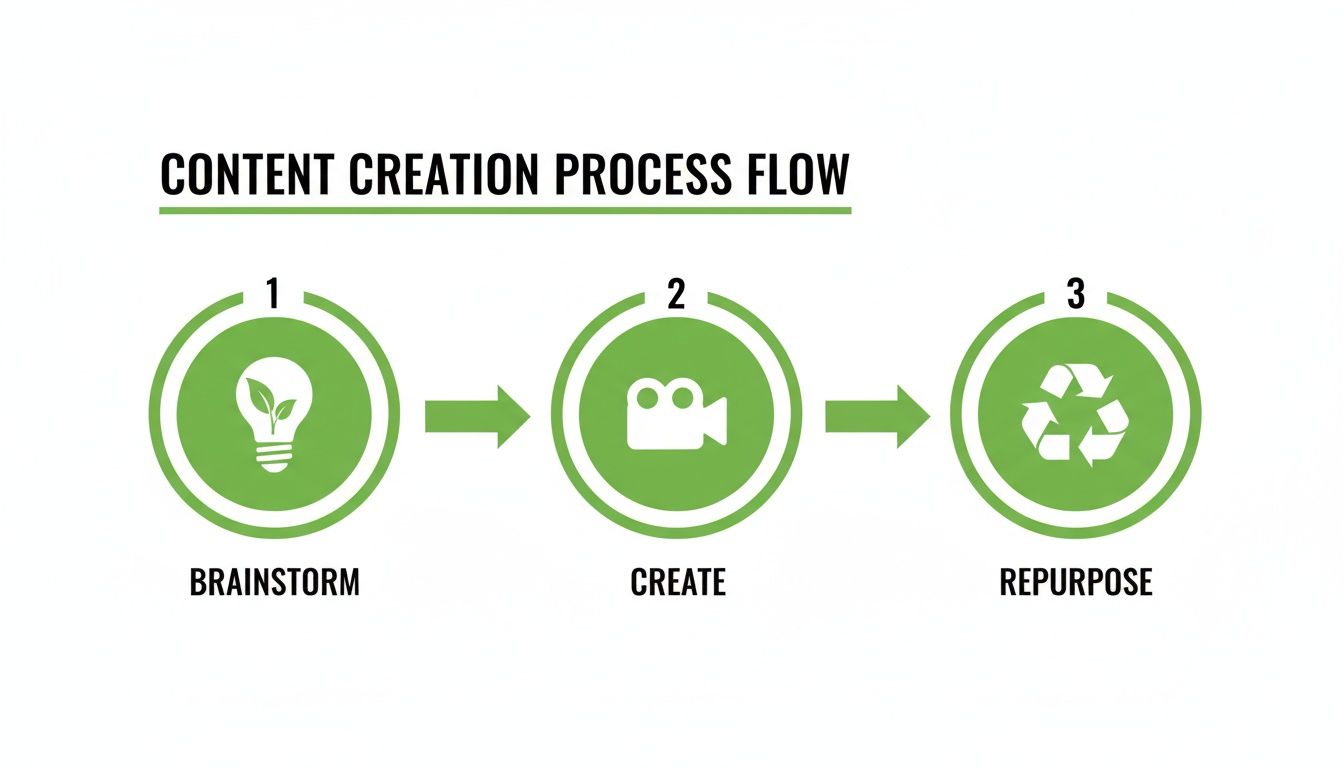
The key takeaway here is that a single great idea can fuel your marketing across multiple channels for weeks. This saves you an incredible amount of time and energy.
Your 90-Day Strategy: Scale and Optimize
By now, you have data. You know which social media posts got engagement, which blog topics drove traffic, and which ads delivered the best return. Days 61 to 90 are all about digging into that data, analyzing what it’s telling you, and optimizing your strategy.
This is where you double down on what’s working and mercilessly cut what isn’t.
- Analyze Performance: Dive into your Google Analytics data. Which pages are most popular? Where are your visitors coming from? What’s the common thread?
- Scale Winning Ads: If a specific Facebook ad audience or creative is outperforming everything else, it’s time to allocate more budget to it.
- Refine Your SEO: Based on your analytics, you can see which keywords are actually bringing you traffic. Create more content around those topics and related ones.
This 90-day framework isn’t a one-and-done deal. It’s a repeatable cycle: audit, create, optimize, and then do it all over again. This is the simple, sustainable rhythm that will consistently grow your business online.
Frequently Asked Questions About Online Growth
We’ve covered a lot of ground. But even with a solid plan in hand, a few questions always pop up—the kind of “what ifs” that can cause analysis paralysis and stop you from moving forward. Let’s tackle the most common ones I hear from business owners trying to figure out their next move online.
How Do I Choose the Right Social Media Platform?
The biggest mistake you can make is trying to be everywhere at once. A fast track to burnout with little to show for it. The smarter approach? Go where your customers already spend their time.
- B2C (Business-to-Consumer): If you sell products with strong visual appeal—think fashion, home goods, or food—Instagram and Pinterest are non-negotiable. These are discovery platforms where people go for inspiration, and that inspiration often leads directly to a purchase.
- B2B (Business-to-Business): For anyone selling to other businesses, LinkedIn is the only game in town. It’s the digital conference room where professionals network, share industry knowledge, and make purchasing decisions.
- Local Services: If you’re a plumber, salon owner, or run a local café, Facebook remains a powerhouse. Its community features, local groups, and targeted ads are perfect for building a strong neighborhood footprint.
The goal isn’t to have a presence on every platform. It’s to dominate the one or two that actually matter to your bottom line.
How Much Should I Budget for Marketing?
This is the million-dollar question, isn’t it? When you’re starting out, setting a budget can feel like throwing a dart in the dark. While there’s no single magic number, a solid benchmark for a small business is to allocate 5-10% of your total revenue to marketing.
But let’s be real—if you’re a brand new business, you might not have much revenue yet. In that case, your most valuable resource is time, not money. Focus on the “free” marketing efforts you can control:
- Perfecting your Google Business Profile.
- Writing one high-quality, helpful blog post a month.
- Actively engaging on the one social channel you’ve chosen.
Once you start getting some traction, you can pour a little gas on the fire. Start with a small, fixed budget—even $10 to $20 a day—on paid ads to amplify what’s already working.
When should I hire help versus DIY?
My advice is always the same: do it yourself until you physically can’t anymore. Handle your own social media and content until you find that it’s taking up so much time that it’s keeping you from running your business. That’s your sign. That’s when it’s time to bring in a freelancer or an agency.
The same logic applies to tasks you either hate or just aren’t good at, like managing paid ads. Trust me, money wasted on poorly managed ads costs a lot more than hiring an expert to do it right. Your time has a real dollar value—once you can use that time to generate more revenue elsewhere, it’s time to delegate.
Feeling overwhelmed and need a clear path forward? The team at Mr. Green Marketing, LLC specializes in cutting through the noise. We’ll help you create a data-backed action plan that aligns with your specific goals and budget. Let’s build your growth strategy together. Request your free audit today.
Leave a Comment
sing in to post your comment or sign-up if you dont have any account.