
The popular advice is to choose between Amazon SEO and PPC, then optimize each in isolation. That framing is wrong. SEO tells Amazon what your product is relevant for, while PPC reveals which queries produce meaningful shopper behavior. Treating them as separate channels throws away the most useful feedback your advertising can generate.
Amazon search is still the marketplace's primary discovery environment. A National Bureau of Economic Research study analyzed 228,281 Amazon search results and found that 46.5% of product pages in the sample were reached from an Amazon search-results page, compared with 11.2% of referrals from other web domains (NBER research on Amazon search). Your listing therefore needs more than keyword coverage. It must earn the click, satisfy the shopper, and convert the traffic that PPC helps uncover.
The practical model is a loop. Paid campaigns test demand and expose search-term behavior. Listing improvements turn qualified traffic into stronger conversion signals. Organic visibility then captures more demand without requiring every sale to come from an ad. And when the loop breaks, the data usually tells you where.
Table of Contents
- Why Most Sellers Keep SEO and PPC Apart (and Lose)
- How A9 Uses Paid Velocity to Boost Organic Ranking
- Keyword Research for the Unified SEO and PPC Strategy
- Campaign Structures That Support Both Organic and Paid Goals
- Optimizing Bids and Ads for Conversion Quality
- Closing the Loop from Paid Data to Listing Updates
- Measuring Success Beyond ACoS and ROAS
Why Most Sellers Keep SEO and PPC Apart (and Lose)
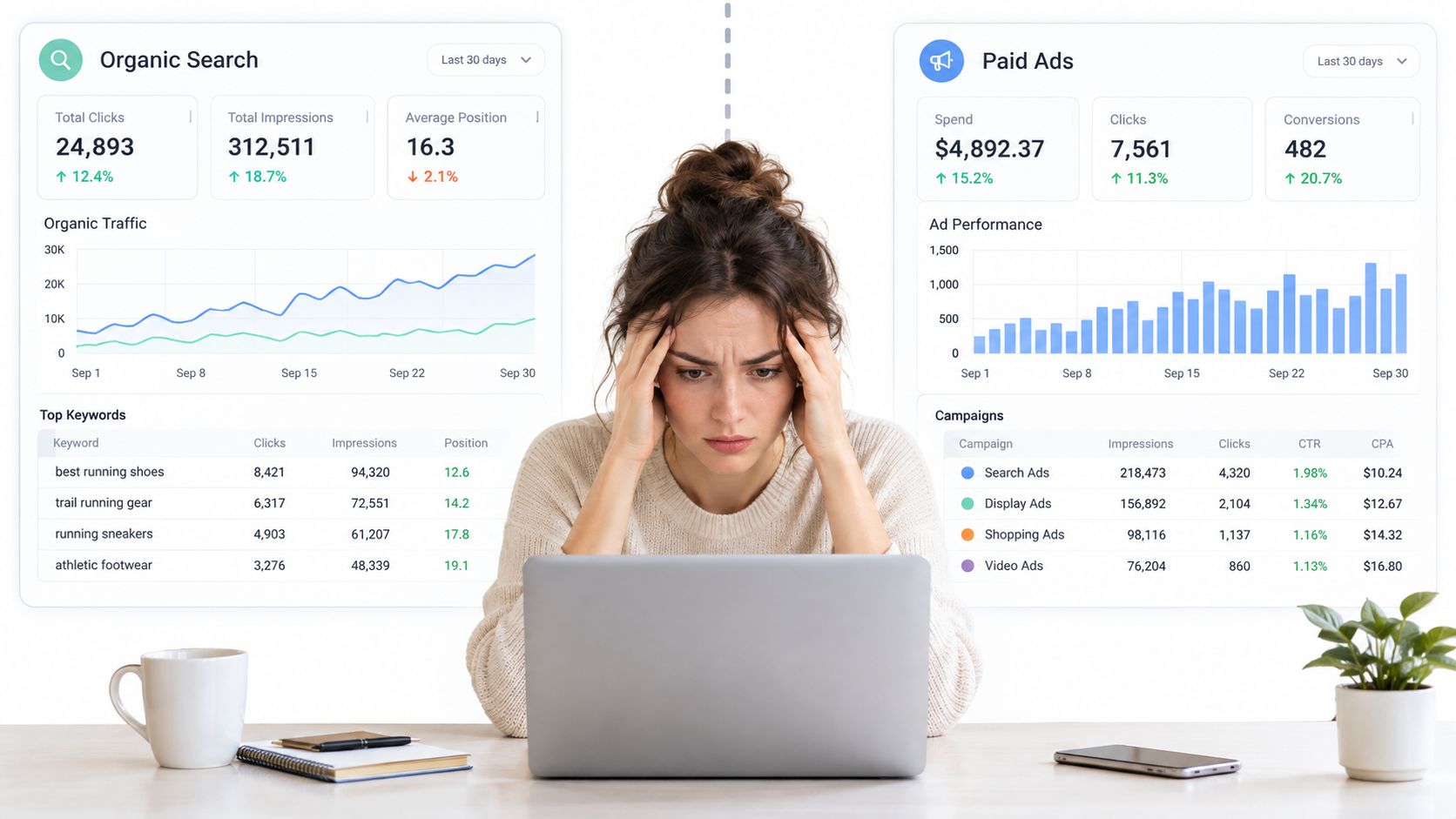
Separating Amazon SEO from PPC creates a reporting problem before it creates a ranking problem. One person edits titles and bullets, another adjusts bids, and neither sees which search terms bring qualified shoppers. The result is an SEO list built around keyword volume, PPC campaigns built around automatic targeting, and no process for turning ad results into listing decisions.
Amazon can use shopper behavior without labeling a sale “SEO” or “PPC.” It records whether shoppers find a product, click, add it to the cart, and purchase. Paid traffic does not automatically guarantee a stronger organic position. PPC does provide controlled exposure and search-term evidence that can show whether a listing meets the demand behind a query.
A unified process asks three practical questions:
- Can the listing earn relevance? The title, bullets, images, attributes, and backend terms should describe the product accurately and naturally.
- Can the offer convert qualified shoppers? Price, reviews, delivery promise, variations, and product presentation shape what happens after the click.
- Can the campaign produce usable evidence? Search-term reports should reveal which queries generate clicks, cart activity, and purchases, not only impressions.
PPC therefore serves as more than a visibility channel. It acts as a live test of product-market and listing fit. A term that earns clicks but no cart additions may indicate unclear positioning, weak merchandising, or an offer problem rather than an insufficient bid. A query that converts through paid traffic while producing little organic visibility can justify a precise update to the title, bullets, or other relevant listing fields.
Practical rule: Use PPC to discover and validate demand, then use organic optimization to capture that validated demand at lower advertising dependence.
Amazon search remains central because visibility determines whether shoppers encounter the product at all. The NBER referral pattern cited earlier supports that point and also shows why SEO involves more than inserting keywords into a title. Relevance earns consideration, while the offer and detail page determine whether consideration becomes a sale.
Teams coordinating these workstreams can review SEO and PPC services from Mr. Green Marketing. The operating principle remains broader than any agency relationship: organic and paid teams should share one search-term map, one conversion diagnosis, and one testing calendar.
How A9 Uses Paid Velocity to Boost Organic Ranking
Amazon's ranking system is often discussed as if it were a simple keyword-matching database. That's too narrow. Amazon needs to decide which product is most likely to satisfy a shopper for a given query, so relevance is only the starting point. Sales behavior, shopper engagement, offer quality, and conversion performance all influence the strength of that prediction.
PPC can contribute to the evidence, but sellers should describe the relationship accurately. Amazon does not publicly promise that buying an ad directly increases an organic position. Instead, a Sponsored Products campaign can bring qualified shoppers to a listing for a target query. If those shoppers click and purchase, the product generates sales activity associated with that demand. Continued organic performance for the same query can then reinforce the case that the listing deserves visibility.
Paid traffic is only useful when the listing can finish the job
Suppose a product appears for a generic query through an ad. The shopper sees a clear main image, recognizes the product's use case, accepts the price, and completes the purchase. That campaign has done more than deliver an attributed order. It has tested whether the listing can compete for non-branded demand.
Now change one element. The ad earns clicks, but the image doesn't clarify the product, the bullets omit a key feature, or the reviews create hesitation. More bids may increase traffic, but they won't repair the conversion problem. PPC becomes fuel only when the listing has enough retail readiness to convert the traffic it receives.
Branded and non-branded queries also deserve different treatment. Branded terms can defend existing demand and help shoppers find a known product. Generic terms are more revealing because they test whether the product can win when the shopper is comparing alternatives. The more useful question isn't “Did the ad sell?” It's “What did this sale prove about the listing's ability to satisfy this type of shopper?”
Read velocity as a feedback signal, not a promise
Use paid data to compare:
- Query relevance: Does the search term describe the product precisely?
- Click quality: Do shoppers engage with the detail page after seeing the ad?
- Conversion quality: Do clicks lead to purchases, or do they stop at consideration?
- Organic position: Is the listing visible naturally for the same query?
- Offer readiness: Are price, delivery, reviews, and images competitive enough to sustain demand?
A campaign can generate sales while still failing as an organic growth test if the term is branded, the traffic is poorly qualified, or the listing only converts under heavy promotional pressure. Conversely, a lower-volume generic term may be strategically valuable when it attracts shoppers with a clear product need.
The Amazon advertising campaign framework should therefore be built around evidence collection, not just spend expansion. PPC supports organic growth when it produces qualified sales and exposes specific listing improvements. It doesn't replace relevance, and it can't compensate indefinitely for a weak offer.
Keyword Research for the Unified SEO and PPC Strategy
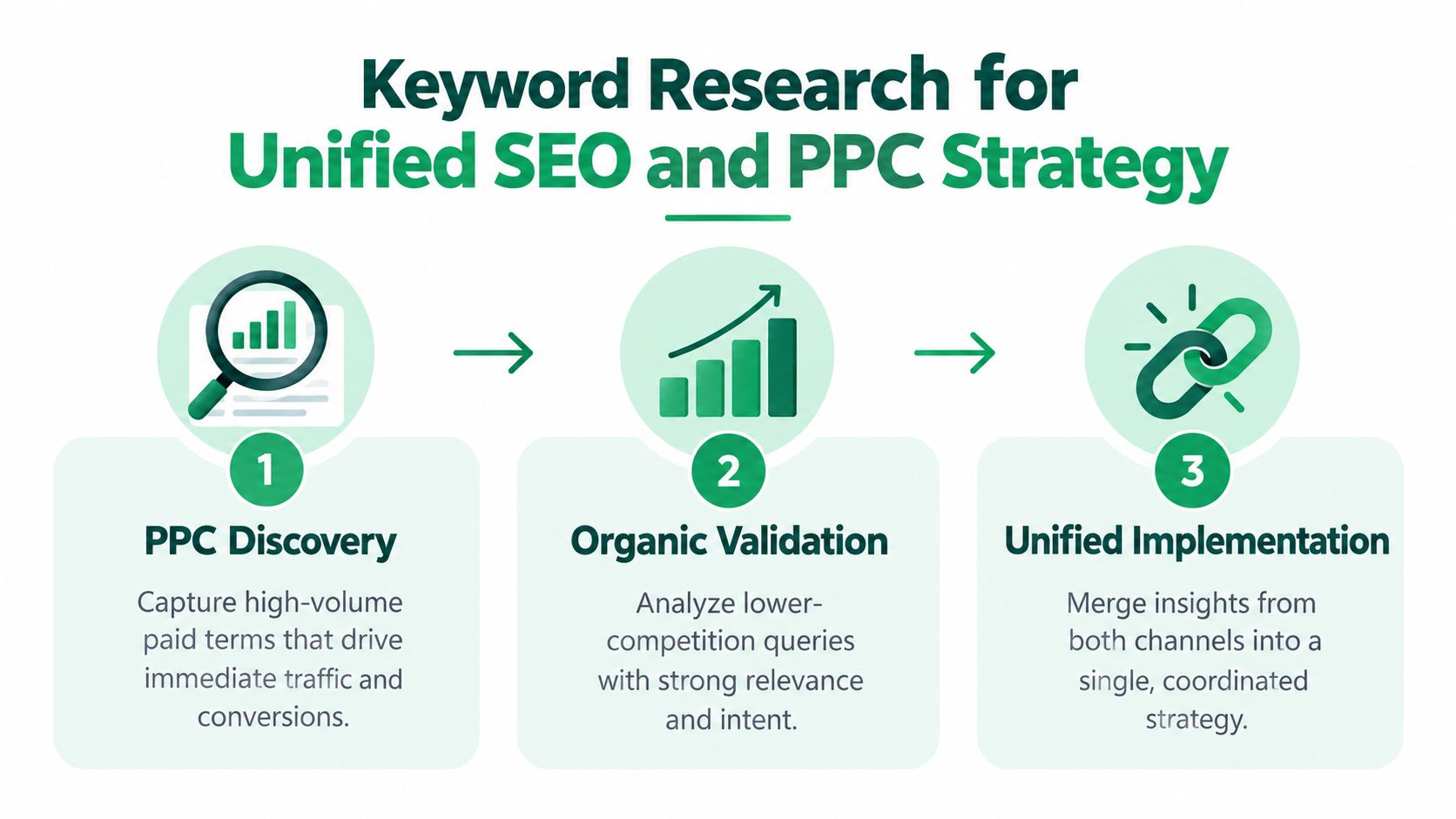
PPC search terms can improve SEO research, but only when they are treated as evidence rather than ready-made listing copy. A query may generate impressions and clicks while revealing that the product, offer, or page does not satisfy the shopper's intent. SEO needs terms the product can genuinely support, while PPC needs enough reach to expose demand your initial research missed.
Amazon Brand Analytics overview connects those tasks through Search Query Performance reporting. For selected ASINs and date ranges, Amazon's documentation maps the funnel across query volume, impressions, clicks, cart additions, and purchases, allowing sellers to compare their results with total query performance across Amazon. That sequence shows where a promising search term loses momentum.
Build one master list with separate jobs
Start with terms tied to existing organic visibility. These are defensive opportunities. The listing already appears for them, so the priority may be protecting relevance, improving conversion, or using paid placement to keep competitors from capturing demand.
Then review customer search terms from PPC. Find queries that earn meaningful attention while the product has weak organic visibility. They can become growth targets, but qualify them before changing the listing. A click alone does not prove that a phrase belongs in the title or bullets.
Organize the working list into three groups:
- Exact-match terms: Reserve these for high-intent queries with strong conversion evidence and a clear reason to defend visibility.
- Broad or phrase discovery terms: Use them to find variations, adjacent needs, and language absent from the original research.
- Negative terms: Exclude irrelevant or repeatedly poor-quality traffic so the campaign does not pay for the same mismatch again.
Automatic targeting helps reveal shopper wording and close variants that manual research may miss. Manual campaigns provide control over terms selected for testing, defense, or expansion. Use both, with each assigned a distinct learning job.
Match listing changes to funnel evidence
A high-impression query can attract clicks without producing cart activity. The cause may be weak intent match, an uncompetitive offer, or creative that creates expectations the detail page cannot meet. Adding the phrase to the title or backend fields would increase keyword coverage without fixing that problem.
Rank candidate terms by what shoppers do after seeing the listing:
- Relevant and converting: Add a natural placement in the title, bullets, or backend terms when the wording fits the product.
- Relevant but under-clicked: Review the main image, title clarity, and alignment between the query and the page.
- Clicked but not added to cart: Check the offer, detail page, variation, and shopper expectations.
- Added to cart but not purchased: Examine price, delivery, availability, and final conversion friction.
- Irrelevant: Exclude the term from paid targeting and keep it out of organic copy.
The SEO process for Amazon sellers works best when keyword placement follows this evidence. Search language should describe the product naturally, reinforce a supported benefit, and help shoppers decide. Search volume starts the investigation. Paid search behavior determines whether a term deserves a place in the listing.
Campaign Structures That Support Both Organic and Paid Goals
Campaign architecture determines whether PPC produces clean learning or an expensive pile of mixed signals. A single campaign with broad targeting, inconsistent bids, and unrelated products makes it difficult to tell which query, offer, or placement deserves attention.
Sponsored Products operates through a cost-per-click auction. Amazon says advertisers pay when shoppers click, not when the ad receives an impression, and can choose keyword or automatic targeting while setting a maximum bid and campaign budget. The minimum daily budget is $1.00 (Amazon Sponsored Products FAQ). That minimum makes a campaign possible, not necessarily useful. Your budget still needs to support enough delivery to produce interpretable data.
Automatic and manual targeting serve different purposes
| Campaign approach | Best use | Main trade-off |
|---|---|---|
| Automatic targeting | Query discovery and listing validation | Less control over where spend goes |
| Manual broad or phrase targeting | Search-term expansion and controlled testing | Requires regular query review |
| Manual exact targeting | Defending validated, high-intent demand | Can restrict discovery |
| Product or ASIN targeting | Competitive comparison and detail-page visibility | Intent is harder to infer from the placement alone |
Keep the campaigns operationally separate. A discovery campaign should not compete for the same budget as a core exact-match campaign without a clear reason. Separate products with different margins and retail readiness, too. A profitable hero product shouldn't inherit the bidding logic of a low-margin item just because they share a catalog.
Use negative targeting to remove irrelevant traffic, but don't use it as a blunt tool. If a term converts organically but paid clicks appear to replace sales you would have received anyway, test whether the ad is protecting a strategic position or merely shifting attribution. A competitor may take the sponsored placement if you withdraw, so cannibalization needs a business decision, not an automatic rule.
Give each campaign a job
A practical structure includes:
- Validation: Automatic targeting and controlled discovery terms reveal language and matching behavior.
- Qualification: Broad and phrase campaigns collect variations while you examine query quality.
- Defense: Exact campaigns protect terms that matter to revenue, relevance, or branded demand.
- Competition: ASIN targeting tests whether your offer can win consideration on competitor detail pages.
Don't confuse a higher bid with a better strategy. The bid affects auction competitiveness, while the budget controls how much the campaign can spend during its configured period. A campaign can therefore have an attractive bid and still stop delivering after its budget is exhausted. That distinction is central to managing paid velocity without losing margin.
Optimizing Bids and Ads for Conversion Quality
Bidding should answer a commercial question: which shoppers are most likely to become profitable customers? Buying impressions for an irrelevant query creates costly noise. A controlled bid on a closely matched term can produce better evidence, even with less reach, because its clicks reveal whether the listing satisfies genuine demand.
Amazon's cost-per-click model charges after a shopper clicks, not just because an ad appeared. Click quality therefore matters more than impression volume alone. Review placement performance, search-term behavior, and purchase outcomes together. Paid search data can validate listing language, while weak conversion signals can show where the page needs improvement before higher bids make sense.
Match bidding controls to the decision
Use conservative bids while a campaign is still testing relevance. Down-only bidding can limit spend when Amazon's delivery system identifies a lower likelihood of conversion. Fixed bids suit a defined defensive objective, where consistent auction participation matters more than automated adjustments. For a practical framework, see this PPC bid strategy guide.
Placement adjustments should follow evidence. Top-of-search visibility may suit branded or highly qualified queries when the listing and offer are ready to convert. Rest-of-search traffic can support discovery, but tighter controls may be needed when shoppers are comparing several alternatives.
Review each decision in sequence:
- Check the query: Does the shopper's intent match the product's actual offer?
- Check the placement: Does that location bring visitors who engage with the page?
- Check the detail page: Does the image, title, and opening copy answer the query quickly?
- Check the outcome: Did shoppers click, add the product to the cart, and purchase?
- Change one lever: Adjust the bid, creative, targeting, or listing separately so the result remains interpretable.
Creative is part of the bid strategy
A weak main image can make a relevant ad appear unsuitable. Clutter, unclear scale, or a missing use-case cue may reduce click quality before a shopper reads the bullets. Improve the retail creative first, then assess whether a higher bid is justified.
Keyword additions will not repair every low click-through rate. Titles need clear relevance, images need immediate recognition, and bullets need to explain why the product fits the query. Listing diagnostics should therefore accompany bid management, since bidding cannot fix a conversion problem that occurs after the click.
Negative keywords also require evidence. Exclude a term when the product is clearly irrelevant or repeated traffic produces poor downstream behavior. Record the reason for every exclusion. That history helps prevent a useful variation from being blocked without a clear understanding of the original search-term data.
Closing the Loop from Paid Data to Listing Updates
The best PPC report does more than explain last month's spend. It identifies which listing change deserves testing next.
Begin with paid search terms that generate purchases, then compare those terms with organic visibility. A relevant query that converts through ads but has little organic presence may belong naturally in the title, bullets, or backend search terms. Add it where it clarifies the product or benefit. Awkward keyword placement can weaken customer-facing copy, so relevance to the shopper's intent comes first.

Use funnel gaps to choose the edit
Amazon's Search Query Performance reporting connects queries with impressions, clicks, add-to-cart events, and purchases. The Brand Analytics funnel cited in the keyword research section provides a practical way to diagnose those gaps. High exposure with limited clicks may indicate a mismatch in the title, main image, or query relevance. Clicks without cart activity can point to an offer or detail-page problem.
Use each gap to choose a focused edit:
- Impressions without clicks: Improve the main image, title promise, and query alignment.
- Clicks without cart additions: Reassess price, reviews, variation clarity, delivery, and product-page persuasion.
- Cart additions without purchases: Check availability, shipping expectations, purchase friction, and resistance to the final price.
- Purchases with weak organic visibility: Strengthen natural relevance signals, then monitor organic discovery.
A reported term should not enter the listing automatically. Confirm that the product satisfies the search intent. If the query describes a feature the product lacks, exclude it or treat the gap as a product-development issue rather than inserting the keyword.
Establish a recurring update rhythm
Review paid search-term evidence on a regular schedule. Record the query, campaign, placement, downstream action, current organic position, and proposed listing change. Change one meaningful element at a time when possible, then assess whether clicks and conversion quality improve.
This feedback loop makes PPC a research channel for SEO. Search terms reveal the language shoppers use, paid performance tests whether that language attracts qualified demand, and listing updates give organic search a stronger relevance signal. The listing becomes an ongoing response to observed behavior instead of a one-time keyword document.
Measuring Success Beyond ACoS and ROAS
ACoS and ROAS are useful, but they answer narrow questions. They tell you how attributed revenue relates to ad spend. They don't fully explain whether a campaign introduced a new customer, assisted a later purchase, increased branded demand, or helped a listing compete more effectively in organic search.
Amazon's advertising-services revenue grew from $15.5 billion in 2020 to $56.2 billion in 2024, then reached approximately $68.6 billion in 2025, about 22% year-over-year growth, according to the Amazon advertising revenue history. Amazon also reported $21.3 billion in advertising revenue in the fourth quarter of 2025, a 23% year-over-year increase during the holiday period. That scale signals a crowded auction environment, where last-click efficiency alone can encourage sellers to underfund useful discovery or overfund already-known demand.
Add measures that explain the journey
Track the relationship between paid exposure and later behavior:
- New-to-brand sales: Identify whether the campaign reaches shoppers who haven't previously purchased from the brand.
- Assisted conversions: Look for campaigns that contribute to a purchase without receiving the final interaction.
- Branded-search movement: Monitor whether shoppers increasingly search for the brand or product after exposure.
- Organic rank correlation: Compare organic visibility for a query before and after sustained paid activity, while accounting for listing, price, review, and promotional changes.
- Detail-page engagement: Use clicks, cart additions, and purchases to separate attention from genuine shopping progress.
A campaign with weaker immediate ROAS can be strategically stronger when it introduces qualified demand and improves later organic conversion. That conclusion requires disciplined comparison, not optimism. Where possible, compare exposed and unexposed audiences, separate branded from non-branded terms, and annotate every major listing or offer change.
The marketing campaign measurement framework should therefore include immediate efficiency and delayed contribution. ACOs is not a verdict on its own. The better decision is whether the campaign creates profitable customer progress that your organic listing can eventually capture more efficiently.
Mr. Green Marketing, LLC helps sellers coordinate Amazon listing optimization, Sponsored Ads management, keyword analysis, bid and budget adjustments, placement testing, and performance reporting. Visit Mr. Green Marketing, LLC to request a free audit and performance report that identifies visibility gaps across Amazon SEO and PPC.
Leave a Comment
sing in to post your comment or sign-up if you dont have any account.