
Amazon Advertising Campaign: You open Seller Central expecting a clean answer and get the opposite. Spend is rising, clicks are coming in, and sales look just strong enough to keep the campaign alive. Then you ask the question that matters: is this Amazon advertising campaign good, or is it only buying activity?
The answer rarely comes from one metric. A campaign can have efficient ACoS and weak growth, strong conversion rate and poor traffic quality, or impressive ROAS that mostly captures shoppers who already intended to buy. The practical job is to connect targeting, auction behavior, listing quality, budget control, and marketplace context.
Amazon Advertising Campaign: Table of Contents
- Why Amazon Advertising Campaigns Matter Right Now
- The Three Core Amazon Ad Types
- Campaign Structure, Targeting, and Bidding
- The KPIs That Actually Tell You If a Campaign Is Working
- Optimization Tactics That Move the Needle
- Seller Use Cases Versus Brand Use Cases
- Measuring Against Peers and Planning for 2026
Why Amazon Advertising Campaigns Matter Right Now
A seller usually notices the problem after the campaign has already run for a while. The search-term report contains clicks that don’t match the product, the daily budget disappears before the most valuable shopping hours, and the listing converts only when the shopper arrives through a branded query. Lowering every bid feels responsible, but it can also remove the product from the auctions that create new demand.
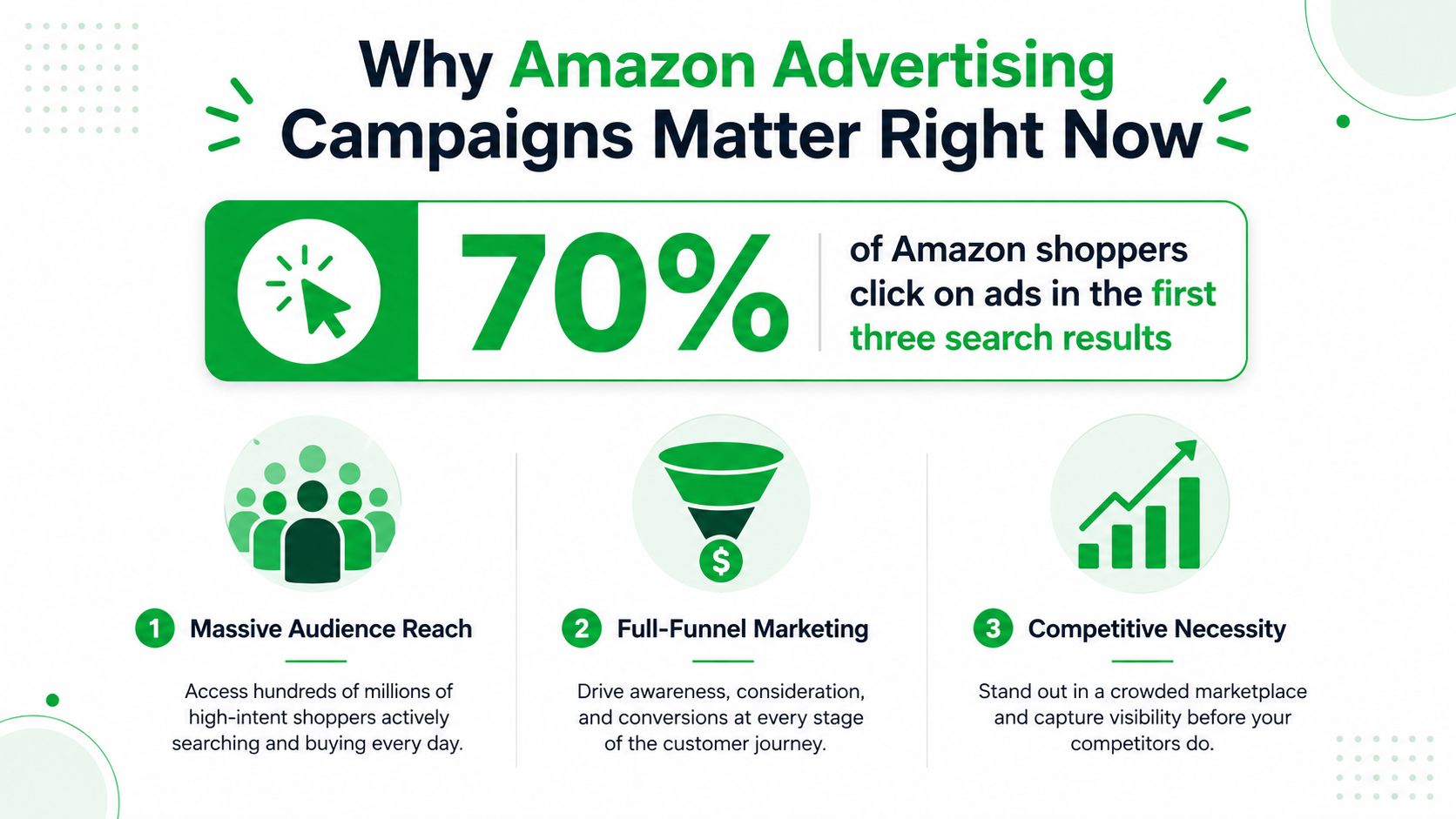
Amazon advertising has become a core media channel rather than a small retail add-on. Amazon reported $68.6 billion in advertising revenue for full-year 2025, including $21.3 billion in the fourth quarter, up 23% year over year. The company also reported $15.7 billion in advertising revenue in Q2 2025, up 22%, and $13.92 billion in Q1 2025, up 19%, evidence of sustained double-digit expansion across that year, as summarized by Amazon’s 2025 advertising revenue coverage.
Paid visibility now supports organic momentum
Sponsored placements put a product in front of shoppers at the moment of search, but paid traffic doesn’t repair a weak offer. If the image, price, reviews, variation structure, or detail-page copy fails to close the click, more traffic just increases waste. If the product converts well, advertising can help generate the sales velocity and query relevance that support broader marketplace visibility.
Amazon’s advertising segment reached about 9.36% of total company revenue in Q2 2025, on $15.69 billion in ad sales, according to Amazon advertising milestone reporting. That scale changes the planning conversation. Sellers aren’t competing only for organic placement. They’re competing for paid inventory across search, product pages, display, video, and streaming environments.
Practical rule: Don’t ask whether advertising is expensive in isolation. Ask whether each dollar is buying profitable orders, qualified new shoppers, or useful learning that improves the next campaign.
Amazon’s 2026 direction also moves beyond keyword-only thinking. Amazon describes Full-Funnel Campaigns built with natural-language workflows, AI-assisted creative, audience selection, and optimization across formats in its 2026 advertising outlook. Automation can handle more execution, but it won’t decide whether your product has a defendable position, whether a creative concept fits the category, or whether a sale is incremental.
For a practical framework around positioning, audience, and channel selection, review this Amazon marketing strategy guide. The useful mindset is simple: paid media should support the product’s commercial strategy, not substitute for one.
Amazon Advertising Campaign: The Three Core Amazon Ad Types
Amazon’s self-service sponsored ecosystem has three core formats: Sponsored Products, Sponsored Brands, and Sponsored Display. Sponsored Products and Sponsored Brands use CPC pricing, while Sponsored Display can use CPC or vCPM pricing, where vCPM charges per 1,000 viewable impressions, as Amazon explains in its Sponsored Ads product overview.
Think of the formats as different jobs. Sponsored Products works like a sales associate placing one product beside a relevant search. Sponsored Brands functions more like a storefront sign that introduces the brand and several products. Sponsored Display follows audiences or products through consideration and re-engagement environments.
Sponsored Products
Sponsored Products is the default workhorse for most sellers. It promotes an individual ASIN in search results and product-detail environments, making it the clearest choice when the immediate objective is a sale.
Use automatic targeting to discover queries and product relationships, then use manual keyword and product targeting to control proven demand. The format is strongest when the detail page already answers the shopper’s objections. A high bid can’t compensate for a confusing title or an image that doesn’t communicate the product’s use.
Sellers who want a deeper operating model can reference this guide to Amazon Sponsored Products. Keep the campaign focused enough that the search-term report tells you something actionable.
Sponsored Brands
Sponsored Brands earns its place when a seller has a real brand story, multiple relevant products, or a category where competitor names dominate the search experience. Banner, collection, and video executions can occupy prominent search real estate and send shoppers to a Store, a product collection, or a detail page.
The trade-off is attribution. A Sponsored Brands campaign may influence discovery and future branded demand without producing the same immediate efficiency as a tightly controlled Sponsored Products campaign. Judge it by its role in brand defense, product discovery, and assisted demand, not only by last-click sales.
Sponsored Display
Sponsored Display is useful for mid-funnel reach, product targeting, and audience-based re-engagement. It can place a product near competing detail pages or reach shoppers who have shown relevant shopping behavior, depending on the available targeting and campaign setup.
It isn’t a replacement for search capture. Display often needs stronger creative and a clearer audience purpose because the shopper may not be actively searching for the product at the moment of exposure.
| Ad Type | Placement | Targeting Reach | Creative Format | Best For |
|---|---|---|---|---|
| Sponsored Products | Search results and product pages | Keywords, products, automatic discovery | Product image and listing content | Direct response and ASIN sales |
| Sponsored Brands | Search placements and brand destinations | Keywords, products, categories, audiences where available | Banner, collection, or video | Brand discovery and category defense |
| Sponsored Display | Product pages and broader audience environments | Products and shopper audiences | Display creative and product-focused units | Retargeting and mid-funnel consideration |
Amazon says sponsored ads can start without a minimum spend requirement. It lists a $1.00 minimum daily budget for Sponsored Products and Sponsored Brands, or the local-currency equivalent, while its getting-started guidance recommends $10 per day in markets including the United States, Canada, the United Kingdom, and several European Union countries so ads have a better chance of running throughout the day, as explained in Amazon’s advertising basics guide.
Amazon Advertising Campaign: Structure, Targeting, and Bidding
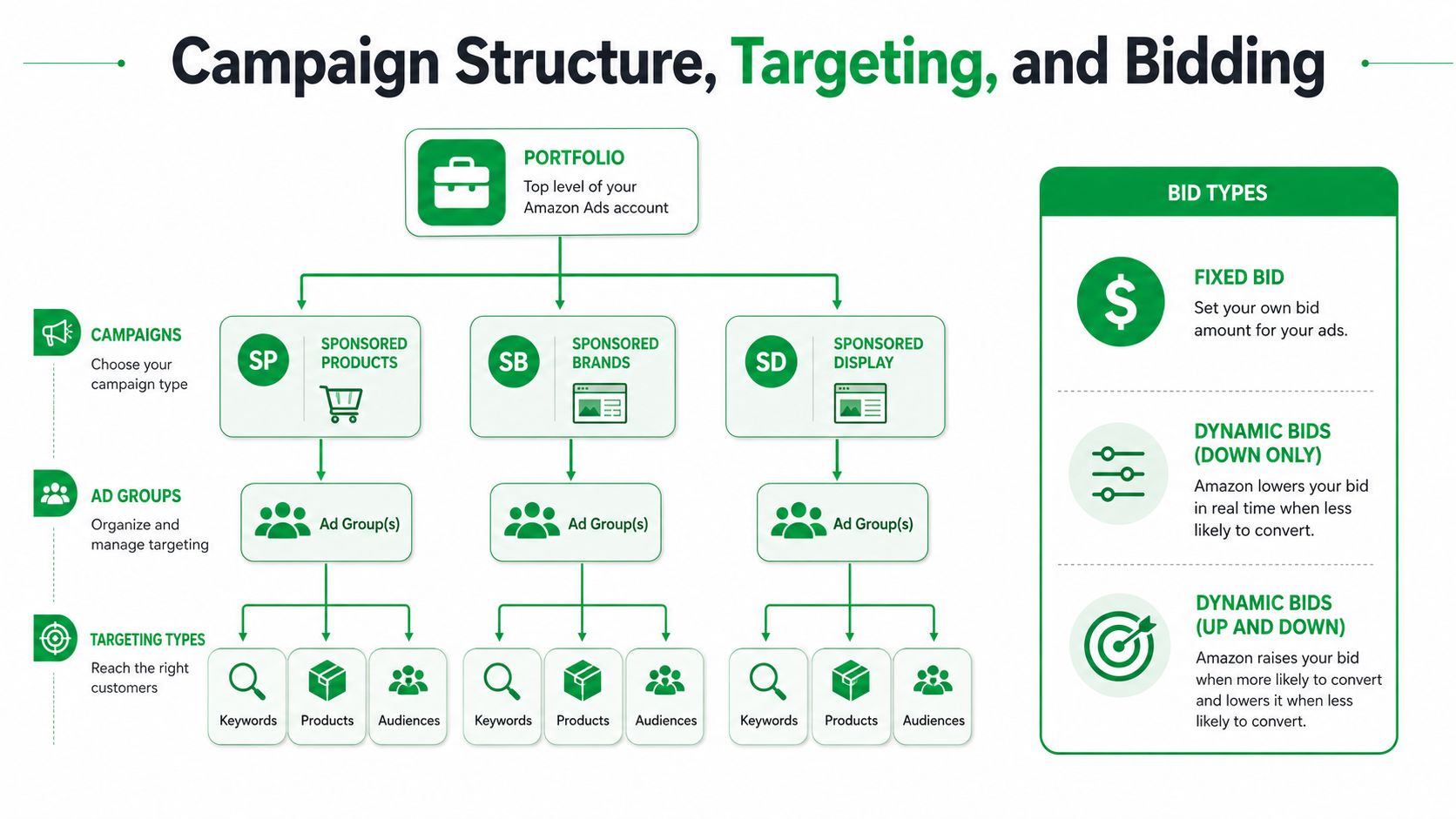
A workable account lets you answer three questions quickly: what is being advertised, who is being targeted, and where is the budget going? If one campaign mixes discovery terms, branded terms, competitor ASINs, and unrelated products, performance data becomes difficult to interpret.
Build the hierarchy around decisions
Take a private-label supplement brand selling a daily magnesium capsule. The portfolio might group the product line by business objective. Inside it, separate campaigns for branded search, non-branded discovery, competitor products, and automatic research. Each campaign can contain an ad group for the relevant ASINs and targeting set.
That structure gives you control over budget and reporting. A profitable exact-match term can receive a different bid from an automatic campaign that is still searching for opportunities. A competitor ASIN can be excluded or isolated without muddying the performance of the core category campaign.
Amazon Advertising Campaign: Match targeting to the job
Automatic targeting is a discovery layer. It helps expose search terms and product relationships you may not have anticipated, but it needs regular search-term review and negative targeting.
Manual keyword targeting gives you control over broad, phrase, and exact match. Broad finds variations and adjacent intent, phrase preserves a meaningful sequence, and exact gives the clearest control over a proven query. I generally treat broad and phrase as research environments, then move validated terms into exact campaigns where budgets and bids can be managed independently.
Product targeting places an ASIN against specific products, categories, or related detail-page contexts. It can work well for comparison shopping, but the product needs a credible price, review profile, and value proposition.
Bid settings change delivery
Dynamic bids down only reduce bids when Amazon estimates a click is less likely to convert. Dynamic bids up and down can increase bids when a conversion appears more likely, which can expand reach but also spend more aggressively. Fixed bids hold the submitted bid steadier and can be useful when you want a cleaner test of targeting or placement.
Placement multipliers matter. Amazon identifies Top of Search as the first row of first-page desktop results and the first four mobile positions. Sponsored Brands can adjust placement percentages for Top of Search and Rest of Search, while Sponsored Products also includes Product Pages and Amazon Business placements, according to Amazon’s placement guidance.
A daily budget is a delivery constraint, not a performance guarantee. If a campaign runs out early, it may miss later demand. If it never spends, increasing the budget won’t fix weak relevance or an uncompetitive bid. For broader account-management context, see this resource on PPC campaign management.
Amazon Advertising Campaign: The KPIs That Actually Tell You If a Campaign Is Working
A campaign becomes diagnosable when each metric has one job. CTR tells you whether the impression and creative earn attention. Conversion rate tells you what happens after the click. CPC reflects the cost of winning traffic. ACoS connects ad spend to attributed product sales, while ROAS expresses the same relationship from the revenue side.
Amazon defines CPC as the average amount paid for an ad click and ROAS as total product sales divided by total advertising spend in its advertising metrics documentation. That distinction matters because lowering CPC alone doesn’t improve ROAS if the cheaper clicks don’t convert.
Read the metrics as a diagnostic chain
A weak CTR usually points toward relevance, creative, placement, or query selection. A healthy CTR with a weak conversion rate shifts attention to the listing, offer, reviews, price, delivery promise, or product-market fit. A strong conversion rate with rising CPC suggests auction pressure or a placement strategy that needs tighter economics.
ACoS is useful only against the product’s contribution margin and growth objective. A low ACoS can be a warning if the campaign captures mostly branded demand or throttles discovery. A higher ACoS can be rational for a launch or category expansion, provided the seller understands the investment and has a path toward stronger efficiency.
ROAS is the inverse framing of ACoS. A campaign with a 4.28 ROAS and a 13% improvement in ROAS appeared in Amazon’s Sponsored Products video case study, alongside a 27% conversion-rate increase and a 12% ACoS reduction versus static-image campaigns, as reported in Amazon’s Sponsored Products video case study. Treat those figures as that case’s reported result, not a universal benchmark.
| KPI | Typical Range | What It Tells You | Common Mistake |
|---|---|---|---|
| CTR | Category-dependent | Whether impressions attract qualified attention | Raising bids before improving relevance |
| Conversion rate | Offer and category-dependent | Whether the detail page closes the click | Blaming targeting for listing friction |
| CPC | Auction and placement-dependent | What traffic costs | Treating cheaper clicks as automatically better |
| ACoS | Margin and objective-dependent | Spend relative to attributed sales | Chasing a low number at the expense of reach |
| ROAS | Inverse of ACoS | Revenue generated per advertising dollar | Ignoring incremental demand and branded traffic |
The practical habit is to read ACoS alongside TACoS, which compares advertising spend with total sales. ACoS can look excellent while total business growth stalls. TACoS gives a wider view of whether advertising is helping the business generate additional demand or merely subsidizing shoppers who were already likely to purchase. For a broader measurement framework, review how to measure marketing campaign effectiveness.
Amazon Advertising Campaign: Optimization Tactics That Move the Needle
Optimization works best in priority order. Don’t begin by changing every bid in the account. Start with the waste you can identify, then adjust the auction variables that influence qualified traffic, and only afterward invest time in structural or creative changes.
Start with search terms
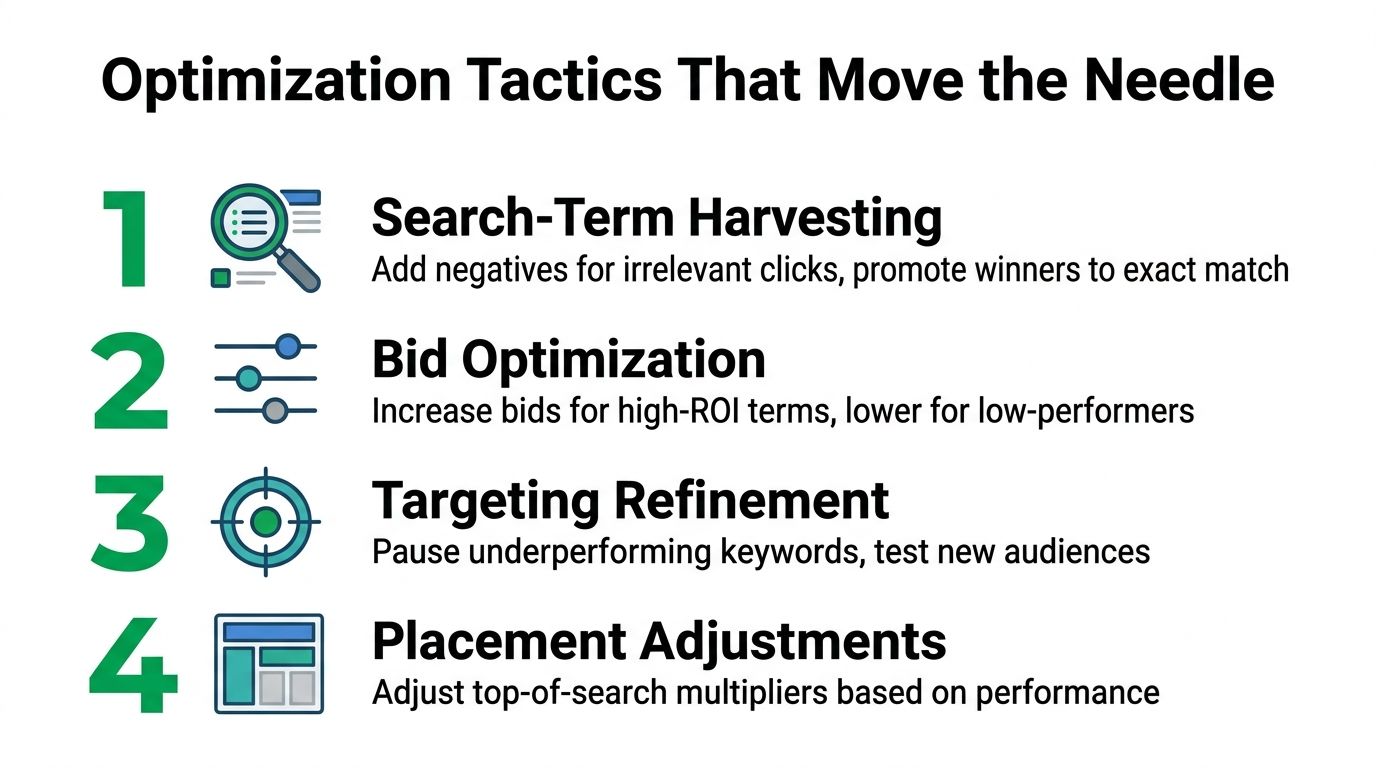
Search-term harvesting is usually the fastest way to improve control. Move converting queries into an intentional manual campaign, add irrelevant queries as negatives where appropriate, and separate research traffic from proven traffic.
- Protect relevance: Remove terms that attract clicks but don’t describe the product’s actual use.
- Promote evidence: Give converting queries their own match-type and budget logic when volume justifies it.
- Segment intent: Keep branded, category, competitor, and product-specific demand distinct.
Adjust bids by placement
Look at performance by Top of Search, Rest of Search, and Product Pages before applying a blanket bid change. Top of Search can carry a higher CPC but still produce stronger ROAS when shoppers show clearer intent. Product Pages may offer cheaper reach, yet the surrounding competitors can make conversion harder.
Amazon’s guidance supports CPC comparisons across ad products, so the useful control loop is bid adjustment, query segmentation, and placement-level budget reallocation, not just cutting spend everywhere. A campaign that spends efficiently in one placement shouldn’t be penalized because another placement underperforms.
Fix pacing before adding money
If a campaign exhausts its budget early, inspect the hourly delivery pattern and the value of the traffic it receives. If the campaign barely spends, diagnose eligibility, bids, relevance, targeting volume, and listing quality before increasing the budget.
Creative becomes the constraint once traffic quality is sound. Improve the main image, title clarity, A+ content, offer presentation, and video before asking the auction to deliver more clicks. Amazon’s reported video case demonstrates why format can alter downstream economics, but the creative still has to communicate the product quickly.
Use a repeatable cadence:
- Weekly: Review search terms, negatives, placement performance, and conversion changes.
- Biweekly: Reset bids and budgets based on sufficient recent evidence rather than one unusual day.
- Monthly: Audit campaign structure, duplicated targeting, ASIN isolation, creative coverage, and portfolio allocation.
For listing work that supports these advertising decisions, see Amazon product listing optimization. And don’t change bids, budgets, targeting, and creative at the same time if you need to know what caused the result.
Amazon Advertising Campaign: Seller Use Cases Versus Brand Use Cases
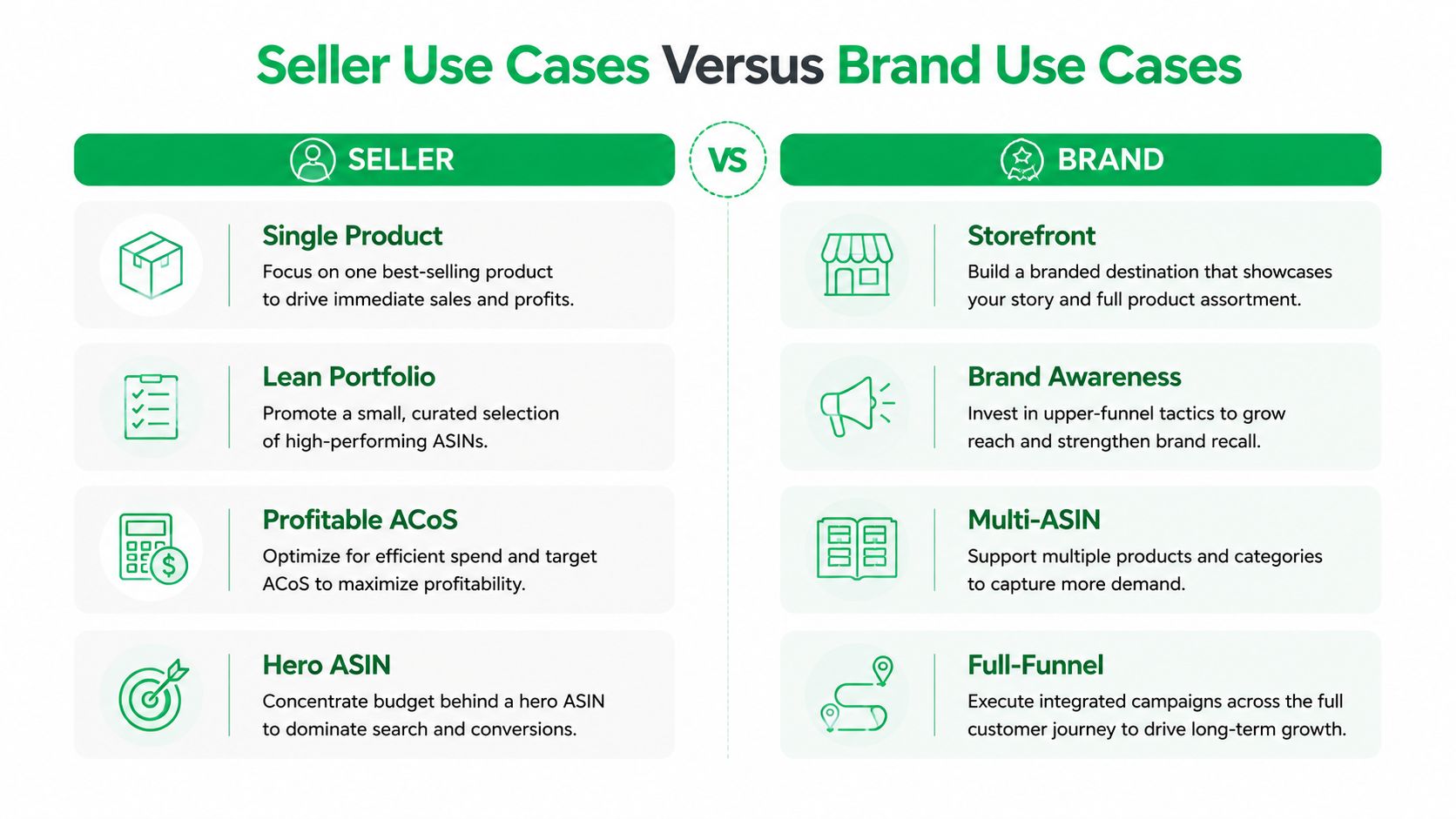
A single-ASIN seller and a growing brand can use the same Amazon console but should not optimize toward the same outcome. The seller often needs controlled demand at a profitable unit margin. The brand may accept a broader role for advertising, including category defense, product discovery, audience development, and assisted conversion.
The seller model
A lean seller account usually starts with Sponsored Products. The focus stays on the hero ASIN, profitable search terms, product targeting, and disciplined ACoS. Sponsored Brands can become useful when the catalog supports a coherent destination and the seller can tell a brand-level story rather than promoting one isolated item.
The mistake is graduating to broader formats because they look more advanced. If the detail page has weak conversion or the campaign can’t sustain qualified traffic, adding video or display often spreads the problem across more placements.
The brand model
Brands can use Sponsored Brands to defend branded searches, present several products together, and direct shoppers to a Store. Sponsored Display can support retargeting and competitor-product exposure. Amazon DSP and streaming placements become more relevant when the objective includes incremental reach beyond shoppers already searching for a specific product.
Amazon’s 2026 direction connects Sponsored Products, Sponsored Brands, Sponsored Display, Sponsored TV, and Amazon DSP through broader benchmark reporting and full-funnel planning. The measurement question changes from “Which keyword produced the order?” to “Which audience and format moved the shopper closer to purchase?”
A practical progression looks like this:
- Single product: Sponsored Products captures demand and supplies search-term evidence.
- Brand defense: Sponsored Brands protects branded discovery and connects related ASINs.
- Full funnel: Sponsored Display, DSP, video, and streaming support awareness and consideration, while Sponsored Products converts high-intent shoppers.
A monthly ad-spend threshold alone shouldn’t decide the transition, but Sponsored Brands starts making more strategic sense around $5,000 in monthly ad spend when the catalog can support a brand story. That figure is a planning rule of thumb, not an Amazon requirement. The stronger test is whether the business has enough products, creative, inventory, and measurement discipline to learn from upper-funnel activity.
Amazon Advertising Campaign: Measuring Against Peers and Planning for 2026
A campaign isn’t “good” because its ACoS improved versus last month. It may be good because it outperforms comparable advertisers in the same category, marketplace, and format while supporting the business objective.
Amazon expanded benchmark reporting worldwide across 15+ marketplaces, with peer-category comparisons for new-to-brand purchases, CTR, CPC, video completion rate, and CPM, according to Amazon’s worldwide benchmarks announcement. Use the advertising console to compare the campaign with its category peers, then decide whether the gap calls for a bid change, a creative revision, a targeting adjustment, or a budget shift.
Third-party platforms such as Helium 10, Perpetua, and Jungle Scout can add workflow, historical views, and automation. They don’t replace first-party interpretation. A benchmark can tell you that a metric is unusual, but the operator still has to determine whether the cause is the offer, the auction, the placement, or the audience.
Category Benchmark Ranges for Amazon Sponsored Products
The verified data doesn’t provide numerical category ranges for ACoS, CTR, or conversion rate. Don’t fill that gap with generic targets. A 15% ACoS in pet supplements and a 35% ACoS in luxury cookware could each be healthy or unhealthy depending on margin, repeat purchase behavior, branded demand, and growth intent. Compare like with like.
Planning for an AI-led account
Amazon says its 2026 full-funnel direction uses natural-language campaign creation, AI-assisted creative, audience selection, and continuous optimization across formats. The practical response isn’t to surrender judgment. It is to give automation clean inputs, separated objectives, strong creative, and a measurement plan that includes more than last-click sales.
Use this checklist:
- Diversify deliberately: Add formats when the business has a clear audience or funnel job for them.
- Protect learning: Keep major changes isolated long enough to evaluate their effect.
- Fund reach carefully: Shift budget toward incremental audiences instead of defending existing demand automatically.
- Review peers: Use category and marketplace context before declaring success or failure.
Short FAQ
How should attribution be interpreted? Use the attribution window configured for the report and avoid treating every attributed sale as incremental. Branded search, retargeting, and high-intent product targeting often capture demand that already existed.
What budget lets an algorithm learn? Amazon says performance-based budget rules require a minimum daily budget of $10, so the lowest-budget campaigns can’t use that automation feature, as documented in Amazon’s dynamic budget control guidance. A practical learning budget depends on CPC, conversion rate, category volume, and the campaign objective.
Does organic rank affect paid efficiency? Yes, in practical terms. A stronger listing and stronger organic presence can improve shopper confidence and reduce reliance on paid discovery, while advertising can expose the product to queries where organic visibility is still developing.
Measure against peers, automate repetitive controls, and reserve human judgment for creative, offer strategy, and category positioning.
Mr. Green Marketing, LLC offers Amazon PPC, Sponsored Ads, DSP support, campaign setup, monitoring, bid optimization, keyword harvesting, negative filtering, product targeting, and performance segmentation. Visit Mr. Green Marketing, LLC to request a free audit and performance report that identifies visibility gaps and practical opportunities in your Amazon advertising campaign.
Leave a Comment
sing in to post your comment or sign-up if you dont have any account.