
Winning Amazon marketing strategy : So, what does a real Amazon marketing strategy actually look like?
Let’s get one thing straight—it’s not just running a few ads and hoping for the best. And far too many sellers fall into this trap, treating their marketing as a checklist of disconnected tasks instead of a unified engine built for growth.
A truly effective strategy is more like a flywheel. A connected system where every part you work on adds momentum to the others. Get it spinning, and it starts to build its own relentless velocity. This single concept is what separates the top 1% of sellers from everyone else.

The Amazon Flywheel Effect in Action
Here’s how it works in the real world. Strong Amazon SEO on your product pages helps you rank higher in organic search results. The better you rank, the less you have to rely on expensive ads just to get noticed—your products are already visible.
Those ads, in turn, drive an initial burst of sales and traffic. This activity generates customer reviews, which act as powerful social proof. And more positive reviews boost your conversion rate, convincing new shoppers to click “Add to Cart.” It all feeds back into itself. A perfect loop.
Your strategy is a system of interconnected parts. Organic rank lowers ad costs, ads drive sales that generate reviews, and reviews increase conversion rates—which in turn improves your organic rank all over again.
This virtuous cycle is what turns a simple Amazon store into a growth machine. For a deeper playbook on this, our guide to increasing Amazon sales offers a ton of actionable steps.
Winning Amazon Marketing Strategy: The Core Pillars of Your Strategy
To get your flywheel spinning, you need to master three core pillars. We’ll break down exactly how to execute on each one, but first, you need to understand how they fit together.
- Organic Presence (SEO): Your foundation. It’s how customers find you without you paying for a single click. This includes everything from keyword optimization and high-quality images to your A+ Content and Brand Store.
- Paid Advertising (PPC): Your accelerator. It’s how you get immediate visibility, test new products, and defend your market share. This means running smart campaigns with Sponsored Products, Brands, and Display ads.
- Reputation & Reviews: Your trust engine. It’s how you build confidence with shoppers through reviews, ratings, and excellent seller feedback. Without social proof, the rest of your efforts will fall flat.
This guide will give you a clear roadmap for building and connecting each of these pillars into a single, cohesive strategy. Let’s start by building that foundation.
Amazon Marketing Strategy: Building Your Foundation with Amazon SEO
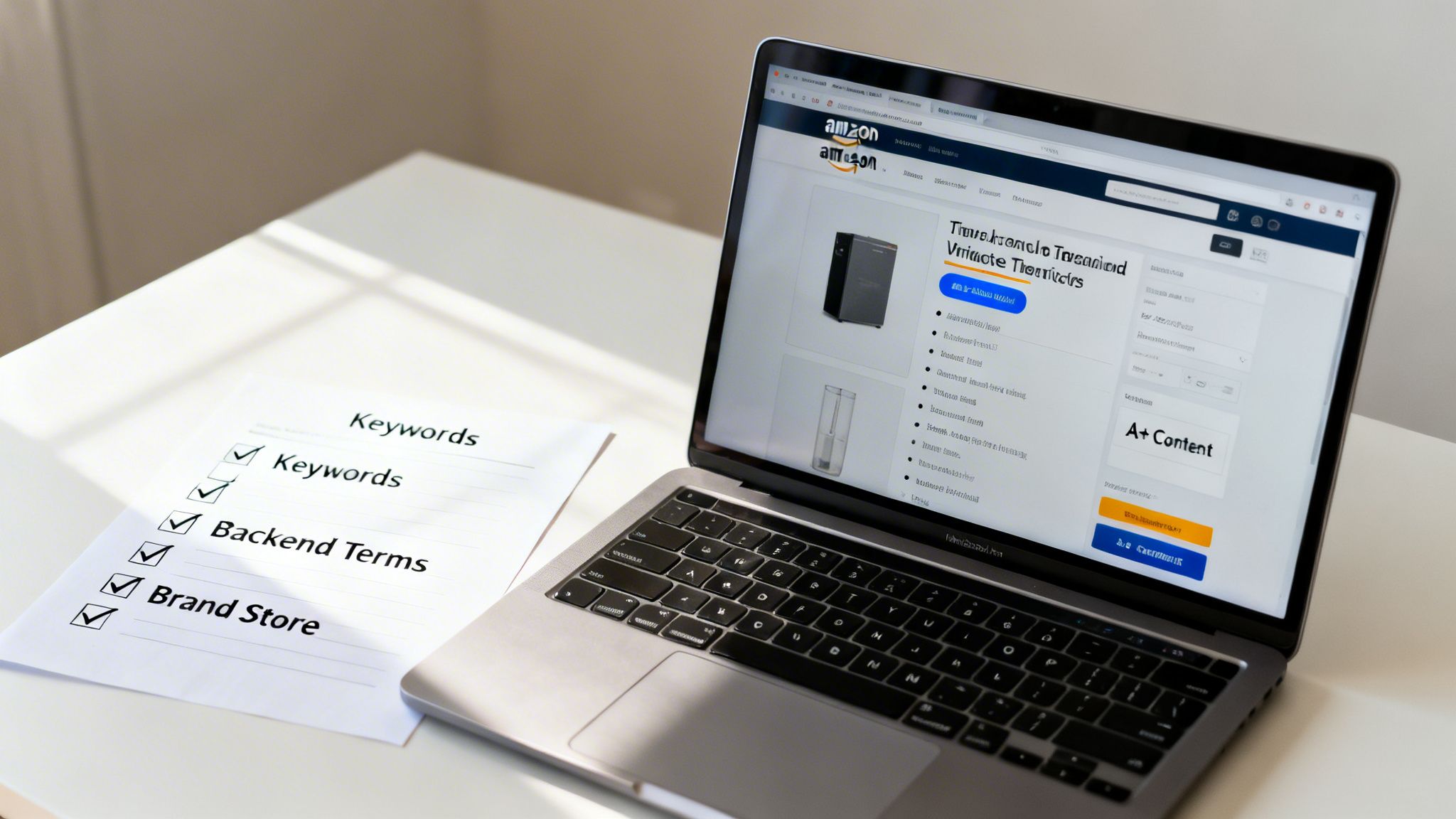
Before you spend a single dollar on ads, you need to get your house in order. That starts with mastering the most critical piece of your organic Amazon marketing strategy: the product listing itself. This is Amazon SEO. And it’s the bedrock of everything you’ll do.
Think of Amazon as its own massive search engine. It’s not just a store; it’s where nearly 60% of consumers kick off their product search. If your listing isn’t optimized for how real people search, you’re basically invisible.
Unpacking the A9 Algorithm
Amazon’s search algorithm, known as A9, has one simple job: show customers the products they’re most likely to buy. And it figures this out by looking at two main things:
- Relevance: How well does your product match what the customer typed in the search bar? This is all about the keywords in your title, bullet points, and backend fields.
- Performance: How well does your product actually sell? A9 tracks your sales history, conversion rate, customer reviews, and even your price.
A9 weighs these factors to decide where you rank. The key takeaway? Just stuffing keywords into your listing won’t cut it. You also need a product that converts traffic into sales.
Amazon marketing strategy: Core Components of Listing Optimization
Getting your listing right isn’t a one-and-done task. It’s a full optimization process—not a quick keyword swap. Here are the core elements you have to nail.
- The Title: Your most valuable SEO real estate. It must include your brand, product type, key features (like size or color), and your most important keywords. Crucially, it has to be readable for humans, not just the algorithm.
- Bullet Points (Key Product Features): Don’t just list features—sell the benefits. Use each bullet point to solve a problem or answer a customer’s question before they even ask it. A great format is to lead with a capitalized, benefit-focused phrase and then elaborate.
- Product Description & A+ Content: For sellers in the Brand Registry, the standard text description gets replaced by A+ Content. A total game-changer. You can use it to tell your brand story, add high-quality images and comparison charts, and build serious trust. Well-designed A+ Content can boost conversion rates by up to 10%.
- Backend Search Terms: Your hidden keywords. Customers don’t see them, but the A9 algorithm does. This is the place for synonyms, long-tail keyword variations, and common misspellings that you couldn’t fit in your main copy. And don’t repeat words from your title or bullets.
The competition is fierce. In Q4 2025 alone, third-party sellers—the backbone of the marketplace—accounted for 62% of all units sold. With Amazon controlling nearly 40% of the U.S. e-commerce market, these sellers are all fighting for attention across a catalog of over 350 million products.
Your Amazon Brand Store is your own digital storefront on the world’s biggest shopping platform. It’s a space free from competitor ads where you can create a branded shopping experience, tell your story, and guide customers through your entire product catalog.
Beyond the Listing Page
A complete SEO strategy goes beyond a single page. It’s about creating a unified brand presence. For a deep dive into every detail, check out our guide on Amazon listing optimization.
Building a strong Brand Store is essential. Think of it as your brand’s home base on Amazon—a powerful tool for building loyalty and increasing a customer’s average order value by cross-selling your other products.
When you get this organic foundation right, every other part of your marketing—especially your paid advertising—becomes far more effective and profitable.
Amazon marketing strategy: Powering Growth with Amazon Advertising
Alright, your listings are optimized and ready for prime time. Now it’s time to pour some fuel on the fire. This is where a smart advertising strategy comes into play—it’s how you get immediate, targeted visibility on the world’s biggest product search engine.
Welcome to the world of Amazon Advertising. A massive ecosystem, but we can break it down simply. Think of it as a machine designed to meet shoppers at every single stage of their journey, from casual browsing all the way to the final purchase. Getting this right means more than just turning on ads; it’s about building a system that drives predictable growth.
The Core Amazon Ad Types
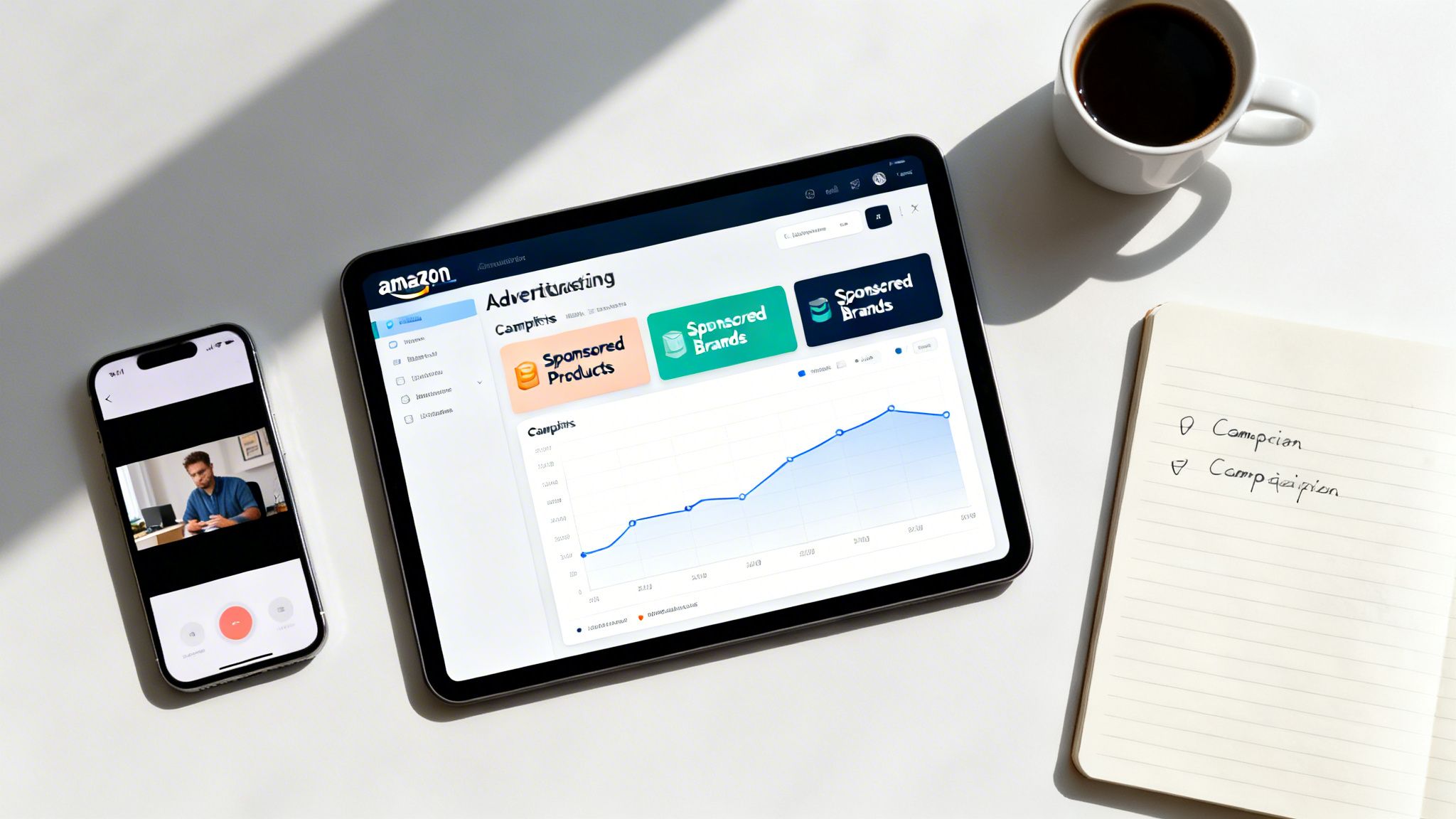
Your advertising strategy will be built on three primary ad formats, with a fourth, more advanced option available to larger brands. Each serves a distinct purpose. And the real magic happens when you use them together to create a seamless customer experience.
Here’s a quick look at the main ad types and what they’re best for:
Amazon Ad Types at a Glance
| Ad Type | Primary Goal | Best For |
|---|---|---|
| Sponsored Products (SP) | Driving sales & capturing intent | Getting your product in front of shoppers actively searching for what you sell. The workhorse of Amazon ads. |
| Sponsored Brands (SB) | Building brand awareness | Showcasing your brand logo, a custom headline, and multiple products at the top of search results. Great for telling a story. |
| Sponsored Display (SD) | Retargeting & conquesting | Re-engaging shoppers who viewed your product but didn’t buy, or targeting competitor listings. |
These ad types form the foundation of most successful strategies.
- Sponsored Products (SP): The bread and butter for nearly every seller. These ads appear directly in shopping results and on product detail pages, looking almost identical to organic listings. They are fantastic for capturing high-intent buyers who are actively searching for products just like yours.
- Sponsored Brands (SB): These ads live at the very top of the search results page and are all about brand awareness. They let you feature your logo, a custom headline, and a collection of your products or a link to your Brand Store. The video version—Sponsored Brand Video—is especially powerful for grabbing attention.
- Sponsored Display (SD): Think of this as your retargeting engine. Sponsored Display ads can follow shoppers both on and off Amazon, reminding them of the products they looked at but didn’t purchase. The perfect tool for staying top-of-mind and bringing bounced traffic back to seal the deal.
The scale of Amazon’s ad business is immense. Its advertising revenue soared to $56.2 billion in 2025, with ad services pulling in about $14.6 billion in Q1 2026 alone. Sponsored Products are the main driver, making up 68% of that revenue and hitting an average conversion rate of 11.55% when optimized correctly. For more details on these figures, you can discover more insights about Amazon’s advertising dominance on Investing.com.
Structuring Your Campaigns for Success
Just launching ads isn’t a strategy. The real work is in the structure. A common mistake we see is sellers lumping all their keywords into one massive campaign—it’s a recipe for wasted spend and completely useless data. A much better approach is to segment your campaigns by intent.
Here’s a simple, effective framework we use:
- Discovery Campaigns: Start with an “Automatic” Sponsored Products campaign. Here, you let Amazon’s algorithm do the heavy lifting to find relevant customer search terms for you. Your only job is to monitor the “Search Term Report” this campaign generates.
- Performance Campaigns: After your auto campaign runs for a couple of weeks, you’ll have a list of search terms that actually led to clicks and sales. You then “harvest” these proven keywords and move them into a “Manual” campaign where you gain precise control over bids.
- Refinement and Blocking: As you find high-performing keywords, you’ll also uncover irrelevant ones that are just wasting your budget. You add these to your “Negative Keywords” list. This cycle—Discovery, Performance, Blocking—is a continuous loop of optimization that refines your targeting over time.
This isn’t just about ads; it’s about data. Your advertising campaigns are a powerful research tool. They tell you exactly what customers are searching for, which keywords convert, and where your organic SEO efforts might have gaps.
A Full-Funnel Advertising Approach
The most effective Amazon marketing strategy uses these ad types in concert to guide a customer from awareness all the way to purchase.
Imagine a shopper sees your engaging Sponsored Brand Video at the top of their search results—their interest is piqued. They click to your Brand Store, browse around, but get distracted and leave. A day later, they see one of your Sponsored Display ads on a third-party website, reminding them of your product. They click back, land on your perfectly optimized product page, and a Sponsored Products ad for a complementary item on that same page even convinces them to add a second product to their cart.
That is a full-funnel approach. It’s about using the right tool at the right time to turn a casual browser into a loyal customer. Building this kind of system can be complex, which is why many sellers find value in expert help. If you’re exploring that path, it’s worth understanding the benefits of working with an Amazon PPC agency.
Amazon marketing strategy: Building Social Proof and Managing Reputation
This is the part where your entire Amazon marketing strategy can either take off or completely fall apart. You can have the slickest ads, a beautifully designed listing, and a fantastic product—but if you don’t have positive reviews, you’re basically invisible. On Amazon, social proof isn’t a “nice-to-have.” It’s the currency of trust.
Just think about how you shop. You see two similar products. One has 1,500 reviews and a 4.5-star rating. The other has 12 reviews and a shaky 3.8-star rating. Which one do you buy? We all do the same thing. This is all about how you ethically build that mountain of social proof.
Amazon marketing strategy: The Right Way to Get More Reviews
Getting those first few reviews is always the toughest grind. The good news is, Amazon gives you a few legitimate, powerful ways to get them. This isn’t about using sketchy tactics that will land your account in hot water; it’s about using the systems Amazon built for this very reason.
- The “Request a Review” Button: Your most direct tool. You can find it in Seller Central on any order details page. Clicking it triggers a standardized, 100% compliant email from Amazon to the buyer, asking for both a product review and seller feedback. Simple, safe, and it works surprisingly well.
- Amazon Vine: An upfront investment, but it’s one of the fastest ways to get high-quality, detailed reviews from credible shoppers. You send free products to Amazon’s most trusted reviewers (called “Vine Voices”), and they leave honest feedback. It’s a game-changer for new product launches.
- Third-Party Email Automation: Tools can automate the “Request a Review” process, saving you from a mind-numbing amount of manual clicking. Just make absolutely sure the tool you choose uses Amazon’s official system and doesn’t send custom, non-compliant messages.
Think of every review as a direct line to your customer. Good reviews tell you what’s working. And the bad reviews—yes, even the painful one-star takedowns—are free market research telling you exactly what you need to fix.
Handling the Inevitable Negative Review
It’s going to happen. No matter how perfect your product is, a negative review will eventually show up. How you respond is what separates the pros from the amateurs. And panicking is not a strategy.
First, take a breath. Read the feedback and figure out what’s really going on. Is it a legitimate complaint about a defective product? A simple misunderstanding of how to use it? Or just an angry troll? Your response depends entirely on the root cause. Your reputation is a critical asset; for a deeper look at protecting it, you can learn more about social reputation management in our detailed guide.
The goal usually isn’t to get the review removed. That’s incredibly difficult unless it clearly violates Amazon’s policies (like using profanity or including private information). The real opportunity is in your public response.
Turning a Crisis into a Trust-Building Moment
When you get a bad review, remember your reply isn’t just for that one unhappy customer. It’s for the hundreds of future shoppers who will read it. And seeing a seller who is responsive, professional, and genuinely wants to help is a huge trust signal.
Here’s a simple framework for your public reply:
- Acknowledge and Apologize: Thank them for their feedback and apologize that their experience wasn’t up to par. Never get defensive.
- Offer a Solution: If there’s a product issue, explain how you’ve already addressed it or offer to make it right through your customer service channel.
- Take it Offline: Don’t get into a public argument. Give them a clear path to contact your customer service team to resolve the issue privately.
A public comment like, “We’re so sorry to hear the pump on your bottle was defective. That’s definitely not our standard, and we’ve flagged this with our quality team. Please contact us through Amazon’s buyer-seller messaging so we can ship a replacement to you immediately,” shows every potential customer that you stand behind your product. You’ve just turned a sales-killer into a powerful piece of marketing.
Amazon marketing strategy: Using Advanced Levers to Outsmart Competitors
Once you’ve built a solid foundation with SEO, advertising, and a strong reputation, you’re playing the game. But to actually win it, you need to start pulling the levers that most sellers don’t even know exist. This is where you create a real, lasting moat around your brand.
We’re moving beyond the basics and into the strategies that separate the breakout successes from the sellers who just tread water. We’ll focus on three areas the pros obsess over: dynamic pricing, razor-sharp inventory management, and driving your own high-intent traffic.
Dynamic Pricing and Promotional Strategy
Let’s be honest: most sellers handle pricing by setting it once, maybe matching the lowest competitor, and then walking away. A huge mistake. It’s like playing a chess match but only ever moving your pawns.
A sophisticated pricing strategy is alive—it reacts constantly to competitor moves, your own stock levels, and sales velocity. The goal is always to win the Buy Box, which is where over 80% of Amazon sales happen. But you have to do it without triggering a race to the bottom that torches your profits.
The Buy Box isn’t just a lowest-price-wins game. Amazon’s algorithm heavily factors in your fulfillment method (FBA is still king), shipping speed, and seller feedback. You can often win the Buy Box without being the absolute cheapest option.
Here’s how to do it smartly:
- Algorithmic Repricers: Put technology to work for you. These tools automatically adjust your prices based on rules you set, fighting for the Buy Box 24/7. Just set your floor price based on your COGS and target margin, and let the software handle the micro-adjustments.
- Strategic Couponing: That little green coupon badge is one of the most powerful conversion tools on Amazon. It creates urgency and a perception of value that often works better than a simple price drop. Test different discount levels—like 5% vs. 10%—to find what gives you the biggest lift.
Strategic Inventory Management
Running out of stock is one of the fastest ways to kill your momentum on Amazon. A stockout isn’t just a loss of today’s sales; it’s a negative signal to the A9 algorithm that your product is unreliable. Your search rank drops, your sales velocity disappears, and it can take weeks of hard work to claw your way back.
Thinking of inventory management as just an operational headache is a rookie mistake. It’s a critical marketing function.
Here’s how to treat it like one:
- Demand Forecasting: Don’t guess. Use your sales data from the last 30, 60, and 90 days to build a projection of future demand. Make sure to factor in seasonality and major sales events like Prime Day to avoid getting caught flat-footed.
- Inventory Performance Index (IPI): Your report card from Amazon. A low IPI score in Seller Central can lead to punishing storage limits and extra fees. Stay on top of it by clearing out slow-moving products and ensuring your bestsellers are always well-stocked.
As your brand scales, you’ll need to think beyond just FBA. For many growing businesses, a Third-Party Logistics (3PL) partner becomes essential for managing prep, storage, and fulfillment efficiently. You can learn more about this by mastering 3PL for Amazon sellers.
Driving High-Intent External Traffic
Relying only on the traffic Amazon gives you is like fishing in a community pond. The real pros build their own channels to drive high-quality traffic—traffic they control—directly to their product pages. And the best part? Amazon actually pays you for it.
Through the Brand Referral Bonus program, Amazon gives registered brands a bonus of around 10% of the sale price for any purchases driven by your off-Amazon marketing. This bonus effectively discounts your referral fees, making external campaigns much more profitable.
This means you can and should be running ads on platforms like:
- Google & Bing Ads: Target shoppers using long-tail, high-intent keywords and send them straight to your Amazon listing to convert.
- Social Media (Facebook, Instagram, TikTok): Use engaging video and lifestyle content to find new audiences and introduce them to your brand story.
- Email Marketing & Influencers: Leverage your own customer list or collaborate with creators in your niche to send their dedicated followers directly to your product page.
The traffic you drive is often your best traffic. You’ve already warmed them up with your own content, so they arrive on Amazon ready to buy. This boosts your conversion rate, which is a massive positive signal to the A9 algorithm. It’s the final piece of the puzzle that connects your entire marketing ecosystem into a powerful growth flywheel.
Amazon marketing strategy: Your Phased Amazon Marketing Roadmap
Okay, we’ve covered a ton of ground. It’s easy to feel overwhelmed by all the moving parts. So, let’s pull all these threads together into a simple, actionable plan you can actually follow.
This isn’t just a summary; it’s a phased roadmap for building your Amazon marketing strategy.
Forget trying to do everything at once. A surefire recipe for burnout and getting nowhere fast. The key is doing the right things at the right time. We’ll break it down into three distinct stages—think of it as Crawl, Walk, Run. No more guessing what to tackle next.
Amazon marketing strategy – Phase 1: The First 90 Days (Launch and Foundation)
Your mission in the first three months is simple: build a rock-solid foundation. This is all about getting the fundamentals right before you even think about scaling. Rushing this step is the most common—and costly—mistake we see sellers make.
Your priorities should be laser-focused. Don’t get distracted by shiny objects or advanced tactics just yet.
- Listing Optimization: Your product detail page must be retail-ready. This means a fully optimized title, compelling bullet points that sell benefits, high-quality images, and basic A+ Content.
- Initial Review Generation: Use Amazon’s “Request a Review” button and enroll your product in the Amazon Vine program. The goal is to get those crucial first 5-10 reviews. This is non-negotiable for building customer trust.
- Simple Ad Campaigns: Launch a single Sponsored Products “Automatic” campaign. Its only job is to gather data. Let Amazon’s algorithm do the heavy lifting and tell you which search terms customers are using to find and buy your product.
This timeline shows how the core levers you pull will evolve, starting with foundational elements like pricing and inventory before you layer on more complex traffic strategies.

As you can see, a successful Amazon strategy is built in layers. You need operational excellence before you can justify aggressive marketing spend.
Amazon marketing strategy – Phase 2: The Next 6 Months (Optimization and Scaling)
Now that you have a foundation and some initial data, it’s time to start walking. This phase is all about optimization and controlled scaling. You’ll take the learnings from Phase 1 and start building a more sophisticated, data-driven machine.
Your focus shifts from just “getting live” to “getting smart.” This is where you start to pull ahead of the competition.
The goal of this phase is to move from reactive to proactive. You’re no longer just launching things to see what happens; you’re using data to make calculated decisions that improve profitability and reach.
Here’s your checklist:
- Ad Campaign Segmentation: Take the winning search terms from your automatic campaign and “harvest” them. Move them into their own manual Sponsored Products campaign. This gives you precise control over your bids and budget.
- A+ Content Enhancement: Time to upgrade from basic A+ Content. Add comparison charts, lifestyle imagery, and brand story modules. Elevate the customer experience and give your conversion rate a serious boost.
- Brand Store Build-Out: Create a simple but effective Amazon Brand Store. This becomes the dedicated landing page for your Sponsored Brands ads, letting you create a branded shopping experience, free from competitor ads.
- Initial External Traffic: Start experimenting with the Brand Referral Bonus program. Drive a small, controlled amount of traffic from a social media post or a Google Ad to your listing and measure the impact.
Amazon marketing strategy – Phase 3: Year One and Beyond (Domination and Brand Building)
With a year of data and experience under your belt, you’re ready to run. This phase is about expanding your reach, building a defensible brand, and cementing your market position. You have a working system; now it’s time to feed the machine.
Your strategy evolves from winning individual sales to winning long-term market share.
- Full-Funnel Advertising: Implement a true full-funnel ad strategy. Use Sponsored Brands Video for top-of-funnel awareness, Sponsored Products for mid-funnel conversion, and Sponsored Display for retargeting shoppers who visited your page but didn’t buy.
- Off-Amazon Audience Building: Scale up your external traffic. It’s time to build an email list, work with influencers, and create a content engine that consistently drives high-intent buyers back to your Amazon listings.
- Portfolio Expansion: Use the data you’ve gathered to spot opportunities for new products. What are customers asking for? Where are the gaps in the market? You can now launch new products into your proven system for a much higher chance of success.
This phased approach turns a mountain of tasks into a series of manageable steps. Just focus on the phase you’re in. Master it, then move to the next.
Your Top Amazon Marketing Questions, Answered
Let’s get straight to it. Here are the tough, practical questions we hear every day from sellers trying to build a winning Amazon marketing strategy. My goal is to give you clear, no-nonsense answers so you can make decisions with confidence.
How Much Should I Budget for Amazon Marketing?
There’s no single magic number, but a solid rule of thumb is to set aside 10-20% of your total Amazon revenue for marketing. This isn’t a “set it and forget it” figure—your budget will, and should, change based on where your product is in its lifecycle.
- Launch Phase: This is where you invest heavily. Plan to spend more, often in the 25-35% range of your projected revenue. The goal here isn’t instant profit; it’s about gaining visibility, sparking initial sales velocity, and collecting crucial reviews. You’re buying data and momentum.
- Mature Phase: Once your product is established, your budget can settle into that 10-15% sweet spot. The focus shifts from aggressive growth to maintaining profitability and defending your hard-won market share.
It’s also critical to look past just your Advertising Cost of Sale (ACoS). The metric that truly matters is your Total Advertising Cost of Sale (TACoS), which is your total ad spend divided by your total revenue. TACoS tells you the real story: whether your ads are lifting all boats and driving overall sales, not just the ones directly attributed to a click.
How Long Until My Amazon SEO Efforts Work?
This is a marathon, not a sprint. While small changes, like a title update, can get re-indexed and show an effect in just a few days, building real, lasting organic rank is a longer game. You should be thinking in terms of 3 to 6 months.
Why so long? Because Amazon’s A9 algorithm is watching more than just your keywords. It’s evaluating your sales history, conversion rate, and customer satisfaction over a sustained period. You can’t fake that kind of trust. The goal is to build sustainable sales velocity that the algorithm rewards over time.
Remember the difference between indexing and ranking. Indexing is when Amazon sees your keywords and understands what your product is. Ranking is when Amazon trusts your product enough to actually show it on page one for those keywords.
What Are the Biggest Mistakes New Sellers Make with Ads?
We see the same painful—and expensive—mistakes over and over. They almost always boil down to one thing: getting impatient and trying to run before you can walk.
Here are the most common pitfalls that burn through budgets:
- Launching Ads on an Unoptimized Listing: This is like paying to send traffic to a storefront with boarded-up windows. You’re flushing money down the drain on clicks that have zero chance of converting.
- Relying Only on Automatic Campaigns: Auto campaigns are a fantastic tool for research, not a long-term profit strategy. You have to “graduate” your winning search terms into manual campaigns where you can control your bids with precision.
- Ignoring Negative Keywords: Failing to tell Amazon which search terms are irrelevant is like setting your ad budget on fire. This single step is the fastest and easiest way to slash wasted spend and improve your ACoS.
Ready to build an Amazon marketing strategy that drives real results? Mr. Green Marketing, LLC builds custom plans that align with your measurable business goals. Request a free audit and performance report to find your quick wins.
Leave a Comment
sing in to post your comment or sign-up if you dont have any account.