
Social Media Management for Small Business: You opened Facebook, Instagram, and TikTok to publish one quick update. Two hours later, you’re still trimming a video, rewriting a caption, answering messages, and wondering whether any of it will produce a sale. The business is waiting, the invoice is overdue, and your social calendar is held together by screenshots and good intentions.
That’s why social media management services for small businesses deserve to be judged as an operating decision, not a vanity purchase. The right provider removes repetitive work, builds a measurable process, and connects content to enquiries. The wrong one delivers a pile of posts that keeps your accounts busy while your pipeline stays quiet.
Social Media Management for Small Business: Table of Contents
- Why Small Businesses Are Drowning in Social Media
- What Social Media Management Services Actually Include
- Choosing the Right Platforms for Your Business
- DIY, Freelancer, or Agency, Which Model Fits
- How Social Media Management Pricing Really Works
- How to Evaluate and Choose the Right Provider
- Setting Realistic ROI Expectations and SLAs
- Where to Start Without Burning Your Budget
Why Small Businesses Are Drowning in Social Media
A bakery owner shouldn’t have to edit a Reel after closing. A dentist shouldn’t be checking TikTok audio between patients. An HVAC owner shouldn’t be writing captions while preparing a quote. Yet that’s how many accounts get managed, late at night, by the person who already handles sales, delivery, payroll, and customer complaints.
The pressure is constant. Customers expect fresh content, fast replies, useful information, and a recognisable presence across the channels where they spend time. Social platforms also reward consistency, but consistency becomes difficult when posting depends on whoever has a spare moment.
The operational problem: Most owners don’t lack ideas. They lack protected time, repeatable systems, and someone accountable for the work.
A 2020 Yellow Pages SMB survey found that 90% of SMBs used Facebook, while 33% used LinkedIn, 32% used Instagram, 25% used YouTube, and 22% used Twitter/X. Adoption was high, but only 36% had a strategic plan, and just 8% fully outsourced social media. The same report found that 45% monitored or updated accounts at least once a day, with 71% of owner-managers most likely to handle social media themselves.
That combination creates the familiar mess: social media is important enough to demand attention, but not organised enough to receive it. The owner posts when business slows down, disappears during busy periods, and returns when the account already looks neglected.
Social Media Management for Small Business: Outsourcing fixes the process, not your positioning
A provider can create a calendar, prepare assets, schedule posts, manage comments, and report on outcomes. They can’t invent a credible offer, replace weak customer service, or make an unclear brand persuasive. You still need to provide access, approvals, real business knowledge, and timely feedback.
The best reason to outsource is simple: you’re buying consistency and accountability. You’re not buying a magic content machine.
What Social Media Management Services Actually Include
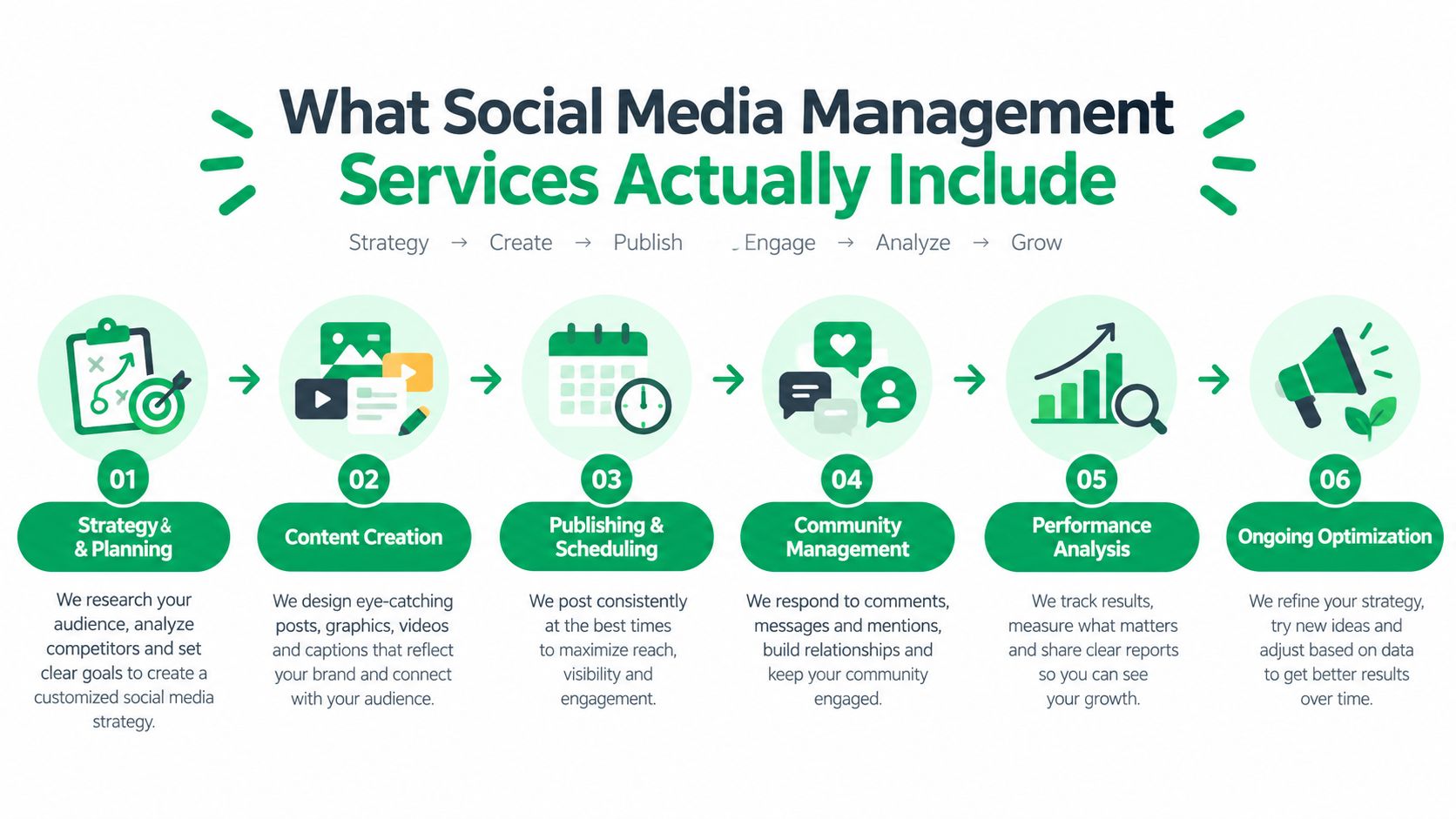
A proper service covers more than writing captions and pressing publish. Use a specialty coffee shop as the test case. If a proposal can’t explain how it would help that shop attract local customers, increase repeat visits, or promote seasonal offers, it’s probably describing activity rather than a marketing system.
Social Media Management for Small Business: Strategy and audit
The provider reviews existing profiles, audience signals, competitors, offers, and past content. For the coffee shop, that might mean separating content for commuters, remote workers, and weekend visitors rather than treating every follower as one audience.
Owner involvement: Explain the business priorities, best-selling products, service areas, and restrictions.
Cheap-package omission: No meaningful audit, no content pillars, and no connection between posts and commercial goals.
Social Media Management for Small Business: Content creation
This includes copywriting, graphics, photography direction, and short-form video. A capable team might turn a barista demonstration, a new pastry, and a customer question into distinct pieces of content instead of repeating the same promotional image.
Owner involvement: Supply access to the location, products, staff, and brand assets.
Cheap-package omission: Generic stock images, recycled captions, or content created without original footage.
Social Media Management for Small Business: Scheduling and posting
Scheduling gives the work a production rhythm. The provider should use a content calendar, format posts for each platform, and maintain an approval process before anything goes live.
Community management
Comments, direct messages, reviews, and mentions need responses. Community management is often the difference between a visible account and a useful one. See this guide to social media community management for the operational distinction between publishing and active audience care.
Owner involvement: Supply answers for technical, medical, legal, or product-specific questions.
Cheap-package omission: Posts are published, but nobody monitors replies or escalates buying signals.
Social Media Management for Small Business: Paid social and boosting
Paid work involves creative variants, audience targeting, campaign setup, budget control, and conversion tracking. A coffee shop might promote a local offer, but the campaign still needs a defined destination, such as a booking page, offer form, or tracked message.
Reporting and optimization
A useful monthly report connects reach, engagement, follower movement, clicks, messages, leads, and conversions where tracking allows it. The provider should explain what changed, what performed, and what gets adjusted next.
Practical rule: If the proposal only lists posts, ask who owns the strategy, replies, reporting, and optimisation. The visible content is only part of the job.
Social Media Management for Small Business: Choosing the Right Platforms for Your Business
Platform selection should follow customer behaviour and operating capacity, not whatever format is trending this week. A local service provider may need Facebook and Instagram because customers ask questions there. A B2B consultant may get more value from LinkedIn. A visually demonstrative product may justify short-form video, but only if the team can produce it consistently.
The audience is large enough to matter. Meltwater’s 2026 Global State of Social Media Report reported that global social media use reached 5.66 billion people in 2025, up 4.8% year over year. That doesn’t mean your business needs every channel. It means the discovery opportunity is broad, while your resources remain limited.
Quid’s 2026 social media benchmark report placed TikTok’s engagement rate at 3.70%, compared with 0.48% for Instagram, 0.15% for Facebook, and 0.12% for X, based on a 70-million-post dataset. The same benchmark says brands average about 5 Instagram posts per week, with Reels performing best on Instagram.
| Platform | Avg. Engagement Rate | Best For |
|---|---|---|
| TikTok | 3.70% | Demonstrations, personality-led video, discovery |
| 0.48% | Reels, visual proof, products, local brand building | |
| 0.15% | Community updates, local reach, customer messages | |
| X | 0.12% | Public commentary and timely conversation |
Engagement rates aren’t interchangeable with leads. A high interaction rate can still produce weak commercial results if the audience isn’t made up of buyers. For a practical channel decision, document where customers discover providers, which platform receives genuine enquiries, and what your team can create without burning out.
Use the capacity test
If you can produce only occasional quality video, don’t promise daily TikTok content. If the owner can write one thoughtful LinkedIn post each week, a focused LinkedIn system may beat thin activity everywhere else. Most small businesses should start with one or two platforms, then expand only when the first channels have a reliable workflow.
A social media strategy plan should therefore include a reason for every channel, a format the team can sustain, and a measurable action for the audience.
Social Media Management for Small Business: DIY, Freelancer, or Agency, Which Model Fits
There are four workable models: owner-led execution, a part-time employee, a freelancer, or an agency. The right choice depends on how much strategic direction you need, how quickly customers expect responses, and whether social is a supporting channel or a major source of demand.
The first model costs cash but consumes attention. DIY works when the owner enjoys content, has a clear voice, and can protect time every week. It fails when posting gets pushed behind sales, fulfilment, and administration. A part-timer can handle production, but usually needs an owner or manager to provide strategy, approvals, and escalation support.
A freelancer brings stronger specialist execution without the overhead of a full team. The trade-off is capacity. One person may write well and manage a channel effectively, but may not cover paid campaigns, video production, community management, analytics, and strategic planning with equal depth.
Boutique agencies usually make sense when you need structured strategy and coverage across a small set of channels. Full-service firms can add paid social, analytics, creative production, landing pages, and broader digital coordination. That depth is useful, but unnecessary if your basic offer and lead capture process are still unclear.
| Model | Typical Monthly Cost | Time on Owner | Strategic Depth | Best Fit |
|---|---|---|---|---|
| DIY | Qualitative, mainly time and tools | High | Depends on owner | Strong communicator with protected time |
| Part-timer | Varies by hours and responsibility | Medium to high | Usually moderate | Business with an internal coordinator |
| Freelancer | Varies by channel and scope | Medium | Specialist depth | Focused channel or defined production need |
| Boutique agency | Varies by scope | Low to medium | Strong for selected channels | Business needing strategy and execution |
| Full-service agency | Higher, based on services included | Low | Broadest | Business combining content, paid media, and reporting |
Small businesses commonly allocate 7% to 12% of revenue to marketing overall, according to Sprout Social’s guidance on social media packages. Social media must fit inside that wider allocation, alongside search, website work, advertising, events, and sales materials.
Budget reality: Don’t compare a freelancer’s production fee with an agency’s complete operating system. First list the work you need, then compare who owns each task.
Tool subscriptions, creative production, paid media, photography, and account management can sit outside the headline fee. Review the social media agency options by scope, not by label.
Social Media Management for Small Business: How Social Media Management Pricing Really Works
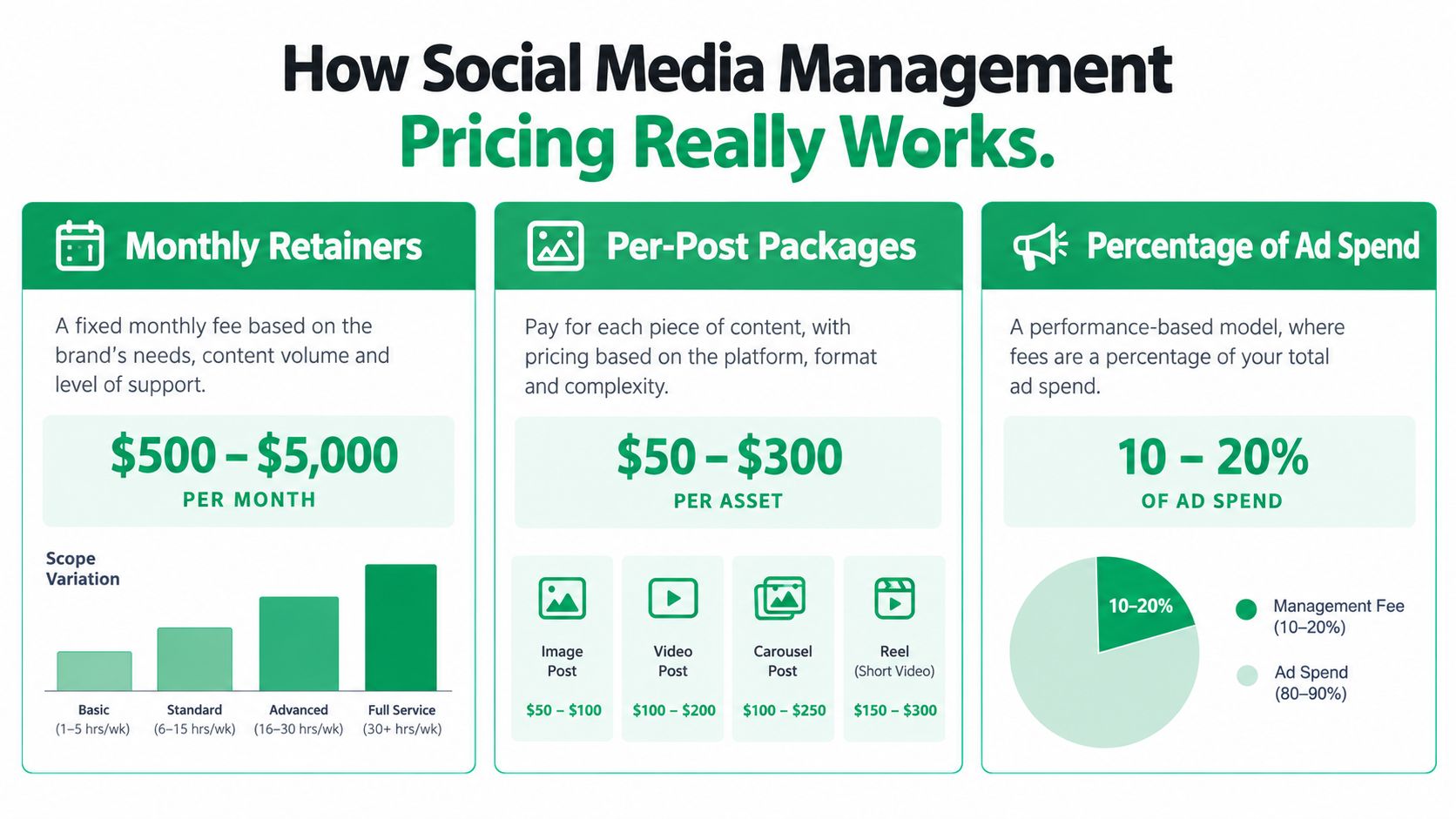
Most quotes use one of three structures. None is automatically good or bad. The problem starts when the buyer assumes a low production fee includes strategy, engagement, advertising, and measurement.
Monthly retainers commonly range from $500 to $5,000, depending on scope, according to Mr. Green Marketing’s overview of digital marketing agency cost. A lower retainer may cover a limited content calendar and scheduling. A higher one can include video, multiple platforms, community management, paid campaigns, reporting, and strategic reviews.
Per-post packages often range from $50 to $300 per asset. They suit a business that has a clear plan but needs help producing specific graphics, captions, or videos. They don’t necessarily include publishing, comment monitoring, campaign management, or performance analysis.
Percentage-of-ad-spend fees are tied to paid media management. The supplied benchmark for this structure is typically 12% to 20% of ad spend, with media minimums often applying. Ask whether the percentage covers creative, setup, optimisation, reporting, and landing-page recommendations, or only campaign administration.
Social Media Management for Small Business: Read the exclusions
A proposal should identify:
- Content production: Who writes, designs, films, edits, and supplies assets?
- Publishing: Is scheduling included, or charged separately?
- Community management: Who answers comments, DMs, and reviews?
- Paid campaigns: Does the fee include creative, targeting, and optimisation?
- Reporting: Which metrics appear, and how often does someone explain them?
If a quote below $500 per month includes no strategy work, it’s likely production-only. That can keep a feed active, but it won’t automatically create a coherent acquisition system. Stock imagery and ad spend may also be marked up, so insist on a transparent breakdown of management fees, media costs, and third-party tools.
How to Evaluate and Choose the Right Provider
The first meeting should produce more than a list of deliverables. Ask questions that expose the provider’s thinking.
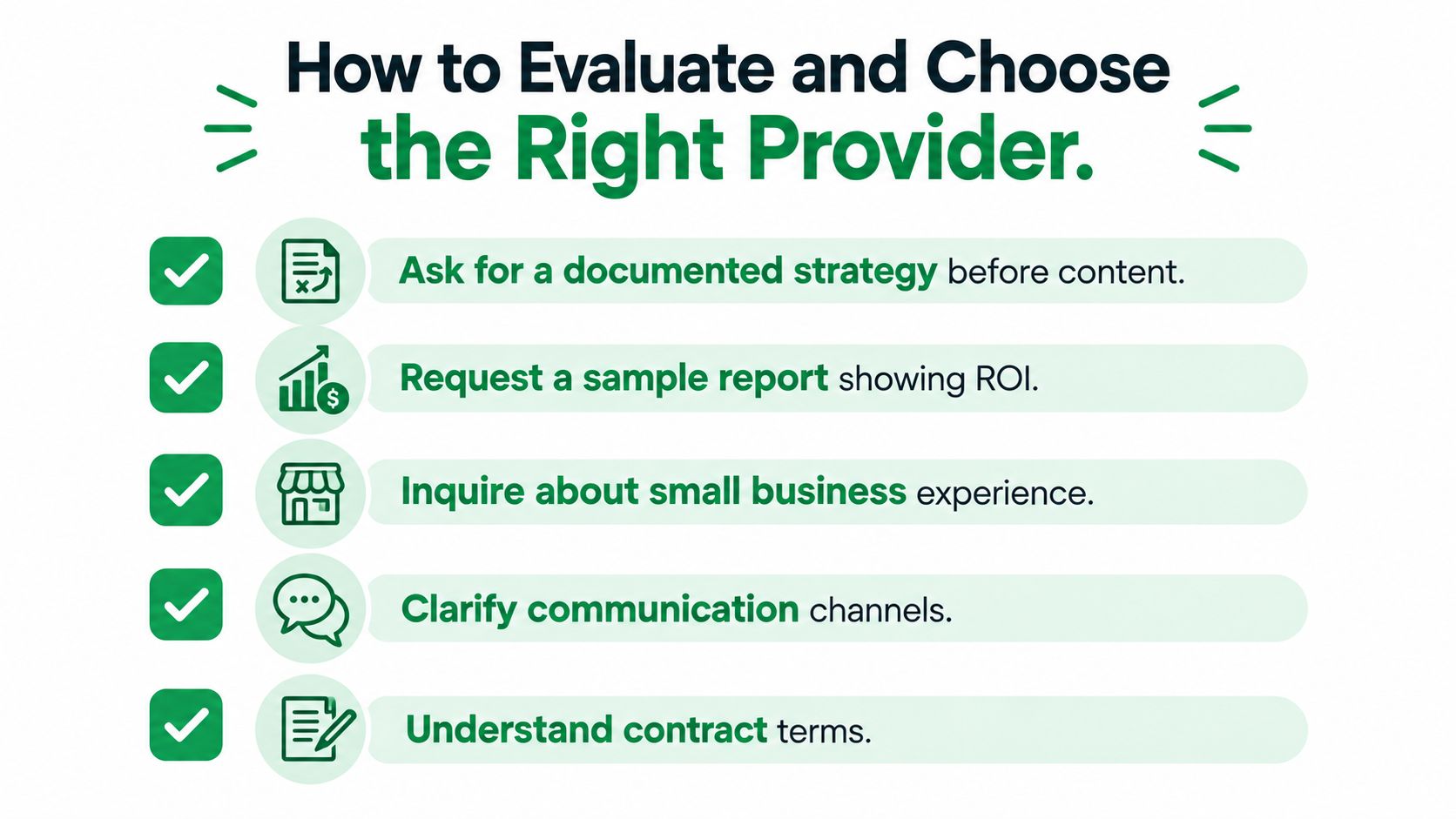
- Can you show me the documented strategy before content production begins?
A green flag is a clear audience, offer, channel rationale, content system, and measurement plan. A red flag is a promise to “start posting and see what happens.” - Can I review a sample report with attributed outcomes?
Look for clicks, enquiries, conversions, cost data where relevant, and commentary. A report filled with impressions but no business context is decorative. - Who owns the advertising accounts and creative assets?
You should retain access and ownership. Don’t let a provider make your business dependent on an account you can’t reach. - How many revisions are included?
Clear revision limits protect both sides. Unlimited revisions can create delays, while no revisions can leave you approving content you dislike. - Who is my account lead, and how quickly do you respond?
You need a named person, communication channel, approval process, and escalation route.
Check the contract before the excitement
Review the portfolio for businesses with similar buying cycles, geography, compliance needs, and average order value. Request references from comparable clients, confirm the reporting cadence, and identify the exit clause before signing.
Be wary of vague deliverables, locked accounts, unclear ad ownership, long commitments without review points, and proposals that guarantee outcomes they can’t control. The cheapest proposal rarely reflects the most thorough discovery process. Evaluate price against strategic depth, accountability, and ownership, not the headline monthly rate.
Social Media Management for Small Business: Setting Realistic ROI Expectations and SLAs
A post can earn attention without producing a sale. Treat engagement as a diagnostic, not a revenue guarantee. Hootsuite’s engagement guidance gives a practical cross-platform benchmark of about 1.3% to 3.5%, calculated from likes, comments, and shares divided by followers or impressions, multiplied by 100.
Choose one formula and keep it consistent. A provider reporting engagement by followers cannot be compared fairly with one using impressions. Track interaction rate beside clicks, enquiries, booked appointments, qualified leads, and sales.
| Metric | Industry Benchmark | Realistic 90-Day Target | Red Flag Below |
|---|---|---|---|
| Engagement rate | About 1.3% to 3.5% across platforms | Clear improvement in quality and consistency, measured with one formula | Provider can’t define the formula |
| Response handling | Qualitative service standard | Agreed response window for routine comments and DMs | No named owner for replies |
| Reporting | Monthly measurement | Report delivered on an agreed schedule with next actions | Vanity metrics only |
| Lead tracking | Depends on offer and channel | Every tracked enquiry reaches a defined destination | No form, booking path, or attribution method |
Write operating commitments into the contract instead of accepting vague promises such as “increased engagement.” Specify response handling, account access, approval deadlines, reporting cadence, content delivery timing, escalation rules, and campaign review dates. A provider may propose a response time under 4 business hours, outage reporting within 24 hours, monthly reporting within 5 business days of month-end, quarterly strategy reviews, and content delivery at least 72 hours before posting. These are service terms, not revenue guarantees.
Contract test: Define a measurable lead. “More visibility” is not a measurable outcome.
Set up attribution before judging performance. Use a tracked form, booking path, phone number, or CRM stage, then calculate marketing ROI using a defined framework. Without that process, a provider can report activity while your team cannot determine whether social generated profitable business.
A retainer tied to a qualified-lead target can be tested, provided the business supplies a credible offer, functioning lead destination, timely approvals, and accurate sales follow-up. Social can create attention and demand. It cannot repair every stage after the click.
Where to Start Without Burning Your Budget
Hiring an agency first is often backwards. Before paying for management, establish the pieces that make management productive:
- One-page customer profile: Describe who buys, what they need, what they fear, and how they choose.
- Clear offer: Give people a reason to respond now, not a vague invitation to “learn more.”
- Lead capture method: Choose a form, booking link, tracked landing page, or inbox process.
During the first week, audit every account, identify the platform where customers ask questions, write three reusable post templates, set up basic UTM tracking, and choose one lead destination. Don’t spend on management until someone can explain where a prospect goes after engaging with a post.
For a provider, start with a controlled 60-day pilot: two platforms, eight posts per month, one ad campaign capped at $300, and a written go/no-go review at day 60. The pilot should assess content quality, response handling, tracking, lead relevance, and working communication, not just follower movement.
Mr. Green Marketing, LLC offers strategy-led social media management alongside SEO, PPC, web design, branding, video production, and reporting for businesses that need connected digital execution. If you want a provider to audit your current process, identify visibility gaps, and build a measurable social plan, visit Mr. Green Marketing, LLC and request a free audit and performance report.
Leave a Comment
sing in to post your comment or sign-up if you dont have any account.