
Social Media Strategy Plan: Your marketing manager launched six social channels, posted every day for two months, and still can’t explain what social media contributed to the business. The calendar is full. The team is tired. The revenue report has no dependable social line item.
That isn’t a content problem. It’s a planning failure.
A useful social media strategy plan starts with business objectives, defines measurement, assigns channels a job, and only then decides what to publish. In 2026, global social media usage reached 5.79 billion user identities, equal to 69.9% of the world’s population, while the typical user actively uses 6.5 platforms per month and spends 18 hours and 36 minutes per week on social media, according to Digital Applied’s 2026 social media statistics. Your audience is moving across networks, but your team shouldn’t spread itself thin without a reason.
Social Media Strategy Plan: Table of Contents
- Why Most Social Media Strategy Plans Fail Before They Start
- Set Objectives That Map to Revenue, Not Reach
- Build Lean Personas and Pick Channels by Role
- Design Content Pillars, Cadence, and a Paid Layer
- Measure What Matters and Report on It Weekly
- Quick Wins and Common Pitfalls for Small Teams
- Your 30-60-90 Rollout and First Action Step
Why Most Social Media Strategy Plans Fail Before They Start
Most small and mid-sized businesses invert the correct order. They choose platforms, create a content calendar, publish relentlessly, and attempt to attach business meaning afterward. By then, the team has accumulated activity, not evidence.
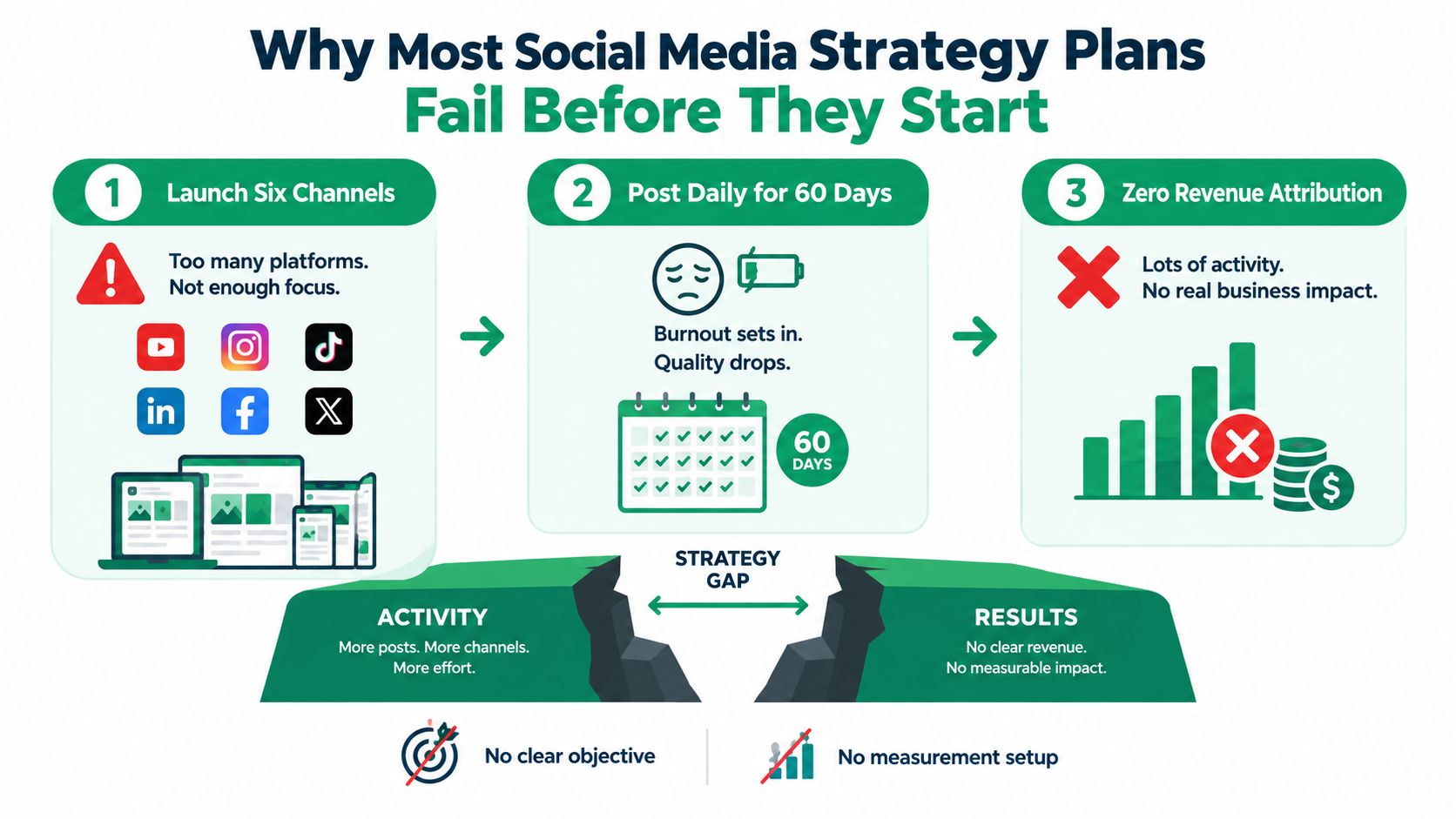
Three failure modes appear in review after review:
- Vanity objectives: “Grow followers” and “increase engagement” sound measurable, but they don’t tell the team whether social is creating qualified demand, supporting retention, or influencing sales.
- Competitor-led channel selection: A competitor’s presence on TikTok or LinkedIn proves only that the competitor chose to be there. It doesn’t prove your audience is reachable in the same context or that your team can produce the right format.
- Premature content production: Designers and writers create posts before anyone defines the decision each post should support. The result is attractive work with no clear next action.
The fix is a strict sequence:
- Define the business outcome.
- Choose the KPI and baseline.
- Assign one North Star metric to each priority channel.
- Build lean personas from customer evidence.
- Select channels by strategic role.
- Create pillars, cadence, and paid support.
- Review performance and cut what doesn’t contribute.
Practical rule: If a post can’t be connected to awareness, qualified consideration, conversion, retention, or customer support, it probably doesn’t belong in the calendar.
Start by auditing your current accounts, links, content, and measurement setup. A focused social media audit exposes where the plan has activity without accountability. Then use the findings to build targets that a finance leader can understand.
The order matters because KPIs determine which channels deserve attention and which creative formats make sense. Once every channel has a job, weak content becomes easier to identify, strong content becomes easier to amplify, and cuttable waste stops hiding inside a busy publishing schedule.
Social Media Strategy Plan: Set Objectives That Map to Revenue, Not Reach
A CFO doesn’t approve “more visibility.” A CFO can evaluate a target tied to qualified leads, pipeline, revenue, retention, or acquisition cost.
Start with the commercial result, then work backward. If the business needs more sales-qualified opportunities, social might support demand capture, proof, retargeting, or assisted conversion. The social objective should state the contribution, the metric, and the deadline.
For example, a 20-person SaaS company targeting $40K MRR could set an objective for social to contribute 8% of assisted social pipeline. Those figures belong to the worked example, not a market benchmark. The team would then define what counts as assisted pipeline, identify the relevant CRM stages, and assign one channel metric that signals progress toward that contribution.
Build the objective ladder
Separate what the team produces from what the business gains. Post count is an output. Likes and shares are interaction signals. Demo requests, assisted pipeline, and customer acquisition cost are outcome measures.
| Tier | Example Objective | Sample Metric | Revenue Link |
|---|---|---|---|
| Output | Publish consistently on priority channels | Published posts by format | Creates the inventory needed for testing |
| Engagement | Earn meaningful audience interaction | Engagement rate, saves, shares, qualified comments | Indicates interest and content relevance |
| Traffic | Bring the right visitors to owned pages | Click-through rate, landing-page behavior | Connects social activity to consideration |
| Revenue | Influence or generate commercial action | Demo requests, conversion rate, assisted pipeline, cost per lead | Ties social to sales efficiency and growth |
Engagement rate is commonly calculated as (total engagements ÷ total followers) × 100, as outlined in ICUC’s social media benchmark guidance. Use the formula consistently, but don’t compare every platform to one universal target. Current median engagement rates reported in that market are 6.2% on LinkedIn, 5.6% on Facebook, 5.5% on Instagram, 4.6% on TikTok, 4.0% on Pinterest, 3.6% on Threads, and 2.5% on X, so platform context is essential.
Give every channel a tiebreaker
Choose one North Star metric per channel. LinkedIn might prioritize qualified site visits or assisted pipeline. Instagram might use saves from the target audience. TikTok might use qualified profile visits or landing-page clicks. The exact choice depends on the commercial role, but each channel needs one primary decision signal.
Keep the plan to three objectives maximum. Add more and the team will optimize for conflicting outcomes. For a practical financial framework, use this guide to calculate marketing ROI and document the assumptions behind attribution.
Social Media Strategy Plan: Build Lean Personas and Pick Channels by Role
You don’t need an expensive research project to create useful personas. You need evidence from people who already interact with the business.
Build three to five lightweight personas. Each one should answer five questions:
- Role: Who makes, influences, or uses the buying decision?
- Company size: What operating context shapes the problem?
- Problem: What outcome are they trying to improve?
- Existing behavior: Where do they already spend attention?
- Response trigger: What proof, format, or offer would make them reply?
Pull the signals from sales call notes, support tickets, lost-deal reasons, customer reviews, LinkedIn searches, and recurring questions in DMs. A sales representative’s wording often gives you more actionable insight than a polished demographic profile. The objective isn’t to describe an imaginary person. It’s to identify repeatable buying situations.
Buyer persona development should produce a one-page working document, not a fictional biography.
Assign channels a job
Platform selection should reflect strategic role, audience fit, format capacity, and buying context. Global usage is broad, but demographic differences still matter. For example, current platform demographic reporting says YouTube reaches 95% of U.S. adults aged 18 to 29 but 64% of adults aged 65 and older. The same source identifies ages 25 to 34 as the largest group on Facebook and Instagram, while TikTok skews younger, with most users between 18 and 34.
| Platform | Primary Job | Best For Persona | Watch Out |
|---|---|---|---|
| B2B discovery and consideration | Executives, operators, specialists, and professional buyers | Generic company announcements | |
| Visual discovery and relationship building | Consumer buyers, local audiences, and visually oriented prospects | Polished posts with no useful point | |
| TikTok | Short-form discovery and human proof | Younger consumers and audiences comfortable with creator-led content | Copying trends without a business connection |
| Community, local reach, and customer communication | Existing customers, local buyers, and broad consumer segments | Treating reach as proof of demand | |
| X | Timely commentary and customer support | News-sensitive audiences, specialists, and active communities | Reactive posting without a clear perspective |
| YouTube | Searchable education and consideration | Buyers who need demonstrations, explanations, or comparisons | Producing videos without a strong topic |
Start with one primary channel and one secondary channel. Review the mix quarterly, based on comparable performance and capacity, not platform fashion.
Social Media Strategy Plan: Design Content Pillars, Cadence, and a Paid Layer
Content comes after measurement and channel roles. Otherwise, pillars become themes the team likes rather than subjects that move a buyer toward a useful action.
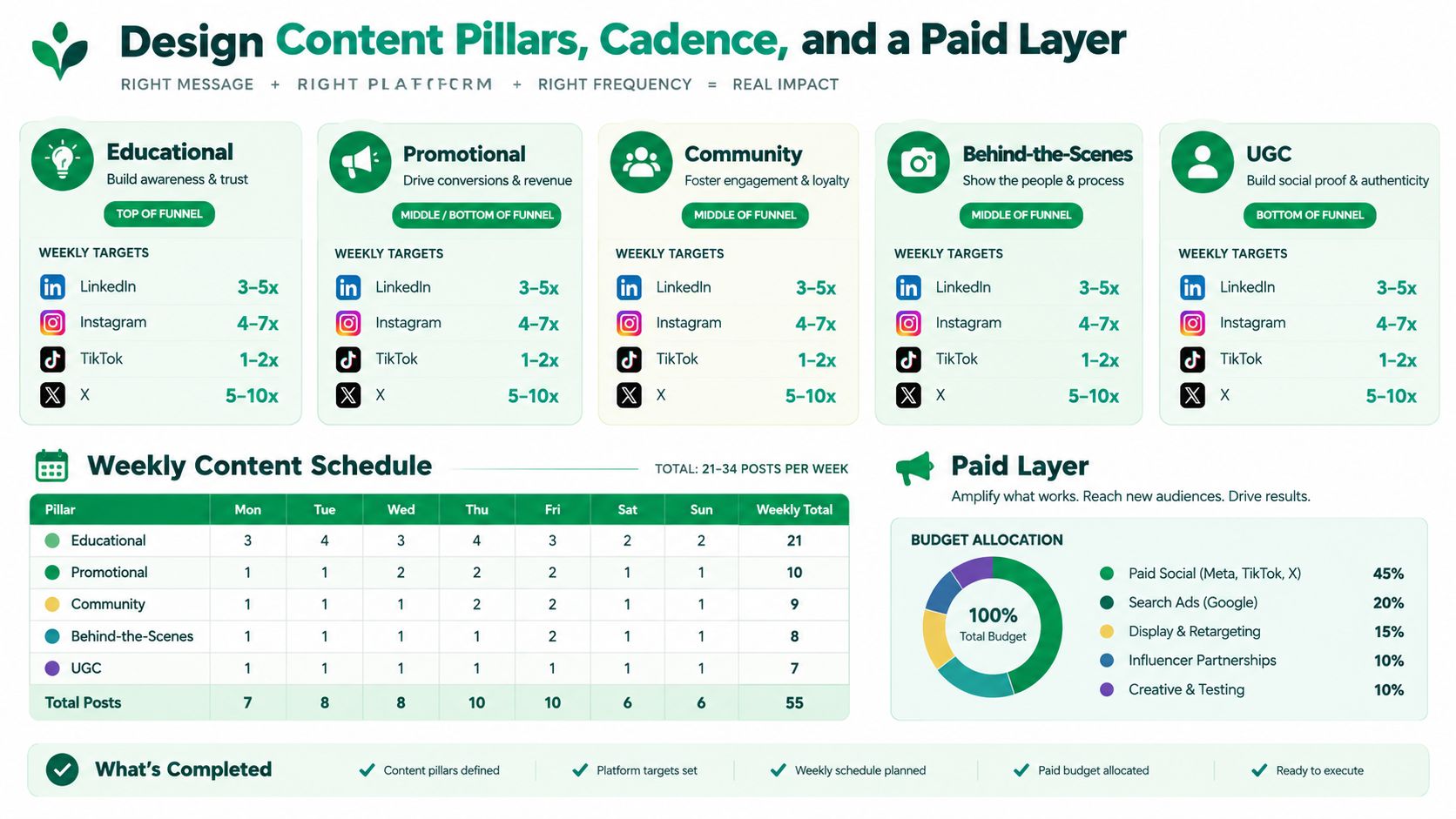
Choose three to five pillars. Give each one a funnel purpose:
- Educational: Answers a recurring customer question and supports discovery.
- Proof and promotion: Shows outcomes, offers, comparisons, or product use.
- Community: Responds to customer language, objections, and conversations.
- Behind the scenes: Makes the people and process credible.
- User-generated content: Brings customer experience into the brand story.
Build a weekly calendar that rotates these pillars. A LinkedIn week might include a practical opinion, a customer objection, a proof-led document post, and a direct offer. Instagram can adapt the same ideas into carousels, Reels, Stories, and saved-reference posts. Adaptation beats identical cross-posting.
Social Media Strategy Plan: Set a cadence your team can sustain
Use a minimum cadence, then increase output only when quality and response coverage hold. One publishing guide recommends 1 to 2 Facebook posts per day, 2 to 3 Instagram in-feed posts per week plus 1 to 2 Stories per day, 2 to 4 X posts per day, 1 to 4 TikTok posts per day, 1 to 2 LinkedIn posts per day, 1 Pinterest post per week, and 1 long-form YouTube video per week with 2 to 5 Shorts, as detailed in Vista Social’s publishing guidance. Treat those figures as operating references, not mandatory quotas.
A realistic calendar names the pillar, format, hook, owner, destination URL, CTA, and measurement tag. The content calendar workflow should also reserve time for comments, DMs, revisions, and reporting.
Add paid support selectively
Paid media should amplify evidence, not rescue weak fundamentals. Boost posts that earn strong-quality engagement, saves, qualified comments, or meaningful clicks from the right audience. Use dark posts when you need controlled targeting, multiple creative variants, or a campaign that shouldn’t clutter the organic feed.
A small monthly budget of $500 to $2,000 can support testing and amplification, but only if the team has defined the conversion event, audience, landing page, and stop rule. Put budget behind the organic ideas that already show audience pull. Don’t pay to distribute content nobody wants.
Social Media Strategy Plan: Measure What Matters and Report on It Weekly
A social dashboard should answer one question quickly: what should the team do differently this week?
Tier the metrics by funnel stage. Awareness needs reach and branded search lift. Consideration needs engagement quality, video completion, follower quality, and site behavior. Conversion needs click-through rate, lead cost, conversion rate, assisted revenue, and cost per acquisition.
Use a decision table
| Funnel Stage | Primary KPIs | Secondary KPIs | Ignore |
|---|---|---|---|
| Awareness | Reach, branded search lift | Impressions, qualified audience growth | Impressions without context |
| Consideration | Engagement rate, video completion, follower quality | Saves, shares, profile visits, comments | Raw likes |
| Conversion | Click-through rate, conversion rate, assisted revenue | Lead cost, landing-page behavior, sales cycle signals | Follower count |
| Retention | Repeat engagement, support resolution signals | Community growth, customer mentions | Volume without customer relevance |
A useful measurement framework maps reach and engagement quality to awareness, CTR and landing-page behavior to traffic, and conversion rate, cost per lead, and assisted revenue to sales. Sprout Social’s content benchmark guidance emphasizes grounding decisions in large-scale audience and content data rather than assumptions, while also separating channel outcomes from vanity engagement.
Review the dashboard every Monday in five minutes. Check the North Star metric, top and bottom content, spend, leads, and tracking errors. Don’t redesign the strategy because one post missed. Record the signal, assign an owner, and decide whether to repeat, revise, or stop.
Attribute the messy middle
Buyers rarely touch only one post. They might watch a video, search the brand, click a retargeting ad, and convert through a direct visit. Use campaign UTMs, CRM source fields, platform reporting, and assisted-conversion views to preserve that sequence.
Run a deeper review monthly. Compare channels over the same time window and against the same audience context, then feed the findings into pillar decisions. This marketing campaign effectiveness framework can help turn reporting into an operating loop rather than a retrospective presentation.
Social Media Strategy Plan: Quick Wins and Common Pitfalls for Small Teams
A two-person marketing team shouldn’t pretend it can sustain high-quality work across five networks. It can support two focused platforms, adapt a strong idea between them, respond to the audience, and learn from performance. That beats five neglected profiles filled with recycled announcements.
The audience itself is cross-platform. One industry report identifies about 5.66 billion active social media users worldwide, says 93.8% of internet users have at least one social media identity, and reports that the average user moves between 6.75 social networks each month, as summarized by Sprout Social’s social media demographics research. Your brand can be present across the broader ecosystem without assigning equal production effort to every channel.
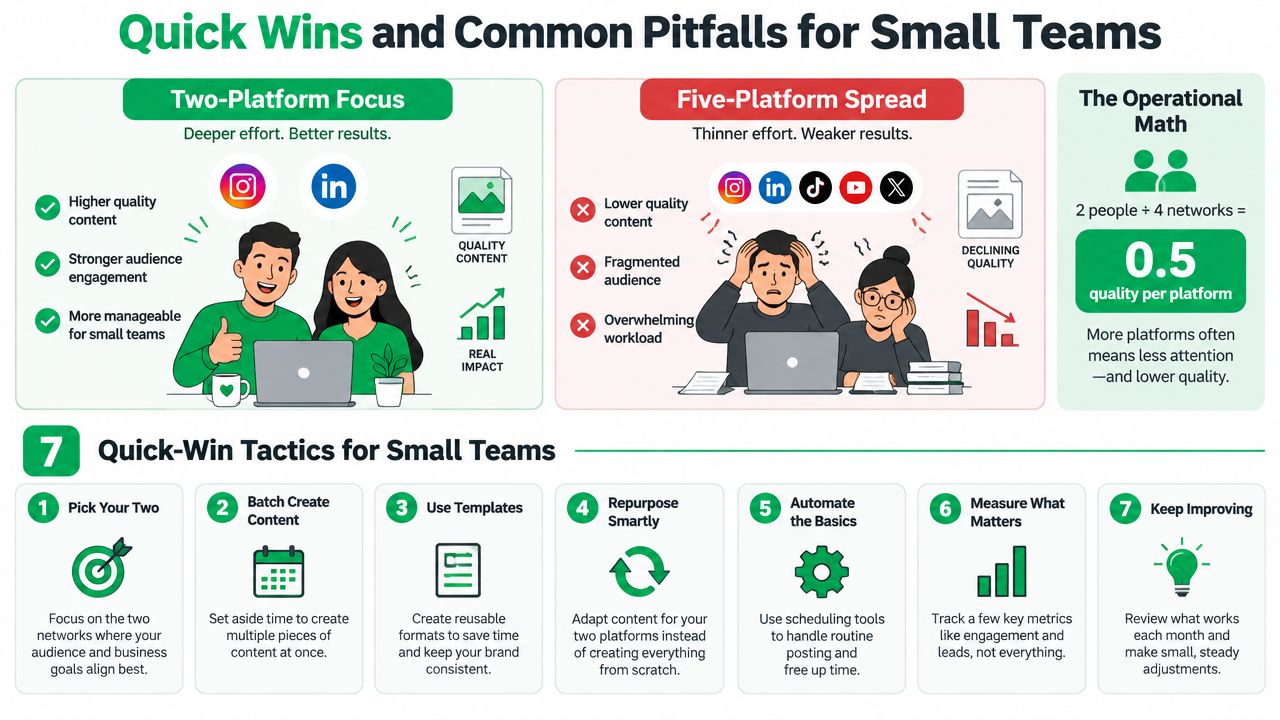
Ship these seven fixes in week one
- Standardize your handles: Make account names, profile images, bios, and links recognizable across priority channels.
- Pin a conversion post: Give new visitors one clear explanation of the offer and one next step.
- Repurpose one substantial asset: Turn one guide, webinar, or customer interview into ten short, platform-specific assets.
- Add UTM parameters: Label campaigns and links so analytics can separate social traffic from direct or referral activity.
- Enable native lead forms: Reduce friction for prospects who aren’t ready to leave the platform.
- Schedule a comment block: Assign recurring time for replies, DMs, useful comments, and escalation.
- Review competitor activity: Audit the last 30 posts from three competitors and note repeated topics, formats, offers, and gaps.
Weak hooks cause avoidable losses, especially in short-form video. Open with the problem, tension, or useful promise immediately. Don’t bury the point behind a logo animation.
Ignore DMs and you turn intent into frustration. Ads can’t repair unclear positioning, weak landing pages, or content that earns attention from the wrong audience. Paid distribution multiplies the quality of the system you already have.
Your 30-60-90 Rollout and First Action Step
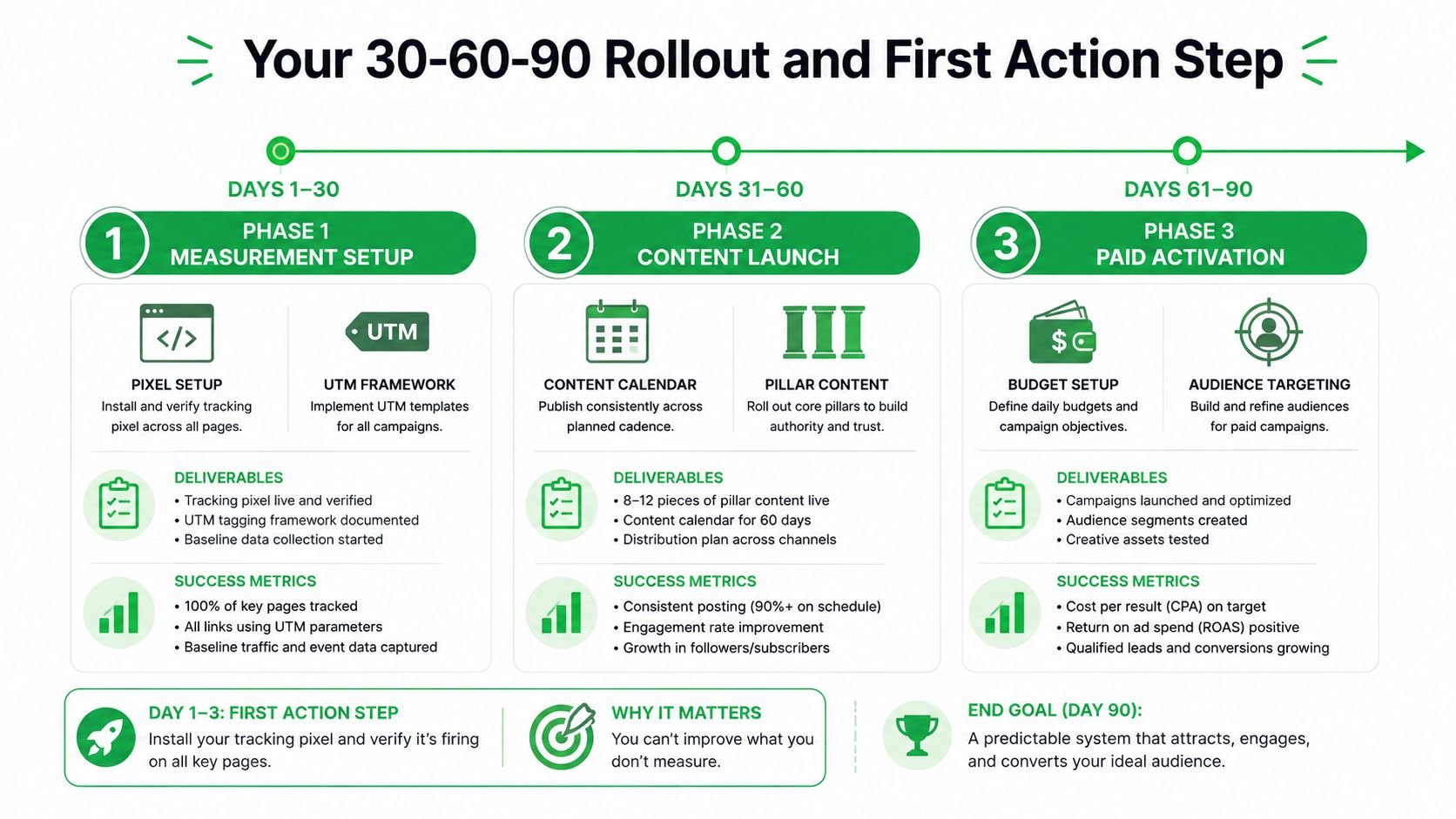
Print this rollout. Put owners beside each deliverable. Don’t move to the next phase because the calendar looks busy. Move when the measurement and decision rules are ready.
Days 0 to 30 focus on measurement setup
Install the relevant tracking pixels, confirm UTM conventions, document CRM source fields, and baseline each channel’s North Star metric. Audit current accounts, content, offers, and landing pages. Write one persona for every priority segment, using sales notes, support questions, and existing audience signals.
Deliverables:
- A measurement map with events, owners, and reporting locations.
- A channel audit with keep, improve, test, and pause decisions.
- Persona one-pagers tied to buying problems and proof needs.
- A baseline report that records current performance without pretending the data is comparable when it isn’t.
Days 31 to 60 shift into build mode
Lock three content pillars and connect each to a funnel role. Prepare a two-week calendar with hooks, formats, CTAs, owners, and destination pages. Draft paid creative briefs, choose the audience and conversion event, and mark which organic posts qualify for amplification.
Keep the first production cycle narrow. Two strong channels, consistent tagging, and reliable response coverage will teach you more than a sprawling launch.
Days 61 to 90 move into optimize mode
Review KPI movement weekly and conduct a deeper monthly analysis. Kill underperforming pillars when the evidence supports the decision. Double down on the channel with the best customer acquisition cost, provided lead quality and sales context remain sound. Formalize the monthly reporting template so every review compares the same definitions and time windows.
Copy these working templates
- Objective worksheet: Business outcome, social contribution, target metric, deadline, owner, and measurement definition.
- Persona one-pager: Role, company context, problem, channel behavior, objections, and convincing proof.
- Content pillar matrix: Pillar, funnel stage, audience question, format, CTA, and success metric.
- 30-day calendar: Publishing date, channel, hook, asset, owner, URL, UTM, and status.
- Weekly KPI dashboard: North Star metric, supporting KPIs, spend, leads, revenue signals, and next action.
- 90-day review document: Results, lessons, stopped activities, expanded tests, budget decisions, and next-quarter objectives.
Mr. Green Marketing, LLC offers strategy-led social media management, monthly planning sessions, four-week campaign planning, hashtag research, SEO, PPC, web design, and GEO optimization tied to measurable growth goals. If your team needs a clearer social media strategy plan and reporting system, visit Mr. Green Marketing, LLC to request a free audit and performance report.
Open a blank document, write your North Star metric in the title, and schedule the 30-day kickoff meeting before closing the tab.
Leave a Comment
sing in to post your comment or sign-up if you dont have any account.