
Product Launch on Amazon: More than 100,000 new ASINs are listed on Amazon every day, yet fewer than 5% reach the top 100 in their category within 30 days, according to independent Amazon launch analytics. That changes the job completely. A product launch on Amazon isn’t finished when the listing goes live. It enters a short, demanding race for search visibility, conversion, reviews, and sustained marketplace relevance.
Discounts alone won’t win that race. A disciplined launch validates demand before inventory is committed, builds a listing that can convert unfamiliar shoppers, establishes operational readiness, and then buys targeted traffic while review velocity and organic visibility develop. The sequence matters. So does the order in which you spend cash.
Product Launch on Amazon: Table of Contents
- Why Most Product Launches on Amazon Stall Before They Start
- Validate Demand Before You Buy Inventory
- Build a Listing That Converts Browsers Into Buyers
- Lock In Pricing Inventory and Amazon Programs the Right Way
- Drive Early Traffic Reviews and Visibility in the First 30 Days
- Measure What Matters and Keep Your Ranking After Launch
Why Most Product Launches on Amazon Stall Before They Start
Amazon Marketplace launched in November 2000 as Amazon’s third-party selling platform, shifting the company from retailer-only commerce toward a hybrid marketplace. During its first four months, monthly gross merchandise sales on Marketplace more than tripled, and Amazon said the service launched to more than 30 million customers. By March 2002, Marketplace orders represented approximately 15% of total Amazon.com orders in Q4 2001, according to the history of Amazon Marketplace.
That history still explains the pressure behind a launch today. Amazon does not rank a product just because a seller uploads a polished catalog page. The listing must show relevance and commercial usefulness through search engagement, purchases, conversion, customer satisfaction, and review activity. A strong product can vanish when its first traffic generates weak buying signals.
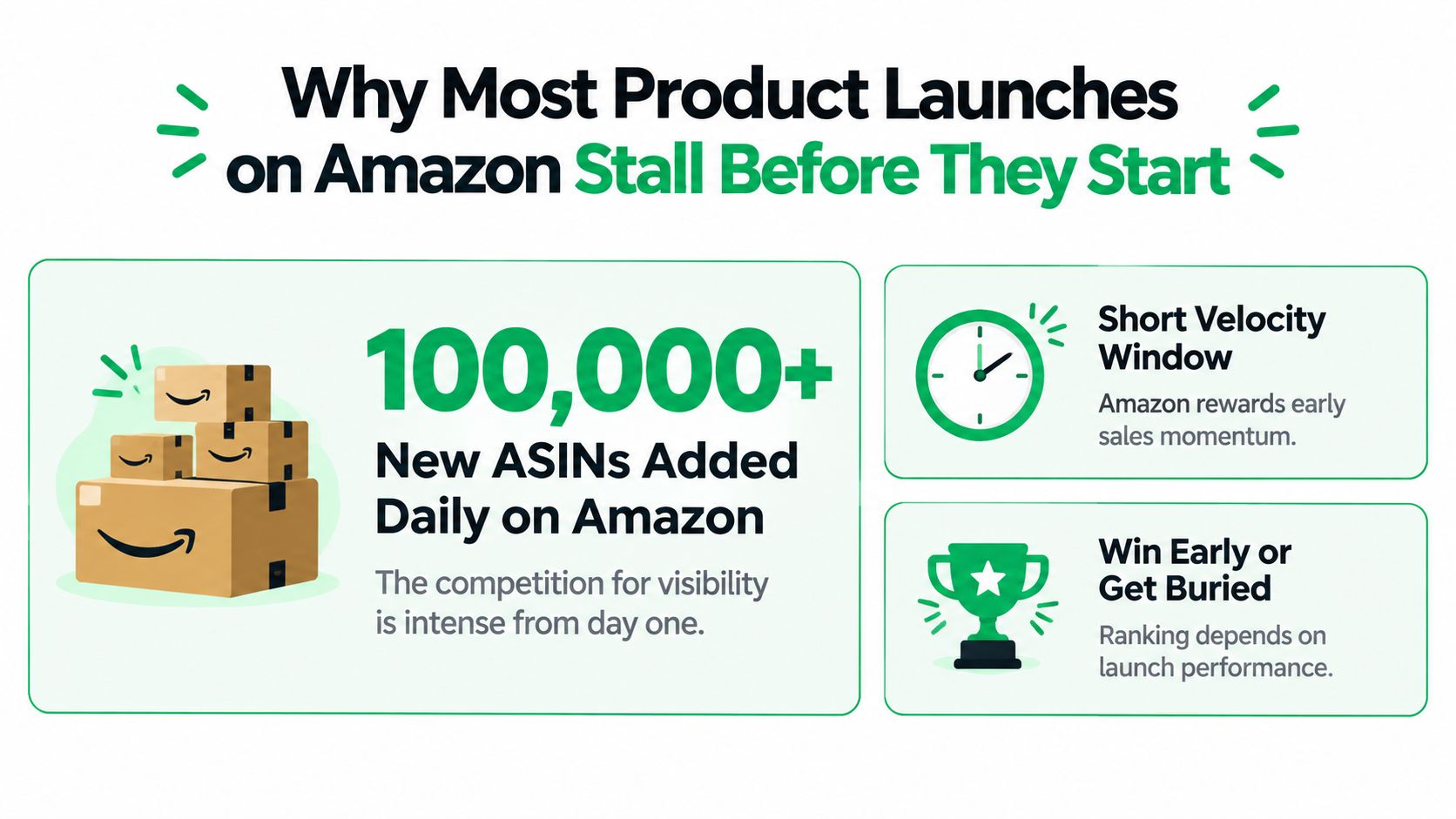
Product Launch on Amazon: The launch window is short
Industry analysis estimates that 60% to 70% of new Amazon products fail to achieve sustainable profitability within their first year. The same analysis reports that more than 100,000 new ASINs enter Amazon daily, while fewer than 5% reach the top 100 in their category within 30 days. Those figures appear in NovaData’s Amazon launch analysis. Waiting for organic discovery is not a launch plan.
Treat the first 30 days as a velocity race focused on search visibility and review velocity. That does not mean buying unprofitable orders or exhausting margin through discounts. It means generating qualified activity that helps Amazon identify the product’s audience, relevant searches, and commercial credibility. Low inventory can validate the offer before a larger commitment, while a trend-timed entry window may create demand before competitors adjust.
Practical rule: A launch should prove four things in sequence: demand exists, the listing converts, customers trust the offer, and paid traffic can scale without destroying economics.
The operating sequence is straightforward:
- Validate the niche: Confirm customer demand and identify competitive gaps before placing a large order.
- Optimize the offer: Build the title, images, bullets, A+ Content, price, and fulfillment setup around the buying decision.
- Prove conversion: Use early traffic to test whether shoppers understand and trust the product.
- Scale visibility: Expand paid search and organic keyword coverage after the listing earns its traffic.
Monitor search visibility, conversion rate, review velocity, paid and organic search presence, advertising efficiency, and inventory health. Sales alone can hide a weak listing, an expensive keyword mix, or inventory too thin to support momentum. A broader Amazon marketing strategy should start with launch readiness, not a coupon code.
Validate Demand Before You Buy Inventory
A product can fail before Seller Central records its first order. The usual cause is an inventory decision based on personal enthusiasm, a supplier’s suggestion, or a competitor’s visible sales. Weak demand becomes expensive only after cash, storage capacity, and attention are already committed.
Use Amazon’s Product Opportunity Explorer to screen for products and niches with high customer demand and low competition, as described in Amazon’s Product Opportunity Explorer guidance. Treat the output as evidence to investigate, not as permission to place a purchase order.
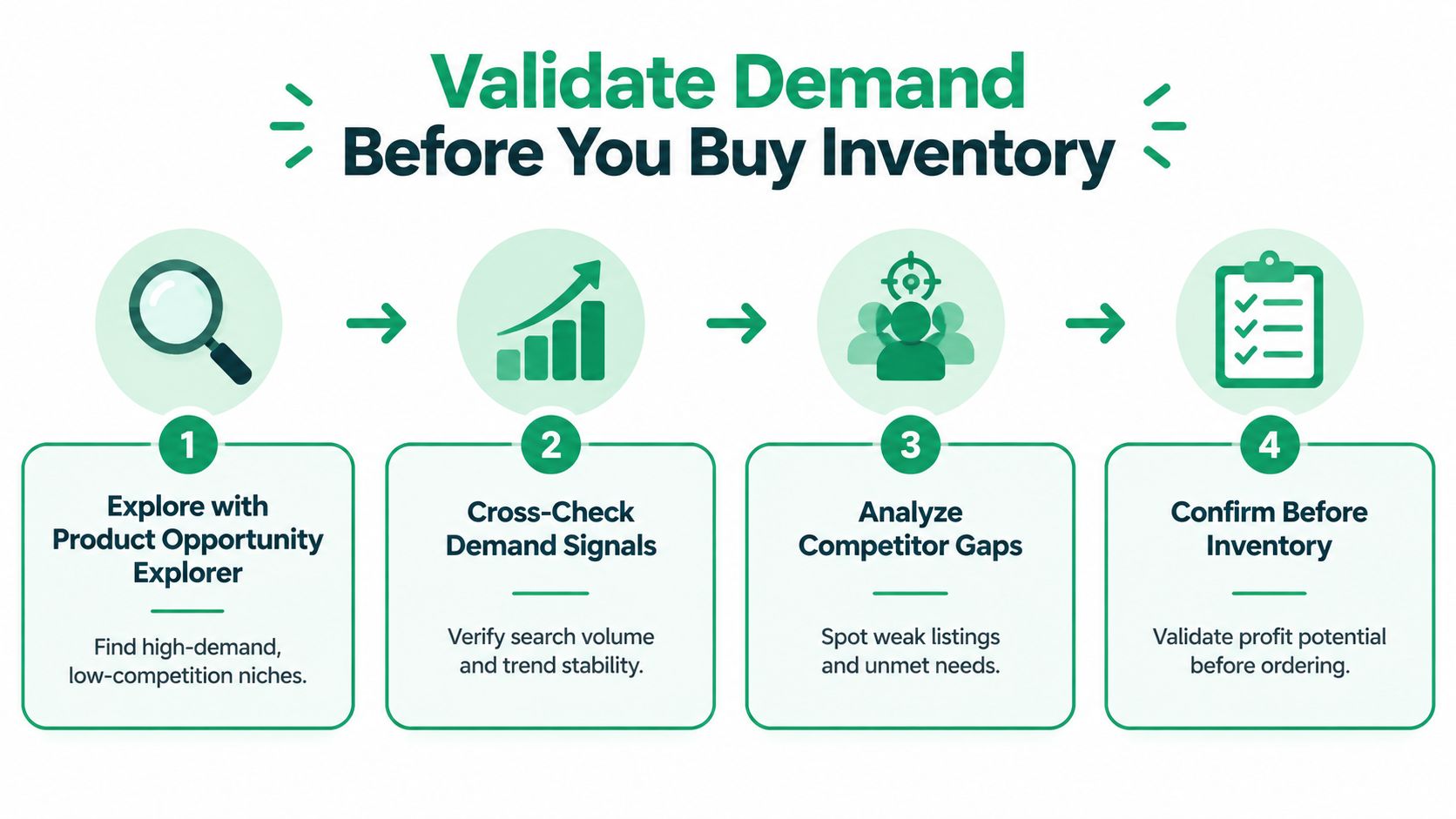
Product Launch on Amazon: Start with the customer problem
Begin with a broad product area, then narrow it to a specific customer need. Compare search behavior with product complaints, comparison content, and review language. The opportunity is rarely “another version of a popular item.” It is usually a clear improvement that shoppers already recognize as useful.
Examine search behavior, purchase patterns, and competing offers, then record the findings in a working sheet:
- Customer language: Capture the phrases shoppers use, including practical use cases, frustrations, and objections.
- Competitive weakness: Note missing information, weak imagery, confusing variations, and repeated complaints.
- Offer clarity: Check whether your improvement can be explained quickly on a mobile product page.
- Unit economics: Include landed cost, Amazon fees, fulfillment, advertising tolerance, returns, and expected contribution margin.
A large demand pool is not enough. Approve the niche only when the product gives a persuasive answer to a visible customer problem and the economics leave room to acquire traffic.
Cross-check demand and timing
Amazon’s product-ideas guidance points sellers toward hourly updates on Hot New Releases. These updates can expose categories where customer interest and new-product activity are building. Social platforms provide another signal, but a viral spike does not prove durable demand.
Independent trend coverage reports that products often appear on Amazon 6 to 8 weeks after social trend acceleration, with week 4 to week 8 described as a safer entry window. Those observations are included in Amazon’s product-ideas guidance and the verified launch data. The practical opportunity is to enter after demand has evidence behind it, while the category still has room before competitors crowd the results.
Track three signals together:
- Amazon search behavior, which indicates whether customers are actively looking.
- New-release movement, which shows whether products in the niche are gaining marketplace attention.
- External trend stability, which helps separate a lasting use case from a short content spike.
A smaller first order can turn this research into a controlled test. Order enough units to collect meaningful demand and conversion feedback, then use the results before committing to deeper inventory. This also creates a 30-day velocity test: watch whether the offer earns relevant search exposure and early review activity without relying on discounts that hide weak economics.
Run a go or no-go check before contacting the supplier:
- Can the product solve a specific, visible customer need?
- Can the listing explain that improvement without excessive copy?
- Is there a defensible gap in competing offers?
- Can the first inventory commitment support learning without overexposure?
- Does the expected conversion opportunity justify paid traffic?
Complete a structured Amazon competitor analysis framework before placing the supplier order. It is cheaper to reject a weak opportunity on a worksheet than after advertising spend, storage fees, and slow-moving inventory have accumulated.
Product Launch on Amazon: Build a Listing That Converts Browsers Into Buyers
A listing should move a shopper from recognition to confidence. Search terms earn the detail-page visit, while images, price, proof, benefits, and fulfillment expectations determine whether that visit becomes a sale. During a 30-day launch, this page also affects velocity: weak conversion wastes paid clicks and slows the search visibility and review activity needed to compete.
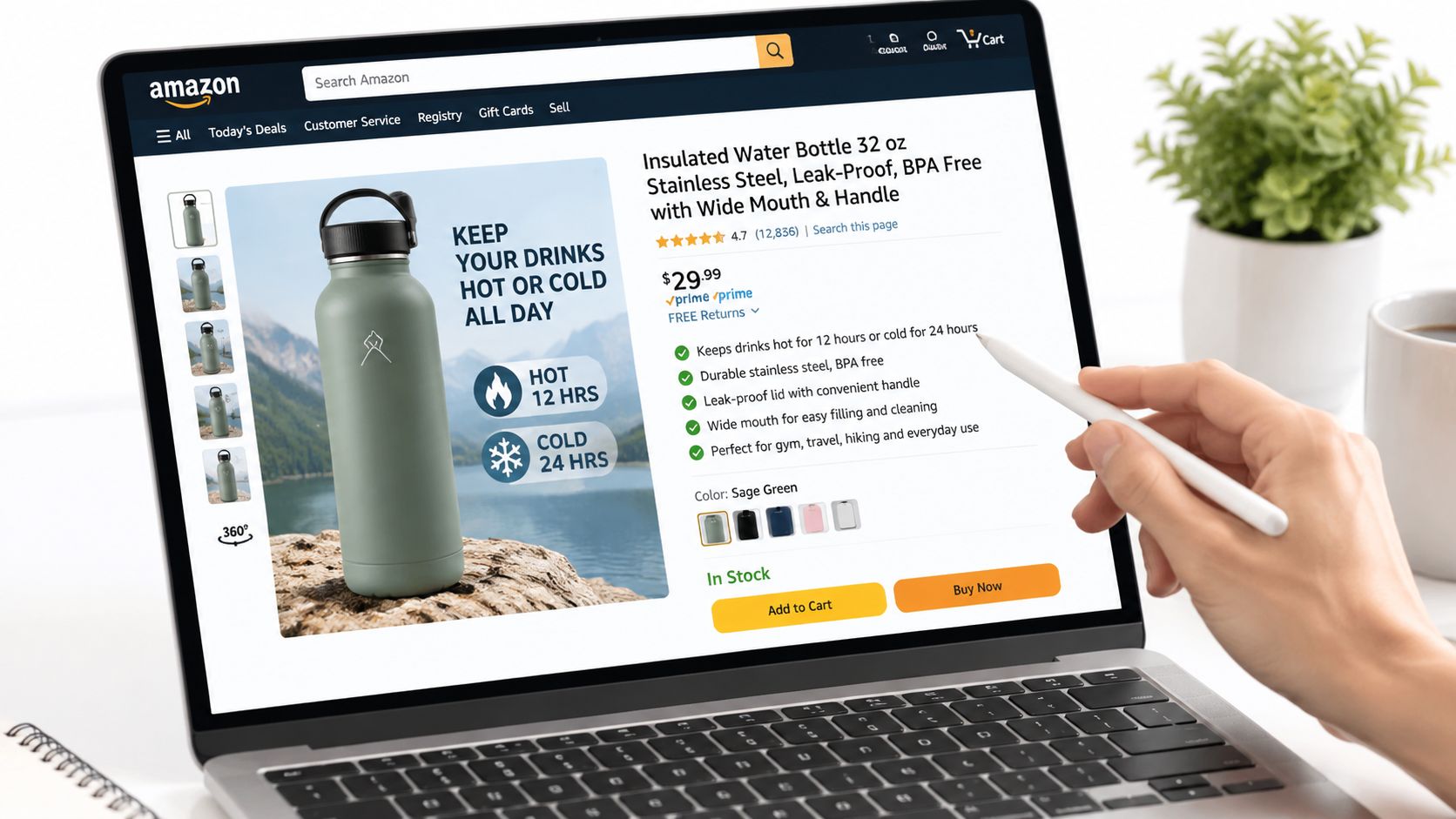
Write for relevance and decisions
Build the title around the product identity, primary use, differentiating feature, and key specification. Use the strongest search language naturally, but do not force every variation into the first line. A title that reads like a keyword dump slows comprehension, particularly on mobile.
Bullets should answer the questions that block purchase:
- What does it do? State the primary outcome in plain language.
- Why is it different? Explain the feature that matters, rather than using a vague quality adjective.
- Who is it for? Clarify the situation, user, or compatibility requirement.
- What concern does it remove? Address cleaning, sizing, durability, setup, ingredients, or returns where relevant.
- What arrives? Make the contents, quantity, and limitations unambiguous.
Backend search terms support discoverability, but they cannot repair an unclear offer. Put the customer’s strongest language in visible copy first. Use backend fields for relevant variants and phrasing that would make the front end awkward.
Product Launch on Amazon: Plan the media before production
The main image earns the click. Secondary images earn understanding and reduce hesitation.
A practical sequence can include a clean hero image, feature infographic, product-in-use scene, dimensions or compatibility graphic, comparison chart, and close-up that addresses a quality concern. The category may change the order, but every asset should perform a separate job. Repeating the same product angle leaves objections unanswered.
Short video can demonstrate setup, scale, use, texture, movement, or the result the customer wants. Show the value quickly instead of repeating the title over background music. A+ Content can provide deeper storytelling, comparison modules, and brand context for shoppers who need more reassurance. Amazon describes A+ Content as available to eligible sellers with the relevant Brand Registry roles in its new product success guidance.
Conversion principle: Every visible element should answer one question or remove one hesitation. If it does neither, replace it.
Diagnose conversion before buying more clicks
Category benchmarks are directional rather than universal targets. A new listing may need time to establish proof, but sustained conversion below the relevant category norm calls for a content or offer diagnosis before bid increases. Review the page first, especially while inventory is limited and each early visit should produce useful learning.
Use this mobile checklist:
- First-frame clarity: Can a shopper identify the product and its use from the main image?
- Readable overlays: Are image captions legible on a small screen?
- Benefit order: Do the first bullets explain outcomes before technical detail?
- Price context: Is the value understandable beside competing offers?
- Trust evidence: Do images, reviews, answers, and policies address obvious risks?
- Variation clarity: Can shoppers select the correct size, color, pack, or configuration without confusion?
Conversion problems often appear before traffic problems. If qualified visitors leave without buying, higher bids only expose the same weakness faster. Check the page on a phone, compare it with the strongest competing offers, and test one meaningful change at a time. This Amazon product listing optimization guide provides a structured content and merchandising audit when the page needs a closer review.
Product Launch on Amazon: Lock In Pricing Inventory and Amazon Programs the Right Way
Operational errors can erase the value of good advertising. A launch can have strong demand and still stall because the product can’t be replenished, the variation family is malformed, the brand can’t enroll, or the category requires documentation that wasn’t prepared.
Price for value, not panic
Launch pricing should make the offer easy to understand without training shoppers to wait for a deep discount. A modest, deliberate promotion can reduce first-purchase hesitation, but a permanent price gap between promotional and normal pricing makes the underlying value harder to measure.
Compare the complete offer, including shipping promise, pack size, warranty, materials, compatibility, and review maturity. If your product costs more, the listing has to show why. If it costs less, explain what the buyer still receives and what trade-off exists.
Inventory planning requires a similar balance. Smaller initial inventory lowers exposure and helps validate demand, but an avoidable stockout can interrupt the very velocity you’re trying to build. Coordinate supplier lead time, inbound preparation, FBA receiving, reorder timing, and a practical buffer before launch day.
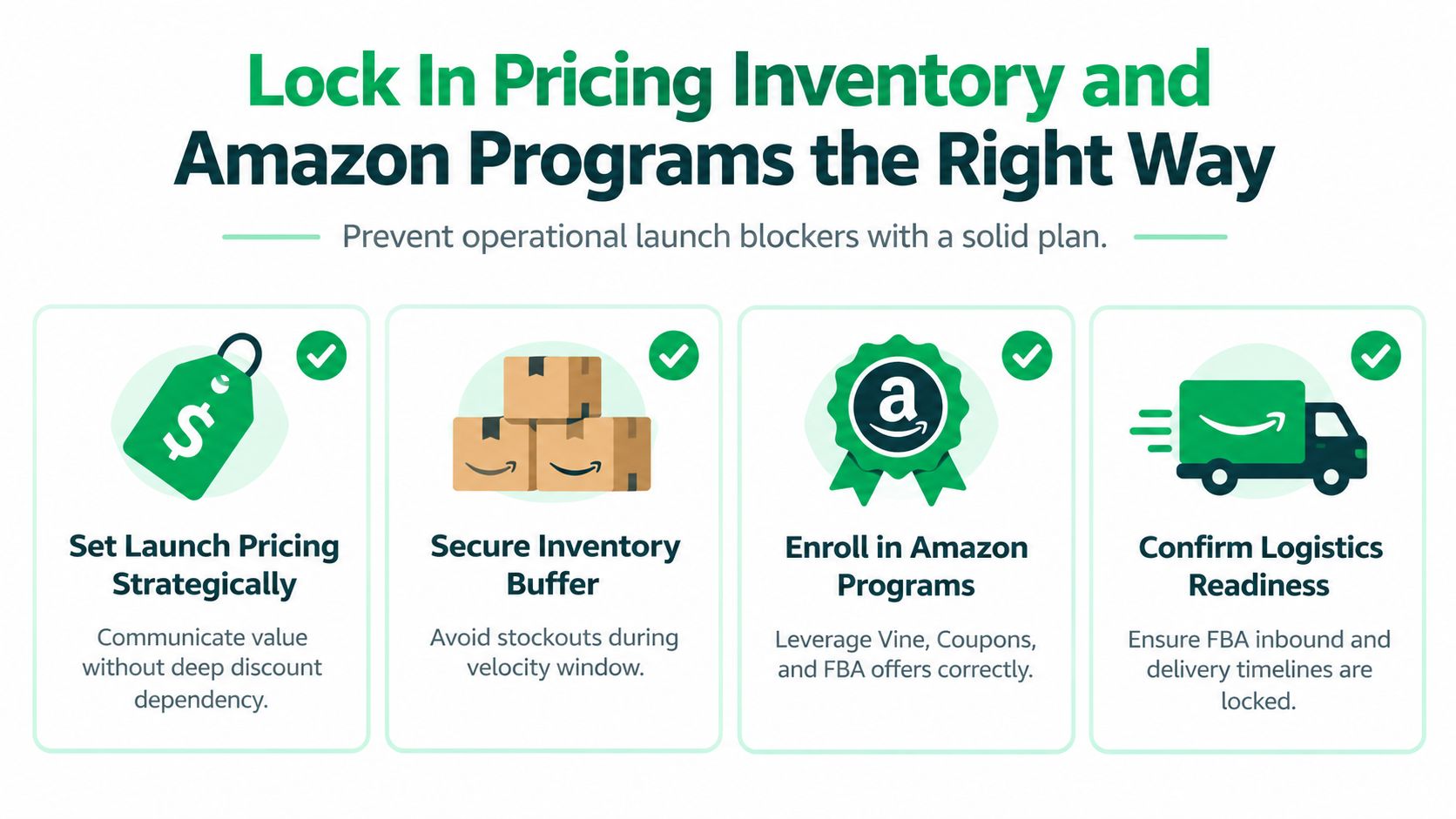
Clear the compliance and catalog gates
Amazon Brand Registry requires a brand name and logo tied to a pending or registered trademark issued by a designated government trademark office. The brand also needs a logo permanently affixed to the product or packaging, and Amazon’s enrollment guidance says the trademark must correspond to an Amazon store in that country. Review the requirements in Amazon Brand Registry before you print packaging or schedule a launch.
Variations deserve equal care. Amazon identifies the parent ASIN as non-buyable, with no price, quantity, or offer details. Each child variation needs its own unique seller SKU and unique product identifier unless it qualifies for a product ID exemption, according to Amazon’s variation documentation.
Children must share the same product type and sit beneath a parent created at the parentage level, grouped by a declared theme such as size or color. Product ID-exempt items can’t be combined with branded products under the variation rules summarized by Amazon listing variation guidance. Don’t create a family merely to combine unrelated products. It can confuse shoppers, complicate reviews, and create catalog problems.
Some categories impose a harder gate. Sellers in categories with enhanced safety listing requirements must obtain and maintain commercial liability insurance for those products regardless of monthly gross proceeds, as stated in Amazon’s commercial liability insurance requirements.
Before traffic starts, confirm:
- Offer readiness: Price, fulfillment method, shipping promise, returns, and inventory are live.
- Program eligibility: Brand Registry, Vine, Coupons, FBA offers, and category permissions are checked.
- Catalog integrity: Parent, child, SKU, product identifier, and variation theme are correct.
- Inbound execution: Units are labeled, prepared, shipped, received, and available for sale.
Use this Amazon Buy Box guidance to pressure-test the offer and fulfillment details before launch traffic makes every defect more expensive.
Drive Early Traffic Reviews and Visibility in the First 30 Days
The first 30 days are a velocity race. Search visibility, relevant traffic, and review velocity determine whether a new ASIN earns a place in the results. Discounts may create orders, but they do not repair weak relevance or a listing that fails to convert.
Start with the searches that describe the product precisely. Expand into broader discovery terms only after the detail page proves it can convert that traffic.
Sponsored Products should carry the initial keyword and product-targeting workload. Sponsored Brands can send shoppers to the new product and its Storefront when Brand Registry access is available. Sponsored Display can support retargeting and detail-page reach, but buying broad impressions before the listing works usually wastes budget.
Product Launch on Amazon: A practical 30-day sequence
Before launch day, separate exact, phrase, broad, and product targets when the account has enough data to support that structure. Add negative keywords and products as search-term evidence arrives. Build the Storefront before traffic starts, especially when the product needs education or serves several use cases.
On launch day, confirm that the offer is buyable, inventory is available, the main image is correct, and every campaign points to the intended ASIN. Begin with tightly relevant targets. Watch clicks, detail-page views, and orders. Change one major variable at a time so the result remains interpretable.
During the first week, review search-term relevance, detail-page traffic, conversion, spend, and customer questions. A nonconverting click may reflect a keyword and offer mismatch. Repeated nonconversion from highly relevant traffic points to the listing, price, reviews, or other trust signals.
During the remaining weeks, expand winning search terms, refine negatives, test creative improvements, and protect inventory. Increase traffic where relevance and conversion support it. Pause expensive targets that produce activity without useful customer signals.
The launch objective is qualified traffic that creates durable search and customer signals.
Review velocity belongs beside sales in the daily launch report. Momentum Commerce analyzed thousands of Amazon US launches and found that products with a large total and paid search presence, higher star ratings, and association with top-revenue brands were more likely to generate higher sales in the first three months. Its reporting also found that winning products averaged 262% more written reviews than their category mean, while typical launches trailed by 2%. That supports treating review accumulation as part of launch execution, not a task to postpone.
Review requests must remain compliant. Use eligible programs and Amazon-approved customer follow-up tools, deliver the experience promised on the page, and avoid any method that conditions or manipulates feedback. Amazon’s new-product guidance identifies Vine as an option for eligible sellers to connect products with reviewers. A focused Amazon review generation process keeps those requests organized without trading compliance for speed.
Check paid and organic search presence, review growth, conversion, and advertising efficiency every day at first. Keep inventory lean enough to validate demand, yet sufficient to avoid interrupting momentum. Trend-timed entry windows can give a product attention before competitors adjust, but only if the offer remains available and the listing converts the resulting traffic. Discounts can stimulate a transaction. Visibility and review velocity show whether that transaction is strengthening the listing.
Product Launch on Amazon: Measure What Matters and Keep Your Ranking After Launch
A launch report that tracks revenue alone misses the warning signs. Sales can hold while search visibility declines, advertising efficiency worsens, or available inventory approaches a dangerous level. Review the operating signals early, while there is still time to correct the listing, bids, or replenishment plan.
As noted earlier, search visibility and review activity are leading indicators of launch health. Use conversion as a diagnostic, not a vanity score. New listings should move toward 8% to 12%, while mature performance can reach 15% or higher. Sustained conversion below about 7% points to a likely gap in the main image, title, price, reviews, or another part of the offer.
Product Launch on Amazon: Use a weekly diagnostic loop
Review the same core measures consistently:
- Search share: Are priority keywords gaining organic and paid presence?
- Conversion rate: Does qualified traffic produce orders at a healthy category level?
- Review velocity: Are written reviews and ratings accumulating at a credible pace?
- TACOS: Is advertising cost rising faster than total sales can support?
- Inventory health: Can available units support momentum and replenishment timing?
When conversion weakens, fix the page before raising bids. Test the main image, title clarity, benefit order, price presentation, comparison content, and review visibility one meaningful change at a time. When conversion holds and search visibility expands, increase coverage gradually. Protect profitable terms, and move budget toward targets that generate sales while strengthening organic placement.
Keep variations tied to a real customer choice under the same product type. Add one only when inventory, imagery, and selection language can support it. Extra catalog breadth creates operational work without necessarily improving the buying decision.
The first 30 days should produce evidence, not just orders. Use that evidence during the following 60 to 90 days to refine creative, search coverage, reviews, pricing, and replenishment. A campaign left unchanged after launch wastes useful information, especially when low inventory can validate demand before a larger purchase and a trend-timed entry window may close.
Mr. Green Marketing, LLC helps Amazon sellers turn launch research into conversion-focused listings, PPC campaigns, branding, and marketplace growth plans. Visit Mr. Green Marketing, LLC to request a free audit and performance report that identifies visibility gaps and practical next steps for your product launch.
Leave a Comment
sing in to post your comment or sign-up if you dont have any account.