
SEO Strategies for AI Tools: AI visibility doesn’t come from publishing more content or buying one platform. That advice is popular because it’s easy to package, but it misses the operating system underneath the tools. Durable visibility depends on aligning search intent, semantic coverage, extractable answers, structured data, technical accessibility, authority, local signals, and measurement.
Google’s AI Overviews illustrate the scale of the change. The feature began rolling out to all users in the United States in May 2024, expanded to more than 100 countries and territories by October 2024, and reached over 1 billion monthly users, according to Google’s announcement about AI Overviews. A page can still rank well in traditional results and miss the answer surface that shapes discovery.
The best SEO strategies for AI visibility tools therefore work as a connected sequence. Map intent, optimize pages for extraction, remove crawl and schema barriers, monitor competitors, use generative AI with editorial control, build relevant authority, support conversational searches, and tailor local experiences. Mr. Green Marketing, LLC provides a useful example of this strategy-led model by connecting GEO, SEO, content, web strategy, and performance reporting instead of treating AI visibility as an isolated add-on.
SEO Strategies for AI Tools: Table of Contents
- 1. AI-Powered Keyword Research and Intent Mapping
- 2. Content Optimization Using AI Analysis and SERP Feature Targeting
- 3. Technical SEO Automation and Site Health Monitoring
- 4. Predictive Analytics for Rank Tracking and Competitive Intelligence
- 5. Generative AI for Content Creation and Scale
- 6. AI-Driven Backlink Analysis and Link Building Strategy
- 7. Voice Search and Conversational Query Optimization
- 8. AI-Enhanced Local SEO and Multi-Location Optimization
- 8-Point Comparison: AI-Powered SEO Strategies
- Turn AI Visibility Signals Into a Repeatable System
1. SEO Strategies for AI Tools: AI-Powered Keyword Research and Intent Mapping
AI visibility begins with the decision behind a query. Keyword volume can help prioritize work, but it cannot determine whether a searcher wants education, comparison, evaluation, or a purchase. Tools such as Semrush and Ahrefs can group related queries, review competing pages, and identify SERP features. The practitioner still has to assign the underlying job.
A SaaS company might separate “what is project management software” from “Asana alternatives for small businesses.” An e-commerce seller could distinguish broad product research from a specific model comparison. A local service provider should separate “how much does roof repair cost” from “roof repair company in Pensacola.” These queries share a topic, yet they need different page types, calls to action, and supporting evidence.
Keyword variations alone rarely reveal that distinction. Customer calls, sales objections, support tickets, and live chat transcripts often contain the language that customers use. Feed those terms into an AI clustering workflow, then have a subject-matter expert verify the groups before assigning pages.
Build intent groups around decisions
Create a working map that connects each query class to a page type:
- Comparison intent: Build comparison pages, alternatives pages, and decision guides that explain meaningful differences.
- Instructional intent: Publish tutorials, templates, and answer-led resources that complete a defined task.
- Commercial intent: Strengthen service, product, category, and landing pages with clear fit, scope, proof, and next steps.
- Local intent: Pair the service with the actual market, neighborhood, or service area. Avoid interchangeable location pages.
AI clustering finds related variants quickly. It does not confirm whether the business can provide a specific answer or a credible reason to be considered. Check both before prioritizing an opportunity.
Practical rule: Track the intent behind a query separately from its wording. AI systems may rephrase the prompt, but they still need a relevant, well-supported answer.
Review the map as search behavior changes. Semrush’s measurement of AI Overview triggers moved from 6.49% of tracked keywords in January 2025 to 24.61% in July 2025, before settling at 15.69% in November 2025, showing why a static keyword plan can become outdated. The same Semrush AI Overview study recorded navigational queries rising from 0.74% to 10.33% of AI Overview triggers by October 2025 in one dataset. Use those changes to revisit page priorities, briefs, and measurement rather than treating the keyword file as finished.

2. SEO Strategies for AI Tools: Content Optimization Using AI Analysis and SERP Feature Targeting
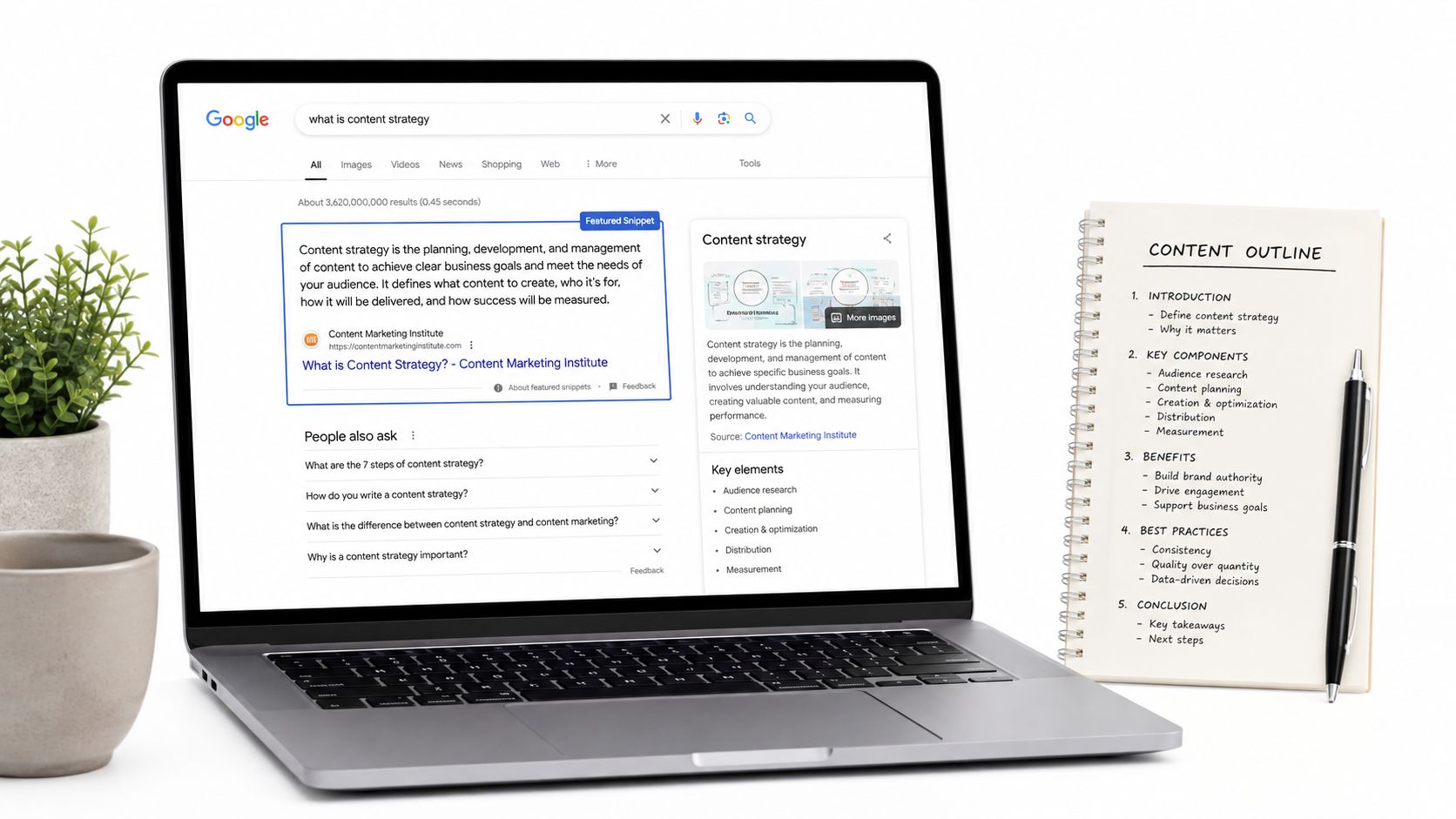
A page can rank well and still contribute little to an AI-generated answer. Use AI analysis to examine what useful results communicate, then improve the page’s ability to answer, support, and clarify a decision. Review competing pages for structure, entity coverage, answer formats, internal links, and the questions users ask next. Copying surface features rarely improves usefulness.
Start with the decision the visitor needs to make. A comparison page may require a concise definition, evaluation criteria, feature differences, limitations, and a clear recommendation path. A local service page may need service boundaries, areas served, qualifications, process details, and a direct contact option. A product page should make specifications, compatibility, use cases, and meaningful distinctions easy to extract.
Design passages for reuse
AI answer surfaces can assemble responses from page fragments. Microsoft’s guidance on content for inclusion in AI search answers emphasizes clear titles, aligned headings, concise answers, lists, tables, and semantically precise language. Google also states that AI features rely on ordinary search fundamentals, including crawlability and clear control over snippets, in its documentation for AI features and your website.
Prioritize pages already close to the first page. Improving an existing answer may produce more value than launching another article. Check whether each page includes:
- Answer blocks: Place a direct, self-contained response near the relevant heading.
- Evidence-first sections: State the claim, explain its context, and identify the source or qualification.
- Comparison formats: Use bullets or a compact table when readers must evaluate options.
- Entity clarity: Name products, services, audiences, locations, and relationships explicitly.
Then test the changes against behavior. AI recommendations can suggest a phrase because competing pages use it, even when that phrase weakens the copy. Engagement data, conversions, and sales feedback provide the better decision rule. Keep useful additions, remove wording that adds no clarity.
For a practical framework, review how to optimize for AI search. The standard is straightforward: readers should understand the answer quickly, while answer engines should be able to reuse the relevant passage without changing its meaning. Content, technical access, local signals, and measurement must support one another.
3. SEO Strategies for AI Tools: Technical SEO Automation and Site Health Monitoring
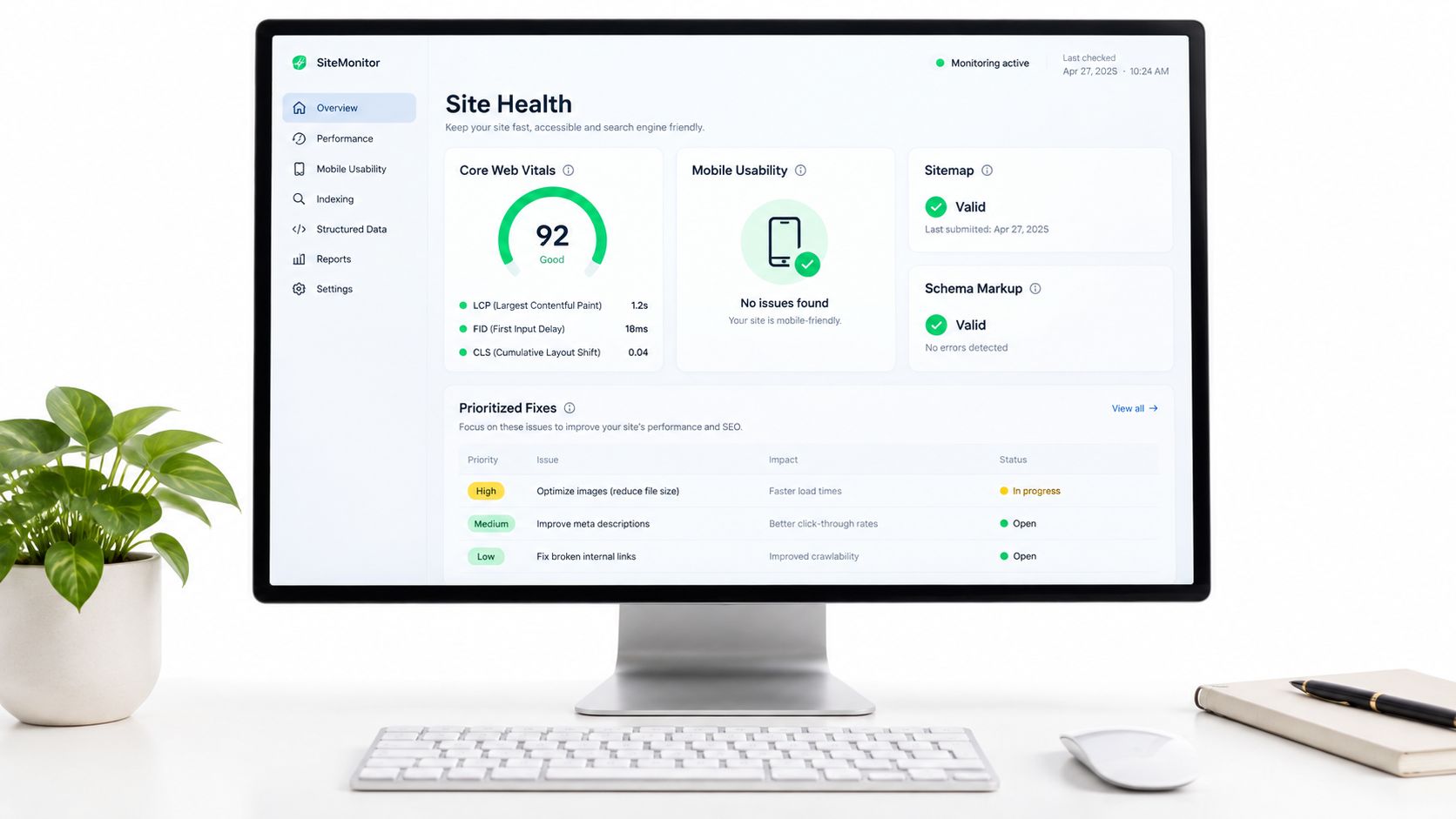
Technical SEO is the operating layer that lets search systems reach, interpret, and serve a page. Set monitoring around the full path, from crawl access to rendering and user experience. Automated crawlers can find broken links, accidental noindex directives, redirect chains, rendering failures, mobile problems, and structured-data errors. An alert has value only when it reaches someone who can assess priority and make the fix.
Google states that AI Overviews rely on crawlable pages. Its guidance points to robots.txt and the CDN or hosting layer, and identifies controls such as nosnippet, data-nosnippet, max-snippet, and noindex that affect search presentation. Technical review therefore supports AI visibility directly. It is not a separate maintenance task.
Connect alerts to page value
An error total does not show what to fix first. A broken link on a low-value archive page may matter less than a rendering failure on a service page that generates conversions. Tie monitoring to page purpose, impressions, rankings, conversions, and revenue opportunity.
Use a simple operating cycle:
- Route indexing failures, availability problems, and accidental blocking to the person who can act immediately.
- Audit templates, canonical behavior, internal links, and rendering across priority page groups on a schedule.
- Validate schema, redirects, and template changes in staging before broad deployment.
- Compare technical releases with visibility, impressions, clicks, and conversion movement.
Core Web Vitals connect technical performance with how pages feel to users. Read the dashboard in context. Fix barriers that prevent discovery or make important pages difficult to use before lower-impact warnings.
Structured data can clarify whether a page describes a product, organization, service, article, or another entity. Google does not require special schema for AI search visibility. Its structured data guidance recommends standard SEO practices, markup validation, URL Inspection, and performance monitoring. For implementation details, use this schema markup for SEO resource, then confirm that the markup matches visible page content. That alignment helps the technical layer reinforce the page’s intent instead of introducing conflicting signals.
4. SEO Strategies for AI Tools: Predictive Analytics for Rank Tracking and Competitive Intelligence
Rank tracking records outcomes. Predictive analysis helps prioritize the next action, as long as forecasts remain scenarios rather than promises. The useful question is not whether a model can name the next ranking change. It is whether the forecast changes what the team does.
Start with an intent map, then connect ranking history to the pages serving each topic. Add content updates, competitor launches, link acquisition, seasonality, and query trends. This creates an operating view of visibility rather than a dashboard of isolated tool outputs.
Consider three practical uses. An Amazon seller can strengthen a product page before seasonal demand rises. A local service provider can spot a competitor publishing location pages and earning local mentions. A SaaS team can identify a comparison topic gaining competition before its page loses visibility.
Turn forecasts into operating decisions
A forecast earns its place in the workflow only when it has an owner, a review date, and a predefined response.
- Set expectations: Content, technical, and authority improvements do not follow a guaranteed timetable.
- Test accuracy: Compare predicted movement with observed rankings and record where the model missed.
- Check demand: Review Search Console trends and broader query behavior before increasing investment.
- Monitor topics: Track competitor pages, refreshed comparisons, product claims, and citations by intent cluster.
- Separate noise from decline: A short-term ranking change may not justify rewriting a page that still answers the query well.
AI visibility requires another layer of measurement. Test consistent prompt groups across markets, user contexts, and time periods, then record whether the brand appears, which source is cited, what query class produced the result, and whether inclusion persists. One generated answer is an observation, not proof of durable visibility.
Forecasts support judgment. They do not replace it. Assign a human owner to decide whether a page needs better evidence, clearer extraction points, stronger internal connections, or no change at all.
Competitive intelligence also needs page-level review. A competitor may outrank a longer page because its product explanation is clearer, its audience is narrower, or its third-party references are stronger. Use the machine signal to locate the page, then read it like a buyer. Check the claim structure, proof, limitations, and next action.
Teams assessing a broader connected workflow can review AI search optimization services alongside their SEO and GEO processes. The practical goal is to identify the next defensible improvement before the market forces a response.

5. SEO Strategies for AI Tools: Generative AI for Content Creation and Scale
Generative AI is useful for repeatable production, not for inventing expertise. It can create outlines, page variants, metadata drafts, product-description structures, and initial FAQ ideas quickly. The output still needs review when a page depends on original judgment, precise nuance, brand positioning, or a claim the business must defend.
AI visibility depends on that distinction. A readable, semantically related draft may still give an answer engine little reason to recommend the brand. Subject-matter expertise supplies the identifying details: who the business serves, which problems it solves, where it is not a fit, how its process works, and what customers should expect.
Put automation behind editorial control
Start with a brief that defines the audience, intent, entities, claims, sources, internal links, and conversion goal. Prompt for structures and workable variants, then have an expert add customer language, product facts, process detail, and meaningful distinctions. Verification should check every factual claim against approved source material and current product information.
A practical production workflow looks like this:
- Brief creation: Set the page’s purpose and required evidence before generation.
- Draft generation: Produce outlines or variants without asking the system to supply unsupported authority.
- Expert enrichment: Add firsthand details, customer terminology, and product-specific context.
- Verification: Check claims against approved references and current information.
- Editorial review: Remove repetition, vague promises, fabricated detail, and wording that does not sound like the brand.
- Performance review: Compare engagement and conversions with the page’s original purpose.
E-commerce teams can generate initial descriptions across a large catalog, then manually review priority products. A local provider can create location-page outlines, while staff confirm service-area details and useful market context. A publisher can expand a topic cluster with draft ideas, while an experienced editor decides which ideas merit publication.
Production volume creates maintenance work, duplication risk, and more opportunities for unsupported claims. A smaller set of specific, accurate pages can give AI systems a clearer understanding of the brand than a large library of interchangeable text.
Use generative AI to multiply sound inputs. Software handles structure and variation. People provide judgment, evidence, and experience. That separation keeps scale connected to the wider visibility system, rather than turning content production into an isolated output target.
6. SEO Strategies for AI Tools: AI-Driven Backlink Analysis and Link Building Strategy
AI-assisted link analysis should move a team from volume chasing to relevance. It can organize referring domains, compare competitor sources, flag unusual patterns, and surface broken-link opportunities. Analysts still need to review each result because link value depends on editorial placement, topical fit, surrounding context, and the audience a page can reach.
Start with the pages and topics the business wants AI systems to understand. A SaaS company might study industry publications, integration partners, and directories that already cover its category. A local provider could assess chambers, associations, community publications, and regional directories. An e-commerce brand may find product guides where a clearer, more current resource could replace an outdated reference.
A link has a better chance of earning attention when the destination gives publishers something useful. Build an asset that answers a difficult question, organizes scattered information, documents an original process, provides a tool, or explains a product category clearly. Then match it to sites whose readers would benefit from that resource.
Run the workflow in this order:
- Source discovery: Find relevant sites that already publish on the target topic.
- Context review: Read the article and confirm that a mention would help its audience.
- Asset matching: Offer a guide, data resource, calculator, template, or expert contribution that fits the page.
- Relationship building: Personalize outreach instead of sending identical requests at scale.
- Quality control: Review new links for relevance, accuracy, and surrounding context.
AI scores are useful for prioritization, not automatic verdicts. A low-quality metric does not make every link toxic. Check the referring page, site, anchor context, and reason the link exists before taking action. Removal campaigns can consume time while leaving genuine authority gaps unresolved.
Authority is contextual. A relevant industry reference can support visibility more effectively than a prestigious but unrelated mention.
Use backlink-building techniques to organize prospecting and outreach, then connect each opportunity to the intent map created earlier. Links should reinforce the pages and topics where the business wants to be discovered. Measure progress by relevance and useful coverage, not isolated monthly link totals.
7. SEO Strategies for AI Tools: Voice Search and Conversational Query Optimization
Spoken searches expose gaps that keyword lists often hide. People ask complete questions, add situational details, and expect an answer they can use immediately. Content should preserve that context so readers, search systems, and AI assistants do not have to reconstruct it from scattered paragraphs.
Consider the difference between “water heater repair” and “Who repairs water heaters near me?” The second query identifies a service, location, and immediate need. Similar questions include, “What project management tool works for a small remote team?” and “Which running shoes are best for wide feet?” Each combines intent with an audience, constraint, and likely next action.
Build passages that can stand alone
Use real customer wording as a starting point, then write a direct answer in a self-contained passage. Question headings help when they clarify the reader’s need. Rewriting every heading as a question only creates awkward copy.
A useful answer should:
- Name the subject: Identify the product, service, audience, or problem.
- Answer promptly: Put the direct response before supporting background.
- State constraints: Cover location, compatibility, budget category, timing, or suitability when those factors affect the choice.
- Support the next step: Point readers to a deeper guide, service page, product detail, or contact option.
A short paragraph can be more reusable than a long introduction. Definitions, ordered steps, comparison points, and concise answers may fit featured snippets or AI-generated summaries, while the surrounding page gives users enough detail to evaluate the recommendation.
FAQ content needs editorial control. Include genuine customer questions and remove variations that add no information. Sales calls, support tickets, query reports, Search Console data, and local reporting can reveal the language people use. Test those patterns in headings, opening answers, and service explanations, without forcing exact-match phrases into sentences.
Voice performance rarely appears as a clean metric in standard analytics. Track the related queries and actions instead, then compare changes in impressions, visits, calls, and conversions where the data supports it.
Clear conversational content can serve voice assistants, AI Overviews, and ordinary readers at the same time. Build it into the existing page rather than creating a separate voice version. The operating system is connected: intent shapes the question, extractable passages supply the answer, and measurement shows whether the page meets the need.
8. SEO Strategies for AI Tools: AI-Enhanced Local SEO and Multi-Location Optimization
AI can expose local SEO gaps quickly, but it cannot manufacture local relevance. Multi-location performance usually declines when every market receives the same page with only the city name changed. Use AI to audit business information, compare nearby competitors, group market-specific queries, monitor reviews, and flag inconsistent location data. Then have local teams verify what the system cannot know.
Start with a controlled location record for names, addresses, phone numbers, hours, categories, service areas, and landing pages. Each location page should explain its services, audience, local coverage, and next action in language that reflects the actual business. That makes the content easier for search systems and AI tools to extract, while giving customers information they can use.
Build one operating system for every location
Central teams should manage templates, permissions, data standards, schema requirements, and publishing rules. Local teams should supply service details, community involvement, staff expertise, and recurring customer questions. The trade-off is clear: central control reduces drift, while local input prevents generic pages.
Review location-level reports through four lenses:
- Data problems: Incorrect hours, duplicate profiles, missing categories, or inconsistent contact details.
- Content problems: Thin service pages, weak location descriptions, or unanswered local questions.
- Reputation problems: Unanswered reviews, recurring complaints, or inconsistent response practices.
- Market problems: Strong competitors, limited demand, or services that do not match local needs.
A plumbing company may need separate pages for emergency repairs, drain cleaning, and water heaters across its service area. A dental group may find that one office needs stronger local authority, while another needs clearer conversion paths. A retailer can improve its store locator by exposing hours, inventory context, directions, and services in crawlable HTML instead of hiding key details behind an interface.
Use multi-location SEO strategy to structure the operating model. Reviews, local mentions, structured business data, and location content should describe the same entity consistently. If those signals conflict, users and search systems have less confidence.
Do not set identical ranking targets for every market. Competition, relevance, proximity, and business quality vary by location. The practical goal is accurate information, extractable content, and a credible reason for each location to appear in its market.
8-Point Comparison: AI-Powered SEO Strategies
| Strategy | Implementation complexity | Resource requirements | Expected outcomes | Ideal use cases | Key advantages |
|---|---|---|---|---|---|
| AI-Powered Keyword Research and Intent Mapping | Medium, tool integration + analyst interpretation | Moderate, subscription data, analyst time | Better keyword targeting and higher conversion relevance | E‑commerce product discovery; local services; SaaS comparison queries | Finds high-intent long-tail opportunities; uncovers content gaps |
| Content Optimization Using AI Analysis and SERP Feature Targeting | Medium, audits and content rewrites | Moderate, content team and optimization tools | Improved rankings and increased SERP feature visibility | Blogs, product & service pages aiming for featured snippets | Data-driven outlines; rapid gap identification for quick wins |
| Technical SEO Automation and Site Health Monitoring | Medium–High, monitoring setup and developer fixes | High, continuous monitoring tools and developer resources | Fewer technical issues, better Core Web Vitals, stable crawlability | Large sites, e‑commerce, multi-location sites | Automates audits; prioritizes fixes by impact |
| Predictive Analytics for Rank Tracking and Competitive Intelligence | High, data integration and model interpretation | High, historical tracking data and analyst oversight | Forecasted ranking movements and proactive strategy signals | Competitive markets; seasonal sellers; strategic planning | Predicts opportunities and flags emerging competitors early |
| Generative AI for Content Creation and Scale | Low–Medium, prompt design and workflow setup | Moderate, AI tools plus human editors for review | Faster content production and scalable metadata generation | Large product catalogs; bulk landing pages; content expansion | Accelerates volume; consistent metadata at scale |
| AI-Driven Backlink Analysis and Link Building Strategy | Medium, link data integration and outreach workflows | Moderate, link tools plus outreach resources | Higher-quality link targets and reduced toxic backlinks | SaaS, e‑commerce, startups building authority | Prioritizes high-impact links; identifies broken-link opportunities |
| Voice Search and Conversational Query Optimization | Medium, content restructuring for natural queries | Low–Moderate, content edits and voice analytics | Improved voice and featured snippet visibility | Local services; informational and health queries | Captures conversational traffic; often lower competition |
| AI-Enhanced Local SEO and Multi-Location Optimization | Medium–High, platform syncing and location customization | High, centralized data systems and local teams | Consistent local presence and targeted market growth | Franchises, chains, multi-location service providers | Scales local audits; identifies high-opportunity markets |
Turn AI Visibility Signals Into a Repeatable System
AI visibility becomes manageable when teams stop treating it as a collection of disconnected features. The operating system is a loop: map the intent, improve the page, expose the right entities, remove technical barriers, strengthen authority, adapt the experience to conversational and local searches, then measure what changed.
Start with an audit, not a platform shopping exercise. Identify the query classes that matter to the business, the pages already close to meaningful visibility, the technical issues blocking access, and the content gaps that prevent a clear recommendation. Select a small group of high-impact pages. A comparison page, a service page, a product category, and a location page may reveal more than an immediate sitewide rewrite.
Measurement must include both classic and AI-specific signals. Google AI Overviews have become a major search feature, and their reach means blue-link rankings alone don’t describe the full discovery environment. At the same time, clicks can fall even when a brand remains visible. Ahrefs’ summary of a large study found AI Overviews associated with a 34.5% lower average CTR for the top-ranking page across 300,000 keywords, while Seer Interactive reported organic CTR falling from 1.76% to 0.61% on queries with AI Overviews in its longitudinal analysis, as documented in Ahrefs’ analysis of AI Overviews and clicks. Those figures should change reporting priorities, not trigger panic.
Track page rankings, impressions, clicks, conversions, AI inclusion, citation share, brand mentions, query class, and referral traffic. Segment informational, comparison, and transactional queries because answer surfaces can affect them differently. Search Engine Land cites datasets showing a 61% organic CTR drop for informational and educational queries with AI Overviews and a roughly 58% decline for the top organic result in another analysis, reinforcing the need for intent-segmented AI search measurement.
Attribution will remain imperfect. A prospect may see a brand in an AI answer, search the brand later, and convert through a branded result. Add a “how did you hear about us?” field to forms, ask sales teams to record AI-assisted discovery, and compare those responses with analytics and AI visibility reports. Search Engine Land’s 2025 AI search optimization survey identifies attribution and volatile answers as major frustrations, with 62% of respondents saying AI search drives less than 5% of revenue. The lesson isn’t to abandon the channel. It’s to report visibility, assisted discovery, and business outcomes together.
Mr. Green Marketing, LLC can support this process through GEO optimization, SEO, web strategy, technical work, content development, and performance reporting. The agency also offers a free audit and performance report to help identify visibility gaps and prioritize practical next steps. Begin with the pages and queries most closely connected to revenue, establish a baseline, make controlled improvements, and refine the system as the evidence changes.
Mr. Green Marketing, LLC offers GEO optimization, SEO, technical strategy, content, and performance reporting for businesses building visibility across traditional and AI-driven search. Visit Mr. Green Marketing, LLC to request a free audit and performance report, identify your most important visibility gaps, and prioritize the next improvements.
Leave a Comment
sing in to post your comment or sign-up if you dont have any account.