
Content Marketing Firm: And this is usually where business owners get stuck. They know content matters, they’ve posted a few articles, maybe pushed some social updates, maybe even paid a freelancer for a batch of blog posts, and still the pipeline doesn’t feel different. The site has activity. It doesn’t have traction.
That gap is the primary issue. Not content volume. Not publishing for the sake of publishing. The problem is that scattered content rarely turns into qualified demand unless someone is driving strategy, production, distribution, and measurement together. That’s where a content marketing firm earns its keep.
Content Marketing Firm: The Content Conundrum Every Business Faces
A familiar scenario. A founder writes a few thoughtful posts late at night. A marketing coordinator repurposes them into LinkedIn updates. Someone on the team uploads a short video clip. A month later, the analytics are murky, sales hasn’t noticed much difference, and the whole thing starts feeling like a side project instead of a growth system.
That frustration is normal. Content looks simple from the outside because everybody can publish. Very few teams can turn publishing into a repeatable engine that supports search visibility, trust, lead quality, and sales conversations at the same time.
The pressure to get this right is only getting stronger. The global content marketing industry is projected to grow by 33% by 2026, from about $72 billion in 2023 to more than $107 billion, and 83% of marketers identify content marketing as the most effective method for demand generation according to industry projections and demand generation data. That doesn’t mean every blog post works. It means businesses are betting on content because, when done well, it works across the full buyer journey.
For startups, this gets even sharper. A young company often has expertise, product insight, and customer stories, but no system for packaging that value in a way prospects can find and trust. That’s why practical guidance like this startup content marketing guide matters. It connects content to growth instead of treating it like a publishing hobby.
Most businesses don’t have a content problem. They have a coordination problem.
A good content marketing firm solves that coordination problem. Not by flooding your site with generic articles, but by turning what your team knows into assets that support visibility, credibility, and revenue. Writers are part of that. So are strategists, editors, SEO operators, designers, video producers, and analysts.
That’s the distinction. You’re not hiring “people to make content.” You’re hiring a partner to make your expertise marketable.
So What Does a Content Marketing Firm Actually Do
Think of a content marketing firm as the general contractor for your brand’s growth. You know the business. You know the offer. The firm turns that into a plan, coordinates the specialists, keeps quality high, and makes sure the final build serves a business goal.
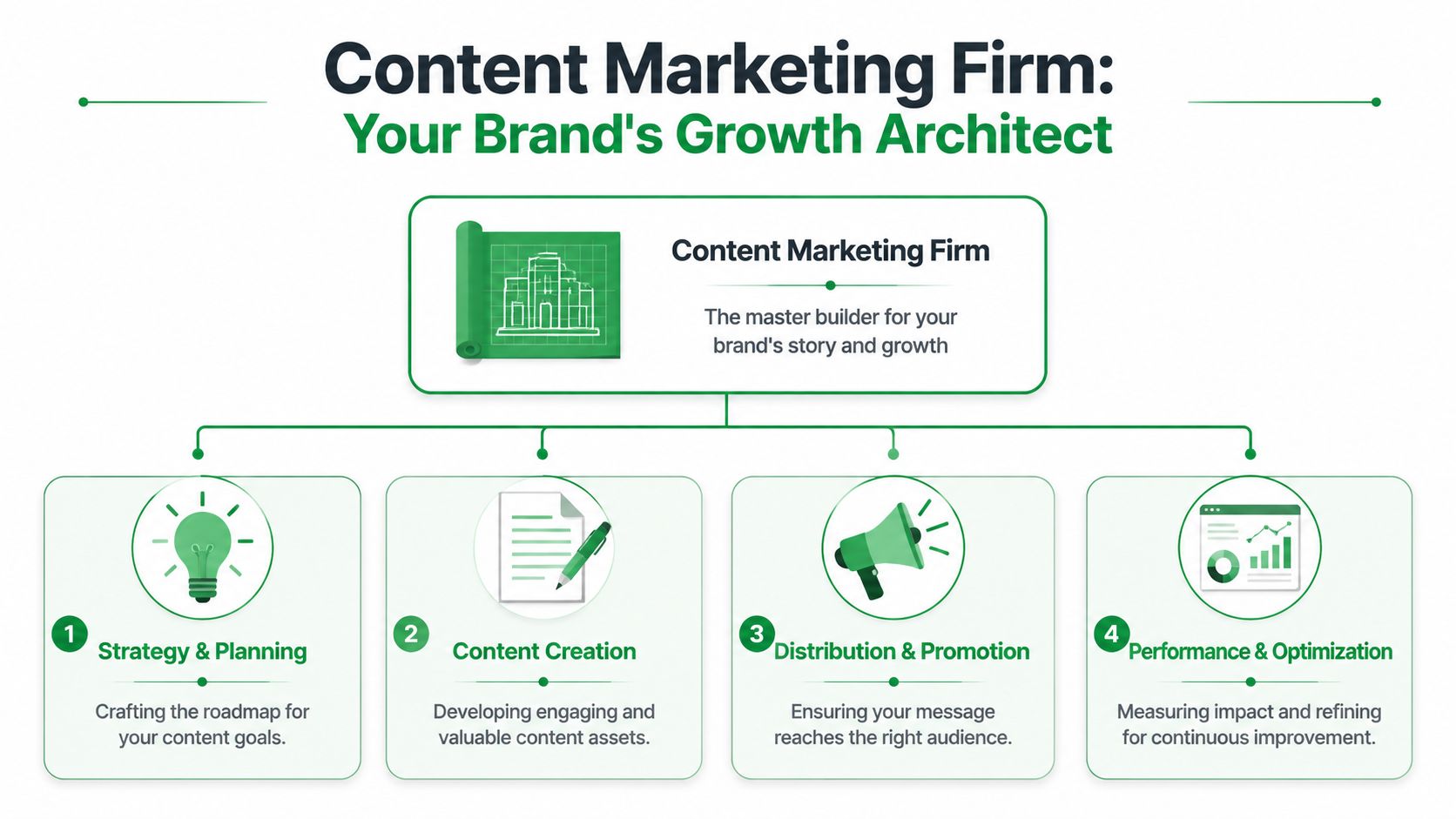
Strategy and planning
At this point, strong firms separate themselves from content mills.
They define who you’re trying to reach, what those buyers care about, which topics align with commercial intent, where your current site is underperforming, and what content formats fit your sales cycle. Sometimes that means thought leadership. Sometimes product education. Sometimes comparison pages, landing pages, video scripts, customer stories, or a podcast promotion plan.
A weak firm asks, “How many blog posts do you want each month?” A serious one asks better questions:
- What sales conversations keep repeating
- Which offers produce the best customers
- Where are leads getting stuck
- Which channels already show signs of buyer intent
That planning work matters because content without prioritization becomes expensive noise.
Content Marketing Firm – Content creation
Creation is the obvious part, but it’s not just article writing.
A capable content marketing firm builds assets in multiple formats: website copy, blog posts, email sequences, short-form video, sales enablement materials, scripts, visuals, and social content. The point isn’t variety for its own sake. The point is matching the format to the buyer’s need and the channel’s behavior.
And yes, AI is in the mix now. It should be. But it should be used as production support, not as a substitute for judgment. As noted in Digital Elevator’s take on modern content agencies, businesses are questioning whether they still need a firm in an AI world, yet the shift toward AI summaries is pushing organizations to prioritize unique, data-backed content rather than generic AI output. That makes experienced editorial judgment more valuable, not less.
Distribution and promotion
Publishing is not distribution.
A content marketing firm should know how to get an asset in front of the right people after it goes live. That can include email sends, social promotion, outreach, internal linking, sales-team usage, syndication, video clipping, community participation, or platform-specific adaptations.
Practical rule: If a firm talks mostly about production and barely mentions distribution, expect mediocre outcomes.
A useful piece of content often succeeds because it was repackaged three or four ways and delivered in the right context. One strong webinar can become a recap article, short clips, a sales follow-up asset, and a customer FAQ page. That’s strategic reuse.
Content Marketing Firm: Performance and optimization
Good firms don’t stop at traffic charts.
They track whether content attracts the right visitors, supports qualified leads, influences pipeline, and improves conversion paths. They also revisit assets, refresh weak pages, consolidate overlap, refine internal linking, and update messaging as buyer behavior changes.
That’s the whole job. Strategy sets direction. Creation builds the asset. Distribution gets attention. Measurement tells you what deserves more investment.
Content Marketing Firm: Core Services and Expected Business Outcomes
Most businesses don’t need more random marketing activity. They need specific services tied to specific outcomes. That’s the only way to judge whether a content marketing firm is worth the spend.

Content that supports demand, not just awareness
Foundational services still matter. Website copy, blog content, landing pages, email nurture content, lead magnets, and case-study development all belong in the mix. But each should connect to a business outcome.
Here’s what that usually looks like in practice:
- SEO-driven articles bring in relevant search traffic when they target commercially useful problems, not vanity keywords.
- Service pages and landing pages improve conversion when they clarify the offer, reduce confusion, and answer objections.
- Email content helps move leads from interest to action, especially when sales cycles are longer.
- Case studies and customer proof make claims believable. Sales teams use them constantly.
- Sales enablement content helps reps follow up faster with material that answers technical or commercial concerns.
A lot of teams benefit from reviewing content marketing best practices for current channels and workflows before they lock themselves into a production schedule. The format should follow the business goal, not the other way around.
Content Marketing Firm: Newer channel demands are changing the service mix
The service menu has expanded because buyer behavior has expanded. In projected B2B budget planning for 2026, 45% of B2B marketers say they plan to increase spend, with AI-powered marketing tools as the top priority, and 73% of Americans listened to a podcast in 2025 according to B2B spend and podcast listening data. That combination tells you something important. Firms now need to understand both AI-assisted workflows and attention channels beyond written search content.
That means a modern content marketing firm may also provide:
| Service | What it should accomplish |
|---|---|
| Short-form video production | Build familiarity and explain value quickly |
| Podcast promotion and distribution support | Extend reach for interview content, founder insight, or niche expertise |
| Social content systems | Keep the brand visible between major campaigns |
| Content repurposing | Increase output from one core asset without lowering quality |
| Marketplace or platform-specific content | Support channels like Amazon, YouTube, or industry communities |
One channel that often gets mishandled in B2B is community-led visibility. If your audience talks in niche forums and discussion platforms, guidance on B2B social media on Reddit can be useful because it forces marketers to think about participation, context, and credibility instead of broadcasting.
A quick example helps. A software company might record one strong expert interview, turn it into a blog article, extract short clips for LinkedIn, create a podcast episode summary, arm sales with a one-page objection-handling sheet, and build a follow-up email around the same theme. One input. Several business uses.
Here’s the broader point in video form:
What good outcomes actually look like
Outcomes vary by business model, but the pattern is consistent. Good content should improve one or more of these:
- Lead quality because the content attracts buyers with the right problems
- Sales efficiency because reps can use content to answer repeated questions
- Search presence because your site covers meaningful topics with depth
- Brand trust because your expertise becomes visible before a call ever happens
- Channel resilience because you’re not relying on one source of attention
If a firm can’t tie services to those outcomes, you’re buying activity. Not momentum.
Content Marketing Firm: How to Choose the Right Firm for Your Business
The wrong firm usually sounds good in the pitch. Nice deck. Decent portfolio. Confident language. Then the work starts, and you realize they’re built to produce content, not to understand your business.
That’s why fit matters more than flash. A local service company, a B2B SaaS team, an Amazon seller, and a multi-location brand do not need the same kind of content partner. Industry familiarity changes the questions a firm asks, the examples it can produce, and the level of nuance it brings to messaging.
Look for strategic fit before channel expertise
Start with business alignment.
A useful firm should be able to explain your buyer journey in plain language. It should know whether your prospects need education, comparison, reassurance, technical proof, or local trust signals. If the team jumps straight into formats without understanding the commercial context, that’s a warning sign.
Ask them how they handle subject-matter extraction. Ask how they prioritize topics. Ask what they do when internal experts are busy. The better answer usually includes structured interviews, editorial planning, validation loops, and a process for turning rough internal knowledge into publishable assets.
The firm doesn’t need to know your business on day one. It does need a method for learning it fast.
Content Marketing Firm: Modern expertise is no longer optional
At this point, many buyers miss the mark.
Search behavior has shifted. Buyers still use traditional search, but they also rely on AI summaries, answer engines, community recommendations, and product-led research paths. A firm that only knows how to publish standard blog posts is behind.
According to Infrasity’s analysis of technical content performance, top-tier technical content firms achieve a 3.5x higher pipeline attribution rate when they combine Answer Engine Optimization and LLM visibility with traditional SEO, and they show a 28% increase in organic traffic growth compared with agencies relying only on blog production. That’s a meaningful distinction because it changes what “content strategy” includes.
So ask direct questions like these:
- How do you approach AEO and LLM visibility
- How do you structure content for AI summaries without flattening the message
- What makes a piece cite-worthy or answer-worthy
- How do you measure influence beyond sessions and rankings
If they dodge those questions, keep looking.
What the outdated model looks like
The old blog-only agency model tends to have the same traits:
- It sells volume first
- It treats SEO as topic stuffing and calendar management
- It reports on traffic but not business impact
- It rarely integrates with sales, product, or customer insights
By contrast, the firms worth hiring tend to act more like embedded growth partners. They ask for call recordings. They want access to customer objections. They care about message-market fit. They can work across editorial, video, visual content, and sales support when the business needs it.
That doesn’t mean you need the most technical firm on the market. It means you need one that understands how people discover and trust brands now, not how they did several years ago.
Content Marketing Firm: Your Vetting Checklist and Common Pricing Models
Most agency sales calls are too easy on the agency. The buyer asks for samples, hears a process overview, gets a proposal, and then has to guess whether the engagement will produce value. Better approach. Ask sharper questions, and make the firm show how it thinks.
Questions worth asking before you sign
Use these in a discovery call or proposal review. They cut past polished language pretty fast.
- How do you define success for an account like ours
Listen for business metrics, lead quality, sales support, and pipeline influence. Be careful if the answer stops at impressions or pageviews. - How do you choose topics
Strong firms talk about buyer intent, sales conversations, commercially relevant problems, and content gaps. Weak firms talk mostly about keyword volume. - What’s your process for turning our internal expertise into publishable content
This tells you whether they can work with busy founders, technical leads, or service operators without creating chaos. - How do you distribute content after it’s published
If the plan is “post and wait,” that’s not enough. - How do you report on performance
For SMBs, ROI is the core question. As discussed in Ten Speed’s agency selection guidance for SMBs, effective firms align content to the buyer journey, focus on commercially relevant topics, connect strategy to lead generation, and should be able to prove value in the first 90 days with clear reporting. - What would you try to prove in the first 90 days
This is a very revealing question. Good firms usually answer with a short list of priorities, early hypotheses, and measurable checkpoints. - Who does the work
Ask whether strategy, writing, design, SEO, and editing are handled in-house, by freelancers, or through a mixed model. - How do you handle revision cycles and subject-matter accuracy
Especially important if your offer is technical, regulated, or reputation-sensitive.
A proposal should make the path to value clearer, not foggier.
Practical signs you’re talking to the right team
Sometimes the decision comes down to pattern recognition. Good firms tend to do a few things consistently:
| Signal | Why it matters |
|---|---|
| They ask for sales context | Content performs better when tied to real buyer questions |
| They discuss repurposing early | Efficient systems create more value from each asset |
| They define reporting cadence | You want visibility into progress, not mystery |
| They challenge weak assumptions | A real partner won’t just nod through a bad plan |
If you want a broader reference point for agency cost structures before those conversations, this overview of digital marketing agency pricing packages is a useful companion.
Content Marketing Firm: Common content marketing firm pricing models
You asked for plain language, so here it is. Pricing varies a lot by scope, industry complexity, and channel mix. Since this guide can’t invent budget numbers, use the ranges below as framework labels rather than fixed market quotes.
| Model | Typical Price Range (USD/Month) | Best For |
|---|---|---|
| Monthly retainer | Custom quote based on ongoing scope | Businesses that need continuous strategy, production, and reporting |
| Project-based fee | Custom quote based on defined deliverables | Website rewrites, launches, campaign builds, or one-time content sprints |
| Hourly rate | Custom quote based on specialist time | Advisory work, audits, workshops, and overflow support |
Retainers usually make sense when content is becoming part of how you generate demand every month. Project work fits businesses with a clear, contained need. Hourly support can work when your internal team is strong but needs specialist help in spots.
The trap is choosing by sticker price alone. Cheap content often becomes expensive when it requires rewrites, gets no traction, or creates clean-up work for your team later. Better to ask what the model includes, how decisions get made, and what evidence of progress you should expect early on.
Content Marketing Firm: Finding Your Growth Partner and Taking the First Step
A content marketing firm should function like a growth partner, not a content vending machine. That difference matters because your business does not need more deliverables in a vacuum. It needs messaging that reflects reality, distribution that reaches actual buyers, and reporting that helps you decide what to do next.
That’s why the best engagements usually feel collaborative from the start. The firm listens carefully. It asks for context. It pushes on weak assumptions. It learns how your customers buy, how your team sells, and where visibility is breaking down.

Start smaller than most firms want you to
You do not need to begin with a giant commitment.
A smarter first step is usually a focused audit, a messaging review, a topic map, or a channel assessment that shows where the gaps are. That gives both sides something concrete to evaluate. Can this team identify real opportunities? Do they understand your buyers? Are their recommendations specific enough to act on?
For businesses that need support across content, SEO for AI visibility, podcast promotion, Amazon marketing, and broader digital execution, Mr. Green Marketing, LLC is one example of a boutique agency that offers strategy-led services tied to measurable goals, including audits and performance reporting.
What to look for in that first conversation
A strong initial conversation usually includes:
- Clear diagnosis of where visibility or conversion is weak
- Focused recommendations instead of a giant menu dump
- Real questions about your audience, sales cycle, and offer quality
- A sensible testing path before major expansion
Don’t hire the firm that promises the most. Hire the one that understands the assignment most clearly.
That’s the practical takeaway. The right content marketing firm will help you publish better, yes. Ultimately, it will help you compete better in a search and media environment that rewards relevance, originality, and usable expertise.
If you’ve been treating content like a checklist item, this is the moment to fix that. Start with a real assessment. Then decide whether the partner in front of you can turn your expertise into growth.
If you want a practical next step, Mr. Green Marketing, LLC offers a free audit and performance report that can help identify visibility gaps, content opportunities, and quick wins before you commit to a broader engagement.
Leave a Comment
sing in to post your comment or sign-up if you dont have any account.