
Content Marketing for Startups – Let’s be honest. As a startup, you’re counting every dollar and every minute. You can burn through cash on paid ads or chase short-lived growth hacks, but real, sustainable growth? That comes from content. This is how you build a business with a genuine competitive edge.
Content Marketing for Startups: Why Content Is Your Startup’s Secret Weapon

As a founder, you’re in a constant battle for attention. And you have a choice. You could try to shout the loudest with a massive ad budget, or you could earn that attention by becoming the most helpful voice in your niche. That’s the essence of modern content marketing.
It’s about building trust from day one – long before you ask for a sale. By consistently solving your audience’s problems with valuable information, you become the only logical choice when they’re finally ready to buy. Imagine launching your product to an audience that already knows, trusts, and understands what you’re about because you’ve been helping them for months. That’s the power we’re talking about.
Build Authority, Not Just Backlinks
Let’s get one thing straight: as a new startup, you aren’t going to outrank established giants for major keywords overnight. Don’t even try. Your mission is different. You need to build topical authority in a niche you can realistically own.
This means becoming the undisputed, go-to resource for a very specific set of problems your ideal customer is facing. Answering their questions better than anyone else. Creating the guides and resources they wish they had.
The goal isn’t just to rank on Google; it’s to become the answer people seek out directly. When you provide value upfront without asking for anything in return, you build a foundation of trust that paid ads simply cannot buy.
An Engine for Sustainable Growth
Content marketing is the ultimate compound-interest machine for a startup. A paid ad works for exactly as long as you pay for it. The second you turn it off, it’s gone. A great piece of content, on the other hand, can attract traffic, generate leads, and build your brand for years.
The numbers don’t lie. A recent B2B marketing report found that 87% of marketers said content significantly drove brand awareness, while 74% saw it generate leads and demand. And nearly half—almost 50%—credited it with directly driving sales. You can find more proven digital marketing tips for small business that reinforce this. The data clearly shows it’s the affordable engine startups need, and you can get a deeper look at content marketing’s growing importance on Originality.ai.
This playbook is your road to turning a great idea into a brand that people recognize, remember, and trust. It’s hard work, but for a founder on a tight budget, the ROI is unmatched.
Content Marketing for Startups: Building a Lean Content Strategy From Scratch

Alright, you get why you need content. Now for the part that trips everyone up—the ‘how’. When you hear “content strategy,” you probably picture some dusty, 50-page corporate binder. Forget that. For a startup, your strategy needs to be lean, mean, and built for action.
We’re not trying to build a massive content factory that just pumps out noise. This is about being brutally efficient with your limited time and budget.
The mission is simple: find a few core topics you can dominate, and then map out a realistic 90-day plan. Traction, not burnout. That’s the goal.
Content Marketing for Startups: Find Where Your Customers Actually Live
Those generic buyer personas are useless for an early-stage startup. “Marketing Mike, 35-45, likes coffee and business podcasts.” What can you do with that? Absolutely nothing.
Instead, go find where your real customers—or the people who should be your customers—are already talking.
- Scour Niche Communities: Dive into specific subreddits, Slack channels, and private forums in your industry. What questions do people ask over and over? What problems are they complaining about? That’s your content goldmine.
- “Spy” on Competitor Comments: Read the comment sections on your competitors’ blogs and social media. What are people confused about? What follow-up questions do they have? Your job is to answer those questions better.
- Talk to Your First Users: Even if you only have ten users, email them two simple questions: “Where do you normally look for info about [your industry/problem]?” and “What’s one thing you wish you understood better about [your solution]?”
This isn’t about guessing. It’s about listening to the exact language your audience uses to describe their pain points. Your first articles should feel like a direct answer to a question they just asked.
Content Marketing for Startups: Pinpoint Your Unique Angle and Core Topics
You can’t be everything to everyone. Your unique angle is where your audience’s problems meet your startup’s expertise. It’s the one thing you can explain better, simpler, or with more authority than anyone else.
Let’s say you’re a fintech startup. Instead of writing about “personal finance tips”—a hopelessly crowded topic—you could own “navigating freelancer taxes for the first time.” Specific. Solves a real pain point. And immediately positions you as an expert.
Don’t try to boil the ocean. Pick 3-5 core content pillars—these are the big topics you want to own. For the first 90 days, every single thing you create must fall under one of these pillars. That’s how you build authority fast.
The proof is in the numbers. A staggering 71% of marketers said content became more important last year, and 90% of organizations now have a dedicated strategy. For startups, owned media like blogs (78% usage) and email (69%) are the most reliable ways to build an audience.
Content Marketing for Startups: Build Your First 90-Day Editorial Calendar
An editorial calendar sounds complicated, but it can be a simple spreadsheet or Trello board. The goal is clarity, not a fancy tool. If you want a deeper dive, you can learn more about how to create a content calendar.
Start by mapping it out with a few key columns:
- Publish Date: Be honest with yourself. If one blog post a week is your max, that’s perfect. Consistency always wins over frequency.
- Working Title: Frame it as a solution. Think “How to…” or “A Simple Guide to…”
- Content Pillar: Which of your 3-5 core topics does this support?
- Target Keyword: What’s the main search phrase you want to rank for?
- Status: A simple tracker like Idea, Drafting, or Published is all you need.
This simple grid turns a vague idea—”we should do content”—into a concrete plan you can actually execute. To make this even easier, you can lean on some of the best social media content planning tools to keep everything organized. And this approach keeps you focused and makes sure every piece of content you create has a purpose.
Content Marketing for Startups: Producing High-Impact Content on a Startup Budget

Think you need a Hollywood budget or a massive in-house team to make an impact? That’s one of the biggest myths in startup content marketing. It’s not about big spending. It’s about being scrappy and resourceful—creating content that punches well above its weight, even when you’re bootstrapping.
The secret isn’t a bigger budget; it’s working smarter. And it’s all about taking one great idea and stretching it as far as it can possibly go.
Content Marketing for Startups: Embrace the “Create Once, Distribute Forever” Mindset
As a founder, your time is the most valuable asset you have. So, stop trying to create a dozen different things from scratch every week. Instead, build your strategy around one “pillar” piece of content and then slice and dice it into countless smaller assets.
This is the “Create Once, Distribute Forever” (CODF) model. For a startup, this isn’t just a tactic – it’s a lifeline.
Imagine you host a 45-minute webinar with an industry expert. That single recording is a goldmine, not just a one-off event.
- Full Video: The entire webinar gets posted to YouTube and embedded in a detailed blog post on your site.
- Key Highlights: Cut 3-5 short, punchy clips (1-2 minutes each) that share the best advice. Perfect for LinkedIn, X (Twitter), and Instagram Reels.
- Audio Version: Strip the audio and you’ve got a podcast episode. Now people can listen during their commute.
- Blog Post Series: Transcribe the webinar. Turn the key discussion points into a series of 3-4 in-depth articles.
- Quote Graphics: Pull the most powerful quotes and design simple, shareable images for all your social channels.
- Email Newsletter: Summarize the top takeaways for your next newsletter, driving traffic back to the full video and blog posts.
See what just happened? From one 45-minute effort, you generated over a dozen pieces of content. That’s how you win when resources are tight.
Content Marketing for Startups: Focus on Low-Cost Content with High Perceived Value
Some content formats just feel more valuable, even if they don’t cost a fortune to make. If you want to look like a major player, focus your energy here.
Expert Roundups
Instead of positioning yourself as the lone expert, become the expert curator. A brilliant shortcut. Reach out to 10-15 respected voices in your niche and ask them to answer one compelling question. Compile their answers into a single, epic blog post.
Not only do you get amazing, high-value content for free, but every expert you feature is also likely to share the post with their audience. Free promotion built right in.
Data-Driven Posts From Public Info
You don’t need a fancy research department. Use publicly available data from government sites, industry reports, or even social media trends to build a unique story. The real work is finding a fresh angle or an insight that no one else has spotted yet.
By piecing together public data into a new and compelling narrative, you’re not just reporting facts—you’re creating original thought leadership. This is one of the fastest ways to build authority and earn high-quality backlinks.
And the market is hungry for this stuff. The global content marketing industry is projected to hit a staggering $1.95 trillion by 2032. Looking ahead from 2026, marketers are doubling down on video (61%), thought leadership (52%), and of course, AI.
Use AI as Your Content Creation Intern
Let’s be crystal clear: AI is not here to replace your expertise or your unique voice. It certainly can’t replace the insights you get from talking to your customers. But it’s an unbelievable assistant for blasting through the tedious parts of content creation that slow you down.
Think of it as the best marketing intern you’ve ever had—one that works 24/7 and never needs a coffee break.
Here are a few smart ways to use it:
- Outlining: Feed it a topic and your target audience, then ask for five different blog post outlines. Pick the best one and start writing.
- Research: Use it to quickly summarize long, dense reports or pull statistics on a specific topic.
- Writer’s Block: Stuck on a sentence? Paste your paragraph and ask for three different ways to phrase it.
The adoption rate for these tools is off the charts for a reason. Back in 2024, 72% of marketers were already using generative AI for content, and 68% reported seeing a higher ROI from their AI-assisted work. You can dive into the complete findings from Reboot Online to understand where content is headed.
Content Marketing for Startups: Getting Your Content Seen with Smart Distribution
Creating fantastic content is only half the job. And honestly? It’s the easier half. If no one ever sees what you’ve built, you might as well not exist. So, let’s get tactical—way beyond the lazy “share it on social media” advice that everyone gives.
Your goal isn’t just to get clicks; it’s to get the right clicks. This is about building a targeted distribution plan that focuses on the channels where your audience actually lives and breathes. It’s about being incredibly intentional with your promotion efforts.
The classic rule of thumb is to spend 20% of your time on creation and 80% on distribution. For a startup, this isn’t just advice; it’s a survival strategy. Smart distribution is how you punch far above your weight class and compete with brands that have bigger budgets.
Make Google Your Top Salesperson with On-Page SEO
Before you even think about sharing, you have to make sure Google can find and understand your content. Basic on-page SEO is non-negotiable for every single piece you publish. It’s what turns your blog from a simple library into an inbound lead machine.
Get these absolute essentials right for every article:
- Target a Primary Keyword: Each post needs one main keyword it’s trying to rank for. Put it in your title, your first paragraph, and a few subheadings.
- Write a Compelling Meta Description: This is the snippet under your title in search results. It doesn’t directly impact rankings, but a great one convinces people to click your link instead of the competition’s.
- Use Descriptive Subheadings (H2s and H3s): Break up your content with clear, keyword-rich subheadings. This helps Google understand your article’s structure and makes it far easier for humans to scan.
- Optimize Your URL: Keep it short, clean, and include your primary keyword. Something like
yourdomain.com/blog/startup-content-distributionis perfect. - Internal Linking: Always link to other relevant articles on your own blog. This keeps people on your site longer and helps Google discover and index older content.
Nailing these basics is the first step in building a long-term, organic traffic engine that works for you 24/7.
Go Where Your Audience Already Gathers
Just blasting your content across broad social media channels is like shouting into the void. Posting your B2B SaaS article to a general Facebook page is a waste of time. You need to find the niche watering holes where your ideal customers hang out.
The goal is to find active, engaged communities that are hungry for good content and desperate for solutions to the problems you solve.
Your hit list should include:
- Niche Subreddits: Look for communities like r/SaaS or r/ecommerce. Don’t just dump your link—become an active member and share your content only when it genuinely helps answer a question or adds to the conversation.
- Private Slack and Discord Communities: These have become massive hubs for industry professionals. Find relevant communities, participate, and share your insights before you share your links.
- Industry-Specific Forums: They might look a bit old-school, but forums are often filled with die-hard experts and potential customers asking very specific questions you can answer.
- Relevant Newsletters: Find non-competing newsletters that your target audience subscribes to. A single mention in the right newsletter can drive more qualified traffic than a week of social media posts.
For a deeper dive into making social channels work for you, check out our guide on social media marketing for startups.
Pitch Partners and Build Cross-Promotional Relationships
One of the most powerful—and underused—distribution tactics for startups is partnering with other, non-competing companies that serve a similar audience. You can pool your resources and get your content in front of a whole new set of potential customers.
Start by making a list of 10-15 potential partners. Then, reach out with a simple, personal email. No generic blasts.
Here’s a template you can adapt that we’ve seen work time and time again:
Subject: Quick idea for [Partner Company Name] + [Your Company Name]
Hey [Partner’s Name],
I’ve been following [Partner Company Name] for a while and love how you’re helping [their audience] with [their specific problem].
I just published a guide on [Your Content Topic], and I think it would be super valuable for your audience, especially the section on [Specific Point].
Would you be open to sharing it in your next newsletter or on social? I’d be more than happy to do the same for your best content.
Best,
[Your Name]
This approach is about building real, mutually beneficial relationships. And—it works. By focusing on smart distribution channels like SEO, niche communities, and partnerships, you ensure your great content actually gets seen by the people who matter most.
Content Marketing for Startups: Measuring What Matters and Building Growth Loops
Vanity metrics are the sugar high of startup content marketing. Sure, it feels good to see a spike in page views or a few dozen likes, but let’s be honest—those numbers don’t pay the bills. They don’t keep the lights on, and they certainly don’t impress investors.
This is where we separate the noise from the results. It’s time to draw a straight line from your content to actual business outcomes. You don’t need a massive dashboard with fifty charts. For a startup, you only need to obsess over a handful of metrics that truly move the needle.
The Only Metrics That Matter for a Startup
Your focus here needs to be razor-sharp. We’re not tracking for the sake of it; we’re measuring to see if our content is actually driving growth. If a metric doesn’t tie back to a potential customer or revenue, it’s a distraction.
Here are the big three:
- Actionable Organic Traffic: We’re not talking about just any traffic. We’re talking about visitors who land on your blog from a search engine and then do something. They don’t just read and bounce; they click to another page, sign up for a newsletter, or explore your product features.
- Email Sign-ups from Content: An email address is a direct line to a future customer. Tracking how many people subscribe or download a lead magnet after reading a blog post is a direct measure of trust and interest. This is your pipeline.
- Content-Attributed Leads: This is the big one. How many people requested a demo, started a free trial, or actually made a purchase after engaging with your content? This directly ties your writing to revenue.
Setting up tracking for these isn’t rocket science, and it doesn’t have to cost you a dime. You can get started with free tools like Google Analytics and Google Search Console. Just focus on creating simple goals, like tracking form submissions for your newsletter or button clicks for “Request a Demo.”
Content Marketing for Startups: Shifting from Publishing to Building Growth Loops
Okay, you’ve published a great article. You’ve promoted it. Now what? Most startups stop right there. They fall into the “publish and pray” trap, hoping people will magically find their content week after week. An exhausting, slow way to grow.
Instead, you need to build content-driven growth loops. A growth loop is a self-sustaining system where your content acquires a user, and that user’s actions help you acquire more users. It’s a flywheel, not a hamster wheel.
A growth loop turns your content from a static library into a dynamic growth engine. Instead of constantly pushing a boulder uphill, you give it one good shove and watch it gain momentum on its own.
Think about it this way. A traditional funnel is linear: attract, engage, convert, and you’re done. A growth loop is circular—the output of one cycle becomes the input for the next. This is how you achieve compounding growth. You can get a better handle on tracking these cycles by learning how to measure marketing campaign effectiveness in a more structured way.
Content Marketing for Startups: Real-World Examples of Content Growth Loops
This idea can feel a bit abstract, so let’s make it concrete. A growth loop isn’t some mythical marketing tactic; it’s a practical model you can build right into your content.
Here are a few examples I’ve seen work wonders:
- The Shareable Template Loop: You write an in-depth guide on “How to Create a Startup Budget.” Embedded in the article is a link to a free, high-quality Google Sheets budget template. To get the template, users enter their email. The template itself is so useful that they share it with other founders, who then visit your site to download it… and the loop repeats.
- The User-Generated Content Loop: A project management tool like Asana creates a blog post showcasing innovative ways their customers use the product. They encourage readers to share their own setups on X (formerly Twitter) using a specific hashtag. The company then features the best examples in a follow-up article, driving more users to share their own tips and exposing the tool to their networks.
- The “Powered By” Loop: A startup offering a free website analytics tool includes a small, non-intrusive “Powered by [Your Brand]” badge on the public reports users can generate. When a user shares their report, everyone who sees it is introduced to your tool, driving new sign-ups.
The key is to create content that has a viral or referral mechanism built directly into it. Don’t just give value—give value that people feel compelled to share. That’s the core of smart, sustainable content marketing for any startup.
Content Marketing for Startups: Your First 90-Day Content Action Plan
A great strategy is worthless without execution. Especially for a startup, where momentum is everything. This isn’t about theory—this is your practical, 90-day roadmap to get real results you can show your team and investors.
Forget trying to do everything at once. The goal here isn’t to boil the ocean. It’s about getting a few critical, early wins on the board by focusing on small, consistent actions that build on each other, week after week.
To make this even more concrete, here’s a sample sprint you can adapt.
Your First 90-Day Content Marketing Sprint
| Month | Focus | Key Actions | Success Metric |
|---|---|---|---|
| Month 1 | Foundational Content | Publish 5 “Top Question” blog posts. Create a comprehensive FAQ page. Publish 1 detailed how-to guide. | 1,000 new visitors from organic search. |
| Month 2 | Promotion & Reach | Repurpose top content into social posts and video. Launch a simple email newsletter. Guest post on 1 relevant industry blog. | 250 new email subscribers. |
| Month 3 | Pillar & Flywheel | Create 1 “pillar” asset (e.g., a free template, data report, or webinar). Launch a multi-channel promotion campaign for it. | 50 qualified leads from the pillar asset. |
This table maps out a realistic path from zero to a functioning content engine. Let’s break down each phase.
Month 1: Laying the Foundation
Your first month is all about building a solid base with the lowest-hanging fruit. We’re not chasing viral hits; we’re just trying to answer the most obvious questions your ideal customers have. Pure, problem-solving work.
For these first 30 days, your primary mission is to solve problems, not sell your product.
- Week 1: The Top 5 Questions. Sit down with your sales team—even if that’s just you—and list the top five questions you get on every single call. Write a detailed, genuinely helpful blog post answering each one. No sales pitch. Just pure value.
- Week 2: The Ultimate FAQ Page. Combine those five posts into a single, powerful FAQ resource page. Add a good introduction, organize it with clear headings, and make it incredibly easy to navigate. This one page can become an SEO powerhouse over time.
- Week 3: Your First “How-To” Guide. Listen to your customer conversations. What’s one process they always seem to struggle with? Create a step-by-step guide with screenshots and clear instructions showing them exactly how to do it. This is how you build instant authority.
- Week 4: Repurpose and Distribute. Take your best piece of content from the past three weeks—probably that how-to guide—and start slicing it up. Create a short video walkthrough, a handful of social media tips, and a quick summary for your first email newsletter.
The most powerful content for early-stage startups often comes from simply documenting what you already know. You don’t need to invent new topics; just answer the questions people are already asking you.
Month 2: Gaining Momentum
With your foundation in place, month two is about scaling up and getting more strategic. You’ll start creating slightly more ambitious content and begin actively promoting it to a wider audience. This is where you shift from just answering questions to actively building your brand’s voice.
You’ve proven you can create helpful content. Now it’s time to get more people to actually see it.
This is where your efforts really start to compound. You begin with foundational traffic, which leads to valuable subscribers, and eventually powers a self-sustaining growth loop.
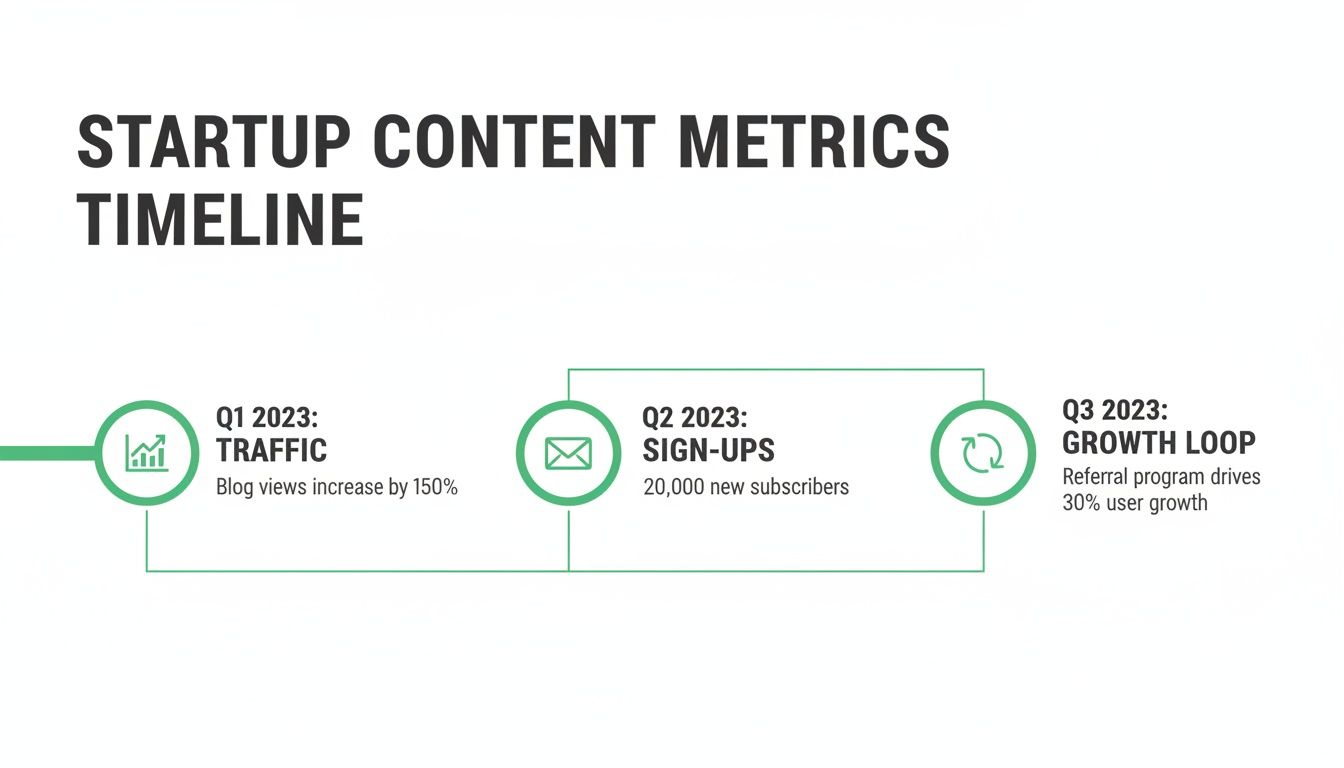
The key insight here is that each stage feeds the next. Your content starts doing the heavy lifting for you, creating an engine that drives growth long-term.
Month 3: Building Your Flywheel
The final month of your 90-day sprint is about turning these efforts into a repeatable, scalable system. This is where you build the “flywheel” we talked about—creating assets that work for you long after you hit publish. And this is where it gets really fun.
The goal is to create one major “pillar” piece of content and use it to fuel all your other channels for weeks.
- Weeks 9-10: Create a Pillar Asset. This is your big rock. It could be a comprehensive data study using public information, a free tool or template, or an in-depth webinar with an industry partner. Spend two full weeks making this a truly 10x resource that your audience can’t ignore.
- Weeks 11-12: The Pillar Promotion Blitz. This is an all-out promotional push. Slice that pillar asset into at least 10-15 smaller pieces of content—video clips, standalone blog posts, quote graphics for social media, and a dedicated email series. Pitch it to newsletters, share it in relevant communities, and run a targeted, low-budget ad campaign to get it in front of the right people.
By the end of these 90 days, you’ll have much more than just a collection of blog posts. You’ll have a functioning content engine that generates traffic, builds your email list, and establishes your startup as a genuine authority in your niche. Now, you just have to rinse and repeat.
Common Startup Content Questions Answered
Every startup founder I talk to eventually asks the same core questions about content marketing. You’re not alone in wondering where to put your limited resources.
Most of the confusion comes down to three things: money, time, and focus. Let’s clear that up right now.
How Much Should a Startup Spend on Content?
Early on, the best way to think about this isn’t in dollars, but in hours. Your most valuable asset is your team’s time and expertise.
At the beginning, your budget is time. Focus on creating one or two incredibly valuable, well-researched pieces of content a month. Then, spend the rest of your time making sure the right people see them.
Once you have product-market fit and are ready to scale, a good benchmark is to reinvest 5-10% of your total marketing budget back into your content engine.
How Long Does Content Marketing Take to Work?
Content is a long game. A marathon, not a sprint. While you might get some initial buzz from a social media post, the real, compounding results take time.
You can expect to see meaningful organic traffic and leads that you can trace directly back to your content in about 6-9 months. This requires consistent, high-quality output. If you stop, your momentum stops.
Consistency is everything.
Should I Start With SEO or Social Media?
This is a big one. For the vast majority of startups, especially in B2B, the answer is SEO.
Think of SEO as building a permanent asset. A well-ranked article can generate leads on autopilot for years to come. Social media is powerful, but it’s best used as a distribution channel to amplify the assets you’re building—it shouldn’t be the foundation itself.
At Mr. Green Marketing, LLC, we build these foundational content strategies that drive consistent, compounding results. If you’re ready to turn your expertise into a growth engine, request your free audit and performance report today.
Leave a Comment
sing in to post your comment or sign-up if you dont have any account.