
Digital Marketing for Small Business: You’re answering emails, checking inventory, chasing invoices, and somewhere in the back of your mind there’s that nagging thought: we should be doing more online. Maybe you’ve posted on Instagram a few times. Maybe you boosted a post once, didn’t love the result, and didn’t pursue it further. Maybe your website exists, but it isn’t really helping.
That’s the normal small business experience. Not a failure. Just a sign that digital marketing for small business has been sold to you as a pile of disconnected tactics instead of a working system.
And that’s the part that matters.
Digital marketing isn’t a bag of tricks. It’s how customers find you, compare you, decide whether to trust you, and take the next step. For some businesses that means a phone call. For others it means an online sale, a booked appointment, a form fill, a store visit, or a repeat purchase a month later.
A lot of owners get stuck because every channel sounds urgent. SEO. Social. Google Ads. Email. Video. AI search. Marketplaces. Local listings. All of it sounds important, so nothing gets done with focus.
This guide cuts through that. It treats digital marketing for small business the way a strategist would approach it in a practical setting. Start with goals. Pick channels based on how your business genuinely sells. Set a budget that won’t wreck cash flow. Then follow a practical 90-day plan and measure what’s worth measuring.
Your Guide to Digital Marketing for Small Business
It usually starts the same way. A customer says they found you on Google, another mentions Instagram, and someone else asks why your site doesn’t let them book online. Suddenly “do more marketing” turns into ten different jobs competing for the same limited budget.
That’s why small business marketing needs a framework, not a pile of tactics.
Digital marketing for small business is the process of getting found, earning trust, and turning attention into action. Sometimes that action is a sale. Sometimes it’s a call, a quote request, an appointment, or a repeat order. The channel matters less than the outcome.
Plenty of owners stay busy online and still get poor results because the pieces don’t connect. Social posts go out, but there’s no follow-up system. Ads drive clicks, but the landing page is weak. The website looks fine, but it doesn’t answer the questions a buyer needs answered before reaching out.
That supporting work sits underneath it.
Digital Marketing for Small Business: What digital marketing actually looks like in practice
For a local service business, digital marketing often means showing up when intent is high, then making it easy to call, book, or request an estimate.
For an e-commerce business, it usually means balancing acquisition and retention. Paid traffic can bring in first-time buyers. Email can turn one order into three. Product pages and reviews reduce hesitation.
For a B2B company, the timeline is often longer. Prospects may visit your site, read a case study, compare options, leave, then come back weeks later ready to talk. In that case, credibility and follow-up matter as much as reach.
Each channel has a job. Search captures existing demand. Social builds familiarity. Email drives repeat action. Your website converts interest into leads or sales.
Small businesses waste money when they expect one channel to carry the whole load.
A better approach is simpler. Put most of the budget into what already works or has clear buying intent. Put a smaller share into channels with upside but less certainty. Keep a small test budget for new ideas. That 70/20/10 split is how you stay visible without gambling the month’s cash flow on one experiment.
And yes, quick wins exist. Clean up your Google Business Profile. Tighten your offer. Fix the contact form that nobody completes. Add stronger proof on service pages. Those changes are rarely flashy, but they improve performance fast.
This guide is built for that reality. Clear goals. Practical channel choices. A budget you can live with. Then a 90-day plan you can execute.
Digital Marketing for Small Business: First Things First Set Your Marketing Goals
Monday morning. The phone rang twice last week. You posted on Instagram three times, boosted one post, and spent a little on ads. Now you are asking the question I hear all the time. What should we do more of?
Wrong starting point.
The first job is deciding what result matters over the next 90 days. More calls. More booked appointments. More repeat purchases. More quote requests from the right customers. Until that is clear, every tactic looks urgent, and small businesses end up spreading a thin budget across five channels that never get enough attention to work.

Start with the business problem, then set the marketing goal
Owners usually say they want growth. Fair. But “grow the business” is too broad to guide weekly decisions.
A useful marketing goal translates the business need into a measurable customer action. If revenue is flat because the sales pipeline is thin, the marketing goal might be more qualified estimate requests. If first-time sales are fine but customers never come back, the goal might be increasing repeat purchase rate through email and remarketing. Different problem, different plan, different budget mix.
That matters because this guide uses a 70/20/10 budgeting approach. Seventy percent goes to proven channels, 20 percent goes to opportunities with solid potential, and 10 percent goes to tests. You cannot apply that framework well if the goal is fuzzy. The budget follows the goal, not the other way around.
Separate outcomes from activities
Many owners experience considerable financial loss. They write down a task and call it a goal.
These are activities:
- Post on social media three times a week
- Start SEO
- Run Google Ads
- Send an email newsletter
These are goals:
- Increase qualified calls from homeowners in our service area
- Get more appointment bookings from local search traffic
- Raise repeat orders from existing customers
- Improve demo requests from visitors already landing on high-intent pages
See the difference? One gives you a checklist. The other gives you a standard for judging whether the checklist is doing its job.
Pick one primary goal first
You can care about awareness, leads, sales, and retention at the same time. You probably do. But if you are a small business with a limited budget, one of those has to go first.
I usually tell owners to choose the goal that sits closest to cash flow pressure.
If your schedule is half full, focus on lead generation or bookings.
If traffic is healthy but revenue is soft, focus on conversion or retention.
If nobody knows you exist yet, awareness may deserve more attention, but only if you can afford the longer payback window.
That trade-off matters. Awareness campaigns can help later, but they rarely fix this month’s sales problem. Search ads can drive calls faster, but they stop the minute you stop paying. Email often delivers a better return than either, but only if you already have a customer list worth working.
Digital Marketing for Small Business: Four goal types that actually fit small businesses
Most small businesses fall into one of these categories.
- Lead generation
Best for service businesses, professional firms, and any company where a sale starts with a call, form fill, or consultation. The metric is not “traffic.” It is qualified inquiries. - Online sales
Best for e-commerce brands and product businesses. Revenue is the outcome, but the work usually involves product pages, checkout friction, abandoned cart follow-up, and repeat purchase strategy. If social is part of that mix, a practical social media marketing strategy for small business should support sales, not just posting consistency. - Local appointments or foot traffic
Best for salons, clinics, restaurants, gyms, and local retail. Here the goal is getting found at the moment somebody is ready to visit, book, or call. - Brand awareness
Useful for newer businesses, crowded categories, or businesses entering a new area. Worth doing, but only if you define what awareness should lead to, such as branded searches, direct traffic, or more engaged remarketing audiences.
For product businesses that want to test short-form video without turning it into a time sink, this guide for e-commerce on TikTok is a helpful reference. The point is not to chase every platform. It is to decide whether TikTok supports your actual sales goal.
Use a simple filter before you spend
Pressure test the goal with five questions:
- Is it tied to revenue or a clear step before revenue?
- Can your team respond fast if marketing starts working?
- Does the website or landing page make the next action easy?
- Can you track the result with basic reporting?
- Is this still the right priority 90 days from now?
That last one matters more than owners expect. Random acts of marketing usually come from panic, not strategy.
Digital Marketing for Small Business: What a good goal looks like
Good goals are specific, plain-English, and connected to one action.
“Increase quote requests from commercial property owners in our county.”
“Get 20 more booked consultations per month from Google search.”
“Raise repeat purchases from existing customers over the next quarter.”
That level of clarity makes the next decisions easier. It tells you what to measure. It tells you where the 70 percent of your budget probably belongs. And it gives your 90-day roadmap something solid to build around.
Digital Marketing for Small Business: Choosing Your Marketing Channels A Practical Tour
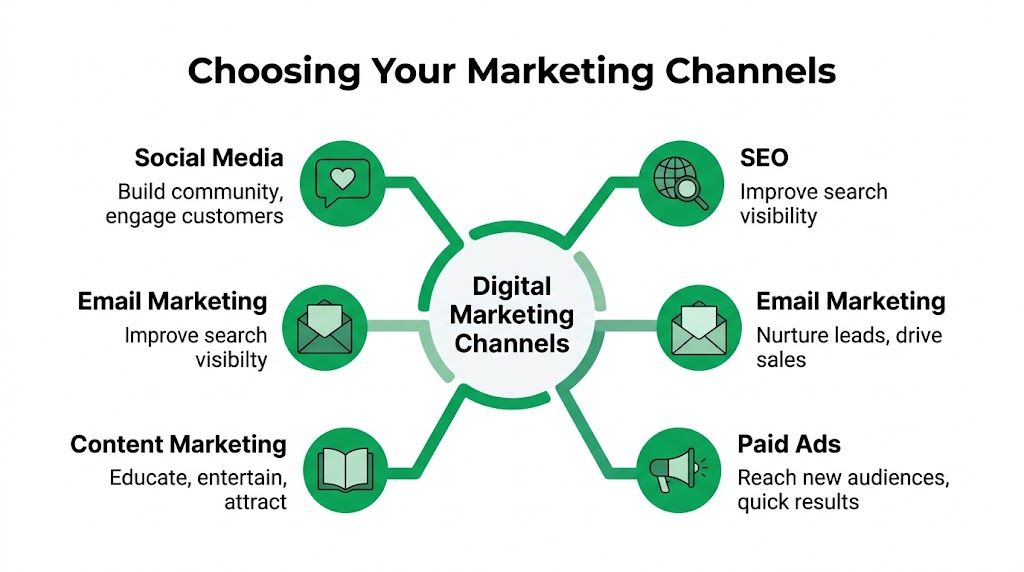
Every marketing channel has a job. Trouble starts when you assign the wrong one.
A small business doesn’t need all channels firing at once. It needs the right mix. Some channels create long-term visibility. Some create immediate traffic. Some help you keep the customers you’ve already paid to acquire.
SEO
Search engine optimization is an asset-building channel. You’re improving your site and content so people can find you organically when they search.
For small businesses, SEO is especially useful when customers already know what they need and search with intent. Think “emergency plumber near me,” “accounting services for small business,” or “best dog food for allergies.” Those searches aren’t casual. They come from people moving toward a decision.
SEO fits best for:
- Local services
- Professional services
- E-commerce brands with searchable products
- Businesses with educational or comparison-driven buying journeys
The trade-off is time. SEO usually takes consistency before it pays off. But unlike ads, you aren’t renting every click.
SEO is slower to start and stronger over time. Paid traffic is faster to start and disappears when you stop paying.
Local search and GEO
Local search deserves its own lane because it’s often the highest-priority play for service businesses and brick-and-mortar brands. Your Google Business Profile, location pages, reviews, service descriptions, photos, and local citations all influence whether you show up when someone nearby is ready to act.
And yes, businesses also need to think about how their content appears in AI-powered results. Clear service pages, strong FAQs, structured information, and location relevance help both search engines and AI systems understand what you do.
This is one of those areas where small, boring improvements can beat loud marketing. Better categories. Better service descriptions. More complete profile data. Faster response to reviews. Real location-specific pages.
PPC
Pay-per-click advertising is rented attention. That isn’t a criticism. Sometimes rented attention is exactly what you need.
Google Ads can work well when there’s direct demand and you need leads now, not six months from now. Branded search, high-intent service keywords, product shopping campaigns, and retargeting all fall into this bucket.
PPC fits best when:
- Your margins can support ad spend
- You have a strong offer
- Your landing page is built to convert
- You need speed or controlled testing
It performs badly when owners send paid traffic to a generic homepage, don’t track conversions, or chase broad keywords because they look impressive.
Social media
Social media is where a lot of small businesses spend time without a plan. That doesn’t mean social is bad. It means social needs a clearer role.
For some businesses, it builds trust and familiarity. For others, it supports retention, referrals, and customer service. Product-driven brands may use it for discovery and user-generated content. Local businesses often benefit from showing real people, real work, and proof of activity.
If you need a practical starting point, this social media marketing strategy for small business breaks down how to think about platform choice and consistency.
Short-form video can be useful here, especially for visual products and fast demonstrations. For sellers exploring that route, this guide for e-commerce on TikTok offers a grounded look at how the platform can fit a broader sales strategy.
Content marketing
Content marketing is how you answer questions before a buyer asks them directly.
That can mean blog posts, videos, FAQ pages, comparison pages, downloadable guides, product explainers, or even strong service pages. Good content reduces uncertainty. It also improves SEO, sales conversations, and follow-up campaigns.
A mistake I see often: businesses publish generic content because they think frequency matters more than usefulness. It doesn’t. One specific article that answers a real buying question can outperform ten fluffy posts.
Useful content usually does one of these things:
- Clarifies what a service includes
- Compares options clearly
- Explains pricing structure
- Handles objections
- Shows what happens next
Email marketing
Email still does work that social media can’t. It reaches people you already have permission to contact, and it lets you follow up based on behavior.
This gets much more powerful once automation enters the picture. Email marketing automation with behavioral segmentation can increase revenue by up to 760% per recipient compared to generic campaigns, and triggered emails based on user actions can raise open rates from a 20% baseline to over 35%, according to Salesforce’s SMB digital marketing guide.
That doesn’t mean every small business needs a huge email machine. But almost every business can benefit from a few smart flows:
- Welcome sequence
- Abandoned cart sequence
- Quote follow-up
- Post-purchase follow-up
- Re-engagement email
And yes, if you’re choosing between posting another random social update and fixing your follow-up emails, fix the emails first.
Amazon marketing
For businesses selling on Amazon, marketplace marketing is its own discipline. Search visibility inside Amazon, listing quality, creative assets, reviews, and ad structure all affect performance.
This is not the same as general social media marketing or standard SEO. Buyer intent is different, competition is tighter, and your product page has to do a lot of persuasion fast. If Amazon is a meaningful sales channel, treat it like a separate operating environment.
A simple channel selection test
Use this when you’re deciding where to focus first:
| Channel | Best for | Main trade-off |
|---|---|---|
| SEO | Long-term visibility and high-intent discovery | Takes time to build |
| Local search | Nearby buyers ready to act | Requires steady profile and review management |
| PPC | Fast lead generation and testing | Stops when spend stops |
| Social media | Trust, awareness, community, proof | Easy to waste time without a role |
| Content marketing | Education, SEO support, objection handling | Needs consistency and relevance |
| Follow-up, retention, repeat sales | Only works if list quality and segmentation are solid | |
| Amazon marketing | Marketplace sales | Platform-specific competition and rules |
The right answer isn’t “do everything.” It’s “pick the channels that match how customers buy from you.”
Digital Marketing for Small Business: Budgeting for Digital Marketing Without Going Broke
Most small business owners don’t ask, “What’s the perfect budget?” They ask, “How do I spend without making an expensive mess?” That’s the better question.
The cleanest framework I know for that is the 70/20/10 rule. Put most of your money into what already works. Reserve some for channels that look promising. Keep a small portion for controlled experiments so you don’t get stale.
How the 70/20/10 split works
The breakdown is simple:
- 70% to proven channels such as local SEO, core Google Ads campaigns, or your strongest email programs
- 20% to promising channels such as targeted paid social, content production, or retargeting
- 10% to experiments such as a new platform, a new creative format, or a fresh audience test
According to Xero’s guide to digital marketing for small businesses, applying the 70/20/10 budget allocation rule can lead to a 15 to 25% uplift in overall campaign efficiency for small businesses. The reason is practical, not magical. You protect the channels that already generate results while still learning where the next gains might come from.
Why this works for small businesses
Small businesses usually don’t have the luxury of wasting a quarter on random tests. Cash flow matters. Team bandwidth matters. Owner attention matters.
The 70/20/10 model solves for that by forcing discipline:
- It stops you from moving all your budget to the newest shiny thing
- It prevents overcommitting to a channel you haven’t validated
- It builds a habit of testing without turning testing into chaos
If you want a deeper look at pricing variables across channels, this breakdown of how much it costs to advertise helps frame the trade-offs.
Sample monthly digital marketing budgets
These are sample structures, not universal prescriptions. The point is the split.
| Business Type | Total Budget | 70% Proven (e.g., Local SEO, Google Ads) | 20% Promising (e.g., Facebook Ads, Content) | 10% Experimental (e.g., TikTok, Podcast Ads) |
|---|---|---|---|---|
| Local service provider | $2,000 | $1,400 | $400 | $200 |
| Single-location retailer | $3,500 | $2,450 | $700 | $350 |
| Regional home services company | $5,000 | $3,500 | $1,000 | $500 |
| Niche e-commerce brand | $7,500 | $5,250 | $1,500 | $750 |
| Multi-location brand | $10,000 | $7,000 | $2,000 | $1,000 |
What belongs in each bucket
The categories matter more than the exact examples.
Proven
These are channels with evidence behind them in your business. Not in someone else’s business. Yours.
That might be branded search ads, your Google Business Profile work, high-intent service pages, or an email sequence that reliably brings back customers.
Promising
These channels have logic behind them and some early signs, but they haven’t earned the bulk of your budget yet. Maybe your remarketing is decent but underbuilt. Maybe your content is starting to rank. Maybe Instagram ads are producing useful traffic, but not enough data exists yet to trust them as a core spend.
Experimental
This is the sandbox. Keep it small and deliberate.
One test at a time works better than five scattered experiments. Pick a single hypothesis. A new creative concept. A new audience. A new placement. A new offer angle. Run it, evaluate it, then either graduate it upward or kill it.
Budgeting well isn’t about spending less. It’s about protecting focus.
Owners often think a budget should be static. It shouldn’t. Revisit the split monthly or quarterly. If an experiment proves itself, promote it. If a “proven” channel starts slipping, challenge it.
Digital Marketing for Small Business: Your First 90 Days A Tactical Digital Marketing Roadmap
A good plan has sequence. That’s what keeps small businesses from doing ten half-finished things.
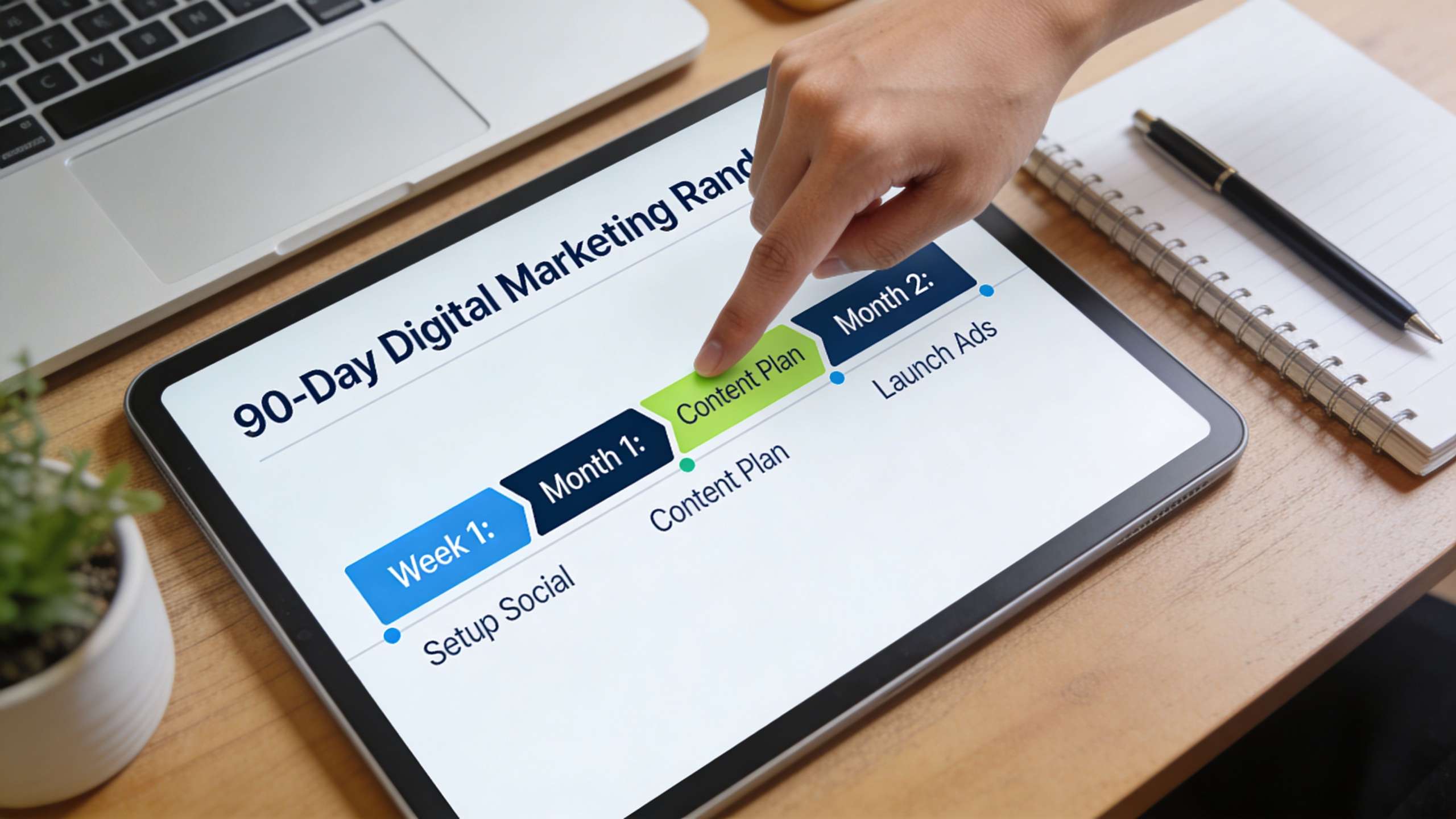
The first 90 days should build momentum in layers. Foundation first. Then useful assets. Then refinement. Not glamorous, but it works.
Digital Marketing for Small Business: Days 1 through 30 Build the foundation
The first month is about making sure your marketing can function.
Start with the basics:
- Tighten your website: Make the homepage clear. State what you do, who you help, and what action to take next.
- Set up tracking: Use Google Analytics 4 and define the actions that matter to your business, such as form submissions, purchases, booked appointments, or calls.
- Claim and improve your Google Business Profile: Especially for local businesses. Fill out services, categories, hours, photos, and business description.
- Fix obvious conversion leaks: Broken forms, slow pages, unclear buttons, weak contact details, missing trust signals
- Choose one primary offer: Don’t make visitors sort through five equal priorities
This month is also a good time to pick your core channels. Usually that means one demand-capture channel and one follow-up channel.
For many small businesses, a simple version looks like this:
| Business type | Early channel focus |
|---|---|
| Local service business | Google Business Profile, local SEO, Google Ads |
| E-commerce brand | Product pages, paid search or paid social, email capture |
| B2B service firm | Website clarity, search visibility, email nurture |
| Retail location | Local search, social proof, basic paid promotion |
Digital Marketing for Small Business: Days 31 through 60 Publish and follow up
Month two is where businesses often drift. Don’t.
You’ve built the base. Now give people reasons to trust you and ways to re-engage with you.
Focus on these moves:
- Publish useful content: Service pages, FAQs, one or two articles answering common buying questions, or short educational videos
- Start list building: Add an email capture point with a sensible offer or reason to subscribe
- Collect reviews: Ask satisfied customers while the experience is still fresh
- Create one or two automated email flows: Welcome, quote follow-up, abandoned cart, or post-purchase depending on your model
- Launch a pilot campaign: Keep it focused. One audience. One message. One landing page.
This is also the month to get more mileage from what you create. If your team is small, content reuse matters a lot. This piece on repurposing content for B2B teams is useful even beyond B2B because the workflow principle holds up for lean teams in general.
One well-made piece of content should become several working assets. A blog can become an email, a short video, a sales follow-up, and a FAQ update.
A quick visual walkthrough can help keep this phase grounded:
Digital Marketing for Small Business: Days 61 through 90 Optimize what you started
Now you earn the right to tweak.
By month three, you should have enough signal to spot weak points. Not perfect data. Just enough to stop guessing.
Look for:
- Which pages get action and which get ignored
- Which campaigns produce useful leads versus low-quality inquiries
- Which emails get opened and clicked
- Where users drop off in the buying path
- Which offer or message gets the fastest response
Then act on it.
Practical optimization tasks
- Rewrite weak headlines on landing pages
- Test a stronger call to action
- Remove distractions from high-intent pages
- Pause low-quality keywords or audiences
- Improve follow-up speed for inbound leads
- Refresh creative that gets seen but not clicked
If you use outside support, this is a sensible point to bring in more specialized execution. Mr. Green Marketing, LLC handles work across SEO, PPC, web design, social media, Amazon marketing, and related digital channels, which is useful when a business has enough traction to need tighter coordination across them.
The mistake in month three is adding more channels too early. Better to sharpen the system you already started than pile on more complexity.
Digital Marketing for Small Business: Measuring What Matters KPIs for Small Business Marketing
You do not need a giant reporting dashboard to manage digital marketing for small business. You need a short list of numbers tied to business actions.
That’s it.
The easiest way to stay sane is to group metrics into three buckets: awareness, engagement, and conversion. Each one tells a different part of the story.

Awareness metrics
These tell you whether people are seeing you.
Examples include search visibility, impressions, reach, profile views, and branded search interest. Awareness matters most when you’re new, expanding, or trying to stay visible in a crowded market.
But awareness alone doesn’t pay the bills. It just tells you whether the front door exists.
Engagement metrics
This bucket tells you whether people are interacting with what they found.
Think about page engagement, email clicks, social saves, replies, time spent on key pages, and actions like tapping directions or opening a product detail. Message quality starts to show itself in these interactions. If people see your marketing but don’t interact, the issue is usually relevance, clarity, or trust.
A good landing page helps a lot here. If you’re tightening conversion pages, Exclusive Addons’ landing page guide is a useful reference for the basic design decisions that affect whether traffic turns into action.
Conversion metrics
This is the business end of the system.
For small businesses, the core conversion metrics are usually:
- Leads: Calls, form fills, booked appointments, demo requests
- Sales: Completed purchases or closed deals
- Cost per lead: How much you spend to generate one lead
- Return on ad spend: Revenue tied to ad spend
- Lead quality: Whether the leads are worth pursuing
Not every lead is equal. A flood of weak inquiries can look good in a spreadsheet and still waste your team’s time.
If a metric doesn’t help you decide what to do next, it’s reporting theater.
A simple KPI map
| Goal type | Awareness | Engagement | Conversion |
|---|---|---|---|
| Local lead generation | Search visibility, profile views | Clicks to call, direction taps | Calls, form fills, booked estimates |
| E-commerce sales | Product impressions, ad reach | Product page views, email clicks | Purchases, cart recovery, repeat orders |
| B2B services | Search impressions, content visibility | Time on service pages, form starts | Qualified inquiries, meetings booked |
| Retention | Email reach, campaign visibility | Opens, clicks, repeat site visits | Repeat purchases, reorders, returning customers |
How to use KPIs without overcomplicating them
Track weekly. Review monthly. Make decisions quarterly.
Weekly checks help you catch obvious problems. A broken form. A campaign burning spend with no action. A sudden drop in lead flow. Monthly reviews are better for judging patterns. Quarterly reviews are better for bigger decisions like shifting budget or changing channel priorities.
A lot of owners also need help deciding which numbers matter most in the first place. This guide on how to measure marketing campaign effectiveness is useful if you want a tighter framework for reporting.
What doesn’t work is chasing vanity metrics. A post with nice reach but no action. A spike in traffic from the wrong audience. A campaign that “looks active” but doesn’t contribute to revenue.
Good measurement isn’t about knowing everything. It’s about knowing enough to improve the next decision.
Digital Marketing for Small Business: Your Path to Sustainable Digital Growth
Digital marketing for small business gets easier once you stop treating it like a checklist and start treating it like an operating system. Goals first. Channels second. Budget with discipline. Execute in phases. Measure the numbers that connect to business outcomes.
That approach isn’t flashy. It is effective.
The businesses that grow online usually don’t win because they found a secret tactic. They win because they stay consistent long enough to learn what fits their audience, then they improve the parts that matter. Better local visibility. Better landing pages. Better follow-up. Better offers. Better use of budget.
And yes, there are trade-offs. SEO takes patience. PPC requires control. Social needs a role. Email needs structure. Content needs a purpose. That’s normal. The answer isn’t to avoid those trade-offs. It’s to make them consciously.
If you’re resource-strapped, start narrower than you think. One clear goal. A focused budget. A 90-day plan you can maintain. Then build.
That’s how digital growth becomes sustainable. Not by doing everything. By doing the right things, in the right order, and sticking with them long enough to see compounding returns.
If you want a second set of eyes before you spend more time or money, request a free, no-obligation audit from Mr. Green Marketing, LLC. A good audit can show where visibility is leaking, which channels deserve attention first, and what quick wins are worth tackling now.
Leave a Comment
sing in to post your comment or sign-up if you dont have any account.