
And a solid social media marketing strategy for small business isn’t just about posting pretty pictures. Not even close. It’s your direct line to customers and—when you do it right—one of the most powerful tools you have for generating actual sales. Think of it as the blueprint that turns random posts into real, measurable growth.
Why a Social Media Marketing Strategy Is Non-Negotiable
Let’s be real. If you’re running a small business, you’re juggling a million things at once. Is social media just another task on that endless to-do list? It shouldn’t be. A strategic approach isn’t just nice to have—it’s a core driver of growth that your competitors are already using to get ahead.
It’s about more than just having a presence. It’s about building a brand that people genuinely trust and actively seek out. Platforms like Facebook and Instagram have leveled the playing field, letting small shops build massive followings and drive revenue in ways that were once only possible for big corporations. This is about making every post, every story, and every dollar work harder for your business.
It’s a Numbers Game You Can Win
The data doesn’t lie. A whopping 92% of businesses now use social media for marketing, turning it into an absolute powerhouse for small businesses looking to punch above their weight.
Recent insights show this isn’t just hype—78% of marketers report that social media directly boosts brand recognition, while 69% see it driving actual leads. For a local service provider or an e-commerce seller, skipping social is like leaving money on the table. In fact, a stunning 56% of marketers say social media ads outperform all other paid channels in ROI, often returning $3 to $5 for every dollar spent when done right.
The goal is to stop posting into the void and start posting with purpose. A strategy ensures your efforts are deliberate, measurable, and directly tied to your bottom-line goals—whether that’s more foot traffic, online sales, or client bookings.
Beyond Posts and Pictures
Your strategy is the framework for everything you do online. It dictates not just what you post, but how you interact, who you target, and how you measure success. It’s the difference between a forgotten Facebook page and a thriving online community.
Here’s what a good strategy actually does:
- Builds Authentic Connections: This is your direct line to customer feedback, questions, and praise. Engaging directly builds loyalty that paid ads simply can’t buy. For more on this, check out our guide on how to improve brand awareness.
- Drives Targeted Traffic: A smart strategy pushes followers from your social profiles directly to your website, product pages, or lead forms where the real conversion happens.
- Offers Powerful Insights: Social platforms are a goldmine of data about your audience—what they like, when they’re online, and what makes them click.
As a core part of that strategy, a robust video marketing plan can be transformative. To get started, you should explore this ultimate guide to small business video marketing to see how you can integrate this powerful medium.
Social Media Marketing Strategy: Defining Your Goals and Finding Your People
Alright, let’s get down to business. A social media strategy without goals is just posting into the void, hoping something sticks. Hope isn’t a strategy. This is where we stop guessing and start building a real plan.
What does success actually look like for you? It’s not about racking up vanity metrics like followers. It’s about achieving tangible results that move the needle for your company. Think Specific, Measurable, Achievable, Relevant, and Time-bound—or SMART goals.
And seriously, get specific. Don’t just say “more sales.” How many? From where? By when? A weak goal is useless.
Setting Goals That Actually Matter
Let’s make this real. Instead of vague wishes, we need to frame them as concrete objectives you can track and measure. Your goals will define every piece of content you create and every dollar you spend.
Here are a few examples of strong, actionable goals:
- Increase website traffic from social media by 25% within the next quarter. This tells you to focus on creating compelling posts with clear calls-to-action that drive clicks back to your site.
- Generate 30 qualified leads per month through Instagram DMs and Facebook lead forms. This pushes you to create content that speaks directly to customer pain points and offers a clear next step.
- Boost online sales for our new product line by 15% in the next 60 days using targeted ads. This gives you a specific target and a deadline, forcing you to measure your ad performance closely.
The secret sauce here is tying every social media action back to a business outcome. If you can’t explain how a post helps you reach one of your goals, you should question why you’re posting it at all.
This simple flowchart illustrates the growth process we’re aiming for: connecting with people to build your brand and ultimately grow your business.
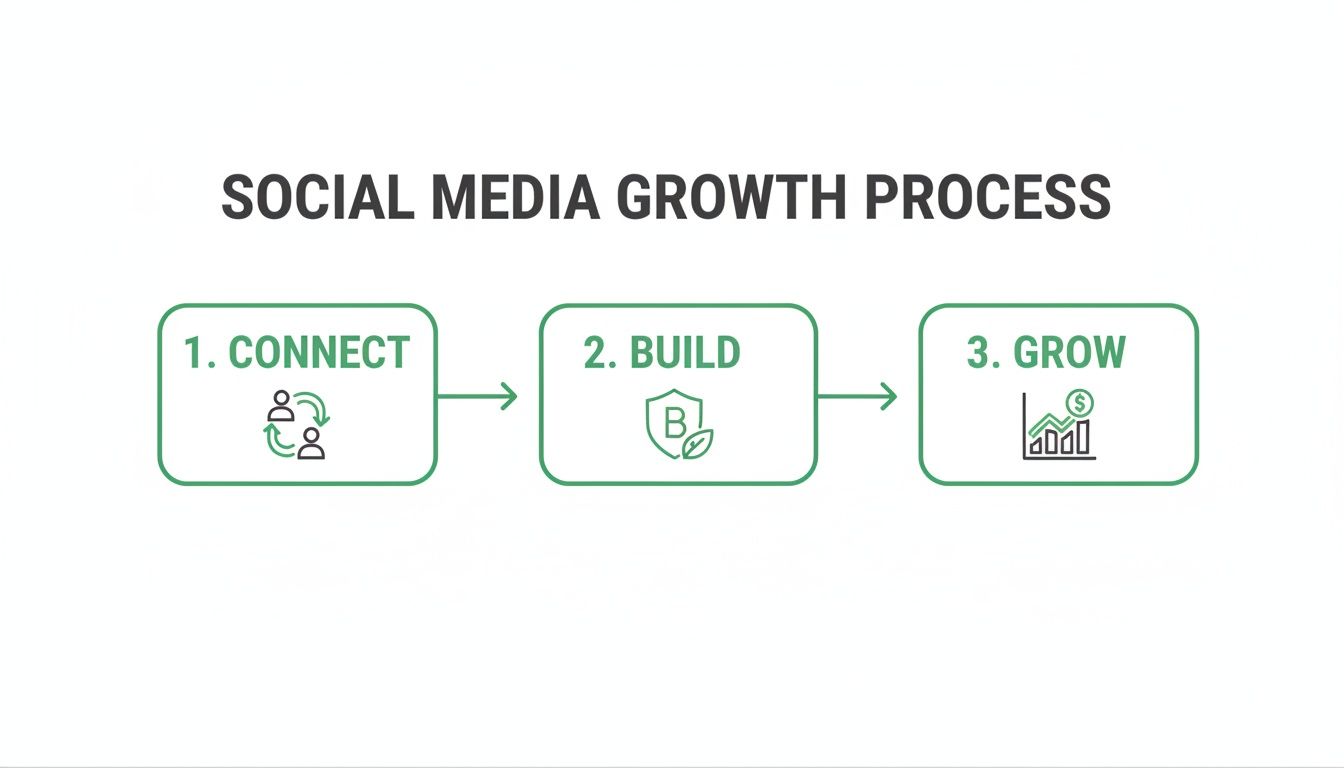
This process shows how intentional connection builds the brand authority needed to drive meaningful growth.
Finding the People You Want to Reach
Once you know what you want to achieve, you need to figure out who you’re talking to. And I mean really figure it out. Shouting your message to everyone means you’re actually connecting with no one.
This is where creating customer personas comes in. A persona is a detailed profile of your ideal customer. And no, it’s not just “women, 25-40.” That’s not a persona; that’s a lazy demographic.
We need to go deeper—much deeper. What keeps them up at night? What blogs do they read? What makes them laugh? Understanding these details is what turns generic content into messages that feel personal and drive action. For a deeper look, check out our guide on content marketing best practices that can help refine your messaging.
Let’s imagine you run a local, eco-friendly coffee shop. Your persona might be “Eco-Conscious Emily,” a 32-year-old graphic designer who values sustainability, shops at the local farmers market, follows minimalist bloggers on Instagram, and listens to podcasts about ethical business. Now you know exactly who you’re creating content for.
It’s no surprise that 69.2% of small businesses use Facebook ads, which often top the charts for ROI. While organic reach on Facebook is low, paid boosts can skyrocket visibility. With 55.6% of small businesses prioritizing sales growth, a strategic, audience-first approach ensures your social strategy delivers compounding results.
With clear goals and a deep understanding of your audience, you’ve built the essential foundation for a powerful social media strategy.
Choosing the Right Platforms and Content Pillars
Here’s some good news: you do not need to be everywhere. Seriously.
Spreading yourself too thin across every shiny new platform is one of the most common—and costly—mistakes I see small businesses make. The goal isn’t to show up on every channel; it’s to dominate the right channels.
This means finding the digital spots where your ideal customers are already hanging out, ready to listen. Are they scrolling Instagram for visual inspiration? Networking on LinkedIn for professional insights? Or are they on TikTok for quick, entertaining videos? It’s time to stop guessing and start knowing.

Where Does Your Audience Actually Live Online?
The audience research you just did is your treasure map. If you’re selling handmade jewelry to a younger crowd, platforms like Instagram and TikTok are your gold mines. Their entire ecosystem is built on visual storytelling, which is perfect for showing off beautiful products in photos and Reels.
In fact, over 55% of consumers discover new brands on social media, so simply being where they already are is half the battle won.
On the flip side, if you’re a B2B consultant offering financial advice, your time is far better spent on LinkedIn. That’s the digital water cooler where professionals gather to network and find solutions to business problems. Trying to sell complex B2B services on TikTok is like trying to fish in a swimming pool—the audience just isn’t there for that.
Which Social Media Platform Is Right for Your Small Business?
To make this decision a little easier, I’ve put together a quick-reference table. Think of this as your cheat sheet for matching your business goals with the right platform.
| Platform | Primary Audience | Best For | Content To Focus On |
|---|---|---|---|
| Gen X & Millennials (Broad) | Community Building, Local Business, Ads | How-to Videos, Blog Posts, Customer Stories, Events | |
| Millennials & Gen Z | Visual Brands (Fashion, Food, E-comm) | High-Quality Photos, Reels, Stories, Influencer Content | |
| Professionals, B2B Decision-Makers | B2B Lead Gen, Professional Services | Industry Insights, Company News, Case Studies, Articles | |
| TikTok | Gen Z & Younger Millennials | Entertainment, Trends, User-Generated Content | Short-Form Videos, Challenges, Behind-the-Scenes |
| Predominantly Female, DIYers, Planners | Driving Website Traffic, E-commerce | Infographics, Tutorials, Product Pins, Guides |
Don’t overthink it. Pick one or two platforms where your ideal customer spends their time and commit to mastering them. You can always expand later once you have a solid foundation.
Building Your Content Pillars
Once you’ve chosen your platforms, it’s time to figure out what you’re actually going to talk about. This is where a strong social media marketing strategy for small business goes from theory to reality. Instead of scrambling for post ideas every morning, you’ll work from a handful of core themes called content pillars.
Think of content pillars as the three to five main topics your brand will own. They need to be broad enough to spark lots of different post ideas but specific enough to attract your target audience. This simple framework keeps your content relevant and saves you from the stress of staring at a blank cursor.
A content pillar strategy is about creating value, not just volume. Every post should either educate, entertain, inspire, or persuade your audience, tying back directly to your brand’s expertise and goals.
Let’s bring back our “Eco-Conscious Emily” persona for the local coffee shop. What would her content pillars be?
- Pillar 1: The Perfect Brew. This is all about the coffee. Think sourcing stories, brewing tutorials, new seasonal drinks, and “meet the barista” features.
- Pillar 2: Community & Local Love. Here, you’d post about local events, feature other nearby small businesses, and share photos of happy customers (with permission, of course!).
- Pillar 3: Sustainable Living. This pillar connects directly to Emily’s core values. You could share tips on reducing waste, highlight your eco-friendly packaging, and partner with local environmental groups.
With these pillars, you never have to wonder what to post again. You just rotate through them. Monday is for brewing tips, Wednesday is a community spotlight, and Friday is a sustainability feature. Simple, right?
The key is consistency, which our social media management services can help streamline. And since video is king, checking out a strategic guide to social media video can be a game-changer as you start creating. It’s all about building a predictable rhythm that your followers can look forward to.
Using Paid Social and Engagement to Amplify Reach using Social Media Marketing Strategy
Let’s be real: organic reach on social media isn’t what it used to be. Getting your content seen by new eyes is tougher than ever, but that’s where a little bit of ad spend can make a huge difference.
And I do mean a little bit. You don’t need a massive budget to play the game.
This is where we get into paid social without all the confusing jargon. For a small business, even $5 or $10 a day can put your message in front of thousands of highly targeted potential customers. The whole game is about starting small, testing what resonates, and then putting more fuel on the fire when you find a winner.
But ads are only one side of the coin. The other, arguably more important side, is genuine human engagement. Paid ads get you in the door with new people, but authentic interaction is what makes them want to stay.
Your First Step into Paid Social Advertising
Jumping into ads can feel like a big leap, but it doesn’t have to be. For most small businesses, the easiest and most effective starting point is a simple boosted post on Facebook or Instagram.
You’ve already created a fantastic piece of content based on your pillars, right? Maybe it’s a quick video tip or a beautiful photo of a new product. Instead of just letting it sit on your feed, you can put a small budget behind it to “boost” it to a specific audience that you get to define.
It’s surprisingly powerful. You can target people based on:
- Location: Perfect for a brick-and-mortar shop wanting to reach people within a 5-mile radius.
- Demographics: Things like age, gender, and even job titles.
- Interests: Hobbies, pages they’ve liked, and other online behaviors.
- Lookalike Audiences: This one is a game-changer. You can upload your customer email list, and the platform will find new users who share similar characteristics.
Let’s say you own a local coffee shop. You could boost a post about your new fall latte, targeting women ages 25-45 who live within 10 miles of your shop and have shown an interest in “coffee,” “Starbucks,” and “local cafes.” That’s how dialed-in you can get. This kind of targeting is the foundation of a smart social media marketing strategy for small business because it stops you from wasting money on people who will never buy.
The Immense Power of Community Engagement
Now, let’s talk about the part that costs nothing but time and delivers massive returns: engagement. This isn’t just about double-tapping comments. It’s about building a real community where your followers feel like they’re part of something.
When customers feel a genuine connection to a brand, nearly 80% are more willing to buy from them. That’s huge.
Think of it as a conversation, not a monologue.
Your goal is to make your comments section a place where people hang out. Ask questions in your captions. Run quick polls in your Stories. And when someone takes the time to leave a thoughtful comment, give them a thoughtful reply. A “Thanks!” is okay, but a personalized response that continues the conversation is so much better.
The algorithm is always watching. Posts with a flurry of meaningful interactions—especially in the first hour—get a massive organic boost. High engagement is a direct signal to the platform that says, “Hey, people are loving this content. Show it to more of them!”
Turning Followers into Brand Advocates
So how do you spark this kind of authentic interaction consistently? It’s all about building good habits.
Here are a few simple, actionable things you can start doing today:
- Respond to Comments Quickly: Try to reply within a couple of hours. It shows you’re present and that you actually care what people have to say.
- Encourage User-Generated Content (UGC): Ask your customers to share photos using your product! Create a unique hashtag and make a big deal out of featuring the best posts on your feed (always with credit, of course). UGC is the ultimate social proof.
- Go Live: Hosting a live Q&A or a behind-the-scenes peek at your workspace is an amazing way to connect. It’s raw, it’s real, and it makes your brand feel incredibly human.
- Engage Off Your Own Page: Don’t just sit and wait for comments to roll in. Spend 15 minutes a day interacting with other accounts in your niche or with people who follow you. It’s a fantastic way to build relationships and get your name out there.
Ultimately, paid social opens the door and gets you noticed. But it’s the genuine, heartfelt engagement that invites people in, pulls up a chair for them, and makes them want to stick around for the long haul. When you combine the two, you create a powerful cycle of discovery and loyalty that will truly move the needle for your business.
Measuring What Matters to Optimize Your Strategy
So, you’ve got your goals and your content plan. How do you know if any of this is actually working? The answer is in the data. And don’t worry, you don’t need to be a data scientist to figure it out. We just need to focus on the numbers that tell the real story.
This is the step where your social media marketing strategy for small business goes from hopeful guessing to a predictable growth engine. We’re going to move beyond vanity metrics—you know, the ones that feel good but don’t actually pay the bills—and lock in on what truly drives your business forward.
Beyond Vanity Metrics: What to Actually Track
Follower count feels great, but it doesn’t tell you if people are listening or buying. A million followers who ignore you are worthless. Instead, we need to track Key Performance Indicators (KPIs) that connect directly to those SMART goals you set earlier.
These are the numbers that show whether your efforts are translating into real business results. They tell a story about what your audience loves, what they scroll past, and where your money is best spent.
Here are the KPIs that should be on your dashboard:
- Engagement Rate: This is your bread and butter. It’s the percentage of your audience that actually interacts with your content (likes, comments, shares). A high engagement rate tells the platform algorithms that your content is valuable, which in turn boosts your organic reach. A good benchmark to aim for is 1-3%, though this can vary quite a bit by platform.
- Click-Through Rate (CTR): This metric measures how many people who saw your post actually clicked the link in it. It’s absolutely crucial for goals like driving website traffic or sending people to a specific product page.
- Conversion Rate: This is the big one. It tracks how many people completed a desired action after clicking your link—like signing up for your newsletter, downloading a guide, or making a purchase. It’s the ultimate measure of ROI.
- Cost Per Lead (CPL) / Cost Per Acquisition (CPA): If you’re running ads, this tells you exactly how much it costs to get one new lead or customer. Knowing this number is what lets you make smart, profitable decisions about your ad budget.
Creating Simple Reports That Make Sense
You don’t need fancy software to get started. Honestly, a simple spreadsheet can do the trick. The key is to be consistent. Pick a day each week or month to pull your numbers and jot them down.
Over time, you’ll start to see patterns emerge. Maybe you’ll notice that your video posts get double the clicks of your static images. Or perhaps your engagement tanks on weekends. This is gold.
The goal of reporting isn’t just to collect data; it’s to find insights. An insight is a piece of information that inspires an action. For example: “Our CTR on Instagram Stories is 50% higher than on feed posts, so we should double down on creating more interactive Story content.”
This approach is more important than ever. Recent data shows 81% of small-to-medium businesses now use at least two marketing channels, a massive jump from just a few years ago. With 55.6% of businesses chasing sales as their top priority, a data-driven social strategy is no longer optional—it’s essential for growth. You can discover more insights from the latest social media marketing statistics on marketingltb.com.
The Optimize and Repeat Loop
This brings us to the most important part of the entire process: optimization. Social media marketing isn’t a “set it and forget it” task. Your strategy is a living thing that needs to be constantly tweaked and improved based on what the data tells you.
Think of yourself as a scientist running small experiments. Every post, every ad, and every story is a test.
This continuous loop of measuring and improving is what separates struggling businesses from thriving ones. You measure your results, find an insight, make a small change, and then measure again to see what happened.
Here’s what that looks like in the real world:
- You Notice an Insight: Your weekly report shows that posts with a question in the first sentence get 3x more comments.
- You Form a Hypothesis: “If I start more of my posts with a direct question, my overall engagement rate will increase.”
- You Run a Test: For the next two weeks, you make sure half of your posts lead with a question.
- You Analyze the Results: At the end of the test, you compare the engagement rates. Did it work? If yes, you make it a permanent part of your content strategy. If not, you try another experiment.
This cycle—measure, analyze, test, repeat—is the secret to long-term success. It takes the emotion and guesswork out of your marketing and replaces it with a simple, data-backed process for growth. It’s how you ensure your social media efforts are always getting smarter, sharper, and more effective over time.
Your Social Media Marketing Strategy Questions Answered
Alright, let’s get into the nitty-gritty. Once you’ve got the big picture of your strategy down, a bunch of smaller, more specific questions always seem to pop up. Completely normal.
Here are some of the most common ones I hear from small business owners, with straightforward answers to help you move forward.
How Much Should a Small Business Spend on Social Media Marketing
There’s no magic number, but a solid starting point is between 5-15% of your total marketing budget. For a new business, this might only be a few hundred dollars a month for boosting key posts or running a small, targeted ad campaign. It’s not about how much you spend, but how smartly you spend it.
The real key is to start small, get obsessed with your return on ad spend (ROAS), and then double down on what’s actually working. Funnel your limited budget into the one or two platforms where your customers hang out the most. A B2C brand selling handmade jewelry, for instance, should be all-in on Instagram and Facebook ads. A B2B consultant, on the other hand, will almost always see a better return from LinkedIn.
Remember, a small, consistent budget with a smart strategy behind it will always outperform a huge, one-time spend with no direction. Start lean, learn fast, and scale from there.
How Often Should I Post on Social Media
This one’s simple: quality and consistency beat quantity, every single time. The goal is not to flood every platform with daily posts. That’s a fast track to burnout and creating a ton of mediocre content that nobody engages with.
Instead, build a schedule you can realistically stick to for the long haul.
A good rule of thumb:
- For platforms like Instagram and Facebook: Aim for 3-5 high-quality, valuable posts per week.
- For a professional network like LinkedIn: 2-3 thoughtful posts a week is plenty to stay on your audience’s radar.
The most important part is just showing up consistently. Your audience will start to know when to expect content from you. A content calendar is your best friend here—use it to plan ahead and batch-create your posts to eliminate the daily scramble.
What Are Some Quick Wins for a Business with No Time – It Is Social Media Marketing Strategy
I get it. “Strapped for time” is the default setting for pretty much every small business owner. When you have zero bandwidth, you have to focus on the high-impact stuff that delivers the most bang for your buck—or in this case, your minute.
Here are a few things you can do right now:
- Fully Optimize Your Profiles: This is a one-and-done task. Get a sharp, high-quality profile picture or logo, write a bio that clearly explains what you do (with keywords!), and add a direct link to your website.
- Engage for 15 Minutes a Day: Set a timer. For just 15 minutes, your only job is to respond to comments and DMs. Replying promptly and thoughtfully shows you’re listening and builds massive goodwill.
- Leverage User-Generated Content (UGC): Sharing customer photos, reviews, or testimonials is pure gold. It’s authentic social proof, incredibly effective, and requires almost zero creative effort on your part.
- Use “Stories” for Quick Hits: Instagram and Facebook Stories are perfect for quick, informal, behind-the-scenes content. They don’t need to be polished, and they’re fantastic for building trust.
Which Social Media Marketing Strategy Actually Matter
Stop obsessing over your follower count. It’s the ultimate vanity metric and rarely has any real connection to business success. You need to track the numbers that show genuine engagement and tie directly back to your goals.
For a small business, these are the metrics that matter:
- Engagement Rate: Likes, comments, shares, and saves divided by your follower count. This tells you if your audience is actually paying attention.
- Reach/Impressions: This is how many unique people are seeing your content. Think of it as your top-of-funnel awareness metric.
- Click-Through Rate (CTR): For any post with a link, this measures what percentage of viewers actually clicked through to your site. This is crucial for driving traffic.
- Conversion Rate: The holy grail. This tracks how many people took the action you wanted them to, like signing up for your newsletter or, even better, making a purchase. This is where your social media marketing strategy proves its ROI.
Ready to stop guessing and start growing? At Mr. Green Marketing, LLC, we build custom digital marketing strategies that deliver real, measurable results. Request your free audit today and let’s create a plan that works for you.
Leave a Comment
sing in to post your comment or sign-up if you dont have any account.